Market Overview:
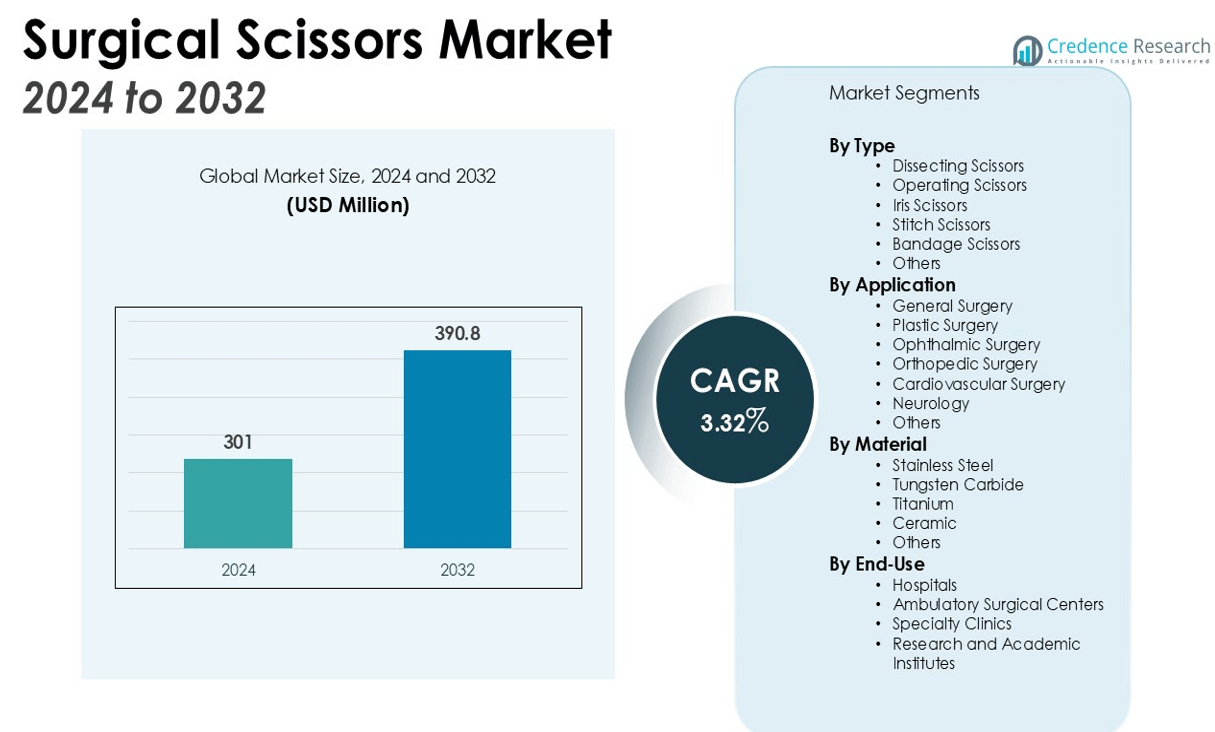
The Surgical Scissors Market size was valued at USD 301 million in 2024 and is anticipated to reach USD 390.8 million by 2032, at a CAGR of 3.32% during the forecast period (2024-2032).
| REPORT ATTRIBUTE | DETAILS |
|---|---|
| Historical Period | 2019-2022 |
| Base Year | 2023 |
| Forecast Period | 2024-2032 |
| Surgical Scissors Market Size 2024 | USD 301 million |
| Surgical Scissors Market, CAGR | 3.32% |
| Surgical Scissors Market Size 2032 | USD 390.8 million |
Key drivers for the Surgical Scissors Market include the growing geriatric population, a surge in chronic diseases necessitating surgical intervention, and ongoing improvements in healthcare infrastructure across developed and emerging economies. The adoption of minimally invasive procedures has further elevated the demand for specialized and microsurgical scissors, as healthcare providers seek instruments that optimize accuracy and patient outcomes. Increasing investments in research and development are also leading to product innovations, which further stimulate market growth.
Regionally, North America dominates the Surgical Scissors Market due to advanced healthcare systems, high surgical volumes, and robust investment in medical technology. Europe follows closely, supported by expanding hospital networks and an aging population. The Asia Pacific region is anticipated to experience the fastest growth, attributed to rising healthcare expenditures, increasing patient awareness, and rapid expansion of medical facilities in countries such as China and India. Strategic collaborations among regional manufacturers and international players are further accelerating market expansion in emerging markets.
Market Insights:
- The Surgical Scissors Market reached USD 301 million and is forecast to grow to USD 390.8 million, registering a CAGR of 3.32% during the forecast period.
- Demand is driven by an expanding geriatric population, a surge in chronic diseases, and ongoing advancements in healthcare infrastructure globally.
- Adoption of minimally invasive and specialized procedures fuels the need for high-performance and microsurgical scissors.
- Innovations in material science, such as the use of tungsten carbide and stainless steel, support durability and cutting precision.
- Stringent regulatory requirements and evolving quality standards increase compliance costs, presenting barriers for new and smaller manufacturers.
- North America leads with a 42% share, followed by Europe at 29% and Asia Pacific at 21%, each benefitting from robust healthcare systems, aging demographics, and rising surgical volumes.
- Strategic collaborations and investments in research and development accelerate product innovation and expand market presence, particularly in emerging economies.
Market Drivers:
Growing Geriatric Population and Rising Chronic Diseases Fuel Demand
The global population is aging at an unprecedented rate, leading to an increase in age-related health conditions that require surgical intervention. The Surgical Scissors Market benefits significantly from this trend, as older adults frequently undergo procedures for cardiovascular, orthopedic, and ophthalmic conditions. Chronic diseases such as diabetes and cancer further amplify the demand for surgical care, which in turn drives the need for reliable surgical instruments. Healthcare systems are adapting to accommodate this growing patient pool, ensuring that the demand for surgical scissors remains strong in hospitals and clinics.
- For instance, over 26 million cataract surgeries are performed annually worldwide, with the procedure being the most commonly performed elective surgery globally.
Advancements in Surgical Techniques and Technology Enhance Market Growth
Innovations in surgical procedures, including the widespread adoption of minimally invasive surgeries, have raised the standards for precision and performance in surgical tools. The Surgical Scissors Market has responded with the development of specialized scissors tailored for specific procedures and tissue types. Enhanced materials like tungsten carbide and high-grade stainless steel improve cutting efficiency and durability. Manufacturers are incorporating ergonomic designs, enabling surgeons to perform with greater accuracy and comfort during both routine and complex surgeries.
Expansion of Healthcare Infrastructure and Rising Surgical Volumes
The expansion and modernization of healthcare infrastructure, especially in emerging economies, support the sustained growth of the Surgical Scissors Market. Governments and private organizations are investing in new hospitals and surgical centers to meet the growing healthcare needs of larger populations. This expansion translates into higher surgical procedure volumes, increasing the consumption of surgical scissors. It also drives the adoption of advanced surgical instruments in both public and private healthcare settings.
- For instance, Ethicon’s HARMONIC FOCUS™+ Shears achieved a 29-minute reduction in operating room time per thyroidectomy procedure.
Focus on Quality Assurance and Regulatory Compliance Stimulates Product Innovation
Stringent regulatory standards regarding the safety and performance of surgical instruments have encouraged manufacturers to prioritize quality assurance. The Surgical Scissors Market experiences continual product innovation, with companies investing in research and development to introduce new designs and features. Certification and compliance with global standards ensure that products meet the expectations of healthcare professionals and patients. It supports the reputation of manufacturers and enhances market competitiveness.
Market Trends:
Adoption of Advanced Materials and Ergonomic Designs Gains Traction
The Surgical Scissors Market is witnessing a marked shift toward the use of advanced materials and improved ergonomics in instrument design. Manufacturers are introducing scissors made from high-grade stainless steel, titanium, and tungsten carbide to enhance durability, sharpness, and corrosion resistance. These material innovations support longer instrument lifespans and reduce maintenance requirements, making them more cost-effective for healthcare providers. Ergonomic handle designs are also becoming standard, reducing surgeon fatigue during lengthy procedures and increasing precision. The trend toward single-use and disposable scissors is gaining momentum in response to infection control protocols, ensuring patient safety and regulatory compliance. This convergence of material science and design innovation is shaping the competitive landscape of the Surgical Scissors Market.
- For instance, Laschal's SERIES ZERO Ring Handle Tenotomy Scissors demonstrated consistent sharpness and performance after withstanding 50 autoclave cycles.
Integration of Technology and Customization Drives Product Differentiation
The trend toward integrating technology and customization in surgical instruments is fueling growth and differentiation in the Surgical Scissors Market. Manufacturers are leveraging computer-aided design and advanced manufacturing processes to develop scissors tailored for specific procedures, tissues, and surgeon preferences. The rise of minimally invasive and robotic-assisted surgeries requires precision instruments compatible with new technologies, prompting companies to invest in research and development. Smart scissors with sensors for performance monitoring and feedback are beginning to emerge, offering new possibilities for surgical training and quality assurance. The demand for customizable instruments enables surgeons to select products best suited to their techniques, further driving innovation. These trends reinforce the market’s focus on improving surgical outcomes and enhancing practitioner satisfaction.
- For instance, Medtronic’s Endo Shears™ 5 mm single-use instrument features a 31 cm shaft length.
Market Challenges Analysis:
Stringent Regulatory Requirements and Quality Standards Increase Compliance Costs
The Surgical Scissors Market faces significant challenges due to evolving regulatory frameworks and stringent quality standards across regions. Regulatory bodies demand thorough documentation, testing, and certification, raising the cost and complexity of market entry for manufacturers. Delays in approvals or non-compliance can disrupt supply chains and restrict access to key markets. It places pressure on manufacturers to maintain rigorous quality assurance programs and invest in advanced manufacturing processes. Smaller companies may struggle to keep pace with these requirements, limiting their competitive presence. These factors contribute to longer product development cycles and higher operational expenses.
Price Sensitivity and Intense Competition Impact Profit Margins
Intense competition and price sensitivity represent persistent challenges for the Surgical Scissors Market, especially in cost-conscious healthcare environments. Hospitals and clinics prioritize cost-effective procurement, often favoring lower-priced or generic instruments over premium brands. It forces manufacturers to balance product quality with competitive pricing strategies, which can constrain profit margins. The influx of low-cost imports further intensifies price competition, particularly in emerging markets. Maintaining product differentiation and value becomes essential for companies seeking long-term sustainability. This environment can limit innovation and discourage investment in premium features or advanced materials.
Market Opportunities:
Rising Demand for Minimally Invasive and Specialized Procedures Fuels Growth
The Surgical Scissors Market stands to benefit from the global shift toward minimally invasive and specialized surgical procedures. Healthcare providers are expanding their portfolios to include advanced and precision-based surgeries, which require high-performance and specialized instruments. It creates opportunities for manufacturers to develop tailored scissors for specific surgical specialties such as microsurgery, neurosurgery, and laparoscopic procedures. The trend toward outpatient and day surgeries further boosts the need for reliable, single-use surgical scissors. Expanding access to healthcare in emerging markets increases the volume of surgical procedures, presenting growth opportunities for both established and new market entrants.
Technological Innovation and Customization Open New Revenue Streams
Technological advancements in materials, design, and manufacturing processes create avenues for differentiation in the Surgical Scissors Market. Manufacturers are leveraging smart technologies, such as sensor integration and digital tracking, to offer enhanced performance monitoring and maintenance capabilities. It enables healthcare providers to track usage and optimize instrument management, improving cost efficiency. Customization options allow surgeons to select scissors based on procedural requirements and personal preferences, driving higher adoption rates. Partnerships with healthcare institutions and research organizations accelerate product innovation and foster market expansion. These dynamics position the market for sustained growth and long-term value creation.
Market Segmentation Analysis:
By Type
The Surgical Scissors Market encompasses dissecting scissors, operating scissors, iris scissors, stitch scissors, and other specialized variants. Dissecting scissors hold the largest share due to their frequent use in both routine and complex procedures across surgical disciplines. Operating scissors continue to gain preference in outpatient and minimally invasive settings. Iris scissors and stitch scissors serve critical roles in ophthalmic and microsurgical fields, supporting precision and delicate tissue handling.
- For instance, Ethicon’s HARMONIC™ 1100 ultrasonic dissection scissors deliver secure vessel sealing for vessels up to 7 mm in diameter and are available in dual shaft lengths of 20 cm and 36 cm.
By Application
Hospitals, ambulatory surgical centers, and specialty clinics form the primary application segments within the Surgical Scissors Market. Hospitals dominate, driven by the highest surgical volumes and extensive surgical departments. Ambulatory surgical centers represent a fast-growing segment, reflecting the global shift toward minimally invasive and same-day surgeries. Specialty clinics contribute steady growth, focusing on advanced and niche surgical needs in fields such as ophthalmology, plastic surgery, and neurology.
By Material
Stainless steel, tungsten carbide, and titanium are the leading material choices for surgical scissors. Stainless steel remains the material of choice for most healthcare providers due to its cost-effectiveness, durability, and resistance to rust. Tungsten carbide scissors capture the premium segment, recognized for their precision and long service life. Titanium scissors, while less common, are increasingly favored in delicate microsurgeries for their lightweight design and non-magnetic attributes. This diverse segmentation supports the adaptability and growth of the Surgical Scissors Market.
- For instance, Medline Industries produces floor-grade, single-use 5.5-inch straight surgical scissors from stainless steel, providing a reliable and sterile option for operating rooms.
Segmentations:
By Type:- Dissecting Scissors
- Operating Scissors
- Iris Scissors
- Stitch Scissors
- Bandage Scissors
- Others
- General Surgery
- Plastic Surgery
- Ophthalmic Surgery
- Orthopedic Surgery
- Cardiovascular Surgery
- Neurology
- Others
- Stainless Steel
- Tungsten Carbide
- Titanium
- Ceramic
- Others
- Hospitals
- Ambulatory Surgical Centers
- Specialty Clinics
- Research and Academic Institutes
- North America
- U.S.
- Canada
- Mexico
- Europe
- Germany
- France
- U.K.
- Italy
- Spain
- Rest of Europe
- Asia Pacific
- China
- Japan
- India
- South Korea
- South-east Asia
- Rest of Asia Pacific
- Latin America
- Brazil
- Argentina
- Rest of Latin America
- Middle East & Africa
- GCC Countries
- South Africa
- Rest of the Middle East and Africa
Regional Analysis:
North America Maintains Dominance with Advanced Healthcare Infrastructure
North America accounted for 42% share of the Surgical Scissors Market, maintaining its lead through a combination of advanced healthcare infrastructure and strong investment in medical technologies. The region benefits from high surgical volumes, robust reimbursement systems, and early adoption of innovative surgical tools. The presence of leading manufacturers and continuous product launches strengthen market leadership in the region. Healthcare providers in the United States and Canada prioritize quality and precision, driving demand for advanced and specialized surgical scissors. Ongoing training and professional development further contribute to high instrument utilization rates.
Europe Benefits from Expanding Hospital Networks and Aging Population
Europe held 29% share of the Surgical Scissors Market, reflecting its extensive network of hospitals, clinics, and ambulatory surgical centers. The region’s aging population and increasing prevalence of chronic diseases stimulate demand for surgical interventions and precision instruments. It experiences steady growth due to national healthcare reforms, investments in facility upgrades, and rising healthcare expenditure. Manufacturers focus on partnerships with healthcare institutions to introduce new products and address evolving clinical needs. Stringent regulatory requirements ensure high-quality standards and foster a competitive landscape.
Asia Pacific Exhibits Rapid Growth Driven by Expanding Healthcare Access
Asia Pacific represented 21% share of the Surgical Scissors Market, registering the fastest pace of expansion among all regions. Governments and private organizations invest in hospital expansion and advanced medical technologies to address the needs of large and diverse populations. It benefits from the growing adoption of minimally invasive surgeries in countries such as China, India, and Japan. Local manufacturing capabilities and strategic collaborations with international players help address cost pressures and technology gaps. Increasing patient awareness and demand for quality care propel further market expansion across emerging economies.
Key Player Analysis:
- B. Braun Melsungen AG
- Arthrex, Inc.
- BD
- Thermo Fisher Scientific
- World Precision Instruments
- Scanlan International
- Stryker
- Purple Surgical International
- Olympus Corporation
- Teleflex Incorporated
Competitive Analysis:
The Surgical Scissors Market is characterized by intense competition among established global players and specialized regional manufacturers. Leading companies such as B. Braun Melsungen AG, Medline Industries, Inc., KLS Martin Group, Sklar Surgical Instruments, and Integra LifeSciences Corporation focus on product innovation, quality enhancement, and expanding distribution networks. It encourages continuous investment in research and development to introduce advanced materials, ergonomic designs, and procedure-specific scissors. Strategic collaborations, mergers, and acquisitions further strengthen market positions and broaden product portfolios. Regional players compete by offering cost-effective solutions and adapting to local regulatory standards. The market remains dynamic, with competitive differentiation driven by technological advancements, customer service, and compliance with international quality certifications. This environment fosters ongoing improvement in product offerings and operational efficiency across the Surgical Scissors Market.
Recent Developments:
- In June 2024, B. Braun Interventional Systems Inc. launched its new ACCEL® All-Purpose and Biliary Drainage Catheters with TrueGlide® Hydrophilic Coating for percutaneous drainage procedures.
- In August 2025, Arthrex received both Gold and Bronze awards at the 2025 Edison Awards, with the TightRope® SB (Soft Button TightRope) winning Gold for being the first ACL reconstruction device to use only suture, and the NanoScopic™ Release system winning Bronze for its endoscopic approach to carpal tunnel surgery.
- In September 2024, BD announced the commercial release of the BD Neopak™ XtraFlow™ Glass Prefillable Syringe and expanded capacity of the BD Neopak™ Glass Prefillable Syringe platform to serve the growing market for biologic therapies.
Market Concentration & Characteristics:
The Surgical Scissors Market exhibits moderate to high market concentration, with a few multinational companies holding significant shares alongside numerous regional and niche manufacturers. It features strong brand recognition, strict regulatory compliance, and a continuous focus on technological innovation. The market is defined by quality assurance, diverse product portfolios, and global distribution networks. Product differentiation hinges on advanced materials, ergonomic designs, and specialty scissors for specific procedures. While leading players drive innovation and set industry benchmarks, regional firms address local demand with cost-effective solutions. The Surgical Scissors Market remains dynamic, responsive to healthcare advancements, and highly competitive in pricing and product development.
Report Coverage:
The research report offers an in-depth analysis based on Type, Application, Material, End-Use and Region. It details leading market players, providing an overview of their business, product offerings, investments, revenue streams, and key applications. Additionally, the report includes insights into the competitive environment, SWOT analysis, current market trends, as well as the primary drivers and constraints. Furthermore, it discusses various factors that have driven market expansion in recent years. The report also explores market dynamics, regulatory scenarios, and technological advancements that are shaping the industry. It assesses the impact of external factors and global economic changes on market growth. Lastly, it provides strategic recommendations for new entrants and established companies to navigate the complexities of the market.
Future Outlook:
- Surgeons demand ergonomic instruments to reduce fatigue and musculoskeletal stress, creating opportunities for design-focused market entrants.
- Robotics and AI integration into surgical systems will raise precision expectations, increasing demand for scissors compatible with advanced platforms.
- Deep-learning instrument recognition and segmentation will support enhanced tool tracking and lifecycle management in surgical settings.
- Disposable surgical scissors will gain traction in infection-control focused settings, especially in outpatient and day-surgery centers.
- Ceramic and tungsten carbide variants will rise within the premium segment, due to sharpness, wear resistance, and longevity.
- Asia Pacific will grow fastest through increased healthcare access, higher surgical volumes, and expanding local production capacities.
- Hospitals will remain dominant end-users, while ambulatory surgical centers will expand swiftly due to cost-effective, same-day surgical models.
- Strategic R&D investments and collaborations between manufacturers and clinical institutions will accelerate innovation cycles and product differentiation.
- Regional manufacturers offering competitively priced tools will gain market share in emerging economies by addressing local regulatory and cost constraints.
- Brand strength built on compliance with global quality certifications will become essential for maintaining competitive advantage in a crowded marketplace.

Request a Free Sample
Fill in your details and we'll send you a free sample report.
- Sample data tables & charts
- Research methodology
Market Dynamics
Growing Geriatric Population and Chronic Disease Prevalence
An aging global population and rising incidence of chronic diseases such as diabetes, cancer, and cardiovascular conditions are increasing the volume of surgical procedures, directly boosting demand for surgical scissors across hospitals and clinics.
Advancements in Minimally Invasive and Specialized Surgeries
The shift toward minimally invasive and specialized surgical techniques requires high-precision and procedure-specific scissors, driving manufacturers to innovate and expand their product portfolios to meet evolving surgical needs.
Healthcare Infrastructure Expansion in Emerging Markets
Significant investments in new hospitals, surgical centers, and healthcare modernization - especially in Asia Pacific and Latin America - are increasing surgical volumes and the adoption of advanced surgical instruments, fueling market growth.
Material Innovation and Ergonomic Design
The introduction of advanced materials like tungsten carbide and titanium, along with ergonomic handle designs, enhances instrument durability, sharpness, and surgeon comfort, encouraging healthcare providers to upgrade to newer, higher-value surgical scissors.
Stringent Regulatory Standards and Quality Assurance
Tighter regulatory requirements for surgical instrument safety and performance are prompting manufacturers to invest in quality assurance and product innovation, ensuring compliance and supporting market differentiation.
Need a Custom Version of This Report?
Tailor the scope, geography, or segments to your exact requirements.
- Custom geography or segment scope
- Direct access to our analyst team
Frequently Asked Questions
What is the current market size for Surgical Scissors, and what is its projected size in 2032?
At what Compound Annual Growth Rate is the Surgical Scissors market projected to grow between 2024 and 2032?
Which Surgical Scissors market segment held the largest share in 2024?
What are the primary factors fueling the growth of the Surgical Scissors market?
Table of Content
Chapter 1 Market Segmentation
- 1.1 Segmentation Framework
- 1.1.1 Product and Service Classification
- 1.1.2 Application and End-Use Classification
- 1.1.3 Technology and Solution Classification
- 1.1.4 Customer and Distribution Channel Classification
- 1.1.5 Geographic Segmentation
- 1.1.6 Market Segment Definitions and Boundaries
- 1.2 By Type
- 1.2.1 Dissecting Scissors
- 1.2.2 Operating Scissors
- 1.2.3 Iris Scissors
- 1.2.4 Stitch Scissors
- 1.2.5 Bandage Scissors
- 1.2.6 Others
- 1.3 By End-Use
- 1.3.1 Hospitals
- 1.3.2 Ambulatory Surgical Centers
- 1.3.3 Specialty Clinics
- 1.3.4 Research and Academic Institutes
- 1.4 By Material
- 1.4.1 Stainless Steel
- 1.4.2 Tungsten Carbide
- 1.4.3 Titanium
- 1.4.4 Ceramic
- 1.4.5 Others
- 1.5 By Application
- 1.5.1 General Surgery
- 1.5.2 Plastic Surgery
- 1.5.3 Ophthalmic Surgery
- 1.5.4 Orthopedic Surgery
- 1.5.5 Cardiovascular Surgery
- 1.5.6 Neurology
- 1.5.7 Others
Chapter 2 Introduction
- 2.1 Report Objectives and Scope
- 2.2 Product Definition and Industry Terminology
- 2.3 Market Inclusions and Exclusions
- 2.4 Research Process
- 2.4.1 Primary Research and Expert Interviews
- 2.4.2 Secondary Research and Source Review
- 2.4.3 Top-Down and Bottom-Up Estimation
- 2.4.4 Data Triangulation and Verification
- 2.5 Market Size Measurement Basis
- 2.5.1 2024: USD 301 million → 2032: USD 390.8 million
- 2.6 Historical and Forecast Reference Periods
- 2.6.1 Base Year: 2024
- 2.6.2 Forecast Period: 2024-2032
- 2.7 Research Assumptions and Limitations
Chapter 3 Executive Summary
- 3.1 Market Snapshot and Key Findings
- 3.2 Base-Year Market Size, 2024
- 3.3 Forecast Market Size, 2032
- 3.4 Revenue and Volume Growth Outlook
- 3.5 Key Demand and Supply Indicators
- 3.6 Leading Market Segments
- 3.7 Fastest-Growing Market Opportunities
- 3.8 Regional Performance Highlights
- 3.9 Technology and Industry Transformation
- 3.10 Competitive Landscape Summary
- 3.11 Analyst View and Strategic Implications
Chapter 4 Global Surgical Scissors Market Trends and Developments
- 4.1 Historical Industry Development
- 4.2 Recent Market Trends and Developments
- 4.3 Demand and Customer Behavior Trends
- 4.4 Technology and Product Innovation
- 4.5 Artificial Intelligence, Automation and Digitalization
- 4.6 Local Manufacturing and Supply Chain Realignment
- 4.7 Industry Partnerships, Mergers and Acquisitions
- 4.8 Sustainability and Circular Economy Developments
- 4.9 Government and Private Sector Investment Trends
- 4.10 Emerging Business Models and Commercialization
- 4.11 Industry Developments and Announcements
Chapter 5 Global Surgical Scissors Market Production, Supply and Demand Analysis
- 5.1 Demand Trend and Consumption Analysis
- 5.2 Demand Forecast, 2024-2032
- 5.3 Production and Output Trend
- 5.4 Production and Output Forecast, 2024-2032
- 5.5 Installed Capacity and Capacity Utilization
- 5.6 Company-Wise Production Plants and Statistics
- 5.6.1 Installed Production Capacity
- 5.6.2 Actual Production
- 5.6.3 Planned Capacity and Expansion Targets
- 5.7 Supply Chain Structure and Procurement Trends
- 5.8 Supply-Demand Gap and Bottlenecks
- 5.9 Import Dependence and Sourcing Structure
- 5.10 Contract Manufacturing and Outsourcing
- 5.11 Regional Supply and Demand Concentration
Chapter 6 Global Surgical Scissors Market Pricing Analysis
- 6.1 Pricing Structure and Measurement
- 6.2 Historical Pricing Trends
- 6.3 Pricing Outlook, 2024-2032
- 6.4 Average Selling Price and Unit Economics
- 6.5 Pricing by Product and Market Segment
- 6.6 Geographic Pricing Differences
- 6.7 Key Input, Energy, Labor and Logistics Costs
- 6.8 Contract Pricing and Purchasing Models
- 6.9 Pricing Sensitivity and Competitive Positioning
- 6.10 Price, Margin and Profitability Implications
Chapter 7 Global Surgical Scissors Market Dynamics
- 7.1 Market Growth Drivers
- 7.1.1 Demand-Side Drivers
- 7.1.2 Technology and Innovation Drivers
- 7.1.3 Infrastructure and Investment Drivers
- 7.1.4 Regulatory and Policy Drivers
- 7.2 Market Restraints
- 7.2.1 Cost and Affordability Constraints
- 7.2.2 Technology and Adoption Barriers
- 7.2.3 Supply Chain and Operational Constraints
- 7.3 Market Challenges
- 7.3.1 Competitive Pressure and Margin Erosion
- 7.3.2 Skills, Infrastructure and Implementation Gaps
- 7.4 Emerging Market Opportunities
- 7.5 Market Dynamics Impact and Time-Horizon Assessment
Chapter 8 Global Surgical Scissors Value Chain Analysis
- 8.1 Industry Value Chain Overview
- 8.2 Upstream Suppliers and Critical Inputs
- 8.3 Technology and Component Providers
- 8.4 Manufacturing or Service Delivery
- 8.5 Distribution, Channel Partners and Integrators
- 8.6 Downstream Applications and End Users
- 8.7 Value Addition and Profit Pools
- 8.8 Vertical Integration and Outsourcing
- 8.9 Supplier Concentration and Risk
- 8.10 Supply Chain Localization and Resilience
Chapter 9 Global Surgical Scissors Market Regulations and Policies
- 9.1 Relevant Laws, Standards and Compliance Frameworks
- 9.2 Product, Service, Safety and Quality Requirements
- 9.3 Government Policies, Incentives and Subsidies
- 9.4 Imports, Exports and Trade Barriers
- 9.5 Public Procurement and Local Content Requirements
- 9.6 Environmental and Sustainability Compliance
- 9.7 Upcoming Policy Changes and Market Implications
Chapter 10 Global Surgical Scissors Market Hotspots and Opportunities
- 10.1 Market Opportunity Mapping and Growth Hotspots
- 10.2 High-Growth Applications and Customer Groups
- 10.3 Underserved Markets and White-Space Opportunities
- 10.4 Emerging Technology and Product Opportunities
- 10.5 New Capacity and Investment Hotspots
- 10.6 Market Entry and Expansion Opportunities
- 10.7 Distribution and Partnership Opportunities
- 10.8 Near-Term and Long-Term Commercial Potential
- 10.9 Opportunity Attractiveness and Execution Risks
Chapter 11 Global Surgical Scissors Market Outlook, 2024-2032
- 11.1 Market Size and Analysis
- 11.1.1 Revenue (Market Measurement: 2024: USD 301 million → 2032: USD 390.8 million)
- 11.1.2 Market Volume and Quantity Sold
- 11.1.3 Historical Market Size
- 11.1.4 Base-Year Market Size, 2024
- 11.2 Market Forecast, 2024-2032
- 11.2.1 Revenue Forecast to 2032
- 11.2.2 Volume Forecast to 2032
- 11.2.3 CAGR and Year-on-Year Growth
- 11.2.4 Incremental Revenue Opportunity
- 11.3 Forecast Assumptions and Scenario Analysis
- 11.3.1 Base-Case Forecast
- 11.3.2 Optimistic and Conservative Scenarios
- 11.3.3 Technology, Pricing and Policy Sensitivities
- 11.4 Market Attractiveness and Growth Outlook
Chapter 12 Global Surgical Scissors Market Segmentation and Outlook
- 12.1 Segmentation Summary and Market Shares, 2024
- 12.2 Largest and Fastest-Growing Segments
- 12.3 By Type - Market Size and Forecast, 2024-2032
- 12.3.1 Segment Definition and Scope
- 12.3.2 Historical Market Size
- 12.3.3 Revenue Forecast, 2024-2032
- 12.3.4 Volume Forecast, 2024-2032
- 12.3.5 Base-Year Market Share, 2024
- 12.3.6 Segment CAGR and Growth Drivers
- 12.3.7 Subsegment Market Size and Forecast
- 12.3.7.1 Dissecting Scissors
- 12.3.7.2 Operating Scissors
- 12.3.7.3 Iris Scissors
- 12.3.7.4 Stitch Scissors
- 12.3.7.5 Bandage Scissors
- 12.3.7.6 Others
- 12.3.8 Subsegment Pricing and Adoption Trends
- 12.3.9 Leading Suppliers and Competition
- 12.3.10 Regional Demand and Opportunities
- 12.4 By End-Use - Market Size and Forecast, 2024-2032
- 12.4.1 Segment Definition and Scope
- 12.4.2 Historical Market Size
- 12.4.3 Revenue Forecast, 2024-2032
- 12.4.4 Volume Forecast, 2024-2032
- 12.4.5 Base-Year Market Share, 2024
- 12.4.6 Segment CAGR and Growth Drivers
- 12.4.7 Subsegment Market Size and Forecast
- 12.4.7.1 Hospitals
- 12.4.7.2 Ambulatory Surgical Centers
- 12.4.7.3 Specialty Clinics
- 12.4.7.4 Research and Academic Institutes
- 12.4.8 Subsegment Pricing and Adoption Trends
- 12.4.9 Leading Suppliers and Competition
- 12.4.10 Regional Demand and Opportunities
- 12.5 By Material - Market Size and Forecast, 2024-2032
- 12.5.1 Segment Definition and Scope
- 12.5.2 Historical Market Size
- 12.5.3 Revenue Forecast, 2024-2032
- 12.5.4 Volume Forecast, 2024-2032
- 12.5.5 Base-Year Market Share, 2024
- 12.5.6 Segment CAGR and Growth Drivers
- 12.5.7 Subsegment Market Size and Forecast
- 12.5.7.1 Stainless Steel
- 12.5.7.2 Tungsten Carbide
- 12.5.7.3 Titanium
- 12.5.7.4 Ceramic
- 12.5.7.5 Others
- 12.5.8 Subsegment Pricing and Adoption Trends
- 12.5.9 Leading Suppliers and Competition
- 12.5.10 Regional Demand and Opportunities
- 12.6 By Application - Market Size and Forecast, 2024-2032
- 12.6.1 Segment Definition and Scope
- 12.6.2 Historical Market Size
- 12.6.3 Revenue Forecast, 2024-2032
- 12.6.4 Volume Forecast, 2024-2032
- 12.6.5 Base-Year Market Share, 2024
- 12.6.6 Segment CAGR and Growth Drivers
- 12.6.7 Subsegment Market Size and Forecast
- 12.6.7.1 General Surgery
- 12.6.7.2 Plastic Surgery
- 12.6.7.3 Ophthalmic Surgery
- 12.6.7.4 Orthopedic Surgery
- 12.6.7.5 Cardiovascular Surgery
- 12.6.7.6 Neurology
- 12.6.7.7 Others
- 12.6.8 Subsegment Pricing and Adoption Trends
- 12.6.9 Leading Suppliers and Competition
- 12.6.10 Regional Demand and Opportunities
- 12.7 Segment Growth Comparison
- 12.8 Segment Attractiveness and Priority Matrix
Chapter 13 Global Surgical Scissors End-Use and Application Market Outlook
- 13.1 End-Use Industry and Customer Demand Structure
- 13.2 Leading Applications and Customer Groups
- 13.3 End-Use Market Size, Share and Forecast
- 13.4 Major End-Use Industry Deep Dives
- 13.4.1 Customer Requirements and Use Cases
- 13.4.2 Demand and Replacement Cycles
- 13.4.3 Technical and Regulatory Considerations
- 13.4.4 Purchasing and Procurement Models
- 13.4.5 Leading Vendors and Distribution Channels
- 13.4.6 Forecast and Commercial Opportunities
- 13.5 Emerging Applications and Cross-Segment Demand
- 13.6 End-Use Industry Investment Priorities
Chapter 14 Global Surgical Scissors Geographic Market Outlook, 2024-2032
- 14.1 Regional Market Size and Share, 2024
- 14.2 Regional Market Forecast, 2024-2032
- 14.3 Regional Pricing, Production and Demand Differences
- 14.4 North America
- 14.4.1 United States
- 14.4.2 Canada
- 14.4.3 Mexico
- 14.5 Europe
- 14.5.1 Germany
- 14.5.2 France
- 14.5.3 Italy
- 14.5.4 United Kingdom
- 14.5.5 Spain
- 14.5.6 Poland
- 14.5.7 Russia
- 14.5.8 Netherlands
- 14.5.9 Belgium
- 14.5.10 Sweden
- 14.5.11 Denmark
- 14.5.12 Norway
- 14.5.13 Rest of Europe
- 14.6 Asia Pacific
- 14.6.1 China
- 14.6.2 India
- 14.6.3 Japan
- 14.6.4 South Korea
- 14.6.5 Thailand
- 14.6.6 Indonesia
- 14.6.7 Vietnam
- 14.6.8 Malaysia
- 14.6.9 Australia
- 14.6.10 Rest of Asia Pacific
- 14.7 Latin America
- 14.7.1 Brazil
- 14.7.2 Argentina
- 14.7.3 Colombia
- 14.7.4 Chile
- 14.7.5 Rest of Latin America
- 14.8 Middle East
- 14.8.1 Saudi Arabia
- 14.8.2 United Arab Emirates
- 14.8.3 Turkey
- 14.8.4 Israel
- 14.8.5 Iran
- 14.8.6 Rest of the Middle East
- 14.9 Africa
- 14.9.1 South Africa
- 14.9.2 Egypt
- 14.9.3 Nigeria
- 14.9.4 Morocco
- 14.9.5 Rest of Africa
- 14.10 Regional Investment, Policy and Supply Chain Differences
- 14.11 Regional Competitive Landscape
- 14.12 Geographic Growth Hotspots
Chapter 15 Global Surgical Scissors Technology, Innovation and Sustainability Outlook
- 15.1 Technology Landscape and Maturity
- 15.2 Product, Process and Service Innovation
- 15.3 AI, Automation and Digital Tools in the Industry
- 15.4 Technology Adoption and Performance Benchmarking
- 15.5 Innovation Pipeline and R&D Investment
- 15.6 Patent and Intellectual Property Trends
- 15.7 Energy Efficiency and Resource Management
- 15.8 Sustainability, Recycling and Circularity
- 15.9 Technology Roadmap, 2024-2032
- 15.10 Risks of Obsolescence and Technology Substitution
Chapter 16 Global Surgical Scissors Market Key Strategic Imperatives
- 16.1 Growth and Market Entry Priorities
- 16.2 High-Return Products and Segments
- 16.3 Pricing, Profitability and Cost Optimization
- 16.4 Technology Investment and Product Differentiation
- 16.5 Supply Chain Localization and Resilience
- 16.6 Distribution and Customer Acquisition
- 16.7 Partnership, Acquisition and Capacity Strategy
- 16.8 Regional Expansion Priorities
- 16.9 Short-, Medium- and Long-Term Actions
Chapter 17 Competition Outlook
- 17.1 Industry Competition Characteristics
- 17.2 Market Structure and Concentration
- 17.3 Market Share and Competitive Positioning, 2024
- 17.4 Company-Wise Revenue and Product Benchmarking
- 17.5 Production and Service Capacity Benchmarking
- 17.6 Technology, Pricing and Differentiation
- 17.7 Regional Footprint and Distribution Strength
- 17.8 Mergers, Acquisitions and Strategic Alliances
- 17.9 New Entrants and Competitive Threats
- 17.10 Porter's Five Forces and Industry Attractiveness
- 17.11 Competitive Outlook, 2024-2032
Chapter 18 Company Profiles
- 18.1 Company Coverage and Selection Criteria
- 18.2 B. Braun Melsungen AG
- 18.2.1 Business Description
- 18.2.2 Company Ownership and Geographic Presence
- 18.2.3 Product and Service Portfolio
- 18.2.4 Manufacturing and Operating Footprint
- 18.2.5 Production Capacity and Expansion Plans
- 18.2.6 Financial Performance and Investment
- 18.2.7 Market Share and Competitive Position
- 18.2.8 Technology and Innovation Capabilities
- 18.2.9 Strategic Alliances or Partnerships
- 18.2.10 Recent Developments
- 18.2.11 Growth Strategy and Outlook
- 18.3 Arthrex, Inc.
- 18.4 BD (Becton, Dickinson and Company)
- 18.5 Thermo Fisher Scientific
- 18.6 World Precision Instruments
- 18.7 Scanlan International
- 18.8 Stryker
- 18.9 Purple Surgical International
- 18.10 Olympus Corporation
- 18.11 Teleflex Incorporated
- 18.12 Other Relevant Market Participants
Note: Every listed company is profiled on the structure shown under the first company. The company list is preliminary and may change based on research findings, market developments, data availability and client requirements.
Chapter 19 Disclaimer
- 19.1 Research and Forecast Disclaimer
- 19.2 Data Source and Estimation Limitations
Note: The depth of individual sections depends on data availability for this market. Volume, capacity, trade and other unit-based metrics are included where applicable.