
Asia-Pacific urology laser demand follows stone caseloads
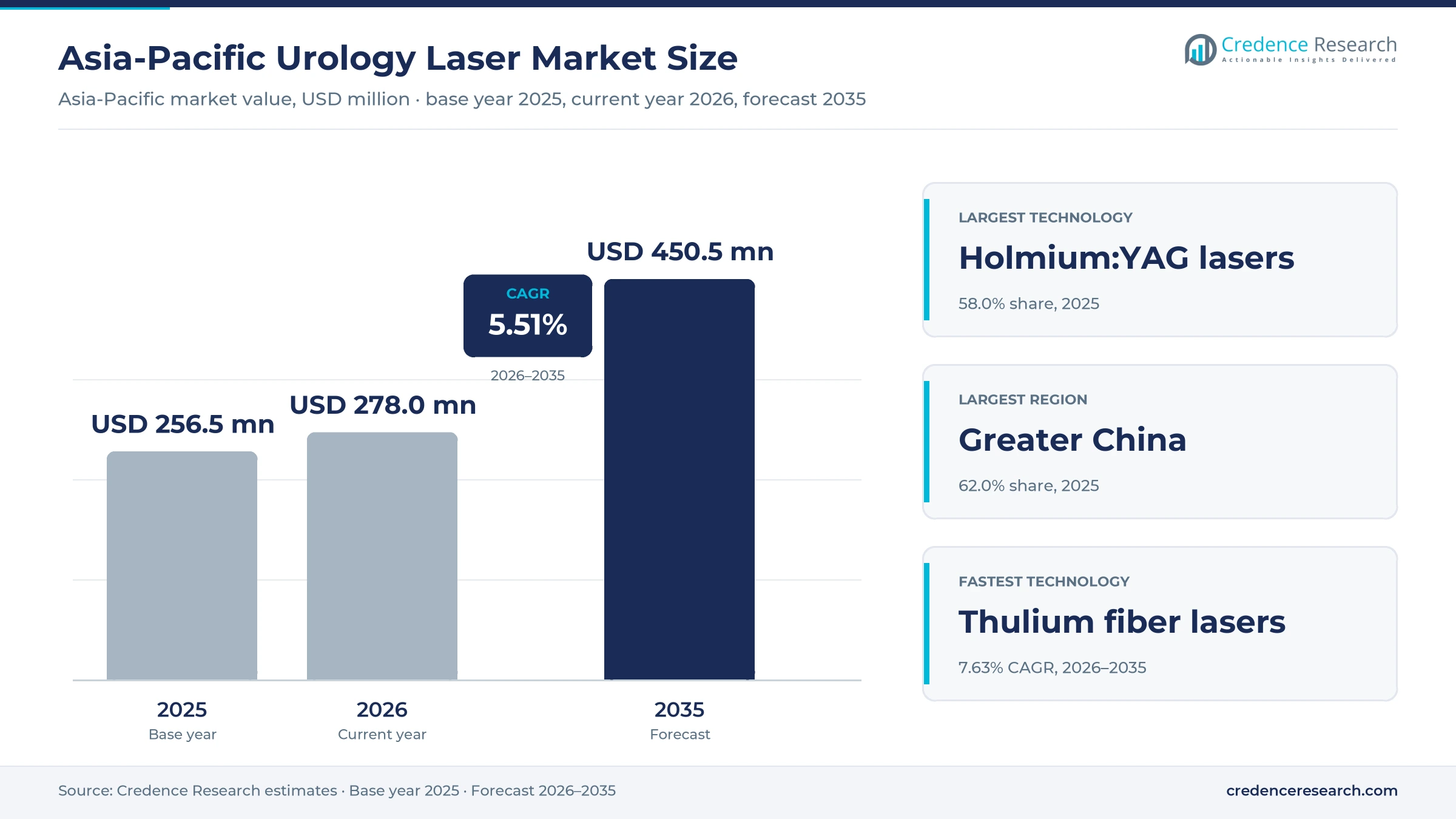
The Asia-Pacific urology laser market was valued at USD 256.5 million in 2025 and is projected to increase from USD 278.0 million in 2026 to USD 450.5 million by 2035, registering a CAGR of 5.51% during 2026–2035. Spending rests on endoscopic stone removal and laser enucleation of the prostate, two procedures that older populations and hospital upgrades keep expanding across the region. Greater China held the largest regional share, 62.0% in 2025, supported by a large stone and prostate caseload and a strong domestic manufacturing base. South and Southeast Asia is the fastest-growing region at 7.11% a year, as teaching hospitals in India tender for high-power systems and provincial centers in Vietnam use holmium platforms. Thulium fiber systems are the main commercial change, because Chinese makers now sell them alongside imported holmium consoles and that widens the choice for public tenders.
Which lasers, fibers and buyers fall inside this study?
The market counts laser consoles, optical fibers and accessories, and service contracts sold for stone fragmentation, prostate enucleation and bladder lesion resection. Buyers are mainly public hospitals, which purchase through tenders, followed by private hospital groups and independent urology providers, which often buy through specialist distributors.
The scope excludes shock wave lithotripters, ureteroscopes, disposable access sheaths and lasers sold for dermatology or general surgery. The value chain runs from laser sources and fiber makers through console assemblers and national distributors to hospital urology departments, and each stage carries its own price pressure.
Asia-Pacific Urology Laser Market Insights
- The market grows from USD 256.5 million in 2025 to USD 450.5 million by 2035, a 5.51% CAGR built on procedure volume rather than on higher console prices.
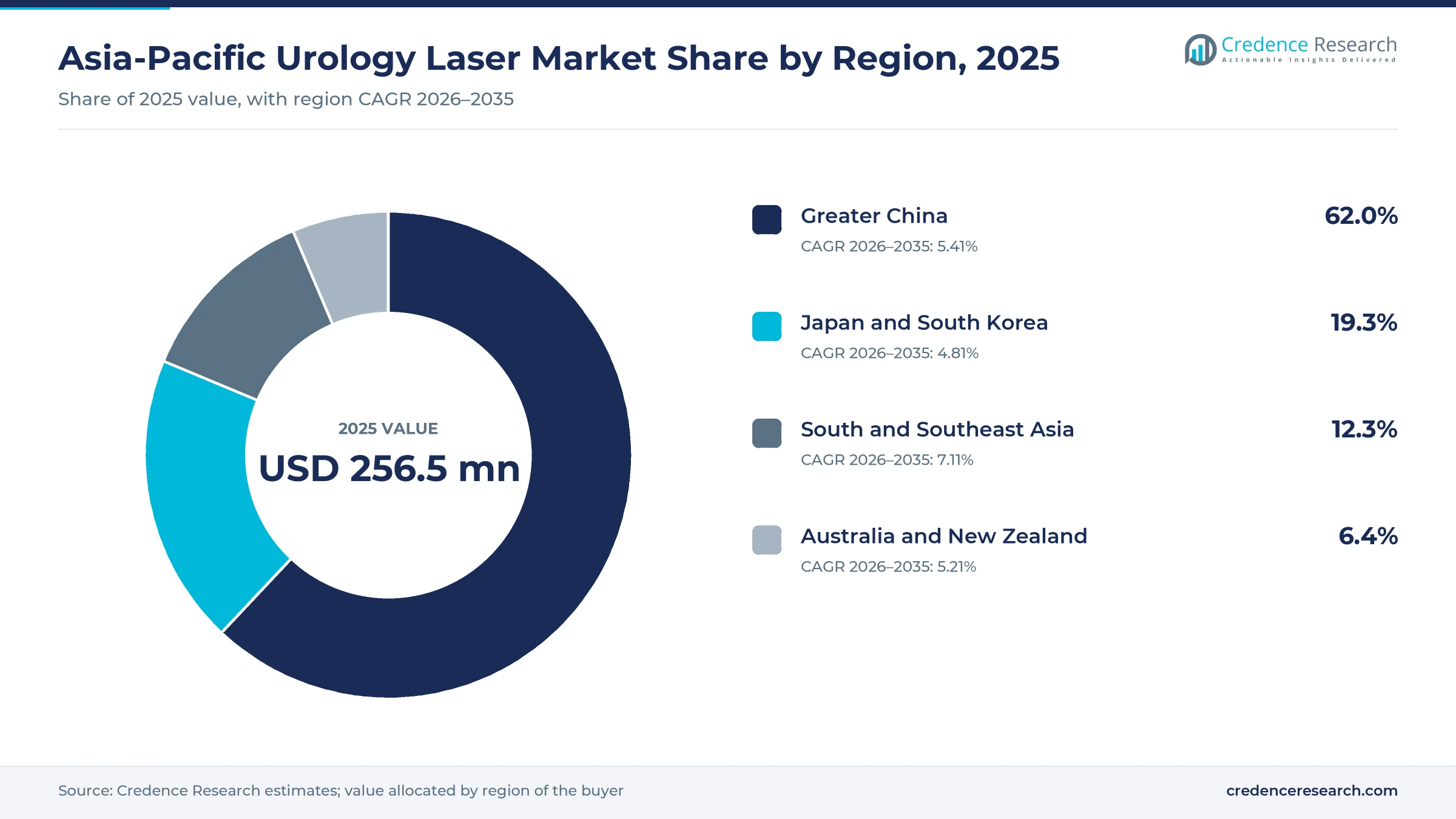
- Greater China held 62.0% of regional value in 2025, reflecting its stone caseload, its aging male population and a deep base of domestic laser manufacturers.
- Holmium:YAG lasers led technology spending with 58.0% in 2025, although Thulium fiber lasers are expanding fastest at 7.63% a year.
- China selected 398 urological interventional products from 170 manufacturers in its January 2026 procurement round, signaling firm price discipline across adjacent urology consumables.
- Dornier MedTech gained distribution rights for Potent Medical lasers in agreed Asia-Pacific territories in March 2026, showing how Western brands now source Chinese platforms to widen portfolios.
Holmium systems and capital sales still anchor spending
Why do consoles still outweigh fibers and service contracts?
Based on product type, the market is categorized into laser capital equipment, optical fibers and laser accessories, and service and maintenance. Laser capital equipment led with 46.0% of 2025 value because high-power consoles remain expensive, specification-heavy purchases, as an August 2026 Indian Institute of Science tender calling for at least 120 watts and pulse modulation shows. Service and maintenance is growing fastest at 6.29% a year, as South Metropolitan Health Service in Western Australia tendered in May 2026 for consumables and ongoing maintenance on a holmium laser installed in June 2023. Those contracts turn each installed console into a recurring line of revenue for suppliers.
How quickly can thulium fiber displace holmium systems?
Based on technology, the market is categorized into holmium:YAG lasers, thulium fiber lasers, diode lasers and green and solid-state thulium lasers. Holmium:YAG lasers led with 58.0% of 2025 value because the installed base is large, and holmium use for stone cases at 17 facilities in Japan's San-in region rose from 33.9% to 64.9% between 2014 and 2023, according to Yonago Acta Medica. Thulium fiber lasers are growing fastest at 7.63% a year, as a 2024 BMC Urology meta-analysis of 1,394 patients found operations about 5.47 minutes shorter than with holmium, and Chinese suppliers now offer competing consoles.
Which conditions generate the most laser procedures?
Based on disease area, the market is categorized into urolithiasis, benign prostatic hyperplasia, non-muscle-invasive bladder cancer and other specified urological lesions. Urolithiasis led with 57.0% of 2025 value because stones are common and recur, with a BJU International survey of 9,310 Chinese adults finding 6.4% prevalence by ultrasonography. Benign prostatic hyperplasia is growing fastest at 6.07% a year, as a BMC Urology study counted 19.36 million prevalent cases among men aged 60 and older in East Asia in 2019 and ranked China first among all countries for prevalent cases.
Where are laser procedures moving outside the main theatre?
Based on care setting, the market is categorized into hospital operating theatres, ambulatory surgery centres and specialist clinic procedure units. Hospital operating theatres led with 81.0% of 2025 value because anesthesia, imaging and tender budgets sit inside hospitals, and a 2025 review in Paediatric Anaesthesia notes that Chinese ambulatory centers are attached to large public hospitals. Ambulatory surgery centres are growing fastest at 6.77% a year, as the same review reports that 639 Chinese hospitals had set up such centers by 2018, when day surgery reached 12.8% of elective operations.
| Segment Group | Leading Sub-segment | Share, 2025 | Fastest-growing Sub-segment | CAGR, 2026–2035 |
|---|---|---|---|---|
| By Product Type | Laser capital equipment | 46.0% | Service and maintenance | 6.29% |
| By Technology | Holmium:YAG lasers | 58.0% | Thulium fiber lasers | 7.63% |
| By Disease Area | Urolithiasis | 57.0% | Benign prostatic hyperplasia | 6.07% |
| By Care Setting | Hospital operating theatres | 81.0% | Ambulatory surgery centres | 6.77% |
Request a Free Sample
Fill in your details and we'll send you a free sample report.
- Sample data tables & charts
- Research methodology
Aging men and replacement cycles carry procedure growth
Age-linked prostate treatment demand
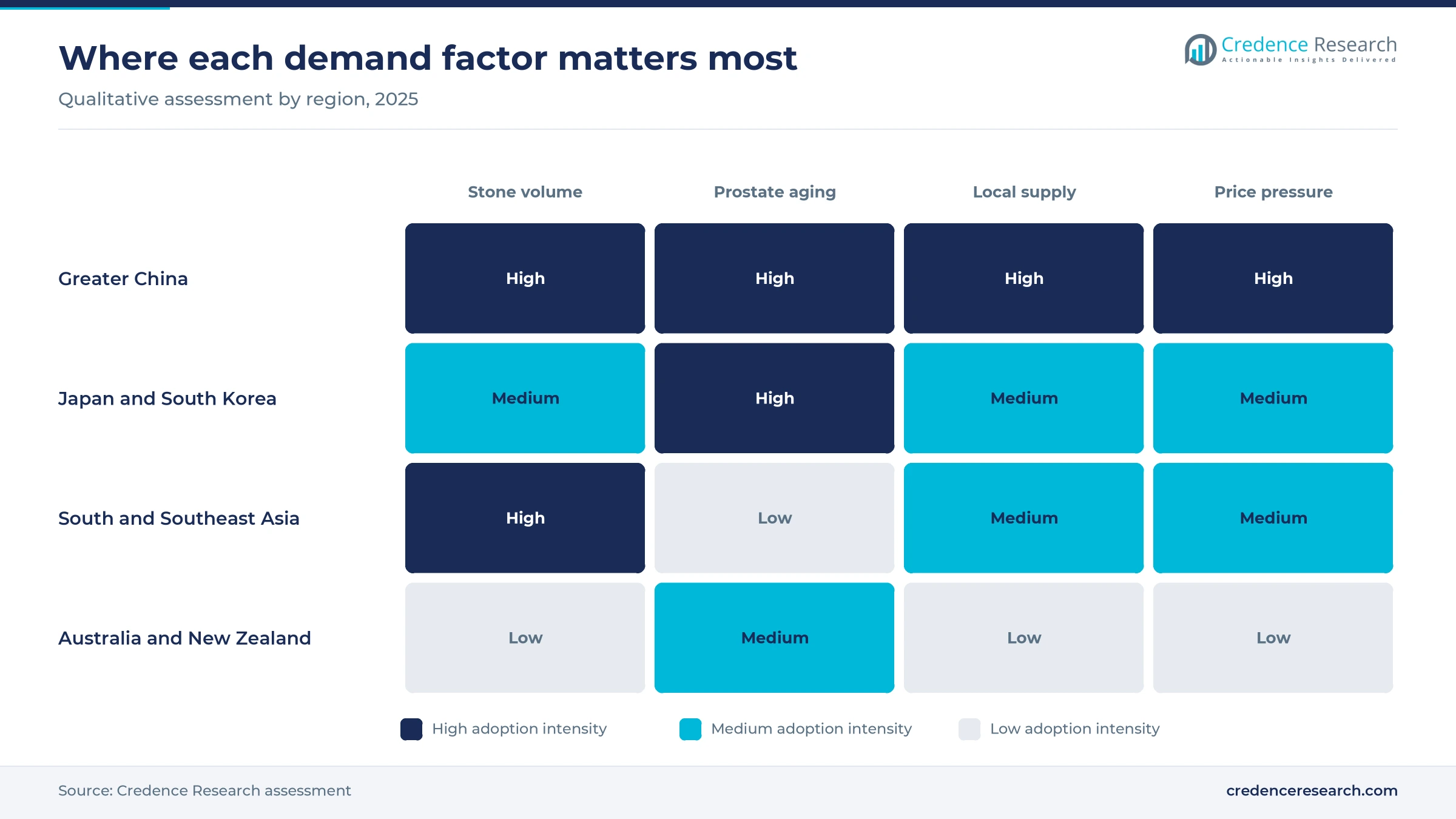
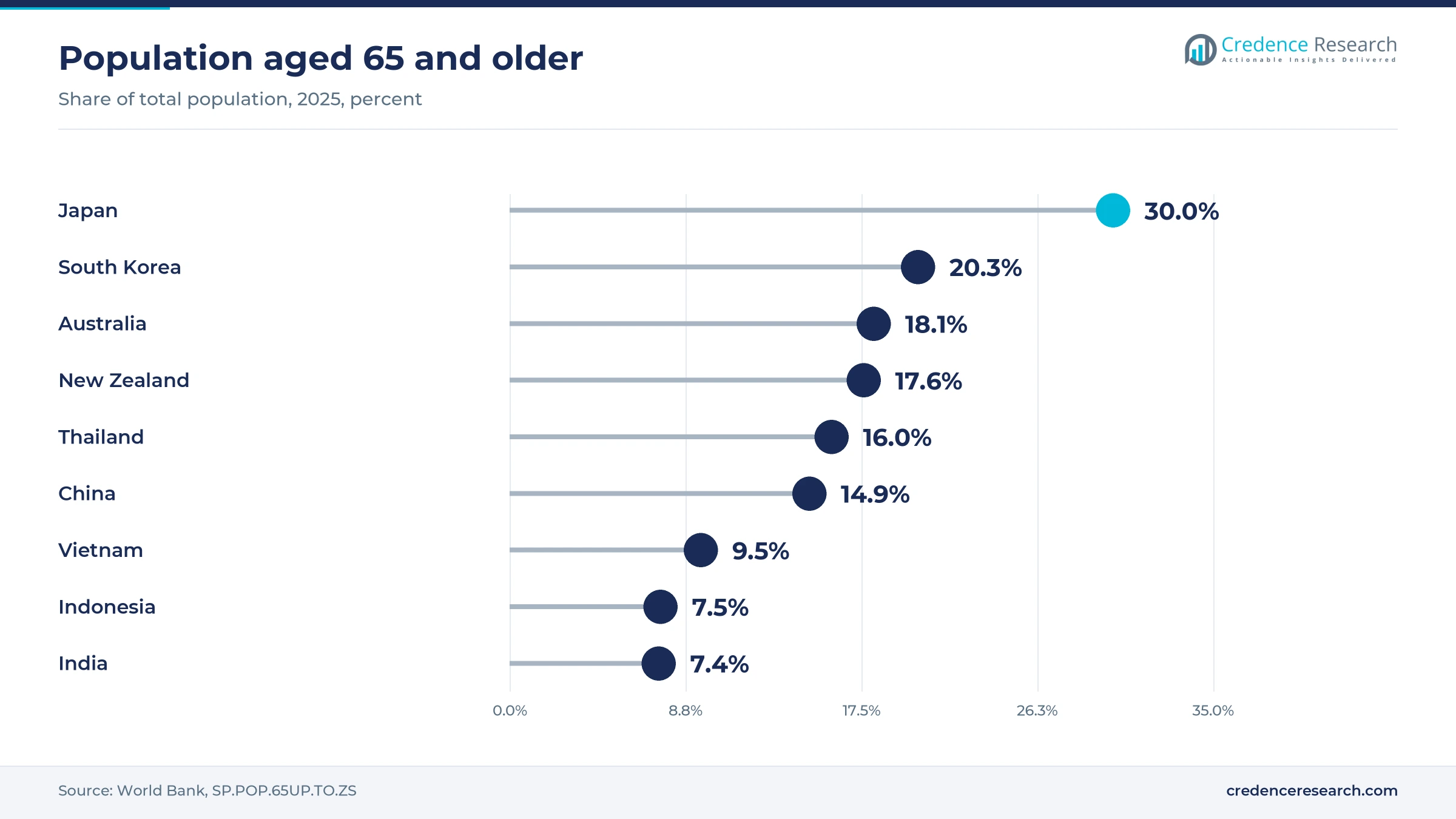
Older male populations are the most durable source of laser volume in the region because prostate enlargement rises sharply with age and often needs surgery. China's National Bureau of Statistics puts residents aged 60 and older at about 23% of the population. Japan's internal affairs ministry counted 36.19 million residents aged 65 or older in September 2025, a record 29.4% share. World Bank population data show the same age group at 20.3% in South Korea and 18.1% in Australia in 2025. Laser enucleation competes for these patients, and a 2026 Yonago Acta Medica survey of 17 Japanese facilities named it and bipolar resection as the two common prostate procedures.
Technology replacement and platform differentiation
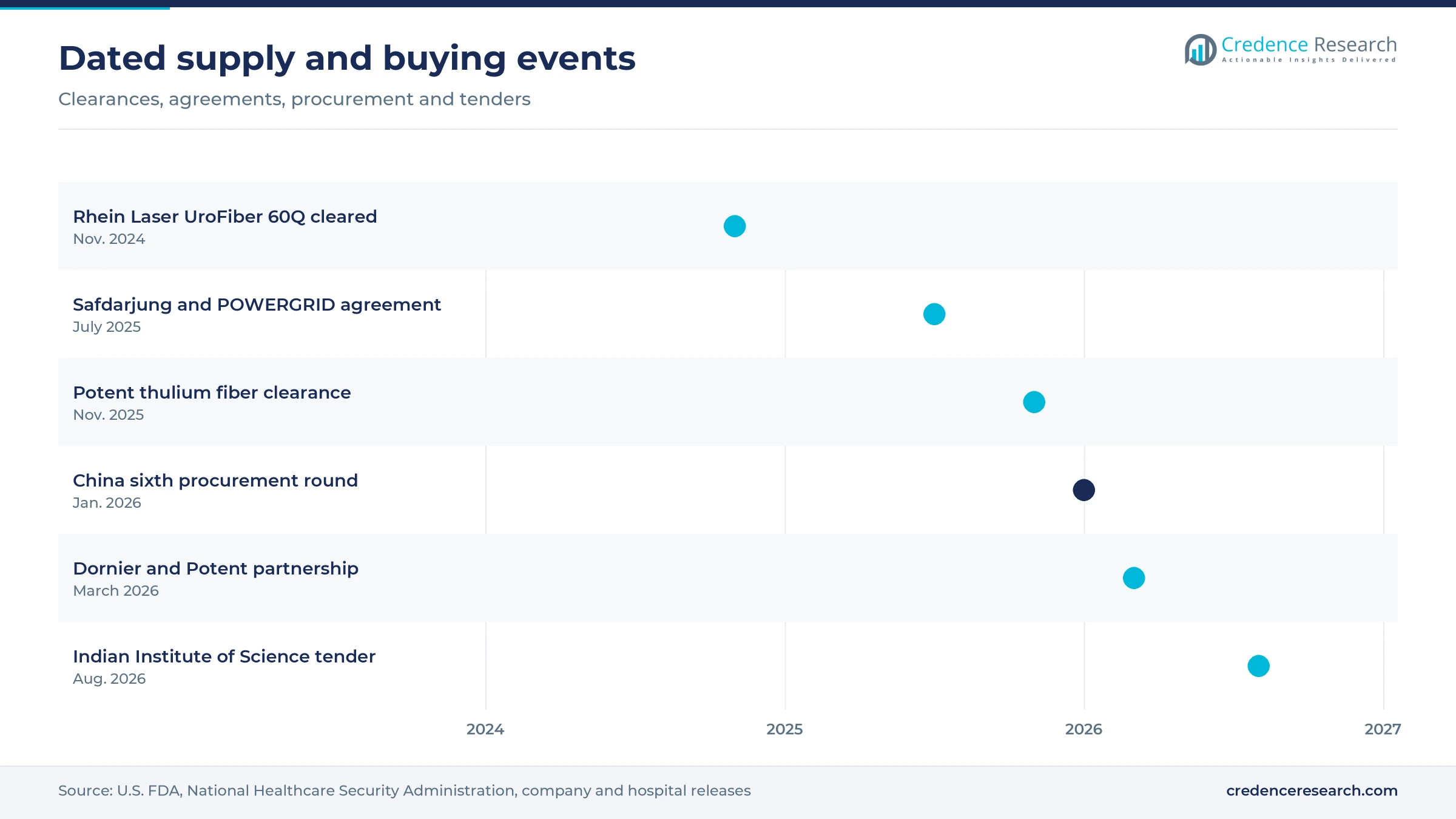
Hospitals replacing older consoles now specify capabilities rather than simple wattage, and that lifts the value of each replacement. An Indian Institute of Science global tender enquiry issued on Aug. 3, 2026 requires at least 120 watts, 80 hertz and pulse modulation that reduces stone retropulsion. Thulium fiber adds a second reason to upgrade, because a 2024 BMC Urology meta-analysis covering studies from China and India reported shorter operations than with holmium. Safdarjung Hospital in New Delhi also signed a July 24, 2025 agreement with POWERGRID that funds a thulium fiber machine for prostate surgery and retrograde stone procedures. These purchases keep Thulium fiber lasers on a 7.63% growth path across the forecast period.
Recurring fiber and service activation
Each installed console creates years of follow-on spending, so the installed base now supports revenue well beyond the initial sale. All India Institute of Medical Sciences Bhopal published a rate contract tender for holmium laser fibers on May 19, 2026, which placed its urology consumables on a standing purchase basis. South Metropolitan Health Service in Western Australia tendered on May 12, 2026 for machine-specific consumables and ongoing maintenance for the Fremantle Hospital urology department. The Indian Institute of Science tender goes further, asking bidders to fix annual maintenance rates for up to nine years after warranty. Together these contracts explain why Service and maintenance is growing at 6.29% a year while console pricing faces far greater competition from new regional suppliers.
Stone care moving from shock waves to lasers
Stone treatment is shifting from shock wave lithotripsy toward endoscopic laser fragmentation, which adds console hours and fiber use alongside other kidney stone management devices in hospitals. A survey published in Yonago Acta Medica in 2026 found that shock wave treatment fell from 59.9% to 32.1% of stone cases at 17 facilities in western Japan between 2014 and 2023. The patient pool is wide, because a BJU International survey found kidney stones in about one in 16 Chinese adults surveyed between May 2013 and July 2014. Laser use is also reaching smaller centers, as four provincial hospitals in northern Vietnam reported 236 mini-percutaneous cases using a 100-watt holmium laser in a 2025 Frontiers in Urology study. Urolithiasis therefore holds 57.0% of 2025 value in this market.
Chinese thulium platforms are reshaping regional supply
A shift toward domestically built thulium consoles in China
Chinese manufacturers have moved from holmium assembly into thulium fiber, which is shifting price expectations across the region. Shanghai Raykeen, also known as Ruikang, told 36Kr in November 2024 that it held about 50% of its lithotripsy laser subfield in China and had ranked first nationally for five consecutive years, while selling its Youlu FreeStar thulium fiber system. Guangzhou Potent Medical then gained U.S. Food and Drug Administration clearance for its thulium fiber systems on Nov. 24, 2025, followed by its HZ-40 holmium unit on Jan. 24, 2026. Rhein Laser, with research teams in Wuhan, received clearance for its UroFiber 60Q on Nov. 19, 2024. This supply base gives Greater China hospitals credible local alternatives at each power level.
The rise of cross-border distribution alliances
Laser makers are increasingly pairing Asian manufacturing with established urology sales networks, which changes how products reach regional hospitals. Dornier MedTech announced a March 11, 2026 partnership with Potent Medical, securing exclusive distribution rights for its thulium fiber and holmium lasers in agreed territories across Asia-Pacific, Europe and the Americas. Raykeen formed a foreign trade team in 2023 and told 36Kr that its customers span more than ten countries, including Vietnam, India and Thailand. Allengers, based in Punjab, India, added its own U.S. clearance for a holmium medical laser on Aug. 18, 2023, a credential that helps South Asian makers in export tenders. As a result, specialist distributors now choose among several origin countries when they build portfolios for tenders.
Opportunity in first-time laser installations across South Asia
South and Southeast Asia offers the clearest opening for first installations, because many public teaching hospitals are only now adding high-power platforms. The region holds 12.3% of 2025 value, helped by younger populations that will age through the forecast period. World Bank data put the share aged 65 and older at 7.4% in India and 9.5% in Vietnam in 2025, well below Japan. Corporate funding also helps, as POWERGRID support for Safdarjung Hospital in July 2025 shows. In Vietnam, a 2025 Frontiers in Urology study reported a mean postoperative hospital stay of 6.94 days after mini-percutaneous surgery with a 100-watt holmium laser, which leaves room for suppliers offering training and higher-power systems.
Opportunity in laser resection of bladder tumors
Bladder tumor resection is a small but open opportunity, because it brings laser platforms into bladder cancer budgets that stone and prostate work rarely reaches. A multicenter trial across five Chinese hospitals, published in Frontiers in Oncology in January 2023, randomized 174 patients to a 450-nanometer blue diode laser or electrocautery and recorded 100% effective resection in both arms. Relative wound healing at three months reached 89.7% with the laser against 31.8% with electrocautery, which gives clinicians a measurable reason to switch. The wider caseload is large, since a 2025 Experimental Hematology and Oncology study estimated about 266,887 new genitourinary cancers in China in 2021, a total that is not limited to bladder tumors. Non-muscle-invasive bladder cancer therefore offers suppliers a clinical specialty beyond their core stone customers.
Procurement and budget pressure squeeze vendor margins
National procurement pushes consumable prices lower
Centralized buying is the most direct margin threat for consumable suppliers in China. The sixth national consumables procurement round in January 2026 selected 398 urological interventional products from 170 manufacturers, with lower prices expected to reach patients from about May 2026. Laser fibers were not named in that report, yet distributors now negotiate against this benchmark. Suppliers with thin fiber margins are most exposed, so local production and bundled service offer them the clearest defense of hospital accounts.
Hospital equipment budgets have cooled after the renewal surge
China's equipment renewal plan of 2024 targets healthcare investment more than 25% above 2023 levels by 2027, yet bidding has already slowed. Guotai Haitong Securities reported in March 2026 that new endoscope bidding fell 21.3% in February from a high base. National Health Commission data, reported by Yicai in August 2026, also showed hospital numbers down about 550 in 2025. Console sellers therefore face longer sales cycles, and service income offers them a steadier base.
Reimbursement gaps leave patients with large bills
Patient payment gaps slow adoption in private settings, even where laser surgery is formally reimbursed. An Australian Medical Services Advisory Committee review reported a fee of AUD 1,262.15 for item 37245 in 2018, against a median charged fee of AUD 2,406 and out-of-pocket costs near AUD 1,500. It also recorded 855 services in 2016-17, below the 1,258 predicted. Private urologists absorb this friction first, so vendors gain by supporting them with clearer patient cost guidance.
Tender service terms raise the cost of competing
Public tender terms increasingly demand service commitments that smaller vendors struggle to meet. The Indian Institute of Science enquiry of August 2026 requires 99% uptime, a two-hour response and spare parts on site within 72 hours for up to nine years after warranty. Raykeen also told 36Kr in 2024 that thulium components were still bought externally, which exposes newer makers to supply risk. Distributors with local engineers gain an advantage, and partnerships are the practical mitigation for others.
Greater China leads while South and Southeast Asia adds pace
| Region | Value, 2025 (USD million) | Share, 2025 | CAGR, 2026–2035 |
|---|---|---|---|
| Greater China | 159.0 | 62.0% | 5.41% |
| Japan and South Korea | 49.5 | 19.3% | 4.81% |
| South and Southeast Asia | 31.5 | 12.3% | 7.11% |
| Australia and New Zealand | 16.4 | 6.4% | 5.21% |
Greater China sets volume and the price benchmark
Greater China held 62.0% of 2025 value and grows at 5.41% a year, because its caseload and local manufacturing base outweigh every other zone in the region. National Health Commission data reported by Yicai show about 38,160 hospitals at the end of 2025, with nearly 10.7 billion visits. Raykeen and Potent Medical compete there with imported systems, while January 2026 procurement results set pricing expectations for urology consumables nationwide. Growth now depends more on procedure volume than on new console placement.
Japan and South Korea favor premium replacement
Japan and South Korea held 19.3% of 2025 value and grow at 4.81% a year, the slowest pace in the region, because installed bases are mature. Boston Scientific markets its Lumenis Pulse 120H in Japan for ureteroscopic stone surgery and prostate enucleation, which illustrates the premium tier. South Korea also has its own supply, since WON TECH reported U.S. approval in 2019 for its Holinwon Prima holmium laser. Replacement decisions in both countries favor efficiency gains over first-time capacity.
South and Southeast Asia adds the fastest growth
South and Southeast Asia held 12.3% of 2025 value and grows at 7.11% a year, the fastest pace in the region, because laser programs are spreading beyond flagship institutes. All India Institute of Medical Sciences Bhopal and the Indian Institute of Science both tendered for holmium supplies in 2026, while Boston Scientific lists the Pulse 120H on its India site. Provincial hospitals in Vietnam already use 100-watt holmium systems, and Raykeen names Thailand among its export markets.
Australia and New Zealand rely on private surgery funding
Australia and New Zealand held 6.4% of 2025 value and grow at 5.21% a year, a small but stable base with strong private surgical funding. Medicare recorded 851 patients for prostate enucleation under item 37245 in 2016-17, according to Australian health technology assessors. Olympus Australia sponsors the SOLTIVE laser system under registration number 344431 on the Australian Register of Therapeutic Goods, and Western Australian hospitals are tendering for holmium service support as well.
Clearances and tenders mark the 2024 to 2026 shift
| Development | Status and market relevance |
|---|---|
| In November 2024, Rhein Laser received U.S. Food and Drug Administration clearance for its UroFiber 60Q thulium fiber laser | Cleared; widens Chinese export supply |
| In July 2025, Safdarjung Hospital signed a POWERGRID agreement covering a thulium fiber laser machine for urology | Signed; public hospital upgrade in India |
| In November 2025, Guangzhou Potent Medical gained U.S. clearance for its TFL-A and TFL-B thulium fiber laser systems | Cleared; strengthens export credentials |
| In January 2026, China selected 398 urological interventional products in its sixth national consumables procurement round | Preliminary results; prices expected from about May 2026 |
| In March 2026, Dornier MedTech announced distribution rights for Potent Medical lasers covering agreed Asia-Pacific territories | Announced; widens the regional distribution channel |
Pulse modulation and fiber design separate the platforms
- Pulse modulation reduces stone retropulsion, and the August 2026 Indian Institute of Science tender lists Moses or an equivalent mode as a requirement.
- Thulium fiber sources offer hospitals an alternative to holmium consoles, and a 2024 BMC Urology meta-analysis of 13 studies reported shorter ureteroscopic operations than with holmium.
- Blue diode lasers operate at 450 nanometers, and a five-center Chinese trial tested them for resection of non-muscle-invasive bladder tumors with favorable wound healing.
- Automatic fiber recognition appears in the same Indian Institute of Science specification, which also lists reusable and single-use fibers in three core sizes as optional items.
Need a Custom Version of This Report?
Tailor the scope, geography, or segments to your exact requirements.
- Custom geography or segment scope
- Direct access to our analyst team
Global brands and Chinese challengers compete on total cost
Competition splits into global endourology brands and fast-moving Chinese specialists, and buyers increasingly compare total procedure cost rather than console price alone. Boston Scientific sells its Lumenis Pulse 120H through Japanese and Indian sites, positioning pulse modulation as a premium feature. Olympus holds an active Australian registration for SOLTIVE, while Dornier MedTech added Potent Medical systems in March 2026 to offer each major laser type. Raykeen claims about half of its Chinese subfield and has opened exports to Vietnam, India and Thailand. Allengers gives South Asia a domestic holmium option with U.S. clearance. Sales run through direct manufacturer teams, specialist distributors and managed contracts, and tenders in India now reward long maintenance commitments. Rhein Laser adds a further Chinese thulium option with a research team in Wuhan. Buyers also weigh laser budgets against disposable ureteroscopes, which a 2024 Indian Journal of Urology audit projected at INR 60,000 to 107,427 each.
Companies profiled and their roles in this market
| Company | Type | Role in the market |
|---|---|---|
| Boston Scientific Corporation | Global endourology brand | Sells Lumenis Pulse 120H in Japan and India with pulse modulation |
| Olympus Corporation | Global endoscopy brand | SOLTIVE system registered in Australia through Olympus Australia |
| Dornier MedTech GmbH | Urology specialist | Holds exclusive distribution rights for Potent lasers in agreed Asia-Pacific territories since March 2026 |
| Guangzhou Potent Medical Equipment Joint-Stock Co., Ltd. | Chinese manufacturer | Thulium fiber and holmium systems cleared in the U.S. in 2025 and 2026 |
| Shanghai Raykeen Laser Technology Co., Ltd. | Chinese manufacturer | Holmium, thulium and fiber lines with exports to South and Southeast Asia |
| Allengers Global Healthcare Private Limited | Indian manufacturer | Holmium medical laser cleared in the U.S. in August 2023 |
Consumables and service will decide vendor returns
Credence Research's view is that the urology laser profit pool is moving from the console to the procedure. Chinese thulium and holmium suppliers have narrowed the technical gap, and national procurement results show how quickly public buyers can compress prices once enough qualified sellers exist. Vendors that win will pair a credible platform with fiber supply, local engineers and multi-year service terms, which Indian tenders already require. Laser makers should treat South and Southeast Asia as the main source of new placements, and they should treat Greater China as a procedure-volume market where service reliability protects margin better than console pricing.
How the regional estimates were built and checked
The report uses 2025 as the base year and forecasts values through 2035. Market values come from the Credence Research model, and the regional, product, technology, disease and care-setting splits are Credence Research estimates. The inputs include regulator records, national statistics, published clinical studies, public hospital tenders and company announcements. No interviews or surveys were conducted for this edition, and company roles are described only where a public page supported them. Regional shares follow the Credence Research regional model and remain the most assumption-heavy part of the analysis.
Procedure volume should outrun console pricing to 2035
The Asia-Pacific urology laser market is projected to reach USD 450.5 million by 2035, and procedure volume should matter more than pricing in that outcome. Prostate work will gain share as China's older population keeps growing, while stone care will remain the largest disease area. Thulium fiber should continue taking replacement orders, although holmium keeps a large installed base that needs fibers and service for years. Greater China will stay dominant, yet its growth will depend on procurement outcomes and hospital budgets. South and Southeast Asia should supply most first-time placements, provided distributors can meet long maintenance commitments.
Frequently Asked Questions
How big is the Asia-Pacific urology laser market?
Which region leads the market?
Which region grows fastest?
Which technology holds the largest share?
Why are thulium fiber lasers growing fastest?
What conditions create the most demand?
What is the biggest challenge for suppliers?
Who are the leading companies?
Table of Content
Chapter 1 Market Segmentation
- 1.1 Segmentation Framework
- 1.1.1 Product and Service Classification
- 1.1.2 Application and End-Use Classification
- 1.1.3 Technology and Solution Classification
- 1.1.4 Customer and Distribution Channel Classification
- 1.1.5 Geographic Segmentation
- 1.1.6 Market Segment Definitions and Boundaries
- 1.2 By Product Type
- 1.2.1 Laser capital equipment
- 1.2.2 Optical fibers and laser accessories
- 1.2.3 Service and maintenance
- 1.3 By Technology
- 1.3.1 Holmium:YAG lasers
- 1.3.2 Thulium fiber lasers
- 1.3.3 Green and solid-state thulium lasers
- 1.3.4 Diode lasers
- 1.4 By Disease Area
- 1.4.1 Urolithiasis
- 1.4.2 Benign prostatic hyperplasia
- 1.4.3 Non-muscle-invasive bladder cancer
- 1.4.4 Other specified urological lesions
- 1.5 By Care Setting
- 1.5.1 Hospital operating theatres
- 1.5.2 Ambulatory surgery centres
- 1.5.3 Specialist clinic procedure units
Chapter 2 Introduction
- 2.1 Report Objectives and Scope
- 2.2 Product Definition and Industry Terminology
- 2.3 Market Inclusions and Exclusions
- 2.4 Research Process
- 2.4.1 Primary Research and Expert Interviews
- 2.4.2 Secondary Research and Source Review
- 2.4.3 Top-Down and Bottom-Up Estimation
- 2.4.4 Data Triangulation and Verification
- 2.5 Market Size Measurement Basis
- 2.5.1 2025: USD 256.5 million → 2035: USD 450.5 million
- 2.6 Historical and Forecast Reference Periods
- 2.6.1 Historical Period: 2018-2025
- 2.6.2 Base Year: 2025
- 2.6.3 Forecast Period: 2025-2035
- 2.7 Research Assumptions and Limitations
Chapter 3 Executive Summary
- 3.1 Market Snapshot and Key Findings
- 3.2 Base-Year Market Size, 2025
- 3.3 Forecast Market Size, 2035
- 3.4 Revenue and Volume Growth Outlook
- 3.5 Key Demand and Supply Indicators
- 3.6 Leading Market Segments
- 3.7 Fastest-Growing Market Opportunities
- 3.8 Regional Performance Highlights
- 3.9 Technology and Industry Transformation
- 3.10 Competitive Landscape Summary
- 3.11 Analyst View and Strategic Implications
Chapter 4 Asia-Pacific Urology Laser Market Trends and Developments
- 4.1 Historical Industry Development, 2018-2025
- 4.2 Recent Market Trends and Developments
- 4.3 Demand and Customer Behavior Trends
- 4.4 Technology and Product Innovation
- 4.5 Artificial Intelligence, Automation and Digitalization
- 4.6 Local Manufacturing and Supply Chain Realignment
- 4.7 Industry Partnerships, Mergers and Acquisitions
- 4.8 Sustainability and Circular Economy Developments
- 4.9 Government and Private Sector Investment Trends
- 4.10 Emerging Business Models and Commercialization
- 4.11 Industry Developments and Announcements
Chapter 5 Asia-Pacific Urology Laser Market Production, Supply and Demand Analysis
- 5.1 Demand Trend and Consumption Analysis, 2018-2025
- 5.2 Demand Forecast, 2025-2035
- 5.3 Production and Output Trend, 2018-2025
- 5.4 Production and Output Forecast, 2025-2035
- 5.5 Installed Capacity and Capacity Utilization
- 5.6 Company-Wise Production Plants and Statistics
- 5.6.1 Installed Production Capacity
- 5.6.2 Actual Production
- 5.6.3 Planned Capacity and Expansion Targets
- 5.7 Supply Chain Structure and Procurement Trends
- 5.8 Supply-Demand Gap and Bottlenecks
- 5.9 Import Dependence and Sourcing Structure
- 5.10 Contract Manufacturing and Outsourcing
- 5.11 Regional Supply and Demand Concentration
Chapter 6 Asia-Pacific Urology Laser Market Pricing Analysis
- 6.1 Pricing Structure and Measurement
- 6.2 Historical Pricing Trends, 2018-2025
- 6.3 Pricing Outlook, 2025-2035
- 6.4 Average Selling Price and Unit Economics
- 6.5 Pricing by Product and Market Segment
- 6.6 Geographic Pricing Differences
- 6.7 Key Input, Energy, Labor and Logistics Costs
- 6.8 Contract Pricing and Purchasing Models
- 6.9 Pricing Sensitivity and Competitive Positioning
- 6.10 Price, Margin and Profitability Implications
Chapter 7 Asia-Pacific Urology Laser Market Dynamics
- 7.1 Market Growth Drivers
- 7.1.1 Demand-Side Drivers
- 7.1.2 Technology and Innovation Drivers
- 7.1.3 Infrastructure and Investment Drivers
- 7.1.4 Regulatory and Policy Drivers
- 7.2 Market Restraints
- 7.2.1 Cost and Affordability Constraints
- 7.2.2 Technology and Adoption Barriers
- 7.2.3 Supply Chain and Operational Constraints
- 7.3 Market Challenges
- 7.3.1 Competitive Pressure and Margin Erosion
- 7.3.2 Skills, Infrastructure and Implementation Gaps
- 7.4 Emerging Market Opportunities
- 7.5 Market Dynamics Impact and Time-Horizon Assessment
Chapter 8 Asia-Pacific Urology Laser Value Chain Analysis
- 8.1 Industry Value Chain Overview
- 8.2 Upstream Suppliers and Critical Inputs
- 8.3 Technology and Component Providers
- 8.4 Manufacturing or Service Delivery
- 8.5 Distribution, Channel Partners and Integrators
- 8.6 Downstream Applications and End Users
- 8.7 Value Addition and Profit Pools
- 8.8 Vertical Integration and Outsourcing
- 8.9 Supplier Concentration and Risk
- 8.10 Supply Chain Localization and Resilience
Chapter 9 Asia-Pacific Urology Laser Market Regulations and Policies
- 9.1 Relevant Laws, Standards and Compliance Frameworks
- 9.2 Product, Service, Safety and Quality Requirements
- 9.3 Government Policies, Incentives and Subsidies
- 9.4 Imports, Exports and Trade Barriers
- 9.5 Public Procurement and Local Content Requirements
- 9.6 Environmental and Sustainability Compliance
- 9.7 Upcoming Policy Changes and Market Implications
Chapter 10 Asia-Pacific Urology Laser Market Hotspots and Opportunities
- 10.1 Market Opportunity Mapping and Growth Hotspots
- 10.2 High-Growth Applications and Customer Groups
- 10.3 Underserved Markets and White-Space Opportunities
- 10.4 Emerging Technology and Product Opportunities
- 10.5 New Capacity and Investment Hotspots
- 10.6 Market Entry and Expansion Opportunities
- 10.7 Distribution and Partnership Opportunities
- 10.8 Near-Term and Long-Term Commercial Potential
- 10.9 Opportunity Attractiveness and Execution Risks
Chapter 11 Asia-Pacific Urology Laser Market Outlook, 2025-2035
- 11.1 Market Size and Analysis
- 11.1.1 Revenue (Market Measurement: 2025: USD 256.5 million → 2035: USD 450.5 million)
- 11.1.2 Market Volume and Quantity Sold
- 11.1.3 Historical Market Size, 2018-2025
- 11.1.4 Base-Year Market Size, 2025
- 11.2 Market Forecast, 2025-2035
- 11.2.1 Revenue Forecast to 2035
- 11.2.2 Volume Forecast to 2035
- 11.2.3 CAGR and Year-on-Year Growth
- 11.2.4 Incremental Revenue Opportunity
- 11.3 Forecast Assumptions and Scenario Analysis
- 11.3.1 Base-Case Forecast
- 11.3.2 Optimistic and Conservative Scenarios
- 11.3.3 Technology, Pricing and Policy Sensitivities
- 11.4 Market Attractiveness and Growth Outlook
Chapter 12 Asia-Pacific Urology Laser Market Segmentation and Outlook
- 12.1 Segmentation Summary and Market Shares, 2025
- 12.2 Largest and Fastest-Growing Segments
- 12.3 By Product Type - Market Size and Forecast, 2025-2035
- 12.3.1 Segment Definition and Scope
- 12.3.2 Historical Market Size, 2018-2025
- 12.3.3 Revenue Forecast, 2025-2035
- 12.3.4 Volume Forecast, 2025-2035
- 12.3.5 Base-Year Market Share, 2025
- 12.3.6 Segment CAGR and Growth Drivers
- 12.3.7 Subsegment Market Size and Forecast
- 12.3.7.1 Laser capital equipment
- 12.3.7.2 Optical fibers and laser accessories
- 12.3.7.3 Service and maintenance
- 12.3.8 Subsegment Pricing and Adoption Trends
- 12.3.9 Leading Suppliers and Competition
- 12.3.10 Regional Demand and Opportunities
- 12.4 By Technology - Market Size and Forecast, 2025-2035
- 12.4.1 Segment Definition and Scope
- 12.4.2 Historical Market Size, 2018-2025
- 12.4.3 Revenue Forecast, 2025-2035
- 12.4.4 Volume Forecast, 2025-2035
- 12.4.5 Base-Year Market Share, 2025
- 12.4.6 Segment CAGR and Growth Drivers
- 12.4.7 Subsegment Market Size and Forecast
- 12.4.7.1 Holmium:YAG lasers
- 12.4.7.2 Thulium fiber lasers
- 12.4.7.3 Green and solid-state thulium lasers
- 12.4.7.4 Diode lasers
- 12.4.8 Subsegment Pricing and Adoption Trends
- 12.4.9 Leading Suppliers and Competition
- 12.4.10 Regional Demand and Opportunities
- 12.5 By Disease Area - Market Size and Forecast, 2025-2035
- 12.5.1 Segment Definition and Scope
- 12.5.2 Historical Market Size, 2018-2025
- 12.5.3 Revenue Forecast, 2025-2035
- 12.5.4 Volume Forecast, 2025-2035
- 12.5.5 Base-Year Market Share, 2025
- 12.5.6 Segment CAGR and Growth Drivers
- 12.5.7 Subsegment Market Size and Forecast
- 12.5.7.1 Urolithiasis
- 12.5.7.2 Benign prostatic hyperplasia
- 12.5.7.3 Non-muscle-invasive bladder cancer
- 12.5.7.4 Other specified urological lesions
- 12.5.8 Subsegment Pricing and Adoption Trends
- 12.5.9 Leading Suppliers and Competition
- 12.5.10 Regional Demand and Opportunities
- 12.6 By Care Setting - Market Size and Forecast, 2025-2035
- 12.6.1 Segment Definition and Scope
- 12.6.2 Historical Market Size, 2018-2025
- 12.6.3 Revenue Forecast, 2025-2035
- 12.6.4 Volume Forecast, 2025-2035
- 12.6.5 Base-Year Market Share, 2025
- 12.6.6 Segment CAGR and Growth Drivers
- 12.6.7 Subsegment Market Size and Forecast
- 12.6.7.1 Hospital operating theatres
- 12.6.7.2 Ambulatory surgery centres
- 12.6.7.3 Specialist clinic procedure units
- 12.6.8 Subsegment Pricing and Adoption Trends
- 12.6.9 Leading Suppliers and Competition
- 12.6.10 Regional Demand and Opportunities
- 12.7 Segment Growth Comparison
- 12.8 Segment Attractiveness and Priority Matrix
Chapter 13 Asia-Pacific Urology Laser Geographic Market Outlook, 2025-2035
- 13.1 Regional Market Size and Country-Level Shares, 2025
- 13.2 Country Market Size Comparison, 2025
- 13.3 Country Market Forecasts, 2025-2035
- 13.4 Subregional Industrial and Demand Clusters
- 13.5 Intra-Regional Pricing and Cost Differences
- 13.6 Cross-Border Trade and Supply Networks
- 13.7 Regional Supply and Demand Balances
- 13.8 Country Opportunity Comparison and Prioritization
Note: Every listed country is covered on the structure shown under the first country.
Chapter 14 Asia-Pacific Urology Laser Technology, Innovation and Sustainability Outlook
- 14.1 Technology Landscape and Maturity
- 14.2 Product, Process and Service Innovation
- 14.3 AI, Automation and Digital Tools in the Industry
- 14.4 Technology Adoption and Performance Benchmarking
- 14.5 Innovation Pipeline and R&D Investment
- 14.6 Patent and Intellectual Property Trends
- 14.7 Energy Efficiency and Resource Management
- 14.8 Sustainability, Recycling and Circularity
- 14.9 Technology Roadmap, 2025-2035
- 14.10 Risks of Obsolescence and Technology Substitution
Chapter 15 Asia-Pacific Urology Laser Market Key Strategic Imperatives
- 15.1 Growth and Market Entry Priorities
- 15.2 High-Return Products and Segments
- 15.3 Pricing, Profitability and Cost Optimization
- 15.4 Technology Investment and Product Differentiation
- 15.5 Supply Chain Localization and Resilience
- 15.6 Distribution and Customer Acquisition
- 15.7 Partnership, Acquisition and Capacity Strategy
- 15.8 Regional Expansion Priorities
- 15.9 Short-, Medium- and Long-Term Actions
Chapter 16 Competition Outlook
- 16.1 Industry Competition Characteristics
- 16.2 Market Structure and Concentration
- 16.3 Market Share and Competitive Positioning, 2025
- 16.4 Company-Wise Revenue and Product Benchmarking
- 16.5 Production and Service Capacity Benchmarking
- 16.6 Technology, Pricing and Differentiation
- 16.7 Regional Footprint and Distribution Strength
- 16.8 Mergers, Acquisitions and Strategic Alliances
- 16.9 New Entrants and Competitive Threats
- 16.10 Porter's Five Forces and Industry Attractiveness
- 16.11 Competitive Outlook, 2025-2035
Chapter 17 Company Profiles
- 17.1 Company Coverage and Selection Criteria
- 17.2 Boston Scientific Corporation
- 17.2.1 Business Description
- 17.2.2 Company Ownership and Geographic Presence
- 17.2.3 Product and Service Portfolio
- 17.2.4 Manufacturing and Operating Footprint
- 17.2.5 Production Capacity and Expansion Plans
- 17.2.6 Financial Performance and Investment
- 17.2.7 Market Share and Competitive Position
- 17.2.8 Technology and Innovation Capabilities
- 17.2.9 Strategic Alliances or Partnerships
- 17.2.10 Recent Developments
- 17.2.11 Growth Strategy and Outlook
- 17.3 Olympus Corporation
- 17.4 KARL STORZ SE & Co. KG
- 17.5 Quanta System S.p.A.
- 17.6 Dornier MedTech GmbH
- 17.7 Richard Wolf GmbH
- 17.8 Asclepion Laser Technologies GmbH
- 17.9 Guangzhou Potent Medical Equipment Joint-Stock Co., Ltd.
- 17.10 Shanghai Raykeen Laser Technology Co., Ltd.
- 17.11 Allengers Global Healthcare Private Limited
- 17.12 Other Relevant Market Participants
Note: Every listed company is profiled on the structure shown under the first company. The company list is preliminary and may change based on research findings, market developments, data availability and client requirements.
Chapter 18 Disclaimer
- 18.1 Research and Forecast Disclaimer
- 18.2 Data Source and Estimation Limitations
Note: The depth of individual sections depends on data availability for this market. Volume, capacity, trade and other unit-based metrics are included where applicable.

