
Knee and trauma implants anchor Indian orthopedic spending
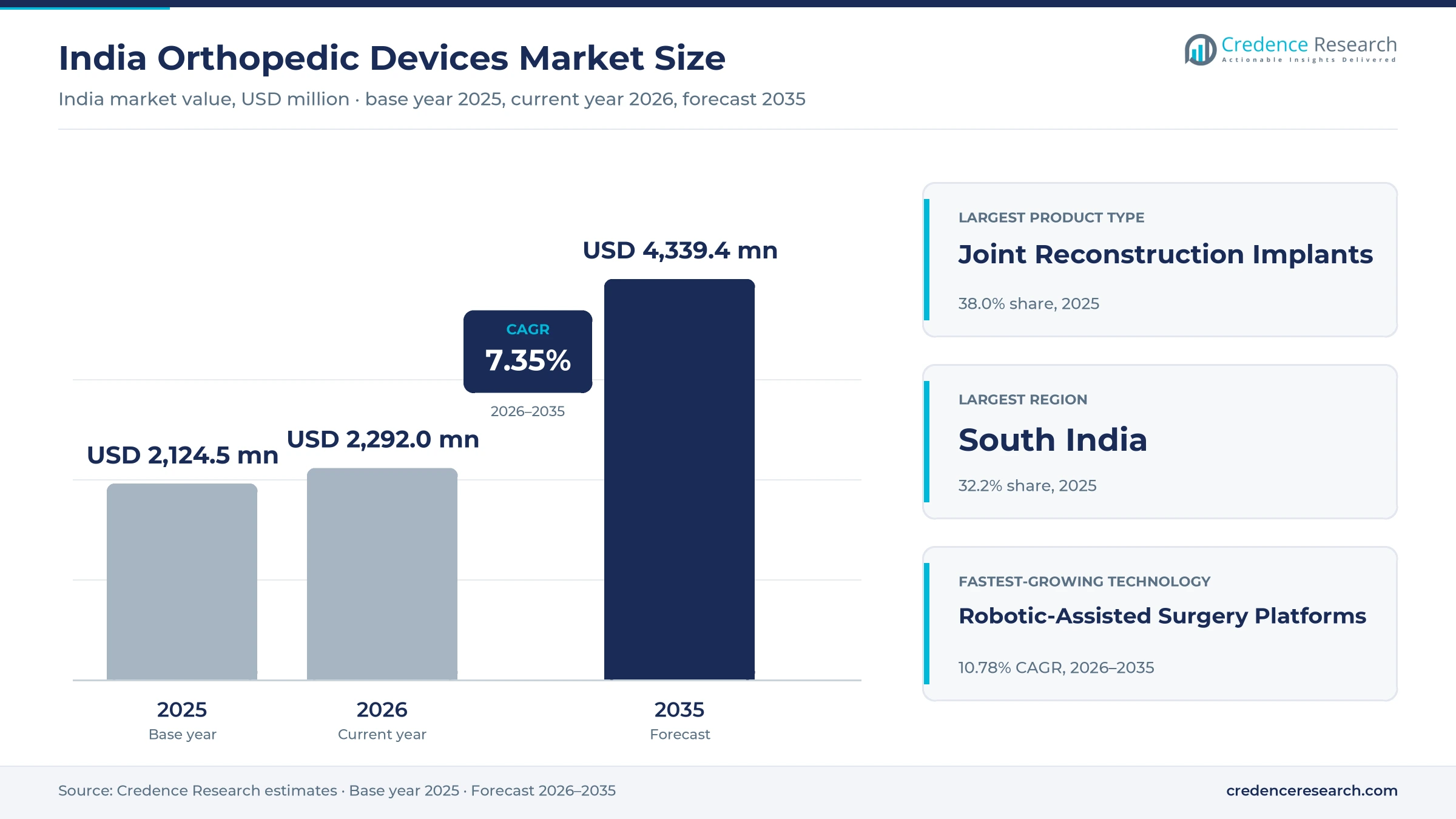
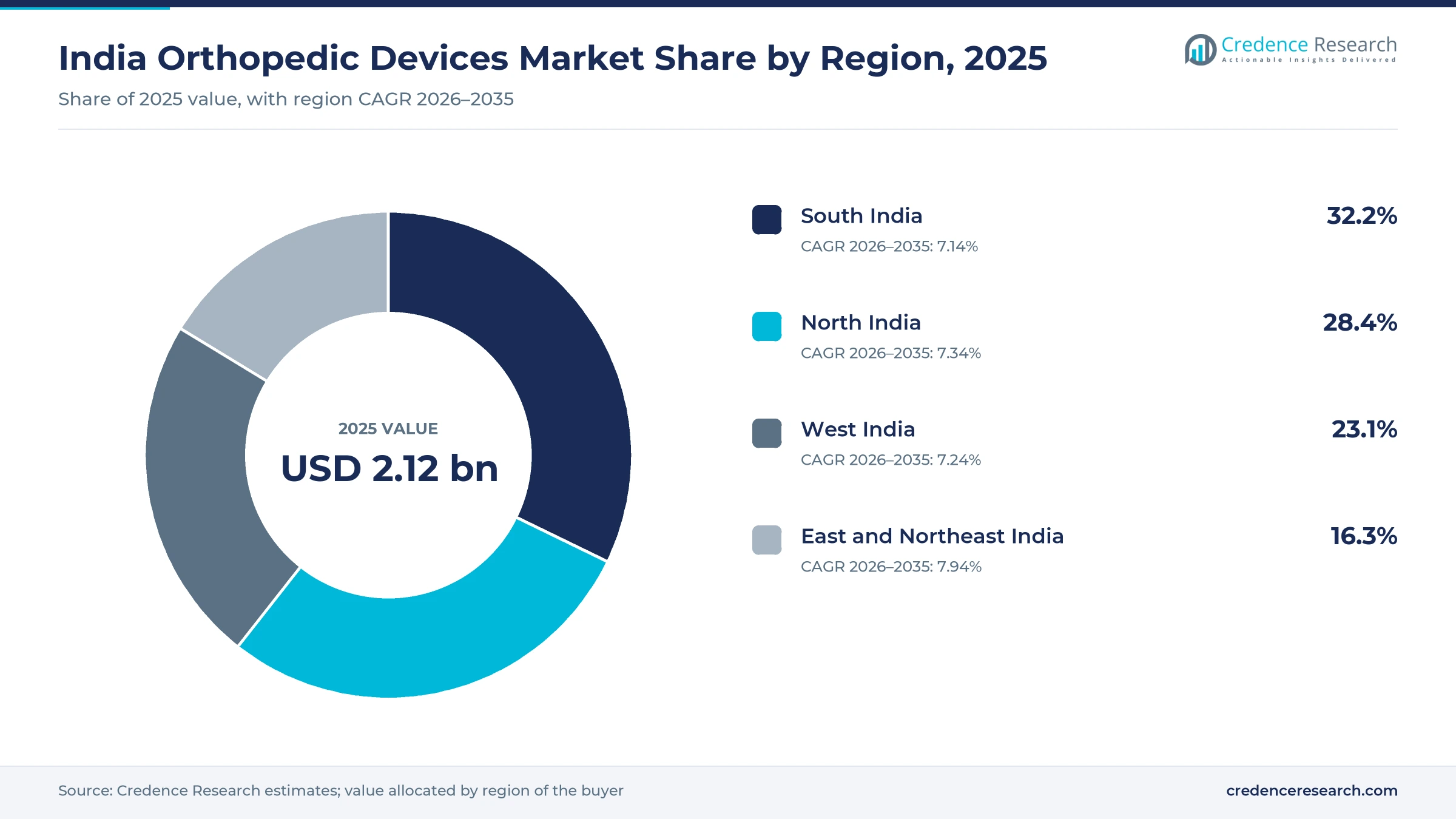
The India orthopedic devices market was valued at USD 2.12 billion in 2025 and is projected to increase from USD 2.29 billion in 2026 to USD 4.34 billion by 2035, registering a CAGR of 7.35% during 2026–2035. Demand comes from an ageing population with degenerative joint disease, a heavy road-trauma burden and wider public insurance for surgery. South India held the largest regional share, 32.2% in 2025, helped by older state populations and dense private hospital networks. East and Northeast India is the fastest-growing region at 7.94% a year, although it starts from far fewer licensed plants and specialists. Pricing remains the defining commercial factor, because the National Pharmaceutical Pricing Authority has capped knee implants since 2017 and extended that ceiling in November 2025 to Nov. 15, 2026. At the same time, Meril Life Sciences and several multinationals are placing competing robotic platforms in hospitals, which is changing how surgeons and purchasing teams select implant systems.
What implant, fixation and spine spending counts here?
The India orthopedic devices market counts implants, fixation hardware, spinal systems, orthobiologics and surgical platforms that hospitals and clinics buy for joint, trauma, spine and sports procedures. Buyers purchase through dealers, direct company contracts, public tenders and online government procurement, and surgeons strongly influence which brand a hospital stocks.
The estimate excludes surgeon fees, hospital room charges, physiotherapy services and braces sold directly to consumers. The value chain runs from titanium, cobalt-chrome and polymer inputs through licensed plants in Gujarat, Haryana, Delhi and Tamil Nadu, then importers and dealers, and finally hospital theaters.
India Orthopedic Devices Market Insights
- The market grows from USD 2.12 billion in 2025 to USD 4.34 billion by 2035, a 7.35% CAGR across 2026–2035, as surgery reaches more older and insured patients.
- South India led with 32.2% of 2025 value, supported by Kerala and Tamil Nadu, whose elderly shares were among the highest in government 2021 data.
- Joint Reconstruction Implants held 38.0% of 2025 value, reflecting knee arthroplasty, which makes up nearly 95% of Indian Joint Registry entries through April 2026.
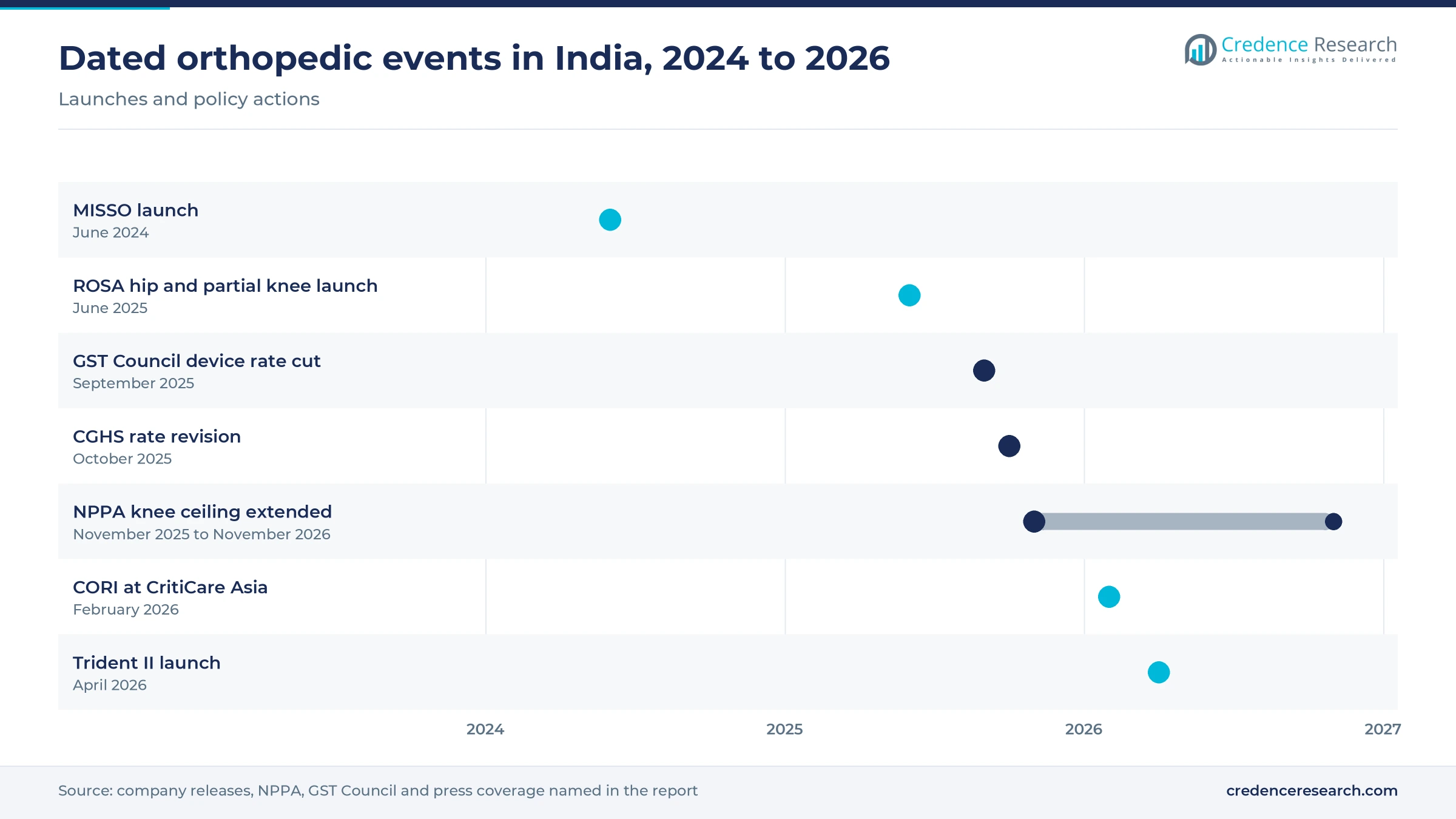
- Meril launched MISSO in June 2024 at a claimed 66% below available systems, and rival platforms from Zimmer Biomet and Smith+Nephew expanded through 2026.
- Regulators kept primary knee systems at INR 51,563 through Nov. 15, 2026, so suppliers compete on service, surgeon training and platform access rather than list price.
Joint implants, big hospitals and dealers lead the mix
Why knee volumes keep joint implants ahead
Based on product type, the market is categorized into joint reconstruction implants, trauma fixation devices, spinal implants and systems, and orthobiologics. Joint Reconstruction Implants led with 38.0% of 2025 value because knee arthroplasty dominates elective volume, and the Indian Joint Registry had recorded more than 351,000 primary knee procedures by April 2026, according to the Indian Society of Hip and Knee Surgeons. Spinal Implants and Systems grow fastest at 8.19% a year as local spine capacity deepens. Machinist reported in December 2025 that Medi-Mold will invest INR 1 billion in Visakhapatnam to make patient-specific spine, trauma and hip implants, which also suits spinal fusion cases.
Insurance keeps surgery inside large hospitals
Based on care setting, the market is categorized into multispecialty hospitals, orthopedic specialty hospitals, ambulatory surgical centers and outpatient orthopedic clinics. Multispecialty Hospitals led with 52.0% of 2025 value because public payers route patients to empaneled inpatient beds, and a Lok Sabha reply reported by Outlook Money showed 159,000 senior citizen admissions across specialties, worth INR 14.29 billion, authorized as of Nov. 26, 2025. Ambulatory Surgical Centers grow fastest at 9.07% a year as same-day pathways spread. PTI reported in October 2025 that Max Multi Speciality Center in New Delhi discharged a 78-year-old patient within 12 hours of a robotic knee replacement.
Scattered buyers favor dealers over direct contracts
Based on channel, the market is categorized into institutional tenders, distributor networks, direct manufacturer sales and group purchasing and e-procurement. Distributor Networks led with 44.0% of 2025 value because implant demand is spread across many small buyers, and the joint registry alone draws entries from 491 hospitals in 22 states, according to the ISHKS 2026 newsletter. Dealers suit that pattern, since they hold sizes close to theaters. Group Purchasing and E-Procurement grows fastest at 8.90% a year as public buying moves online. Government e-Marketplace recorded INR 5.42 trillion of procurement in fiscal 2024-25, and Outlook Business named medical procurement a key vertical in August 2025.
Scarce capital keeps conventional systems dominant
Based on technology, the market is categorized into conventional implant systems, robotic-assisted surgery platforms, navigation and patient-specific planning, and additively manufactured patient-specific implants. Conventional Implant Systems led with 78.0% of 2025 value because capital remains scarce relative to case volume, and Business Standard counted about 200 knee robots deployed in June 2024. Robotic-Assisted Surgery Platforms grow fastest at 10.78% a year as entry prices fall. Meril priced MISSO at INR 20 million in June 2024, about 66% below available systems by its own claim, with consumables of INR 25,000 per surgery, while navigation systems offer another route to guided placement.
| Segment Group | Leading Sub-segment | Share, 2025 | Fastest-growing Sub-segment | CAGR, 2026–2035 |
|---|---|---|---|---|
| By Product Type | Joint Reconstruction Implants | 38.0% | Spinal Implants and Systems | 8.19% |
| By Care Setting | Multispecialty Hospitals | 52.0% | Ambulatory Surgical Centers | 9.07% |
| By Channel | Distributor Networks | 44.0% | Group Purchasing and E-Procurement | 8.90% |
| By Technology | Conventional Implant Systems | 78.0% | Robotic-Assisted Surgery Platforms | 10.78% |
Request a Free Sample
Fill in your details and we'll send you a free sample report.
- Sample data tables & charts
- Research methodology
Ageing, road injury and policy lift procedure volumes
Accelerating ageing lifts degenerative joint demand
India's older population is the structural source of joint reconstruction demand, because osteoarthritis is the primary indication for knee surgery in the Indian Joint Registry, according to a May 2025 EFORT Open Reviews paper. The India Ageing Report 2023 from IIPS and UNFPA counts 149 million people aged 60 and above in 2022 and projects 347 million by 2050. World Bank data put the share aged 65 and above at 7.15% in 2024, which leaves a long runway. Payment is widening too, since the government had issued more than 9.6 million Ayushman Vay Vandana cards to citizens over 70 by Dec. 31, 2025, according to Deccan Herald, each carrying up to INR 500,000 of annual cover. As a result, knee replacement candidates in lower-income households gain a funded route to surgery.
Large trauma pool sustains fracture fixation
Road injury keeps trauma fixation volumes high and largely non-deferrable, which gives plates, screws and nails a demand base independent of elective cycles. The Road Ministry counted 480,583 accidents in 2023, a 4.2% rise from 2022, with 172,890 deaths and 462,825 injuries reported by PTI in August 2025. Two-wheeler riders made up 44.8% of fatalities, the largest share of any road-user group. Fragility fractures add a second pool, because the International Osteoporosis Foundation's 2025 audit counts about 57.7 million adults aged 70 and above and lists surgery for about 76% to 90% of hip fractures. Domestic makers are positioned for this work, and Auxein Medical reported EU-MDR certification for its trauma plating, screws and nailing systems in November 2024.
Regulation and local manufacturing formalize supply
Policy is shifting implant supply toward licensed domestic plants, which raises compliance thresholds and shortens supply lines for hospitals. The government told the Rajya Sabha on July 29, 2025, that import dependence stood at about 70%, down from more than 85% in 2020, according to Medical Dialogues. A Lok Sabha reply of July 24, 2026 reported 27 approved PLI projects and INR 11.53 billion of actual investment, with implants among the four scheme segments and Meril Life Sciences among the major beneficiaries. Meanwhile, a December 2025 Lok Sabha reply listed more than 4,000 licensed device manufacturing sites since 2021, led by Gujarat at 738 and Maharashtra at 721. In turn, Indian-made knee and trauma lines have a larger licensed base from which to bid for hospital and tender business.
Public cover and tax cuts reduce patient cost
Public payers and tax changes are lowering the out-of-pocket barrier that often delays elective surgery. A Lok Sabha reply in December 2025 confirmed that total knee replacement, including revision, is covered under AB-PMJAY with up to INR 500,000 of annual family cover, as reported by Outlook Money. The Central Government Health Scheme also revised rates for nearly 2,000 procedures from Oct. 13, 2025, its first major update since 2014, paying 15% less to non-accredited facilities and 15% more to super-specialty hospitals, according to Angel One. In addition, the GST Council recommended a 5% rate on medical devices in September 2025, and AiMeD's coordinator told Business Standard that makers would reduce maximum retail prices proportionately. Together, these steps enlarge the pool able to afford implants.
Robots and local 3D printing are reshaping implant supply
Shift to a contested robotic knee platform market
Robotic knee surgery is shifting from a few metro programs toward a contested platform market with Indian and imported options. BioSpectrum India reported in March 2025 that MISSO was presented at the inauguration of the 450-bed Namo Hospital in Silvassa. Zimmer Biomet launched ROSA Partial Knee and ROSA Hip at showcases in Mumbai and Delhi in June 2025, then announced ROSA Knee with OptimiZe on Oct. 26, 2026. CritiCare Asia Hospitals in Mumbai inaugurated Smith+Nephew's CORI on Feb. 15, 2026, as its third platform alongside Cuvis and Velys, while DHS Multispecialty Hospital in Ahmedabad added Johnson & Johnson's VELYS in August 2026. Hospitals running several platforms gain bargaining room, so implant suppliers increasingly need a robot offer to stay on formulary.
Emerging additive production of patient-specific implants
Additive manufacturing is emerging as a local production route for implants that were previously imported or machined. OIC International, Medi Mold and AddUp announced on Aug. 7, 2025, a facility at the Andhra Pradesh MedTech Zone that will install a FormUp metal 3D printer, according to BioSpectrum India. That venture explicitly targets low-cost implants for government hospitals and health schemes as well as private buyers. Auxein Medical also said it unveiled customized implants at MEDICA in November 2024, and Zimmer Biomet brought Signature ONE Version 2 planning software to India in June 2025. These steps link digital planning with local printing capacity for Indian surgeons. Volumes stay small, with additively made products inside a technology group led by Conventional Implant Systems at 78.0% of 2025 value.
Opportunity in day-care joint replacement programs
Short-stay joint replacement offers an opening for suppliers that can package implants, instruments and recovery protocols for smaller theaters. Dr. Rohan Dessai of Manipal Hospital in Goa wrote in April 2025 that his patients are encouraged to walk within three to four hours, with home physiotherapy afterward. The cost case is strong, since Business Standard put knee replacement at INR 150,000 to INR 350,000 in June 2024, and Meril claims robotic surgery on MISSO could become 40% to 60% cheaper. Payment rules help as well, because CGHS rates for day-care services stay uniform across ward and city categories under the October 2025 revision. Suppliers that train anesthesia and physiotherapy teams could therefore win new accounts among Ambulatory Surgical Centers, which is the fastest-growing setting.
Opportunity in sports and ligament repair lines
Sports medicine gives implant companies an opening among younger patients whose purchase decisions are less tied to the knee price ceiling. Apollo Hospitals launched a dedicated sports injury center in Hyderabad, reported by The Siasat Daily on May 8, 2026, equipped for ligament injuries and complex joint conditions. Local supply is widening too, as Auxein Medical, which cites more than 500 employees and 250 machines, introduced an osteochondral transfer system, a ligament augmentation set and bioabsorbable interference screws at MEDICA in November 2024. South India is a logical first market given these hospital investments. Companies that pair arthroscopy hardware with surgeon training can therefore build a position that is separate from arthroplasty, although patient volumes remain poorly documented in national data.
Price caps and thin surgeon cover constrain suppliers
Knee price ceiling limits recovery on new designs
The price ceiling restricts what suppliers can recover on the most common elective implant. The pricing authority kept primary knee systems at INR 51,563 and revision systems at INR 83,547 until Nov. 15, 2026, or further order, according to Business Standard, and did not grant requests for a 10% increase or a separate category for innovative implants. Multinationals must therefore weigh whether newer designs justify launch costs, and the ceiling comes up for review at its Nov. 15, 2026, expiry. A pricing committee also deferred a decision on a separate cementless category on Feb. 11, 2026, according to Medical Dialogues.
Vacant surgeon posts narrow rural access
Surgeon availability limits where implants can be used outside cities. The Health Ministry's Health Dynamics of India 2022-23 showed only 913 of 3,371 sanctioned surgeon posts filled at rural community health centers as of March 31, 2023, a 73% vacancy rate, according to Deccan Herald. Madhya Pradesh, the starkest case, had just seven of 332 posts filled. Trauma patients in those districts must travel further for fixation, which concentrates demand in cities and leaves rural dealers with thin volumes.
Import reliance exposes costs to currency swings
Import reliance leaves many hospitals and dealers exposed to currency and freight costs. Surgical instrument imports rose from USD 104 million in fiscal 2020-21 to USD 263 million in fiscal 2024-25, according to a Rajya Sabha reply reported by Medical Dialogues. Knee implant makers cited foreign exchange and freight when they sought a price increase in 2025. Domestic producers face a separate cash issue, because AiMeD told Business Standard that refund speed on accumulated GST will decide whether the 5% rate helps them.
Patchy procedure data complicates supply planning
Thin national data makes planning difficult for buyers and suppliers. The International Osteoporosis Foundation states that India has no centralized fracture database, while the Indian Joint Registry held 384,484 entries by April 2026, far short of national activity. Published annual knee estimates range from about 150,000 in The Goan in April 2025 to 550,000 in Business Standard in June 2024. Procurement teams therefore size knee implants inventory largely from their own hospital records.
South India leads while the east grows from a low base
| Region | Value, 2025 (USD billion) | Share, 2025 | CAGR, 2026–2035 |
|---|---|---|---|
| South India | 0.68 | 32.2% | 7.14% |
| North India | 0.60 | 28.4% | 7.34% |
| West India | 0.49 | 23.1% | 7.24% |
| East and Northeast India | 0.35 | 16.3% | 7.94% |
South India leads on age profile and hospital depth
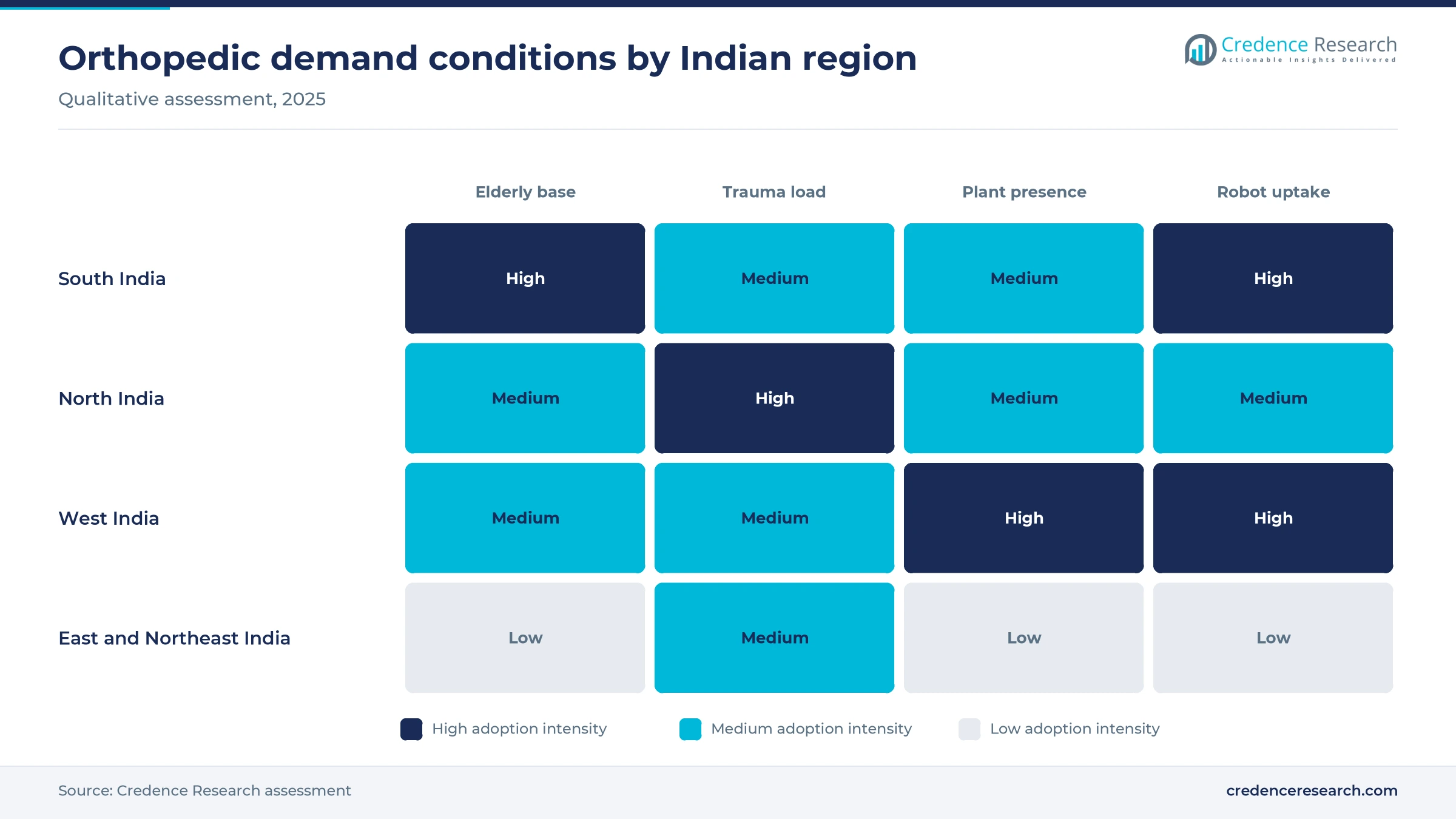
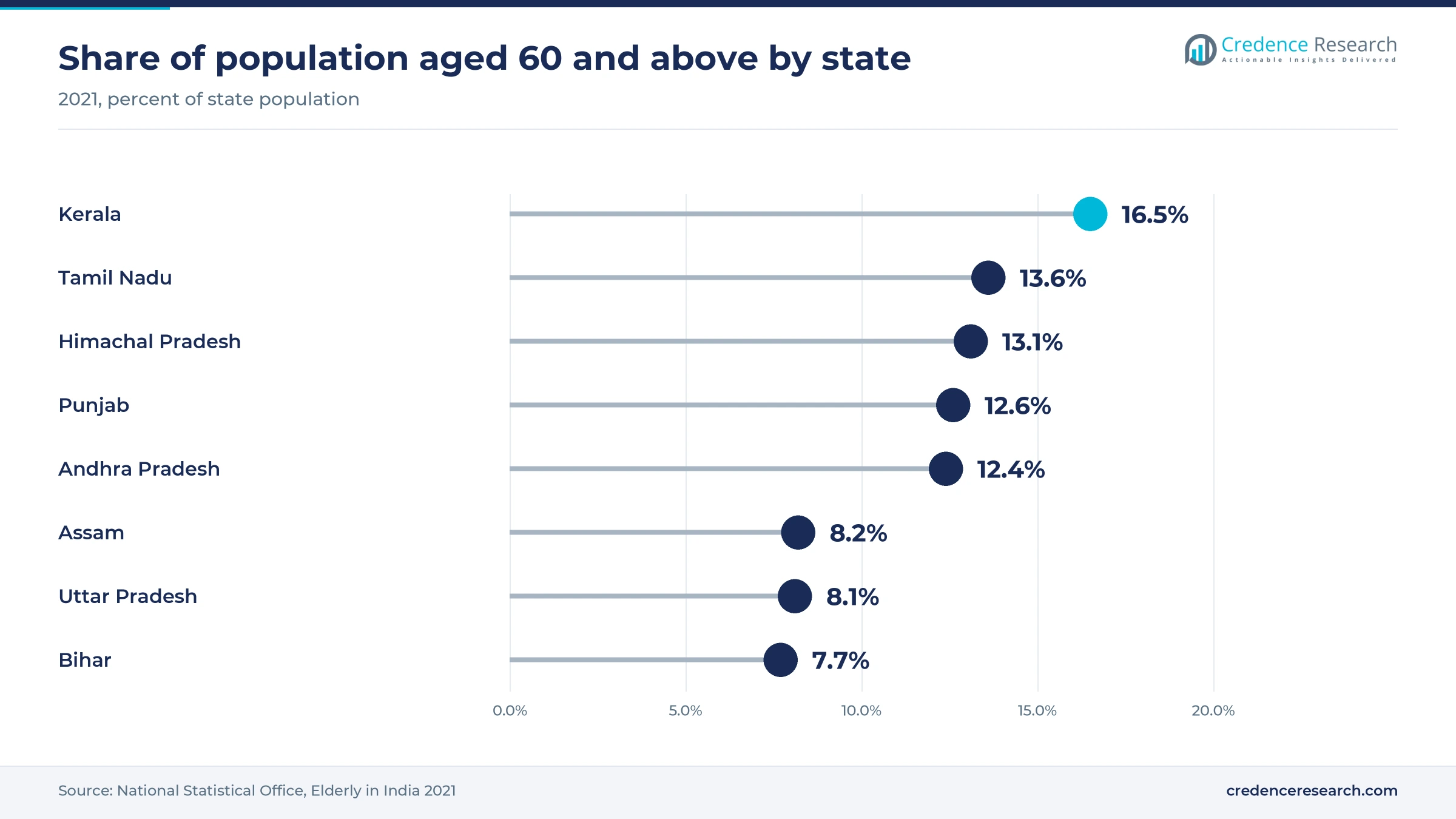
South India held 32.2% of 2025 value and grows at 7.14% a year. The National Statistical Office's Elderly in India 2021 report, as reported by ThePrint, projected the 60-plus share at 16.5% in Kerala, 13.6% in Tamil Nadu and 12.4% in Andhra Pradesh, well above the shares in northern plains states. Telangana also ranks among the top contributors to the Indian Joint Registry, and Apollo Hospitals added a Hyderabad sports injury center in May 2026. Supply is nearby too, since Tamil Nadu, Karnataka, Telangana and Kerala hold 989 licensed device sites between them.
North India pairs trauma burden with export plants
North India held 28.4% of 2025 value and grows at 7.34% a year. Uttar Pradesh recorded the most road accident deaths in 2023, according to the Road Ministry report, which supports heavy trauma fixation use at public and private hospitals. Himachal Pradesh and Punjab add older populations, with 13.1% and 12.6% projected to be aged 60 and above in 2021. Haryana and Delhi hold 302 and 291 licensed device sites, and Siora Surgicals operates its plant in Sonepat, Haryana, close to the region's dealer networks.
West India benefits from registry activity and plants
West India held 23.1% of 2025 value and grows at 7.24% a year. Gujarat and Maharashtra are the top two states for licensed device sites, at 738 and 721, according to a December 2025 Lok Sabha reply. They also rank among the leading contributors to the Indian Joint Registry through April 2026. Hospital investment is visible as well, with CritiCare Asia Hospitals adding CORI in Mumbai in February 2026 and DHS Multispecialty Hospital adding VELYS in Ahmedabad in August 2026.
East and Northeast India grows from a thin base
East and Northeast India held 16.3% of 2025 value and grows fastest at 7.94% a year, starting from limited local capacity. Assam and Bihar had some of the lowest elderly shares in 2021, at 8.2% and 7.7%, so demand leans younger and toward trauma. Jharkhand and Manipur each counted only three licensed device sites in the December 2025 Lok Sabha reply, which leaves hospitals dependent on supply from other regions. Growth therefore rests on wider public insurance use and new surgical capacity.
Launches and pricing orders shaped 2024 to 2026
| Development | Status and market relevance |
|---|---|
| In June 2024, Meril launched MISSO, an indigenously developed knee replacement robot, at a stated INR 20 million. | Commercial; sets a lower entry price for hospitals |
| In June 2025, Zimmer Biomet introduced ROSA Partial Knee, ROSA Hip and the G7 Acetabular System at events in Mumbai and Delhi. | Commercial; widens its robot and hip offer |
| In November 2025, the National Pharmaceutical Pricing Authority extended the knee implant ceiling for up to one year, to Nov. 15, 2026. | In force; renewal decision falls due in November 2026 |
| In December 2025, Medi-Mold announced an INR 1 billion additive implant facility at the Andhra Pradesh MedTech Zone. | Announced; no commissioning date stated |
| In April 2026, Stryker launched the Trident II Acetabular System in India for total hip arthroplasty. | Commercial; extends its premium hip range |
Robotic and planning tools change how implants are chosen
- Robotic-assisted platforms tie implant selection to a capital decision, and MISSO, ROSA, CORI and VELYS were all placed or launched in Indian hospitals between 2024 and 2026.
- Spine robotics entered through India Medtronic with the Mazor X Stealth Edition, launched in November 2019 with first cases at a spinal injuries hospital in New Delhi.
- Planning software such as Signature ONE Version 2, introduced by Zimmer Biomet in June 2025, lets surgeons map implant position before entering the theater.
- Metal additive manufacturing at the Andhra Pradesh MedTech Zone uses an AddUp FormUp printer and targets patient-specific trauma, spine and hip implants.
Need a Custom Version of This Report?
Tailor the scope, geography, or segments to your exact requirements.
- Custom geography or segment scope
- Direct access to our analyst team
Multinationals and Indian makers compete on price and reach
Competition in India orthopedic devices splits between multinationals with premium joint and spine portfolios and Indian manufacturers with strength in price-sensitive trauma and tender business. Stryker, Zimmer Biomet, Smith+Nephew and Johnson & Johnson MedTech increasingly sell through a robot-plus-implant offer, as launches and hospital placements from 2025 and 2026 show. Meril has challenged that model with a locally developed robot and a lower entry price. Auxein Medical, GPC Medical and Siora Surgicals compete on broad trauma, spine and arthroscopy catalogs, export credentials and machining capacity, with Auxein citing more than 250 machines. The knee price ceiling removes much list-price room, so rivalry centers on surgeon training, instrument access, dealer service and speed of supply. Tender and online procurement, by contrast, favor lower-cost licensed Indian producers.
Companies profiled and their roles in this market
| Company | Type | Role in the market |
|---|---|---|
| Stryker India Pvt. Ltd. | Multinational | Launched the Trident II Acetabular System for hip arthroplasty in April 2026 |
| DePuy Synthes (Johnson & Johnson MedTech) | Multinational | VELYS robotic knee system added at DHS Multispecialty Hospital, Ahmedabad, in August 2026 |
| Zimmer India Pvt. Ltd. | Multinational | ROSA Knee with OptimiZe announced in October 2026, following 2025 ROSA launches |
| Smith+Nephew Healthcare Pvt. Ltd. | Multinational | CORI robotic system installed at CritiCare Asia Hospitals, Mumbai, in February 2026 |
| India Medtronic Pvt. Ltd. | Multinational | Introduced the Mazor X Stealth Edition for spine surgery in November 2019 |
| Meril Life Sciences Pvt. Ltd. | Domestic manufacturer | Developer of the MISSO knee robot and a named PLI beneficiary |
| Auxein Medical Pvt. Ltd. | Domestic manufacturer | Trauma and arthroscopy lines with EU-MDR certification for trauma systems |
| GPC Medical Ltd. | Domestic manufacturer | Orthopedic implant and instrument maker that cites U.S. FDA 510(k) products |
| Siora Surgicals Pvt. Ltd. | Domestic manufacturer | Orthopedic implant and spine system maker with a plant in Sonepat, Haryana |
Local robots and price caps will set the next decade
Credence Research's view is that India orthopedic devices will grow on volume rather than price through the forecast period. The knee ceiling, online procurement and a lower-cost Indian robot all restrain price, while ageing and public insurance widen the eligible pool. The decisive contest is therefore control of the theater, since a hospital that adopts a platform tends to standardize its implant purchases around it. Multinationals keep an edge in hips, revision and complex spine, but Indian makers are better placed in tenders and in trauma. Buyers should watch the November 2026 ceiling decision closely, because it will signal how much room remains for premium knee designs.
How Credence Research built these estimates
The report uses 2025 as the base year and projects to 2035, with market values from the Credence Research model. Regional and segment shares and growth rates are Credence Research estimates, built from public data on population, licensed sites, procedure registries and dated company activity. Source types are government and parliamentary statements, regulator orders, statistical publications, professional society reports, company releases and named press coverage. No interviews or surveys were conducted for this edition of the report. Reported procedure counts vary widely by publisher, so volume inputs were treated as ranges, and segment estimates carry more uncertainty than the regional figures.
Volume growth should outrun price pressure through 2035
The market should reach USD 4.34 billion by 2035, with growth sustained by the projected rise in older citizens and by trauma that does not wait for budgets. Knee implants will likely stay the largest single line, although spine and same-day settings should gain share. Robot placement could broaden beyond metros if lower-cost platforms keep gaining hospitals, and additive output should scale once Andhra Pradesh MedTech Zone capacity is commissioned. The main risks are a tighter price regime, slower GST refunds and persistent surgeon gaps in rural districts. Even so, progress on local licensing and public cover points to steady, broad-based expansion.
Frequently Asked Questions
How big is the India orthopedic devices market?
Which product type leads the market?
Which region holds the largest share?
Which region grows fastest?
How do price controls affect knee implants?
What is driving robotic surgery adoption?
Does public insurance cover knee replacement?
Who are the main companies in this market?
Table of Content
Chapter 1 Market Segmentation
- 1.1 Segmentation Framework
- 1.1.1 Product and Service Classification
- 1.1.2 Application and End-Use Classification
- 1.1.3 Technology and Solution Classification
- 1.1.4 Customer and Distribution Channel Classification
- 1.1.5 Geographic Segmentation
- 1.1.6 Market Segment Definitions and Boundaries
- 1.2 By Product Type
- 1.2.1 Joint Reconstruction Implants
- 1.2.2 Trauma Fixation Devices
- 1.2.3 Spinal Implants and Systems
- 1.2.4 Orthobiologics
- 1.3 By Care Setting
- 1.3.1 Multispecialty Hospitals
- 1.3.2 Orthopedic Specialty Hospitals
- 1.3.3 Ambulatory Surgical Centers
- 1.3.4 Outpatient Orthopedic Clinics
- 1.4 By Channel
- 1.4.1 Distributor Networks
- 1.4.2 Direct Manufacturer Sales
- 1.4.3 Institutional Tenders
- 1.4.4 Group Purchasing and E-Procurement
- 1.5 By Technology
- 1.5.1 Conventional Implant Systems
- 1.5.2 Robotic-Assisted Surgery Platforms
- 1.5.3 Navigation and Patient-Specific Planning
- 1.5.4 Additively Manufactured Patient-Specific Implants
Chapter 2 Introduction
- 2.1 Report Objectives and Scope
- 2.2 Product Definition and Industry Terminology
- 2.3 Market Inclusions and Exclusions
- 2.4 Research Process
- 2.4.1 Primary Research and Expert Interviews
- 2.4.2 Secondary Research and Source Review
- 2.4.3 Top-Down and Bottom-Up Estimation
- 2.4.4 Data Triangulation and Verification
- 2.5 Market Size Measurement Basis
- 2.5.1 2025: USD 2.12 billion → 2035: USD 4.34 billion
- 2.6 Historical and Forecast Reference Periods
- 2.6.1 Historical Period: 2018-2025
- 2.6.2 Base Year: 2025
- 2.6.3 Forecast Period: 2025-2035
- 2.7 Research Assumptions and Limitations
Chapter 3 Executive Summary
- 3.1 Market Snapshot and Key Findings
- 3.2 Base-Year Market Size, 2025
- 3.3 Forecast Market Size, 2035
- 3.4 Revenue and Volume Growth Outlook
- 3.5 Key Demand and Supply Indicators
- 3.6 Leading Market Segments
- 3.7 Fastest-Growing Market Opportunities
- 3.8 Regional Performance Highlights
- 3.9 Technology and Industry Transformation
- 3.10 Competitive Landscape Summary
- 3.11 Analyst View and Strategic Implications
Chapter 4 India Orthopedic Devices Market Trends and Developments
- 4.1 Historical Industry Development, 2018-2025
- 4.2 Recent Market Trends and Developments
- 4.3 Demand and Customer Behavior Trends
- 4.4 Technology and Product Innovation
- 4.5 Artificial Intelligence, Automation and Digitalization
- 4.6 Local Manufacturing and Supply Chain Realignment
- 4.7 Industry Partnerships, Mergers and Acquisitions
- 4.8 Sustainability and Circular Economy Developments
- 4.9 Government and Private Sector Investment Trends
- 4.10 Emerging Business Models and Commercialization
- 4.11 Industry Developments and Announcements
Chapter 5 India Orthopedic Devices Market Production, Supply and Demand Analysis
- 5.1 Demand Trend and Consumption Analysis, 2018-2025
- 5.2 Demand Forecast, 2025-2035
- 5.3 Production and Output Trend, 2018-2025
- 5.4 Production and Output Forecast, 2025-2035
- 5.5 Installed Capacity and Capacity Utilization
- 5.6 Company-Wise Production Plants and Statistics
- 5.6.1 Installed Production Capacity
- 5.6.2 Actual Production
- 5.6.3 Planned Capacity and Expansion Targets
- 5.7 Supply Chain Structure and Procurement Trends
- 5.8 Supply-Demand Gap and Bottlenecks
- 5.9 Import Dependence and Sourcing Structure
- 5.10 Contract Manufacturing and Outsourcing
- 5.11 Regional Supply and Demand Concentration
Chapter 6 India Orthopedic Devices Market Pricing Analysis
- 6.1 Pricing Structure and Measurement
- 6.2 Historical Pricing Trends, 2018-2025
- 6.3 Pricing Outlook, 2025-2035
- 6.4 Average Selling Price and Unit Economics
- 6.5 Pricing by Product and Market Segment
- 6.6 Geographic Pricing Differences
- 6.7 Key Input, Energy, Labor and Logistics Costs
- 6.8 Contract Pricing and Purchasing Models
- 6.9 Pricing Sensitivity and Competitive Positioning
- 6.10 Price, Margin and Profitability Implications
Chapter 7 India Orthopedic Devices Market Dynamics
- 7.1 Market Growth Drivers
- 7.1.1 Demand-Side Drivers
- 7.1.2 Technology and Innovation Drivers
- 7.1.3 Infrastructure and Investment Drivers
- 7.1.4 Regulatory and Policy Drivers
- 7.2 Market Restraints
- 7.2.1 Cost and Affordability Constraints
- 7.2.2 Technology and Adoption Barriers
- 7.2.3 Supply Chain and Operational Constraints
- 7.3 Market Challenges
- 7.3.1 Competitive Pressure and Margin Erosion
- 7.3.2 Skills, Infrastructure and Implementation Gaps
- 7.4 Emerging Market Opportunities
- 7.5 Market Dynamics Impact and Time-Horizon Assessment
Chapter 8 India Orthopedic Devices Value Chain Analysis
- 8.1 Industry Value Chain Overview
- 8.2 Upstream Suppliers and Critical Inputs
- 8.3 Technology and Component Providers
- 8.4 Manufacturing or Service Delivery
- 8.5 Distribution, Channel Partners and Integrators
- 8.6 Downstream Applications and End Users
- 8.7 Value Addition and Profit Pools
- 8.8 Vertical Integration and Outsourcing
- 8.9 Supplier Concentration and Risk
- 8.10 Supply Chain Localization and Resilience
Chapter 9 India Orthopedic Devices Market Regulations and Policies
- 9.1 Relevant Laws, Standards and Compliance Frameworks
- 9.2 Product, Service, Safety and Quality Requirements
- 9.3 Government Policies, Incentives and Subsidies
- 9.4 Imports, Exports and Trade Barriers
- 9.5 Public Procurement and Local Content Requirements
- 9.6 Environmental and Sustainability Compliance
- 9.7 Upcoming Policy Changes and Market Implications
Chapter 10 India Orthopedic Devices Market Hotspots and Opportunities
- 10.1 Market Opportunity Mapping and Growth Hotspots
- 10.2 High-Growth Applications and Customer Groups
- 10.3 Underserved Markets and White-Space Opportunities
- 10.4 Emerging Technology and Product Opportunities
- 10.5 New Capacity and Investment Hotspots
- 10.6 Market Entry and Expansion Opportunities
- 10.7 Distribution and Partnership Opportunities
- 10.8 Near-Term and Long-Term Commercial Potential
- 10.9 Opportunity Attractiveness and Execution Risks
Chapter 11 India Orthopedic Devices Market Outlook, 2025-2035
- 11.1 Market Size and Analysis
- 11.1.1 Revenue (Market Measurement: 2025: USD 2.12 billion → 2035: USD 4.34 billion)
- 11.1.2 Market Volume and Quantity Sold
- 11.1.3 Historical Market Size, 2018-2025
- 11.1.4 Base-Year Market Size, 2025
- 11.2 Market Forecast, 2025-2035
- 11.2.1 Revenue Forecast to 2035
- 11.2.2 Volume Forecast to 2035
- 11.2.3 CAGR and Year-on-Year Growth
- 11.2.4 Incremental Revenue Opportunity
- 11.3 Forecast Assumptions and Scenario Analysis
- 11.3.1 Base-Case Forecast
- 11.3.2 Optimistic and Conservative Scenarios
- 11.3.3 Technology, Pricing and Policy Sensitivities
- 11.4 Market Attractiveness and Growth Outlook
Chapter 12 India Orthopedic Devices Market Segmentation and Outlook
- 12.1 Segmentation Summary and Market Shares, 2025
- 12.2 Largest and Fastest-Growing Segments
- 12.3 By Product Type - Market Size and Forecast, 2025-2035
- 12.3.1 Segment Definition and Scope
- 12.3.2 Historical Market Size, 2018-2025
- 12.3.3 Revenue Forecast, 2025-2035
- 12.3.4 Volume Forecast, 2025-2035
- 12.3.5 Base-Year Market Share, 2025
- 12.3.6 Segment CAGR and Growth Drivers
- 12.3.7 Subsegment Market Size and Forecast
- 12.3.7.1 Joint Reconstruction Implants
- 12.3.7.2 Trauma Fixation Devices
- 12.3.7.3 Spinal Implants and Systems
- 12.3.7.4 Orthobiologics
- 12.3.8 Subsegment Pricing and Adoption Trends
- 12.3.9 Leading Suppliers and Competition
- 12.3.10 Regional Demand and Opportunities
- 12.4 By Care Setting - Market Size and Forecast, 2025-2035
- 12.4.1 Segment Definition and Scope
- 12.4.2 Historical Market Size, 2018-2025
- 12.4.3 Revenue Forecast, 2025-2035
- 12.4.4 Volume Forecast, 2025-2035
- 12.4.5 Base-Year Market Share, 2025
- 12.4.6 Segment CAGR and Growth Drivers
- 12.4.7 Subsegment Market Size and Forecast
- 12.4.7.1 Multispecialty Hospitals
- 12.4.7.2 Orthopedic Specialty Hospitals
- 12.4.7.3 Ambulatory Surgical Centers
- 12.4.7.4 Outpatient Orthopedic Clinics
- 12.4.8 Subsegment Pricing and Adoption Trends
- 12.4.9 Leading Suppliers and Competition
- 12.4.10 Regional Demand and Opportunities
- 12.5 By Channel - Market Size and Forecast, 2025-2035
- 12.5.1 Segment Definition and Scope
- 12.5.2 Historical Market Size, 2018-2025
- 12.5.3 Revenue Forecast, 2025-2035
- 12.5.4 Volume Forecast, 2025-2035
- 12.5.5 Base-Year Market Share, 2025
- 12.5.6 Segment CAGR and Growth Drivers
- 12.5.7 Subsegment Market Size and Forecast
- 12.5.7.1 Distributor Networks
- 12.5.7.2 Direct Manufacturer Sales
- 12.5.7.3 Institutional Tenders
- 12.5.7.4 Group Purchasing and E-Procurement
- 12.5.8 Subsegment Pricing and Adoption Trends
- 12.5.9 Leading Suppliers and Competition
- 12.5.10 Regional Demand and Opportunities
- 12.6 By Technology - Market Size and Forecast, 2025-2035
- 12.6.1 Segment Definition and Scope
- 12.6.2 Historical Market Size, 2018-2025
- 12.6.3 Revenue Forecast, 2025-2035
- 12.6.4 Volume Forecast, 2025-2035
- 12.6.5 Base-Year Market Share, 2025
- 12.6.6 Segment CAGR and Growth Drivers
- 12.6.7 Subsegment Market Size and Forecast
- 12.6.7.1 Conventional Implant Systems
- 12.6.7.2 Robotic-Assisted Surgery Platforms
- 12.6.7.3 Navigation and Patient-Specific Planning
- 12.6.7.4 Additively Manufactured Patient-Specific Implants
- 12.6.8 Subsegment Pricing and Adoption Trends
- 12.6.9 Leading Suppliers and Competition
- 12.6.10 Regional Demand and Opportunities
- 12.7 Segment Growth Comparison
- 12.8 Segment Attractiveness and Priority Matrix
Chapter 13 India Orthopedic Devices Geographic Market Outlook, 2025-2035
- 13.1 Domestic Market Distribution and Demand Clusters
- 13.2 State- or Province-Wise Market Size and Forecast, 2025-2035
- 13.3 City and Metropolitan Market Outlook
- 13.4 Industrial, Manufacturing and Commercial Clusters
- 13.5 Geographic Concentration of Key End Users
- 13.6 Local Pricing and Purchasing Differences
- 13.7 Domestic Production Facilities and Capacity Map
- 13.8 Local Infrastructure and Project Pipeline
- 13.9 State-Level Policy and Incentive Differences
- 13.10 Subnational Investment Hotspots and Opportunities
- 13.11 Distribution and Logistics Networks
- 13.12 Domestic Competitive Footprint
Chapter 14 India Orthopedic Devices Technology, Innovation and Sustainability Outlook
- 14.1 Technology Landscape and Maturity
- 14.2 Product, Process and Service Innovation
- 14.3 AI, Automation and Digital Tools in the Industry
- 14.4 Technology Adoption and Performance Benchmarking
- 14.5 Innovation Pipeline and R&D Investment
- 14.6 Patent and Intellectual Property Trends
- 14.7 Energy Efficiency and Resource Management
- 14.8 Sustainability, Recycling and Circularity
- 14.9 Technology Roadmap, 2025-2035
- 14.10 Risks of Obsolescence and Technology Substitution
Chapter 15 India Orthopedic Devices Market Key Strategic Imperatives
- 15.1 Growth and Market Entry Priorities
- 15.2 High-Return Products and Segments
- 15.3 Pricing, Profitability and Cost Optimization
- 15.4 Technology Investment and Product Differentiation
- 15.5 Supply Chain Localization and Resilience
- 15.6 Distribution and Customer Acquisition
- 15.7 Partnership, Acquisition and Capacity Strategy
- 15.8 Regional Expansion Priorities
- 15.9 Short-, Medium- and Long-Term Actions
Chapter 16 Competition Outlook
- 16.1 Industry Competition Characteristics
- 16.2 Market Structure and Concentration
- 16.3 Market Share and Competitive Positioning, 2025
- 16.4 Company-Wise Revenue and Product Benchmarking
- 16.5 Production and Service Capacity Benchmarking
- 16.6 Technology, Pricing and Differentiation
- 16.7 Regional Footprint and Distribution Strength
- 16.8 Mergers, Acquisitions and Strategic Alliances
- 16.9 New Entrants and Competitive Threats
- 16.10 Porter's Five Forces and Industry Attractiveness
- 16.11 Competitive Outlook, 2025-2035
Chapter 17 Company Profiles
- 17.1 Company Coverage and Selection Criteria
- 17.2 Stryker India Pvt. Ltd.
- 17.2.1 Business Description
- 17.2.2 Company Ownership and Geographic Presence
- 17.2.3 Product and Service Portfolio
- 17.2.4 Manufacturing and Operating Footprint
- 17.2.5 Production Capacity and Expansion Plans
- 17.2.6 Financial Performance and Investment
- 17.2.7 Market Share and Competitive Position
- 17.2.8 Technology and Innovation Capabilities
- 17.2.9 Strategic Alliances or Partnerships
- 17.2.10 Recent Developments
- 17.2.11 Growth Strategy and Outlook
- 17.3 DePuy Synthes (Johnson & Johnson MedTech)
- 17.4 Zimmer India Pvt. Ltd.
- 17.5 Smith+Nephew Healthcare Pvt. Ltd.
- 17.6 India Medtronic Pvt. Ltd.
- 17.7 Meril Life Sciences Pvt. Ltd.
- 17.8 Globus Medical India Pvt. Ltd.
- 17.9 Auxein Medical Pvt. Ltd.
- 17.10 GPC Medical Ltd.
- 17.11 Siora Surgicals Pvt. Ltd.
- 17.12 Other Relevant Market Participants
Note: Every listed company is profiled on the structure shown under the first company. The company list is preliminary and may change based on research findings, market developments, data availability and client requirements.
Chapter 18 Disclaimer
- 18.1 Research and Forecast Disclaimer
- 18.2 Data Source and Estimation Limitations
Note: The depth of individual sections depends on data availability for this market. Volume, capacity, trade and other unit-based metrics are included where applicable.

