
Closure adhesives tie spending to surgery and acute visits
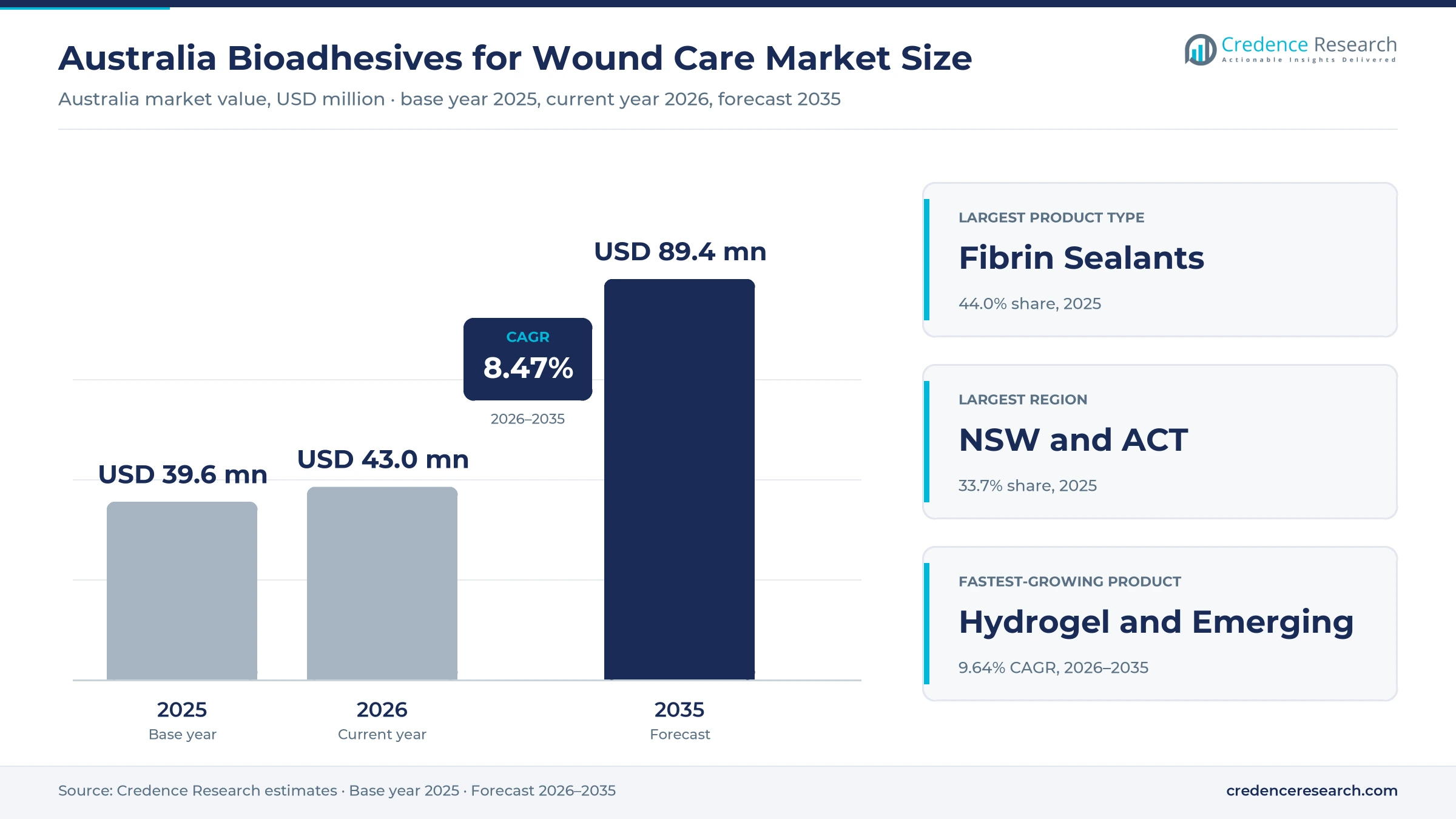
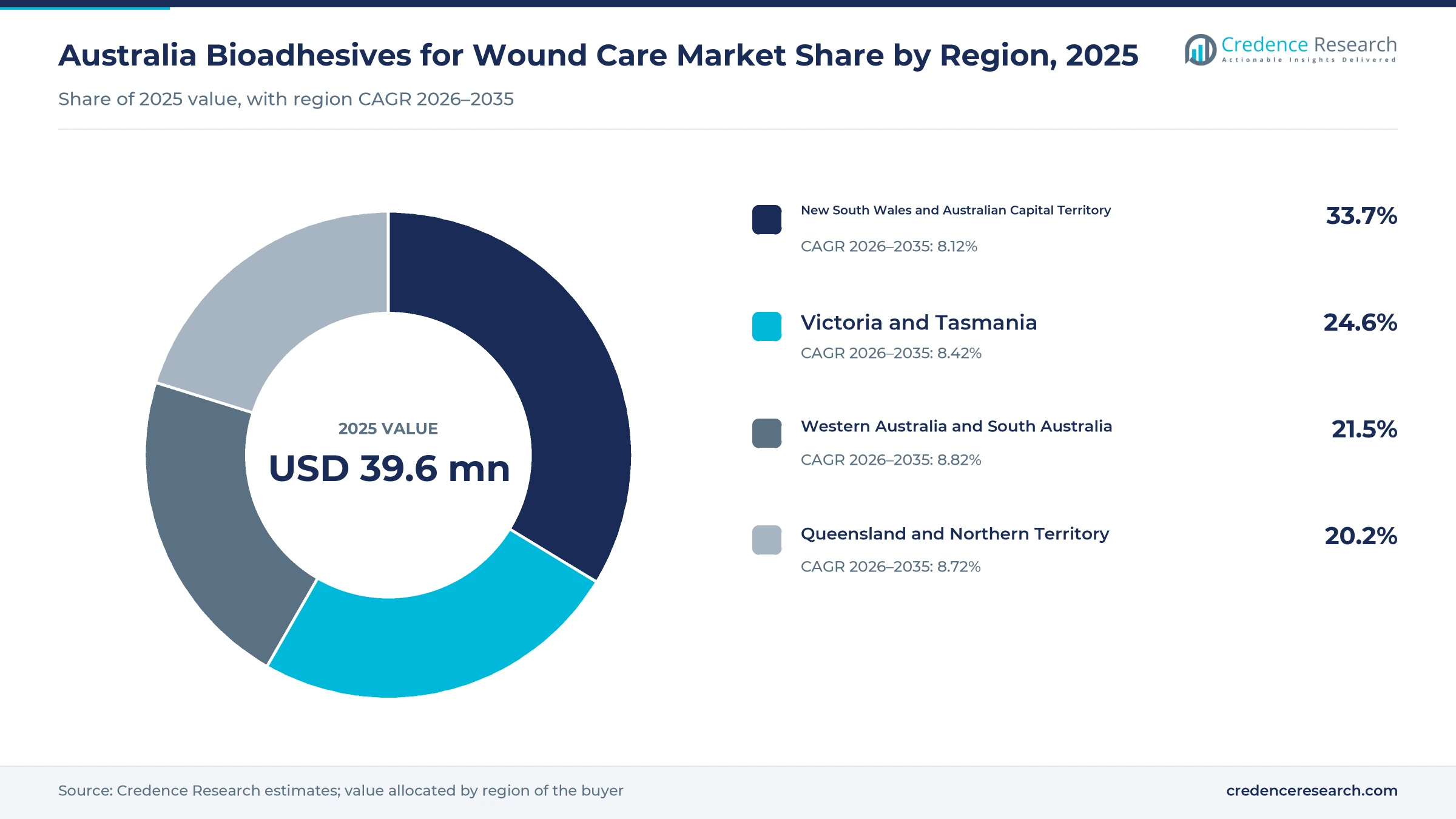
The Australia bioadhesives for wound care market was valued at USD 39.6 million in 2025 and is projected to increase from USD 43.0 million in 2026 to USD 89.4 million by 2035, registering a CAGR of 8.47% during 2026–2035. Demand comes from operating lists in public and private hospitals, from laceration repair in emergency departments and urgent care clinics, and from a small but funded chronic wound base. New South Wales and Australian Capital Territory held the largest regional share, 33.7% in 2025, because that zone has the largest population and the largest public elective surgery count. Western Australia and South Australia is the fastest-growing region at 8.82% a year, helped by Western Australia recording the country's fastest population growth in the year to June 2025. The main commercial change came on Nov. 1, 2024, when the federal health department removed fibrin sealants from the Prescribed List and began treating them as medicines. That decision moved a large part of the value pool into direct negotiation between hospitals, surgeons and private health funds.
What counts as a bioadhesive for wound care in Australian practice?
The market counts adhesives and sealants applied to close or seal a wound, including cyanoacrylate skin glues, fibrin sealants, protein-based adhesives and hydrogel sealants. Hospitals buy most wound care adhesive volume through sponsor contracts, while clinics and community services buy smaller packs through distributors and federal supply schemes.
The scope excludes sutures, staples, ordinary dressings, adhesive tapes and hemostatic powders that do not seal tissue. The value chain runs from overseas manufacturers to Australian sponsors listed with the Therapeutic Goods Administration, then to hospital procurement teams, emergency clinicians, surgeons and nursing teams that select the product at the point of use.
Australia Bioadhesives for Wound Care Market Insights
- The market moves from USD 39.6 million in 2025 to USD 89.4 million by 2035, an 8.47% CAGR built on surgical volumes, acute visits and funded community supply.
- New South Wales and Australian Capital Territory held 33.7% of value in 2025, supported by the largest population base and the largest public elective surgery count of any zone.
- Fibrin Sealants led product types with 44.0% in 2025 because each high-cost application in surgery carries far more value than a skin glue ampoule.
- Removal of fibrin sealants from the Prescribed List on Nov. 1, 2024, shifted price negotiation toward hospitals, surgeons and private health funds across the country.
- Competition rests on registered sponsors, since Johnson & Johnson Medical, B Braun Australia and Device Technologies Australia each hold local listings for established adhesive or sealant brands.
Fibrin sealants and surgical use anchor segment value
Why fibrin sealants carry the most value per case
Based on product type, the market is categorized into Cyanoacrylate Tissue Adhesives, Fibrin Sealants, Protein-Based Tissue Adhesives and Hydrogel and Emerging Tissue Adhesives. Fibrin Sealants led with 44.0% of 2025 value because unit costs are high, with a Prostheses List advisory paper released by the federal health department putting average Evicel cost at A$1,871.55 per case in one billing group. Hydrogel and Emerging Tissue Adhesives grows fastest at 9.64% a year as the Therapeutic Goods Administration register carries Stryker's Adherus dural sealant as a hydrogel device, and because University of Sydney researchers reported that their MeTro glue seals wounds in about 60 seconds.
How operating lists and clinics split adhesive use
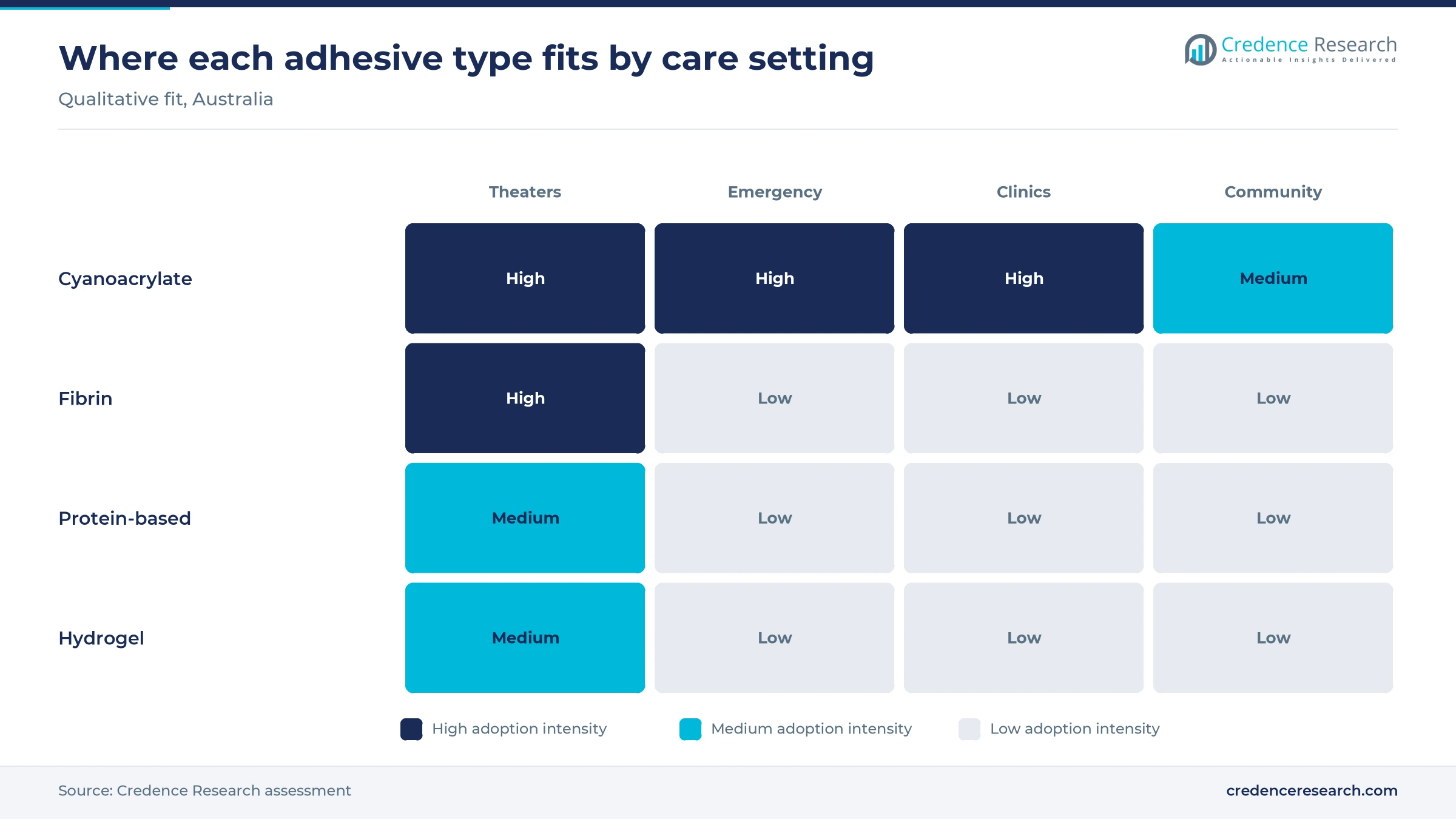
Based on care setting, the market is categorized into Hospital Operating Theatres, Emergency Departments, Outpatient Procedure Clinics and Community Wound Services. Hospital Operating Theatres held 64.0% of 2025 value because sealants and surgical glues follow theater activity, and the Australian Institute of Health and Welfare counted 3.1 million surgical hospitalizations in 2024–25. Brisbane South PHN lists stitches and glue for minor cuts among Medicare Urgent Care Clinic services, which widens the outpatient base. Community Wound Services expands fastest at 9.73% a year as the scheme launched on June 20, 2025, supplies subsidized adhesives, bandages and dressings at home, according to Diabetes Australia.
Surgical incisions outweigh lacerations and chronic wounds
Based on disease area, the market is categorized into Surgical Incisions, Traumatic Lacerations and Chronic Wounds. Surgical Incisions led with 72.0% of 2025 value because elective lists anchor consumption, with the Australian Institute of Health and Welfare reporting 2.6 million elective admissions in 2024–25, 67% of them in private hospitals. Traumatic Lacerations remain narrower because Perth Children's Hospital guidance limits Dermabond to simple, clean cuts under 3 cm. Chronic Wounds grows fastest at 9.56% a year as a federal scheme now funds consumables for people with diabetes aged 65 or older and First Nations people from age 50.
Sponsor registration shapes how adhesives reach buyers
Based on channel, the market is categorized into Direct Manufacturer Contracts, Sponsor and Distributor Sales and Pharmacy Sales. Direct Manufacturer Contracts led with 56.0% of 2025 value because large groups hold their own listings, with Johnson & Johnson Medical in North Ryde sponsoring Evicel under AUST R 266221 and B Braun Australia sponsoring Histoacryl. Sponsor and Distributor Sales grows fastest at 8.87% a year as the register names Device Technologies Australia as sponsor of Glubran 2 from Italy's Gem, a route open to smaller overseas makers. Pharmacy Sales stay small because Johnson & Johnson's Australian product sheet states that Evicel is not listed on the Pharmaceutical Benefits Scheme.
| Segment Group | Leading Sub-segment | Share, 2025 | Fastest-growing Sub-segment | CAGR, 2026–2035 |
|---|---|---|---|---|
| By Product Type | Fibrin Sealants | 44.0% | Hydrogel and Emerging Tissue Adhesives | 9.64% |
| By Care Setting | Hospital Operating Theatres | 64.0% | Community Wound Services | 9.73% |
| By Disease Area | Surgical Incisions | 72.0% | Chronic Wounds | 9.56% |
| By Channel | Direct Manufacturer Contracts | 56.0% | Sponsor and Distributor Sales | 8.87% |
Request a Free Sample
Fill in your details and we'll send you a free sample report.
- Sample data tables & charts
- Research methodology
Surgery volumes and urgent care lift adhesive use
Recurring surgical closure and sealing demand
Surgical activity is the most dependable source of adhesive volume because sealants and glues are consumed case by case. The Australian Institute of Health and Welfare reports 3.1 million surgical hospitalizations for 2024–25, with private hospitals handling 58% of them. Public elective demand reached 791,000 admissions in the same year, up from 712,000 in 2015–16, which shows the steady expansion of the base. Fibrin sealant sales grew faster still, as the Prostheses List advisory paper recorded combined private sales rising from A$6.17 million in 2012/13 to A$19.27 million in 2018/19. Orthopedics became a major user during that period, accounting for 638 of 862 procedures in one Evicel billing group. As a result, Surgical Incisions hold 72.0% of 2025 value.
Acute-care access and appropriate laceration closure
Acute access points are multiplying, and each one is a new buyer of skin glue for minor cuts. The Australian Institute of Health and Welfare recorded 9.1 million emergency department presentations in 2024–25, or 328 per 1,000 people, against 7.6 million in 2015–16. Only 53% of those patients finished treatment within four hours, which favors faster closure methods for simple cuts. The federal 2025–26 budget paper then committed A$657.9 million to grow Medicare Urgent Care Clinics from 87 to 137 sites, with 2 million visits expected each year. Brisbane South PHN lists glue among the services for minor cuts. Perth Children's Hospital endorsed its Dermabond guideline in December 2025, which confirms continuing pediatric use.
Targeted chronic-wound access support
Federal supply support has opened a small but funded route into chronic wound treatment. McCosker and colleagues, writing in the International Wound Journal, put the health cost of chronic wounds in Australia above A$3.5 billion, about 2% of national health spending. They also found diabetic foot ulcers in 1.2% to 2.5% of people with diabetes. The Chronic Wound Consumables Scheme began on June 20, 2025, with nearly A$50 million in federal funding and an expected reach of about 20,000 people a year, according to Diabetes Australia. Medical Republic reported patient costs of about A$4,000 a year. The scheme names adhesives without saying whether that includes skin glue, so the 9.56% annual growth for Chronic Wounds is a Credence Research estimate from a small base.
Prescribed List retention keeps surgical glues funded
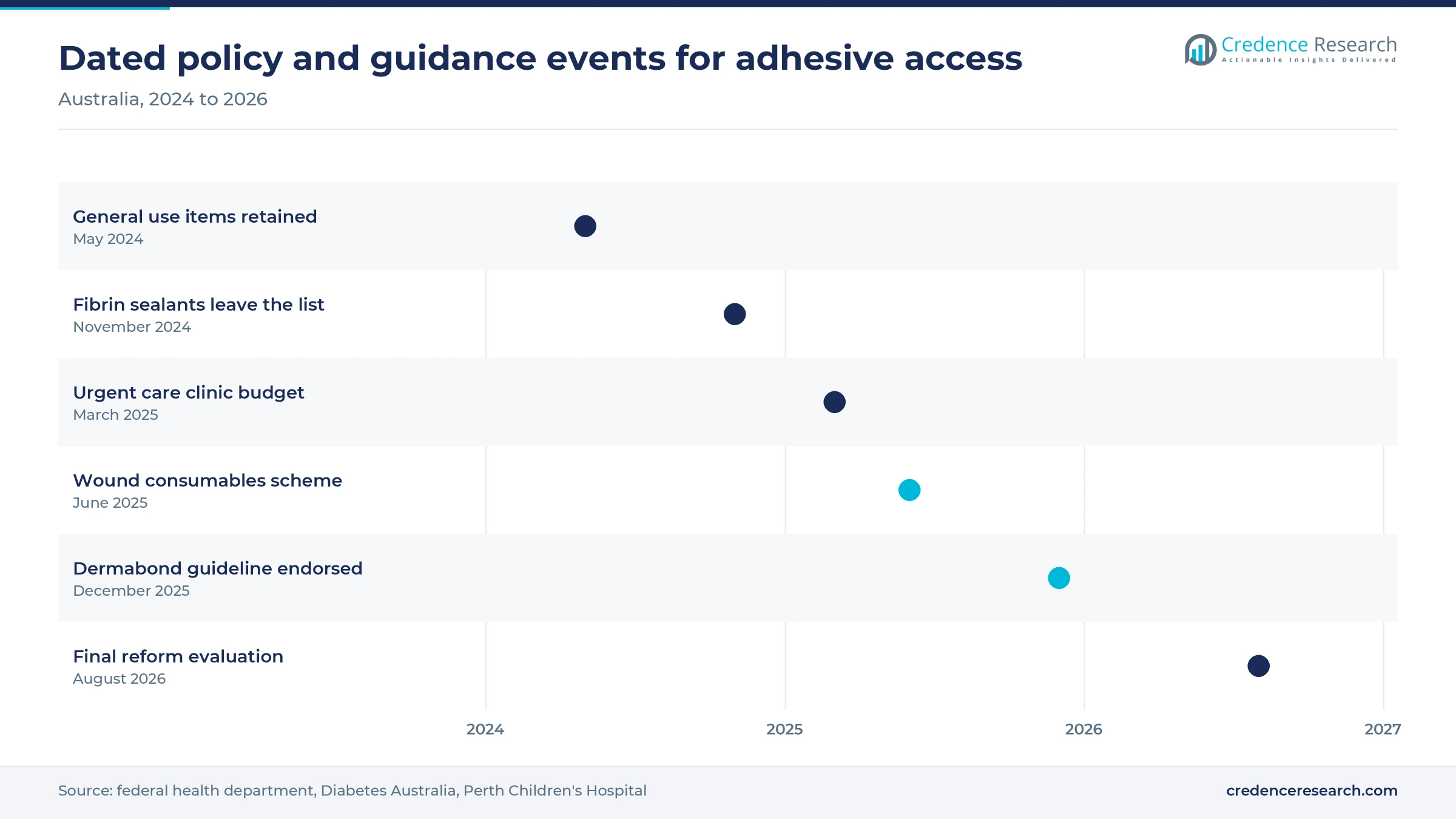
Private funding remains steady for glues on the federal list, which supports routine theater use. Health Minister Mark Butler announced that general use items such as staples, sutures and glues would stay on the Prescribed List, reversing a removal planned for July 1, 2024. The department's final evaluation of the reforms dates that decision to May 2024 and estimates these items drew A$228 million to A$240 million in benefits during fiscal 2024. More than 15 million Australians hold private health insurance, according to the same ministerial statement, and private hospitals handled 67% of elective surgical admissions in 2024–25, the Australian Institute of Health and Welfare found. This base helps Hospital Operating Theatres retain 64.0% of value, although benefit reductions completed in March 2023 trimmed prices.
Funding rules and nurse-led roles reshape adhesive trends
Shift of fibrin sealants from device to medicine funding
The funding route for fibrin products has changed, and that shift now shapes hospital purchasing. The Urological Society of Australia and New Zealand reported that the federal department removed fibrin sealants from the Prescribed List on Nov. 1, 2024, and now treats them as medicines. PuraStat and Floseal stayed on the list, which leaves other surgical sealant choices with a listed benefit. Evicel had joined the list in 2012–13, and combined private sales then grew about 21% a year through 2018/19, so the change touches a large product group. The Australian Medical Association sought a reversal, warning that no-gap contracts could leave doctors carrying the cost. Private Healthcare Australia said health funds would keep paying for them. As a result, access now depends more on individual contracts than on one national benefit.
Rise of nurse-led and primary care wound closure
Closure and wound decisions are spreading beyond surgeons and hospital doctors, which widens the group that suppliers must train. Nurse practitioners no longer needed a collaborative arrangement with a doctor to access rebates from Nov. 1, 2024, according to Medical Republic, and Health Minister Mark Butler said their general consultation rebates rose by 30%. The Chronic Wound Consumables Scheme then allowed general practitioners, practice nurses, nurse practitioners, podiatrists and Aboriginal and Torres Strait Islander health practitioners to order products after an online course. More than 3,500 professionals had registered for that training by June 2025. In turn, Community Wound Services are forecast to grow at 9.73% a year, the highest rate among care settings in the Credence Research model.
Opportunity in glue supply for new urgent care clinics
The urgent care rollout gives suppliers an opening among buyers that have no long hospital contract history. The federal health department states that more than 134 clinics have been set up since 2023, with cuts and wounds named among the problems they treat. Its budget paper counted 1.3 million bulk-billed presentations at the first 87 clinics, and those sites sit outside the theater contracts that dominate purchasing. Small single-use glue formats suit these clinics because Perth Children's Hospital restricts its own Dermabond use to low-tension cuts under 3 cm, which is a defined, repeatable case. Sponsors that package training with supply can therefore win early standing orders. This opening is one reason Outpatient Procedure Clinics hold a growing place in the Credence Research model.
Opening for hydrogel sealants as frozen logistics weigh
Handling limits on fibrin products leave an opening for hydrogel sealants that are simpler to store and prepare. The Australian Evicel product sheet requires storage at or below -18 degrees Celsius, allows thawed unopened vials up to 30 days at 2 to 8 degrees, and calls for warming to 20 to 30 degrees before use. The same sheet promotes a set-up time 4.5 minutes shorter than a rival spray system, which shows how much preparation time matters to theater teams. Local science adds to the case, as the University of Sydney sought funding to move its MeTro glue toward clinical use, according to 3AW in October 2017. Hydrogel and Emerging Tissue Adhesives are forecast to grow at 9.64% a year from a small base.
Cost scrutiny and register changes pressure suppliers
Payer scrutiny of high per-case sealant costs
High per-case costs draw direct payer scrutiny, particularly in joint replacement. The Prostheses List advisory paper said average Evicel use in one billing group added effectively 28% to the cost of a total knee replacement. It also cited a patient who received eight units costing A$10,360 where the implant cost under A$7,000. Surgeons and sponsors therefore face pressure to prove clinical benefit by procedure type. Suppliers can respond with procedure-specific evidence and smaller pack sizes that reduce waste per case.
Thin private hospital margins limit premium purchasing
Private hospital finances limit how far premium products can spread through operating lists. Health Minister Mark Butler stated that private hospital margins fell from 9.6% in 2017–18 to 1% in 2021–22, and seven in 10 private hospitals made a loss in 2021–22. Procurement teams under that strain favor lower-cost closure unless a sealant clearly shortens a stay or prevents a complication. As a result, suppliers often need hospital-level cost data before a new product wins a place on a preferred list.
Register cancellations disrupt supply continuity
Register changes can interrupt supply, because hospitals need a local sponsor behind every product they buy. The Therapeutic Goods Administration entry 137751 shows the BioGlue listing held by Cryolife Medical (Australia) as cancelled, and a separate entry shows a Glubran 2 spray listing under Morton Surgical as cancelled as well. Clinicians who standardize on such products must then revalidate alternatives, which takes committee time. Hospitals reduce this exposure by approving a second product for each main surgical use.
Scheme eligibility keeps chronic wound volume narrow
Federal support reaches only part of the chronic wound population, which limits near-term wound care volume for adhesive suppliers. Medical Republic reported in June 2025 that the scheme excludes people funded through the National Disability Insurance Scheme, Veterans' Affairs, residential aged care, public hospitals and state community health services. Its core group is limited to people with diabetes aged 65 or older and First Nations people from age 50. Suppliers therefore depend on clinician enrolment rather than broad patient access, so any wider eligibility would change the outlook.
Elective surgery volumes put new South Wales first
| Region | Value, 2025 (USD million) | Share, 2025 | CAGR, 2026–2035 |
|---|---|---|---|
| New South Wales and Australian Capital Territory | 13.4 | 33.7% | 8.12% |
| Victoria and Tasmania | 9.8 | 24.6% | 8.42% |
| Western Australia and South Australia | 8.5 | 21.5% | 8.82% |
| Queensland and Northern Territory | 8.0 | 20.2% | 8.72% |
New South Wales and Australian Capital Territory lead on scale
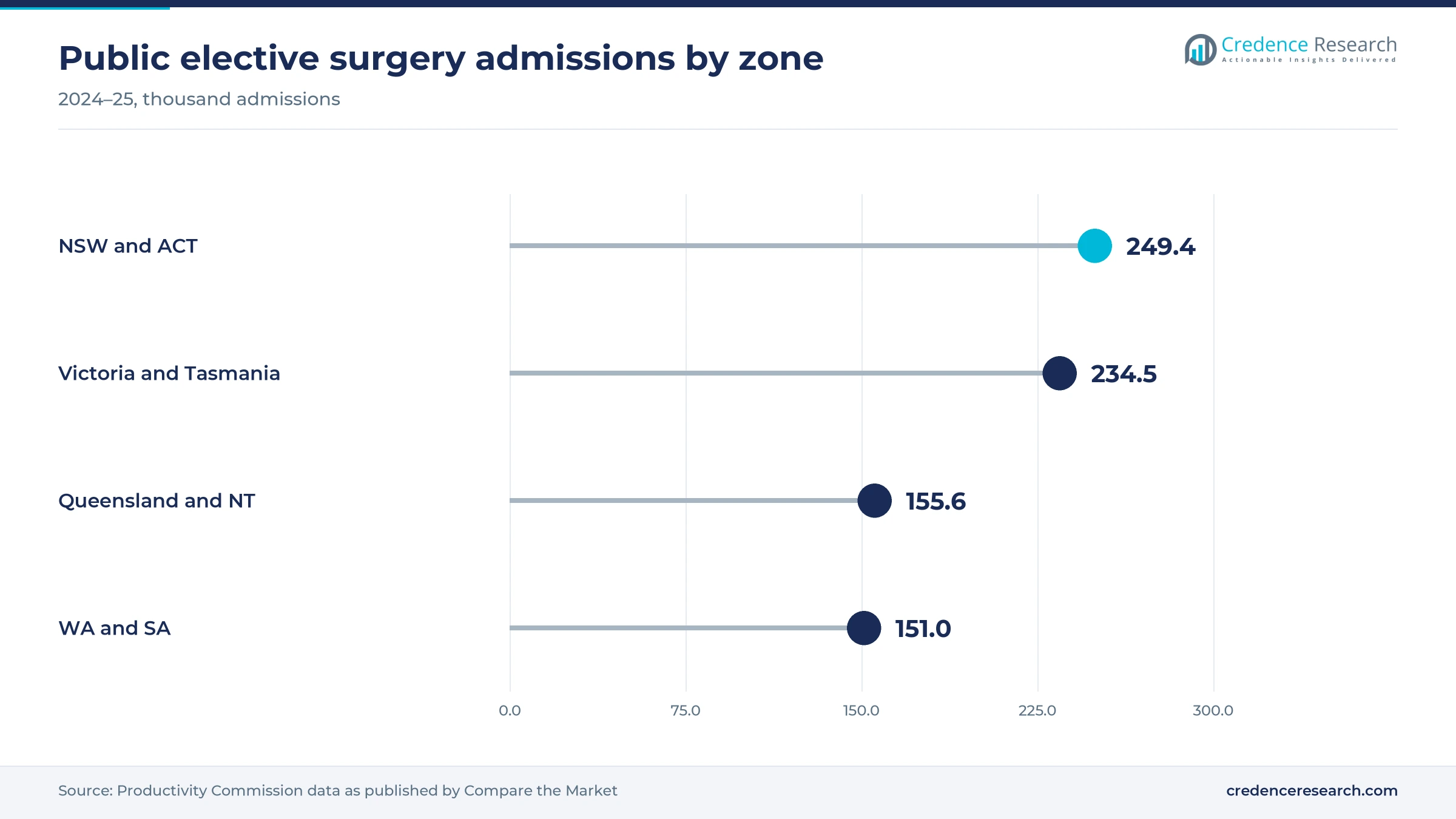
New South Wales and Australian Capital Territory held 33.7% of 2025 value and grow at 8.12% a year. The region has about 9.08 million people, or 32.9% of the national total, according to Australian Bureau of Statistics figures for June 2025. It also recorded 249,414 public elective admissions in 2024–25, based on Productivity Commission data published by Compare the Market. The Australian Capital Territory ran at 3,416.9 admissions per 100,000 people, well above the national 2,862.7. Johnson & Johnson Medical's North Ryde base also lies inside this zone.
Victoria and Tasmania combine volume with high surgery rates
Victoria and Tasmania held 24.6% of 2025 value and grow at 8.42% a year. The region has about 7.65 million people and recorded 234,480 public elective admissions in 2024–25. Tasmania posted the country's highest rate at 3,909.5 admissions per 100,000 people, although only 65% of its patients were treated within the recommended time. Victoria reached 84% on that measure, the best in the country, which points to steady theater throughput and stable consumable orders.
Queensland and Northern Territory add growth over long distances
Queensland and Northern Territory held 20.2% of 2025 value and grow at 8.72% a year. The region has about 5.93 million people, and Queensland added 97,900 residents in the year to June 2025, according to the Australian Bureau of Statistics. Public elective admissions in the zone totaled 155,601 in 2024–25. The Northern Territory's average overdue wait of 469 days was the longest in the country. That gap makes remote supply and home delivery more important here.
Western Australia and South Australia grow fastest
Western Australia and South Australia held 21.5% of 2025 value and grow at 8.82% a year, the fastest rate of any zone. Western Australia's population rose 2.2% in the year to June 2025, the highest state rate according to the Australian Bureau of Statistics. The region recorded 151,033 public elective admissions in 2024–25. South Australia ran at 3,228.7 admissions per 100,000 people, and this high rate lifts the zone above its 17.9% population weight.
Policy moves from 2024 to 2026 reset adhesive access
| Development | Status and market relevance |
|---|---|
| In May 2024, the Australian government decided to keep general use items, including surgical glues, on the Prescribed List rather than remove them on July 1, 2024. | In force; maintains private funding for routine surgical glues. |
| In November 2024, the federal health department removed fibrin sealants from the Prescribed List and began treating them as medicines. | In force; moves pricing toward hospital and health fund contracts. |
| In November 2024, nurse practitioners gained rebate access without a collaborative arrangement with a doctor, and their general consultation rebates rose by 30%. | In force; widens the clinician base for minor wound care. |
| In June 2025, the federal government launched the Chronic Wound Consumables Scheme, which supplies adhesives, bandages and dressings to eligible patients with diabetes. | Active; expected to reach about 20,000 people a year. |
| In December 2025, Perth Children's Hospital endorsed its Dermabond emergency guideline with a review date of December 2028. | Current; sets a clear laceration use case for pediatric care. |
Curing chemistry decides where each adhesive fits
- Moisture-cured systems cover cyanoacrylate glues such as Dermabond and Histoacryl, and Perth Children's Hospital avoids them in the axillae and perineum because high moisture there undermines the closure.
- Two-component systems mix fibrinogen and thrombin at the point of use, as Evicel does and they suit surgery better than clinics because the product needs frozen storage and warming before use.
- Activated adhesive matrices set on a trigger, and the MeTro glue from the University of Sydney uses ultraviolet light to seal within seconds, although it still needed human trials when reported in December 2017.
- Spray delivery accessories extend sealants across larger surfaces, as with the Evicel airless spray accessory, and theater teams weigh them alongside hemostatic instruments when planning bleeding control.
Need a Custom Version of This Report?
Tailor the scope, geography, or segments to your exact requirements.
- Custom geography or segment scope
- Direct access to our analyst team
Registered sponsors and distributors shape competition
Competition turns on who holds a local listing and which surgical specialty has adopted a brand. Johnson & Johnson Medical sponsors Evicel from North Ryde, and the Ethicon name appears on its Australian product material. The Prostheses List advisory paper showed Baxter products taking 92.2% of cardiothoracic fibrin use and Johnson & Johnson products taking 85% of orthopedic use, so specialty habits have been strong. B Braun Australia competes in cyanoacrylates through Histoacryl and Histoacryl GI, while Device Technologies Australia carries Glubran 2 from Gem. These positions matter because hospitals compare local brands against wider tissue sealants and adhesives evidence before approving a product. Pricing pressure has grown since fibrin products left the Prescribed List, because each contract is now negotiated separately. Smaller makers usually enter through distributors, which gives them regulatory cover without a local office. The Cryolife Medical (Australia) BioGlue entry now shows as cancelled on the national register.
Local listings show who supplies each adhesive class
| Company | Type | Role in the market |
|---|---|---|
| Johnson & Johnson MedTech | Sponsor | Johnson & Johnson Medical in North Ryde sponsors Evicel; Dermabond is named in Perth Children's Hospital guidance |
| Ethicon | Brand owner | Named as copyright holder on Evicel material prepared for Australia |
| Baxter Healthcare | Supplier | Tisseel and Artiss fibrin sealants, strong in cardiothoracic use |
| B. Braun | Sponsor | B Braun Australia sponsors Histoacryl, Histoacryl GI and Histoacryl Lapfix |
| GEM | Manufacturer | Maker of Glubran 2, listed through Device Technologies Australia |
| CryoLife Medical | Former sponsor | BioGlue entry 137751 under its Australian company shows as cancelled |
Funding clarity decides where adhesive value moves next
Credence Research's view is that funding clarity will decide where value moves over the next few years. Surgical use will still dominate, but the removal of fibrin sealants from the Prescribed List means hospitals and funds now set prices contract by contract. Cyanoacrylate suppliers stand to gain in clinics, since glue for minor cuts is already part of the urgent care offer. Chronic wound volume is the most assumption-heavy wound care estimate because federal data does not separate adhesives from dressings. Suppliers should build procedure-level cost evidence first, because that evidence now decides access at each hospital.
Model draws on hospital statistics and register data
The report uses 2025 as the base year and forecasts to 2035. Market values come from the Credence Research model, and segment and regional splits are Credence Research estimates. Inputs include Australian Institute of Health and Welfare hospital statistics, Australian Bureau of Statistics population counts, Productivity Commission elective surgery data as published by Compare the Market, federal health department papers, Therapeutic Goods Administration register entries, hospital guidelines and peer-reviewed literature. No interviews or surveys were conducted for this edition of the report. Published company information was used only to confirm local listings and roles.
Hospital and clinic access widens adhesive use to 2035
The market is forecast to reach USD 89.4 million by 2035, an 8.47% CAGR over 2026–2035, as surgical volumes hold and more clinics stock glue for minor cuts. Hospital theaters will stay the largest setting, while hydrogel products and community supply will grow from small bases. Population growth in Western Australia and Queensland will shift a little share away from New South Wales. The largest open question is how fibrin sealants are funded after their removal from the federal list, since any national medicine arrangement would change hospital purchasing. Wider chronic wound eligibility would be the main upside for suppliers.
Frequently Asked Questions
How big is the Australia bioadhesives for wound care market?
Which product type leads the market?
Which region is the largest in Australia?
Which region grows fastest?
Why did fibrin sealants leave the Prescribed List?
Does the Chronic Wound Consumables Scheme cover adhesives?
Where are skin glues used outside operating lists?
Which companies are active in the market?
Table of Content
Chapter 1 Market Segmentation
- 1.1 Segmentation Framework
- 1.1.1 Product and Service Classification
- 1.1.2 Application and End-Use Classification
- 1.1.3 Technology and Solution Classification
- 1.1.4 Customer and Distribution Channel Classification
- 1.1.5 Geographic Segmentation
- 1.1.6 Market Segment Definitions and Boundaries
- 1.2 By Product Type
- 1.2.1 Fibrin Sealants
- 1.2.2 Cyanoacrylate Tissue Adhesives
- 1.2.3 Protein-Based Tissue Adhesives
- 1.2.4 Hydrogel and Emerging Tissue Adhesives
- 1.3 By Care Setting
- 1.3.1 Hospital Operating Theatres
- 1.3.2 Emergency Departments
- 1.3.3 Outpatient Procedure Clinics
- 1.3.4 Community Wound Services
- 1.4 By Disease Area
- 1.4.1 Surgical Incisions
- 1.4.2 Traumatic Lacerations
- 1.4.3 Chronic Wounds
- 1.5 By Channel
- 1.5.1 Direct Manufacturer Contracts
- 1.5.2 Sponsor and Distributor Sales
- 1.5.3 Pharmacy Sales
Chapter 2 Introduction
- 2.1 Report Objectives and Scope
- 2.2 Product Definition and Industry Terminology
- 2.3 Market Inclusions and Exclusions
- 2.4 Research Process
- 2.4.1 Primary Research and Expert Interviews
- 2.4.2 Secondary Research and Source Review
- 2.4.3 Top-Down and Bottom-Up Estimation
- 2.4.4 Data Triangulation and Verification
- 2.5 Market Size Measurement Basis
- 2.5.1 2025: USD 39.6 million → 2035: USD 89.4 million
- 2.6 Historical and Forecast Reference Periods
- 2.6.1 Historical Period: 2018-2025
- 2.6.2 Base Year: 2025
- 2.6.3 Forecast Period: 2025-2035
- 2.7 Research Assumptions and Limitations
Chapter 3 Executive Summary
- 3.1 Market Snapshot and Key Findings
- 3.2 Base-Year Market Size, 2025
- 3.3 Forecast Market Size, 2035
- 3.4 Revenue and Volume Growth Outlook
- 3.5 Key Demand and Supply Indicators
- 3.6 Leading Market Segments
- 3.7 Fastest-Growing Market Opportunities
- 3.8 Regional Performance Highlights
- 3.9 Technology and Industry Transformation
- 3.10 Competitive Landscape Summary
- 3.11 Analyst View and Strategic Implications
Chapter 4 Australia Bioadhesives for Wound Care Market Trends and Developments
- 4.1 Historical Industry Development, 2018-2025
- 4.2 Recent Market Trends and Developments
- 4.3 Demand and Customer Behavior Trends
- 4.4 Technology and Product Innovation
- 4.5 Artificial Intelligence, Automation and Digitalization
- 4.6 Local Manufacturing and Supply Chain Realignment
- 4.7 Industry Partnerships, Mergers and Acquisitions
- 4.8 Sustainability and Circular Economy Developments
- 4.9 Government and Private Sector Investment Trends
- 4.10 Emerging Business Models and Commercialization
- 4.11 Industry Developments and Announcements
Chapter 5 Australia Bioadhesives for Wound Care Market Production, Supply and Demand Analysis
- 5.1 Demand Trend and Consumption Analysis, 2018-2025
- 5.2 Demand Forecast, 2025-2035
- 5.3 Production and Output Trend, 2018-2025
- 5.4 Production and Output Forecast, 2025-2035
- 5.5 Installed Capacity and Capacity Utilization
- 5.6 Company-Wise Production Plants and Statistics
- 5.6.1 Installed Production Capacity
- 5.6.2 Actual Production
- 5.6.3 Planned Capacity and Expansion Targets
- 5.7 Supply Chain Structure and Procurement Trends
- 5.8 Supply-Demand Gap and Bottlenecks
- 5.9 Import Dependence and Sourcing Structure
- 5.10 Contract Manufacturing and Outsourcing
- 5.11 Regional Supply and Demand Concentration
Chapter 6 Australia Bioadhesives for Wound Care Market Pricing Analysis
- 6.1 Pricing Structure and Measurement
- 6.2 Historical Pricing Trends, 2018-2025
- 6.3 Pricing Outlook, 2025-2035
- 6.4 Average Selling Price and Unit Economics
- 6.5 Pricing by Product and Market Segment
- 6.6 Geographic Pricing Differences
- 6.7 Key Input, Energy, Labor and Logistics Costs
- 6.8 Contract Pricing and Purchasing Models
- 6.9 Pricing Sensitivity and Competitive Positioning
- 6.10 Price, Margin and Profitability Implications
Chapter 7 Australia Bioadhesives for Wound Care Market Dynamics
- 7.1 Market Growth Drivers
- 7.1.1 Demand-Side Drivers
- 7.1.2 Technology and Innovation Drivers
- 7.1.3 Infrastructure and Investment Drivers
- 7.1.4 Regulatory and Policy Drivers
- 7.2 Market Restraints
- 7.2.1 Cost and Affordability Constraints
- 7.2.2 Technology and Adoption Barriers
- 7.2.3 Supply Chain and Operational Constraints
- 7.3 Market Challenges
- 7.3.1 Competitive Pressure and Margin Erosion
- 7.3.2 Skills, Infrastructure and Implementation Gaps
- 7.4 Emerging Market Opportunities
- 7.5 Market Dynamics Impact and Time-Horizon Assessment
Chapter 8 Australia Bioadhesives for Wound Care Value Chain Analysis
- 8.1 Industry Value Chain Overview
- 8.2 Upstream Suppliers and Critical Inputs
- 8.3 Technology and Component Providers
- 8.4 Manufacturing or Service Delivery
- 8.5 Distribution, Channel Partners and Integrators
- 8.6 Downstream Applications and End Users
- 8.7 Value Addition and Profit Pools
- 8.8 Vertical Integration and Outsourcing
- 8.9 Supplier Concentration and Risk
- 8.10 Supply Chain Localization and Resilience
Chapter 9 Australia Bioadhesives for Wound Care Market Regulations and Policies
- 9.1 Relevant Laws, Standards and Compliance Frameworks
- 9.2 Product, Service, Safety and Quality Requirements
- 9.3 Government Policies, Incentives and Subsidies
- 9.4 Imports, Exports and Trade Barriers
- 9.5 Public Procurement and Local Content Requirements
- 9.6 Environmental and Sustainability Compliance
- 9.7 Upcoming Policy Changes and Market Implications
Chapter 10 Australia Bioadhesives for Wound Care Market Hotspots and Opportunities
- 10.1 Market Opportunity Mapping and Growth Hotspots
- 10.2 High-Growth Applications and Customer Groups
- 10.3 Underserved Markets and White-Space Opportunities
- 10.4 Emerging Technology and Product Opportunities
- 10.5 New Capacity and Investment Hotspots
- 10.6 Market Entry and Expansion Opportunities
- 10.7 Distribution and Partnership Opportunities
- 10.8 Near-Term and Long-Term Commercial Potential
- 10.9 Opportunity Attractiveness and Execution Risks
Chapter 11 Australia Bioadhesives for Wound Care Market Outlook, 2025-2035
- 11.1 Market Size and Analysis
- 11.1.1 Revenue (Market Measurement: 2025: USD 39.6 million → 2035: USD 89.4 million)
- 11.1.2 Market Volume and Quantity Sold
- 11.1.3 Historical Market Size, 2018-2025
- 11.1.4 Base-Year Market Size, 2025
- 11.2 Market Forecast, 2025-2035
- 11.2.1 Revenue Forecast to 2035
- 11.2.2 Volume Forecast to 2035
- 11.2.3 CAGR and Year-on-Year Growth
- 11.2.4 Incremental Revenue Opportunity
- 11.3 Forecast Assumptions and Scenario Analysis
- 11.3.1 Base-Case Forecast
- 11.3.2 Optimistic and Conservative Scenarios
- 11.3.3 Technology, Pricing and Policy Sensitivities
- 11.4 Market Attractiveness and Growth Outlook
Chapter 12 Australia Bioadhesives for Wound Care Market Segmentation and Outlook
- 12.1 Segmentation Summary and Market Shares, 2025
- 12.2 Largest and Fastest-Growing Segments
- 12.3 By Product Type - Market Size and Forecast, 2025-2035
- 12.3.1 Segment Definition and Scope
- 12.3.2 Historical Market Size, 2018-2025
- 12.3.3 Revenue Forecast, 2025-2035
- 12.3.4 Volume Forecast, 2025-2035
- 12.3.5 Base-Year Market Share, 2025
- 12.3.6 Segment CAGR and Growth Drivers
- 12.3.7 Subsegment Market Size and Forecast
- 12.3.7.1 Fibrin Sealants
- 12.3.7.2 Cyanoacrylate Tissue Adhesives
- 12.3.7.3 Protein-Based Tissue Adhesives
- 12.3.7.4 Hydrogel and Emerging Tissue Adhesives
- 12.3.8 Subsegment Pricing and Adoption Trends
- 12.3.9 Leading Suppliers and Competition
- 12.3.10 Regional Demand and Opportunities
- 12.4 By Care Setting - Market Size and Forecast, 2025-2035
- 12.4.1 Segment Definition and Scope
- 12.4.2 Historical Market Size, 2018-2025
- 12.4.3 Revenue Forecast, 2025-2035
- 12.4.4 Volume Forecast, 2025-2035
- 12.4.5 Base-Year Market Share, 2025
- 12.4.6 Segment CAGR and Growth Drivers
- 12.4.7 Subsegment Market Size and Forecast
- 12.4.7.1 Hospital Operating Theatres
- 12.4.7.2 Emergency Departments
- 12.4.7.3 Outpatient Procedure Clinics
- 12.4.7.4 Community Wound Services
- 12.4.8 Subsegment Pricing and Adoption Trends
- 12.4.9 Leading Suppliers and Competition
- 12.4.10 Regional Demand and Opportunities
- 12.5 By Disease Area - Market Size and Forecast, 2025-2035
- 12.5.1 Segment Definition and Scope
- 12.5.2 Historical Market Size, 2018-2025
- 12.5.3 Revenue Forecast, 2025-2035
- 12.5.4 Volume Forecast, 2025-2035
- 12.5.5 Base-Year Market Share, 2025
- 12.5.6 Segment CAGR and Growth Drivers
- 12.5.7 Subsegment Market Size and Forecast
- 12.5.7.1 Surgical Incisions
- 12.5.7.2 Traumatic Lacerations
- 12.5.7.3 Chronic Wounds
- 12.5.8 Subsegment Pricing and Adoption Trends
- 12.5.9 Leading Suppliers and Competition
- 12.5.10 Regional Demand and Opportunities
- 12.6 By Channel - Market Size and Forecast, 2025-2035
- 12.6.1 Segment Definition and Scope
- 12.6.2 Historical Market Size, 2018-2025
- 12.6.3 Revenue Forecast, 2025-2035
- 12.6.4 Volume Forecast, 2025-2035
- 12.6.5 Base-Year Market Share, 2025
- 12.6.6 Segment CAGR and Growth Drivers
- 12.6.7 Subsegment Market Size and Forecast
- 12.6.7.1 Direct Manufacturer Contracts
- 12.6.7.2 Sponsor and Distributor Sales
- 12.6.7.3 Pharmacy Sales
- 12.6.8 Subsegment Pricing and Adoption Trends
- 12.6.9 Leading Suppliers and Competition
- 12.6.10 Regional Demand and Opportunities
- 12.7 Segment Growth Comparison
- 12.8 Segment Attractiveness and Priority Matrix
Chapter 13 Australia Bioadhesives for Wound Care Geographic Market Outlook, 2025-2035
- 13.1 Domestic Market Distribution and Demand Clusters
- 13.2 State- or Province-Wise Market Size and Forecast, 2025-2035
- 13.3 City and Metropolitan Market Outlook
- 13.4 Industrial, Manufacturing and Commercial Clusters
- 13.5 Geographic Concentration of Key End Users
- 13.6 Local Pricing and Purchasing Differences
- 13.7 Domestic Production Facilities and Capacity Map
- 13.8 Local Infrastructure and Project Pipeline
- 13.9 State-Level Policy and Incentive Differences
- 13.10 Subnational Investment Hotspots and Opportunities
- 13.11 Distribution and Logistics Networks
- 13.12 Domestic Competitive Footprint
Chapter 14 Australia Bioadhesives for Wound Care Technology, Innovation and Sustainability Outlook
- 14.1 Technology Landscape and Maturity
- 14.2 Product, Process and Service Innovation
- 14.3 AI, Automation and Digital Tools in the Industry
- 14.4 Technology Adoption and Performance Benchmarking
- 14.5 Innovation Pipeline and R&D Investment
- 14.6 Patent and Intellectual Property Trends
- 14.7 Energy Efficiency and Resource Management
- 14.8 Sustainability, Recycling and Circularity
- 14.9 Technology Roadmap, 2025-2035
- 14.10 Risks of Obsolescence and Technology Substitution
Chapter 15 Australia Bioadhesives for Wound Care Market Key Strategic Imperatives
- 15.1 Growth and Market Entry Priorities
- 15.2 High-Return Products and Segments
- 15.3 Pricing, Profitability and Cost Optimization
- 15.4 Technology Investment and Product Differentiation
- 15.5 Supply Chain Localization and Resilience
- 15.6 Distribution and Customer Acquisition
- 15.7 Partnership, Acquisition and Capacity Strategy
- 15.8 Regional Expansion Priorities
- 15.9 Short-, Medium- and Long-Term Actions
Chapter 16 Competition Outlook
- 16.1 Industry Competition Characteristics
- 16.2 Market Structure and Concentration
- 16.3 Market Share and Competitive Positioning, 2025
- 16.4 Company-Wise Revenue and Product Benchmarking
- 16.5 Production and Service Capacity Benchmarking
- 16.6 Technology, Pricing and Differentiation
- 16.7 Regional Footprint and Distribution Strength
- 16.8 Mergers, Acquisitions and Strategic Alliances
- 16.9 New Entrants and Competitive Threats
- 16.10 Porter's Five Forces and Industry Attractiveness
- 16.11 Competitive Outlook, 2025-2035
Chapter 17 Company Profiles
- 17.1 Company Coverage and Selection Criteria
- 17.2 Johnson & Johnson MedTech
- 17.2.1 Business Description
- 17.2.2 Company Ownership and Geographic Presence
- 17.2.3 Product and Service Portfolio
- 17.2.4 Manufacturing and Operating Footprint
- 17.2.5 Production Capacity and Expansion Plans
- 17.2.6 Financial Performance and Investment
- 17.2.7 Market Share and Competitive Position
- 17.2.8 Technology and Innovation Capabilities
- 17.2.9 Strategic Alliances or Partnerships
- 17.2.10 Recent Developments
- 17.2.11 Growth Strategy and Outlook
- 17.3 Ethicon
- 17.4 Baxter Healthcare
- 17.5 B. Braun
- 17.6 Advanced Medical Solutions
- 17.7 Artivion
- 17.8 CryoLife Medical
- 17.9 Integra LifeSciences
- 17.10 H.B. Fuller Medical Adhesive Technologies
- 17.11 GEM
- 17.12 Other Relevant Market Participants
Note: Every listed company is profiled on the structure shown under the first company. The company list is preliminary and may change based on research findings, market developments, data availability and client requirements.
Chapter 18 Disclaimer
- 18.1 Research and Forecast Disclaimer
- 18.2 Data Source and Estimation Limitations
Note: The depth of individual sections depends on data availability for this market. Volume, capacity, trade and other unit-based metrics are included where applicable.

