
Antibiotic stop decisions anchor regional test demand
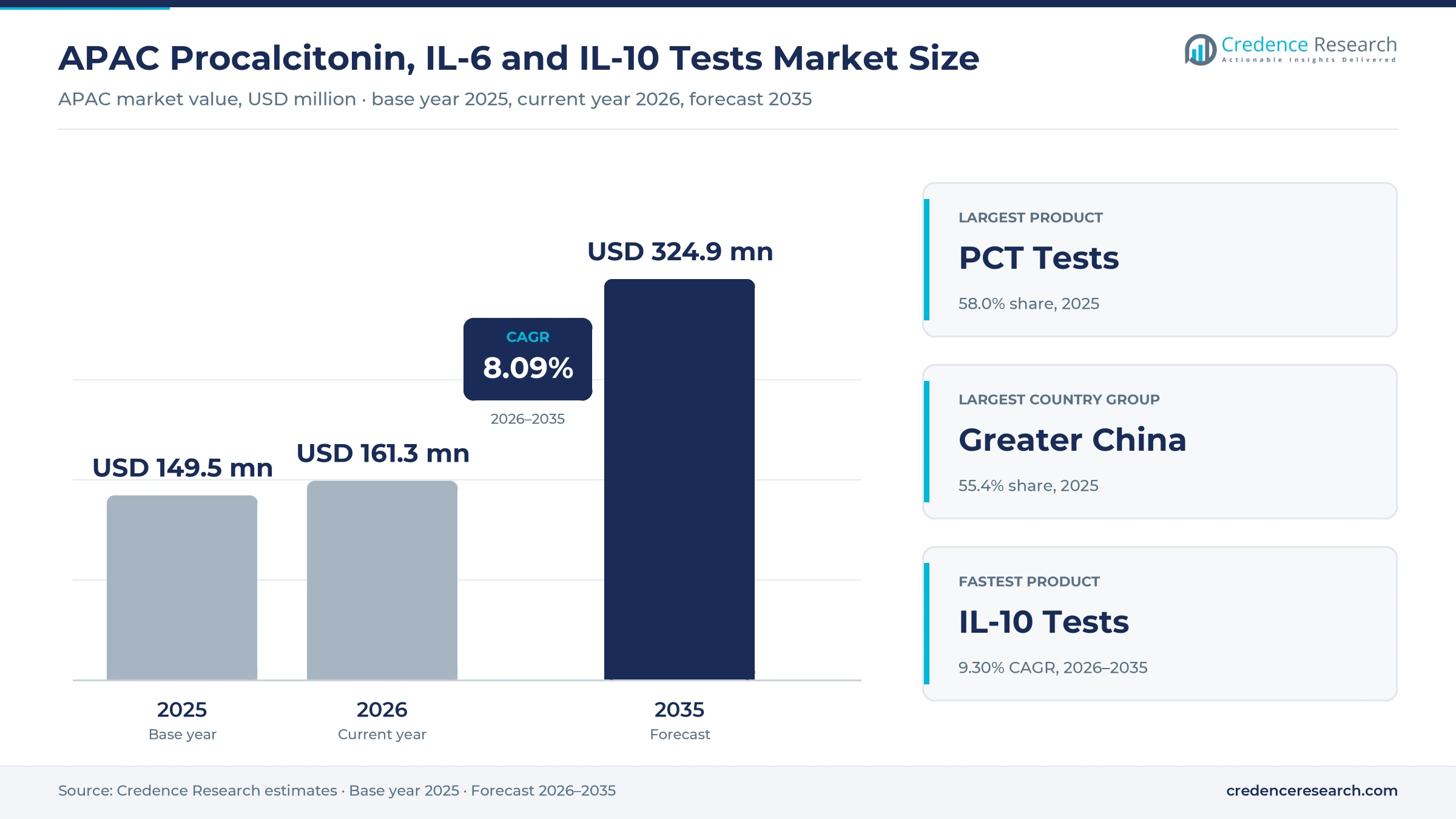
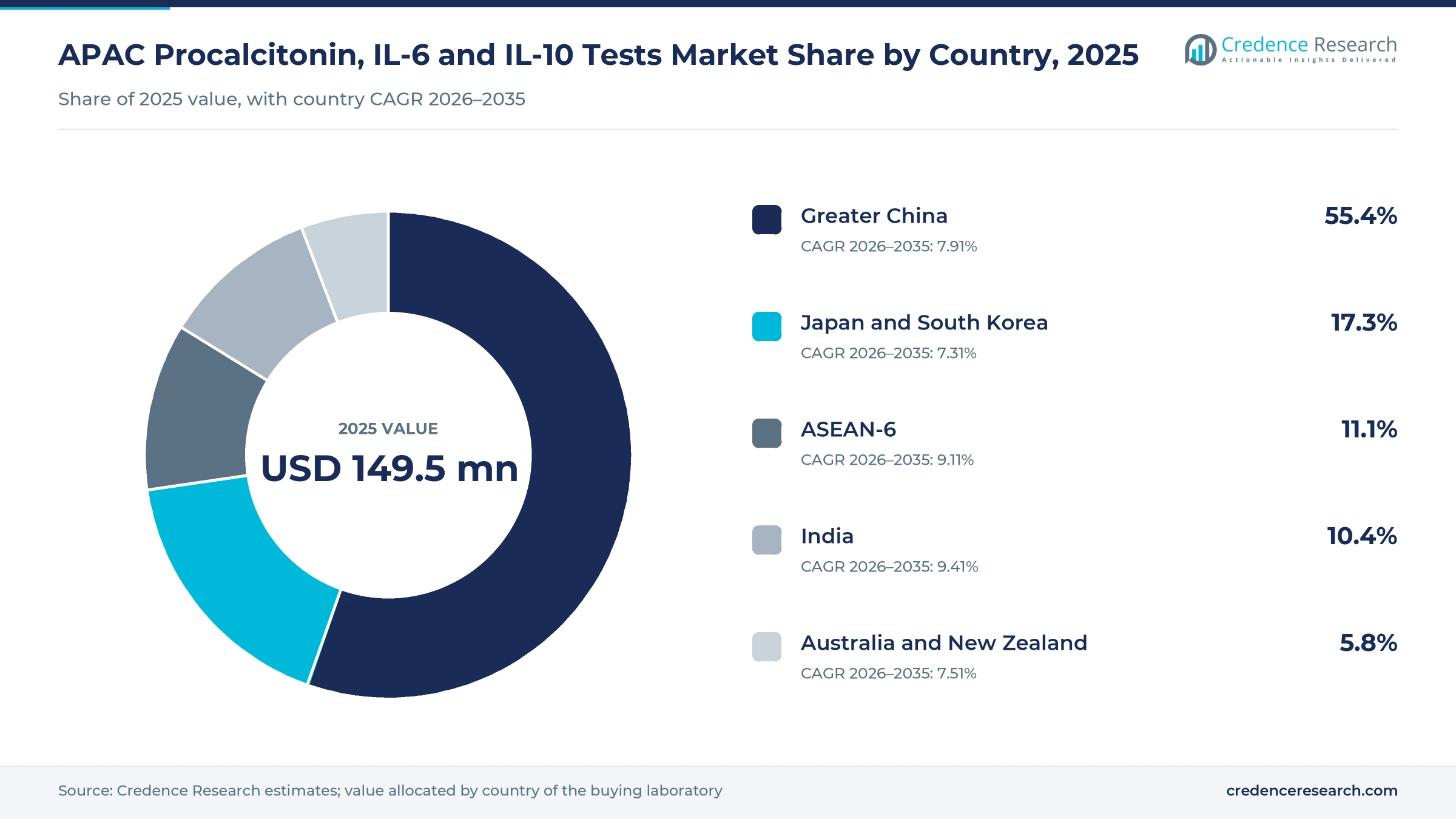
The APAC procalcitonin, IL-6 and IL-10 tests market was valued at USD 149.5 million in 2025 and is projected to increase from USD 161.3 million in 2026 to USD 324.9 million by 2035, registering a CAGR of 8.09% during 2026–2035. Demand comes from hospital laboratories that measure these markers repeatedly to judge infection severity and decide when antibiotics can stop. Greater China held the largest share, 55.4% in 2025, because China combines a very large hospital network with an aging population and a deep field of domestic assay makers. India is the fastest-growing market at 9.41% a year, as independent laboratory chains widen access and a second national antimicrobial resistance plan began in November 2025. The main clinical change came on March 23, 2026, when the Surviving Sepsis Campaign suggested using procalcitonin with clinical evaluation to guide antimicrobial discontinuation. That guidance raises the value of serial testing, although procurement pressure in China continues to compress reagent prices.
What do APAC procalcitonin, IL-6 and IL-10 tests measure and who buys them?
The market counts reagents, kits and cartridges sold for quantitative procalcitonin, interleukin-6 and interleukin-10 measurement in human samples across Greater China, India, Japan and South Korea, Australia and New Zealand, and the ASEAN-6. Hospital laboratories buy most of this volume through tenders, direct manufacturer contracts or authorized distributors, and they often place the assays on analyzers already installed for other immunoassays.
The scope excludes C-reactive protein, presepsin and lactate tests, research-use cytokine kits and the analyzers themselves when sold without reagents. The value chain runs from antibody and calibrator suppliers through assay makers and OEM partners to distributors, laboratories and the intensive care or emergency clinicians who act on the results.
APAC Procalcitonin, IL-6 and IL-10 Tests Market Insights
- Regional test value is projected to climb from USD 149.5 million in 2025 to USD 324.9 million by 2035, reflecting an 8.09% CAGR during 2026–2035 as repeat testing spreads.
- Greater China held 55.4% of 2025 value, supported by a large public hospital base, an aging population and many domestic assay registrations.
- PCT Tests held 58.0% of 2025 value, because antibiotic discontinuation decisions in sepsis care depend mainly on serial procalcitonin results.
- The Surviving Sepsis Campaign guideline of March 23, 2026, suggested procalcitonin with clinical evaluation for stop decisions, although it rated the certainty of evidence as low.
- Roche Diagnostics agreed a 3 billion yuan Suzhou expansion in August 2024, while local makers such as Wondfo Biotech widen their fluorescence test menus.
PCT and sepsis lead as near-patient formats gain share
Why procalcitonin holds the largest product share
Based on product type, the market is categorized into PCT Tests, IL-6 Tests and IL-10 Tests. PCT Tests led with 58.0% of 2025 value because the marker now informs stop decisions, and the Surviving Sepsis Campaign guideline of March 23, 2026, suggests pairing it with clinical evaluation. IL-10 Tests grow fastest at 9.30% a year from a small base as prognostic evidence firms up. At the First Affiliated Hospital of Chongqing Medical University, median IL-10 reached 112.47 pg/mL in 39 nonsurvivors against 9.96 pg/mL in 109 survivors, according to Frontiers in Medicine in September 2025.
How sepsis care and respiratory cut-offs divide demand
Based on disease area, the market is categorized into Sepsis and Septic Shock, Respiratory Infection Without Sepsis, Postoperative Infection Without Sepsis and Noninfectious Inflammatory Assessment. Sepsis and Septic Shock led with 49.0% of 2025 value because critically ill patients are tested repeatedly, and Australia alone recorded 84,382 sepsis hospitalizations in 2022-23, according to its national safety commission. Respiratory Infection Without Sepsis grows fastest at 8.80% a year as lower cut-offs reach respiratory care. A Shanghai Jiahui International Hospital evaluation published June 17, 2025, tested local assays at the 0.1, 0.25 and 0.5 μg/L respiratory thresholds.
Why public hospital laboratories dominate purchasing
Based on end user, the market is categorized into Public Hospital Laboratories, Private Hospital Laboratories, Independent Diagnostic Laboratories and Academic Clinical Laboratories. Public Hospital Laboratories led with 52.0% of 2025 value because China alone has 9,073 secondary and higher public hospitals in regional information-sharing networks, according to CGTN in February 2026. Independent Diagnostic Laboratories grow fastest at 9.03% a year as commercial chains publish walk-in prices for clinical laboratory services. Metropolis listed a serum procalcitonin test at ₹3,270 in Juhu, while Apollo 24|7 listed ₹3,799 in Mumbai with reports in as little as eight hours.
How automated platforms and near-patient formats compete
Based on technology, the market is categorized into Automated Laboratory Immunoassays, Point-of-Care Immunoassays, ELISA and Microfluidic Immunoassays. Automated Laboratory Immunoassays led with 62.0% of 2025 value because laboratories add these markers to installed chemiluminescence immunoassay lines, and Mindray reports 18 minutes per assay on its platform. Point-of-Care Immunoassays grow fastest at 9.23% a year as new local registrations widen near-patient choice. AIVIC Biotechnology received a provincial registration certificate, valid from Dec. 11, 2025, for a fluorescence immunochromatography procalcitonin kit accepting serum, plasma and whole blood, according to its parent Shandong Oriental Ocean.
| Segment Group | Leading Sub-segment | Share, 2025 | Fastest-growing Sub-segment | CAGR, 2026–2035 |
|---|---|---|---|---|
| By Product Type | PCT Tests | 58.0% | IL-10 Tests | 9.30% |
| By Disease Area | Sepsis and Septic Shock | 49.0% | Respiratory Infection Without Sepsis | 8.80% |
| By End User | Public Hospital Laboratories | 52.0% | Independent Diagnostic Laboratories | 9.03% |
| By Technology | Automated Laboratory Immunoassays | 62.0% | Point-of-Care Immunoassays | 9.23% |
Request a Free Sample
Fill in your details and we'll send you a free sample report.
- Sample data tables & charts
- Research methodology
Repeat protocols, wider menus and distributors lift use
Protocol-based PCT repeat testing spreads through ICUs
Repeat testing multiplies volume because a stop decision needs a falling series of results, not a single value. The ADAPT-Sepsis trial, published in JAMA on Dec. 9, 2024, randomized 2,760 adults across 41 U.K. intensive care units and cut antibiotic duration by 0.88 days with daily procalcitonin guidance. As a result, the Surviving Sepsis Campaign guideline of March 23, 2026 suggests procalcitonin with clinical evaluation for discontinuation decisions. Regional practice is moving in parallel, since an Asia-Pacific expert consensus in Clinical Chemistry and Laboratory Medicine describes repeated testing for monitoring and discontinuation. This protocol logic supports the 58.0% share held by PCT Tests.
Integrated inflammation assay menus simplify laboratory orders
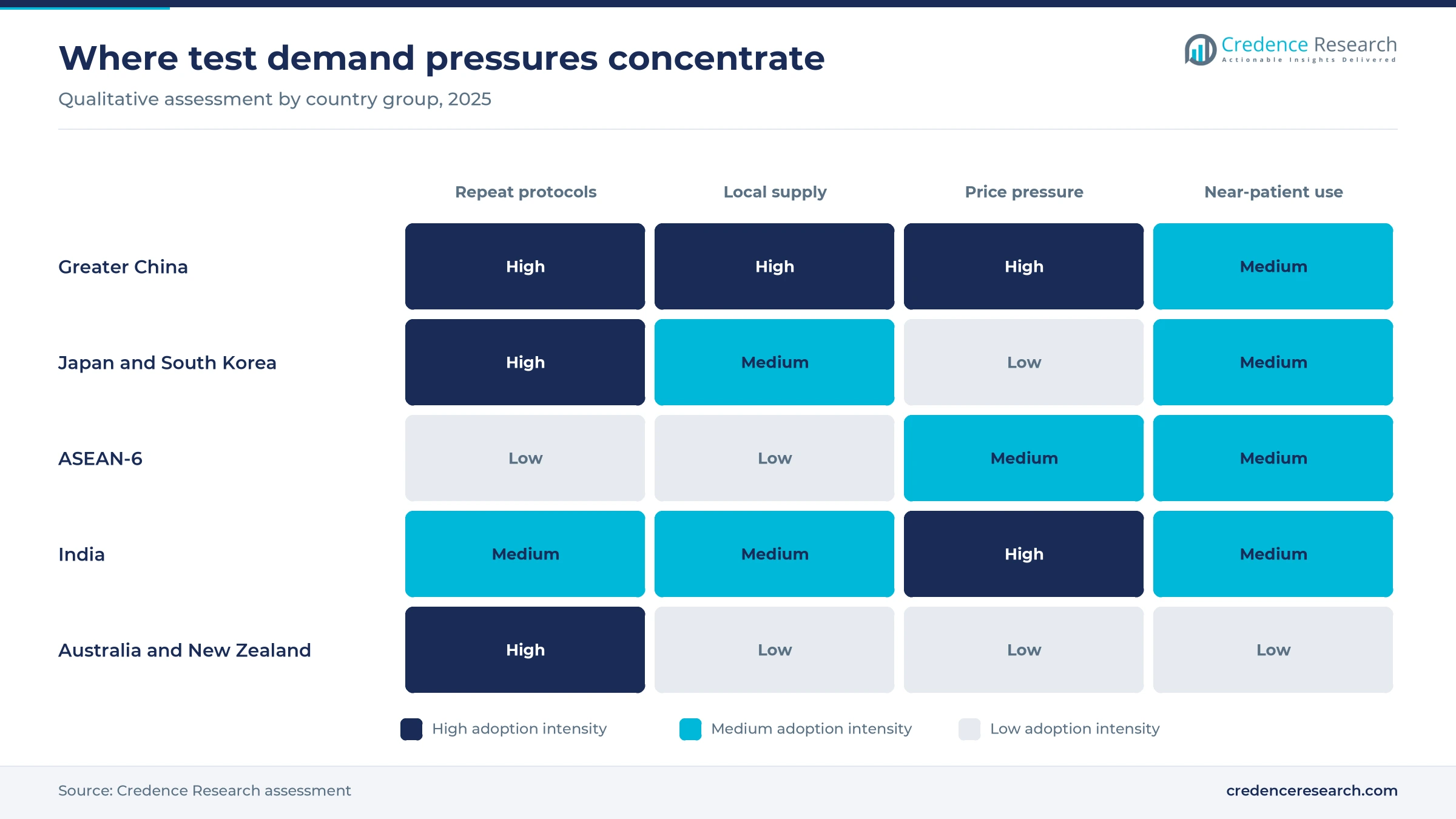
Laboratories prefer ordering several markers from one platform, which lifts IL-6 and IL-10 volume alongside procalcitonin. Mindray launched its IPS inflammation panel on Dec. 14, 2022, adding IL-6 and sCD14-ST to an existing procalcitonin assay on one chemiluminescence platform. Wondfo Biotech said in April 2026 that its immunofluorescence platform carries more than 50 reagents and five devices, with inflammation among the covered areas. Fujirebio and Agappe Diagnostics planned a phased Indian launch from June 2024 covering more than 30 parameters on Mispa analyzers, according to their January 2024 release. Together these menus help IL-10 Tests grow at 9.30% a year, because adding one more marker requires little new equipment.
Regional distribution expansion opens secondary markets
Wider distribution brings these assays to hospitals beyond the tier-one cities and national reference centers. bioMérieux reported on Feb. 27, 2026, that Asia Pacific sales outside China rose 11% at constant rates in 2025, even as its clinical sales in China declined, which shows the pull of other regional markets. Wondfo Biotech set up a subsidiary in the Philippines during 2025 and credited South Asia demand for growth in fluorescence testing. In India, Human Diagnostics and Medsource Ozone Biomedicals announced a joint venture on June 24, 2024, with point-of-care testing and automation among its planned areas. These routes matter most in India and the ASEAN-6, where hospital testing is still concentrated in larger referral centers.
Aging populations and rising sepsis admissions add patients
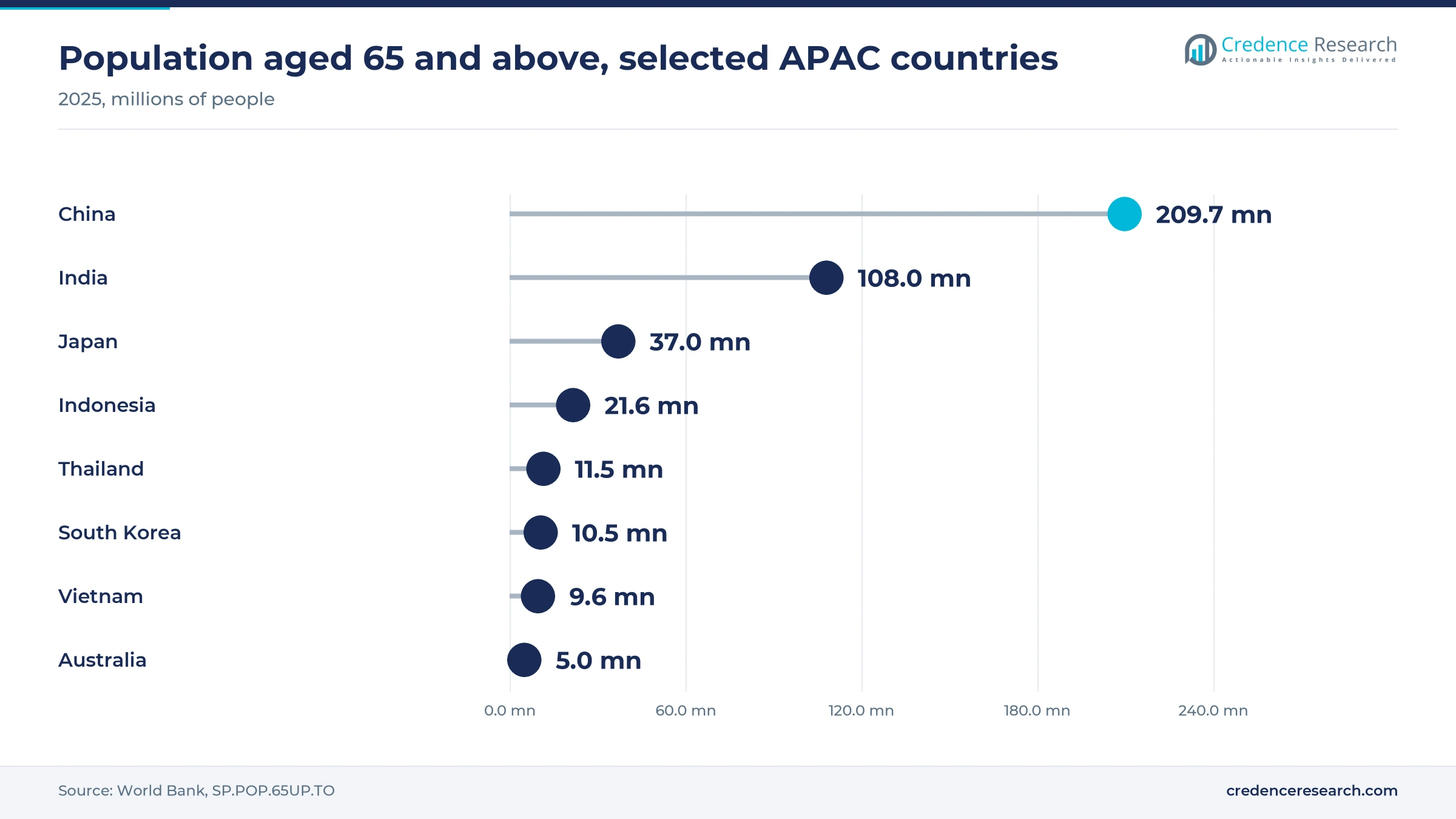
Older patients carry more severe infections, and that burden directly enlarges the tested population across the region. World Bank data show 209.7 million people aged 65 and above in China in 2025, along with 108.0 million in India and 37.0 million in Japan. WHO reported in September 2020 that an estimated 42% of people with sepsis in intensive care units die. Australia recorded 84,382 public hospital sepsis hospitalizations in 2022-23, up from 65,021 in 2013-14, according to its national safety commission. The George Institute reported in January 2020 that Southeast Asia carried one of the heaviest sepsis burdens worldwide. Hospitals treating these patients draw on a wider range of sepsis diagnostics, which supports the 49.0% share of Sepsis and Septic Shock.
Faster analyzers and local assays reshape regional supply
Shift toward faster near-patient results in acute care
Emergency and intensive care teams want results within the treatment window, and suppliers are shortening the wait accordingly. PHC Corporation introduced its next-generation PATHFAST analyzer in Japan in October 2025, and PHC lists a B·R·A·H·M·S PCT assay for PATHFAST with a run time under 17 minutes and whole-blood samples, according to its product page. Wondfo Biotech claims 15 minutes for its procalcitonin assay, according to a Frontiers in Medicine evaluation published June 17, 2025. By contrast, Apollo 24|7 quotes as little as eight hours for a commercial laboratory report in Mumbai, which is too slow for an emergency decision. This gap favors near-patient platforms in acute settings and helps Point-of-Care Immunoassays grow at 9.23% a year.
Rise of local chemiluminescence and reagent production
Supply is moving closer to regional buyers, and that shift changes who wins tenders. Roche Diagnostics signed a 3 billion yuan expansion in Suzhou in August 2024, planning more than 400 products there by 2030, up from 120, according to China Daily. Agappe Diagnostics moved toward locally made chemiluminescence reagents through its Fujirebio technical transfer, which the partners described in January 2024. Wondfo Biotech reported higher chemiluminescence penetration in upper-tier Chinese hospitals during the first quarter of 2026. QuidelOrtho and Shanghai Runda Medical Technology also formed a venture in December 2022 to make immunoassays for China. As a result, domestic production capacity continues to anchor Greater China as the regional center of supply.
Opportunity in stewardship-led laboratory programs in India
India offers a clear opening because antibiotic policy and laboratory expansion are now linked in national planning. The second National Action Plan on Antimicrobial Resistance, covering 2025 to 2029, launched in November 2025 with expanded laboratory capacity among its goals, according to Outlook India. Price remains the barrier, since Metropolis lists a procalcitonin test at ₹3,270 while World Bank data put current health spending near USD 85 per person in 2023. Locally made reagents could narrow that gap, and Agappe products already reach more than 70,000 laboratories worldwide, according to Omnicuris in July 2026. Suppliers pairing lower-cost kits with stewardship training can capture this demand as laboratory networks widen.
Opening for evidence partnerships across ASEAN-6 hospitals
ASEAN-6 hospitals are generating the local evidence that formal test adoption usually requires, which creates room for supplier partnerships. A Denpasar, Bali, intensive care study published March 27, 2026, in Healthcare analyzed 84 patients and found median antibiotic duration of five days with normal procalcitonin against eight days with elevated values. Hospital A Thai Nguyen in Vietnam reported median procalcitonin of 22.1 ng/mL in culture-positive patients against 8.32 ng/mL in culture-negative patients, using 2024 data. Current health spending of about USD 132 per person in Indonesia in 2023, according to the World Bank, makes low-cost formats essential. Suppliers supporting such audits can target growth of 9.11% a year.
Procurement, assay bias and price limit routine testing
Procurement pressure compresses reagent value in China
Bulk purchasing in China reduces value per test, and QuidelOrtho has disclosed that some immunoassay products fall within procurement scope in Anhui Province, according to 360Dx. Separately, bioMérieux reported on Feb. 27, 2026, that immunoassay sales fell 6% in 2025, citing China and procalcitonin, although it did not attribute the fall to procurement. Laboratories gain lower prices, but suppliers lose margin, so they are responding by localizing production and shifting toward panels that protect value per patient.
Assay comparability limits algorithm use at low values
Local assays often disagree at the low cut-offs that stop decisions depend on. A Frontiers in Medicine evaluation published June 17, 2025 found imprecision near 0.25 μg/L of 8.38% to 15.67% for three Chinese assays against 4.64% for KRYPTOR, compromising their fit with established algorithms. Hospitals switching suppliers must therefore revalidate cut-offs, which delays tender savings and adds laboratory workload. Better traceability work and shared calibrators would reduce that burden for local makers and their hospital customers.
Test price remains high against low-income health budgets
Out-of-pocket prices restrict serial testing where patients fund care directly. Metropolis lists one procalcitonin test at ₹3,270 in Juhu, whereas World Bank data show current health spending near USD 85 per person in India in 2023. Because a protocol needs several results per admission, private patients and smaller hospitals often stop after one test. Lower-cost fluorescence kits and bundled hospital pricing can ease this constraint, although results still need quality control at low concentrations.
Modest evidence leaves room for clinician skepticism
Clinical evidence supports procalcitonin only moderately, which slows protocol adoption among cautious intensive care teams. The Surviving Sepsis Campaign rated certainty as low in March 2026, and a Chongqing study published in September 2025 found no significant survival difference in procalcitonin, with a p-value of 0.163. A Bali study also reported specificity of only 61.5% at 0.5 ng/mL. Suppliers and hospital leaders therefore need local audits that show antibiotic days saved before funding routine repeat testing.
Greater China leads while India and ASEAN-6 grow fastest
| Country | Value, 2025 (USD million) | Share, 2025 | CAGR, 2026–2035 |
|---|---|---|---|
| Greater China | 82.8 | 55.4% | 7.91% |
| Japan and South Korea | 25.9 | 17.3% | 7.31% |
| ASEAN-6 | 16.6 | 11.1% | 9.11% |
| India | 15.5 | 10.4% | 9.41% |
| Australia and New Zealand | 8.7 | 5.8% | 7.51% |
Greater China leads on hospital scale and domestic supply
Greater China held 55.4% of 2025 value and grows at 7.91% a year. Its hospital base is unmatched, with 9,073 secondary and higher public hospitals in information-sharing networks, according to CGTN in February 2026. However, provinces are expected to recognize more than 300 test items across hospitals by the end of 2027, which could reduce duplicate orders. Procurement pressure also weighs on value, although domestic registrations continue, including the AIVIC procalcitonin kit certified from Dec. 11, 2025.
Japan and South Korea rely on established sepsis guidance
Japan and South Korea held 17.3% of 2025 value and grow at 7.31% a year. Both have mature critical care systems, with Japanese guidelines covering 78 clinical issues published online Sept. 15, 2025, and Korea issuing its first sepsis guidelines in November 2024. Thermo Fisher Scientific licensed its procalcitonin assay to Fujirebio for Lumipulse instruments in Japan on Nov. 21, 2012. Current health spending above USD 3,100 per person, according to the World Bank, supports routine hospital use.
ASEAN-6 grows from a low testing base
ASEAN-6 held 11.1% of 2025 value and grows at 9.11% a year. The George Institute reported in January 2020 that Southeast Asia carried one of the heaviest sepsis burdens worldwide, yet routine serial testing remains concentrated in tertiary hospitals. Studies from Denpasar in Indonesia and Thai Nguyen in Vietnam show procalcitonin being used in referral care. Wondfo Biotech established a Philippine subsidiary during 2025, which reflects supplier interest in building direct channels rather than relying only on importers.
India is the fastest market as laboratory chains expand
India held 10.4% of 2025 value and grows fastest at 9.41% a year. Commercial chains already publish walk-in prices, including ₹3,270 at Metropolis in Juhu and ₹3,799 at Apollo 24|7 in Mumbai. The second national antimicrobial resistance plan, launched in November 2025, adds policy support through expanded laboratory capacity. Local manufacturing is also advancing, as Agappe Diagnostics moved toward Indian chemiluminescence reagents with Fujirebio technology, which could lower hospital costs over time.
Australia and New Zealand pair high budgets with protocols
Australia and New Zealand held 5.8% of 2025 value and grow at 7.51% a year. The Australian Commission on Safety and Quality in Health Care reported in September 2025 that sepsis hospitalizations reached 84,382 in 2022-23, with 27.8% admitted to intensive care and an average cost of A$31,440 per case. That cost gives hospitals a clear reason to audit antibiotic days, although the small population limits total volume.
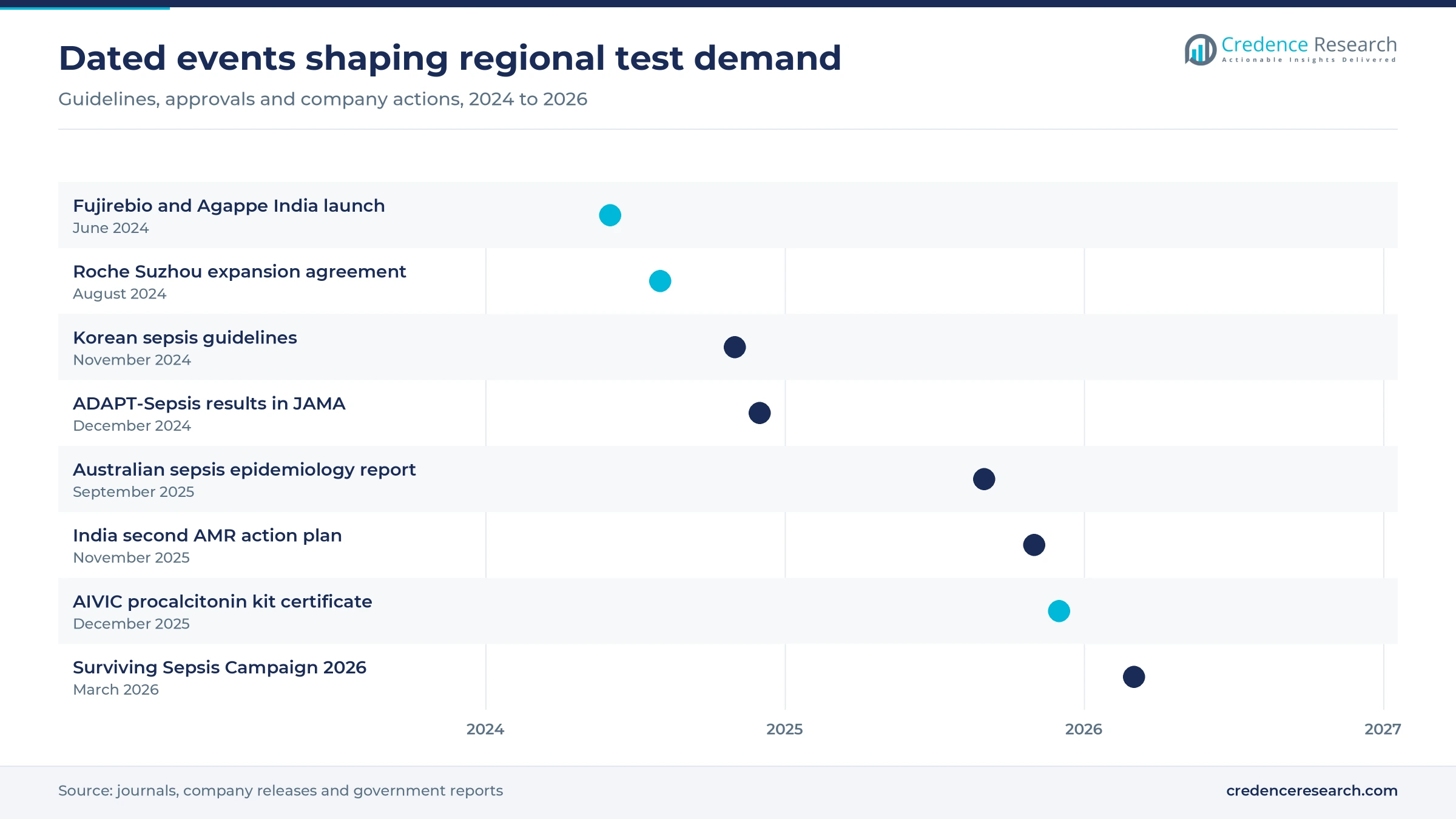
Guidelines and local assay approvals shaped 2024 to 2026
| Development | Status and market relevance |
|---|---|
| In November 2025, India launched its second National Action Plan on Antimicrobial Resistance for 2025 to 2029, naming expanded laboratory capacity among its goals. | Active; supports stewardship testing in Indian hospitals |
| In December 2025, AIVIC Biotechnology received a provincial registration certificate in China for a fluorescence immunochromatography procalcitonin kit, valid from Dec. 11, 2025. | Registered until Dec. 10, 2030; adds near-patient choice |
| In October 2025, PHC Corporation introduced its next-generation PATHFAST analyzer in Japan, and it lists a B·R·A·H·M·S PCT assay for the platform with a run time under 17 minutes. | On sale in Japan; PHC lists a PCT assay for the platform |
| In September 2025, the Japanese sepsis guidelines of 2024 were published online in the Journal of Intensive Care, covering 78 clinical issues. | Published; frames sepsis practice in Japan |
| In August 2024, Roche Diagnostics agreed a 3 billion yuan expansion in Suzhou, with production scheduled to begin in 2028. | Planned; deepens local reagent manufacturing in China |
Assay speed and traceability separate the main platforms
- Automated laboratory immunoassays run these markers on installed high-throughput lines, and Mindray reports 18 minutes per assay on its chemiluminescence platform.
- Point-of-care immunoassays bring results to the emergency room, and PHC lists its PATHFAST B·R·A·H·M·S PCT assay at under 17 minutes.
- ELISA remains a lower-cost batch method that suits academic laboratories, although batching makes it a poor fit for urgent stop decisions.
- Microfluidic immunoassays aim to shrink sample and reagent use, although they remain the smallest technology group in the Credence Research split for 2025.
Need a Custom Version of This Report?
Tailor the scope, geography, or segments to your exact requirements.
- Custom geography or segment scope
- Direct access to our analyst team
Global reference assays face fast local challengers
Competition splits between global companies with established reference assays and domestic makers that compete on menu breadth and supply reach. Roche Diagnostics sells the Elecsys BRAHMS PCT assay for cobas e analyzers and strengthens regional supply through its Suzhou expansion, while bioMérieux pairs procalcitonin assays with growing VIDAS KUBE instrument sales. Fujirebio works through license and technology arrangements, including its long-standing Lumipulse agreement in Japan and its Agappe partnership in India. Mindray competes with a chemiluminescence inflammation panel on its own immunoassay analyzers, and Wondfo Biotech extends fluorescence tests through primary care and export channels. Credence Research estimates that direct sales lead in large hospital contracts, whereas authorized distributors matter more in India and the ASEAN-6. OEM supply agreements let regional brands sell assays without building every reagent step, which lowers the entry barrier. Buyers increasingly weigh traceability to established algorithms alongside price, so independent evaluations can shift tender outcomes.
Companies profiled and their roles in this market
| Company | Type | Role in the market |
|---|---|---|
| Roche Diagnostics | Global supplier | Sells Elecsys BRAHMS PCT for cobas e analyzers; expanding production in Suzhou, China |
| Mindray | Regional manufacturer | Sells a PCT, IL-6 and sCD14-ST chemiluminescence panel |
| bioMérieux | Global supplier | Sells immunoassays across Asia Pacific, with China under pressure |
| Wondfo Biotech | Regional manufacturer | Offers fluorescence inflammation tests with Philippine and South Asia reach |
| Fujirebio | Technology partner | Licensed a PCT assay for Lumipulse in Japan and supplies Agappe in India |
Protocol adoption matters more than new analyzer sales
Credence Research's view is that protocol adoption, not analyzer placement, will decide the value of this market. Hospitals already own suitable immunoassay lines, so each new repeat-testing protocol converts directly into reagent volume. The most useful evidence is local, and audits like the Denpasar study are likely to persuade finance teams more than international trials alone. Suppliers should therefore fund stewardship audits and publish traceability data, because the Shanghai evaluation shows that low-end precision can disqualify an otherwise inexpensive assay.
How the regional inflammation test estimate was built
The report uses 2025 as the base year, and market values come from the Credence Research model. Segment splits, country growth rates and country shares are Credence Research estimates. The model draws on official statistics, national health agency reports, clinical guidelines, peer-reviewed studies, company releases and published laboratory prices. No interviews or surveys were used for this estimate of the market.
Repeat testing and local supply should carry growth
Regional test value is expected to reach USD 324.9 million by 2035, reflecting an 8.09% CAGR during 2026–2035, as serial testing moves from reference hospitals into routine care. Growth should come first from guideline-led intensive care protocols, and later from emergency and near-patient use in India and the ASEAN-6. Deeper procurement cuts in China would lower this outlook, while stronger local evidence and better assay traceability would raise it. Suppliers that combine affordable reagents with credible cut-off performance are best placed to gain share through the forecast period.
Frequently Asked Questions
How big is the APAC procalcitonin, IL-6 and IL-10 tests market?
How fast is the market expected to grow?
Which product type leads the market?
Which country group holds the largest share?
Which market is growing fastest in the region?
What does the 2026 sepsis guideline say about procalcitonin?
What is the main challenge for test suppliers?
Who are the main companies in this market?
Table of Content
Chapter 1 Market Segmentation
- 1.1 Segmentation Framework
- 1.1.1 Product and Service Classification
- 1.1.2 Application and End-Use Classification
- 1.1.3 Technology and Solution Classification
- 1.1.4 Customer and Distribution Channel Classification
- 1.1.5 Geographic Segmentation
- 1.1.6 Market Segment Definitions and Boundaries
- 1.2 By Product Type
- 1.2.1 PCT Tests
- 1.2.2 IL-6 Tests
- 1.2.3 IL-10 Tests
- 1.3 By Disease Area
- 1.3.1 Sepsis and Septic Shock
- 1.3.2 Respiratory Infection Without Sepsis
- 1.3.3 Postoperative Infection Without Sepsis
- 1.3.4 Noninfectious Inflammatory Assessment
- 1.4 By End User
- 1.4.1 Public Hospital Laboratories
- 1.4.2 Private Hospital Laboratories
- 1.4.3 Independent Diagnostic Laboratories
- 1.4.4 Academic Clinical Laboratories
- 1.5 By Technology
- 1.5.1 Automated Laboratory Immunoassays
- 1.5.2 Point-of-Care Immunoassays
- 1.5.3 ELISA
- 1.5.4 Microfluidic Immunoassays
- 1.6 By Country
- 1.6.1 Greater China
- 1.6.2 India
- 1.6.3 Japan and South Korea
- 1.6.4 Australia and New Zealand
- 1.6.5 ASEAN-6
Chapter 2 Introduction
- 2.1 Report Objectives and Scope
- 2.2 Product Definition and Industry Terminology
- 2.3 Market Inclusions and Exclusions
- 2.4 Research Process
- 2.4.1 Primary Research and Expert Interviews
- 2.4.2 Secondary Research and Source Review
- 2.4.3 Top-Down and Bottom-Up Estimation
- 2.4.4 Data Triangulation and Verification
- 2.5 Market Size Measurement Basis
- 2.5.1 2025: USD 149.5 million → 2035: USD 324.9 million
- 2.6 Historical and Forecast Reference Periods
- 2.6.1 Historical Period: 2018-2025
- 2.6.2 Base Year: 2025
- 2.6.3 Forecast Period: 2025-2035
- 2.7 Research Assumptions and Limitations
Chapter 3 Executive Summary
- 3.1 Market Snapshot and Key Findings
- 3.2 Base-Year Market Size, 2025
- 3.3 Forecast Market Size, 2035
- 3.4 Revenue and Volume Growth Outlook
- 3.5 Key Demand and Supply Indicators
- 3.6 Leading Market Segments
- 3.7 Fastest-Growing Market Opportunities
- 3.8 Regional Performance Highlights
- 3.9 Technology and Industry Transformation
- 3.10 Competitive Landscape Summary
- 3.11 Analyst View and Strategic Implications
Chapter 4 APAC Procalcitonin, IL-6 and IL-10 Tests Market Trends and Developments
- 4.1 Historical Industry Development, 2018-2025
- 4.2 Recent Market Trends and Developments
- 4.3 Demand and Customer Behavior Trends
- 4.4 Technology and Product Innovation
- 4.5 Artificial Intelligence, Automation and Digitalization
- 4.6 Local Manufacturing and Supply Chain Realignment
- 4.7 Industry Partnerships, Mergers and Acquisitions
- 4.8 Sustainability and Circular Economy Developments
- 4.9 Government and Private Sector Investment Trends
- 4.10 Emerging Business Models and Commercialization
- 4.11 Industry Developments and Announcements
Chapter 5 APAC Procalcitonin, IL-6 and IL-10 Tests Market Production, Supply and Demand Analysis
- 5.1 Demand Trend and Consumption Analysis, 2018-2025
- 5.2 Demand Forecast, 2025-2035
- 5.3 Production and Output Trend, 2018-2025
- 5.4 Production and Output Forecast, 2025-2035
- 5.5 Installed Capacity and Capacity Utilization
- 5.6 Company-Wise Production Plants and Statistics
- 5.6.1 Installed Production Capacity
- 5.6.2 Actual Production
- 5.6.3 Planned Capacity and Expansion Targets
- 5.7 Supply Chain Structure and Procurement Trends
- 5.8 Supply-Demand Gap and Bottlenecks
- 5.9 Import Dependence and Sourcing Structure
- 5.10 Contract Manufacturing and Outsourcing
- 5.11 Regional Supply and Demand Concentration
Chapter 6 APAC Procalcitonin, IL-6 and IL-10 Tests Market Pricing Analysis
- 6.1 Pricing Structure and Measurement
- 6.2 Historical Pricing Trends, 2018-2025
- 6.3 Pricing Outlook, 2025-2035
- 6.4 Average Selling Price and Unit Economics
- 6.5 Pricing by Product and Market Segment
- 6.6 Geographic Pricing Differences
- 6.7 Key Input, Energy, Labor and Logistics Costs
- 6.8 Contract Pricing and Purchasing Models
- 6.9 Pricing Sensitivity and Competitive Positioning
- 6.10 Price, Margin and Profitability Implications
Chapter 7 APAC Procalcitonin, IL-6 and IL-10 Tests Market Dynamics
- 7.1 Market Growth Drivers
- 7.1.1 Demand-Side Drivers
- 7.1.2 Technology and Innovation Drivers
- 7.1.3 Infrastructure and Investment Drivers
- 7.1.4 Regulatory and Policy Drivers
- 7.2 Market Restraints
- 7.2.1 Cost and Affordability Constraints
- 7.2.2 Technology and Adoption Barriers
- 7.2.3 Supply Chain and Operational Constraints
- 7.3 Market Challenges
- 7.3.1 Competitive Pressure and Margin Erosion
- 7.3.2 Skills, Infrastructure and Implementation Gaps
- 7.4 Emerging Market Opportunities
- 7.5 Market Dynamics Impact and Time-Horizon Assessment
Chapter 8 APAC Procalcitonin, IL-6 and IL-10 Tests Value Chain Analysis
- 8.1 Industry Value Chain Overview
- 8.2 Upstream Suppliers and Critical Inputs
- 8.3 Technology and Component Providers
- 8.4 Manufacturing or Service Delivery
- 8.5 Distribution, Channel Partners and Integrators
- 8.6 Downstream Applications and End Users
- 8.7 Value Addition and Profit Pools
- 8.8 Vertical Integration and Outsourcing
- 8.9 Supplier Concentration and Risk
- 8.10 Supply Chain Localization and Resilience
Chapter 9 APAC Procalcitonin, IL-6 and IL-10 Tests Market Regulations and Policies
- 9.1 Relevant Laws, Standards and Compliance Frameworks
- 9.2 Product, Service, Safety and Quality Requirements
- 9.3 Government Policies, Incentives and Subsidies
- 9.4 Imports, Exports and Trade Barriers
- 9.5 Public Procurement and Local Content Requirements
- 9.6 Environmental and Sustainability Compliance
- 9.7 Upcoming Policy Changes and Market Implications
Chapter 10 APAC Procalcitonin, IL-6 and IL-10 Tests Market Hotspots and Opportunities
- 10.1 Market Opportunity Mapping and Growth Hotspots
- 10.2 High-Growth Applications and Customer Groups
- 10.3 Underserved Markets and White-Space Opportunities
- 10.4 Emerging Technology and Product Opportunities
- 10.5 New Capacity and Investment Hotspots
- 10.6 Market Entry and Expansion Opportunities
- 10.7 Distribution and Partnership Opportunities
- 10.8 Near-Term and Long-Term Commercial Potential
- 10.9 Opportunity Attractiveness and Execution Risks
Chapter 11 APAC Procalcitonin, IL-6 and IL-10 Tests Market Outlook, 2025-2035
- 11.1 Market Size and Analysis
- 11.1.1 Revenue (Market Measurement: 2025: USD 149.5 million → 2035: USD 324.9 million)
- 11.1.2 Market Volume and Quantity Sold
- 11.1.3 Historical Market Size, 2018-2025
- 11.1.4 Base-Year Market Size, 2025
- 11.2 Market Forecast, 2025-2035
- 11.2.1 Revenue Forecast to 2035
- 11.2.2 Volume Forecast to 2035
- 11.2.3 CAGR and Year-on-Year Growth
- 11.2.4 Incremental Revenue Opportunity
- 11.3 Forecast Assumptions and Scenario Analysis
- 11.3.1 Base-Case Forecast
- 11.3.2 Optimistic and Conservative Scenarios
- 11.3.3 Technology, Pricing and Policy Sensitivities
- 11.4 Market Attractiveness and Growth Outlook
Chapter 12 APAC Procalcitonin, IL-6 and IL-10 Tests Market Segmentation and Outlook
- 12.1 Segmentation Summary and Market Shares, 2025
- 12.2 Largest and Fastest-Growing Segments
- 12.3 By Product Type - Market Size and Forecast, 2025-2035
- 12.3.1 Segment Definition and Scope
- 12.3.2 Historical Market Size, 2018-2025
- 12.3.3 Revenue Forecast, 2025-2035
- 12.3.4 Volume Forecast, 2025-2035
- 12.3.5 Base-Year Market Share, 2025
- 12.3.6 Segment CAGR and Growth Drivers
- 12.3.7 Subsegment Market Size and Forecast
- 12.3.7.1 PCT Tests
- 12.3.7.2 IL-6 Tests
- 12.3.7.3 IL-10 Tests
- 12.3.8 Subsegment Pricing and Adoption Trends
- 12.3.9 Leading Suppliers and Competition
- 12.3.10 Regional Demand and Opportunities
- 12.4 By Disease Area - Market Size and Forecast, 2025-2035
- 12.4.1 Segment Definition and Scope
- 12.4.2 Historical Market Size, 2018-2025
- 12.4.3 Revenue Forecast, 2025-2035
- 12.4.4 Volume Forecast, 2025-2035
- 12.4.5 Base-Year Market Share, 2025
- 12.4.6 Segment CAGR and Growth Drivers
- 12.4.7 Subsegment Market Size and Forecast
- 12.4.7.1 Sepsis and Septic Shock
- 12.4.7.2 Respiratory Infection Without Sepsis
- 12.4.7.3 Postoperative Infection Without Sepsis
- 12.4.7.4 Noninfectious Inflammatory Assessment
- 12.4.8 Subsegment Pricing and Adoption Trends
- 12.4.9 Leading Suppliers and Competition
- 12.4.10 Regional Demand and Opportunities
- 12.5 By End User - Market Size and Forecast, 2025-2035
- 12.5.1 Segment Definition and Scope
- 12.5.2 Historical Market Size, 2018-2025
- 12.5.3 Revenue Forecast, 2025-2035
- 12.5.4 Volume Forecast, 2025-2035
- 12.5.5 Base-Year Market Share, 2025
- 12.5.6 Segment CAGR and Growth Drivers
- 12.5.7 Subsegment Market Size and Forecast
- 12.5.7.1 Public Hospital Laboratories
- 12.5.7.2 Private Hospital Laboratories
- 12.5.7.3 Independent Diagnostic Laboratories
- 12.5.7.4 Academic Clinical Laboratories
- 12.5.8 Subsegment Pricing and Adoption Trends
- 12.5.9 Leading Suppliers and Competition
- 12.5.10 Regional Demand and Opportunities
- 12.6 By Technology - Market Size and Forecast, 2025-2035
- 12.6.1 Segment Definition and Scope
- 12.6.2 Historical Market Size, 2018-2025
- 12.6.3 Revenue Forecast, 2025-2035
- 12.6.4 Volume Forecast, 2025-2035
- 12.6.5 Base-Year Market Share, 2025
- 12.6.6 Segment CAGR and Growth Drivers
- 12.6.7 Subsegment Market Size and Forecast
- 12.6.7.1 Automated Laboratory Immunoassays
- 12.6.7.2 Point-of-Care Immunoassays
- 12.6.7.3 ELISA
- 12.6.7.4 Microfluidic Immunoassays
- 12.6.8 Subsegment Pricing and Adoption Trends
- 12.6.9 Leading Suppliers and Competition
- 12.6.10 Regional Demand and Opportunities
- 12.7 By Country - Market Size and Forecast, 2025-2035
- 12.7.1 Segment Definition and Scope
- 12.7.2 Historical Market Size, 2018-2025
- 12.7.3 Revenue Forecast, 2025-2035
- 12.7.4 Volume Forecast, 2025-2035
- 12.7.5 Base-Year Market Share, 2025
- 12.7.6 Segment CAGR and Growth Drivers
- 12.7.7 Subsegment Market Size and Forecast
- 12.7.7.1 Greater China
- 12.7.7.2 India
- 12.7.7.3 Japan and South Korea
- 12.7.7.4 Australia and New Zealand
- 12.7.7.5 ASEAN-6
- 12.7.8 Subsegment Pricing and Adoption Trends
- 12.7.9 Leading Suppliers and Competition
- 12.7.10 Regional Demand and Opportunities
- 12.8 Segment Growth Comparison
- 12.9 Segment Attractiveness and Priority Matrix
Chapter 13 APAC Procalcitonin, IL-6 and IL-10 Tests End-Use and Application Market Outlook
- 13.1 End-Use Industry and Customer Demand Structure
- 13.2 Leading Applications and Customer Groups
- 13.3 End-Use Market Size, Share and Forecast
- 13.4 Major End-Use Industry Deep Dives
- 13.4.1 Customer Requirements and Use Cases
- 13.4.2 Demand and Replacement Cycles
- 13.4.3 Technical and Regulatory Considerations
- 13.4.4 Purchasing and Procurement Models
- 13.4.5 Leading Vendors and Distribution Channels
- 13.4.6 Forecast and Commercial Opportunities
- 13.5 Emerging Applications and Cross-Segment Demand
- 13.6 End-Use Industry Investment Priorities
Chapter 14 APAC Procalcitonin, IL-6 and IL-10 Tests Geographic Market Outlook, 2025-2035
- 14.1 Regional Market Size and Country-Level Shares, 2025
- 14.2 Country Market Size Comparison, 2025
- 14.3 Country Market Forecasts, 2025-2035
- 14.4 Subregional Industrial and Demand Clusters
- 14.5 Intra-Regional Pricing and Cost Differences
- 14.6 Cross-Border Trade and Supply Networks
- 14.7 Regional Supply and Demand Balances
- 14.8 Country Opportunity Comparison and Prioritization
Note: Every listed country is covered on the structure shown under the first country.
Chapter 15 APAC Procalcitonin, IL-6 and IL-10 Tests Technology, Innovation and Sustainability Outlook
- 15.1 Technology Landscape and Maturity
- 15.2 Product, Process and Service Innovation
- 15.3 AI, Automation and Digital Tools in the Industry
- 15.4 Technology Adoption and Performance Benchmarking
- 15.5 Innovation Pipeline and R&D Investment
- 15.6 Patent and Intellectual Property Trends
- 15.7 Energy Efficiency and Resource Management
- 15.8 Sustainability, Recycling and Circularity
- 15.9 Technology Roadmap, 2025-2035
- 15.10 Risks of Obsolescence and Technology Substitution
Chapter 16 APAC Procalcitonin, IL-6 and IL-10 Tests Market Key Strategic Imperatives
- 16.1 Growth and Market Entry Priorities
- 16.2 High-Return Products and Segments
- 16.3 Pricing, Profitability and Cost Optimization
- 16.4 Technology Investment and Product Differentiation
- 16.5 Supply Chain Localization and Resilience
- 16.6 Distribution and Customer Acquisition
- 16.7 Partnership, Acquisition and Capacity Strategy
- 16.8 Regional Expansion Priorities
- 16.9 Short-, Medium- and Long-Term Actions
Chapter 17 Competition Outlook
- 17.1 Industry Competition Characteristics
- 17.2 Market Structure and Concentration
- 17.3 Market Share and Competitive Positioning, 2025
- 17.4 Company-Wise Revenue and Product Benchmarking
- 17.5 Production and Service Capacity Benchmarking
- 17.6 Technology, Pricing and Differentiation
- 17.7 Regional Footprint and Distribution Strength
- 17.8 Mergers, Acquisitions and Strategic Alliances
- 17.9 New Entrants and Competitive Threats
- 17.10 Porter's Five Forces and Industry Attractiveness
- 17.11 Competitive Outlook, 2025-2035
Chapter 18 Company Profiles
- 18.1 Company Coverage and Selection Criteria
- 18.2 Roche Diagnostics
- 18.2.1 Business Description
- 18.2.2 Company Ownership and Geographic Presence
- 18.2.3 Product and Service Portfolio
- 18.2.4 Manufacturing and Operating Footprint
- 18.2.5 Production Capacity and Expansion Plans
- 18.2.6 Financial Performance and Investment
- 18.2.7 Market Share and Competitive Position
- 18.2.8 Technology and Innovation Capabilities
- 18.2.9 Strategic Alliances or Partnerships
- 18.2.10 Recent Developments
- 18.2.11 Growth Strategy and Outlook
- 18.3 Mindray
- 18.4 bioMérieux
- 18.5 Wondfo Biotech
- 18.6 Fujirebio
- 18.7 Other Relevant Market Participants
Note: Every listed company is profiled on the structure shown under the first company. The company list is preliminary and may change based on research findings, market developments, data availability and client requirements.
Chapter 19 Disclaimer
- 19.1 Research and Forecast Disclaimer
- 19.2 Data Source and Estimation Limitations
Note: The depth of individual sections depends on data availability for this market. Volume, capacity, trade and other unit-based metrics are included where applicable.

