
Plasters and sensors define the regional patch market
The Asia-Pacific wearable patch market was valued at USD 6.91 billion in 2025 and is projected to increase from USD 7.41 billion in 2026 to USD 13.48 billion by 2035, registering a CAGR of 6.88% during 2026–2035. Demand rests on three buyer groups, which are older adults using medicated pain plasters, insulin users wearing glucose sensors, and cardiac patients sent for multi-day ECG recording. Greater China held the largest regional share, 54.0% in 2025, because China combines a large medicated plaster market with the largest diabetes population in the world. South Asia is the fastest-growing region at 9.06% a year, as India gains newer sensors and hospital monitoring programs. Reimbursement is the main commercial change, since Singapore, South Korea and Japan have each widened public coverage for glucose sensors in recent years. Longer wear also matters, because sensors from several suppliers now last 15 days and reduce the number of changes each patient needs.
Which plasters, sensors and pumps count in this regional scope?
The wearable patch category counts skin-worn products sold across Greater China, Japan and South Korea, South Asia and Southeast Asia and Oceania. It includes non-electronic medicated plasters, electronic monitoring patches such as glucose sensors and ECG recorders, and electronic therapeutic patches such as tubeless insulin pumps. Wearable patch buyers include hospitals and clinics that procure for patients, pharmacies that serve repeat users, and licensed online sellers.
The wearable patch scope excludes wrist-worn trackers, smart watches, reusable Holter recorders and durable tubed pumps. The value chain runs from adhesive and sensor makers through registered brand owners and distributors to the provider or pharmacy that hands over the product. Public payers influence the chain most, since coverage rules decide who can receive a sensor at a lower cost.
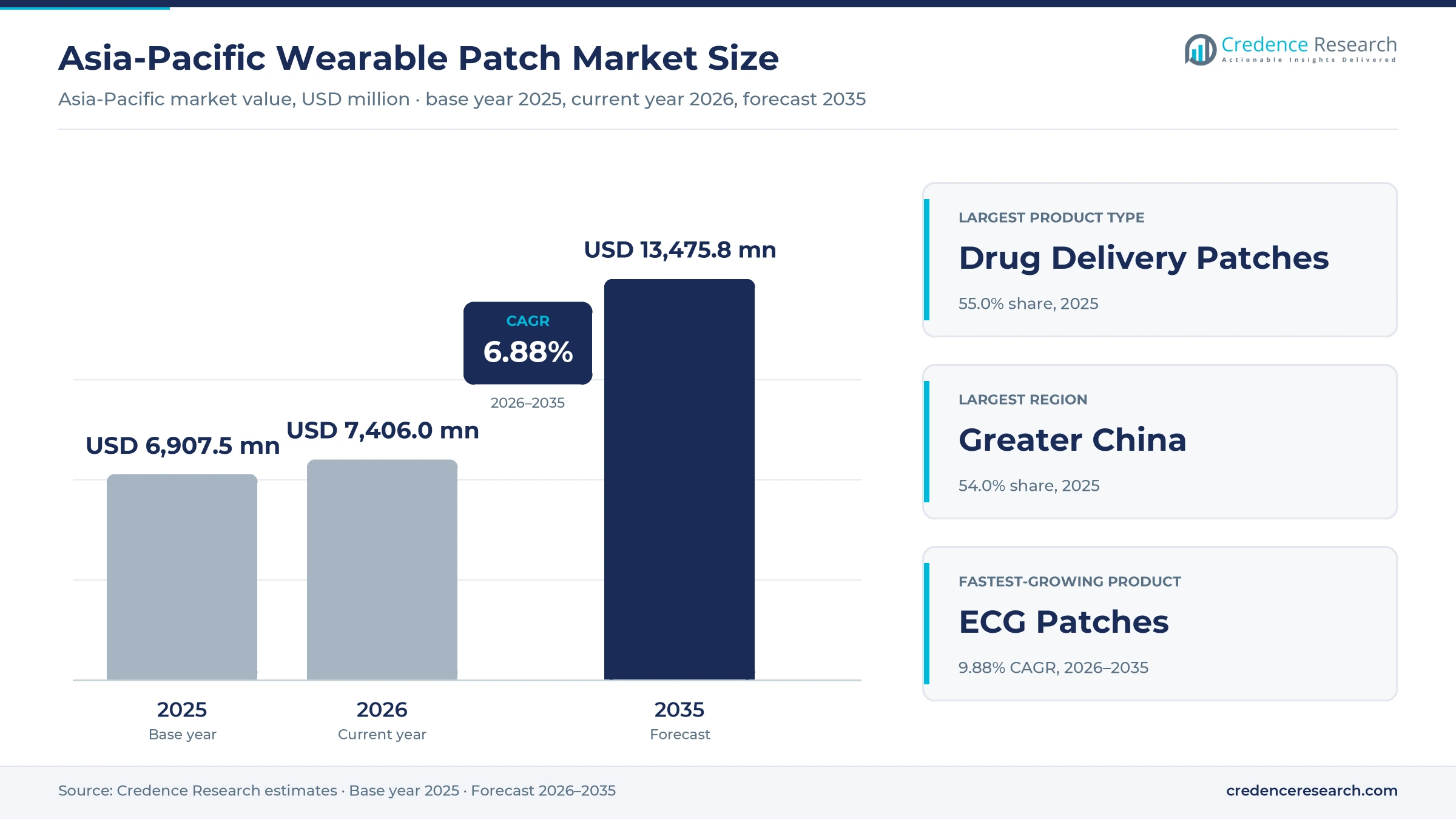
Asia-Pacific Wearable Patch Market Insights
- The market grows from USD 6.91 billion in 2025 to USD 13.48 billion by 2035, a 6.88% annual rate that reflects both mature plaster demand and faster electronic patch uptake.
- Greater China led the region with 54.0% of 2025 value, supported by China's plaster market and 148.0 million adults with diabetes in 2024.
- Drug Delivery Patches led product demand with 55.0% of 2025 value, because medicated plasters serve large numbers of older adults with musculoskeletal pain.
- Singapore extended device subsidies of 30% to 80% to two more diabetes groups on Dec. 1, 2025, which shows how payer decisions now shape regional access.
- China's sensor price fell sharply after 2016, with one entrant selling near 90 yuan per unit, so domestic scale now challenges global brands on cost.
Drug delivery patches lead while ECG patches grow fastest
Why do drug delivery patches hold the largest product share?
Based on product type, the market is categorized into CGM patches, drug delivery patches, ECG patches and supportive monitoring and stimulation patches. Drug Delivery Patches led with 55.0% of 2025 value because China alone had a medicinal plaster market of about RMB 20.4 billion in 2023, according to Pharnexcloud, a Chinese pharmaceutical database. ECG Patches grow fastest at 9.88% a year as test volumes shift from wired recorders. Seers Technology reported that its mobiCARE tests in South Korea rose from 1,700 in 2020 to 102,400 in 2023, according to Asia Economy.
Which disease areas generate the most patch spending?
Based on disease area, the market is categorized into diabetes, cardiovascular disorders, pain disorders and non-cardiometabolic conditions. Pain Disorders led with 46.0% of 2025 value because analgesic plasters carry high volumes, and a filing by Tianjin Pharmaceutical Da Ren Tang in November 2025 put national sales of one reference loxoprofen plaster above RMB 1.7 billion in 2024. Cardiovascular Disorders grow fastest at 9.56% a year as undetected arrhythmia draws more testing. A national study in China published in April 2022 found crude atrial fibrillation prevalence of 2.3%, which rose to 5.9% at age 80 and older.
Why does home care lead while outpatient use accelerates?
Based on care setting, the market is categorized into home care, outpatient care and inpatient care. Home Care led with 61.0% of 2025 value because sensors and plasters are worn through daily life, and Japan has reimbursed sensors since March 2022 for all people using insulin at least once daily, according to MassDevice. Outpatient Care grows fastest at 7.61% a year as clinics order multi-day recordings. Seers Technology said more than 580 primary institutions in South Korea had adopted its service by September 2024, according to Asia Economy, which shows that testing has moved beyond tertiary hospitals.
How do provider, pharmacy and online channels divide sales?
Based on channel, the market is categorized into provider procurement, retail pharmacy and licensed digital channels. Provider Procurement led with 50.0% of 2025 value because hospital sales of plasters in China reached RMB 14.2 billion in 2024, according to Pharnexcloud. Retail pharmacy remains central for repeat users, as Australia sells subsidized sensors through National Diabetes Services Scheme access points. Licensed Digital Channels grow fastest at 9.38% a year as consumers compare prices online. SingHealth reported in December 2025 that the Dexcom G6 sold for about S$95.90 on Lazada and Shopee, so online listings now set visible reference prices.
| Segment Group | Leading Sub-segment | Share, 2025 | Fastest-growing Sub-segment | CAGR, 2026–2035 |
|---|---|---|---|---|
| By Product Type | Drug Delivery Patches | 55.0% | ECG Patches | 9.88% |
| By Disease Area | Pain Disorders | 46.0% | Cardiovascular Disorders | 9.56% |
| By Care Setting | Home Care | 61.0% | Outpatient Care | 7.61% |
| By Channel | Provider Procurement | 50.0% | Licensed Digital Channels | 9.38% |
Request a Free Sample
Fill in your details and we'll send you a free sample report.
- Sample data tables & charts
- Research methodology
Diabetes, coverage and cardiac testing lift patch demand
Chronic-disease monitoring demand rises with diabetes counts
Diabetes prevalence sets the volume base for continuous glucose monitoring devices, because each insulin user becomes a recurring buyer of disposable wear time. The International Diabetes Federation counted 148.0 million adults with diabetes in China and 89.8 million in India in 2024. The federation also projects that its South-East Asia region will rise 73% to 184.5 million adults by 2050, which extends the runway beyond the two largest countries. Age adds a further base, as Japan's Cabinet Office recorded 36.24 million residents aged 65 or older in October 2024. China's Ministry of Civil Affairs counted 323.38 million people aged 60 or older at the end of 2025. These counts keep repeat sensor and plaster purchases high through 2035.
Reimbursement-supported continuity keeps patients on sensors
Public coverage matters because a patch only earns recurring revenue when patients can afford continuous wear. Japan widened sensor coverage in March 2022 to all people using insulin at least once a day, according to MassDevice and a new C150 category in December 2022 extended similar access for the Dexcom G6, according to Drug Delivery Business News. South Korea set a standard amount of 10,000 won per day for glucose sensors, with national insurance paying 70%, according to Asia Economy in September 2024. Australia sets a monthly cost of A$32.50 for eligible people with type 1 diabetes under its National Diabetes Services Scheme since July 2022. Together, these rules explain why 16.9% of 2025 value sits in two aging, well-insured markets.
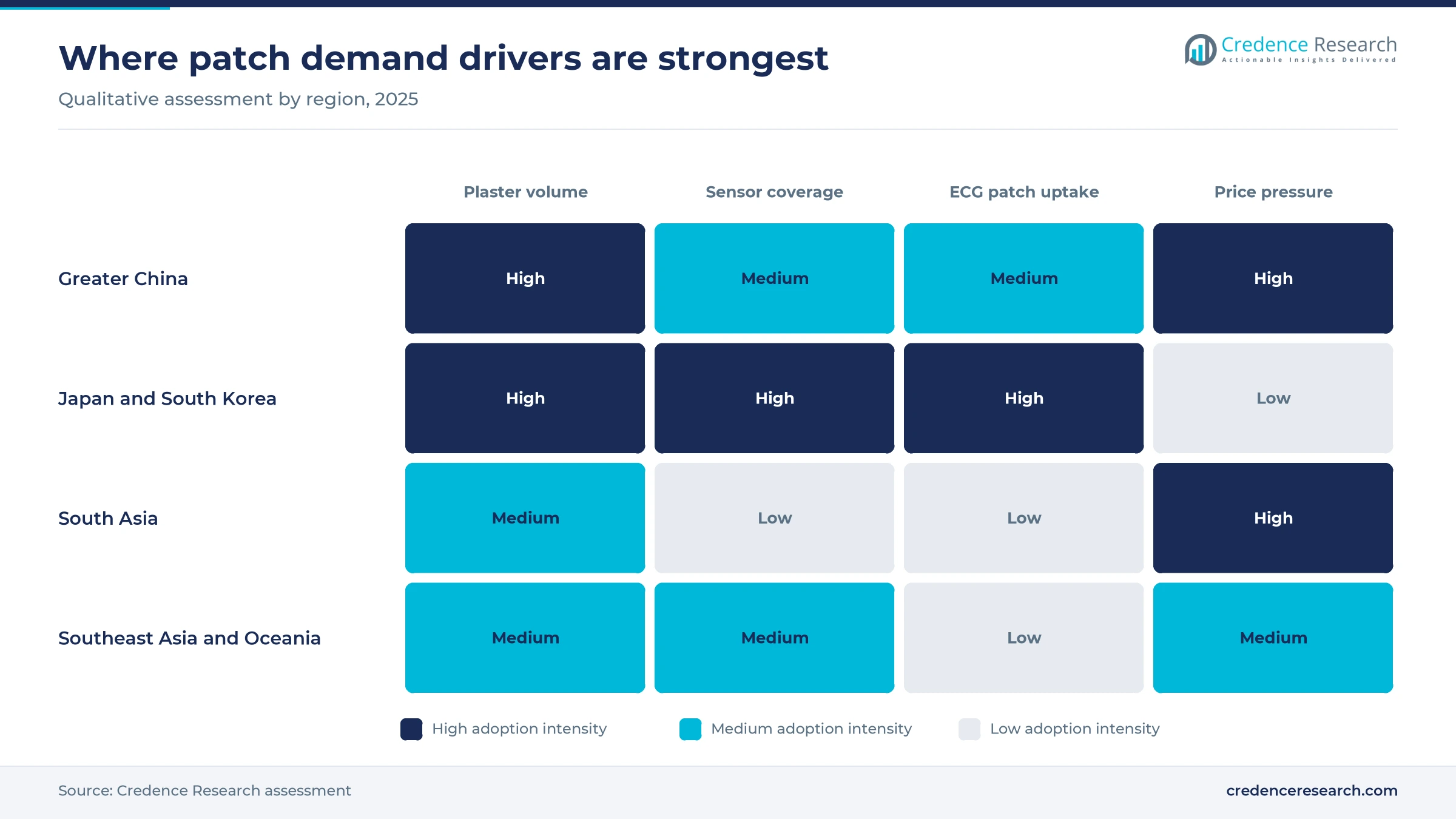
Ambulatory monitoring and channel expansion widen patch reach
Ambulatory testing is moving from wired recorders to adhesive devices, which opens a new route for wireless ECG devices in clinics. iRhythm said in September 2024 that Japan prescribes about 1.6 million ambulatory cardiac tests a year, and its regulator had just approved the 14-day Zio service. South Korea created fee codes in 2022 for wearable ECG recording beyond 48 hours, and Seers Technology then saw annual tests pass 100,000 by 2023, according to Asia Economy. In India, Wellysis said in January 2024 that it would supply S-Patch devices for 50,000 hospital beds through Dozee. Channel reach has widened as well, since Abbott and 1mg began prescription-based online sensor sales in India in July 2020.
New plaster registrations widen pain therapy supply in China
Pain remains the largest volume use, and new registrations show that drug makers still expect returns from plasters. China's medicinal plaster market reached about RMB 20.4 billion in 2023, according to Pharnexcloud, with chemical drugs at 34% of value and traditional Chinese medicine products at the rest. Tianjin Pharmaceutical Da Ren Tang received a loxoprofen cataplasm registration valid to November 2030, according to its November 2025 filing. Hubei Jumpcan's subsidiary won approval in September 2025 for a 700 mg lidocaine patch for post-herpetic neuralgia, according to FilingReader. Hisamitsu Pharmaceutical also said in May 2025 that Salonpas held its top global position among OTC topical analgesic patches for a ninth year, with eight Asian markets in the study base.
Longer wear and patch ECG reshape regional buying
Shift toward 15-day sensors reduces changes for patients
Wear time is becoming a primary purchase criterion, since fewer sensor changes lower both irritation and monthly cost. Abbott launched the FreeStyle Libre 2 Plus in India in August 2025 with up to 15 days of wear, according to Lokmat Times, and its label covers users aged 2 and above. Sinocare presented its iCan sensor at the China International Import Expo in November 2025, with 15-day wear and a design that is 60% smaller than earlier versions, according to the company. iRhythm also sells a 14-day ECG service in Japan, as GuruFocus reported in May 2025. As a result, suppliers selling 7-day or 10-day products face growing pressure to extend wear or lower price in competitive tenders and pharmacy listings.
Rise of patch ECG displaces short Holter recording
Cardiac testing is moving toward longer recording because many arrhythmias do not appear within one or two days. Telemetry monitoring in hospitals is now joined by adhesive recorders that patients keep wearing at home. GuruFocus reported in May 2025 that Japanese wired recorders typically run 24 to 48 hours, against 14 days for the Zio service. In South Korea, Seers Technology said 42 of 47 tertiary hospitals and more than 220 secondary institutions used mobiCARE by September 2024, according to Asia Economy. The Asia-Pacific region also had about 80 million atrial fibrillation cases in 2023, according to a December 2024 editorial in the journal JACC Asia. ECG Patches therefore grow at 9.88%, the fastest product rate in the report.
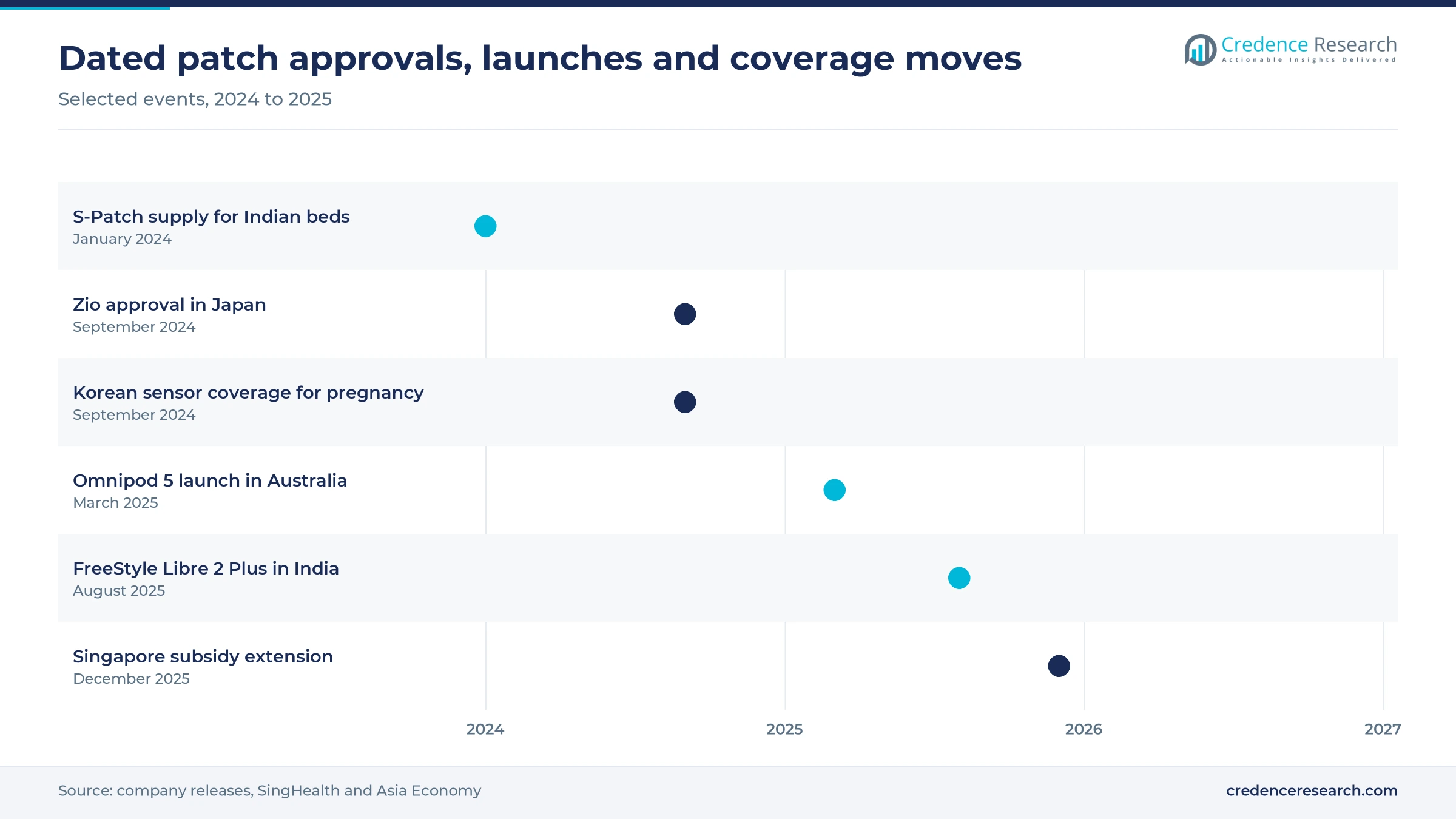
Opening in non-insulin type 2 coverage for sensor makers
The largest untapped pool is people with type 2 diabetes who do not use insulin, and coverage could open it in stages. Singapore's Ministry of Health said in May 2026 that it is assessing possible type 2 subgroups, provided sensors prove clinically and cost-effective, while its subsidies of 30% to 80% now reach mainly type 1 patients. Dexcom's chief executive said in January 2026 that international coverage is a priority, and the company plans a randomized trial of non-insulin patients that year, according to Medical Device Network. Some Chinese regions already provide partial insurance reimbursement, according to Caixin in November 2024. Suppliers that fund local evidence and agree lower prices can open this group first, particularly in Japan and South Korea, where structured payer rules already exist for insulin users.
Opening in South Asia for pediatric and hospital patches
South Asia offers the widest gap between patient numbers and patch use, which creates an opening for affordable sensors and hospital monitoring. The International Diabetes Federation counted 34.5 million adults with diabetes in Pakistan and 13.9 million in Bangladesh in 2024, in addition to India. Medtronic cited 171,300 Indian children and adolescents with type 1 diabetes when it launched the MiniMed 780G in March 2022, according to TimesTech. Abbott now labels its newest Indian sensor for children aged 2 and above. Insulin pump adoption remains early, so tubeless suppliers still have room to enter. These programs matter most outside metropolitan specialist centers, where few patients have used a sensor or a pump.
Price cuts and narrow coverage limit patch returns
Sensor price compression squeezes Chinese margins
Caixin reported in November 2024 that China's first sensor launched at 450 yuan in 2016, while one new entrant now sells near 90 yuan. The publication described that price as unsustainable and linked it to negative gross margins. This squeezes smaller domestic makers most, because several struggled with mass production. As a result, weak entrants may leave the market, so survivors need stronger manufacturing scale and clinical evidence to defend hospital listings against lower-priced rivals.
Narrow subsidy rules keep many users on self-pay
SingHealth reported that patients in Singapore could spend more than S$200 a month on sensors without a subsidy, and the Dexcom G6 is the only subsidized model named in that December 2025 report. Singapore's health ministry added in May 2026 that suppliers charge more there because of the small market and high incomes. Most people with type 2 diabetes therefore remain outside the subsidy. Suppliers can reduce this barrier through lower local pricing and outcome data that supports wider public funding.
Procurement reform adds uncertainty for plaster makers
China's National Healthcare Security Administration asked medical institutions in August 2025 to submit procurement volumes for 55 medicines, which shows how quickly bulk buying can reset hospital prices. Jumpcan warned in September 2025 that its new lidocaine patch faces procurement and policy risks, although urban public hospital sales of the category were only CNY 64.75 million in 2024. Plaster makers therefore need retail demand as a hedge, because hospital channels can reprice sharply after a tender.
Coverage gates delay launches and limit consumer retention
Commercial launches can wait on payers even after approval, as iRhythm said in September 2024 that its Japanese launch depended on a health ministry reimbursement decision. South Korean coverage also moves in narrow steps, since a September 2024 decision added pregnant women needing insulin, with support ending 15 days after the expected delivery date. Caixin also reported low retention among Chinese consumers without diabetes. Suppliers therefore need patient support and payer files prepared before launch, or early volume can fade quickly.
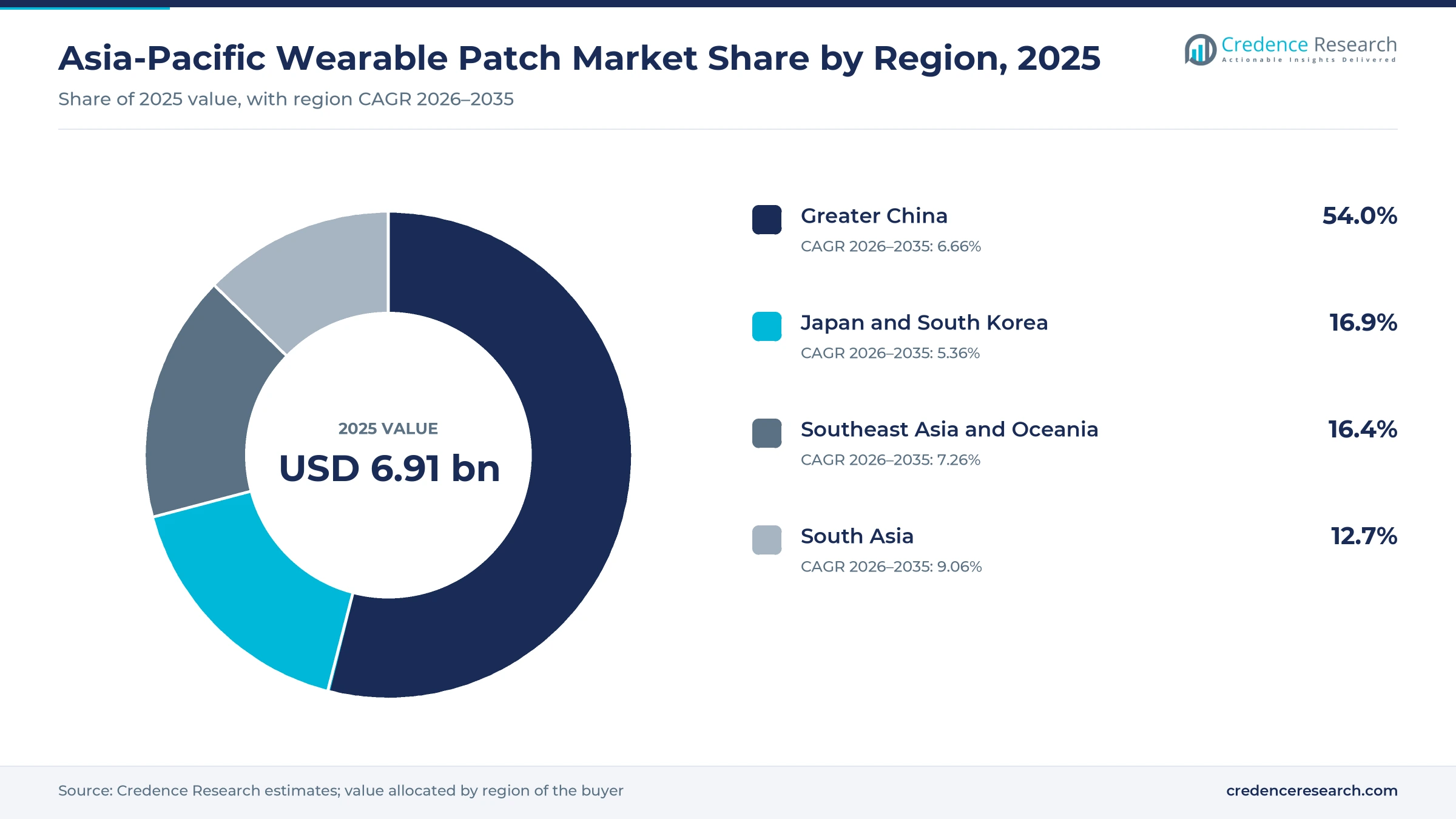
Greater China leads as South Asia gains share
| Region | Value, 2025 (USD billion) | Share, 2025 | CAGR, 2026–2035 |
|---|---|---|---|
| Greater China | 3.73 | 54.0% | 6.66% |
| Japan and South Korea | 1.17 | 16.9% | 5.36% |
| Southeast Asia and Oceania | 1.13 | 16.4% | 7.26% |
| South Asia | 0.88 | 12.7% | 9.06% |
Greater China combines plaster scale with sensor competition
Greater China held 54.0% of 2025 value and grows at 6.66% a year. The region leads because China had 148.0 million adults with diabetes in 2024, according to the International Diabetes Federation, and a medicinal plaster market of about RMB 20.4 billion in 2023, according to Pharnexcloud. Competition is intense, since Caixin reported Abbott at about 57% of sensor sales in 2023 and described a domestic challenger claiming capacity above 6 million units a year.
Japan and South Korea rely on structured reimbursement
Japan and South Korea held 16.9% of 2025 value and grow at 5.36% a year, the slowest regional rate because both populations are already well covered. Japan had 29.3% of residents aged 65 or older in October 2024, according to its Cabinet Office, and South Korea reached 20% in December 2024, according to its interior ministry. Salonpas maker Hisamitsu Pharmaceutical anchors plaster demand, and national fee schedules support glucose and ECG patch use.
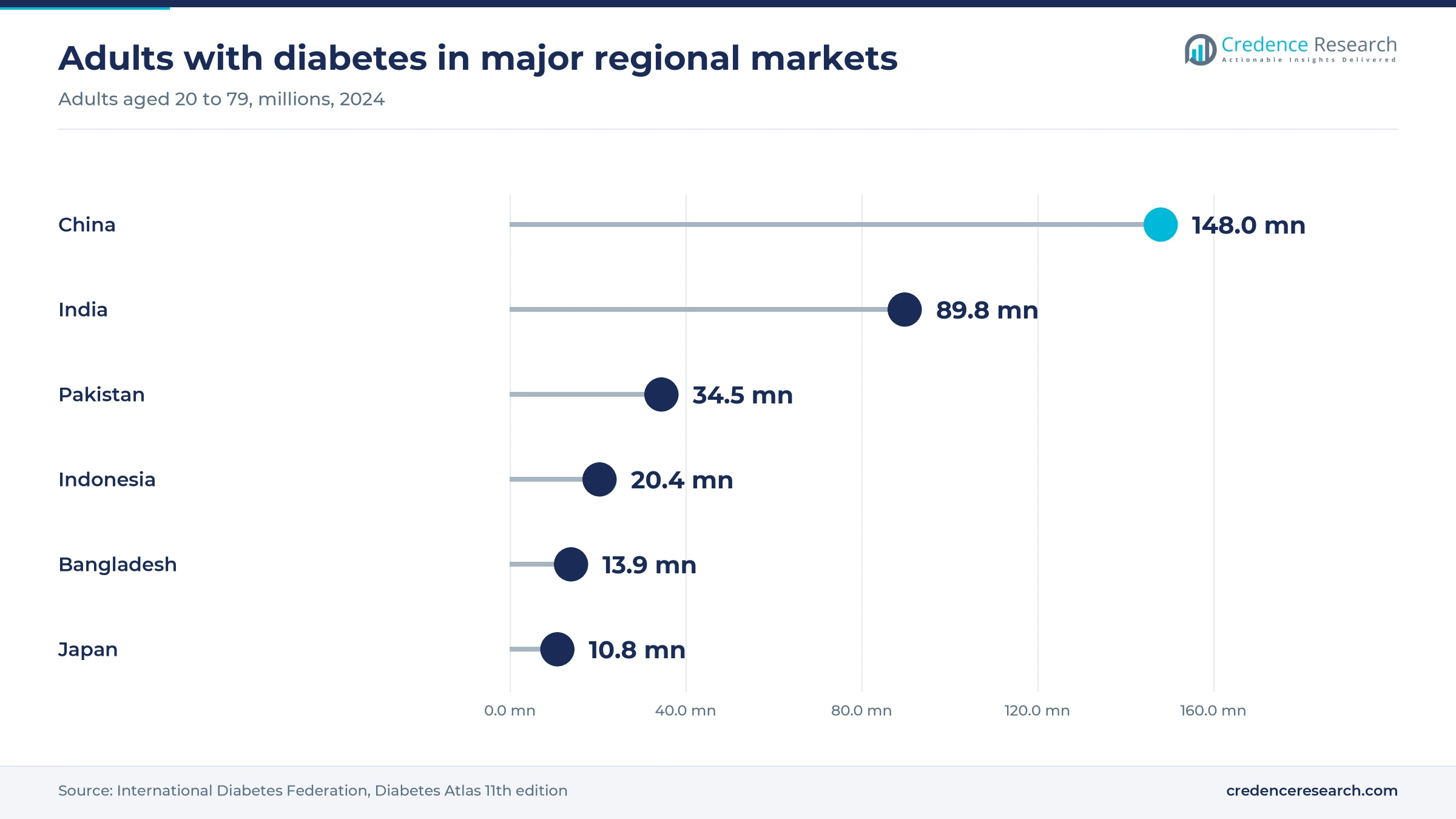
South Asia grows fastest from a low treatment base
South Asia held 12.7% of 2025 value and grows at 9.06% a year, the fastest regional rate. India had 89.8 million adults with diabetes in 2024, Pakistan 34.5 million and Bangladesh 13.9 million, according to the International Diabetes Federation. Access is improving through named products, including Abbott's FreeStyle Libre 2 Plus launched in India in August 2025 and Dr. Reddy's Nerivio migraine wearable rolled out in November 2023. Most users still pay directly, which keeps price central to uptake.
Southeast Asia and Oceania pair subsidies with new launches
Southeast Asia and Oceania held 16.4% of 2025 value and grow at 7.26% a year. Indonesia had 20.4 million adults with diabetes in 2024, according to the International Diabetes Federation, while Singapore and Australia provide the clearest subsidy models. Singapore extended sensor subsidies to two further diabetes groups in December 2025, according to SingHealth. Insulet launched Omnipod 5 in Australia in March 2025, according to Nasdaq, which brought a tubeless automated insulin system working with Dexcom G6 and G7 sensors.
Approvals and launches extended patch access since 2024
| Development | Status and market relevance |
|---|---|
| In September 2024, iRhythm received Japanese approval for its Zio 14-day ECG monitoring service. | Approved, with launch reported in May 2025; widens long-wear cardiac testing in Japan |
| In March 2025, Insulet launched Omnipod 5 in Australia, working with Dexcom G6 and G7 sensors. | Commercial; adds a tubeless automated insulin option in Oceania |
| In August 2025, Abbott launched the FreeStyle Libre 2 Plus sensor in India for users aged 2 and above. | Commercial; extends 15-day wear to South Asian users |
| In November 2025, Tianjin Pharmaceutical Da Ren Tang disclosed a registration for loxoprofen cataplasms in China. | Approved; adds domestic supply in analgesic plasters |
| In December 2025, Singapore extended sensor subsidies of 30% to 80% to monogenic and pancreatogenic diabetes. | In force; widens funded access at public institutions |
Sensor wear time and gel plasters shape product choice
- Long-wear glucose sensors run up to 15 days in current Abbott and Sinocare models, and the Abbott sensor sends readings to a compatible smartphone every minute.
- Single-use ECG patches record continuously for up to 14 days in the Zio service, and an artificial intelligence algorithm supports the report a technician reviews.
- Gel-type cataplasms deliver analgesics such as lidocaine and loxoprofen through the skin, and Chinese makers are now registering their own versions with the national regulator.
- Tubeless insulin patches remove the need for tubing, and Omnipod 5 automates insulin delivery while working with Dexcom G6 and G7 sensors.
Need a Custom Version of This Report?
Tailor the scope, geography, or segments to your exact requirements.
- Custom geography or segment scope
- Direct access to our analyst team
Global sensor brands face fast domestic challengers
Wearable patch competition splits along product lines rather than across the whole market. In glucose sensing, Abbott holds a strong position across the region, and Medical Device Network reported in January 2026 that it far outsells Dexcom in Asia-Pacific. Dexcom competes through subsidized access in Singapore and Terumo-marketed supply in Japan, although Caixin reported that it had not entered China. Domestic makers such as SiBionics and Sinocare press on price and scale in China. Medtronic sells the MiniMed 780G in India and competes on automated delivery, whereas Insulet brings a tubeless design to Australia. In plasters, Hisamitsu Pharmaceutical relies on the Salonpas brand, while Chinese groups such as Tianjin Pharmaceutical Da Ren Tang and Hubei Jumpcan add registered generics. ECG competition is more local, with Seers Technology and Wellysis building positions from South Korea, and iRhythm entering Japan with a 14-day service.
Companies profiled and their roles in this market
| Company | Type | Role in the market |
|---|---|---|
| Abbott | Sensor brand owner | Sells FreeStyle Libre sensors in China, Japan and India, including the 15-day Libre 2 Plus launched in India in August 2025 |
| Hisamitsu Pharmaceutical | Plaster brand owner | Markets Salonpas analgesic patches, and its May 2025 release listed eight Asian markets in its brand study |
| Dexcom | Sensor brand owner | Sold through Terumo in Japan and named as the subsidized sensor in Singapore, and it had not entered China as of November 2024 |
| Medtronic | Automated insulin supplier | Launched the MiniMed 780G in India in March 2022 and received Chinese sensor approval in 2020 |
| Insulet | Tubeless pump supplier | Launched Omnipod 5 in Australia in March 2025, paired with Dexcom G6 and G7 sensors |
Coverage decisions will decide which patches scale
Credence Research's view is that payer decisions on each wearable patch, rather than sensor engineering, will decide the winners over the next five years. Most large suppliers now offer wear times near 15 days, so the difference moves to who secures coverage and at what price. Greater China should stay the largest region because of plaster scale, although sensor price cuts will limit value growth there. Japan and South Korea offer stable margins with slower volume gains. The most assumption-heavy estimate here is the split between pain and diabetes value, because few public sources report both on one basis.
How the regional patch estimates were built
The report uses 2025 as the base year and forecasts values to 2035, drawing market values from the Credence Research model. Segment and regional splits are Credence Research estimates, informed by public sources including International Diabetes Federation statistics, government statistics and health ministry statements, company releases and filings, peer-reviewed papers and business press. The scope covers both non-electronic and electronic patches worn on the skin. No interviews or surveys were conducted for this edition, and estimates should be read as modeled values rather than audited sales totals.
Home use and wider coverage carry growth to 2035
The market is expected to reach USD 13.48 billion by 2035, with growth of 6.88% a year through 2026–2035. Home use should keep the largest place, because older populations and insulin users wear patches through daily life. The next major step would be public coverage for selected type 2 patients without insulin, which would change volumes well beyond current assumptions. Plasters should grow more slowly as China's procurement rules press prices down. ECG patches should keep the fastest product rate, provided clinics in Japan, South Korea and India continue moving away from wired recorders for arrhythmia testing.
Frequently Asked Questions
How big is the Asia-Pacific wearable patch market?
Which region leads the market?
Which region grows fastest?
Which product type is the largest?
Which product type grows fastest?
How does reimbursement affect patch demand?
Who are the main companies in the market?
What are the main challenges for suppliers?
Table of Content
Chapter 1 Market Segmentation
- 1.1 Segmentation Framework
- 1.1.1 Product and Service Classification
- 1.1.2 Application and End-Use Classification
- 1.1.3 Technology and Solution Classification
- 1.1.4 Customer and Distribution Channel Classification
- 1.1.5 Geographic Segmentation
- 1.1.6 Market Segment Definitions and Boundaries
- 1.2 By Product Type
- 1.2.1 Drug Delivery Patches
- 1.2.2 CGM Patches
- 1.2.3 ECG Patches
- 1.2.4 Supportive Monitoring and Stimulation Patches
- 1.3 By Disease Area
- 1.3.1 Pain Disorders
- 1.3.2 Diabetes
- 1.3.3 Cardiovascular Disorders
- 1.3.4 Non-Cardiometabolic Conditions
- 1.4 By Care Setting
- 1.4.1 Home Care
- 1.4.2 Outpatient Care
- 1.4.3 Inpatient Care
- 1.5 By Channel
- 1.5.1 Provider Procurement
- 1.5.2 Retail Pharmacy
- 1.5.3 Licensed Digital Channels
Chapter 2 Introduction
- 2.1 Report Objectives and Scope
- 2.2 Product Definition and Industry Terminology
- 2.3 Market Inclusions and Exclusions
- 2.4 Research Process
- 2.4.1 Primary Research and Expert Interviews
- 2.4.2 Secondary Research and Source Review
- 2.4.3 Top-Down and Bottom-Up Estimation
- 2.4.4 Data Triangulation and Verification
- 2.5 Market Size Measurement Basis
- 2.5.1 2025: USD 6.91 billion → 2035: USD 13.48 billion
- 2.6 Historical and Forecast Reference Periods
- 2.6.1 Historical Period: 2018-2025
- 2.6.2 Base Year: 2025
- 2.6.3 Forecast Period: 2025-2035
- 2.7 Research Assumptions and Limitations
Chapter 3 Executive Summary
- 3.1 Market Snapshot and Key Findings
- 3.2 Base-Year Market Size, 2025
- 3.3 Forecast Market Size, 2035
- 3.4 Revenue and Volume Growth Outlook
- 3.5 Key Demand and Supply Indicators
- 3.6 Leading Market Segments
- 3.7 Fastest-Growing Market Opportunities
- 3.8 Regional Performance Highlights
- 3.9 Technology and Industry Transformation
- 3.10 Competitive Landscape Summary
- 3.11 Analyst View and Strategic Implications
Chapter 4 Asia-Pacific Wearable Patch Market Trends and Developments
- 4.1 Historical Industry Development, 2018-2025
- 4.2 Recent Market Trends and Developments
- 4.3 Demand and Customer Behavior Trends
- 4.4 Technology and Product Innovation
- 4.5 Artificial Intelligence, Automation and Digitalization
- 4.6 Local Manufacturing and Supply Chain Realignment
- 4.7 Industry Partnerships, Mergers and Acquisitions
- 4.8 Sustainability and Circular Economy Developments
- 4.9 Government and Private Sector Investment Trends
- 4.10 Emerging Business Models and Commercialization
- 4.11 Industry Developments and Announcements
Chapter 5 Asia-Pacific Wearable Patch Market Production, Supply and Demand Analysis
- 5.1 Demand Trend and Consumption Analysis, 2018-2025
- 5.2 Demand Forecast, 2025-2035
- 5.3 Production and Output Trend, 2018-2025
- 5.4 Production and Output Forecast, 2025-2035
- 5.5 Installed Capacity and Capacity Utilization
- 5.6 Company-Wise Production Plants and Statistics
- 5.6.1 Installed Production Capacity
- 5.6.2 Actual Production
- 5.6.3 Planned Capacity and Expansion Targets
- 5.7 Supply Chain Structure and Procurement Trends
- 5.8 Supply-Demand Gap and Bottlenecks
- 5.9 Import Dependence and Sourcing Structure
- 5.10 Contract Manufacturing and Outsourcing
- 5.11 Regional Supply and Demand Concentration
Chapter 6 Asia-Pacific Wearable Patch Market Pricing Analysis
- 6.1 Pricing Structure and Measurement
- 6.2 Historical Pricing Trends, 2018-2025
- 6.3 Pricing Outlook, 2025-2035
- 6.4 Average Selling Price and Unit Economics
- 6.5 Pricing by Product and Market Segment
- 6.6 Geographic Pricing Differences
- 6.7 Key Input, Energy, Labor and Logistics Costs
- 6.8 Contract Pricing and Purchasing Models
- 6.9 Pricing Sensitivity and Competitive Positioning
- 6.10 Price, Margin and Profitability Implications
Chapter 7 Asia-Pacific Wearable Patch Market Dynamics
- 7.1 Market Growth Drivers
- 7.1.1 Demand-Side Drivers
- 7.1.2 Technology and Innovation Drivers
- 7.1.3 Infrastructure and Investment Drivers
- 7.1.4 Regulatory and Policy Drivers
- 7.2 Market Restraints
- 7.2.1 Cost and Affordability Constraints
- 7.2.2 Technology and Adoption Barriers
- 7.2.3 Supply Chain and Operational Constraints
- 7.3 Market Challenges
- 7.3.1 Competitive Pressure and Margin Erosion
- 7.3.2 Skills, Infrastructure and Implementation Gaps
- 7.4 Emerging Market Opportunities
- 7.5 Market Dynamics Impact and Time-Horizon Assessment
Chapter 8 Asia-Pacific Wearable Patch Value Chain Analysis
- 8.1 Industry Value Chain Overview
- 8.2 Upstream Suppliers and Critical Inputs
- 8.3 Technology and Component Providers
- 8.4 Manufacturing or Service Delivery
- 8.5 Distribution, Channel Partners and Integrators
- 8.6 Downstream Applications and End Users
- 8.7 Value Addition and Profit Pools
- 8.8 Vertical Integration and Outsourcing
- 8.9 Supplier Concentration and Risk
- 8.10 Supply Chain Localization and Resilience
Chapter 9 Asia-Pacific Wearable Patch Market Regulations and Policies
- 9.1 Relevant Laws, Standards and Compliance Frameworks
- 9.2 Product, Service, Safety and Quality Requirements
- 9.3 Government Policies, Incentives and Subsidies
- 9.4 Imports, Exports and Trade Barriers
- 9.5 Public Procurement and Local Content Requirements
- 9.6 Environmental and Sustainability Compliance
- 9.7 Upcoming Policy Changes and Market Implications
Chapter 10 Asia-Pacific Wearable Patch Market Hotspots and Opportunities
- 10.1 Market Opportunity Mapping and Growth Hotspots
- 10.2 High-Growth Applications and Customer Groups
- 10.3 Underserved Markets and White-Space Opportunities
- 10.4 Emerging Technology and Product Opportunities
- 10.5 New Capacity and Investment Hotspots
- 10.6 Market Entry and Expansion Opportunities
- 10.7 Distribution and Partnership Opportunities
- 10.8 Near-Term and Long-Term Commercial Potential
- 10.9 Opportunity Attractiveness and Execution Risks
Chapter 11 Asia-Pacific Wearable Patch Market Outlook, 2025-2035
- 11.1 Market Size and Analysis
- 11.1.1 Revenue (Market Measurement: 2025: USD 6.91 billion → 2035: USD 13.48 billion)
- 11.1.2 Market Volume and Quantity Sold
- 11.1.3 Historical Market Size, 2018-2025
- 11.1.4 Base-Year Market Size, 2025
- 11.2 Market Forecast, 2025-2035
- 11.2.1 Revenue Forecast to 2035
- 11.2.2 Volume Forecast to 2035
- 11.2.3 CAGR and Year-on-Year Growth
- 11.2.4 Incremental Revenue Opportunity
- 11.3 Forecast Assumptions and Scenario Analysis
- 11.3.1 Base-Case Forecast
- 11.3.2 Optimistic and Conservative Scenarios
- 11.3.3 Technology, Pricing and Policy Sensitivities
- 11.4 Market Attractiveness and Growth Outlook
Chapter 12 Asia-Pacific Wearable Patch Market Segmentation and Outlook
- 12.1 Segmentation Summary and Market Shares, 2025
- 12.2 Largest and Fastest-Growing Segments
- 12.3 By Product Type - Market Size and Forecast, 2025-2035
- 12.3.1 Segment Definition and Scope
- 12.3.2 Historical Market Size, 2018-2025
- 12.3.3 Revenue Forecast, 2025-2035
- 12.3.4 Volume Forecast, 2025-2035
- 12.3.5 Base-Year Market Share, 2025
- 12.3.6 Segment CAGR and Growth Drivers
- 12.3.7 Subsegment Market Size and Forecast
- 12.3.7.1 Drug Delivery Patches
- 12.3.7.2 CGM Patches
- 12.3.7.3 ECG Patches
- 12.3.7.4 Supportive Monitoring and Stimulation Patches
- 12.3.8 Subsegment Pricing and Adoption Trends
- 12.3.9 Leading Suppliers and Competition
- 12.3.10 Regional Demand and Opportunities
- 12.4 By Disease Area - Market Size and Forecast, 2025-2035
- 12.4.1 Segment Definition and Scope
- 12.4.2 Historical Market Size, 2018-2025
- 12.4.3 Revenue Forecast, 2025-2035
- 12.4.4 Volume Forecast, 2025-2035
- 12.4.5 Base-Year Market Share, 2025
- 12.4.6 Segment CAGR and Growth Drivers
- 12.4.7 Subsegment Market Size and Forecast
- 12.4.7.1 Pain Disorders
- 12.4.7.2 Diabetes
- 12.4.7.3 Cardiovascular Disorders
- 12.4.7.4 Non-Cardiometabolic Conditions
- 12.4.8 Subsegment Pricing and Adoption Trends
- 12.4.9 Leading Suppliers and Competition
- 12.4.10 Regional Demand and Opportunities
- 12.5 By Care Setting - Market Size and Forecast, 2025-2035
- 12.5.1 Segment Definition and Scope
- 12.5.2 Historical Market Size, 2018-2025
- 12.5.3 Revenue Forecast, 2025-2035
- 12.5.4 Volume Forecast, 2025-2035
- 12.5.5 Base-Year Market Share, 2025
- 12.5.6 Segment CAGR and Growth Drivers
- 12.5.7 Subsegment Market Size and Forecast
- 12.5.7.1 Home Care
- 12.5.7.2 Outpatient Care
- 12.5.7.3 Inpatient Care
- 12.5.8 Subsegment Pricing and Adoption Trends
- 12.5.9 Leading Suppliers and Competition
- 12.5.10 Regional Demand and Opportunities
- 12.6 By Channel - Market Size and Forecast, 2025-2035
- 12.6.1 Segment Definition and Scope
- 12.6.2 Historical Market Size, 2018-2025
- 12.6.3 Revenue Forecast, 2025-2035
- 12.6.4 Volume Forecast, 2025-2035
- 12.6.5 Base-Year Market Share, 2025
- 12.6.6 Segment CAGR and Growth Drivers
- 12.6.7 Subsegment Market Size and Forecast
- 12.6.7.1 Provider Procurement
- 12.6.7.2 Retail Pharmacy
- 12.6.7.3 Licensed Digital Channels
- 12.6.8 Subsegment Pricing and Adoption Trends
- 12.6.9 Leading Suppliers and Competition
- 12.6.10 Regional Demand and Opportunities
- 12.7 Segment Growth Comparison
- 12.8 Segment Attractiveness and Priority Matrix
Chapter 13 Asia-Pacific Wearable Patch Geographic Market Outlook, 2025-2035
- 13.1 Regional Market Size and Country-Level Shares, 2025
- 13.2 Country Market Size Comparison, 2025
- 13.3 Country Market Forecasts, 2025-2035
- 13.4 Subregional Industrial and Demand Clusters
- 13.5 Intra-Regional Pricing and Cost Differences
- 13.6 Cross-Border Trade and Supply Networks
- 13.7 Regional Supply and Demand Balances
- 13.8 Country Opportunity Comparison and Prioritization
Note: Every listed country is covered on the structure shown under the first country.
Chapter 14 Asia-Pacific Wearable Patch Technology, Innovation and Sustainability Outlook
- 14.1 Technology Landscape and Maturity
- 14.2 Product, Process and Service Innovation
- 14.3 AI, Automation and Digital Tools in the Industry
- 14.4 Technology Adoption and Performance Benchmarking
- 14.5 Innovation Pipeline and R&D Investment
- 14.6 Patent and Intellectual Property Trends
- 14.7 Energy Efficiency and Resource Management
- 14.8 Sustainability, Recycling and Circularity
- 14.9 Technology Roadmap, 2025-2035
- 14.10 Risks of Obsolescence and Technology Substitution
Chapter 15 Asia-Pacific Wearable Patch Market Key Strategic Imperatives
- 15.1 Growth and Market Entry Priorities
- 15.2 High-Return Products and Segments
- 15.3 Pricing, Profitability and Cost Optimization
- 15.4 Technology Investment and Product Differentiation
- 15.5 Supply Chain Localization and Resilience
- 15.6 Distribution and Customer Acquisition
- 15.7 Partnership, Acquisition and Capacity Strategy
- 15.8 Regional Expansion Priorities
- 15.9 Short-, Medium- and Long-Term Actions
Chapter 16 Competition Outlook
- 16.1 Industry Competition Characteristics
- 16.2 Market Structure and Concentration
- 16.3 Market Share and Competitive Positioning, 2025
- 16.4 Company-Wise Revenue and Product Benchmarking
- 16.5 Production and Service Capacity Benchmarking
- 16.6 Technology, Pricing and Differentiation
- 16.7 Regional Footprint and Distribution Strength
- 16.8 Mergers, Acquisitions and Strategic Alliances
- 16.9 New Entrants and Competitive Threats
- 16.10 Porter's Five Forces and Industry Attractiveness
- 16.11 Competitive Outlook, 2025-2035
Chapter 17 Company Profiles
- 17.1 Company Coverage and Selection Criteria
- 17.2 Abbott
- 17.2.1 Business Description
- 17.2.2 Company Ownership and Geographic Presence
- 17.2.3 Product and Service Portfolio
- 17.2.4 Manufacturing and Operating Footprint
- 17.2.5 Production Capacity and Expansion Plans
- 17.2.6 Financial Performance and Investment
- 17.2.7 Market Share and Competitive Position
- 17.2.8 Technology and Innovation Capabilities
- 17.2.9 Strategic Alliances or Partnerships
- 17.2.10 Recent Developments
- 17.2.11 Growth Strategy and Outlook
- 17.3 Hisamitsu Pharmaceutical
- 17.4 Dexcom
- 17.5 Medtronic
- 17.6 Insulet
- 17.7 Other Relevant Market Participants
Note: Every listed company is profiled on the structure shown under the first company. The company list is preliminary and may change based on research findings, market developments, data availability and client requirements.
Chapter 18 Disclaimer
- 18.1 Research and Forecast Disclaimer
- 18.2 Data Source and Estimation Limitations
Note: The depth of individual sections depends on data availability for this market. Volume, capacity, trade and other unit-based metrics are included where applicable.

