
Market Overview:
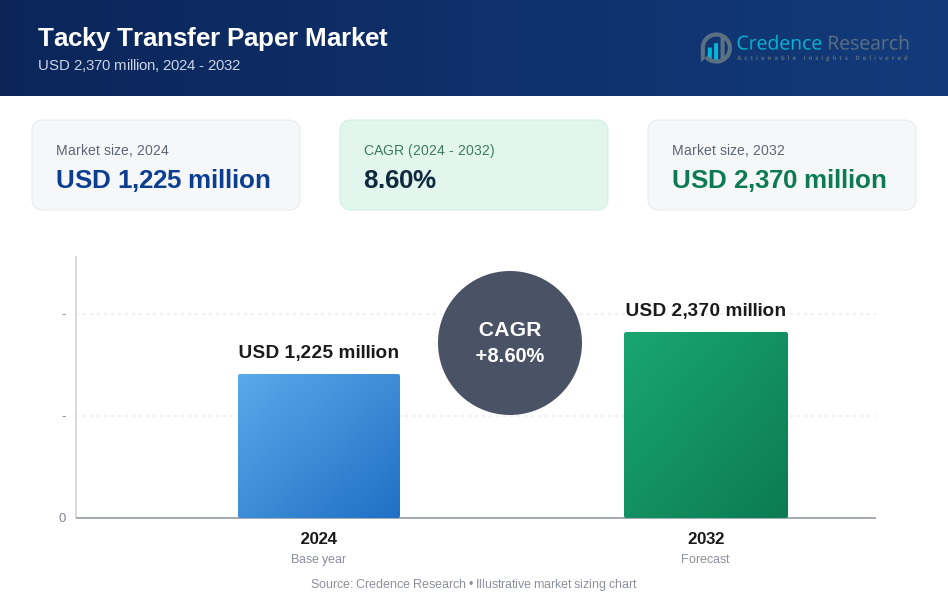
The Tacky transfer paper market size was valued at USD 1225 million in 2024 and is anticipated to reach USD 2370 million by 2032, at a CAGR of 8.6 % during the forecast period (2024-2032).
| REPORT ATTRIBUTE | DETAILS |
|---|---|
| Historical Period | 2020-2023 |
| Base Year | 2024 |
| Forecast Period | 2025-2032 |
| Tacky Transfer Paper Market Size 2024 | USD 1225 million |
| Tacky Transfer Paper Market, CAGR | 8.6% |
| Tacky Transfer Paper Market Size 2032 | USD 2370 million |
Key factors driving the tacky transfer paper market include the rising adoption of digital textile printing, growing demand for customized garments, and increased focus on high-resolution printing in sportswear and fashion industries. Tacky transfer paper plays a critical role in stabilizing prints during heat pressing, reducing ghosting and misalignment, especially on stretchy fabrics like polyester and elastane blends. Advancements in printer technology and the shift from traditional screen printing to digital alternatives have also expanded usage across small-scale and industrial printing operations. Furthermore, the rise in e-commerce-led personalized product offerings has spurred the use of tacky transfer paper in short-run production cycles.
Regionally, Asia Pacific dominates the tacky transfer paper market, accounting for the largest revenue share due to high textile production and rising exports in countries like China, India, Bangladesh, and Vietnam. North America and Europe are also significant markets, driven by strong demand for sportswear, promotional apparel, and customized consumer products, with key players such as Ptpurabarutama, Quad Inc, RR Donnelley & Sons, and Deluxe Corporation actively contributing to regional growth. The U.S., Germany, and Italy are witnessing growing adoption of sublimation printing in both commercial and small business segments. Latin America and the Middle East & Africa are emerging markets, supported by growing textile manufacturing activities and rising demand for customized goods. Overall, the global tacky transfer paper market is poised for consistent expansion across established and emerging economies.
Market Insights:
- The tacky transfer paper market was valued at USD 1,225 million in 2024 and is projected to reach USD 2,370 million by 2032.
- Rising demand for personalized apparel and short-run digital printing boosts market growth across fashion and promotional segments.
- Sportswear and performance apparel segments rely heavily on high-tack paper for accuracy on elastic fabrics like Lycra and polyester.
- Advancements in printer technologies and sublimation inks enhance image transfer quality, fueling demand in commercial setups.
- Asia Pacific leads with 42% market share, driven by strong textile output from China, India, Bangladesh, and Vietnam.
- North America and Europe follow with 26% and 18% shares respectively, supported by eco-friendly printing initiatives and custom printing services.
- Key challenges include sensitivity to humidity and high product costs, urging manufacturers to focus on innovation and affordability.
Market Drivers:
Rising Demand for Customization in Apparel and Promotional Products:
The growing consumer preference for personalized clothing and promotional merchandise is a major driver for the tacky transfer paper market. Brands and individuals increasingly seek custom graphics on apparel, bags, and accessories, fueling demand for precision printing. Tacky transfer paper offers enhanced grip on substrates during heat press, minimizing misalignment in customized applications. It supports short-run and on-demand printing, enabling businesses to respond to specific customer requests efficiently. The shift toward digital platforms and e-commerce is expanding access to personalized products. The tacky transfer paper market benefits from this trend, with increased usage in small businesses and home-based printing setups.
- For instance, Kornit Digital’s Apollo platform enables automated digital decoration of over 1.5 million garments annually with a single operator, exemplifying advanced short-run and on-demand production capabilities in the customization sector.
Expanding Applications in Sportswear and Performance Textiles:
Sportswear and activewear manufacturers prefer sublimation printing for its durability and color vibrancy. Tacky transfer paper plays a critical role in maintaining alignment during heat transfer on stretchable fabrics like polyester and Lycra. The market benefits from rising demand for high-quality, breathable, and branded performance apparel. Sports events, fitness culture, and athleisure trends continue to push the need for vivid and durable prints. It provides reliable image transfer with minimal ghosting, essential for premium garment output. The tacky transfer paper market is well-positioned to grow with the expanding sportswear segment globally.
Advancements in Digital Textile Printing Technology:
Technological improvements in inkjet printers, sublimation inks, and transfer systems are enhancing the overall efficiency of the sublimation printing process. These developments increase the effectiveness of tacky transfer paper by allowing consistent pressure and temperature control. It ensures sharper image transfer and better adhesion to the substrate, particularly in complex textile surfaces. Faster drying times and improved ink compatibility also support high-volume production. The tacky transfer paper market gains from these innovations as print service providers upgrade their infrastructure. Evolving machinery standards are aligning with the technical properties of advanced tacky transfer papers.
- For Instance, HPRT DA186T Plus high-speed sublimation digital printer is equipped with Kyocera industrial printheads, reaching production speeds of up to 1,080 m² per hour-an advancement making it one of the fastest printers available for high-volume operation.
Growth in Sustainable and Eco-Friendly Printing Practices:
Brands and manufacturers are shifting toward environmentally friendly printing solutions to comply with stricter regulations and consumer expectations. Tacky transfer paper with recyclable backings and water-based coatings meets sustainability benchmarks without compromising quality. It eliminates the need for additional adhesives or chemical treatments, reducing the environmental impact. The market sees higher adoption among eco-conscious printing operations, especially in Europe and North America. Government incentives and green certifications encourage the use of low-waste sublimation techniques. The tacky transfer paper market aligns with these sustainability goals through product innovations and material improvements.
Market Trends:
Shift Toward Hybrid and Multi-Use Transfer Paper Solutions:
Manufacturers are developing hybrid tacky transfer papers that perform efficiently across various fabric types and printer models. This trend addresses the growing need for flexibility in production environments handling diverse substrates, such as polyester, spandex, and performance blends. It helps reduce inventory complexity by eliminating the need for multiple paper types, streamlining operations for print service providers. Enhanced tack control features allow better handling during high-speed printing and heat pressing, supporting larger production volumes. The tacky transfer paper market benefits from this shift, as it promotes operational efficiency and cost savings across textile printing businesses. Brands prefer multi-use solutions that maintain print quality without compromising on compatibility or throughput.
- For instance, Epson’s DS Transfer Multi-Use Paper works efficiently on both textile and rigid substrates, achieving instant drying and excellent ink transfer at a basis weight of 85 g/m², enabling seamless production runs across diverse materials for brands leveraging a single paper solution.
Adoption of Water-Based and Sustainable Coating Technologies:
The rising demand for eco-friendly printing practices is driving the adoption of water-based and solvent-free coatings in tacky transfer papers. These coatings reduce emissions during production and ensure safer handling for operators. It supports compliance with international environmental standards, including REACH and OEKO-TEX certifications. Paper manufacturers are also introducing biodegradable and recyclable liner materials to meet sustainability goals. The tacky transfer paper market sees increased interest from apparel and home textile brands aiming to reduce their carbon footprint. The shift toward cleaner materials not only enhances environmental performance but also strengthens brand positioning in regulated and eco-conscious markets.
- Parameltsupplies water-based adhesives and coatings used in over 80 countries, offering products like Latyl™ and Enziflex™ for paper and board converting. The company’s Aquaseal™ range delivers heat-seal and barrier performance to paper-based products, supporting sustainable packaging initiatives globally.
Market Challenges Analysis:
High Sensitivity to Humidity and Handling Conditions:
Tacky transfer paper is highly sensitive to changes in humidity, temperature, and storage conditions, which can affect its performance during heat transfer. Excess moisture may reduce the tackiness of the paper, leading to misalignment or ghosting during printing. It requires controlled storage environments and careful handling to preserve its adhesive properties. This sensitivity creates operational challenges for printers working in variable climate zones. The tacky transfer paper market must address these limitations through improved coatings and packaging solutions. Failure to maintain consistent quality may impact print accuracy and customer satisfaction.
Rising Pressure from Cost-Sensitive End Users:
Price competition in the digital textile printing segment is intense, especially among small-scale businesses and startups. Tacky transfer paper often carries a premium over standard sublimation paper due to its specialized coating. Some users may opt for cheaper alternatives despite lower output quality, impacting overall market penetration. It faces pressure to balance performance with affordability while maintaining technical reliability. The tacky transfer paper market must innovate in cost-efficient formulations to cater to price-sensitive segments. Balancing quality, price, and environmental compliance remains a key challenge for manufacturers.
Market Opportunities:
Expansion in Emerging Textile Manufacturing Hubs:
Emerging markets in Asia, Latin America, and Africa offer significant opportunities for tacky transfer paper manufacturers. Countries such as Vietnam, Bangladesh, and Ethiopia are strengthening their textile and apparel production capabilities. It can benefit from the growing demand for sublimation printing in these regions as global brands shift sourcing to cost-effective locations. The increase in export-oriented garment manufacturing creates a need for reliable transfer paper that ensures consistent print quality. Localized production and distribution strategies can help tap into these expanding hubs. The tacky transfer paper market stands to gain from investments in regional partnerships and capacity building.
Growth of E-Commerce-Based Custom Printing Services:
The rise of e-commerce platforms offering custom printed apparel, merchandise, and home textiles is creating new sales channels. Print-on-demand businesses and online design platforms require tacky transfer paper for short-run, high-quality production. It supports efficient order fulfillment with minimal waste and fast turnaround times. The tacky transfer paper market can leverage this demand by targeting small and medium-sized enterprises with easy-to-use, high-performance products. Integration with digital storefronts and fulfillment services can accelerate adoption. This trend opens long-term opportunities for growth in decentralized, customer-driven printing models.
Market Segmentation Analysis:
By Product Type:
The tacky transfer paper market includes segments such as light tack and high tack papers. Light tack variants are preferred for standard polyester fabrics and general-purpose printing due to their easy release and smooth handling. High tack papers dominate applications involving stretchable or elastic textiles like spandex and Lycra, where stronger grip prevents design misalignment. It sees increasing demand for high tack paper in sportswear and performance apparel due to its stability during heat pressing. Manufacturers continue to refine coating technology to offer controlled tack strength based on fabric type.
- For instance, PPD LightIron-On Transfer Paper is offered in packs of 100 sheets, sized 8.5x11 inches, specifically designed to deliver crisp, full-color images on light fabrics that remain vibrant after 25+ machine washes, providing reliable results for bulk shirt production.
By Application:
Key applications in the tacky transfer paper market include sportswear, fashion apparel, home textiles, and promotional products. Sportswear leads usage due to its reliance on sublimation printing for vibrant, durable prints. Fashion and casualwear segments follow, driven by the trend toward customization and short-run production. It finds expanding utility in personalized home décor products such as cushions, curtains, and soft furnishings. Promotional product printers use tacky paper for logo placement accuracy and brand consistency.
- For instance, Beaver Paper TexPrint Sports sublimation paper is trusted by custom athletic and home textile decorators for producing consistently crisp image transfers, with no adhesive shifting even on high-speed production lines, supporting up to 10,000 yards of printed fabric per month.
By Specialty Features:
Segments under specialty features include moisture-resistant coatings, fast-drying layers, and recyclable backing materials. Papers with moisture control are essential in humid climates, ensuring consistent adhesion and color accuracy. Fast-drying tacky papers support high-speed printing and improve production throughput. It reflects growing demand for eco-friendly variants with water-based adhesives and biodegradable liners. Specialty features enhance the paper’s compatibility with advanced printers and contribute to sustainable printing practices.
Segmentations:
By Product Type:
- Light Tack Paper
- High Tack Paper
- Universal Tack Paper
By Application:
- Sportswear and Activewear
- Fashion Apparel
- Home Textiles
- Promotional Products
By Specialty Features:
- Moisture-Resistant Coated Paper
- Fast-Dry Paper
- Eco-Friendly Paper
By Format:
- Roll Format
- Sheet Format
By Region:
- North America
- U.S.
- Canada
- Mexico
- Europe
- Germany
- France
- U.K.
- Italy
- Spain
- Rest of Europe
- Asia Pacific
- China
- Japan
- India
- South Korea
- South-east Asia
- Rest of Asia Pacific
- Latin America
- Brazil
- Argentina
- Rest of Latin America
- Middle East & Africa
- GCC Countries
- South Africa
- Rest of the Middle East and Africa
Regional Analysis:
Asia Pacific:
Asia Pacific holds 42% of the global tacky transfer paper market, supported by its dominance in textile and garment production. China, India, Bangladesh, and Vietnam continue to lead in volume-based fabric output and sublimation printing demand. The region benefits from cost-effective labor, a well-established textile supply chain, and growing domestic consumption of customized apparel. It witnesses increased adoption of tacky transfer paper in sportswear, home décor, and fashion printing segments. Government initiatives supporting export-oriented textile units further strengthen regional demand. The market sees robust participation from local and international paper manufacturers expanding their production capabilities in Asia.
North America :
North America accounts for 26% of the tacky transfer paper market, driven by the expansion of custom printing services and e-commerce-based apparel platforms. The United States leads regional consumption, supported by a large base of small businesses and print-on-demand operators. It benefits from higher adoption of advanced sublimation printing technologies and consumer demand for personalized merchandise. The region’s regulatory push for eco-friendly products also drives demand for water-based tacky transfer paper solutions. Growth in digital textile printing within education, sports, and promotional sectors continues to expand application areas. Key players focus on product innovation and supply chain efficiency to meet regional quality standards.
Europe :
Europe holds 18% of the global tacky transfer paper market, supported by demand from fashion, promotional, and industrial textile printing sectors. Germany, Italy, France, and the UK are major consumers, emphasizing product quality and environmental compliance. The region prioritizes sustainable printing practices, leading to wider adoption of recyclable and solvent-free tacky transfer papers. It benefits from strong infrastructure, skilled printing professionals, and a growing market for premium, personalized textiles. Rising investments in eco-friendly manufacturing and automation enhance production capabilities. The market in Europe reflects stable demand and high-value applications across industrial and boutique-scale printing environments.
Key Player Analysis:
- Ptpurabarutama,
- Quad Inc
- RR Donnelley & Sons
- Deluxe Corporation
- Miquel y Costas & Miquel
- Asia Pulp and Paper
- Zhejiang Jinchang Special Paper
- V-Replica Sublimation Paper& Alizarin Coating
Competitive Analysis:
The tacky transfer paper market features a mix of global and regional players competing on product performance, pricing, and sustainability. Key companies include Ptpurabarutama, Quad Inc, RR Donnelley & Sons, and Deluxe Corporation. It reflects moderate consolidation, with manufacturers focusing on innovation in coating technologies, substrate compatibility, and environmentally friendly materials. Leading players invest in R&D to improve tack consistency, fast-dry performance, and print clarity across varied textile surfaces. Strategic partnerships with printer OEMs and textile converters help strengthen distribution and enhance customer retention. Companies aim to differentiate through technical support, product customization, and compliance with eco-label standards. Growth in demand from e-commerce and digital textile printing continues to reshape competitive priorities across all regions.
Recent Developments:
- In March 2025, PT Pura Barutama partnered with PT Envidata Inovasi Indonesia (EnvidataID) to verify and improve greenhouse gas (GHG) emissions calculations for paper mill units, supporting accurate reporting and environmental sustainability in the paper industry.
- In July 2025, Quad Inc partnered with Vallarta Supermarkets to deploy its In-Store Connect digital signage network, aiming to enhance retail media offerings and shopper engagement in Vallarta's stores.
- In June 2024, RR Donnelley & Sons entered a strategic collaboration with HP to install more than 15 new HP Indigo and PageWide Presses across global facilities, thereby increasing production capacity and operational efficiency in packaging and commercial print services.
Market Concentration & Characteristics:
The tacky transfer paper market exhibits moderate concentration, with a mix of global manufacturers and regional suppliers competing across price, quality, and product innovation. Leading players focus on enhancing tack control, print clarity, and substrate compatibility to differentiate their offerings. It features a strong presence of specialty paper producers that serve textile printing hubs and custom apparel markets. The market is characterized by product customization, short-run printing demand, and the rising need for sustainable coatings. Strategic partnerships with printer OEMs and distributors help vendors expand market reach. Price sensitivity among small-scale users drives competition, while technological innovation and environmental compliance shape long-term competitiveness.
Report Coverage:
The research report offers an in-depth analysis based on Product Type, Application, Specialty Features, Format and Region. It details leading Market players, providing an overview of their business, product offerings, investments, revenue streams, and key applications. Additionally, the report includes insights into the competitive environment, SWOT analysis, current Market trends, as well as the primary drivers and constraints. Furthermore, it discusses various factors that have driven Market expansion in recent years. The report also explores Market dynamics, regulatory scenarios, and technological advancements that are shaping the industry. It assesses the impact of external factors and global economic changes on Market growth. Lastly, it provides strategic recommendations for new entrants and established companies to navigate the complexities of the Market.
Future Outlook:
- Innovative hybrid formulations will enable compatibility with a wider range of fabrics, reducing inventory complexity and increasing operational efficiency.
- Manufacturers will develop advanced moisture-resistant coatings to enhance performance in diverse climate conditions and improve shelf life.
- Eco-certified transfer papers with biodegradable liners will gain traction among sustainability-focused brands and regulatory-driven markets.
- Printer-OEM collaborations will drive integrated solutions, ensuring optimal tack control and print precision through hardware–paper synergy.
- Expansion into emerging textile hubs will boost local supply chains and shorten delivery cycles for regional apparel producers.
- Custom printing platforms will integrate tailored transfer paper options into their services, enhancing quality for on-demand merchandise.
- Digital finishing centers will adopt tacky transfer papers to deliver high-resolution graphics on sportswear, promotional items, and home textiles.
- Manufacturers will explore coatings that reduce heat press dwell time and energy consumption, improving productivity and lowering costs.
- Investment in advanced quality control systems will ensure consistent adhesion and alignment, minimizing print defects and waste.
- Industry-wide adoption of water-based adhesive technology will support compliance with global environmental standards and strengthen brand positioning.
Request a Free Sample
Fill in your details and we'll send you a free sample report.
- Sample data tables & charts
- Research methodology
Market Dynamics
Growth of Digital Textile Printing
The shift from traditional screen printing to digital textile printing is expanding the use of tacky transfer paper, as digital methods require precise alignment and high-resolution image transfer, especially for short-run and customized orders.
Rising Demand for Customization in Apparel and Promotional Products
Consumers and brands increasingly seek personalized garments and promotional items, driving demand for tacky transfer paper that enables accurate, high-quality prints on a variety of substrates, supporting the growth of e-commerce and print-on-demand services.
Expansion of Sportswear and Performance Apparel
The popularity of sportswear and athleisure, which require vibrant, durable prints on stretchable fabrics like polyester and Lycra, is fueling demand for high-tack transfer papers that prevent misalignment and ghosting during heat pressing.
Advancements in Printer and Sublimation Ink Technologies
Improvements in printer hardware and sublimation inks enhance the compatibility and performance of tacky transfer papers, enabling faster production speeds, sharper image transfer, and better adhesion, which supports both industrial and small-scale printing operations.
Sustainability and Eco-Friendly Printing Practices
Increasing regulatory and consumer focus on sustainability is driving adoption of tacky transfer papers with water-based coatings, recyclable backings, and biodegradable liners, aligning with environmental standards and boosting market growth in eco-conscious regions.
Need a Custom Version of This Report?
Tailor the scope, geography, or segments to your exact requirements.
- Custom geography or segment scope
- Direct access to our analyst team
Frequently Asked Questions
What is the current size of the Tacky Transfer Paper Market?
What are the key segments within the Tacky Transfer Paper Market?
What are some challenges faced by the Tacky Transfer Paper Market?
Who are the major players in the Tacky Transfer Paper Market?
Table of Content
Chapter 1 Market Segmentation
- 1.1 Segmentation Framework
- 1.1.1 Product and Service Classification
- 1.1.2 Application and End-Use Classification
- 1.1.3 Technology and Solution Classification
- 1.1.4 Customer and Distribution Channel Classification
- 1.1.5 Geographic Segmentation
- 1.1.6 Market Segment Definitions and Boundaries
- 1.2 By Format
- 1.2.1 Roll Format
- 1.2.2 Sheet Format
- 1.3 By Application
- 1.3.1 Sportswear and Activewear
- 1.3.2 Fashion Apparel
- 1.3.3 Home Textiles
- 1.3.4 Promotional Products
- 1.4 By Product Type
- 1.4.1 Light Tack Paper
- 1.4.2 High Tack Paper
- 1.4.3 Universal Tack Paper
- 1.5 By Specialty Features
- 1.5.1 Moisture-Resistant Coated Paper
- 1.5.2 Fast-Dry Paper
- 1.5.3 Eco-Friendly Paper
Chapter 2 Introduction
- 2.1 Report Objectives and Scope
- 2.2 Product Definition and Industry Terminology
- 2.3 Market Inclusions and Exclusions
- 2.4 Research Process
- 2.4.1 Primary Research and Expert Interviews
- 2.4.2 Secondary Research and Source Review
- 2.4.3 Top-Down and Bottom-Up Estimation
- 2.4.4 Data Triangulation and Verification
- 2.5 Market Size Measurement Basis
- 2.5.1 2024: USD 1,225 million → 2032: USD 2,370 million
- 2.6 Historical and Forecast Reference Periods
- 2.6.1 Base Year: 2024
- 2.6.2 Forecast Period: 2024-2032
- 2.7 Research Assumptions and Limitations
Chapter 3 Executive Summary
- 3.1 Market Snapshot and Key Findings
- 3.2 Base-Year Market Size, 2024
- 3.3 Forecast Market Size, 2032
- 3.4 Revenue and Volume Growth Outlook
- 3.5 Key Demand and Supply Indicators
- 3.6 Leading Market Segments
- 3.7 Fastest-Growing Market Opportunities
- 3.8 Regional Performance Highlights
- 3.9 Technology and Industry Transformation
- 3.10 Competitive Landscape Summary
- 3.11 Analyst View and Strategic Implications
Chapter 4 Global Tacky Transfer Paper Market Trends and Developments
- 4.1 Historical Industry Development
- 4.2 Recent Market Trends and Developments
- 4.3 Demand and Customer Behavior Trends
- 4.4 Technology and Product Innovation
- 4.5 Artificial Intelligence, Automation and Digitalization
- 4.6 Local Manufacturing and Supply Chain Realignment
- 4.7 Industry Partnerships, Mergers and Acquisitions
- 4.8 Sustainability and Circular Economy Developments
- 4.9 Government and Private Sector Investment Trends
- 4.10 Emerging Business Models and Commercialization
- 4.11 Industry Developments and Announcements
Chapter 5 Global Tacky Transfer Paper Market Production, Supply and Demand Analysis
- 5.1 Demand Trend and Consumption Analysis
- 5.2 Demand Forecast, 2024-2032
- 5.3 Production and Output Trend
- 5.4 Production and Output Forecast, 2024-2032
- 5.5 Installed Capacity and Capacity Utilization
- 5.6 Company-Wise Production Plants and Statistics
- 5.6.1 Installed Production Capacity
- 5.6.2 Actual Production
- 5.6.3 Planned Capacity and Expansion Targets
- 5.7 Supply Chain Structure and Procurement Trends
- 5.8 Supply-Demand Gap and Bottlenecks
- 5.9 Import Dependence and Sourcing Structure
- 5.10 Contract Manufacturing and Outsourcing
- 5.11 Regional Supply and Demand Concentration
Chapter 6 Global Tacky Transfer Paper Market Pricing Analysis
- 6.1 Pricing Structure and Measurement
- 6.2 Historical Pricing Trends
- 6.3 Pricing Outlook, 2024-2032
- 6.4 Average Selling Price and Unit Economics
- 6.5 Pricing by Product and Market Segment
- 6.6 Geographic Pricing Differences
- 6.7 Key Input, Energy, Labor and Logistics Costs
- 6.8 Contract Pricing and Purchasing Models
- 6.9 Pricing Sensitivity and Competitive Positioning
- 6.10 Price, Margin and Profitability Implications
Chapter 7 Global Tacky Transfer Paper Market Dynamics
- 7.1 Market Growth Drivers
- 7.1.1 Demand-Side Drivers
- 7.1.2 Technology and Innovation Drivers
- 7.1.3 Infrastructure and Investment Drivers
- 7.1.4 Regulatory and Policy Drivers
- 7.2 Market Restraints
- 7.2.1 Cost and Affordability Constraints
- 7.2.2 Technology and Adoption Barriers
- 7.2.3 Supply Chain and Operational Constraints
- 7.3 Market Challenges
- 7.3.1 Competitive Pressure and Margin Erosion
- 7.3.2 Skills, Infrastructure and Implementation Gaps
- 7.4 Emerging Market Opportunities
- 7.5 Market Dynamics Impact and Time-Horizon Assessment
Chapter 8 Global Tacky Transfer Paper Value Chain Analysis
- 8.1 Industry Value Chain Overview
- 8.2 Upstream Suppliers and Critical Inputs
- 8.3 Technology and Component Providers
- 8.4 Manufacturing or Service Delivery
- 8.5 Distribution, Channel Partners and Integrators
- 8.6 Downstream Applications and End Users
- 8.7 Value Addition and Profit Pools
- 8.8 Vertical Integration and Outsourcing
- 8.9 Supplier Concentration and Risk
- 8.10 Supply Chain Localization and Resilience
Chapter 9 Global Tacky Transfer Paper Market Regulations and Policies
- 9.1 Relevant Laws, Standards and Compliance Frameworks
- 9.2 Product, Service, Safety and Quality Requirements
- 9.3 Government Policies, Incentives and Subsidies
- 9.4 Imports, Exports and Trade Barriers
- 9.5 Public Procurement and Local Content Requirements
- 9.6 Environmental and Sustainability Compliance
- 9.7 Upcoming Policy Changes and Market Implications
Chapter 10 Global Tacky Transfer Paper Market Hotspots and Opportunities
- 10.1 Market Opportunity Mapping and Growth Hotspots
- 10.2 High-Growth Applications and Customer Groups
- 10.3 Underserved Markets and White-Space Opportunities
- 10.4 Emerging Technology and Product Opportunities
- 10.5 New Capacity and Investment Hotspots
- 10.6 Market Entry and Expansion Opportunities
- 10.7 Distribution and Partnership Opportunities
- 10.8 Near-Term and Long-Term Commercial Potential
- 10.9 Opportunity Attractiveness and Execution Risks
Chapter 11 Global Tacky Transfer Paper Market Outlook, 2024-2032
- 11.1 Market Size and Analysis
- 11.1.1 Revenue (Market Measurement: 2024: USD 1,225 million → 2032: USD 2,370 million)
- 11.1.2 Market Volume and Quantity Sold
- 11.1.3 Historical Market Size
- 11.1.4 Base-Year Market Size, 2024
- 11.2 Market Forecast, 2024-2032
- 11.2.1 Revenue Forecast to 2032
- 11.2.2 Volume Forecast to 2032
- 11.2.3 CAGR and Year-on-Year Growth
- 11.2.4 Incremental Revenue Opportunity
- 11.3 Forecast Assumptions and Scenario Analysis
- 11.3.1 Base-Case Forecast
- 11.3.2 Optimistic and Conservative Scenarios
- 11.3.3 Technology, Pricing and Policy Sensitivities
- 11.4 Market Attractiveness and Growth Outlook
Chapter 12 Global Tacky Transfer Paper Market Segmentation and Outlook
- 12.1 Segmentation Summary and Market Shares, 2024
- 12.2 Largest and Fastest-Growing Segments
- 12.3 By Format - Market Size and Forecast, 2024-2032
- 12.3.1 Segment Definition and Scope
- 12.3.2 Historical Market Size
- 12.3.3 Revenue Forecast, 2024-2032
- 12.3.4 Volume Forecast, 2024-2032
- 12.3.5 Base-Year Market Share, 2024
- 12.3.6 Segment CAGR and Growth Drivers
- 12.3.7 Subsegment Market Size and Forecast
- 12.3.7.1 Roll Format
- 12.3.7.2 Sheet Format
- 12.3.8 Subsegment Pricing and Adoption Trends
- 12.3.9 Leading Suppliers and Competition
- 12.3.10 Regional Demand and Opportunities
- 12.4 By Application - Market Size and Forecast, 2024-2032
- 12.4.1 Segment Definition and Scope
- 12.4.2 Historical Market Size
- 12.4.3 Revenue Forecast, 2024-2032
- 12.4.4 Volume Forecast, 2024-2032
- 12.4.5 Base-Year Market Share, 2024
- 12.4.6 Segment CAGR and Growth Drivers
- 12.4.7 Subsegment Market Size and Forecast
- 12.4.7.1 Sportswear and Activewear
- 12.4.7.2 Fashion Apparel
- 12.4.7.3 Home Textiles
- 12.4.7.4 Promotional Products
- 12.4.8 Subsegment Pricing and Adoption Trends
- 12.4.9 Leading Suppliers and Competition
- 12.4.10 Regional Demand and Opportunities
- 12.5 By Product Type - Market Size and Forecast, 2024-2032
- 12.5.1 Segment Definition and Scope
- 12.5.2 Historical Market Size
- 12.5.3 Revenue Forecast, 2024-2032
- 12.5.4 Volume Forecast, 2024-2032
- 12.5.5 Base-Year Market Share, 2024
- 12.5.6 Segment CAGR and Growth Drivers
- 12.5.7 Subsegment Market Size and Forecast
- 12.5.7.1 Light Tack Paper
- 12.5.7.2 High Tack Paper
- 12.5.7.3 Universal Tack Paper
- 12.5.8 Subsegment Pricing and Adoption Trends
- 12.5.9 Leading Suppliers and Competition
- 12.5.10 Regional Demand and Opportunities
- 12.6 By Specialty Features - Market Size and Forecast, 2024-2032
- 12.6.1 Segment Definition and Scope
- 12.6.2 Historical Market Size
- 12.6.3 Revenue Forecast, 2024-2032
- 12.6.4 Volume Forecast, 2024-2032
- 12.6.5 Base-Year Market Share, 2024
- 12.6.6 Segment CAGR and Growth Drivers
- 12.6.7 Subsegment Market Size and Forecast
- 12.6.7.1 Moisture-Resistant Coated Paper
- 12.6.7.2 Fast-Dry Paper
- 12.6.7.3 Eco-Friendly Paper
- 12.6.8 Subsegment Pricing and Adoption Trends
- 12.6.9 Leading Suppliers and Competition
- 12.6.10 Regional Demand and Opportunities
- 12.7 Segment Growth Comparison
- 12.8 Segment Attractiveness and Priority Matrix
Chapter 13 Global Tacky Transfer Paper End-Use and Application Market Outlook
- 13.1 End-Use Industry and Customer Demand Structure
- 13.2 Leading Applications and Customer Groups
- 13.3 End-Use Market Size, Share and Forecast
- 13.4 Major End-Use Industry Deep Dives
- 13.4.1 Customer Requirements and Use Cases
- 13.4.2 Demand and Replacement Cycles
- 13.4.3 Technical and Regulatory Considerations
- 13.4.4 Purchasing and Procurement Models
- 13.4.5 Leading Vendors and Distribution Channels
- 13.4.6 Forecast and Commercial Opportunities
- 13.5 Emerging Applications and Cross-Segment Demand
- 13.6 End-Use Industry Investment Priorities
Chapter 14 Global Tacky Transfer Paper Geographic Market Outlook, 2024-2032
- 14.1 Regional Market Size and Share, 2024
- 14.2 Regional Market Forecast, 2024-2032
- 14.3 Regional Pricing, Production and Demand Differences
- 14.4 North America
- 14.4.1 United States
- 14.4.2 Canada
- 14.4.3 Mexico
- 14.5 Europe
- 14.5.1 Germany
- 14.5.2 France
- 14.5.3 Italy
- 14.5.4 United Kingdom
- 14.5.5 Spain
- 14.5.6 Poland
- 14.5.7 Russia
- 14.5.8 Netherlands
- 14.5.9 Belgium
- 14.5.10 Sweden
- 14.5.11 Denmark
- 14.5.12 Norway
- 14.5.13 Rest of Europe
- 14.6 Asia Pacific
- 14.6.1 China
- 14.6.2 India
- 14.6.3 Japan
- 14.6.4 South Korea
- 14.6.5 Thailand
- 14.6.6 Indonesia
- 14.6.7 Vietnam
- 14.6.8 Malaysia
- 14.6.9 Australia
- 14.6.10 Rest of Asia Pacific
- 14.7 Latin America
- 14.7.1 Brazil
- 14.7.2 Argentina
- 14.7.3 Colombia
- 14.7.4 Chile
- 14.7.5 Rest of Latin America
- 14.8 Middle East
- 14.8.1 Saudi Arabia
- 14.8.2 United Arab Emirates
- 14.8.3 Turkey
- 14.8.4 Israel
- 14.8.5 Iran
- 14.8.6 Rest of the Middle East
- 14.9 Africa
- 14.9.1 South Africa
- 14.9.2 Egypt
- 14.9.3 Nigeria
- 14.9.4 Morocco
- 14.9.5 Rest of Africa
- 14.10 Regional Investment, Policy and Supply Chain Differences
- 14.11 Regional Competitive Landscape
- 14.12 Geographic Growth Hotspots
Chapter 15 Global Tacky Transfer Paper Technology, Innovation and Sustainability Outlook
- 15.1 Technology Landscape and Maturity
- 15.2 Product, Process and Service Innovation
- 15.3 AI, Automation and Digital Tools in the Industry
- 15.4 Technology Adoption and Performance Benchmarking
- 15.5 Innovation Pipeline and R&D Investment
- 15.6 Patent and Intellectual Property Trends
- 15.7 Energy Efficiency and Resource Management
- 15.8 Sustainability, Recycling and Circularity
- 15.9 Technology Roadmap, 2024-2032
- 15.10 Risks of Obsolescence and Technology Substitution
Chapter 16 Global Tacky Transfer Paper Market Key Strategic Imperatives
- 16.1 Growth and Market Entry Priorities
- 16.2 High-Return Products and Segments
- 16.3 Pricing, Profitability and Cost Optimization
- 16.4 Technology Investment and Product Differentiation
- 16.5 Supply Chain Localization and Resilience
- 16.6 Distribution and Customer Acquisition
- 16.7 Partnership, Acquisition and Capacity Strategy
- 16.8 Regional Expansion Priorities
- 16.9 Short-, Medium- and Long-Term Actions
Chapter 17 Competition Outlook
- 17.1 Industry Competition Characteristics
- 17.2 Market Structure and Concentration
- 17.3 Market Share and Competitive Positioning, 2024
- 17.4 Company-Wise Revenue and Product Benchmarking
- 17.5 Production and Service Capacity Benchmarking
- 17.6 Technology, Pricing and Differentiation
- 17.7 Regional Footprint and Distribution Strength
- 17.8 Mergers, Acquisitions and Strategic Alliances
- 17.9 New Entrants and Competitive Threats
- 17.10 Porter's Five Forces and Industry Attractiveness
- 17.11 Competitive Outlook, 2024-2032
Chapter 18 Company Profiles
- 18.1 Company Coverage and Selection Criteria
- 18.2 Ptpurabarutama
- 18.2.1 Business Description
- 18.2.2 Company Ownership and Geographic Presence
- 18.2.3 Product and Service Portfolio
- 18.2.4 Manufacturing and Operating Footprint
- 18.2.5 Production Capacity and Expansion Plans
- 18.2.6 Financial Performance and Investment
- 18.2.7 Market Share and Competitive Position
- 18.2.8 Technology and Innovation Capabilities
- 18.2.9 Strategic Alliances or Partnerships
- 18.2.10 Recent Developments
- 18.2.11 Growth Strategy and Outlook
- 18.3 Quad Inc
- 18.4 RR Donnelley & Sons
- 18.5 Deluxe Corporation
- 18.6 Miquel y Costas & Miquel
- 18.7 Asia Pulp and Paper
- 18.8 Zhejiang Jinchang Special Paper
- 18.9 V-Replica Sublimation Paper & Alizarin Coating
- 18.10 Beaver Paper
- 18.11 Epson
- 18.12 Other Relevant Market Participants
Note: Every listed company is profiled on the structure shown under the first company. The company list is preliminary and may change based on research findings, market developments, data availability and client requirements.
Chapter 19 Disclaimer
- 19.1 Research and Forecast Disclaimer
- 19.2 Data Source and Estimation Limitations
Note: The depth of individual sections depends on data availability for this market. Volume, capacity, trade and other unit-based metrics are included where applicable.

