
| REPORT ATTRIBUTE | DETAILS |
|---|---|
| Historical Period | 2019-2022 |
| Base Year | 2023 |
| Forecast Period | 2024-2032 |
| Custom Apparel Market Size 2024 | USD 2,303.13 Million |
| Custom Apparel Market, CAGR | 7.9% |
| Custom Apparel Market Size 2032 | USD 4,231.45 Million |
Market Overview:
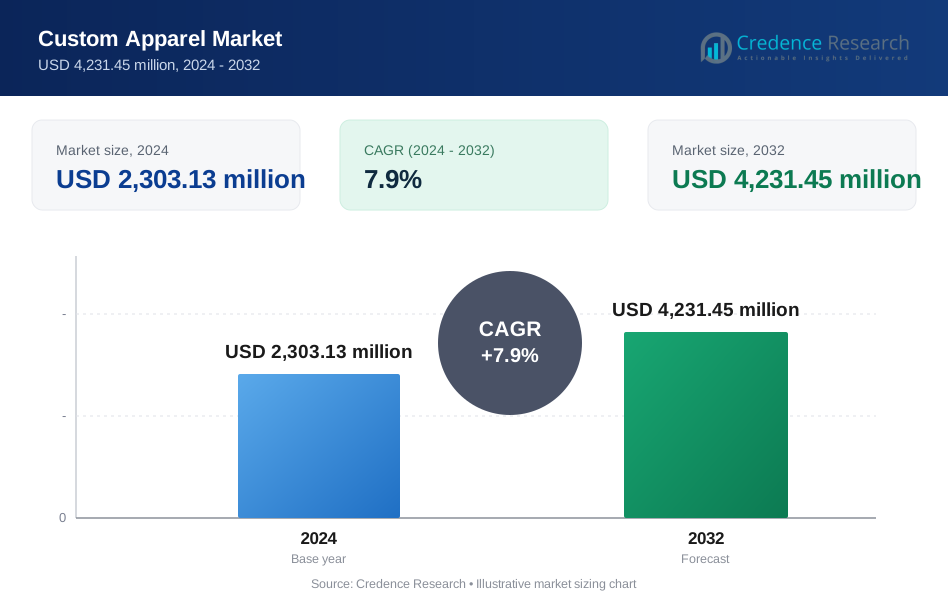
The Global Custom Apparel Market is projected to grow from USD 2,303.13 million in 2024 to an estimated USD 4,231.45 million by 2032, with a compound annual growth rate (CAGR) of 7.9%from 2024 to 2032.
Several factors are propelling the growth of the global custom apparel market. Personalization and individual expression have become significant trends among consumers, particularly younger demographics, who seek unique clothing that aligns with their personalities and lifestyles. The rise of digital printing technologies has revolutionized customization by enabling cost-effective, high-quality production of small batches. Furthermore, the proliferation of e-commerce platforms has made custom apparel more accessible, with features like interactive design tools and augmented reality enabling consumers to visualize their creations before purchase. The corporate and promotional sectors also contribute significantly to market demand, as organizations increasingly invest in branded apparel for marketing and team-building purposes. Moreover, growing environmental awareness has spurred demand for sustainable customization options, such as eco-friendly fabrics and ethical production practices.
North America leads the global custom apparel market, accounting for a significant share due to the presence of established e-commerce platforms, advanced manufacturing capabilities, and high consumer spending on personalized clothing. The United States and Canada dominate this region, driven by strong demand from corporate clients and fashion-conscious individuals. Europe follows closely, with countries like the United Kingdom, Germany, and France adopting custom apparel trends driven by their rich fashion heritage and innovative retail technologies. The Asia-Pacific region is emerging as the fastest-growing market, fueled by a burgeoning middle class, increasing disposable incomes, and a rising preference for Western-style fashion trends. Countries such as China, India, and Japan are witnessing robust growth, supported by large-scale investments in digital printing and textile innovation. Meanwhile, the Middle East, Africa, and Latin America represent growing opportunities, with rising internet penetration and the expansion of retail infrastructure enabling greater market reach in these regions.
Market Insights:
- The Global Custom Apparel Market is projected to grow from USD 2,303.13 million in 2024 to USD 4,231.45 million by 2032, reflecting a robust CAGR of 7.9%.
- Increasing consumer demand for personalization and self-expression, especially among millennials and Gen Z, is significantly driving market growth.
- Advancements in digital printing technologies enable high-quality, cost-efficient, and small-batch production, fostering accessibility for businesses and consumers alike.
- The rapid expansion of e-commerce platforms and online customization tools has revolutionized consumer purchasing behavior, making personalized apparel more widely available.
- The corporate and promotional sectors contribute substantially to demand, as businesses invest in branded apparel to enhance visibility and unity.
- Challenges such as high production costs and scalability issues pose constraints, particularly for small and medium-sized enterprises operating in price-sensitive regions.
- Emerging markets in Asia-Pacific, Latin America, and the Middle East offer growth potential, driven by rising incomes, increasing internet penetration, and regional investments in retail and textile infrastructure.
Market Drivers:
Growing Demand for Personalization and Self-Expression
One of the primary drivers of the global custom apparel market is the increasing consumer desire for personalization and self-expression. For instance, Printful has reported a significant rise in demand for personalized clothing, with customers frequently opting for unique designs that reflect their personal styles and preferences. Modern consumers are seeking clothing that reflects their individuality and aligns with their personal identity, moving away from mass-produced apparel. This trend is especially prominent among millennials and Gen Z, who prioritize unique designs and customized products. The availability of advanced customization tools, such as interactive design platforms and augmented reality (AR) fitting solutions, has further fueled this demand. These tools empower consumers to create tailored clothing, fostering a sense of ownership and exclusivity.
Advancements in Digital Printing and On-Demand Manufacturing
Technological innovations in digital printing and on-demand manufacturing are significantly driving the growth of the custom apparel market. Digital printing technologies enable cost-efficient production of small batches while maintaining high-quality outputs, making customization more accessible for businesses and consumers. For instance, Zazzle utilizes AI-driven design tools that allow customers to visualize their creations before placing orders, enhancing the customization experience. These advancements also minimize lead times and reduce waste, catering to the growing demand for sustainable production practices. On-demand manufacturing, coupled with automated systems, allows companies to respond quickly to dynamic consumer preferences without the need for large inventory investments, making the custom apparel industry more agile and responsive.
Expansion of E-Commerce and Online Customization Platforms
The rapid growth of e-commerce and the proliferation of online customization platforms have been pivotal in expanding the reach of custom apparel. For instance, Custom Ink provides a seamless and interactive shopping experience through their online platform, offering a wide range of customization options. Digital storefronts equipped with user-friendly interfaces, design tools, and interactive experiences have made it easier for consumers to explore and purchase personalized clothing. E-commerce also allows brands to reach a global audience, bridging geographical gaps and providing smaller businesses with opportunities to compete in the market. The convenience of online shopping, coupled with the ability to create and visualize unique designs, has amplified consumer interest in custom apparel across demographics and regions.
Rising Adoption in Corporate and Promotional Sectors
Custom apparel has become a valuable tool in corporate branding and promotional activities, driving its adoption in the business sector. Organizations across industries are increasingly investing in branded apparel for employee uniforms, promotional giveaways, and event merchandising. Customized clothing not only enhances brand visibility but also fosters a sense of unity and professionalism among employees. Additionally, the growing number of small and medium-sized enterprises (SMEs) leveraging personalized apparel for marketing campaigns has contributed to the rising demand. The corporate sector's preference for high-quality, sustainable, and uniquely designed products continues to play a crucial role in shaping the market landscape. For instance, Vistaprint has seen a significant increase in orders from small and medium-sized enterprises (SMEs) looking to strengthen their brand presence through personalized apparel.
Market Trends:
Integration of Artificial Intelligence and Machine Learning
The integration of artificial intelligence (AI) and machine learning (ML) in the custom apparel market is shaping the industry's future. AI-driven recommendation systems are enabling brands to predict customer preferences and offer personalized design suggestions, enhancing user experience and engagement. ML algorithms are also streamlining production processes by optimizing material usage and reducing operational inefficiencies. For instance, Adidas uses AI and ML in its "Speedfactory" operations to produce custom footwear in days rather than weeks, leading to a significant increase in customer satisfaction due to personalized fit and design. The application of these technologies allows businesses to deliver tailored products at scale while maintaining high precision and quality. This trend reflects the industry's shift towards smarter, data-driven operations to meet evolving consumer demands.
Growth of Sustainable and Eco-Friendly Customization
Sustainability is becoming a key focus in the global custom apparel market, with consumers increasingly prioritizing environmentally friendly products. Brands are responding by incorporating organic fabrics, recycled materials, and biodegradable dyes into their customization processes. For example, Patagonia has integrated sustainable materials like recycled nylon, organic cotton, and hemp into its product lines, promoting circular fashion through its "Worn Wear" program. The use of advanced production techniques, such as waterless dyeing and energy-efficient machinery, is further aligning custom apparel with sustainability goals. This trend is driven not only by consumer awareness but also by regulatory pressures and global sustainability initiatives. As eco-conscious practices gain momentum, companies that adopt green customization solutions are poised to gain a competitive edge.
Rise of Direct-to-Consumer Business Models
Direct-to-consumer (DTC) business models are gaining prominence in the custom apparel market, reshaping traditional retail dynamics. By bypassing intermediaries, brands are establishing closer relationships with their customers, offering personalized experiences and competitive pricing. For instance, Nike has been at the forefront, leveraging its DTC model to offer exclusive products and manage inventory more effectively. DTC platforms often leverage social media and influencer marketing to connect with niche audiences, fostering brand loyalty and trust. The flexibility of this model allows businesses to experiment with limited-edition collections and on-demand designs, catering to the growing consumer demand for exclusivity and uniqueness. This shift reflects the market's emphasis on consumer-centric strategies and agile business operations.
Increasing Popularity of Athleisure and Lifestyle Apparel
The rising popularity of athleisure and lifestyle apparel has introduced new opportunities for customization in the market. Consumers are seeking personalized activewear and casual clothing that combines style, comfort, and functionality. Customization options such as monograms, unique color palettes, and tailored fits are becoming increasingly sought after in this segment. Additionally, the growing trend of hybrid work environments has driven demand for versatile clothing that transitions seamlessly between professional and casual settings. This evolving preference underscores the market's ability to adapt to lifestyle changes and cater to diverse consumer needs. For instance, brands like Lululemon and Adidas leading the charge in offering personalized athleisure options
Market Challenges Analysis:
High Production Costs and Pricing Pressure
The custom apparel market faces significant challenges related to high production costs and pricing pressures. Customization requires specialized technologies, materials, and skilled labor, which often results in higher costs compared to mass-produced apparel. Businesses must balance the need for competitive pricing with the demand for quality and uniqueness. Small and medium-sized enterprises (SMEs), in particular, struggle to achieve cost efficiencies while competing with larger players that benefit from economies of scale. This pricing dynamic can limit market penetration, especially in price-sensitive regions.
Scalability and Production Complexities
Custom apparel production is inherently complex and poses scalability challenges for manufacturers. Unlike traditional mass production, custom orders often involve unique designs, materials, and sizes, requiring highly flexible and adaptable processes. Managing diverse consumer demands without compromising quality or delivery timelines can strain operational efficiency. Additionally, the reliance on advanced technologies like digital printing and automation demands substantial upfront investment, which may deter new entrants or smaller businesses from entering the market.
Limited Consumer Awareness in Emerging Markets
While the demand for custom apparel is growing globally, limited consumer awareness in emerging markets remains a key restraint. Many consumers in these regions still rely on traditional clothing options due to lack of exposure to customization benefits or unfamiliarity with digital platforms. Limited internet penetration and technological infrastructure further hinder market expansion in such areas. Companies must invest in education, marketing, and localized strategies to build consumer trust and drive adoption in untapped markets.
Environmental and Regulatory Challenges
The custom apparel market is increasingly impacted by environmental concerns and regulatory pressures. Sustainable production practices and ethical sourcing are becoming essential, but adhering to these standards can increase costs and operational complexity. Additionally, varying regulations across regions regarding material use, labor practices, and sustainability create compliance challenges for global players, necessitating constant adaptation to local requirements.
Market Opportunities:
The global custom apparel market presents substantial growth opportunities, driven by the increasing consumer demand for personalization and the rising penetration of digital technologies. As consumers increasingly prioritize unique, tailored clothing, businesses have the chance to cater to diverse preferences through innovative customization solutions. The advent of advanced technologies such as AI-driven design tools, augmented reality (AR) for virtual fitting, and digital printing systems offers a significant advantage in delivering high-quality, on-demand apparel. Additionally, the shift towards sustainable practices provides an opportunity for brands to position themselves as eco-conscious leaders by incorporating organic fabrics, recycled materials, and energy-efficient production techniques.
Emerging markets, particularly in regions such as Asia-Pacific, Latin America, and the Middle East, represent untapped potential for the custom apparel industry. Growing disposable incomes, urbanization, and the increasing influence of Western fashion trends in these regions are fostering demand for personalized clothing. Furthermore, the rapid expansion of e-commerce and digital platforms is enabling businesses to reach a broader audience, bridging the gap between consumers and custom apparel providers. Corporate and promotional sectors also provide a lucrative opportunity, with businesses seeking branded apparel for marketing and employee engagement. By leveraging technological advancements, sustainability initiatives, and regional expansion strategies, stakeholders in the global custom apparel market are well-positioned to capitalize on the growing demand and drive long-term growth.
Market Segmentation Analysis:
The global custom apparel market is segmented by type, end-user, and distribution channel, reflecting the diverse nature of consumer preferences and purchasing behaviors.
By Type, the market encompasses coats, skirts, pants, shirts, and suits. Among these, shirts hold the largest market share due to their widespread demand for both casual and professional purposes. Suits and coats also account for a significant portion of the market, driven by their adoption in corporate and formal settings. Skirts and pants demonstrate steady growth, with customization gaining traction in both casual and workwear categories. The ability to personalize fit, fabric, and design continues to attract consumers across these segments.
By End-User, the market is categorized into women, men, and children. Women represent the largest end-user segment, accounting for the highest revenue share, owing to a strong preference for personalized fashion and innovative designs. The men’s segment follows, driven by rising demand for tailored suits, shirts, and activewear. The children’s segment, while smaller, is expanding as parents increasingly opt for personalized clothing options for their children, especially for special occasions.
By Distribution Channel, the market is divided into offline and online segments. The online channel is growing rapidly, supported by the proliferation of e-commerce platforms offering interactive design tools and user-friendly customization options. However, offline stores continue to hold a significant share, catering to consumers who prefer in-person fittings and tactile experiences.
Segmentation:
By Type
- Coat
- Skirt
- Pants
- Shirt
- Suit
By End-user
- Women
- Men
- Children
By Distribution Channel
- Offline
- Online
- North America
- U.S.
- Canada
- Mexico
- Europe
- Germany
- France
- U.K.
- Italy
- Spain
- Rest of Europe
- Asia Pacific
- China
- Japan
- India
- South Korea
- South-east Asia
- Rest of Asia Pacific
- Latin America
- Brazil
- Argentina
- Rest of Latin America
- Middle East & Africa
- GCC Countries
- South Africa
- Rest of the Middle East and Africa
Regional Analysis:
The global custom apparel market demonstrates diverse growth patterns across regions, driven by variations in consumer preferences, technological advancements, and economic development. North America, Europe, Asia-Pacific, Latin America, and the Middle East & Africa are the primary regions shaping the market landscape.
North America holds the largest market share, accounting for approximately 35% of the global revenue in 2024. This dominance is attributed to the strong presence of e-commerce platforms, advanced customization technologies, and high disposable incomes. The United States and Canada are the key contributors to regional growth, with significant demand from corporate clients and fashion-forward consumers. The region’s emphasis on sustainable practices and the adoption of eco-friendly customization options further enhance its market position.
Europe follows closely with a market share of around 30%, driven by the region’s rich fashion heritage and innovation in retail technologies. Countries like the United Kingdom, Germany, and France lead the market, reflecting a strong preference for personalized, high-quality apparel. The European market is also influenced by sustainability trends, with brands incorporating organic and recycled materials into their offerings to cater to environmentally conscious consumers.
Asia-Pacific is emerging as the fastest-growing region, with a market share of approximately 20% and a high compound annual growth rate (CAGR). The rise in disposable incomes, increasing internet penetration, and growing influence of Western fashion trends are key drivers in countries such as China, India, and Japan. The region’s booming e-commerce sector and investments in advanced textile manufacturing technologies further boost market growth.
Latin America and the Middle East & Africa collectively account for about 15% of the market share. In Latin America, countries like Brazil and Mexico are witnessing growing adoption of custom apparel, fueled by a young population and increasing fashion awareness. Meanwhile, the Middle East & Africa benefit from rising internet penetration, expanding retail infrastructure, and an emerging focus on personalized clothing among affluent consumers.
Key Player Analysis:
- Adidas AG
- Allied Shirts
- Amazon.com Inc.
- CafePress Inc.
- Carhartt Inc.
- Cimpress Plc
- CustomInk LLC
- Designhill Inc.
- DOWNTOWN CUSTOM PRINTWEAR
- Jakprints
- Lynka Sp. z.o.o.
- Nike Inc.
- Printful Inc.
- Redbubble Ltd.
- Society6 LLC
- Spreadshirt Inc.
- TeeTalkies
- THREADBIRD
- UberPrints Inc.
- Vantage Custom Classics Inc.
- Zazzle Inc.
Competitive Analysis:
The global custom apparel market is characterized by intense competition, driven by the presence of established players and emerging startups leveraging advanced technologies. Key industry leaders, including Nike, Adidas, and Under Armour, have integrated customization options into their product offerings, targeting tech-savvy and style-conscious consumers. These companies focus on leveraging e-commerce platforms and digital design tools to enhance customer experiences and increase market share. Emerging players and niche brands are gaining traction by catering to specific consumer demands, such as sustainable materials, regional cultural influences, and affordability. For instance, Emerging players like Printful and CustomCat offer affordable print-on-demand services, allowing businesses and individuals to create custom apparel without the need for large minimum order quantities. The adoption of direct-to-consumer (DTC) models and the integration of artificial intelligence (AI) for personalized recommendations have allowed smaller firms to compete effectively. The market’s competitive landscape is further shaped by collaborations with technology providers and investments in advanced manufacturing processes. Companies that prioritize innovation, customer-centric strategies, and sustainability are poised to maintain a competitive edge in this dynamic market.
Recent Developments:
- Carhartt Inc.expanded its Carhartt Reworked resale program on February 27, 2024, introducing a mail-in trade-in option in partnership with Trove, a leader in branded resale. This expansion allows customers to trade in their worn Carhartt workwear remotely, reinforcing the brand's commitment to sustainability and rewarding customer loyalty. The program leverages Trove's modular resale technology to facilitate growth and evolution in branded resale.
- Lowe'sand Carhartt announced a partnership on October 2, 2023, to bring Carhartt's premium workwear collection to Lowes.com and select stores nationwide. This collaboration introduces Carhartt's iconic duck jackets, vests, hoodies, T-shirts, workwear pants, and beanies to Lowe's customers, initially available in roughly 250 stores across the Northeast, Midwest, and Pacific Northwest, with plans to expand to additional stores in Texas, the Southeast, and California in early 2024
- On August 14, 2024, Trove, a resale platform, acquired Recurate, a competing platform, to expand its offerings in branded resale. This acquisition will allow Trove to include peer-to-peer trade-ins and e-commerce integration for Shopify-based brands. With this deal, Trove now oversees 44 partner labels and controls up to 80% of branded resale traffic, enhancing its market position and offering a one-stop shop for brands looking to enter the resale space
Market Concentration & Characteristics:
The global custom apparel market exhibits a moderately fragmented structure, with a mix of established multinational corporations and smaller niche players. Major brands such as Nike, Adidas, and Levi’s dominate the market, leveraging their extensive resources, advanced technologies, and global reach to offer personalized solutions. These companies account for a significant share of the market, supported by their strong brand equity and integrated e-commerce platforms. Conversely, the market also includes numerous smaller and regional players that cater to localized or niche demands, such as cultural designs, eco-friendly materials, or budget-friendly options. The rise of direct-to-consumer (DTC) business models has further diversified the competitive landscape, enabling smaller firms to capture market share through targeted offerings. Key characteristics of the market include rapid technological innovation, a focus on sustainability, and increasing consumer demand for convenience and uniqueness. The market is poised for continued growth as players prioritize differentiation and customer-centric strategies.
Report Coverage:
The research report offers an in-depth analysis based on By Type, By End-user and By Distribution Channel.It details leading market players, providing an overview of their business, product offerings, investments, revenue streams, and key applications. Additionally, the report includes insights into the competitive environment, SWOT analysis, current market trends, as well as the primary drivers and constraints. Furthermore, it discusses various factors that have driven market expansion in recent years. The report also explores market dynamics, regulatory scenarios, and technological advancements that are shaping the industry. It assesses the impact of external factors and global economic changes on market growth. Lastly, it provides strategic recommendations for new entrants and established companies to navigate the complexities of the market.
Future Outlook:
- The market is expected to witness robust growth, driven by rising demand for personalized clothing across diverse demographics.
- Technological advancements, such as AI and 3D printing, will enable faster, cost-effective, and scalable customization solutions.
- Sustainability will become a major focus, with increased adoption of eco-friendly materials and ethical production practices.
- Expansion of e-commerce platforms and digital design tools will enhance consumer access to customization options globally.
- Emerging markets, particularly in Asia-Pacific and Latin America, will drive significant growth due to rising disposable incomes and fashion trends.
- Direct-to-consumer business models will continue gaining popularity, fostering closer brand-consumer relationships.
- Corporate and promotional sectors will generate sustained demand for custom-branded apparel.
- Hybrid work environments and lifestyle changes will create new opportunities for personalized casual and athleisure wear.
- Smaller players leveraging niche markets, such as cultural or occasion-specific apparel, will challenge established brands.
- Strategic partnerships and investments in advanced manufacturing technologies will shape the competitive landscape.
Request a Free Sample
Fill in your details and we'll send you a free sample report.
- Sample data tables & charts
- Research methodology
Need a Custom Version of This Report?
Tailor the scope, geography, or segments to your exact requirements.
- Custom geography or segment scope
- Direct access to our analyst team
Frequently Asked Questions
What is the growth projection for the global custom apparel market?
What factors are driving the growth of the custom apparel market?
Which region holds the largest share of the custom apparel market?
What challenges does the global custom apparel market face?
Table of Content
Chapter 1. Report Introduction
- 1.1 Report Description & Purpose
- 1.1.1 Report Title & Market Definition
- 1.1.2 Unique Selling Propositions (USP) & Key Differentiators
- 1.1.3 Value Proposition for Stakeholders
- 1.2 Research Objectives
- 1.2.1 Market Sizing Objectives (Volume & Revenue)
- 1.2.2 Segmentation Objectives
- 1.2.3 Competitive Intelligence Objectives
- 1.2.4 Forecast & Scenario Objectives
- 1.3 Report Scope
- 1.3.1 Custom Apparel Scope – Types & Subtypes Covered
- 1.3.2 Geographic Scope – Regions & Countries Covered
- 1.3.3 Historical Period, Base Year & Forecast Period (2024; forecast to 2032)
- 1.3.4 Inclusions & Exclusions
- 1.4 HS Code & Classification Framework
- 1.5 Currency, Units & Pricing Basis
- 1.6 Target Stakeholders
- 1.7 Limitations & Assumptions
Chapter 2. Executive Summary
- 2.1 Global Custom Apparel Market Snapshot
- 2.1.1 Market Size – Historical (2024) & Forecast (2024-2032) (2024: USD 2,303.13 million → 2032: USD 4,231.45 million)
- 2.1.2 Volume & Revenue – Global Totals
- 2.1.3 Key Market Highlights – Top Five Facts
- 2.2 Custom Apparel Market Segmentation Snapshot
- 2.2.1 Market Split by Region – 2024 vs. 2032
- 2.3 Competitive Snapshot
- 2.3.1 Top 10 Players by Revenue Share – 2024
- 2.3.2 Top 10 Players by Volume Share – 2024
- 2.3.3 Recent Strategic Developments (18-Month Summary)
- 2.4 Key Investment Highlights & Strategic Conclusions
Chapter 3. Custom Apparel Market Dynamics & Industry Analysis
- 3.1 Market Overview & Context
- 3.1.1 Custom Apparel Market Position in the Broader Automotive Value Chain
- 3.1.2 OEM vs. Replacement Market Dynamics
- 3.1.3 Market Maturity & Development Stage by Region
- 3.2 Custom Apparel Market Drivers
- 3.3 Custom Apparel Market Restraints & Challenges
- 3.4 Custom Apparel Market Opportunities
- 3.5 Porter's Five Forces Analysis
- 3.5.1 Threat of New Entrants
- 3.5.2 Bargaining Power of Suppliers
- 3.5.3 Bargaining Power of Buyers
- 3.5.4 Threat of Substitutes
- 3.5.5 Competitive Rivalry – Intensity Assessment
- 3.6 Custom Apparel Value Chain Analysis
- 3.6.1 Upstream – Raw Material/Input Suppliers
- 3.6.1.1 Raw Material/Input 1
- 3.6.1.2 Raw Material/Input 2
- 3.6.1.3 Raw Material/Input 3
- 3.6.2 Midstream – Production/Manufacturing/Service Delivery
- 3.6.2.1 Production/Process Overview
- 3.6.2.2 Key Facility Locations & Capacity by Manufacturer
- 3.6.3 Downstream – Distribution & End Consumer
- 3.6.3.1 Primary Channel – B2B/OEM
- 3.6.3.2 Secondary Channels – Dealer, Retail, Online, Direct
- 3.6.4 Value Chain Profitability Analysis
- 3.6.1 Upstream – Raw Material/Input Suppliers
- 3.7 PESTEL Analysis
- 3.7.1 Political Factors
- 3.7.2 Economic Factors
- 3.7.3 Social Factors
- 3.7.4 Technological Factors
- 3.7.5 Environmental Factors
- 3.7.6 Legal Factors
- 3.8 Custom Apparel Supply Chain Analysis
- 3.8.1 Raw Material/Input Supply Risk Assessment
- 3.8.2 Manufacturing Concentration Risk (Geographic Exposure)
- 3.8.3 Trade Disruption Impact Analysis
- 3.9 Regulatory & Policy Landscape
Note: The regulatory and policy landscape section covers regulations based on their applicability to the market, Custom Apparel category, geography, and scope of the study. Only regulatory frameworks with a material impact on operations, compliance, trade, sustainability, or market access are analyzed in detail.
Chapter 4. Key Investment Pockets & Opportunity Analysis
- 4.1 Custom Apparel Market Attractiveness Analysis
- 4.1.1 By Region – Investment Attractiveness Matrix (Volume × CAGR)
- 4.2 Absolute Revenue Growth Opportunity
- 4.2.1 By Region – Absolute USD Growth Through 2032
- 4.3 Incremental Volume Opportunity
- 4.3.1 By Region – Incremental Volume Through 2032
- 4.3.2 Segment – Incremental Volume
- 4.4 Emerging Submarket Opportunity Deep Dive (Subject to Applicability)
- 4.5 Emerging Market Opportunity Scorecards
- 4.5.1 United States
- 4.5.2 Europe
- 4.5.3 Asia
- 4.5.4 Middle East & Africa
Note: Emerging Market Opportunity Scorecards will be included based on relevance and strategic importance. Regions listed are indicative and may vary depending on data availability and market dynamics.
Chapter 5. Custom Apparel Import-Export Analysis & Trade Flows
- 5.1 Global Trade Overview
- 5.1.1 Global Export Value by Country (2024)
- 5.1.2 Global Export Volume by Country (2024)
- 5.1.3 Global Import Value by Country (2024)
- 5.1.4 Global Import Volume by Country (2024)
- 5.1.5 Net Trade Balance by Country (2024)
- 5.2 Export Analysis – Segment
- 5.2.1 Type 1 (HS Code)
- 5.2.2 Type 2 (HS Code)
- 5.2.3 Type 3 (HS Code)
- 5.2.4 Type 4 (HS Code)
- 5.2.5 Type 5 (HS Code)
- 5.3 Import Analysis – Segment
- 5.3.1 Type 1 (HS Code)
- 5.3.2 Type 2 (HS Code)
- 5.3.3 Type 3 (HS Code)
- 5.3.4 Type 4 (HS Code)
- 5.3.5 Type 5 (HS Code)
- 5.4 Average Unit Trade Prices
- 5.4.1 Average Export Price – Segment & Country
- 5.4.2 Average Import Price – Segment & Source Country
- 5.4.3 Price Trends (2024)
- 5.5 Key Trade Route Analysis
- 5.5.1 Trade Route 1
- 5.5.2 Trade Route 2
- 5.5.3 Trade Route 3
- 5.5.4 Trade Route 4
- 5.5.5 Trade Route 5
- 5.6 Trade Policy Impact Assessment
- 5.6.1 US Anti-Dumping & Section 301 Tariffs
- 5.6.2 EU Customs Union Impact
- 5.6.3 Major Free Trade Agreements
- 5.6.4 USMCA Rules of Origin
Note: Trade policy analysis will be included only where relevant to the Custom Apparel market.
Chapter 6. Competitive Landscape & Company Benchmarking
- 6.1 Custom Apparel Market Concentration & Structure
- 6.1.1 Herfindahl-Hirschman Index (HHI) – vs. 2024
- 6.1.2 Tier 1, Tier 2 & Tier 3 Market Structure
- 6.1.3 Global, Regional & Local Player Dynamics
- 6.2 Custom Apparel Market Share Analysis – 2024
- 6.2.1 Global Revenue Share by Company
- 6.2.2 Global Volume Share by Company
- 6.2.3 Regional Revenue Share
- 6.2.4 Market Share Evolution ( vs. 2024)
- 6.2.5 OEM Segment Share by Company
- 6.2.6 Replacement Segment Share by Company
- 6.3 Production/Delivery Capacity & Facility Analysis
- 6.3.1 Global Installed Capacity
- 6.3.2 Capacity Utilization Rates
- 6.3.3 Production/Output Volume
- 6.3.4 Facility Locations & Capacity Map
- 6.3.5 Planned Capacity Additions
- 6.4 Custom Apparel Competitive Benchmarking Matrix
- 6.4.1 Revenue, Volume, CAGR & Profitability Comparison
- 6.4.2 Channel Revenue Mix
- 6.4.3 Geographic Revenue Exposure
- 6.4.4 R&D Intensity
- 6.4.5 Sustainability Maturity
- 6.5 Strategic Developments in Custom Apparel (Last 24 Months)
- 6.5.1 Mergers, Acquisitions & Divestments
- 6.5.2 New Custom Apparel Launches
- 6.5.3 Facility Expansions
- 6.5.4 Strategic Alliances, Joint Ventures & Partnerships
- 6.5.5 Distribution Expansion & Market Entry
- 6.5.6 Sustainability & ESG Initiatives
- 6.6 Competitive Strategy Mapping
- 6.6.1 Leader, Challenger, Follower & Niche Classification
- 6.6.2 Pricing Strategy Comparison
- 6.6.3 Channel Strategy Matrix
Note: Strategic developments are included based on their materiality and the availability of reliable information.
Chapter 7. Global Custom Apparel Market – By Distribution Channel
- 7.1 Segment Overview
- 7.1.1 Volume & Revenue Split by Channel (2024 & 2032)
- 7.1.2 Channel Mix Evolution (2024-2032)
Chapter 8. Regional Market Analysis – Global Overview
- 8.1 Global Regional Overview
- 8.1.1 Regional Volume Share
- 8.1.2 Regional Revenue Share
- 8.1.3 Regional Volume by Region
- 8.1.4 Regional Revenue by Region
- 8.1.5 Regional Forecast Through 2032
- 8.2 Cross-Regional Segment Analysis
- 8.2.1 By Distribution Channel
- 8.2.2 By Brand/Price Tier
Chapter 9. North America Custom Apparel Market
- 9.1 United States
- 9.2 Canada
- 9.3 Mexico
Chapter 10. Europe Custom Apparel Market
- 10.1 Germany
- 10.2 France
- 10.3 Italy
- 10.4 United Kingdom
- 10.5 Spain
- 10.6 Poland
- 10.7 Russia
- 10.8 Netherlands
- 10.9 Belgium
- 10.10 Sweden
- 10.11 Denmark
- 10.12 Norway
- 10.13 Rest of Europe
Chapter 11. Asia Pacific Custom Apparel Market
- 11.1 China
- 11.2 India
- 11.3 Japan
- 11.4 South Korea
- 11.5 Thailand
- 11.6 Indonesia
- 11.7 Vietnam
- 11.8 Malaysia
- 11.9 Australia
- 11.10 Rest of Asia Pacific
Chapter 12. Latin America Custom Apparel Market
- 12.1 Brazil
- 12.2 Argentina
- 12.3 Colombia
- 12.4 Chile
- 12.5 Rest of Latin America
Chapter 13. Middle East Custom Apparel Market
- 13.1 Saudi Arabia
- 13.2 United Arab Emirates
- 13.3 Turkey
- 13.4 Israel
- 13.5 Iran
- 13.6 Rest of the Middle East
Chapter 14. Africa Custom Apparel Market
- 14.1 South Africa
- 14.2 Egypt
- 14.3 Nigeria
- 14.4 Morocco
- 14.5 Rest of Africa
Chapter 15. Custom Apparel Company Profiles
- 15.1 [Company 01]
- 15.1.1 Company Overview
- 15.1.2 Key Management Personnel
- 15.1.3 Products & Services Portfolio
- 15.1.4 Financial Performance
- 15.1.5 Key Market Focus & Geographic Presence
- 15.1.6 Recent Developments & Strategic Initiatives
Note: The company profile list is preliminary and may change based on research findings, market developments, data availability, and client requirements.
Chapter 16. Appendices
- Appendix A – List of Abbreviations & Acronyms
- Appendix B – Industry Classification Code Reference – Full Series
- Appendix C – Production & Capacity Data Tables
- Appendix D – End-Use & Demand Base Tables
- Appendix E – Consumption & Replacement Rate Assumptions
- Appendix F – ASP Reference Tables
- Appendix G – Manufacturing & Facility Database
- Appendix H – Import-Export Data Tables
- Appendix I – Regulatory Summary Tables
- Appendix J – Primary Research Participant List (Anonymized)
- Appendix K – Primary Research Questionnaire Framework
- Appendix L – Data Sources & Bibliography
- Appendix M – Market Size Divergence & Source Comparison
Chapter 17. Research Methodology
- 17.1 Research Framework & Philosophy
- 17.2 Secondary Research – Sources, Hierarchy & Data Extraction
- 17.3 Data Modeling – Bottom-Up & Top-Down Market Sizing
- 17.4 Primary Research – Stakeholder Framework, LOI & Sample Sizes
- 17.5 Forecast Methodology – Regression, Scenario & Sensitivity Analysis
- 17.6 Quality Control – Four-Layer Validation Framework
- 17.7 Limitations & Standard Assumptions
- 17.8 Disclaimer
