Talent Acquisition Software Market Overview:
Talent Acquisition Software market size was valued at USD 10,789.6 million in 2024 and is projected to reach USD 20,418.93 million by 2032, registering a CAGR of 8.3% during the forecast period.
| REPORT ATTRIBUTE | DETAILS |
|---|---|
| Historical Period | 2020-2023 |
| Base Year | 2024 |
| Forecast Period | 2025-2032 |
| Talent Acquisition Software Market Size 2024 | USD 10,789.6 million |
| Talent Acquisition Software Market, CAGR | 8.3% |
| Talent Acquisition Software Market Size 2032 | USD 20,418.93 million |
Talent Acquisition Software Market Insights
- Demand grows as firms adopt automated hiring tools, with software holding a 57% share due to strong usage in AI-enabled candidate screening and workflow management.
- Digital hiring, predictive analytics, and mobile recruitment continue to shape market trends as organizations enhance efficiency and candidate engagement.
- Competition strengthens as leading vendors expand cloud capabilities, improve platform integrations, and address restraints tied to cybersecurity risks and complex HR system compatibility.
- North America leads with a 38% share, followed by Europe at 30% and Asia Pacific at 22%, supported by rising adoption of cloud-based recruitment platforms and enterprise HR digitalization across regions.
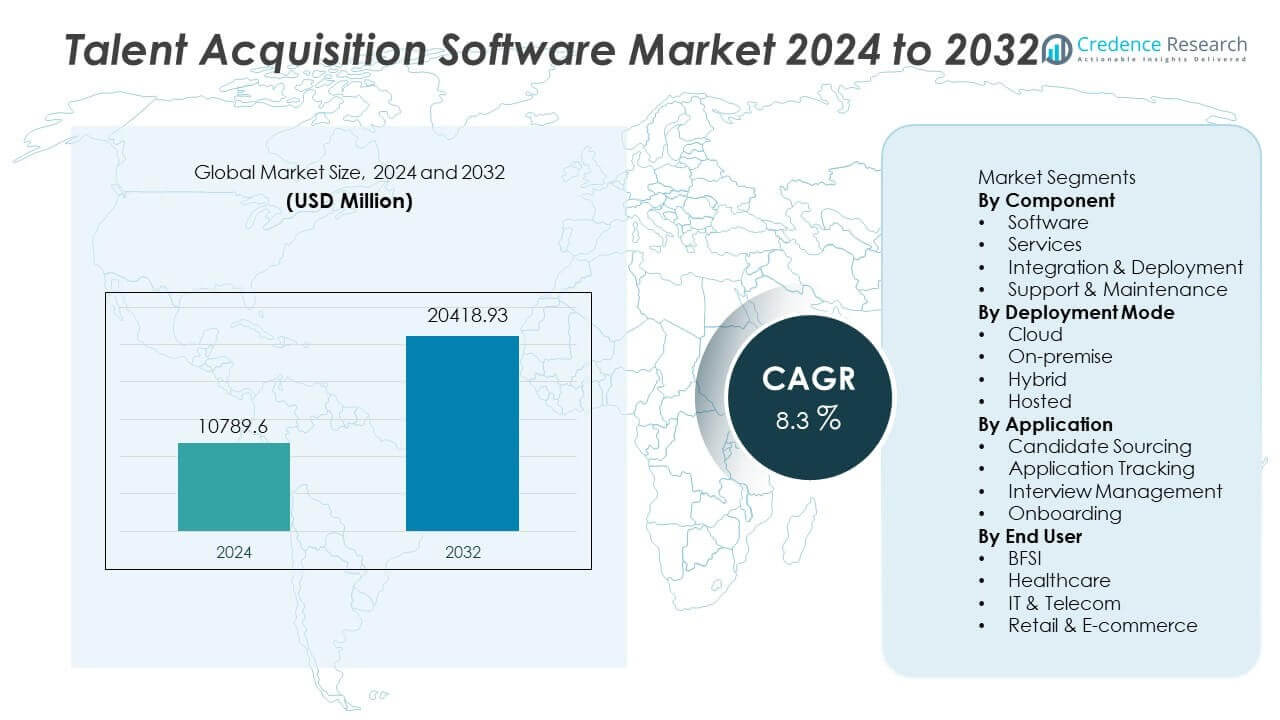
Talent Acquisition Software Market Segmentation Analysis:
By Component
Software leads this segment with a 57% share, driven by rising adoption of AI-powered tools that streamline recruitment workflows, automate screening, and improve candidate matching. Companies invest in advanced software modules for talent analytics, automated job posting, and digital assessment platforms to accelerate hiring decisions. Services also gain traction as organizations seek training, optimization, and customization support for large-scale recruitment systems. Integration and deployment solutions grow with rising demand for seamless connectivity across HR suites, payroll systems, and productivity tools. Support and maintenance remain essential as firms require regular updates, troubleshooting, and performance enhancements.
- For instance, SAP SuccessFactors enhanced its Recruiting solution with AI-driven candidate recommendations. The platform processes over 2 billion job applications annually across global clients.
By Deployment Mode
Cloud deployment dominates with a 62% share, supported by its scalability, lower infrastructure costs, and remote accessibility, which allow HR teams to manage recruitment from any location. Organizations increasingly prefer cloud-based systems for faster implementation and real-time collaboration across distributed hiring teams. On-premise adoption continues in enterprises with strict data governance requirements. Hybrid deployment grows as companies balance data control with cloud flexibility. Hosted solutions gain moderate traction among mid-sized firms seeking cost-effective platforms without heavy IT involvement. The shift toward digital transformation strengthens cloud-led growth.
- For instance, Workday Recruiting operates on a unified cloud architecture supporting more than 10,000 organizations. The system handles millions of candidate records with automated workflow routing.
By Application
Application tracking leads with a 48% share, driven by growing need for structured recruitment pipelines, automated screening, and centralized candidate management. Organizations rely on ATS platforms to reduce hiring timelines and improve compliance across recruitment stages. Candidate sourcing tools expand rapidly as companies use AI-driven platforms to reach diverse talent pools and enhance employer branding. Interview management solutions gain adoption through digital scheduling, virtual interview tools, and automated evaluation workflows. Onboarding applications continue to grow as employers prioritize seamless transition processes that support productivity and retention from day one.
Key Growth Drivers
Rising Adoption of AI and Automation in Recruitment
Organizations increasingly adopt AI-driven talent acquisition tools to streamline hiring, enhance candidate matching, and reduce manual screening efforts. Automated workflows improve recruiter productivity by handling repetitive tasks such as resume parsing, shortlisting, and communication. AI-powered analytics provide deeper insights into candidate behavior and hiring performance. As companies face higher hiring volumes and tighter competition for skilled talent, demand for intelligent recruitment solutions continues to rise. This shift toward automation drives strong market growth across enterprises and fast-growing sectors.
- For instance, iCIMS uses machine-learning models trained on hundreds of millions of data points from resumes, job postings, and hiring workflows to make improvements. The platform parses numerous resumes across enterprise clients, extracting key information like skills, work history, and education, and organizing it into a structured format for recruiters.
Growing Demand for Remote and Digital Hiring Solutions
The rise of remote work accelerates adoption of digital hiring platforms that support virtual interviews, remote assessments, and paperless onboarding. Companies rely on cloud-based systems to manage distributed recruitment teams and collaborate efficiently across locations. Digital hiring tools improve transparency, reduce time-to-hire, and enable real-time decision-making. As hybrid work becomes standard across global industries, organizations invest in scalable solutions that ensure continuity and flexibility in recruitment operations. This digital shift strengthens long-term demand for modern talent acquisition software.
- For instance, HireVue supports a large number of clients around the globe with on-demand video interviewing and digital assessments. The platform has built its scientific models on data from a substantial number of interviews globally.
Increasing Focus on Employer Branding and Candidate Experience
Businesses prioritize candidate experience to attract high-quality talent in competitive labor markets. Talent acquisition software enhances communication, personalized engagement, and transparent hiring processes. Features such as automated updates, seamless scheduling, and branded career portals improve the applicant journey. Strong employer branding tools help companies differentiate themselves and build lasting talent pipelines. As candidate expectations rise, organizations adopt advanced platforms to strengthen their reputation and improve conversion rates. This focus on experience-driven hiring fuels market expansion.
Key Trends & Opportunities
Integration of Predictive Analytics and Talent Intelligence
Predictive analytics transforms hiring by enabling data-driven decisions related to performance forecasting, skill matching, and workforce planning. Talent intelligence platforms integrate external market data, helping recruiters identify skill gaps and target ideal candidate pools. These capabilities improve hiring accuracy and reduce turnover risks. As organizations adopt long-term workforce strategies, demand grows for systems that deliver deeper insights and predictive outcomes. Vendors offering advanced analytics gain strong competitive advantage and new market opportunities.
- For instance, Oracle Recruiting uses machine-learning models across its HCM suite. The system analyzes millions of employee records for skill inference and role fit. Oracle’s skills engine maps over 10,000 distinct skills from resumes and profiles.
Expansion of Mobile and Self-Service Recruitment Solutions
Mobile-first hiring trends shape software development as both recruiters and candidates prefer accessible, on-the-go platforms. Mobile applications support job search, application submission, interview scheduling, and real-time communication. Self-service portals empower candidates to track progress, upload documents, and complete onboarding tasks independently. These features improve efficiency and enhance user experience. As smartphone usage increases, mobile-enabled recruitment solutions create strong growth opportunities for vendors across industries.
- For instance, BambooHR offers native iOS and Android apps for recruiting workflows. The mobile app supports job posting approvals, applicant reviews, and interview scheduling. BambooHR serves more than 30,000 organizations with employee self-service tools.
Key Challenges
Data Security and Compliance Concerns
Talent acquisition platforms manage sensitive personal and employment data, making security a major concern for organizations. Compliance with data protection laws such as GDPR, CCPA, and regional privacy regulations increases operational complexity. Companies face risks related to data breaches, unauthorized access, and cyber threats. Vendors must implement advanced security frameworks, encryption, and compliance tools to retain customer trust. These requirements raise costs and slow adoption among highly regulated industries.
Integration Complexity with Existing HR Ecosystems
Many enterprises struggle to integrate new talent acquisition software with legacy HR systems, payroll platforms, and workforce management tools. Integration challenges lead to data silos, disrupted workflows, and increased implementation timelines. Smaller organizations may lack technical resources for seamless integration, affecting system performance and usability. Vendors must provide flexible APIs and integration support to reduce barriers. This challenge remains a key restraint for widespread adoption, especially in multi-system enterprise environments.
Regional Analysis
North America
North America holds a 38% share, driven by strong adoption of AI-enabled hiring tools, large enterprise investments, and mature HR digitalization. Companies in the United States and Canada increasingly rely on cloud-based platforms to manage high recruitment volumes and remote hiring needs. Demand rises across technology, healthcare, and financial services, where talent shortages push organizations to adopt advanced sourcing and screening solutions. The presence of major software providers, combined with continuous innovation in analytics and automation, strengthens the region’s leadership. Robust regulatory compliance frameworks and strong HR tech ecosystems further support sustained market growth.
Europe
Europe accounts for a 30% share, supported by growing demand for digital recruitment systems and compliance-driven hiring processes across major economies such as Germany, the United Kingdom, and France. Organizations adopt advanced applicant tracking and onboarding tools to meet strict labor regulations and enhance workforce planning. Rising focus on multilingual talent acquisition and cross-border hiring strengthens software adoption. The region’s expanding technology and manufacturing sectors further contribute to demand. Increasing emphasis on diversity, candidate experience, and sustainable workforce strategies drives continued investment in cloud-based talent acquisition platforms.
Asia Pacific
Asia Pacific holds a 22% share, fueled by rapid digital transformation, expanding enterprise adoption, and strong growth in the IT, retail, and service sectors. Countries such as China, India, Japan, and South Korea invest in scalable recruitment technologies to manage large workforce demands. The shift toward mobile hiring, AI-driven screening, and virtual interviews accelerates adoption across both large enterprises and fast-growing SMEs. Rising competition for skilled talent pushes organizations to adopt advanced sourcing and analytics tools. Government support for digital workforce development also strengthens market momentum across the region.
Latin America
Latin America captures a 6% share, driven by increasing adoption of cloud-based HR solutions and rising demand for efficient recruitment tools in Brazil, Mexico, and Chile. Organizations modernize hiring processes to address talent shortages and improve recruitment efficiency across key industries. Economic shifts and growing startup ecosystems further encourage adoption of flexible talent acquisition platforms. While budget constraints limit large-scale deployments, mid-sized companies increasingly invest in ATS and digital onboarding solutions. Improving internet access and HR digitalization initiatives support steady market growth across the region.
Middle East & Africa
The Middle East & Africa region holds a 4% share, supported by growing investments in workforce modernization, digital HR systems, and large-scale hiring initiatives, particularly in the Gulf countries. Organizations in sectors such as construction, energy, and government adopt talent acquisition platforms to streamline high-volume recruitment. Rising demand for expatriate hiring and cross-border talent management strengthens software adoption. Africa experiences gradual growth as enterprises shift from manual hiring to cloud-based solutions. Limited digital infrastructure remains a challenge, but expanding economic diversification initiatives encourage long-term market development.
Talent Acquisition Software Market Segmentations:
By Component
- Software
- Services
- Integration & Deployment
- Support & Maintenance
By Deployment Mode
- Cloud
- On-premise
- Hybrid
- Hosted
By Application
- Candidate Sourcing
- Application Tracking
- Interview Management
- Onboarding
By End User
- BFSI
- Healthcare
- IT & Telecom
- Retail & E-commerce
By Geography
- North America
- U.S.
- Canada
- Mexico
- Europe
- Germany
- France
- U.K.
- Italy
- Spain
- Rest of Europe
- Asia Pacific
- China
- Japan
- India
- South Korea
- South-east Asia
- Rest of Asia Pacific
- Latin America
- Brazil
- Argentina
- Rest of Latin America
- Middle East & Africa
- GCC Countries
- South Africa
- Rest of the Middle East and Africa
Competitive Landscape
The Talent Acquisition Software market is shaped by leading companies such as SAP SuccessFactors, Oracle Taleo, Workday, IBM Kenexa, iCIMS, BambooHR, Cornerstone OnDemand, SmartRecruiters, Greenhouse Software, and ADP Recruiting Management. These players compete by offering AI-driven recruitment tools, advanced analytics, and scalable cloud-based platforms that streamline sourcing, screening, and hiring processes. Many companies invest heavily in automation, predictive insights, and mobile-first solutions to enhance candidate experience and recruiter efficiency. Partnerships with HR technology ecosystems and integrations with payroll, workforce management, and collaboration tools strengthen platform adoption. Vendors differentiate through customizable workflows, multilingual support, and sector-specific hiring capabilities. As enterprises accelerate digital HR transformation, these companies focus on innovation, security compliance, and user-friendly design to maintain a strong market presence in a rapidly evolving recruitment landscape.
Key Player Analysis
- SAP SuccessFactors
- Oracle Taleo
- Workday
- IBM Kenexa
- iCIMS
- BambooHR
- Cornerstone OnDemand
- SmartRecruiters
- Greenhouse Software
- ADP Recruiting Management
Recent Developments
- In September 2025, SAP completed the acquisition of SmartRecruiters, expanding AI-powered recruiting features and planning unified talent acquisition workflows.
- In September 2025, SAP completed its acquisition of SmartRecruiters, a move intended to integrate SmartRecruiters' existing AI capabilities for smarter hiring decisions and predictive insights with the SAP SuccessFactors HCM suite.
- In 2025, Oracle’s talent acquisition remains part of Oracle Recruiting Cloud with AI-driven automation and intelligent candidate scoring.
Report Coverage
The research report offers an in-depth analysis based on Component, Deployment Mode, Application, End User and Geography. It details leading market players, providing an overview of their business, product offerings, investments, revenue streams, and key applications. Additionally, the report includes insights into the competitive environment, SWOT analysis, current market trends, as well as the primary drivers and constraints. Furthermore, it discusses various factors that have driven market expansion in recent years. The report also explores market dynamics, regulatory scenarios, and technological advancements that are shaping the industry. It assesses the impact of external factors and global economic changes on market growth. Lastly, it provides strategic recommendations for new entrants and established companies to navigate the complexities of the market.
Future Outlook
- AI-driven hiring tools will become standard as organizations automate screening and decision-making.
- Cloud-based recruitment platforms will expand as companies prioritize scalability and remote hiring needs.
- Predictive analytics will gain adoption to improve talent forecasting and reduce turnover risks.
- Mobile-first recruitment solutions will grow as candidates prefer quick and accessible application processes.
- Personalization in candidate engagement will increase through automated communication and tailored job recommendations.
- Integration with HR suites, payroll, and collaboration tools will strengthen platform interoperability.
- Virtual interviewing and digital assessment technologies will continue to rise across global hiring processes.
- Data security and compliance enhancements will become essential due to stricter privacy regulations.
- SMEs will increasingly adopt affordable, subscription-based hiring platforms to streamline recruitment.
- Global competition for skilled talent will drive investment in intelligent sourcing and employer branding tools.

Request a Free Sample
Fill in your details and we'll send you a free sample report.
- Sample data tables & charts
- Research methodology
Need a Custom Version of This Report?
Tailor the scope, geography, or segments to your exact requirements.
- Custom geography or segment scope
- Direct access to our analyst team
Frequently Asked Questions
What is the current market size for the Talent Acquisition Software market, and what is its projected size in 2032?
At what Compound Annual Growth Rate is the Talent Acquisition Software market projected to grow between 2024 and 2032?
Which Talent Acquisition Software market segment held the largest share in 2024?
What are the primary factors fueling the growth of the Talent Acquisition Software market?
Who are the leading companies in the Talent Acquisition Software market?
Which region commanded the largest share of the Talent Acquisition Software market in 2024?
Table of Content
Chapter 1 Market Segmentation
- 1.1 Segmentation Framework
- 1.1.1 Product and Service Classification
- 1.1.2 Application and End-Use Classification
- 1.1.3 Technology and Solution Classification
- 1.1.4 Customer and Distribution Channel Classification
- 1.1.5 Geographic Segmentation
- 1.1.6 Market Segment Definitions and Boundaries
Chapter 2 Introduction
- 2.1 Report Objectives and Scope
- 2.2 Product Definition and Industry Terminology
- 2.3 Market Inclusions and Exclusions
- 2.4 Research Process
- 2.4.1 Primary Research and Expert Interviews
- 2.4.2 Secondary Research and Source Review
- 2.4.3 Top-Down and Bottom-Up Estimation
- 2.4.4 Data Triangulation and Verification
- 2.5 Market Size Measurement Basis
- 2.5.1 2024: USD 10,789.6 million → 2032: USD 20,418.93 million
- 2.6 Historical and Forecast Reference Periods
- 2.6.1 Base Year: 2024
- 2.6.2 Forecast Period: 2024-2032
- 2.7 Research Assumptions and Limitations
Chapter 3 Executive Summary
- 3.1 Market Snapshot and Key Findings
- 3.2 Base-Year Market Size, 2024
- 3.3 Forecast Market Size, 2032
- 3.4 Revenue and Volume Growth Outlook
- 3.5 Key Demand and Supply Indicators
- 3.6 Leading Market Segments
- 3.7 Fastest-Growing Market Opportunities
- 3.8 Regional Performance Highlights
- 3.9 Technology and Industry Transformation
- 3.10 Competitive Landscape Summary
- 3.11 Analyst View and Strategic Implications
Chapter 4 Global Talent Acquisition Software Market Trends and Developments
- 4.1 Historical Industry Development
- 4.2 Recent Market Trends and Developments
- 4.3 Demand and Customer Behavior Trends
- 4.4 Technology and Product Innovation
- 4.5 Artificial Intelligence, Automation and Digitalization
- 4.6 Local Manufacturing and Supply Chain Realignment
- 4.7 Industry Partnerships, Mergers and Acquisitions
- 4.8 Sustainability and Circular Economy Developments
- 4.9 Government and Private Sector Investment Trends
- 4.10 Emerging Business Models and Commercialization
- 4.11 Industry Developments and Announcements
Chapter 5 Global Talent Acquisition Software Market Supply and Demand Analysis
- 5.1 Demand Trend and Consumption Analysis
- 5.2 Demand Forecast, 2024-2032
- 5.3 Supply Chain Structure and Procurement Trends
- 5.4 Supply-Demand Gap and Bottlenecks
- 5.5 Import Dependence and Sourcing Structure
- 5.6 Regional Supply and Demand Concentration
Chapter 6 Global Talent Acquisition Software Market Pricing Analysis
- 6.1 Pricing Structure and Measurement
- 6.2 Historical Pricing Trends
- 6.3 Pricing Outlook, 2024-2032
- 6.4 Pricing by Product and Market Segment
- 6.5 Geographic Pricing Differences
- 6.6 Key Input, Energy, Labor and Logistics Costs
- 6.7 Contract Pricing and Purchasing Models
- 6.8 Pricing Sensitivity and Competitive Positioning
- 6.9 Price, Margin and Profitability Implications
Chapter 7 Global Talent Acquisition Software Market Dynamics
- 7.1 Market Growth Drivers
- 7.1.1 Demand-Side Drivers
- 7.1.2 Technology and Innovation Drivers
- 7.1.3 Infrastructure and Investment Drivers
- 7.1.4 Regulatory and Policy Drivers
- 7.2 Market Restraints
- 7.2.1 Cost and Affordability Constraints
- 7.2.2 Technology and Adoption Barriers
- 7.2.3 Supply Chain and Operational Constraints
- 7.3 Market Challenges
- 7.3.1 Competitive Pressure and Margin Erosion
- 7.3.2 Skills, Infrastructure and Implementation Gaps
- 7.4 Emerging Market Opportunities
- 7.5 Market Dynamics Impact and Time-Horizon Assessment
Chapter 8 Global Talent Acquisition Software Value Chain Analysis
- 8.1 Industry Value Chain Overview
- 8.2 Upstream Suppliers and Critical Inputs
- 8.3 Technology and Component Providers
- 8.4 Manufacturing or Service Delivery
- 8.5 Distribution, Channel Partners and Integrators
- 8.6 Downstream Applications and End Users
- 8.7 Value Addition and Profit Pools
- 8.8 Vertical Integration and Outsourcing
- 8.9 Supplier Concentration and Risk
- 8.10 Supply Chain Localization and Resilience
Chapter 9 Global Talent Acquisition Software Market Regulations and Policies
- 9.1 Relevant Laws, Standards and Compliance Frameworks
- 9.2 Product, Service, Safety and Quality Requirements
- 9.3 Government Policies, Incentives and Subsidies
- 9.4 Imports, Exports and Trade Barriers
- 9.5 Public Procurement and Local Content Requirements
- 9.6 Data Protection, AI and Cybersecurity Compliance
- 9.7 Upcoming Policy Changes and Market Implications
Chapter 10 Global Talent Acquisition Software Market Hotspots and Opportunities
- 10.1 Market Opportunity Mapping and Growth Hotspots
- 10.2 High-Growth Applications and Customer Groups
- 10.3 Underserved Markets and White-Space Opportunities
- 10.4 Emerging Technology and Product Opportunities
- 10.5 New Capacity and Investment Hotspots
- 10.6 Market Entry and Expansion Opportunities
- 10.7 Distribution and Partnership Opportunities
- 10.8 Near-Term and Long-Term Commercial Potential
- 10.9 Opportunity Attractiveness and Execution Risks
Chapter 11 Global Talent Acquisition Software Market Outlook, 2024-2032
- 11.1 Market Size and Analysis
- 11.1.1 Revenue (Market Measurement: 2024: USD 10,789.6 million → 2032: USD 20,418.93 million)
- 11.1.2 Historical Market Size
- 11.1.3 Base-Year Market Size, 2024
- 11.2 Market Forecast, 2024-2032
- 11.2.1 Revenue Forecast to 2032
- 11.2.2 CAGR and Year-on-Year Growth
- 11.2.3 Incremental Revenue Opportunity
- 11.3 Forecast Assumptions and Scenario Analysis
- 11.3.1 Base-Case Forecast
- 11.3.2 Optimistic and Conservative Scenarios
- 11.3.3 Technology, Pricing and Policy Sensitivities
- 11.4 Market Attractiveness and Growth Outlook
Chapter 12 Global Talent Acquisition Software Market Segmentation and Outlook
- 12.1 Segmentation Summary and Market Shares, 2024
- 12.2 Largest and Fastest-Growing Segments
- 12.3 Segment Growth Comparison
- 12.4 Segment Attractiveness and Priority Matrix
Chapter 13 Global Talent Acquisition Software Geographic Market Outlook, 2024-2032
- 13.1 Regional Market Size and Share, 2024
- 13.2 Regional Market Forecast, 2024-2032
- 13.3 Regional Pricing, Production and Demand Differences
- 13.4 North America
- 13.4.1 United States
- 13.4.2 Canada
- 13.4.3 Mexico
- 13.5 Europe
- 13.5.1 Germany
- 13.5.2 France
- 13.5.3 Italy
- 13.5.4 United Kingdom
- 13.5.5 Spain
- 13.5.6 Poland
- 13.5.7 Russia
- 13.5.8 Netherlands
- 13.5.9 Belgium
- 13.5.10 Sweden
- 13.5.11 Denmark
- 13.5.12 Norway
- 13.5.13 Rest of Europe
- 13.6 Asia Pacific
- 13.6.1 China
- 13.6.2 India
- 13.6.3 Japan
- 13.6.4 South Korea
- 13.6.5 Thailand
- 13.6.6 Indonesia
- 13.6.7 Vietnam
- 13.6.8 Malaysia
- 13.6.9 Australia
- 13.6.10 Rest of Asia Pacific
- 13.7 Latin America
- 13.7.1 Brazil
- 13.7.2 Argentina
- 13.7.3 Colombia
- 13.7.4 Chile
- 13.7.5 Rest of Latin America
- 13.8 Middle East
- 13.8.1 Saudi Arabia
- 13.8.2 United Arab Emirates
- 13.8.3 Turkey
- 13.8.4 Israel
- 13.8.5 Iran
- 13.8.6 Rest of the Middle East
- 13.9 Africa
- 13.9.1 South Africa
- 13.9.2 Egypt
- 13.9.3 Nigeria
- 13.9.4 Morocco
- 13.9.5 Rest of Africa
- 13.10 Regional Investment, Policy and Supply Chain Differences
- 13.11 Regional Competitive Landscape
- 13.12 Geographic Growth Hotspots
Chapter 14 Global Talent Acquisition Software Technology, Innovation and Sustainability Outlook
- 14.1 Technology Landscape and Maturity
- 14.2 Product, Process and Service Innovation
- 14.3 AI, Automation and Digital Tools in the Industry
- 14.4 Technology Adoption and Performance Benchmarking
- 14.5 Innovation Pipeline and R&D Investment
- 14.6 Patent and Intellectual Property Trends
- 14.7 Energy Efficiency and Resource Management
- 14.8 Sustainability, Recycling and Circularity
- 14.9 Technology Roadmap, 2024-2032
- 14.10 Risks of Obsolescence and Technology Substitution
Chapter 15 Global Talent Acquisition Software Market Key Strategic Imperatives
- 15.1 Growth and Market Entry Priorities
- 15.2 High-Return Products and Segments
- 15.3 Pricing, Profitability and Cost Optimization
- 15.4 Technology Investment and Product Differentiation
- 15.5 Supply Chain Localization and Resilience
- 15.6 Distribution and Customer Acquisition
- 15.7 Partnership, Acquisition and Capacity Strategy
- 15.8 Regional Expansion Priorities
- 15.9 Short-, Medium- and Long-Term Actions
Chapter 16 Competition Outlook
- 16.1 Industry Competition Characteristics
- 16.2 Market Structure and Concentration
- 16.3 Market Share and Competitive Positioning, 2024
- 16.4 Company-Wise Revenue and Product Benchmarking
- 16.5 Production and Service Capacity Benchmarking
- 16.6 Technology, Pricing and Differentiation
- 16.7 Regional Footprint and Distribution Strength
- 16.8 Mergers, Acquisitions and Strategic Alliances
- 16.9 New Entrants and Competitive Threats
- 16.10 Porter's Five Forces and Industry Attractiveness
- 16.11 Competitive Outlook, 2024-2032
Chapter 17 Company Profiles
- 17.1 Company Coverage and Selection Criteria
- 17.2 Leading Market Participants – Standard Profile Structure
- 17.2.1 Business Description
- 17.2.2 Company Ownership and Geographic Presence
- 17.2.3 Product and Service Portfolio
- 17.2.4 Manufacturing and Operating Footprint
- 17.2.5 Financial Performance and Investment
- 17.2.6 Market Share and Competitive Position
- 17.2.7 Technology and Innovation Capabilities
- 17.2.8 Strategic Alliances or Partnerships
- 17.2.9 Recent Developments
- 17.2.10 Growth Strategy and Outlook
- 17.3 Other Relevant Market Participants
Note: Every listed company is profiled on the structure shown under the first company. The company list is preliminary and may change based on research findings, market developments, data availability and client requirements.
Chapter 18 Disclaimer
- 18.1 Research and Forecast Disclaimer
- 18.2 Data Source and Estimation Limitations
Note: The depth of individual sections depends on data availability for this market. Volume, capacity, trade and other unit-based metrics are included where applicable.