
Market Overview:
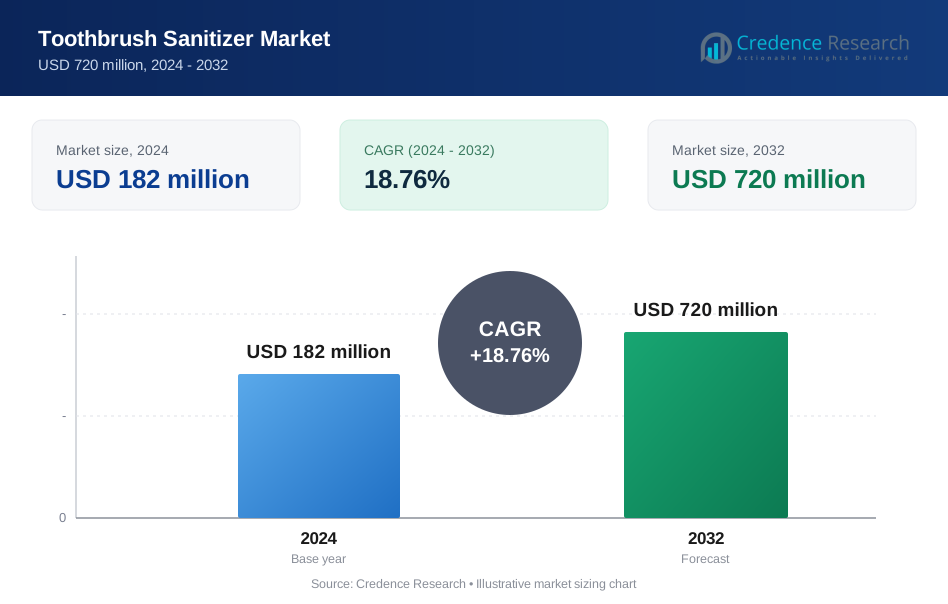
The Toothbrush Sanitizer Market size was valued at USD 182 million in 2024 and is anticipated to reach USD 720 million by 2032, at a CAGR of 18.76% during the forecast period (2024-2032).
| REPORT ATTRIBUTE | DETAILS |
|---|---|
| Historical Period | 2020-2023 |
| Base Year | 2024 |
| Forecast Period | 2025-2032 |
| Toothbrush Sanitizer Market Size 2024 | USD 182 million |
| Toothbrush Sanitizer Market, CAGR | 18.76% |
| Toothbrush Sanitizer Market Size 2032 | USD 720 million |
The primary drivers of the toothbrush sanitizer market include growing health and hygiene awareness, increasing concerns about bacterial infections, and advancements in sanitizer technology. Consumers are becoming increasingly aware of the potential health risks posed by germs and bacteria that can accumulate on toothbrushes, prompting a shift toward sanitization solutions. The convenience and affordability of toothbrush sanitizers, coupled with technological improvements, have further contributed to their popularity. Additionally, the growing awareness around preventing diseases such as gum infections and other oral health issues due to unhygienic toothbrushes has amplified the demand. In addition, rising disposable income, especially in developing nations, is allowing consumers to prioritize health-related products, driving the market forward.
Regionally, North America holds the largest share of the toothbrush sanitizer market, primarily due to high consumer awareness, established healthcare infrastructure, and a growing trend towards hygiene-conscious living. This region also benefits from strong marketing campaigns and endorsements from dental health professionals, further boosting demand. Europe follows closely, with rising health awareness and the increasing demand for sanitization solutions in households and healthcare settings. The Asia Pacific region is expected to witness the fastest growth during the forecast period, driven by rapid urbanization, improving living standards, and a growing emphasis on personal hygiene among consumers. Additionally, rising disposable income in countries like China and India has led to a higher preference for hygiene products, contributing to market expansion in this region.
Market Insights:
- The toothbrush sanitizer market was valued at USD 182 million in 2024 and is projected to reach USD 720 million by 2032, growing at a CAGR of 18.76%.
- Key drivers include growing health awareness, concerns over bacterial infections, and advancements in sanitizer technology, leading to increased demand for sanitizing solutions.
- Technological advancements, such as UV-based sanitizers, have improved product efficiency, making sanitizing devices more accessible and user-friendly.
- Rising disposable income in developing regions, particularly in countries like China and India, is increasing consumer spending on health-related products like toothbrush sanitizers.
- North America holds the largest market share of 35%, driven by high consumer awareness and a strong healthcare infrastructure.
- Europe accounts for 30% of the market, with growing health consciousness and a preference for UV-C technology in countries like Germany and the UK.
- Asia Pacific, with 25% market share, is expected to see the fastest growth due to urbanization, improving living standards, and increased focus on hygiene.
Market Drivers:
Rising Health and Hygiene Awareness
The increasing awareness about health and hygiene is a key factor driving the growth of the toothbrush sanitizer market. Consumers are becoming more conscious of the risks associated with bacterial infections that can arise from unclean toothbrushes. The growing focus on oral health, particularly in developed regions, has encouraged individuals to adopt measures for maintaining hygienic living environments. With dental professionals emphasizing the importance of clean toothbrushes, more people are seeking out products that ensure their oral hygiene tools are free from harmful bacteria and viruses. This heightened awareness directly impacts the demand for toothbrush sanitizers, as consumers look for effective and convenient solutions.
- For instance, the Philips Sonicare UV Sanitizer is designed to deactivate common bacteria such as Escherichia coli on toothbrush heads in a single 10-minute cycle using ultraviolet light.
Concerns Over Oral Health and Bacterial Infections
Bacterial contamination of toothbrushes is a significant concern, which has led to an increased demand for toothbrush sanitizers. Research indicates that toothbrushes can harbor germs, including those that cause gum diseases and infections. Consumers are increasingly concerned about the potential health risks posed by these contaminants, particularly in the wake of global health crises. These concerns have fueled the growth of the market, as more individuals seek products that offer protection against harmful bacteria. The ongoing shift towards preventive healthcare further accelerates this demand, as consumers focus on maintaining overall health.
Technological Advancements in Toothbrush Sanitizer Solutions
Advancements in sanitizer technology have played a crucial role in shaping the toothbrush sanitizer market. Technological improvements have led to the development of more efficient, user-friendly, and affordable sanitizing devices. These innovations ensure that toothbrushes are sanitized quickly and effectively, often with UV light or other advanced mechanisms. With the growing interest in convenience and automation, these solutions have gained widespread adoption in households, healthcare facilities, and hotels. The integration of these advanced technologies into toothbrush sanitizers is a driving force behind the market's expansion.
- For instance, a laboratory evaluation of the Philips Sonicare UV Sanitizer found that after a 10-minute UV-C exposure, the device was able to completely eliminate colonies of E. coli on toothbrush heads, reducing viable bacteria count from measurable levels to zero for those tested.
Increase in Disposable Income and Spending on Health Products
The increase in disposable income, particularly in developing markets, is another major driver of the toothbrush sanitizer market. As consumer spending power rises, individuals are more likely to prioritize health-related products, including hygiene tools like toothbrush sanitizers. This trend is most evident in countries where improving living standards are accompanied by rising consumer awareness of the importance of hygiene and health. In markets like Asia Pacific, the growing middle class is particularly influencing the demand for products that promote well-being, leading to increased market penetration and adoption of toothbrush sanitizers.
Market Trends:
Integration of Smart Features in Toothbrush Sanitizers
One of the significant trends in the toothbrush sanitizer market is the integration of smart features into sanitizing devices. Many consumers now seek products that offer advanced functionalities, such as automatic activation, mobile connectivity, and real-time monitoring. These features enable users to track their sanitization habits and ensure their toothbrushes are regularly disinfected. The rise of smart home products has influenced this trend, with consumers expecting more connected and convenient solutions. Some toothbrush sanitizers now include features like customizable settings, which allow users to personalize the sanitization process. The increasing demand for smart home devices is expected to continue driving this trend, making it a crucial component of the market's future growth.
- For instance, the BESTEK M-Care Electric Toothbrush achieves 31,000 vibrations per minute using advanced sonic technology, pairing this with a UV sanitizer charging station for enhanced oral hygiene.
Rising Preference for UV-C Technology in Sanitizers
UV-C technology has emerged as a dominant trend in the toothbrush sanitizer market, offering an effective method for disinfecting toothbrushes. UV-C light is known for its ability to kill bacteria, viruses, and other harmful microorganisms, making it a preferred choice for consumers looking for efficient sanitation. This technology is widely regarded as both safe and environmentally friendly, as it does not require the use of chemicals or cleaning agents. As health-conscious consumers demand more hygienic solutions, UV-C toothbrush sanitizers are gaining popularity across various regions. The increasing focus on sustainability and non-chemical disinfection methods is expected to drive continued growth in the adoption of UV-C powered sanitizers in the coming years.
- For instance, the Philips Sonicare UV Sanitizer model HX6907/01 uses a 10-minute UV-C cycle to eliminate bacteria such as Escherichia coli from toothbrush heads, as demonstrated in laboratory tests, presenting a proven cycle duration and technology in consumer products.
Market Challenges Analysis:
High Initial Cost and Affordability Concerns
One of the primary challenges facing the toothbrush sanitizer market is the high initial cost of some sanitizing devices. While these products offer long-term hygiene benefits, their upfront price can be a barrier for price-sensitive consumers, particularly in emerging markets. Many individuals may hesitate to invest in a toothbrush sanitizer, opting instead for traditional, less expensive cleaning methods. The market needs to address this affordability issue to ensure wider adoption, especially in price-conscious regions where disposable income remains limited. The challenge lies in balancing product quality, advanced features, and cost-effectiveness to attract a larger customer base.
Lack of Consumer Awareness and Education
Another significant challenge in the toothbrush sanitizer market is the lack of consumer awareness regarding the benefits of using these devices. While there is growing awareness about the importance of oral hygiene, many consumers remain unaware of the potential risks associated with unclean toothbrushes. Misconceptions about the need for sanitization or lack of understanding about how these products work can hinder market growth. It is essential for brands to invest in educational campaigns that highlight the importance of toothbrush sanitization and its health benefits, thereby encouraging more consumers to incorporate these products into their daily routines.
Market Opportunities:
Growth in Consumer Health Consciousness
The toothbrush sanitizer market holds significant opportunities as consumer health consciousness continues to rise globally. With an increasing focus on hygiene and well-being, consumers are seeking effective solutions to minimize the risk of bacteria and germs, particularly in dental care. This growing demand for products that support oral hygiene creates an opportunity for brands to introduce advanced sanitization solutions. As more people understand the importance of clean toothbrushes, the market for toothbrush sanitizers is likely to expand. Companies can capitalize on this by offering products that align with the increasing awareness of hygiene and health prevention.
Technological Advancements and Product Innovation
Technological innovation in toothbrush sanitizers offers a key opportunity for growth in the market. Advances in ultraviolet (UV) and other sanitation technologies provide a chance for brands to differentiate their products with enhanced effectiveness and convenience. The integration of smart features, such as mobile connectivity and automatic sanitization cycles, can further appeal to tech-savvy consumers. By incorporating these innovations, manufacturers can meet the demand for more advanced, user-friendly sanitizing devices. This focus on product differentiation can drive market expansion by attracting a broader consumer base, particularly in regions where consumers are increasingly looking for high-tech, convenient hygiene solutions.
Market Segmentation Analysis:
By Mounting Type
The market is divided into wall-mounted and countertop toothbrush sanitizers. Wall-mounted models are gaining popularity due to their space-saving design and convenience, particularly in smaller bathrooms. Countertop models, however, are preferred for their ease of use and accessibility, making them more suitable for families and healthcare settings. Both types offer unique advantages that cater to different consumer needs.
- For instance, the Avari TS UV Heat Toothbrush Sanitizer can be mounted on the wall or placed on a countertop, and is designed to hold exactly 5 toothbrushes simultaneously, making it ideal for both individual and family use.
By Charging Mode
The charging mode segment includes battery-operated and plug-in toothbrush sanitizers. Battery-operated models provide portability and convenience, particularly in travel-friendly designs. Plug-in models, on the other hand, offer consistent power for regular household use. The choice between these options depends on user preferences for mobility or long-term usability, with both modes showing substantial demand in the market.
- For instance, the B-Brite UV Toothbrush Sanitizer runs on one AA battery and completes a full sanitization cycle in 3 minutes, offering a travel-ready feature set without the need for charging cables.
By Application
The toothbrush sanitizer market serves multiple applications, including household, commercial, and healthcare use. Household applications dominate due to increasing consumer awareness of hygiene and health risks associated with unclean toothbrushes. Commercial use, especially in hospitality and healthcare settings, is also growing as businesses look to provide hygienic solutions for guests and patients. The healthcare segment focuses on professional-grade devices used in dental offices and clinics, ensuring high standards of sanitation.
Segmentations:
By Mounting Type- Wall-mounted
- Countertop
- Battery-operated
- Plug-in
- Household
- Commercial
- Healthcare
- U.S.
- Canada
- Mexico
- UK
- France
- Germany
- Italy
- Spain
- Russia
- Rest of Europe
- China
- Japan
- South Korea
- India
- Australia
- Southeast Asia
- Rest of Asia Pacific
- Brazil
- Argentina
- Rest of Latin America
- GCC Countries
- Israel
- Turkey
- Rest of Middle East
- South Africa
- Egypt
- Rest of Africa
Regional Analysis:
Market Leadership in North America Driven by Healthcare and Consumer Awareness
North America holds the largest share of the toothbrush sanitizer market, accounting for 35%. The region's strong healthcare infrastructure and high consumer awareness contribute to its leadership position. Consumers in the United States and Canada are highly aware of the risks posed by bacterial contamination, leading to increased adoption of toothbrush sanitizers. With an established retail presence and a preference for high-quality hygiene products, the market is expected to continue its growth. Major manufacturers in the region focus on advanced product innovations, catering to the demand for effective and convenient sanitization solutions. Furthermore, higher disposable income in North America allows consumers to invest in premium products that ensure optimal hygiene.
Rising Health Consciousness and Widespread Adoption of Sanitization Solutions in Europe
Europe accounts for 30% of the toothbrush sanitizer market, driven by rising health consciousness and increasing demand for hygiene products. In countries such as Germany, the UK, and France, consumers are increasingly prioritizing oral health, fueling the adoption of sanitization solutions. The presence of established retailers and the widespread availability of advanced sanitizers make this region a key market. European consumers show a strong preference for UV-C technology, which is further contributing to market growth. Enhanced awareness of hygiene risks, combined with a rising interest in health and wellness, will continue to drive demand in this region.
Rapid Growth and Market Expansion Driven by Urbanization and Health Trends in Asia Pacific
The Asia Pacific region holds a 25% share and is expected to experience the fastest growth during the forecast period. Rapid urbanization, improving living standards, and an increasing focus on health are key factors driving the adoption of toothbrush sanitizers. Countries like China and India are seeing an upward trend in consumer spending, leading to higher demand for health-related products. The growing middle class and shifting preferences towards modern hygiene solutions create significant opportunities for market expansion. Affordable product offerings and advancements in sanitizing technology are expected to further boost market penetration in this region.
Key Player Analysis:
- Philips
- Colgate-Palmolive
- Oral-B (Procter & Gamble)
- Violife
- Panasonic
- Waterpik
- Fairywill
- Mornwell
- Puretta
- Munchkin
- Oclean
- Soocas
Competitive Analysis:
The toothbrush sanitizer market is highly competitive, with key players like Philips, Colgate-Palmolive, and Violife leading through innovation and advanced UV-C technology. These companies focus on improving product efficiency, consumer convenience, and incorporating new features to cater to the growing demand for hygiene solutions. Emerging brands are also gaining traction by offering affordable and portable models, particularly targeting price-sensitive consumers in developing regions. They leverage e-commerce platforms and social media for wider reach. As consumer awareness about oral hygiene increases, competition intensifies, with companies differentiating their products through design, technology, and strategic marketing to capture market share.
Recent Developments:
- In July 2025, Philips launched the ECG AI Marketplace, providing cardiac care teams with a centralized platform for accessing a broad portfolio of AI-powered diagnostic tools.
- In February 2025, Colgate-Palmolive announced an agreement to acquire Australia-based Care TopCo, owner of the Prime100 pet-food brand.
- In January 2025, Panasonic unveiled its flagship Z95B OLED TV series, equipped with Primary RGB Tandem Panel technology for improved brightness, color volume, and audio.
Market Concentration & Characteristics:
The toothbrush sanitizer market is moderately concentrated, with a few key players holding a significant share. Leading companies like Philips, Colgate-Palmolive, and Violife dominate through advanced technology and established brand recognition. Despite the dominance of these major players, several smaller brands are entering the market with innovative, cost-effective solutions to cater to niche segments. These brands focus on affordability, portability, and ease of use, which appeals to price-sensitive consumers. The market is characterized by rapid technological advancements, particularly in UV-C sanitizing technology, which enhances the efficiency and effectiveness of products. Consumer awareness around hygiene and health risks has created a growing demand for these sanitizing solutions, fueling competition. The market also exhibits diverse offerings, from high-end models with advanced features to more basic, budget-friendly options. This diversity allows for broad market coverage, addressing a wide range of consumer preferences.
Report Coverage:
The research report offers an in-depth analysis based on Mounting Type, Charging Mode, Application and Region. It details leading market players, providing an overview of their business, product offerings, investments, revenue streams, and key applications. Additionally, the report includes insights into the competitive environment, SWOT analysis, current market trends, as well as the primary drivers and constraints. Furthermore, it discusses various factors that have driven market expansion in recent years. The report also explores market dynamics, regulatory scenarios, and technological advancements that are shaping the industry. It assesses the impact of external factors and global economic changes on market growth. Lastly, it provides strategic recommendations for new entrants and established companies to navigate the complexities of the market.
Future Outlook:
- The toothbrush sanitizer market is expected to experience significant growth, driven by increasing consumer awareness of oral hygiene and the need for effective germ eradication.
- Technological advancements in UV-C technology are enhancing the efficiency and effectiveness of toothbrush sanitizers, making them more appealing to consumers.
- The market is witnessing a shift towards portable and travel-friendly designs, catering to the on-the-go lifestyle of modern consumers.
- Integration of smart features, such as smartphone connectivity and usage tracking, is becoming a key differentiator among products in the market.
- There is a growing preference for eco-friendly and sustainable materials in the manufacturing of toothbrush sanitizers, aligning with global sustainability trends.
- The expansion of e-commerce platforms is facilitating wider distribution and accessibility of toothbrush sanitizers to a global consumer base.
- Rising disposable incomes, particularly in developing economies, are contributing to increased spending on premium hygiene products, including toothbrush sanitizers.
- The market is witnessing increased competition, with both established brands and new entrants focusing on innovation and customer-centric solutions.
- Regulatory support and awareness campaigns by health organizations are further driving the adoption of toothbrush sanitizers among consumers.
- The toothbrush sanitizer market is poised for substantial growth, with projections indicating a significant increase in market size over the next decade.
Request a Free Sample
Fill in your details and we'll send you a free sample report.
- Sample data tables & charts
- Research methodology
Market Dynamics
Rising Health and Hygiene Awareness
Increasing consumer awareness about the health risks associated with bacterial contamination on toothbrushes is driving demand for effective sanitization solutions, especially as dental professionals and public health campaigns emphasize oral hygiene.
Concerns Over Oral Health and Bacterial Infections
Heightened concerns about gum diseases and infections caused by unclean toothbrushes are prompting consumers to adopt toothbrush sanitizers as a preventive health measure, particularly in the wake of global health crises.
Technological Advancements in Sanitizer Solutions
Innovations such as UV-C and smart-enabled sanitizers have made devices more efficient, user-friendly, and accessible, encouraging adoption in both households and healthcare settings.
Increase in Disposable Income and Health Spending
Rising disposable incomes, especially in developing regions like Asia Pacific, are enabling consumers to prioritize and spend more on premium hygiene products, including advanced toothbrush sanitizers.
Preference for Eco-friendly and Chemical-free Disinfection
Growing environmental consciousness and the desire for non-chemical disinfection methods are boosting the popularity of UV-C and other eco-friendly sanitizer technologies among health-conscious consumers.
Need a Custom Version of This Report?
Tailor the scope, geography, or segments to your exact requirements.
- Custom geography or segment scope
- Direct access to our analyst team
Frequently Asked Questions
What is the current size of the Toothbrush Sanitizer Market?
What factors are driving the growth of the Toothbrush Sanitizer Market?
What are the key segments within the Toothbrush Sanitizer Market?
Who are the major players in the Toothbrush Sanitizer Market?
Table of Content
Chapter 1 Market Segmentation
- 1.1 Segmentation Framework
- 1.1.1 Product and Service Classification
- 1.1.2 Application and End-Use Classification
- 1.1.3 Technology and Solution Classification
- 1.1.4 Customer and Distribution Channel Classification
- 1.1.5 Geographic Segmentation
- 1.1.6 Market Segment Definitions and Boundaries
- 1.2 By Technology
- 1.2.1 UV-C Sanitizer
- 1.2.2 Ozone-based Sanitizer
- 1.2.3 Heat-based Sanitizer
- 1.2.4 Other Advanced Technologies
- 1.3 By Application
- 1.3.1 Household
- 1.3.2 Commercial
- 1.3.3 Healthcare
- 1.4 By Charging Mode
- 1.4.1 Battery-operated
- 1.4.2 Plug-in
- 1.5 By Mounting Type
- 1.5.1 Wall-mounted
- 1.5.2 Countertop
Chapter 2 Introduction
- 2.1 Report Objectives and Scope
- 2.2 Product Definition and Industry Terminology
- 2.3 Market Inclusions and Exclusions
- 2.4 Research Process
- 2.4.1 Primary Research and Expert Interviews
- 2.4.2 Secondary Research and Source Review
- 2.4.3 Top-Down and Bottom-Up Estimation
- 2.4.4 Data Triangulation and Verification
- 2.5 Market Size Measurement Basis
- 2.5.1 2024: USD 182 million → 2032: USD 720 million
- 2.6 Historical and Forecast Reference Periods
- 2.6.1 Base Year: 2024
- 2.6.2 Forecast Period: 2024-2032
- 2.7 Research Assumptions and Limitations
Chapter 3 Executive Summary
- 3.1 Market Snapshot and Key Findings
- 3.2 Base-Year Market Size, 2024
- 3.3 Forecast Market Size, 2032
- 3.4 Revenue and Volume Growth Outlook
- 3.5 Key Demand and Supply Indicators
- 3.6 Leading Market Segments
- 3.7 Fastest-Growing Market Opportunities
- 3.8 Regional Performance Highlights
- 3.9 Technology and Industry Transformation
- 3.10 Competitive Landscape Summary
- 3.11 Analyst View and Strategic Implications
Chapter 4 Global Toothbrush Sanitizer Market Trends and Developments
- 4.1 Historical Industry Development
- 4.2 Recent Market Trends and Developments
- 4.3 Demand and Customer Behavior Trends
- 4.4 Technology and Product Innovation
- 4.5 Artificial Intelligence, Automation and Digitalization
- 4.6 Local Manufacturing and Supply Chain Realignment
- 4.7 Industry Partnerships, Mergers and Acquisitions
- 4.8 Sustainability and Circular Economy Developments
- 4.9 Government and Private Sector Investment Trends
- 4.10 Emerging Business Models and Commercialization
- 4.11 Industry Developments and Announcements
Chapter 5 Global Toothbrush Sanitizer Market Production, Supply and Demand Analysis
- 5.1 Demand Trend and Consumption Analysis
- 5.2 Demand Forecast, 2024-2032
- 5.3 Production and Output Trend
- 5.4 Production and Output Forecast, 2024-2032
- 5.5 Installed Capacity and Capacity Utilization
- 5.6 Company-Wise Production Plants and Statistics
- 5.6.1 Installed Production Capacity
- 5.6.2 Actual Production
- 5.6.3 Planned Capacity and Expansion Targets
- 5.7 Supply Chain Structure and Procurement Trends
- 5.8 Supply-Demand Gap and Bottlenecks
- 5.9 Import Dependence and Sourcing Structure
- 5.10 Contract Manufacturing and Outsourcing
- 5.11 Regional Supply and Demand Concentration
Chapter 6 Global Toothbrush Sanitizer Market Pricing Analysis
- 6.1 Pricing Structure and Measurement
- 6.2 Historical Pricing Trends
- 6.3 Pricing Outlook, 2024-2032
- 6.4 Average Selling Price and Unit Economics
- 6.5 Pricing by Product and Market Segment
- 6.6 Geographic Pricing Differences
- 6.7 Key Input, Energy, Labor and Logistics Costs
- 6.8 Contract Pricing and Purchasing Models
- 6.9 Pricing Sensitivity and Competitive Positioning
- 6.10 Price, Margin and Profitability Implications
Chapter 7 Global Toothbrush Sanitizer Market Dynamics
- 7.1 Market Growth Drivers
- 7.1.1 Demand-Side Drivers
- 7.1.2 Technology and Innovation Drivers
- 7.1.3 Infrastructure and Investment Drivers
- 7.1.4 Regulatory and Policy Drivers
- 7.2 Market Restraints
- 7.2.1 Cost and Affordability Constraints
- 7.2.2 Technology and Adoption Barriers
- 7.2.3 Supply Chain and Operational Constraints
- 7.3 Market Challenges
- 7.3.1 Competitive Pressure and Margin Erosion
- 7.3.2 Skills, Infrastructure and Implementation Gaps
- 7.4 Emerging Market Opportunities
- 7.5 Market Dynamics Impact and Time-Horizon Assessment
Chapter 8 Global Toothbrush Sanitizer Value Chain Analysis
- 8.1 Industry Value Chain Overview
- 8.2 Upstream Suppliers and Critical Inputs
- 8.3 Technology and Component Providers
- 8.4 Manufacturing or Service Delivery
- 8.5 Distribution, Channel Partners and Integrators
- 8.6 Downstream Applications and End Users
- 8.7 Value Addition and Profit Pools
- 8.8 Vertical Integration and Outsourcing
- 8.9 Supplier Concentration and Risk
- 8.10 Supply Chain Localization and Resilience
Chapter 9 Global Toothbrush Sanitizer Market Regulations and Policies
- 9.1 Relevant Laws, Standards and Compliance Frameworks
- 9.2 Product, Service, Safety and Quality Requirements
- 9.3 Government Policies, Incentives and Subsidies
- 9.4 Imports, Exports and Trade Barriers
- 9.5 Public Procurement and Local Content Requirements
- 9.6 Environmental and Sustainability Compliance
- 9.7 Upcoming Policy Changes and Market Implications
Chapter 10 Global Toothbrush Sanitizer Market Hotspots and Opportunities
- 10.1 Market Opportunity Mapping and Growth Hotspots
- 10.2 High-Growth Applications and Customer Groups
- 10.3 Underserved Markets and White-Space Opportunities
- 10.4 Emerging Technology and Product Opportunities
- 10.5 New Capacity and Investment Hotspots
- 10.6 Market Entry and Expansion Opportunities
- 10.7 Distribution and Partnership Opportunities
- 10.8 Near-Term and Long-Term Commercial Potential
- 10.9 Opportunity Attractiveness and Execution Risks
Chapter 11 Global Toothbrush Sanitizer Market Outlook, 2024-2032
- 11.1 Market Size and Analysis
- 11.1.1 Revenue (Market Measurement: 2024: USD 182 million → 2032: USD 720 million)
- 11.1.2 Market Volume and Quantity Sold
- 11.1.3 Historical Market Size
- 11.1.4 Base-Year Market Size, 2024
- 11.2 Market Forecast, 2024-2032
- 11.2.1 Revenue Forecast to 2032
- 11.2.2 Volume Forecast to 2032
- 11.2.3 CAGR and Year-on-Year Growth
- 11.2.4 Incremental Revenue Opportunity
- 11.3 Forecast Assumptions and Scenario Analysis
- 11.3.1 Base-Case Forecast
- 11.3.2 Optimistic and Conservative Scenarios
- 11.3.3 Technology, Pricing and Policy Sensitivities
- 11.4 Market Attractiveness and Growth Outlook
Chapter 12 Global Toothbrush Sanitizer Market Segmentation and Outlook
- 12.1 Segmentation Summary and Market Shares, 2024
- 12.2 Largest and Fastest-Growing Segments
- 12.3 By Technology - Market Size and Forecast, 2024-2032
- 12.3.1 Segment Definition and Scope
- 12.3.2 Historical Market Size
- 12.3.3 Revenue Forecast, 2024-2032
- 12.3.4 Volume Forecast, 2024-2032
- 12.3.5 Base-Year Market Share, 2024
- 12.3.6 Segment CAGR and Growth Drivers
- 12.3.7 Subsegment Market Size and Forecast
- 12.3.7.1 UV-C Sanitizer
- 12.3.7.2 Ozone-based Sanitizer
- 12.3.7.3 Heat-based Sanitizer
- 12.3.7.4 Other Advanced Technologies
- 12.3.8 Subsegment Pricing and Adoption Trends
- 12.3.9 Leading Suppliers and Competition
- 12.3.10 Regional Demand and Opportunities
- 12.4 By Application - Market Size and Forecast, 2024-2032
- 12.4.1 Segment Definition and Scope
- 12.4.2 Historical Market Size
- 12.4.3 Revenue Forecast, 2024-2032
- 12.4.4 Volume Forecast, 2024-2032
- 12.4.5 Base-Year Market Share, 2024
- 12.4.6 Segment CAGR and Growth Drivers
- 12.4.7 Subsegment Market Size and Forecast
- 12.4.7.1 Household
- 12.4.7.2 Commercial
- 12.4.7.3 Healthcare
- 12.4.8 Subsegment Pricing and Adoption Trends
- 12.4.9 Leading Suppliers and Competition
- 12.4.10 Regional Demand and Opportunities
- 12.5 By Charging Mode - Market Size and Forecast, 2024-2032
- 12.5.1 Segment Definition and Scope
- 12.5.2 Historical Market Size
- 12.5.3 Revenue Forecast, 2024-2032
- 12.5.4 Volume Forecast, 2024-2032
- 12.5.5 Base-Year Market Share, 2024
- 12.5.6 Segment CAGR and Growth Drivers
- 12.5.7 Subsegment Market Size and Forecast
- 12.5.7.1 Battery-operated
- 12.5.7.2 Plug-in
- 12.5.8 Subsegment Pricing and Adoption Trends
- 12.5.9 Leading Suppliers and Competition
- 12.5.10 Regional Demand and Opportunities
- 12.6 By Mounting Type - Market Size and Forecast, 2024-2032
- 12.6.1 Segment Definition and Scope
- 12.6.2 Historical Market Size
- 12.6.3 Revenue Forecast, 2024-2032
- 12.6.4 Volume Forecast, 2024-2032
- 12.6.5 Base-Year Market Share, 2024
- 12.6.6 Segment CAGR and Growth Drivers
- 12.6.7 Subsegment Market Size and Forecast
- 12.6.7.1 Wall-mounted
- 12.6.7.2 Countertop
- 12.6.8 Subsegment Pricing and Adoption Trends
- 12.6.9 Leading Suppliers and Competition
- 12.6.10 Regional Demand and Opportunities
- 12.7 Segment Growth Comparison
- 12.8 Segment Attractiveness and Priority Matrix
Chapter 13 Global Toothbrush Sanitizer End-Use and Application Market Outlook
- 13.1 End-Use Industry and Customer Demand Structure
- 13.2 Leading Applications and Customer Groups
- 13.3 End-Use Market Size, Share and Forecast
- 13.4 Major End-Use Industry Deep Dives
- 13.4.1 Customer Requirements and Use Cases
- 13.4.2 Demand and Replacement Cycles
- 13.4.3 Technical and Regulatory Considerations
- 13.4.4 Purchasing and Procurement Models
- 13.4.5 Leading Vendors and Distribution Channels
- 13.4.6 Forecast and Commercial Opportunities
- 13.5 Emerging Applications and Cross-Segment Demand
- 13.6 End-Use Industry Investment Priorities
Chapter 14 Global Toothbrush Sanitizer Geographic Market Outlook, 2024-2032
- 14.1 Regional Market Size and Share, 2024
- 14.2 Regional Market Forecast, 2024-2032
- 14.3 Regional Pricing, Production and Demand Differences
- 14.4 North America
- 14.4.1 United States
- 14.4.2 Canada
- 14.4.3 Mexico
- 14.5 Europe
- 14.5.1 Germany
- 14.5.2 France
- 14.5.3 Italy
- 14.5.4 United Kingdom
- 14.5.5 Spain
- 14.5.6 Poland
- 14.5.7 Russia
- 14.5.8 Netherlands
- 14.5.9 Belgium
- 14.5.10 Sweden
- 14.5.11 Denmark
- 14.5.12 Norway
- 14.5.13 Rest of Europe
- 14.6 Asia Pacific
- 14.6.1 China
- 14.6.2 India
- 14.6.3 Japan
- 14.6.4 South Korea
- 14.6.5 Thailand
- 14.6.6 Indonesia
- 14.6.7 Vietnam
- 14.6.8 Malaysia
- 14.6.9 Australia
- 14.6.10 Rest of Asia Pacific
- 14.7 Latin America
- 14.7.1 Brazil
- 14.7.2 Argentina
- 14.7.3 Colombia
- 14.7.4 Chile
- 14.7.5 Rest of Latin America
- 14.8 Middle East
- 14.8.1 Saudi Arabia
- 14.8.2 United Arab Emirates
- 14.8.3 Turkey
- 14.8.4 Israel
- 14.8.5 Iran
- 14.8.6 Rest of the Middle East
- 14.9 Africa
- 14.9.1 South Africa
- 14.9.2 Egypt
- 14.9.3 Nigeria
- 14.9.4 Morocco
- 14.9.5 Rest of Africa
- 14.10 Regional Investment, Policy and Supply Chain Differences
- 14.11 Regional Competitive Landscape
- 14.12 Geographic Growth Hotspots
Chapter 15 Global Toothbrush Sanitizer Technology, Innovation and Sustainability Outlook
- 15.1 Technology Landscape and Maturity
- 15.2 Product, Process and Service Innovation
- 15.3 AI, Automation and Digital Tools in the Industry
- 15.4 Technology Adoption and Performance Benchmarking
- 15.5 Innovation Pipeline and R&D Investment
- 15.6 Patent and Intellectual Property Trends
- 15.7 Energy Efficiency and Resource Management
- 15.8 Sustainability, Recycling and Circularity
- 15.9 Technology Roadmap, 2024-2032
- 15.10 Risks of Obsolescence and Technology Substitution
Chapter 16 Global Toothbrush Sanitizer Market Key Strategic Imperatives
- 16.1 Growth and Market Entry Priorities
- 16.2 High-Return Products and Segments
- 16.3 Pricing, Profitability and Cost Optimization
- 16.4 Technology Investment and Product Differentiation
- 16.5 Supply Chain Localization and Resilience
- 16.6 Distribution and Customer Acquisition
- 16.7 Partnership, Acquisition and Capacity Strategy
- 16.8 Regional Expansion Priorities
- 16.9 Short-, Medium- and Long-Term Actions
Chapter 17 Competition Outlook
- 17.1 Industry Competition Characteristics
- 17.2 Market Structure and Concentration
- 17.3 Market Share and Competitive Positioning, 2024
- 17.4 Company-Wise Revenue and Product Benchmarking
- 17.5 Production and Service Capacity Benchmarking
- 17.6 Technology, Pricing and Differentiation
- 17.7 Regional Footprint and Distribution Strength
- 17.8 Mergers, Acquisitions and Strategic Alliances
- 17.9 New Entrants and Competitive Threats
- 17.10 Porter's Five Forces and Industry Attractiveness
- 17.11 Competitive Outlook, 2024-2032
Chapter 18 Company Profiles
- 18.1 Company Coverage and Selection Criteria
- 18.2 Philips
- 18.2.1 Business Description
- 18.2.2 Company Ownership and Geographic Presence
- 18.2.3 Product and Service Portfolio
- 18.2.4 Manufacturing and Operating Footprint
- 18.2.5 Production Capacity and Expansion Plans
- 18.2.6 Financial Performance and Investment
- 18.2.7 Market Share and Competitive Position
- 18.2.8 Technology and Innovation Capabilities
- 18.2.9 Strategic Alliances or Partnerships
- 18.2.10 Recent Developments
- 18.2.11 Growth Strategy and Outlook
- 18.3 Colgate-Palmolive
- 18.4 Oral-B (Procter & Gamble)
- 18.5 Violife
- 18.6 Panasonic
- 18.7 Waterpik
- 18.8 Fairywill
- 18.9 Mornwell
- 18.10 Puretta
- 18.11 Munchkin
- 18.12 Other Relevant Market Participants
Note: Every listed company is profiled on the structure shown under the first company. The company list is preliminary and may change based on research findings, market developments, data availability and client requirements.
Chapter 19 Disclaimer
- 19.1 Research and Forecast Disclaimer
- 19.2 Data Source and Estimation Limitations
Note: The depth of individual sections depends on data availability for this market. Volume, capacity, trade and other unit-based metrics are included where applicable.

