
Aging men and prostate cancer care lift urologic medicines
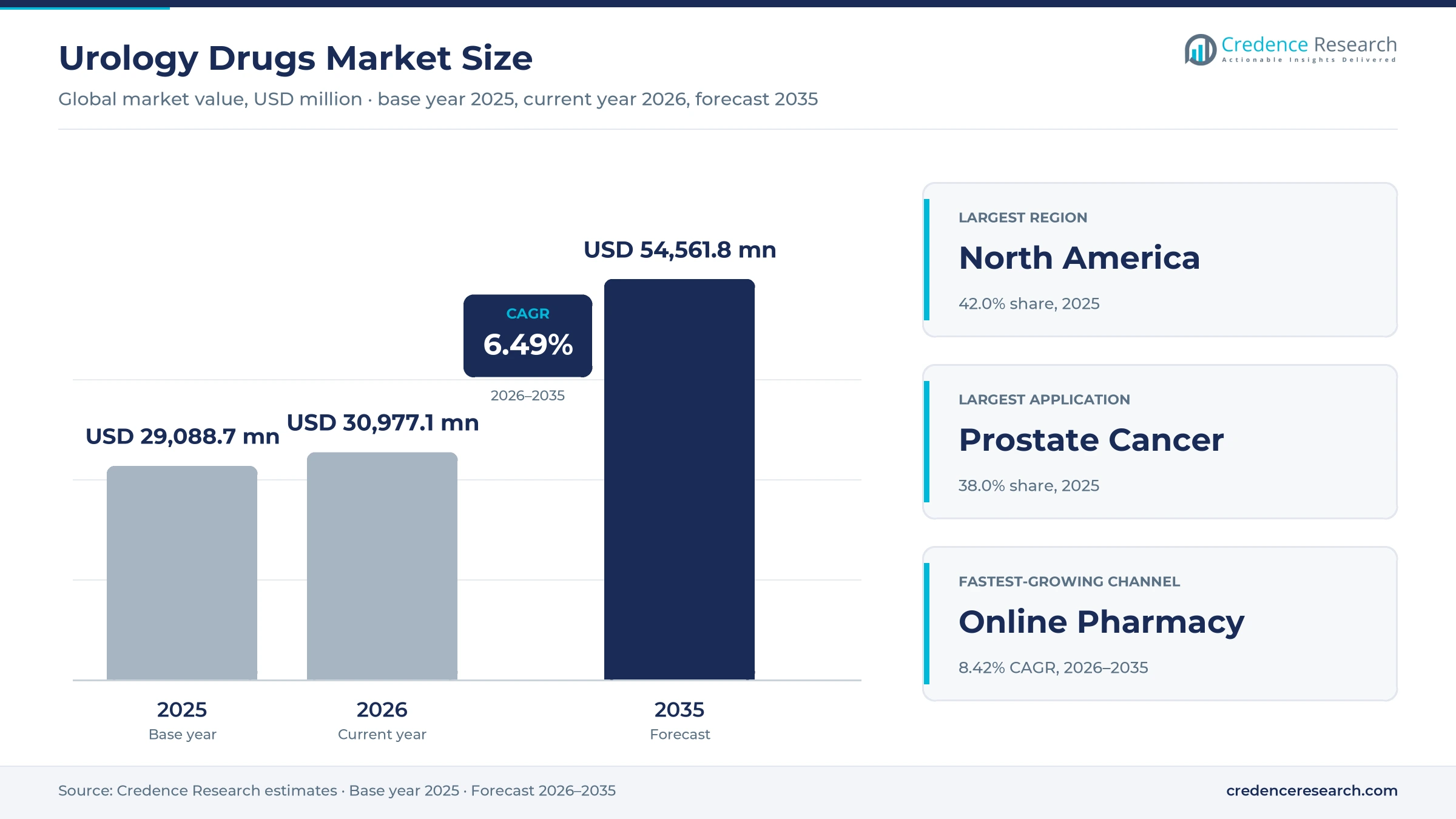
The global urology drugs market was valued at USD 29.09 billion in 2025 and is projected to increase from USD 30.98 billion in 2026 to USD 54.56 billion by 2035, registering a CAGR of 6.49% during 2026–2035. Demand rises because aging men need long-term treatment for prostate enlargement, while prostate and bladder cancer patients now receive more targeted medicines. North America held the largest regional share, 42.0% in 2025, because the United States combines high branded oncology prices with broad Medicare coverage for older men. Asia Pacific is the fastest-growing region at 7.68% a year, as aging populations in China, Japan and India meet wider access to specialist care. The regulatory picture also shifted in March 2025, when the FDA expanded the use of a radioligand therapy to earlier metastatic prostate cancer. As a result, hospital pharmacies handle a rising share of high-value urologic treatment, while low-cost generics keep chronic bladder and prostate therapy affordable.
Which urologic medicines and conditions does this analysis count?
The analysis counts prescription medicines used to treat benign prostatic hyperplasia, prostate cancer, urinary incontinence, kidney and bladder stones, erectile dysfunction and other urologic conditions. It covers alpha blockers, anticholinergic and antispasmodic agents, skeletal muscle relaxants and other classes, such as beta-3 agonists, 5-alpha reductase inhibitors, PDE5 inhibitors and urologic oncology medicines.
Surgical devices, catheters, lithotripsy equipment and diagnostic imaging sit outside the value counted here. The value chain runs from ingredient synthesis and finished dosage manufacturing through wholesale distribution to hospital, retail and online pharmacies, with insurers, public payers and patients paying for each prescription.
Urology Drugs Market Insights
- The urology drugs market grows from USD 29.09 billion in 2025 to USD 54.56 billion by 2035, a 6.49% CAGR as aging men and cancer patients receive longer treatment.
- North America held 42.0% of global value in 2025, because U.S. oncology prices and Medicare coverage for older men remain high.
- Prostate cancer led applications with 38.0% of 2025 value, as androgen receptor and radioligand therapies extend treatment time.
- The FDA approved UroGen Pharma's Zusduri in June 2025 as the first medicine for recurrent low-grade intermediate-risk bladder cancer.
- Mallinckrodt and Endo completed their merger on Aug. 1, 2025, combining branded portfolios that include urology products and planning a generics spin-off.
Prostate cancer leads applications as online refills rise
Which drug classes account for most urologic spending?
Based on drug class, the market is categorized into anticholinergic and antispasmodic agents, skeletal muscle relaxants, alpha blockers and others. The Others group led with 46.0% of 2025 value, because it includes high-priced prostate cancer medicines, PDE5 inhibitors and beta-3 agonists. The same group grows fastest at 7.35% a year, as targeted oncology and combination regimens gain use. Alpha blockers remain the most common first prescription for prostate enlargement.
Which urologic conditions draw the most treatment spending?
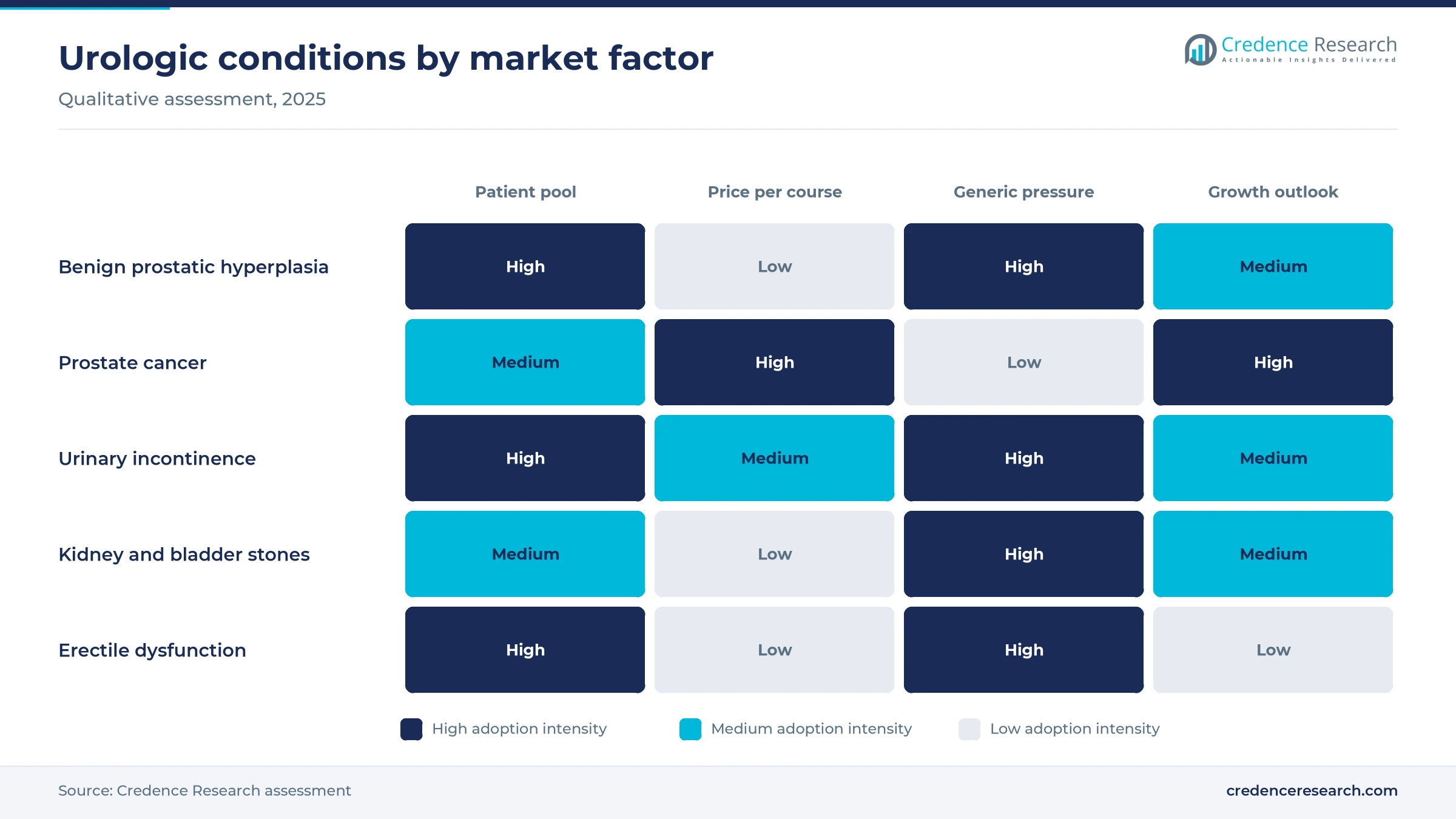
Based on application, the market is categorized into benign prostatic hyperplasia, prostate cancer, urinary incontinence, kidney and bladder stones, erectile dysfunction and others. Prostate Cancer led with 38.0% of 2025 value, because metastatic patients stay on costly therapy for years. The Others group grows fastest at 7.59% a year, as new intravesical bladder cancer treatments reach patients. Erectile dysfunction value grows slowly because generic PDE5 inhibitors dominate.
Where do patients fill urologic prescriptions?
Based on distribution channel, the market is categorized into hospital pharmacy, retail pharmacy, online pharmacy and others. Hospital Pharmacy led with 43.0% of 2025 value, because infused and specialty cancer medicines are dispensed in hospital settings. Online Pharmacy grows fastest at 8.42% a year, as telehealth prescribers and home delivery serve men seeking discreet refills. Retail pharmacies still fill most chronic prostate and bladder prescriptions.
| Segment Group | Leading Sub-segment | Share, 2025 | Fastest-growing Sub-segment | CAGR, 2026–2035 |
|---|---|---|---|---|
| By Drug Class | Others | 46.0% | Others | 7.35% |
| By Application | Prostate Cancer | 38.0% | Others | 7.59% |
| By Distribution Channel | Hospital Pharmacy | 43.0% | Online Pharmacy | 8.42% |
Request a Free Sample
Fill in your details and we'll send you a free sample report.
- Sample data tables & charts
- Research methodology
Prostate disease, bladder cancer and OAB expand treatment
How does an aging male population raise prostate treatment?
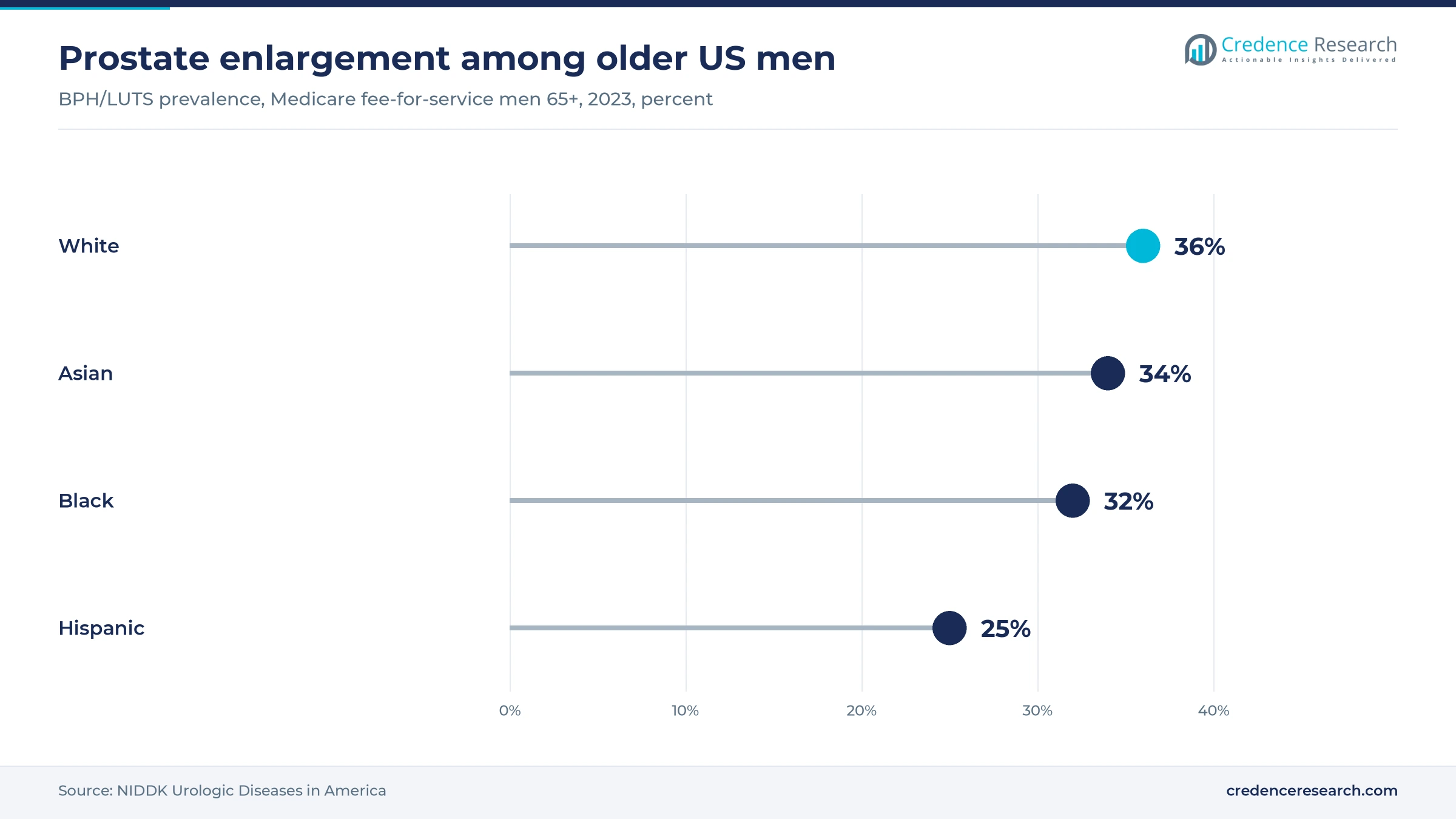
Older men form the largest treated group, because prostate enlargement becomes common after age 60 and usually needs years of daily medicine. The National Institute of Diabetes and Digestive and Kidney Diseases reports that 30% to 35% of men 65 and older in Medicare fee-for-service had benign prostatic hyperplasia from 2016 to 2023. The same report counted about 600,000 new cases each year in that group, and 60% of affected men filled a labeled medicine in 2023. Alpha blockers were filled by 52% of these patients, which keeps volume steady. As a result, benign prostatic hyperplasia held a large share of 2025 value, and benign prostatic hyperplasia treatment remains a core prescription category.
Why do new prostate cancer approvals lift treatment value?
Regulators keep widening prostate cancer labels, which moves costly therapies into earlier disease stages and longer use. On March 28, 2025, the FDA expanded the Pluvicto indication to PSMA-positive metastatic castration-resistant patients before taxane chemotherapy, based on the 468-patient PSMAfore trial. In June 2025, the FDA added final survival data to the Talzenna and Xtandi label, showing median survival of 45.1 months versus 31.1 months in HRR-mutated patients. IARC estimated 849,528 new prostate cancer cases in high-income countries in 2024, the top cancer among men. In turn, prostate cancer led applications with 38.0% of 2025 value, and prostate cancer treatment spending keeps rising.
How are bladder cancer medicines adding new demand?
Recurrent bladder tumors were long managed with repeated surgery, because no approved medicine existed for many of these patients. On June 12, 2025, the FDA approved UroGen Pharma's Zusduri as the first medicine for recurrent low-grade intermediate-risk non-muscle invasive bladder cancer. The ENVISION trial enrolled 240 patients and reported a 78% complete response rate at three months. UroGen estimates that about 59,000 U.S. patients develop this recurrent cancer each year, which defines a large treatable pool. As a result, the others application group grows fastest at 7.59% a year, while hospital pharmacies held 43.0% of 2025 value through urologist-administered treatment.
Why does overactive bladder treatment keep expanding?
Many men and women with urgency and leakage remain untreated, which leaves a large pool for new prescriptions. On Dec. 23, 2024, the FDA approved Gemtesa for men with overactive bladder symptoms who already take prostate medicine, according to Pharmacy Times. The same report notes that up to 75% of men with benign prostatic hyperplasia have overactive bladder symptoms. It also states that about 80% of male cases may go undiagnosed, which leaves room for wider treatment. Urinary incontinence held a solid share of 2025 value and grows at a steady rate. In turn, incontinence devices and oral medicines often serve the same aging patients.
Generic entry, consolidation and stone prevention openings
How is the shift to generics changing chronic bladder care?
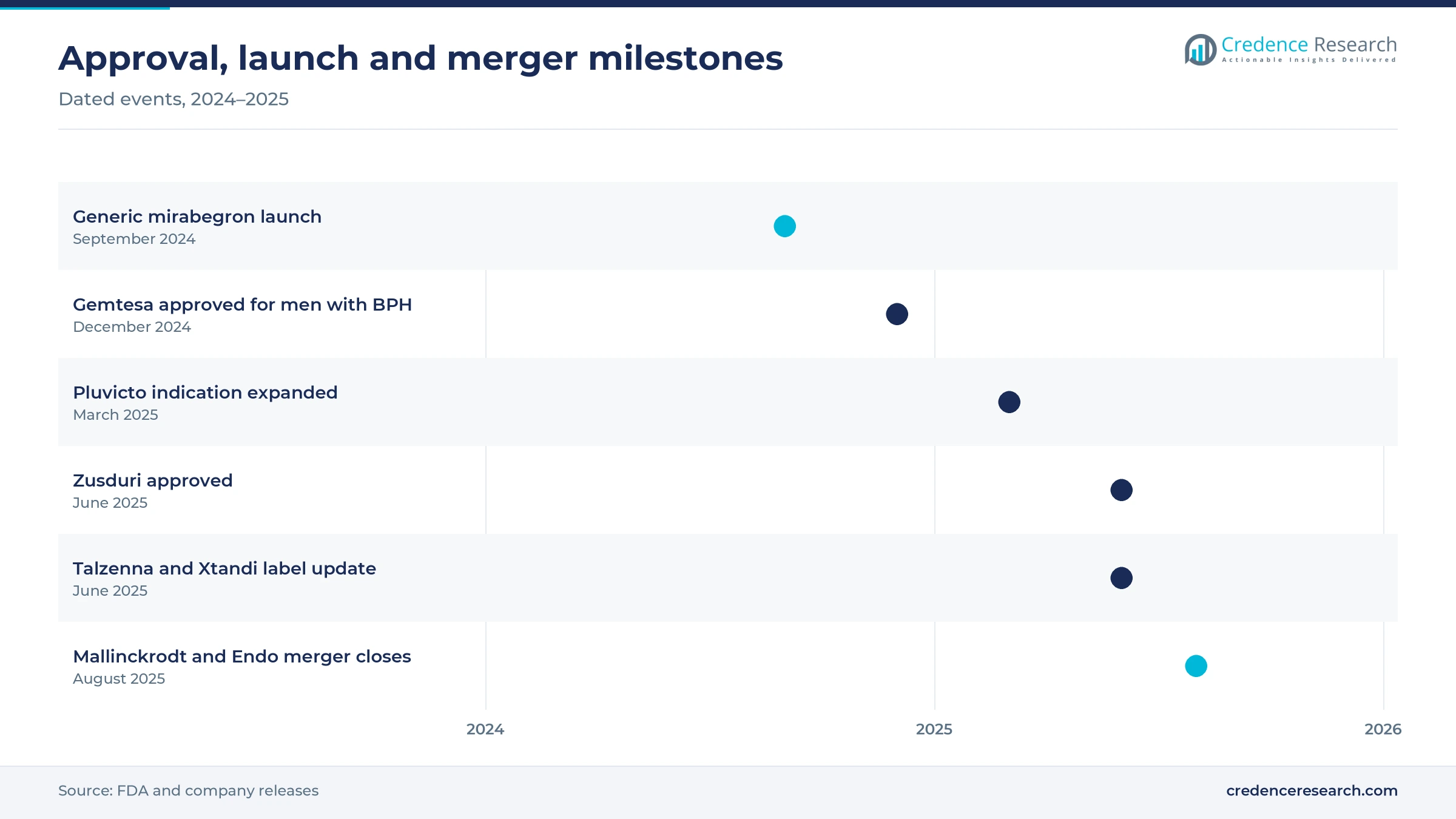
Widely used bladder and prostate brands have lost exclusivity in the United States, which pushes prescriptions toward cheaper copies. On Sept. 4, 2024, Lupin launched generic mirabegron extended-release tablets of 50 mg, referencing Astellas' Myrbetriq. Generic tamsulosin and other alpha blockers already dominate first-line prostate prescriptions at low prices. NIDDK data show that 5-alpha reductase inhibitor use among Medicare men fell from 24% in 2016 to 21% in 2023. As a result, anticholinergic and antispasmodic agents grow more slowly than other classes, while retail pharmacies keep high prescription volumes at falling unit values. Payers also steer new patients toward the cheapest equivalent product.
Is consolidation reshaping branded urology portfolios?
Midsize specialty companies are combining their brands, because larger portfolios help them fund launches and manage debt. Mallinckrodt and Endo completed their merger on Aug. 1, 2025, and the combined company lists urology among its branded therapy areas. The companies also planned to spin off the Par Health generics and sterile injectables business as a separate company in the fourth quarter of 2025, backed by a $1.35 billion secured credit facility. Endo Pharmaceuticals markets Xiaflex, which faces competition risks named in the merger release. Most specialty brands sit in the others drug class, which held 46.0% of 2025 value. In turn, branded makers focus on fewer, higher-value products, while generic units compete on supply reliability and price in retail and hospital channels.
Where can kidney stone prevention open new demand?
Stone recurrence is common and few patients stay on preventive medicine, which makes prevention a clear opening for makers of low-cost therapies. The National Kidney Foundation reports that about one in 10 people will develop a kidney stone during their lifetime. Prevalence rose from about 4 in 100 people in the late 1970s to about 10 in 100 by 2014. More than 500,000 people visit an emergency room each year for stones, and recurrence risk reaches at least one in two. As a result, potassium citrate and thiazide prevention can grow, alongside kidney stone management devices used for removal in hospitals and clinics.
Can combination therapy and online refills widen treatment?
Many men start one prostate medicine and later need a second, which opens room for combination regimens and remote refills. NIDDK data show that 65% of newly diagnosed Medicare men filled a labeled prostate medicine within five years. Alpha blockers made up 78% of first prescriptions, while 17% of incident patients moved to combination therapy. The Gemtesa label of December 2024 also supports adding a beta-3 agonist for bladder symptoms. In turn, online pharmacy grows fastest among channels at 8.42% a year, and erectile dysfunction treatment services already use telehealth refills and home delivery for repeat orders.
Price erosion, side effects and undertreatment limit value
How does generic price erosion limit value growth?
The most prescribed prostate and bladder medicines now sell at low prices, which limits value growth across chronic care. Mirabegron joined tamsulosin, finasteride and oxybutynin as a generic option in the United States in 2024. Each new generic entry lowers average unit prices across retail channels. As a result, makers must offset falling chronic therapy value with oncology and specialty launches, which carry higher development risk and longer timelines before they reach patients.
Why do side effects reduce long-term adherence?
Many patients stop chronic therapy early, because anticholinergic agents can cause dry mouth, constipation and memory concerns in older adults. Alpha blockers can cause dizziness and low blood pressure when patients stand. Many patients stop therapy within months, which cuts refill volume. Clinicians therefore shift some patients to beta-3 agonists or procedures, which changes the class mix and lowers anticholinergic volume over time, especially among patients older than 75 years.
Why does undertreatment persist for bladder symptoms?
Many bladder symptoms go untreated, because many patients view leakage and urgency as a normal part of aging. Up to 80% of male overactive bladder cases may go undiagnosed, according to trade reporting on the Gemtesa approval. Stigma also delays clinic visits for erectile dysfunction and urinary incontinence among older adults. As a result, a large share of treatable patients never reaches a prescription, which limits volume for every drug class.
How do high cancer therapy costs strain payers?
Payers face rising cancer bills, because radioligand and targeted prostate cancer medicines carry high prices per course. Health systems in Europe and Asia apply strict reimbursement reviews before funding them. Radioligand treatment also needs PSMA imaging and licensed nuclear medicine centers. As a result, access to new prostate cancer therapy varies widely between and within countries, which slows uptake outside major cities and in smaller public hospitals.
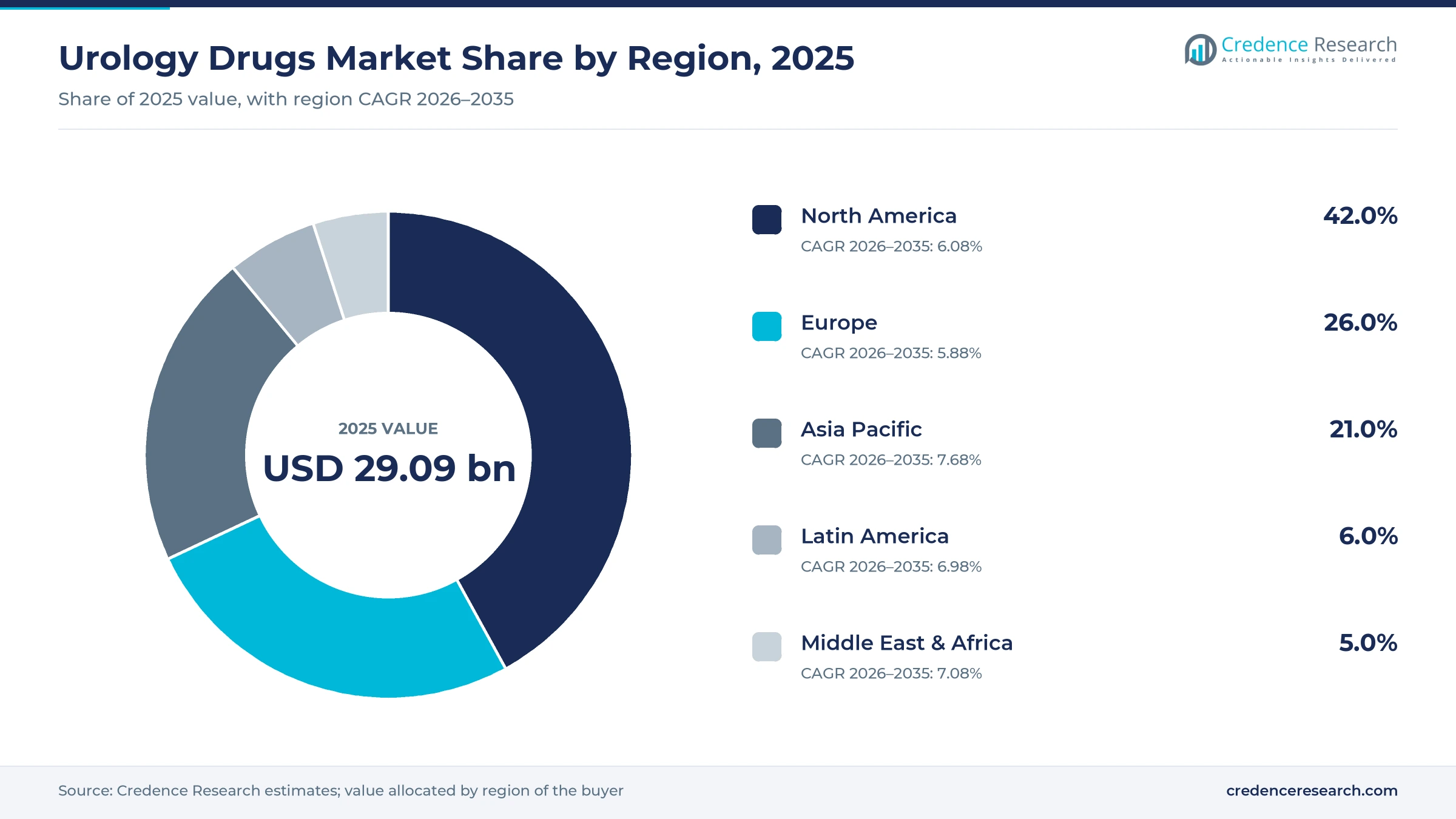
North America leads value as Asia Pacific grows fastest
| Region | Value, 2025 (USD billion) | Share, 2025 | CAGR, 2026–2035 |
|---|---|---|---|
| North America | 12.22 | 42.0% | 6.08% |
| Europe | 7.56 | 26.0% | 5.88% |
| Asia Pacific | 6.11 | 21.0% | 7.68% |
| Latin America | 1.75 | 6.0% | 6.98% |
| Middle East & Africa | 1.45 | 5.0% | 7.08% |
Why does North America hold the largest regional share?
North America held a 42.0% share of 2025 value and grows at 6.08% a year through 2035. U.S. Medicare covers most older men with prostate enlargement, and branded prostate cancer prices remain the highest worldwide. Recent FDA approvals for radioligand therapy, bladder cancer and overactive bladder add new treated patients. Generic entry, however, lowers value in chronic bladder therapy across retail pharmacies. Telehealth prescribers also add online refills for men who prefer remote care and home delivery.
What keeps Europe the second-largest region?
Europe held a 26.0% share of 2025 value and grows at 5.88% a year through 2035. Germany, France, Italy, Spain and the United Kingdom have large populations of older men and established urology networks. National health technology assessment rules slow uptake of costly prostate cancer medicines. As a result, generic alpha blockers and antimuscarinics carry much of the volume. Hospital pharmacies, however, dispense a growing share of value through specialist cancer centers.
How fast is Asia Pacific expanding urologic treatment?
Asia Pacific held a 21.0% share of 2025 value and is the fastest-growing region at 7.68% a year. Japan has one of the oldest populations in the world, and China and India are adding specialist urology capacity. Local generic makers such as Sun Pharmaceutical Limited supply low-cost prostate and bladder medicines. Rising public and private insurance coverage brings more men into long-term treatment. As a result, both prescription volume and treated patient numbers rise faster than in any other region.
Where is Latin America adding demand?
Latin America held a 6.0% share of 2025 value and grows at 6.98% a year through 2035. Brazil and Mexico lead spending through private pharmacies and public hospital programs for prostate cancer.
What limits growth in the Middle East and Africa?
The Middle East and Africa held a 5.0% share of 2025 value and grows at 7.08% a year through 2035. Gulf states fund specialist cancer care, while access in much of Africa remains limited.
Approvals, generic launches and mergers since 2024
| Development | Status and market relevance |
|---|---|
| In September 2024, Lupin launched generic mirabegron extended-release tablets of 50 mg in the United States. | Launched; adds a low-cost option for overactive bladder |
| In December 2024, the FDA approved Gemtesa for men with overactive bladder symptoms who take prostate medicine. | Approved; widens beta-3 agonist use in men |
| In March 2025, the FDA expanded the Pluvicto indication to metastatic prostate cancer before taxane chemotherapy. | Approved; moves radioligand therapy to an earlier stage |
| In June 2025, the FDA approved UroGen Pharma's Zusduri for recurrent low-grade intermediate-risk bladder cancer. | Approved; first medicine for this indication |
| In August 2025, Mallinckrodt and Endo completed their merger, combining branded portfolios that include urology. | Completed; generics spin-off planned under the Par Health name |
Delivery formats and targeted agents reshape urologic care
- Sustained-release intravesical gels hold chemotherapy in the bladder for hours, which lets urologists treat recurrent tumors without repeat surgery.
- Beta-3 agonists relax the bladder muscle with fewer cognitive concerns than anticholinergic agents, which suits older patients.
- Radioligand therapy targets PSMA on prostate cancer cells, which extends treatment options after hormone therapy.
- PARP inhibitor combinations pair targeted agents with androgen receptor inhibitors, which improves survival in HRR-mutated patients.
- Telehealth prescribing lets men renew prostate and erectile dysfunction medicines remotely, which supports online pharmacy growth.
Need a Custom Version of This Report?
Tailor the scope, geography, or segments to your exact requirements.
- Custom geography or segment scope
- Direct access to our analyst team
Originators and generic makers compete across urologic care
Competition in the market splits between originators of branded oncology and bladder medicines and generic makers that supply high-volume chronic therapy. Pfizer Ltd. competes in prostate cancer through its targeted therapy portfolio, while Sanofi offers oncology and specialty medicines used in urologic care. UroGen Pharma focuses on intravesical treatments for bladder cancer and gained a first-of-its-kind approval in 2025. Endo Pharmaceuticals competes with specialty brands and joined Mallinckrodt in August 2025. Sun Pharmaceutical Limited, Innovexia Lifesciences, Salvus Pharma, Silhos Pharma Ltd. and Indizen Pharmaceutical supply generic alpha blockers, antispasmodics and erectile dysfunction products across Asia, Africa and Latin America. However, branded makers hold the advantage in oncology, where clinical data decide formulary access.
Companies profiled and their roles in this market
| Company | Type | Role in the market |
|---|---|---|
| Pfizer Ltd. | Originator | Prostate cancer and urologic medicines portfolio |
| Sanofi | Originator | Oncology and specialty medicines used in urologic care |
| UroGen Pharma | Specialty | Intravesical bladder cancer treatments, including Zusduri |
| Endo Pharmaceuticals | Specialty | Branded specialty medicines; merged with Mallinckrodt in 2025 |
| Sun Pharmaceutical Limited | Generic and specialty | Generic prostate, bladder and oncology medicines |
| Innovexia Lifesciences | Generic | Urologic and men's health formulations |
| Salvus Pharma | Generic | Urologic formulations for domestic and export markets |
| Silhos Pharma Ltd. | Generic | Urologic and general medicines |
| Indizen Pharmaceutical | Generic | Urologic and men's health products |
Oncology and combination use carry growth through 2035
Credence Research's view is that oncology and combination therapy, rather than chronic bladder medicines, will carry most growth through 2035. The market grows at 6.49% a year as radioligand, targeted and intravesical cancer treatments reach earlier stages of disease. Generic entry lowers the cost of prostate enlargement and overactive bladder therapy, which widens access but limits value. The strongest openings sit in bladder cancer, stone prevention and online refills, while payer reviews of costly cancer medicines remain the main risk for originators.
How Credence Research built the urologic medicine model
The report uses 2025 as the base year and 2026 to 2035 as the forecast period. Market values come from the Credence Research model, which builds spending by drug class, application and distribution channel. Regional and segment splits are Credence Research estimates informed by NIDDK reports, FDA approvals, IARC cancer estimates, patient organization data, regulatory filings and company releases. No primary interviews or surveys were used in preparing this edition of the report.
Prostate, bladder and continence treatment outlook to 2035
By 2035, the urology drugs market is projected to reach USD 54.56 billion, with growth led by prostate and bladder cancer therapy, Asia Pacific and online refills. Alpha blockers will remain the most common first prescription for prostate enlargement, even as generic prices fall. Radioligand and intravesical treatments will move into earlier care settings as more data arrive. Payers and specialist capacity will decide how quickly aging men in Asia Pacific and Latin America reach modern urologic treatment.
Frequently Asked Questions
How big is the global urology drugs market?
Which region leads urology drugs spending?
Which application leads the market?
What did the FDA approve for bladder cancer in 2025?
How common is prostate enlargement among older men?
Which channel grows fastest for urologic medicines?
Who are the leading urology drugs companies?
How is generic entry affecting the market?
Table of Content
Chapter 1 Market Segmentation
- 1.1 Segmentation Framework
- 1.1.1 Product and Service Classification
- 1.1.2 Application and End-Use Classification
- 1.1.3 Technology and Solution Classification
- 1.1.4 Customer and Distribution Channel Classification
- 1.1.5 Geographic Segmentation
- 1.1.6 Market Segment Definitions and Boundaries
- 1.2 By Drug Class
- 1.2.1 Anticholinergic/Antispasmodic Agents
- 1.2.2 Skeletal Muscle Relaxants
- 1.2.3 Alpha Blockers
- 1.2.4 Others
- 1.3 By Application
- 1.3.1 Benign Prostatic Hyperplasia
- 1.3.2 Prostate Cancer
- 1.3.3 Urinary Incontinence
- 1.3.4 Kidney/Bladder Stone
- 1.3.5 Erectile Dysfunction
- 1.3.6 Others
Chapter 2 Introduction
- 2.1 Report Objectives and Scope
- 2.2 Product Definition and Industry Terminology
- 2.3 Market Inclusions and Exclusions
- 2.4 Research Process
- 2.4.1 Primary Research and Expert Interviews
- 2.4.2 Secondary Research and Source Review
- 2.4.3 Top-Down and Bottom-Up Estimation
- 2.4.4 Data Triangulation and Verification
- 2.5 Market Size Measurement Basis
- 2.5.1 2025: USD 29.09 billion → 2035: USD 54.56 billion
- 2.6 Historical and Forecast Reference Periods
- 2.6.1 Historical Period: 2018-2025
- 2.6.2 Base Year: 2025
- 2.6.3 Forecast Period: 2025-2035
- 2.7 Research Assumptions and Limitations
Chapter 3 Executive Summary
- 3.1 Market Snapshot and Key Findings
- 3.2 Base-Year Market Size, 2025
- 3.3 Forecast Market Size, 2035
- 3.4 Revenue and Volume Growth Outlook
- 3.5 Key Demand and Supply Indicators
- 3.6 Leading Market Segments
- 3.7 Fastest-Growing Market Opportunities
- 3.8 Regional Performance Highlights
- 3.9 Technology and Industry Transformation
- 3.10 Competitive Landscape Summary
- 3.11 Analyst View and Strategic Implications
Chapter 4 Global Urology Drugs Market Trends and Developments
- 4.1 Historical Industry Development, 2018-2025
- 4.2 Recent Market Trends and Developments
- 4.3 Demand and Customer Behavior Trends
- 4.4 Technology and Product Innovation
- 4.5 Artificial Intelligence, Automation and Digitalization
- 4.6 Local Manufacturing and Supply Chain Realignment
- 4.7 Industry Partnerships, Mergers and Acquisitions
- 4.8 Sustainability and Circular Economy Developments
- 4.9 Government and Private Sector Investment Trends
- 4.10 Emerging Business Models and Commercialization
- 4.11 Industry Developments and Announcements
Chapter 5 Global Urology Drugs Market Production, Supply and Demand Analysis
- 5.1 Demand Trend and Consumption Analysis, 2018-2025
- 5.2 Demand Forecast, 2025-2035
- 5.3 Production and Output Trend, 2018-2025
- 5.4 Production and Output Forecast, 2025-2035
- 5.5 Installed Capacity and Capacity Utilization
- 5.6 Company-Wise Production Plants and Statistics
- 5.6.1 Installed Production Capacity
- 5.6.2 Actual Production
- 5.6.3 Planned Capacity and Expansion Targets
- 5.7 Supply Chain Structure and Procurement Trends
- 5.8 Supply-Demand Gap and Bottlenecks
- 5.9 Import Dependence and Sourcing Structure
- 5.10 Contract Manufacturing and Outsourcing
- 5.11 Regional Supply and Demand Concentration
Chapter 6 Global Urology Drugs Market Pricing Analysis
- 6.1 Pricing Structure and Measurement
- 6.2 Historical Pricing Trends, 2018-2025
- 6.3 Pricing Outlook, 2025-2035
- 6.4 Average Selling Price and Unit Economics
- 6.5 Pricing by Product and Market Segment
- 6.6 Geographic Pricing Differences
- 6.7 Key Input, Energy, Labor and Logistics Costs
- 6.8 Contract Pricing and Purchasing Models
- 6.9 Pricing Sensitivity and Competitive Positioning
- 6.10 Price, Margin and Profitability Implications
Chapter 7 Global Urology Drugs Market Dynamics
- 7.1 Market Growth Drivers
- 7.1.1 Demand-Side Drivers
- 7.1.2 Technology and Innovation Drivers
- 7.1.3 Infrastructure and Investment Drivers
- 7.1.4 Regulatory and Policy Drivers
- 7.2 Market Restraints
- 7.2.1 Cost and Affordability Constraints
- 7.2.2 Technology and Adoption Barriers
- 7.2.3 Supply Chain and Operational Constraints
- 7.3 Market Challenges
- 7.3.1 Competitive Pressure and Margin Erosion
- 7.3.2 Skills, Infrastructure and Implementation Gaps
- 7.4 Emerging Market Opportunities
- 7.5 Market Dynamics Impact and Time-Horizon Assessment
Chapter 8 Global Urology Drugs Value Chain Analysis
- 8.1 Industry Value Chain Overview
- 8.2 Upstream Suppliers and Critical Inputs
- 8.3 Technology and Component Providers
- 8.4 Manufacturing or Service Delivery
- 8.5 Distribution, Channel Partners and Integrators
- 8.6 Downstream Applications and End Users
- 8.7 Value Addition and Profit Pools
- 8.8 Vertical Integration and Outsourcing
- 8.9 Supplier Concentration and Risk
- 8.10 Supply Chain Localization and Resilience
Chapter 9 Global Urology Drugs Market Regulations and Policies
- 9.1 Relevant Laws, Standards and Compliance Frameworks
- 9.2 Product, Service, Safety and Quality Requirements
- 9.3 Government Policies, Incentives and Subsidies
- 9.4 Imports, Exports and Trade Barriers
- 9.5 Public Procurement and Local Content Requirements
- 9.6 Environmental and Sustainability Compliance
- 9.7 Upcoming Policy Changes and Market Implications
Chapter 10 Global Urology Drugs Market Hotspots and Opportunities
- 10.1 Market Opportunity Mapping and Growth Hotspots
- 10.2 High-Growth Applications and Customer Groups
- 10.3 Underserved Markets and White-Space Opportunities
- 10.4 Emerging Technology and Product Opportunities
- 10.5 New Capacity and Investment Hotspots
- 10.6 Market Entry and Expansion Opportunities
- 10.7 Distribution and Partnership Opportunities
- 10.8 Near-Term and Long-Term Commercial Potential
- 10.9 Opportunity Attractiveness and Execution Risks
Chapter 11 Global Urology Drugs Market Outlook, 2025-2035
- 11.1 Market Size and Analysis
- 11.1.1 Revenue (Market Measurement: 2025: USD 29.09 billion → 2035: USD 54.56 billion)
- 11.1.2 Market Volume and Quantity Sold
- 11.1.3 Historical Market Size, 2018-2025
- 11.1.4 Base-Year Market Size, 2025
- 11.2 Market Forecast, 2025-2035
- 11.2.1 Revenue Forecast to 2035
- 11.2.2 Volume Forecast to 2035
- 11.2.3 CAGR and Year-on-Year Growth
- 11.2.4 Incremental Revenue Opportunity
- 11.3 Forecast Assumptions and Scenario Analysis
- 11.3.1 Base-Case Forecast
- 11.3.2 Optimistic and Conservative Scenarios
- 11.3.3 Technology, Pricing and Policy Sensitivities
- 11.4 Market Attractiveness and Growth Outlook
Chapter 12 Global Urology Drugs Market Segmentation and Outlook
- 12.1 Segmentation Summary and Market Shares, 2025
- 12.2 Largest and Fastest-Growing Segments
- 12.3 By Drug Class - Market Size and Forecast, 2025-2035
- 12.3.1 Segment Definition and Scope
- 12.3.2 Historical Market Size, 2018-2025
- 12.3.3 Revenue Forecast, 2025-2035
- 12.3.4 Volume Forecast, 2025-2035
- 12.3.5 Base-Year Market Share, 2025
- 12.3.6 Segment CAGR and Growth Drivers
- 12.3.7 Subsegment Market Size and Forecast
- 12.3.7.1 Anticholinergic/Antispasmodic Agents
- 12.3.7.2 Skeletal Muscle Relaxants
- 12.3.7.3 Alpha Blockers
- 12.3.7.4 Others
- 12.3.8 Subsegment Pricing and Adoption Trends
- 12.3.9 Leading Suppliers and Competition
- 12.3.10 Regional Demand and Opportunities
- 12.4 By Application - Market Size and Forecast, 2025-2035
- 12.4.1 Segment Definition and Scope
- 12.4.2 Historical Market Size, 2018-2025
- 12.4.3 Revenue Forecast, 2025-2035
- 12.4.4 Volume Forecast, 2025-2035
- 12.4.5 Base-Year Market Share, 2025
- 12.4.6 Segment CAGR and Growth Drivers
- 12.4.7 Subsegment Market Size and Forecast
- 12.4.7.1 Benign Prostatic Hyperplasia
- 12.4.7.2 Prostate Cancer
- 12.4.7.3 Urinary Incontinence
- 12.4.7.4 Kidney/Bladder Stone
- 12.4.7.5 Erectile Dysfunction
- 12.4.7.6 Others
- 12.4.8 Subsegment Pricing and Adoption Trends
- 12.4.9 Leading Suppliers and Competition
- 12.4.10 Regional Demand and Opportunities
- 12.5 Segment Growth Comparison
- 12.6 Segment Attractiveness and Priority Matrix
Chapter 13 Global Urology Drugs End-Use and Application Market Outlook
- 13.1 End-Use Industry and Customer Demand Structure
- 13.2 Leading Applications and Customer Groups
- 13.3 End-Use Market Size, Share and Forecast
- 13.4 Major End-Use Industry Deep Dives
- 13.4.1 Customer Requirements and Use Cases
- 13.4.2 Demand and Replacement Cycles
- 13.4.3 Technical and Regulatory Considerations
- 13.4.4 Purchasing and Procurement Models
- 13.4.5 Leading Vendors and Distribution Channels
- 13.4.6 Forecast and Commercial Opportunities
- 13.5 Emerging Applications and Cross-Segment Demand
- 13.6 End-Use Industry Investment Priorities
Chapter 14 Global Urology Drugs Geographic Market Outlook, 2025-2035
- 14.1 Regional Market Size and Share, 2025
- 14.2 Regional Market Forecast, 2025-2035
- 14.3 Regional Pricing, Production and Demand Differences
- 14.4 North America
- 14.4.1 United States
- 14.4.2 Canada
- 14.4.3 Mexico
- 14.5 Europe
- 14.5.1 Germany
- 14.5.2 France
- 14.5.3 Italy
- 14.5.4 United Kingdom
- 14.5.5 Spain
- 14.5.6 Poland
- 14.5.7 Russia
- 14.5.8 Netherlands
- 14.5.9 Belgium
- 14.5.10 Sweden
- 14.5.11 Denmark
- 14.5.12 Norway
- 14.5.13 Rest of Europe
- 14.6 Asia Pacific
- 14.6.1 China
- 14.6.2 India
- 14.6.3 Japan
- 14.6.4 South Korea
- 14.6.5 Thailand
- 14.6.6 Indonesia
- 14.6.7 Vietnam
- 14.6.8 Malaysia
- 14.6.9 Australia
- 14.6.10 Rest of Asia Pacific
- 14.7 Latin America
- 14.7.1 Brazil
- 14.7.2 Argentina
- 14.7.3 Colombia
- 14.7.4 Chile
- 14.7.5 Rest of Latin America
- 14.8 Middle East
- 14.8.1 Saudi Arabia
- 14.8.2 United Arab Emirates
- 14.8.3 Turkey
- 14.8.4 Israel
- 14.8.5 Iran
- 14.8.6 Rest of the Middle East
- 14.9 Africa
- 14.9.1 South Africa
- 14.9.2 Egypt
- 14.9.3 Nigeria
- 14.9.4 Morocco
- 14.9.5 Rest of Africa
- 14.10 Regional Investment, Policy and Supply Chain Differences
- 14.11 Regional Competitive Landscape
- 14.12 Geographic Growth Hotspots
Chapter 15 Global Urology Drugs Technology, Innovation and Sustainability Outlook
- 15.1 Technology Landscape and Maturity
- 15.2 Product, Process and Service Innovation
- 15.3 AI, Automation and Digital Tools in the Industry
- 15.4 Technology Adoption and Performance Benchmarking
- 15.5 Innovation Pipeline and R&D Investment
- 15.6 Patent and Intellectual Property Trends
- 15.7 Energy Efficiency and Resource Management
- 15.8 Sustainability, Recycling and Circularity
- 15.9 Technology Roadmap, 2025-2035
- 15.10 Risks of Obsolescence and Technology Substitution
Chapter 16 Global Urology Drugs Market Key Strategic Imperatives
- 16.1 Growth and Market Entry Priorities
- 16.2 High-Return Products and Segments
- 16.3 Pricing, Profitability and Cost Optimization
- 16.4 Technology Investment and Product Differentiation
- 16.5 Supply Chain Localization and Resilience
- 16.6 Distribution and Customer Acquisition
- 16.7 Partnership, Acquisition and Capacity Strategy
- 16.8 Regional Expansion Priorities
- 16.9 Short-, Medium- and Long-Term Actions
Chapter 17 Competition Outlook
- 17.1 Industry Competition Characteristics
- 17.2 Market Structure and Concentration
- 17.3 Market Share and Competitive Positioning, 2025
- 17.4 Company-Wise Revenue and Product Benchmarking
- 17.5 Production and Service Capacity Benchmarking
- 17.6 Technology, Pricing and Differentiation
- 17.7 Regional Footprint and Distribution Strength
- 17.8 Mergers, Acquisitions and Strategic Alliances
- 17.9 New Entrants and Competitive Threats
- 17.10 Porter's Five Forces and Industry Attractiveness
- 17.11 Competitive Outlook, 2025-2035
Chapter 18 Company Profiles
- 18.1 Company Coverage and Selection Criteria
- 18.2 Endo Pharmaceuticals
- 18.2.1 Business Description
- 18.2.2 Company Ownership and Geographic Presence
- 18.2.3 Product and Service Portfolio
- 18.2.4 Manufacturing and Operating Footprint
- 18.2.5 Production Capacity and Expansion Plans
- 18.2.6 Financial Performance and Investment
- 18.2.7 Market Share and Competitive Position
- 18.2.8 Technology and Innovation Capabilities
- 18.2.9 Strategic Alliances or Partnerships
- 18.2.10 Recent Developments
- 18.2.11 Growth Strategy and Outlook
- 18.3 Sanofi
- 18.4 Pfizer Ltd.
- 18.5 Innovexia Lifesciences
- 18.6 Salvus Pharma
- 18.7 Silhos Pharma Ltd.
- 18.8 Indizen Pharmaceutical
- 18.9 UroGen Pharma
- 18.10 Sun Pharmaceutical Limited
- 18.11 Other Relevant Market Participants
Note: Every listed company is profiled on the structure shown under the first company. The company list is preliminary and may change based on research findings, market developments, data availability and client requirements.
Chapter 19 Disclaimer
- 19.1 Research and Forecast Disclaimer
- 19.2 Data Source and Estimation Limitations
Note: The depth of individual sections depends on data availability for this market. Volume, capacity, trade and other unit-based metrics are included where applicable.

