
Training budgets and footfall carry UAE immersive demand
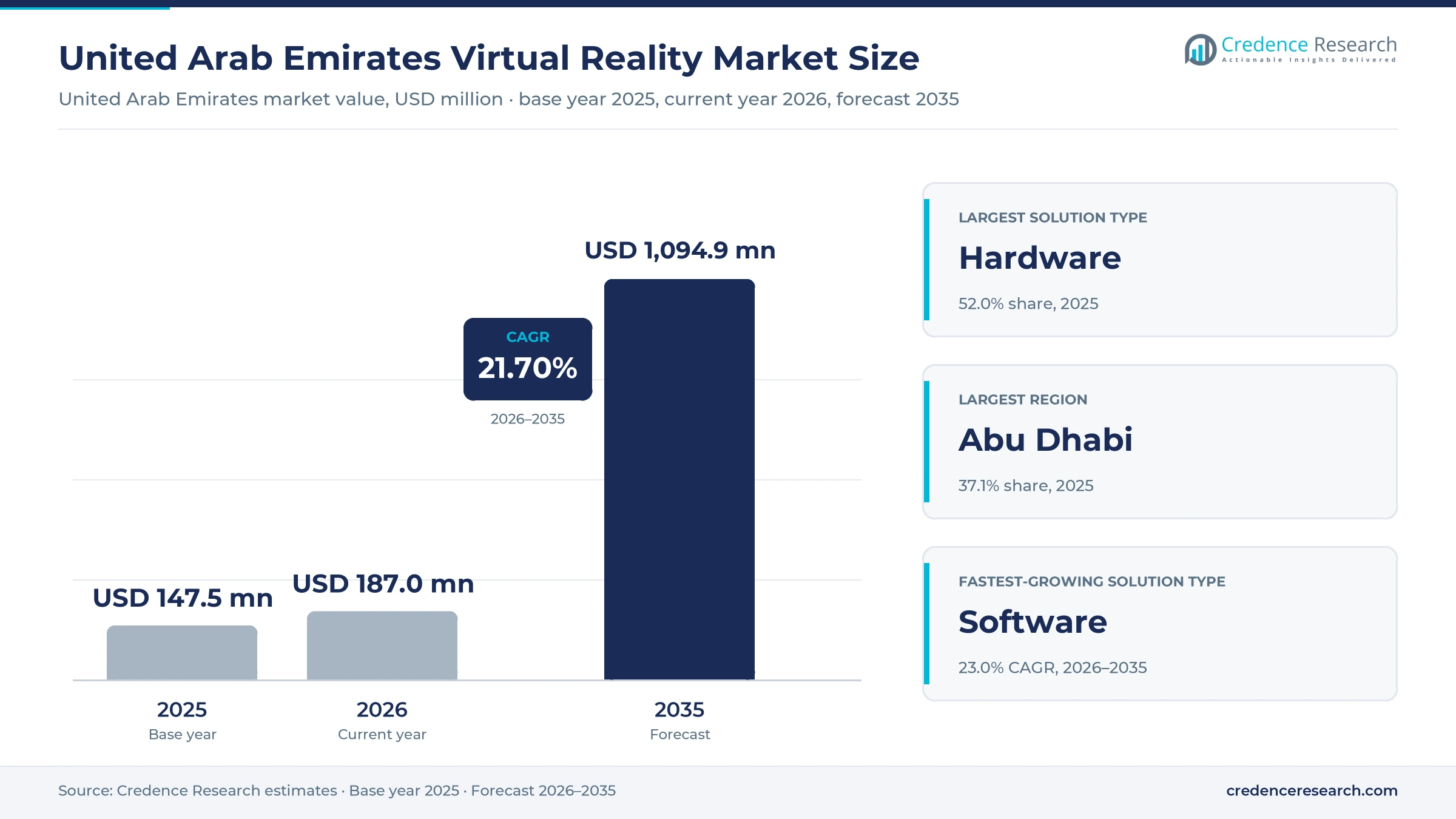
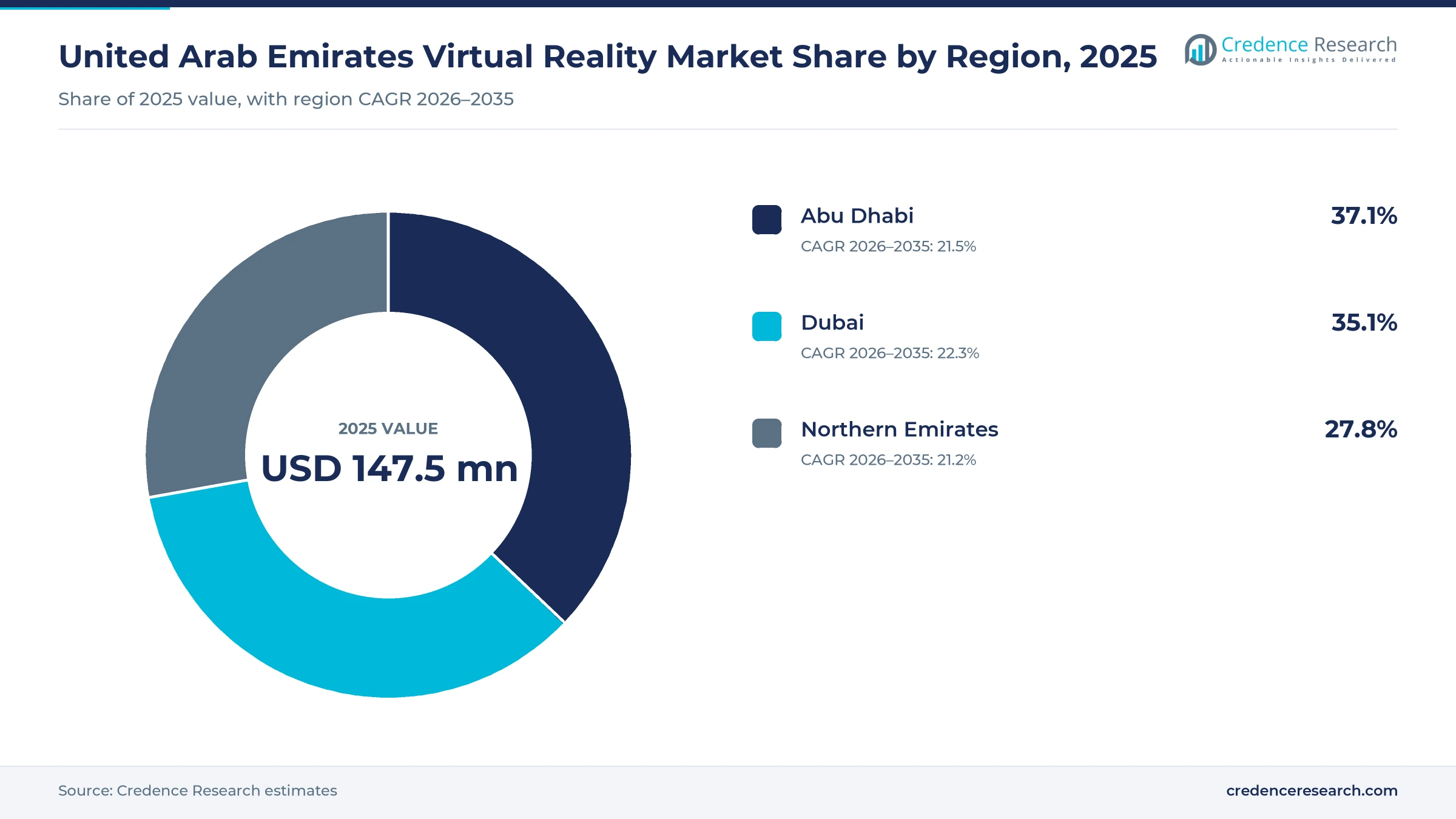
The United Arab Emirates virtual reality market was valued at USD 147.5 million in 2025 and is projected to increase from USD 187.0 million in 2026 to USD 1.09 billion by 2035, registering a CAGR of 21.70% during 2026–2035. Demand comes from households buying standalone headsets, from airlines, police and defense bodies that train staff in simulated settings, and from malls and resorts that sell immersive attractions to residents and visitors. Abu Dhabi held the largest regional share, 37.1% in 2025, because federal and emirate agencies, academies and defense suppliers concentrated there buy training systems in volume. Dubai is the fastest-growing region at 22.3% a year, as tourism, entertainment venues and corporate training programs expand together. The main commercial change is a move from one-off hardware sales toward software licenses, content and managed training, which gives integrators and platform owners a larger part of each contract than the headset maker alone.
Which immersive products and services the UAE market counts
The market counts what households, companies and government bodies in the UAE pay for fully immersive virtual reality. It covers headsets, controllers and tracking hardware, games, training and visualization software, and services such as content production, system integration and the ticket value of venue-based attractions sold through outright purchase, subscription or project and usage fees.
Augmented reality glasses, phone-based filters, 360-degree video watched on flat screens and general gaming consoles are excluded unless they are sold as part of a virtual reality system. The value chain runs from imported headsets through electronics retailers, online stores and enterprise distributors to integrators, venue operators and in-house training teams.
United Arab Emirates Virtual Reality Market Insights
- The United Arab Emirates virtual reality market grows from USD 147.5 million in 2025 to USD 1.09 billion by 2035, a 21.70% CAGR, as training and health programs add to consumer headset sales.
- Abu Dhabi held 37.1% of 2025 value, because public agencies, academies and defense suppliers based in the capital buy simulation and training systems in volume.
- Hardware held 52.0% of 2025 value, as standalone headsets sold through UAE electronics retailers make up most consumer spending.
- Emirates began training nearly 23,000 cabin crew on its MIRA virtual platform in October 2024, a signal of how large employers now buy immersive training.
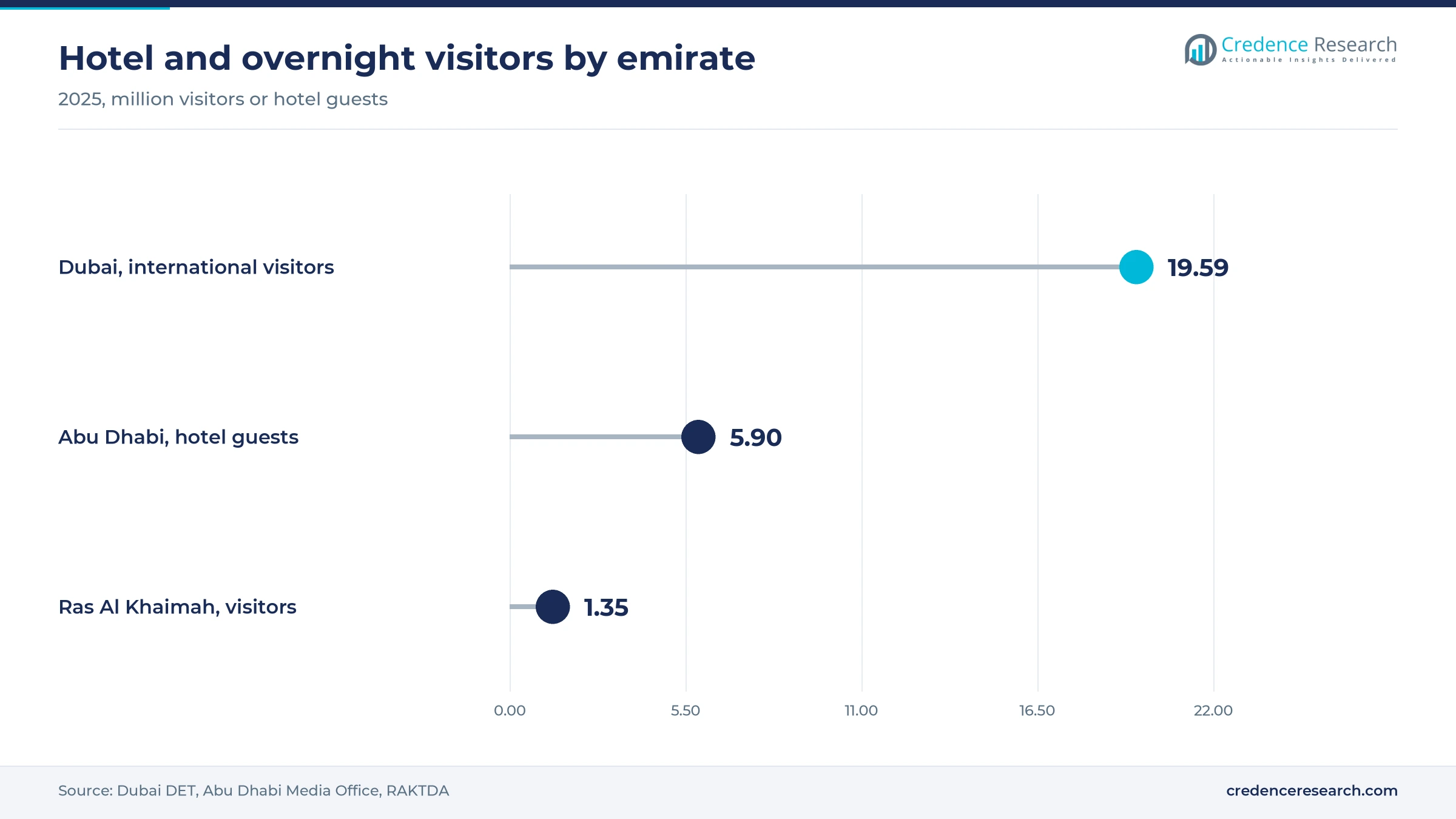
- Dubai welcomed a record 19.59 million international overnight visitors in 2025, which supports ticket sales at mall and resort attractions.
Headsets lead today while software takes a rising share
Why hardware leads and software grows fastest
Based on solution type, the market is categorized into hardware, software and services. Hardware led with 52.0% of 2025 value because every consumer, venue and training deployment starts with a headset purchase, and premium devices now reach UAE stores within months of their debut, with Apple shipping its spatial headset locally from Nov. 15, 2024. Software grows fastest at 23.0% a year as buyers license platforms rather than devices, a model that ZainTECH began distributing across the region in October 2024 through VIVERSE for Business. Services follow both, because content and integration are billed per project.
Standalone headsets lead as venues grow fastest
Based on deployment model, the market is categorized into standalone VR, tethered VR and venue-based VR. Standalone VR led with 55.0% of 2025 value because standalone headsets need no console or gaming PC, and the most widely stocked models in UAE stores, the Meta Quest 3S and PICO 4 Ultra, are both standalone devices. Venue-based VR grows fastest at 22.6% a year as malls and resorts add free-roam arenas, and the 7,000-square-meter VR Park at The Dubai Mall shows how much floor space operators will commit. Tethered systems lose share outside simulation labs and gaming enthusiasts.
Leisure leads while health and education grow fastest
Based on end-use industry, the market is categorized into leisure and tourism, business and public services, property and construction, and health and education. Leisure and tourism led with 44.0% of 2025 value because headsets for home gaming and paid attractions draw on resident and visitor spending. Health and education grows fastest at 23.3% a year as institutions adopt the technology for teaching, with Rabdan Academy in Abu Dhabi starting an eight-week crime scene investigation pilot in virtual reality in April 2025 and planning to extend it to emergency management and homeland security programs.
Households lead as public buyers grow fastest
Based on customer type, the market is categorized into individual buyers, private-sector buyers and public-sector buyers. Individual buyers led with 46.0% of 2025 value because the consumer base is fully connected, and internet use reached 100% of the UAE population in 2024, according to World Bank data. Public-sector buyers grow fastest at 22.7% a year as training rules change, with Dubai Police Academy Law No. 7 of 2026 introducing virtual reality and advanced simulation into officer training, according to Gulf News in March 2026. Private buyers sit between the two, led by airlines and developers.
| Segment Group | Leading Sub-segment | Share, 2025 | Fastest-growing Sub-segment | CAGR, 2026–2035 |
|---|---|---|---|---|
| By Solution Type | Hardware | 52.0% | Software | 23.0% |
| By Deployment Model | Standalone VR | 55.0% | Venue-based VR | 22.6% |
| By End-Use Industry | Leisure and tourism | 44.0% | Health and education | 23.3% |
| By Customer Type | Individual buyers | 46.0% | Public-sector buyers | 22.7% |
UAE headsets range from about AED 1,000 to AED 14,000
Virtual reality pricing in the UAE works on three levels, namely the headset bought outright, the per-game or per-session fee at venues, and project or subscription fees for enterprise content. Consumer headsets cluster between about AED 1,000 and AED 2,500, while the premium spatial headset sits more than five times higher. Retail prices move with launches and discount cycles, because older devices are cleared to make room for new models. Venues earn on repeat visits with low per-game fees, so suppliers make their margins on software, content and multi-year training contracts rather than on hardware.
| Product or offer | Typical price or fee | Basis |
|---|---|---|
| Meta Quest 3S, 128GB standalone headset | AED 1,049 | AlfaShop UAE online listing, November 2026 |
| Sony PlayStation VR2, tethered to PS5 | AED 1,360, down from AED 1,879 | Carrefour UAE online listing, November 2026 |
| PICO 4 Ultra, 256GB standalone headset | AED 2,499 | Lablaab UAE online listing, November 2026 |
| Apple Vision Pro, base model | AED 13,999 | Apple UAE newsroom, November 2024 |
| VR Park, The Dubai Mall, per game | AED 10 to 40 per game | Headout ticket listing, November 2026 |
Request a Free Sample
Fill in your details and we'll send you a free sample report.
- Sample data tables & charts
- Research methodology
State programs, safety training and footfall widen demand
State strategies back immersive commercialization
Government strategy gives immersive technology firms a clear policy runway in the UAE, which lowers the risk of building local content and support teams. The Dubai Metaverse Strategy, launched in July 2022, targets 40,000 jobs and USD 4 billion added to the economy within five years, from a base of about 1,000 companies, according to The National. In November 2023, Dubai launched its Program for Gaming 2033, which aims for 30,000 new jobs and names virtual reality among the trends it will support. Sandbox VR agreed with Apparel Group in May 2024 to open 25 locations in the Middle East by 2028. These programs reward studios that build metaverse technology and attraction content inside the country.
Enterprise safety and workforce training lift public and private spend
Large employers in the UAE now use virtual reality to train staff for rare and dangerous events without taking aircraft, vehicles or plants out of service. In October 2024, Emirates began training nearly 23,000 cabin crew on MIRA, its immersive safety training platform, with Airbus A380, Boeing 777 and Airbus A350 cabins modeled in 3D. EDGE Group entity JAHEZIYA, part of a group active in military simulation and training, signed with Evolution XR at IDEX in February 2023 to build emergency response training for Gulf clients. Dubai Municipality runs a smart training center that uses virtual reality for building regulation and land survey courses, according to the UAE government portal. This demand lifts spending by public-sector buyers and favors multi-year service contracts over one-off device sales.
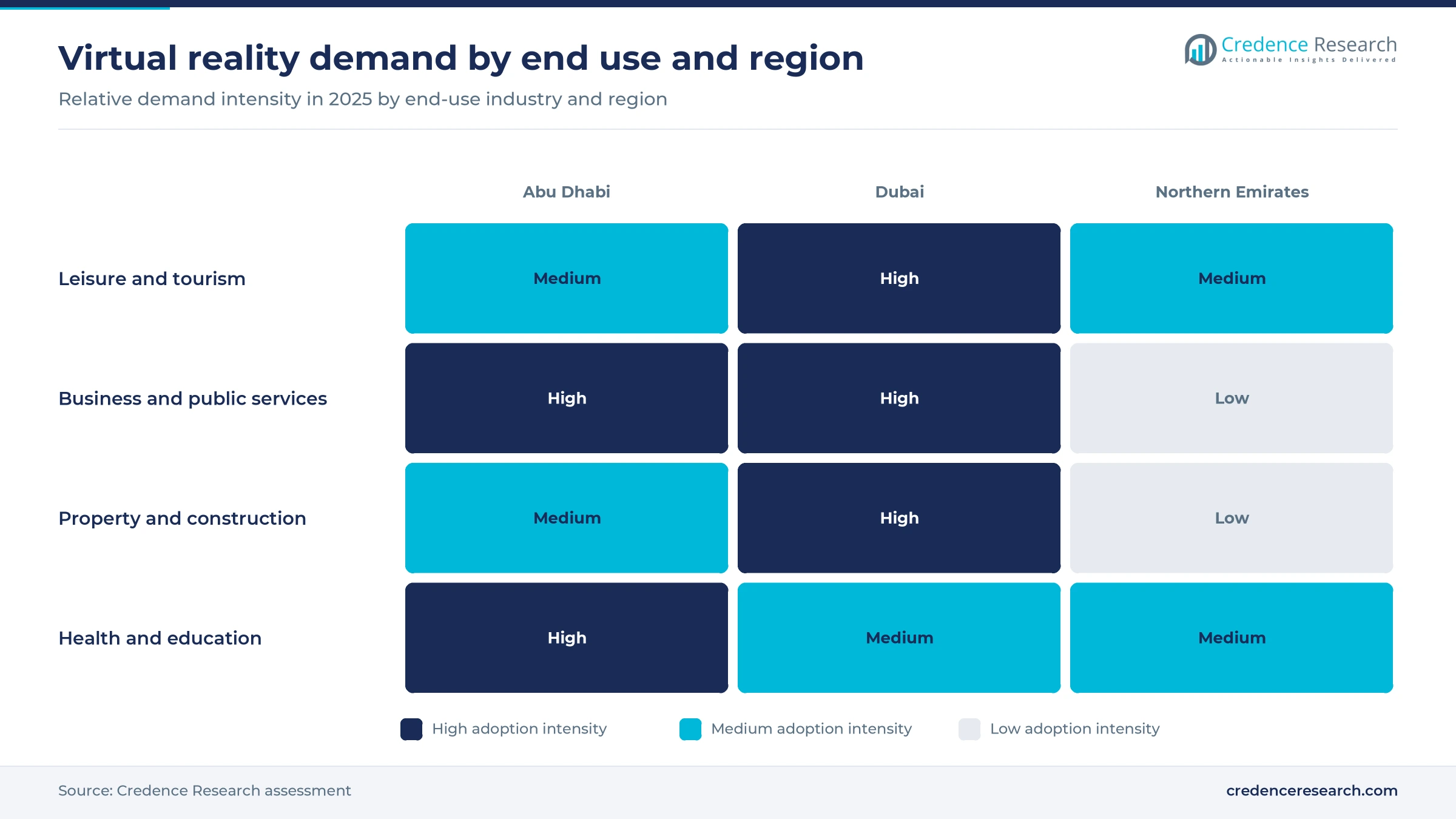
Leisure footfall and institutional rehabilitation sustain usage
Visitor numbers and clinical use keep headsets and venues busy throughout the year. Abu Dhabi recorded 26.6 million visitors in 2025, a record, while meeting and exhibition delegates rose 40% to 2.2 million and culture and leisure event attendance rose 20% to 4.2 million, according to the Abu Dhabi Media Office. Rehabilitation adds a steadier, institutional stream, because the Ministry of Health and Prevention uses virtual reality games for stroke and cerebral palsy therapy at the Ras Al Khaimah Physiotherapy and Sports Centre, Khaleej Times reported. Both forms of demand favor leisure and tourism today and health and education through the forecast.
Premium headsets now reach UAE buyers within months
Global device makers now bring new headsets to the UAE within months of their debut, which shortens the gap between new hardware and local demand. Apple opened UAE pre-orders for its spatial headset on Nov. 4, 2024 and placed it in stores from Nov. 15. HTC has supplied its VIVE Focus Vision headset to enterprise and government buyers through ZainTECH since October 2024. Early access matters in a compact market of 11.5 million people in 2025, according to World Bank data, because a few retail chains and distributors can bring each new device to most buyers quickly. Faster launches keep hardware the largest solution type and give developers a reason to localize apps.
Free-roam venues and enterprise platforms reshape supply
Free-roam multiplayer arenas rise in malls
Venue operators are shifting from single-seat rides toward free-roam arenas where groups move through a shared virtual space. Zero Latency at The Galleria Al Maryah Island in Abu Dhabi runs sessions for up to eight players, according to Visit Abu Dhabi. VR Park at The Dubai Mall sells single games at AED 10 to 40, according to Headout, a low ticket that only pays back through repeat and group visits. Group formats raise revenue per square meter and suit birthday, school and corporate bookings. This shift explains why Venue-based VR grows at 22.6% a year, the fastest deployment model.
Enterprise platforms shift spending toward software
Corporate and government buyers are shifting from buying headsets to buying platforms that manage content, users and results. ZainTECH became the HTC VIVE partner for the Middle East and Africa at GITEX Global in Dubai in October 2024, selling VIVERSE for Business, a spatial collaboration platform with live translation and AI characters, in its six markets including the UAE. The Emirates MIRA platform also runs a 2D version on phones and laptops, so one content library serves several device types. This shift lets software grow at 23.0% a year, the fastest rate of any solution type.
Property visualization opens a large sales channel
Dubai property sales give immersive visualization suppliers a large and repeat customer base among developers and brokers. Dubai recorded more than 270,000 real estate transactions worth AED 917 billion in 2025, up 20% in value, according to the Dubai Media Office. The same release counted 129,600 new investors, and many of them buy off-plan from abroad without visiting the site. Virtual walk-throughs of unbuilt towers and villas let sales teams close these buyers remotely. Suppliers that bundle headsets, 3D content and sales-center installation can win repeat contracts in property and construction, where each new launch needs fresh visualization content.
Hospital pain and anxiety programs open a clinical niche
Hospitals offer an opening for suppliers that can prove clinical value with data rather than demonstrations. In May 2024, Dubai Health began a study with Mohammed Bin Rashid University of Medicine and Health Sciences at its Thalassemia Center to test whether headsets reduce pain and anxiety during cannulation. The study tracks eye movement and heart rate, and the program is planned to extend to Al Jalila Children's Hospital and Latifa Hospital. The UAE government portal, updated in June 2025, lists ministry plans for rehabilitation in Parkinson's and balance disorders, and health and education uses grow at 23.3% a year. Vendors offering metaverse tools in healthcare with outcome data can win multi-site contracts.
Premium prices, discounting and thin Arabic content weigh
Premium headsets stay out of reach for most households
The price gap between entry and premium devices limits how far advanced headsets spread beyond early adopters and businesses. The premium spatial headset launched at AED 13,999 in the UAE, more than thirteen times the AED 1,049 listing for a Meta Quest 3S, as the pricing table shows. Most households therefore buy entry devices, which keeps average selling prices low. Suppliers of premium hardware depend on corporate demonstrations, retail showrooms and leasing to build volume.
Retail discounting signals uneven consumer sell-through
Deep retail discounts on older headsets show that consumer demand does not always absorb imported stock. Carrefour UAE listed the PlayStation VR2 at AED 1,360 in November 2026, 28% below its original AED 1,879, and AlfaShop listed the Meta Quest 3S 30% below its AED 1,499 reference price. Distributors carry inventory risk when new models arrive, and discounting erodes the margins that fund local marketing and after-sales support.
A thin Arabic content base limits mass adoption
Local content is still thin, which limits how far headsets reach Arabic-speaking households and schools. At the UAE launch in November 2024, Apple named only three local apps, from OSN+, STARZ ON and Arabesque Kitchen, against a global catalog built mainly in English. Training buyers face the same gap, because Arabic voice-over, local regulations and culturally fitting scenarios must be commissioned per project. Studios that build Arabic libraries can reduce this barrier and charge for it.
Fast device cycles shorten the life of enterprise fleets
Hardware generations now change within a year, which complicates budgeting for training fleets bought with public money. Apple replaced its first UAE headset with an M5 version on Oct. 22, 2025, according to Gulf News, within a year of the first local launch, and other makers refresh standalone lines at a similar pace. Agencies that buy outright risk running outdated devices before contracts end, so suppliers increasingly offer leasing and device-as-a-service terms.
Abu Dhabi leads on public buyers while Dubai grows fastest
| Region | Value, 2025 (USD million) | Share, 2025 | CAGR, 2026–2035 |
|---|---|---|---|
| Abu Dhabi | 54.7 | 37.1% | 21.5% |
| Dubai | 51.8 | 35.1% | 22.3% |
| Northern Emirates | 41.0 | 27.8% | 21.2% |
Abu Dhabi leads on public training and defense buyers
Abu Dhabi held a 37.1% share of 2025 value and grows at 21.5% a year. The capital hosts the largest group of public-sector buyers, and Abu Dhabi Police began using interactive virtual reality for traffic awareness at schools, universities and mall exhibitions in September 2024, according to Aletihad. The emirate also drew 5.9 million hotel guests in 2025 at 81% occupancy, according to the Abu Dhabi Media Office. Defense suppliers, academies and hospitals in the capital buy simulation systems through tenders, which keeps contract sizes large.
Dubai grows fastest on venues and corporate programs
Dubai held a 35.1% share of 2025 value and grows fastest at 22.3% a year. Its hotel base exceeded 154,000 rooms in 827 establishments in December 2025 at 80.7% average occupancy, according to the Dubai Department of Economy and Tourism, which feeds mall and resort attractions. Dubai is also home to the Emirates training platform, the Dubai Health clinical study and most regional distributors, which concentrates corporate and private demand in the emirate.
The Northern Emirates grow on visitors and lower-cost households
The Northern Emirates held a 27.8% share of 2025 value and grow at 21.2% a year. Ras Al Khaimah received a record 1.35 million overnight visitors, up 6%, according to its tourism development authority. Households in Sharjah and Ajman buy through the same electronics chains and online stores that serve Dubai, and the Ras Al Khaimah rehabilitation program noted above adds clinical use in the north.
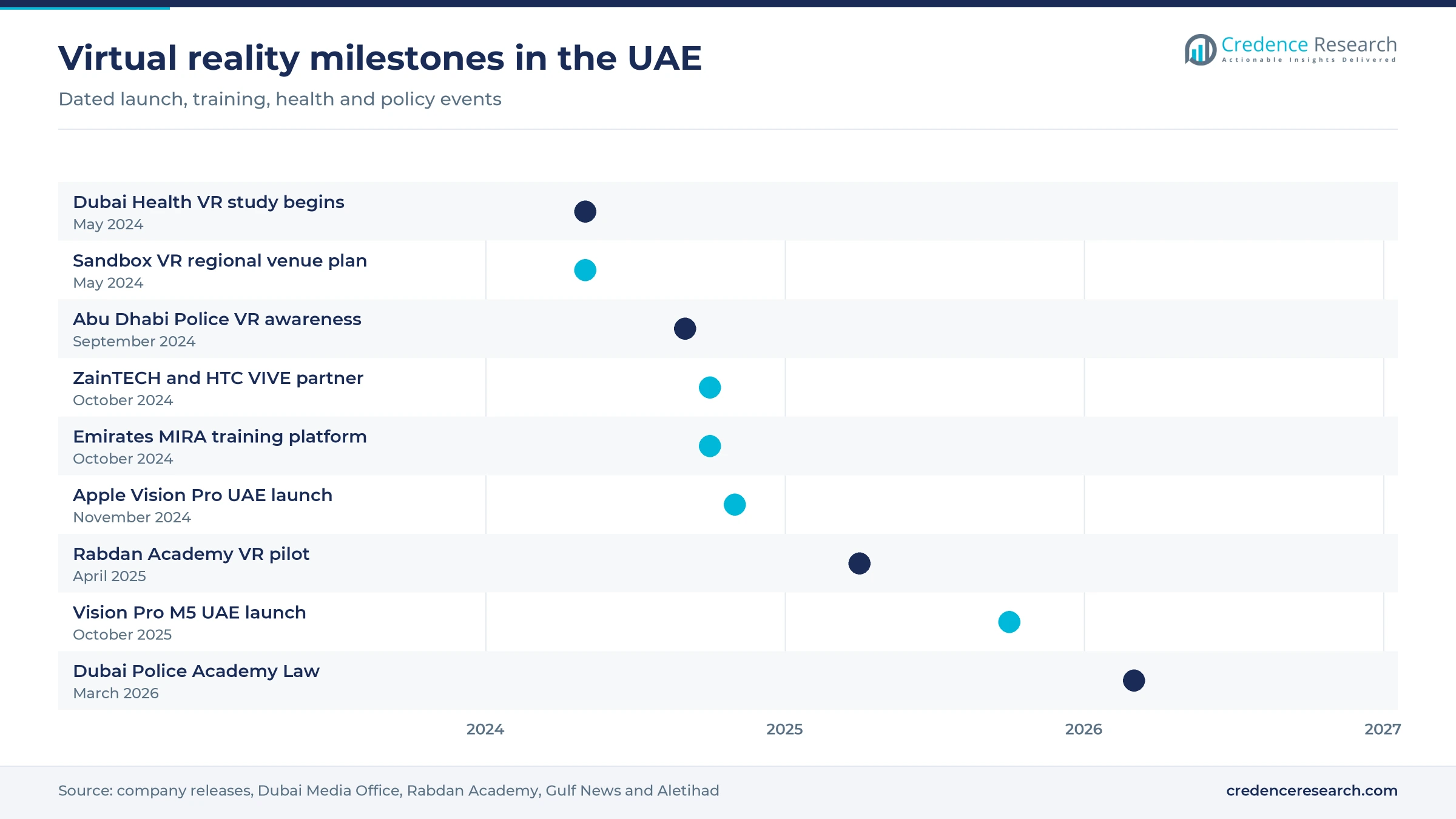
Headset launches and training programs mark 2024 to 2026
| Development | Status and market relevance |
|---|---|
| In May 2024, Sandbox VR and Apparel Group agreed to open 25 location-based virtual reality venues in the Middle East by 2028. | Announced; expands free-roam venue capacity in malls |
| In October 2024, Emirates began training nearly 23,000 cabin crew on its MIRA immersive platform. | Operating; large private-sector training deployment |
| In November 2024, Apple began selling Vision Pro in the UAE at AED 13,999. | Operating; first premium spatial headset sold through local stores |
| In April 2025, Rabdan Academy started an eight-week virtual reality pilot in crime scene investigation. | Pilot; planned extension to emergency management and homeland security programs |
| In March 2026, Dubai Police Academy Law No. 7 of 2026 introduced virtual reality and simulation into officer training. | Enacted; lifts public-sector demand for training systems |
Standalone headsets set the pace for most buyers
- Standalone headsets run games and training apps on a built-in processor, so households, schools and field teams can use them without a PC or console.
- Tethered systems draw on a PS5 console or gaming PC for higher graphics quality, and they remain common in simulators and enthusiast gaming.
- Free-roam arenas track several players across a room-scale space with backpack or standalone headsets, which suits mall venues and team training.
- Spatial computing headsets blend virtual and passthrough views with eye and hand tracking, and they appeal to design, property and premium enterprise users.
Need a Custom Version of This Report?
Tailor the scope, geography, or segments to your exact requirements.
- Custom geography or segment scope
- Direct access to our analyst team
Platform owners compete on price and venues on experience
Competition in the UAE virtual reality market turns on price in consumer hardware, on content and integration in enterprise work and on location and experience quality in venues. Meta and PICO compete for households with standalone headsets sold through electronics chains and online stores, while Sony serves console owners through the PlayStation VR2. Apple sells its premium spatial headset through its own UAE stores and targets design, media and corporate users. HTC reaches enterprise and government buyers through ZainTECH and the VIVERSE for Business platform. Emaar Entertainment runs VR Park at The Dubai Mall, and free-roam operators compete for group bookings in Abu Dhabi and Dubai. Integrators that also supply gaming headsets, training content and maintenance win repeat contracts more often than device sellers alone.
How the UAE supply side is organized
The UAE supply side is organized in three layers with very different margins. A handful of global platform owners, including Meta, Sony, PICO, HTC and Apple, design the headsets and none of them manufactures in the country, so devices arrive through distributors and electronics chains. A second layer of integrators and telecom-backed technology firms, such as ZainTECH, sells hardware with software and support to companies and agencies. Venue operators, led by Emaar Entertainment at The Dubai Mall, form the third layer. Margins sit mainly with platform software, content studios and venue operators, while retail hardware competes on price.
Companies profiled and their roles in this market
| Company | Type | Role in the market |
|---|---|---|
| Meta Platforms | Headset platform owner | Meta Quest 3S standalone headset sold through UAE online and electronics retailers |
| Sony Group | Console and headset maker | PlayStation VR2 sold through UAE retailers, including Carrefour UAE |
| HTC Corporation | Enterprise headset maker | VIVE Focus Vision and VIVERSE for Business distributed by ZainTECH from October 2024 |
| PICO | Standalone headset maker | PICO 4 Ultra sold through UAE online retailers |
| Emaar Entertainment | Venue operator | Runs the 7,000-square-meter VR Park at The Dubai Mall |
| Apple | Spatial headset maker | Vision Pro sold in the UAE from November 2024 and the M5 version from October 2025 |
Institutional buyers will decide the shape of this market
Credence Research's view is that institutional buyers will decide the shape of the United Arab Emirates virtual reality market. Consumer headsets carry the largest share today, but discounting shows how quickly that demand can stall between launches. Airlines, police academies, defense suppliers and hospitals buy on multi-year terms and pay for software, content and support, which is where margins sit. Suppliers that pair devices with Arabic content, outcome data and leasing are best placed. Health and education, where hospitals and academies are still at the pilot stage, is the segment to watch for new entrants.
Visitor, device and program data anchor the estimates
The report uses 2025 as the base year and forecasts value to 2035 in USD million from the Credence Research market model. Segment and regional splits are Credence Research estimates built from World Bank population and internet data, visitor and hotel statistics from the Dubai Department of Economy and Tourism, the Abu Dhabi Media Office and the Ras Al Khaimah Tourism Development Authority, government program announcements, company releases and online retail price listings. No interviews or surveys were used for this edition of the report.
Training and health programs carry growth to 2035
The United Arab Emirates virtual reality market reaches USD 1.09 billion by 2035, growing at 21.70% a year from USD 187.0 million in 2026. Hardware keeps the largest share as households replace and upgrade headsets, while software grows fastest as employers and agencies license training platforms. Abu Dhabi remains the largest region on public buying, and Dubai gains share through venues and corporate programs. The pace of public training tenders and the depth of Arabic content are the two factors most likely to move the forecast, while faster device cycles favor leasing over outright purchase.
Public training budgets and content depth set the range to 2035
The range of outcomes depends on how fast public bodies move training into simulation and whether Arabic content deepens. Slower tenders, weak consumer sell-through and continued discounting of older headsets would produce the downside. Wider adoption of simulation rules beyond Dubai Police, new free-roam venues in malls and a growing local library of Arabic apps and training scenarios would lift both consumer and institutional spending and produce the upside.
| Scenario | CAGR, 2026–2035 | Value, 2035 | What has to hold |
|---|---|---|---|
| Downside | 18.7% | USD 874.8 million | Public tenders slow after 2027 and consumer headset demand stays flat |
| Base | 21.70% | USD 1.09 billion | Training programs expand steadily and venues add capacity at the current pace |
| Upside | 24.2% | USD 1.32 billion | Simulation rules spread to more agencies and Arabic content libraries grow quickly |
Frequently Asked Questions
How big is the United Arab Emirates virtual reality market?
Which solution type leads the market?
Which solution type grows fastest?
Which region leads UAE virtual reality demand?
Which region grows fastest?
How much do headsets cost in the UAE?
What are the main challenges for suppliers?
Who are the key companies in the market?
Table of Content
Chapter 1 Market Segmentation
- 1.1 Segmentation Framework
- 1.1.1 Product and Service Classification
- 1.1.2 Application and End-Use Classification
- 1.1.3 Technology and Solution Classification
- 1.1.4 Customer and Distribution Channel Classification
- 1.1.5 Geographic Segmentation
- 1.1.6 Market Segment Definitions and Boundaries
- 1.2 By Solution Type
- 1.2.1 Hardware
- 1.2.2 Software
- 1.2.3 Services
- 1.3 By Deployment Model
- 1.3.1 Standalone VR
- 1.3.2 Tethered VR
- 1.3.3 Venue-based VR
- 1.4 By End-Use Industry
- 1.4.1 Leisure and tourism
- 1.4.2 Business and public services
- 1.4.3 Property and construction
- 1.4.4 Health and education
- 1.5 By Customer Type
- 1.5.1 Individual buyers
- 1.5.2 Private-sector buyers
- 1.5.3 Public-sector buyers
Chapter 2 Introduction
- 2.1 Report Objectives and Scope
- 2.2 Product Definition and Industry Terminology
- 2.3 Market Inclusions and Exclusions
- 2.4 Research Process
- 2.4.1 Primary Research and Expert Interviews
- 2.4.2 Secondary Research and Source Review
- 2.4.3 Top-Down and Bottom-Up Estimation
- 2.4.4 Data Triangulation and Verification
- 2.5 Market Size Measurement Basis
- 2.5.1 2025: USD 147.5 million → 2035: USD 1.09 billion
- 2.6 Historical and Forecast Reference Periods
- 2.6.1 Historical Period: 2018-2025
- 2.6.2 Base Year: 2025
- 2.6.3 Forecast Period: 2025-2035
- 2.7 Research Assumptions and Limitations
Chapter 3 Executive Summary
- 3.1 Market Snapshot and Key Findings
- 3.2 Base-Year Market Size, 2025
- 3.3 Forecast Market Size, 2035
- 3.4 Revenue and Volume Growth Outlook
- 3.5 Key Demand and Supply Indicators
- 3.6 Leading Market Segments
- 3.7 Fastest-Growing Market Opportunities
- 3.8 Regional Performance Highlights
- 3.9 Technology and Industry Transformation
- 3.10 Competitive Landscape Summary
- 3.11 Analyst View and Strategic Implications
Chapter 4 United Arab Emirates Virtual Reality Market Trends and Developments
- 4.1 Historical Industry Development, 2018-2025
- 4.2 Recent Market Trends and Developments
- 4.3 Demand and Customer Behavior Trends
- 4.4 Technology and Product Innovation
- 4.5 Artificial Intelligence, Automation and Digitalization
- 4.6 Local Manufacturing and Supply Chain Realignment
- 4.7 Industry Partnerships, Mergers and Acquisitions
- 4.8 Sustainability and Circular Economy Developments
- 4.9 Government and Private Sector Investment Trends
- 4.10 Emerging Business Models and Commercialization
- 4.11 Industry Developments and Announcements
Chapter 5 United Arab Emirates Virtual Reality Market Production, Supply and Demand Analysis
- 5.1 Demand Trend and Consumption Analysis, 2018-2025
- 5.2 Demand Forecast, 2025-2035
- 5.3 Production and Output Trend, 2018-2025
- 5.4 Production and Output Forecast, 2025-2035
- 5.5 Installed Capacity and Capacity Utilization
- 5.6 Company-Wise Production Plants and Statistics
- 5.6.1 Installed Production Capacity
- 5.6.2 Actual Production
- 5.6.3 Planned Capacity and Expansion Targets
- 5.7 Supply Chain Structure and Procurement Trends
- 5.8 Supply-Demand Gap and Bottlenecks
- 5.9 Import Dependence and Sourcing Structure
- 5.10 Contract Manufacturing and Outsourcing
- 5.11 Regional Supply and Demand Concentration
Chapter 6 United Arab Emirates Virtual Reality Market Pricing Analysis
- 6.1 Pricing Structure and Measurement
- 6.2 Historical Pricing Trends, 2018-2025
- 6.3 Pricing Outlook, 2025-2035
- 6.4 Average Selling Price and Unit Economics
- 6.5 Pricing by Product and Market Segment
- 6.6 Geographic Pricing Differences
- 6.7 Key Input, Energy, Labor and Logistics Costs
- 6.8 Contract Pricing and Purchasing Models
- 6.9 Pricing Sensitivity and Competitive Positioning
- 6.10 Price, Margin and Profitability Implications
Chapter 7 United Arab Emirates Virtual Reality Market Dynamics
- 7.1 Market Growth Drivers
- 7.1.1 Demand-Side Drivers
- 7.1.2 Technology and Innovation Drivers
- 7.1.3 Infrastructure and Investment Drivers
- 7.1.4 Regulatory and Policy Drivers
- 7.2 Market Restraints
- 7.2.1 Cost and Affordability Constraints
- 7.2.2 Technology and Adoption Barriers
- 7.2.3 Supply Chain and Operational Constraints
- 7.3 Market Challenges
- 7.3.1 Competitive Pressure and Margin Erosion
- 7.3.2 Skills, Infrastructure and Implementation Gaps
- 7.4 Emerging Market Opportunities
- 7.5 Market Dynamics Impact and Time-Horizon Assessment
Chapter 8 United Arab Emirates Virtual Reality Value Chain Analysis
- 8.1 Industry Value Chain Overview
- 8.2 Upstream Suppliers and Critical Inputs
- 8.3 Technology and Component Providers
- 8.4 Manufacturing or Service Delivery
- 8.5 Distribution, Channel Partners and Integrators
- 8.6 Downstream Applications and End Users
- 8.7 Value Addition and Profit Pools
- 8.8 Vertical Integration and Outsourcing
- 8.9 Supplier Concentration and Risk
- 8.10 Supply Chain Localization and Resilience
Chapter 9 United Arab Emirates Virtual Reality Market Regulations and Policies
- 9.1 Relevant Laws, Standards and Compliance Frameworks
- 9.2 Product, Service, Safety and Quality Requirements
- 9.3 Government Policies, Incentives and Subsidies
- 9.4 Imports, Exports and Trade Barriers
- 9.5 Public Procurement and Local Content Requirements
- 9.6 Environmental and Sustainability Compliance
- 9.7 Data Protection, AI and Cybersecurity Compliance
- 9.8 Upcoming Policy Changes and Market Implications
Chapter 10 United Arab Emirates Virtual Reality Market Hotspots and Opportunities
- 10.1 Market Opportunity Mapping and Growth Hotspots
- 10.2 High-Growth Applications and Customer Groups
- 10.3 Underserved Markets and White-Space Opportunities
- 10.4 Emerging Technology and Product Opportunities
- 10.5 New Capacity and Investment Hotspots
- 10.6 Market Entry and Expansion Opportunities
- 10.7 Distribution and Partnership Opportunities
- 10.8 Near-Term and Long-Term Commercial Potential
- 10.9 Opportunity Attractiveness and Execution Risks
Chapter 11 United Arab Emirates Virtual Reality Market Outlook, 2025-2035
- 11.1 Market Size and Analysis
- 11.1.1 Revenue (Market Measurement: 2025: USD 147.5 million → 2035: USD 1.09 billion)
- 11.1.2 Market Volume and Quantity Sold
- 11.1.3 Historical Market Size, 2018-2025
- 11.1.4 Base-Year Market Size, 2025
- 11.2 Market Forecast, 2025-2035
- 11.2.1 Revenue Forecast to 2035
- 11.2.2 Volume Forecast to 2035
- 11.2.3 CAGR and Year-on-Year Growth
- 11.2.4 Incremental Revenue Opportunity
- 11.3 Forecast Assumptions and Scenario Analysis
- 11.3.1 Base-Case Forecast
- 11.3.2 Optimistic and Conservative Scenarios
- 11.3.3 Technology, Pricing and Policy Sensitivities
- 11.4 Market Attractiveness and Growth Outlook
Chapter 12 United Arab Emirates Virtual Reality Market Segmentation and Outlook
- 12.1 Segmentation Summary and Market Shares, 2025
- 12.2 Largest and Fastest-Growing Segments
- 12.3 By Solution Type - Market Size and Forecast, 2025-2035
- 12.3.1 Segment Definition and Scope
- 12.3.2 Historical Market Size, 2018-2025
- 12.3.3 Revenue Forecast, 2025-2035
- 12.3.4 Volume Forecast, 2025-2035
- 12.3.5 Base-Year Market Share, 2025
- 12.3.6 Segment CAGR and Growth Drivers
- 12.3.7 Subsegment Market Size and Forecast
- 12.3.7.1 Hardware
- 12.3.7.2 Software
- 12.3.7.3 Services
- 12.3.8 Subsegment Pricing and Adoption Trends
- 12.3.9 Leading Suppliers and Competition
- 12.3.10 Regional Demand and Opportunities
- 12.4 By Deployment Model - Market Size and Forecast, 2025-2035
- 12.4.1 Segment Definition and Scope
- 12.4.2 Historical Market Size, 2018-2025
- 12.4.3 Revenue Forecast, 2025-2035
- 12.4.4 Volume Forecast, 2025-2035
- 12.4.5 Base-Year Market Share, 2025
- 12.4.6 Segment CAGR and Growth Drivers
- 12.4.7 Subsegment Market Size and Forecast
- 12.4.7.1 Standalone VR
- 12.4.7.2 Tethered VR
- 12.4.7.3 Venue-based VR
- 12.4.8 Subsegment Pricing and Adoption Trends
- 12.4.9 Leading Suppliers and Competition
- 12.4.10 Regional Demand and Opportunities
- 12.5 By End-Use Industry - Market Size and Forecast, 2025-2035
- 12.5.1 Segment Definition and Scope
- 12.5.2 Historical Market Size, 2018-2025
- 12.5.3 Revenue Forecast, 2025-2035
- 12.5.4 Volume Forecast, 2025-2035
- 12.5.5 Base-Year Market Share, 2025
- 12.5.6 Segment CAGR and Growth Drivers
- 12.5.7 Subsegment Market Size and Forecast
- 12.5.7.1 Leisure and tourism
- 12.5.7.2 Business and public services
- 12.5.7.3 Property and construction
- 12.5.7.4 Health and education
- 12.5.8 Subsegment Pricing and Adoption Trends
- 12.5.9 Leading Suppliers and Competition
- 12.5.10 Regional Demand and Opportunities
- 12.6 By Customer Type - Market Size and Forecast, 2025-2035
- 12.6.1 Segment Definition and Scope
- 12.6.2 Historical Market Size, 2018-2025
- 12.6.3 Revenue Forecast, 2025-2035
- 12.6.4 Volume Forecast, 2025-2035
- 12.6.5 Base-Year Market Share, 2025
- 12.6.6 Segment CAGR and Growth Drivers
- 12.6.7 Subsegment Market Size and Forecast
- 12.6.7.1 Individual buyers
- 12.6.7.2 Private-sector buyers
- 12.6.7.3 Public-sector buyers
- 12.6.8 Subsegment Pricing and Adoption Trends
- 12.6.9 Leading Suppliers and Competition
- 12.6.10 Regional Demand and Opportunities
- 12.7 Segment Growth Comparison
- 12.8 Segment Attractiveness and Priority Matrix
Chapter 13 United Arab Emirates Virtual Reality End-Use and Application Market Outlook
- 13.1 End-Use Industry and Customer Demand Structure
- 13.2 Leading Applications and Customer Groups
- 13.3 End-Use Market Size, Share and Forecast
- 13.4 Major End-Use Industry Deep Dives
- 13.4.1 Customer Requirements and Use Cases
- 13.4.2 Demand and Replacement Cycles
- 13.4.3 Technical and Regulatory Considerations
- 13.4.4 Purchasing and Procurement Models
- 13.4.5 Leading Vendors and Distribution Channels
- 13.4.6 Forecast and Commercial Opportunities
- 13.5 Emerging Applications and Cross-Segment Demand
- 13.6 End-Use Industry Investment Priorities
Chapter 14 United Arab Emirates Virtual Reality Geographic Market Outlook, 2025-2035
- 14.1 Domestic Market Distribution and Demand Clusters
- 14.2 State- or Province-Wise Market Size and Forecast, 2025-2035
- 14.3 City and Metropolitan Market Outlook
- 14.4 Industrial, Manufacturing and Commercial Clusters
- 14.5 Geographic Concentration of Key End Users
- 14.6 Local Pricing and Purchasing Differences
- 14.7 Domestic Production Facilities and Capacity Map
- 14.8 Local Infrastructure and Project Pipeline
- 14.9 State-Level Policy and Incentive Differences
- 14.10 Subnational Investment Hotspots and Opportunities
- 14.11 Distribution and Logistics Networks
- 14.12 Domestic Competitive Footprint
Chapter 15 United Arab Emirates Virtual Reality Technology, Innovation and Sustainability Outlook
- 15.1 Technology Landscape and Maturity
- 15.2 Product, Process and Service Innovation
- 15.3 AI, Automation and Digital Tools in the Industry
- 15.4 Technology Adoption and Performance Benchmarking
- 15.5 Innovation Pipeline and R&D Investment
- 15.6 Patent and Intellectual Property Trends
- 15.7 Energy Efficiency and Resource Management
- 15.8 Sustainability, Recycling and Circularity
- 15.9 Technology Roadmap, 2025-2035
- 15.10 Risks of Obsolescence and Technology Substitution
Chapter 16 United Arab Emirates Virtual Reality Market Key Strategic Imperatives
- 16.1 Growth and Market Entry Priorities
- 16.2 High-Return Products and Segments
- 16.3 Pricing, Profitability and Cost Optimization
- 16.4 Technology Investment and Product Differentiation
- 16.5 Supply Chain Localization and Resilience
- 16.6 Distribution and Customer Acquisition
- 16.7 Partnership, Acquisition and Capacity Strategy
- 16.8 Regional Expansion Priorities
- 16.9 Short-, Medium- and Long-Term Actions
Chapter 17 Competition Outlook
- 17.1 Industry Competition Characteristics
- 17.2 Market Structure and Concentration
- 17.3 Market Share and Competitive Positioning, 2025
- 17.4 Company-Wise Revenue and Product Benchmarking
- 17.5 Production and Service Capacity Benchmarking
- 17.6 Technology, Pricing and Differentiation
- 17.7 Regional Footprint and Distribution Strength
- 17.8 Mergers, Acquisitions and Strategic Alliances
- 17.9 New Entrants and Competitive Threats
- 17.10 Porter's Five Forces and Industry Attractiveness
- 17.11 Competitive Outlook, 2025-2035
Chapter 18 Company Profiles
- 18.1 Company Coverage and Selection Criteria
- 18.2 Meta Platforms
- 18.2.1 Business Description
- 18.2.2 Company Ownership and Geographic Presence
- 18.2.3 Product and Service Portfolio
- 18.2.4 Manufacturing and Operating Footprint
- 18.2.5 Production Capacity and Expansion Plans
- 18.2.6 Financial Performance and Investment
- 18.2.7 Market Share and Competitive Position
- 18.2.8 Technology and Innovation Capabilities
- 18.2.9 Strategic Alliances or Partnerships
- 18.2.10 Recent Developments
- 18.2.11 Growth Strategy and Outlook
- 18.3 Sony Group
- 18.4 HTC Corporation
- 18.5 PICO
- 18.6 Emaar Entertainment
- 18.7 Apple
- 18.8 Other Relevant Market Participants
Note: Every listed company is profiled on the structure shown under the first company. The company list is preliminary and may change based on research findings, market developments, data availability and client requirements.
Chapter 19 Disclaimer
- 19.1 Research and Forecast Disclaimer
- 19.2 Data Source and Estimation Limitations
Note: The depth of individual sections depends on data availability for this market. Volume, capacity, trade and other unit-based metrics are included where applicable.

