
Market Overview:
The Metaverse market is projected to grow from USD 75.6 billion in 2024 to an estimated USD 939.4 billion by 2032, with a compound annual growth rate (CAGR) of 37.03% from 2024 to 2032.
| REPORT ATTRIBUTE | DETAILS |
|---|---|
| Historical Period | 2020-2023 |
| Base Year | 2024 |
| Forecast Period | 2025-2032 |
| Metaverse Market Size 2024 | USD 75.6 billion |
| Metaverse Market, CAGR | 37.03% |
| Metaverse Market Size 2032 | USD 939.4 billion |
The market drivers include strong demand for immersive experiences, increasing adoption of advanced gaming platforms, and rapid progress in virtual collaboration tools. Businesses are leveraging the Metaverse to create digital workspaces, enhance remote collaboration, and establish new customer engagement avenues. Growth is further supported by rising consumer interest in virtual commerce, entertainment, and social interaction platforms, combined with the potential of NFTs and blockchain to provide digital ownership and monetization opportunities.
Regionally, North America leads the Metaverse market, supported by robust technology infrastructure, high consumer adoption, and heavy investments from major tech companies. Europe follows with strong growth driven by enterprise adoption and regulatory support for digital innovation. Asia-Pacific is emerging as the fastest-growing region due to rapid digital penetration, strong gaming culture, and large-scale investments from countries such as China, Japan, and South Korea. Latin America and the Middle East & Africa are gradually entering the space, with rising internet penetration and government-backed digital initiatives shaping long-term opportunities.
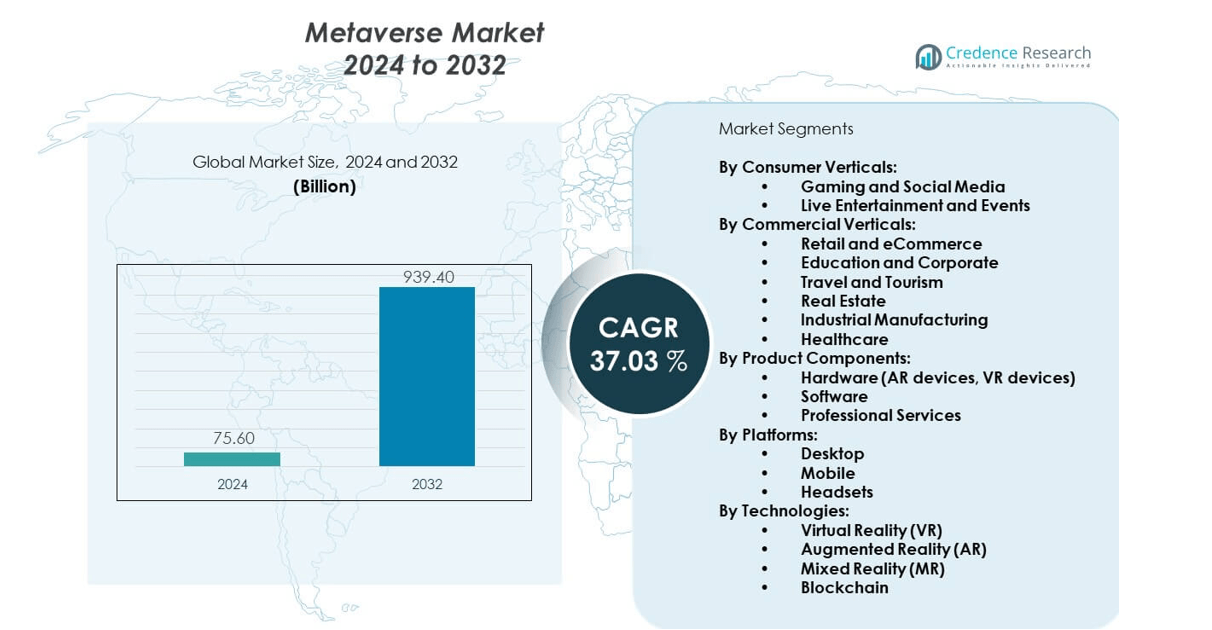
Market Insights:
- The Metaverse market is projected to grow from USD 75.6 billion in 2024 to USD 939.4 billion by 2032, registering a CAGR of 03% during the forecast period.
- Strong demand for immersive experiences in gaming, entertainment, and social interaction drives adoption across consumer and enterprise platforms.
- Enterprises increasingly invest in virtual collaboration, training, and customer engagement, making the metaverse an essential tool for digital transformation.
- Privacy, cybersecurity risks, and lack of clear regulatory frameworks act as significant restraints to market expansion.
- High infrastructure costs and limited accessibility in developing economies continue to hinder wider adoption and scalability.
- North America leads the market due to strong technology infrastructure and heavy investment by leading companies.
- Asia-Pacific emerges as the fastest-growing region, driven by digital penetration, large gaming communities, and rising investments from China, Japan, and South Korea.
Market Drivers:
Increasing Consumer Demand for Immersive Digital Experiences:
The growing consumer appetite for immersive digital platforms acts as a primary driver for the Metaverse market. Rising interest in virtual gaming, social interaction, and entertainment fosters a new ecosystem where users expect more personalized and engaging experiences. It is supported by rapid adoption of virtual reality and augmented reality devices that make immersive experiences accessible. Demand is particularly strong among younger demographics who value digital identity, virtual assets, and interactive spaces. Brands recognize this shift and increasingly invest in creating metaverse-based experiences to strengthen consumer loyalty. E-commerce and fashion sectors are leveraging digital avatars and virtual stores to attract tech-savvy consumers. The rising acceptance of digital ownership through NFTs further fuels adoption. It is setting the foundation for long-term engagement across industries.
- For instance, Roblox Corporation recorded a user base of 380 million monthly active users, making it one of the largest virtual world ecosystems driving immersive digital experiences for younger audiences.
Advancing Enterprise Adoption Across Remote Collaboration and Training:
Businesses are accelerating their adoption of virtual platforms to enable collaboration, training, and customer engagement, which strongly drives the Metaverse market. It benefits from enterprises seeking effective alternatives to traditional offices and conferences. Virtual workspaces support remote collaboration while lowering operational costs and improving productivity. Training programs across healthcare, defense, and manufacturing leverage immersive simulation to improve workforce skills. Enterprises also explore virtual marketplaces for customer engagement, creating new revenue streams. Digital marketing and brand promotion through virtual events are gaining acceptance. Rising interest in hosting large-scale corporate exhibitions in virtual environments demonstrates scalability. It shows the market’s increasing relevance beyond entertainment.
- For instance, Meta’s Reality Labs had employees dedicated to metaverse projects in 2022, facilitating the development of enterprise-grade collaboration and training tools. Across VR platforms, total payment volume on Meta Quest devices increased by 12% in 2024, driven largely by B2B and educational purchases.
Rising Technological Integration with AI, Blockchain, and Cloud Computing:
The convergence of advanced technologies provides a powerful push to the Metaverse market. AI enhances personalization, natural language processing, and intelligent virtual assistants that improve user engagement. Blockchain enables secure digital ownership, monetization, and interoperability of assets across platforms. Cloud computing ensures scalable infrastructure, reducing entry barriers for businesses and developers. It supports seamless virtual environments and expands access to metaverse applications globally. Integration with IoT devices extends opportunities in healthcare, smart homes, and education. Partnerships between technology firms accelerate innovation cycles and deliver advanced user experiences. Continuous development in hardware such as VR headsets and AR glasses makes adoption easier. It illustrates the strong role of innovation in driving growth.
Expanding Investment and Policy Support for Digital Transformation:
Strong investments and favorable policies enhance the growth trajectory of the Metaverse market. Governments in leading economies encourage digital ecosystems, funding research and setting innovation-friendly regulations. Venture capital firms invest heavily in start-ups that build metaverse infrastructure, applications, and virtual economies. Large tech companies allocate significant budgets to develop platforms and hardware, signaling long-term commitment. It gains momentum from collaborations between telecom operators and cloud service providers, enabling faster connectivity. Educational institutions also invest in virtual platforms to expand digital learning. Policy frameworks around digital asset ownership encourage consumer trust and adoption. Strategic investments across sectors validate the market’s potential as a future growth engine.
Market Trends:
Growing Focus on Digital Twins and Virtual Prototyping:
One of the emerging trends reshaping the Metaverse market is the expansion of digital twins and virtual prototyping. Industries such as construction, automotive, and aerospace increasingly leverage digital twins for testing and design validation. It helps companies reduce costs and shorten development cycles while ensuring higher accuracy. Urban planners also use virtual models to simulate infrastructure projects. This trend demonstrates the metaverse’s utility beyond entertainment and gaming. Healthcare institutions use digital twins to improve treatment planning and patient monitoring. The ability to replicate real-world processes virtually accelerates adoption. It strengthens the market’s position as a tool for industrial and scientific progress.
- For instance, Nvidia’s Omniverse platform is widely adopted for industrial digital twin projects, powering concurrent digital twin simulations for clients in manufacturing and automotive sectors by 2025.
Integration of Metaverse with Smart Cities and IoT Ecosystems:
The integration of the metaverse with smart city initiatives highlights another transformative trend. Governments and city planners explore virtual platforms to enhance public services and citizen engagement. IoT devices provide real-time data, which is then mirrored in virtual spaces for improved management. It enables simulation of traffic, energy consumption, and emergency planning in connected cities. Businesses see opportunities in linking IoT networks with metaverse applications for real-time insights. This fosters better resource allocation and sustainability planning. The growing emphasis on smart infrastructure drives metaverse adoption. It shows the role of interconnected digital ecosystems in shaping the market.
Expansion of Virtual Healthcare and Telemedicine Experiences:
The healthcare industry presents a rising trend of incorporating the metaverse into patient care. Hospitals and medical institutions leverage virtual platforms to simulate surgeries, train professionals, and improve patient education. It helps enhance telemedicine by creating immersive consultations between doctors and patients. Virtual environments reduce geographical barriers and improve access to healthcare services. Medical device companies use the metaverse to showcase products in interactive formats. This strengthens collaboration between healthcare professionals globally. The trend reflects how virtual ecosystems extend beyond entertainment to critical industries. It demonstrates the adaptability of the metaverse to essential public needs.
Rising Popularity of Virtual Tourism and Cultural Engagement:
Virtual tourism emerges as a distinctive trend in the Metaverse market. Travel restrictions and rising costs have created demand for digital exploration of global destinations. Tourism boards and cultural institutions use immersive platforms to showcase historical landmarks and cultural heritage. It allows users to interact with monuments and attend virtual festivals. This expands accessibility for individuals unable to travel physically. Virtual tourism also opens revenue streams for the travel and hospitality sector. Educational institutions integrate cultural engagement into learning modules, enhancing global awareness. It indicates the growing role of the metaverse in shaping tourism and education experiences.
Market Challenges Analysis:
Addressing Privacy, Security, and Regulatory Concerns:
The Metaverse market faces significant challenges related to privacy, security, and regulatory frameworks. With users spending more time in virtual environments, data collection and identity protection become critical concerns. It raises questions about compliance with existing regulations such as data protection and consumer rights. Cybersecurity threats including identity theft, phishing, and fraud present barriers to widespread adoption. Policymakers struggle to adapt legal systems to manage ownership of digital assets and NFTs. Cross-border transactions further complicate taxation and jurisdiction issues. Enterprises hesitate to adopt platforms without clear frameworks. Addressing these concerns is vital for sustaining user trust and market expansion.
High Infrastructure Costs and Accessibility Barriers:
Another major challenge is the high cost of infrastructure and accessibility barriers. The Metaverse market depends on advanced hardware, high-speed internet, and cloud infrastructure, which are not universally available. It limits adoption in developing economies where digital divides remain significant. Expensive VR headsets and AR devices restrict access for mainstream consumers. Energy consumption related to blockchain and large-scale virtual environments raises sustainability concerns. Developers face high costs in building immersive platforms, discouraging smaller players from entering. Enterprises also struggle with integration of legacy systems into new digital platforms. These obstacles highlight the need for cost optimization and inclusive adoption strategies.
Market Opportunities:
Expanding Role in Education, Training, and Skill Development:
The Metaverse market presents strong opportunities in transforming education and skill development. Virtual classrooms and immersive training modules allow students to engage interactively with subjects. It provides professionals with simulated environments for real-world skill application in healthcare, aviation, and manufacturing. Lifelong learning platforms can expand access to global learners. Universities and training organizations see the metaverse as a way to enhance global collaboration. Interactive education models help bridge gaps in remote regions. Rising adoption of gamified learning strengthens student engagement. This opportunity strengthens its relevance across formal and informal education systems.
Growing Potential in Retail, Marketing, and Consumer Engagement:
Retail and marketing sectors highlight vast opportunities within the Metaverse market. Virtual stores and digital showrooms redefine consumer experiences by enabling interactive product exploration. It supports direct-to-avatar sales, driving new revenue streams for brands. Digital advertising campaigns leverage immersive storytelling to build stronger connections. Fashion and luxury brands integrate digital collectibles to expand brand loyalty. Social commerce within virtual spaces fosters peer influence and consumer trust. Businesses can test market responses in virtual environments before physical launches. These opportunities establish the metaverse as a critical tool for future consumer engagement strategies.
Market Segmentation Analysis:
By Consumer and Commercial Verticals
The Metaverse market gains significant traction through consumer and commercial applications. Gaming and social media drive mass adoption with immersive experiences and interactive platforms, while live entertainment and events expand through virtual concerts, sports, and cultural gatherings. On the commercial side, retail and eCommerce lead with digital storefronts and virtual shopping. Education and corporate sectors adopt immersive classrooms and training platforms, while travel and tourism use virtual tours for accessibility. Real estate leverages digital property showcases, and industrial manufacturing and healthcare explore digital twins, simulations, and telemedicine.
- For instance, gaming platforms such as Roblox and Fortnite attract more than 70 million concurrent users during major live events, including virtual concerts and film premieres. E-commerce saw adoption from over a dozen global brands in 2024, with virtual goods sales accounting for nearly 1 in 4 digital purchases during promotional events.
By Product Components
Hardware plays a pivotal role with AR and VR devices forming the backbone of immersive adoption, supported by continuous innovation in headsets and sensors. Software is central to the ecosystem, with extended reality applications, gaming engines, and metaverse platforms enabling scalable digital experiences. Professional services such as application development and consulting support enterprises in deploying custom solutions. It shows a balanced reliance on infrastructure, content creation, and advisory services.
- For instance, global VR headset users are projected to reach approximately 216 million by late 2025, with Meta’s Quest accounting for the largest installed base. Usage patterns indicate that fewer than one in three Quest device owners use their headset monthly, yet the average engagement time per active user has risen year-over-year.
By Platforms
The market spans across desktop and mobile platforms, ensuring wide accessibility to mainstream users. Desktop adoption remains strong for gaming and enterprise applications, while mobile platforms provide portability and broader reach. Headsets drive immersive experiences and strengthen user engagement by offering higher realism. It highlights the diversity of user entry points into the metaverse ecosystem.
By Technologies
Virtual reality dominates adoption, providing deep immersion in digital worlds, while augmented reality enhances real-world interactions with digital overlays. Mixed reality offers hybrid engagement by integrating physical and digital elements seamlessly. Blockchain underpins digital ownership, asset monetization, and decentralized governance. It positions technology as the enabler of trust, scalability, and long-term adoption across the ecosystem.
Segmentation:
By Consumer Verticals:
- Gaming and Social Media
- Live Entertainment and Events
By Commercial Verticals:
- Retail and eCommerce
- Education and Corporate
- Travel and Tourism
- Real Estate
- Industrial Manufacturing
- Healthcare
By Product Components:
- Hardware (AR devices, VR devices)
- Software (Extended Reality Software, Gaming Engines, Metaverse Platforms)
- Professional Services (Application Development, Consulting)
By Platforms:
- Desktop
- Mobile
- Headsets
By Technologies:
- Virtual Reality (VR)
- Augmented Reality (AR)
- Mixed Reality (MR)
- Blockchain
By Region:
- North America
- U.S.
- Canada
- Mexico
- Europe
- Germany
- France
- U.K.
- Italy
- Spain
- Rest of Europe
- Asia Pacific
- China
- Japan
- India
- South Korea
- South-east Asia
- Rest of Asia Pacific
- Latin America
- Brazil
- Argentina
- Rest of Latin America
- Middle East & Africa
- GCC Countries
- South Africa
- Rest of the Middle East and Africa
Regional Analysis:
North America: Strongest Market Leadership with Robust Infrastructure
North America accounts for nearly 38 percent share of the Metaverse market, making it the leading region globally. The dominance comes from advanced technology infrastructure, strong consumer adoption, and significant investments from companies such as Meta, Microsoft, and Nvidia. It benefits from a mature gaming and social media ecosystem, which accelerates the adoption of virtual environments and digital platforms. Enterprises actively implement metaverse solutions for collaboration, training, and marketing, strengthening its commercial use cases. The presence of leading tech innovators encourages continuous development in hardware, software, and platforms. Government support for digital transformation further enhances adoption across sectors. The region maintains its leadership with strong capital investment and early consumer engagement.
Europe: Expanding Adoption with Regulatory Support and Industry Integration
Europe holds close to 27 percent share of the Metaverse market, supported by strict digital policies, enterprise adoption, and strong cultural integration. The region emphasizes safe digital practices and regulatory clarity, which creates a trusted environment for users and enterprises. Industries such as retail, automotive, and education adopt immersive platforms to improve customer engagement and workforce training. Entertainment companies in Europe explore virtual concerts, art galleries, and tourism experiences, expanding consumer adoption. The presence of gaming hubs in Germany, France, and the UK drives innovation in content creation. It benefits from strong partnerships between governments and enterprises to encourage digitalization. The region grows steadily through balanced consumer and commercial adoption.
Asia-Pacific: Fastest-Growing Region with Expanding Digital Penetration
Asia-Pacific captures about 25 percent share of the Metaverse market and emerges as the fastest-growing region. Rapid digital penetration, high internet adoption, and strong gaming communities in China, Japan, and South Korea drive this momentum. Governments and enterprises invest heavily in metaverse infrastructure, including 5G connectivity and immersive platforms. It benefits from younger demographics that actively engage with gaming, social platforms, and virtual commerce. Companies in the region accelerate investments in AR/VR hardware and software development. Strong eCommerce adoption in countries like China and India encourages integration of immersive shopping experiences. The region is positioned to surpass others in growth rate, making it the most dynamic contributor to future market expansion.
Key Player Analysis:
- Meta Platforms, Inc.
- Microsoft Corporation
- Roblox Corporation
- Epic Games
- Nvidia Corporation
- Unity Technologies
- Tencent Holdings Ltd.
- HTC Corporation
- Apple Inc.
- Sony Group Corporation
- Decentraland
- The Sandbox (Animoca Brands)
Competitive Analysis:
The Metaverse market is highly competitive, characterized by the presence of global technology leaders, gaming innovators, and emerging decentralized platforms. Major players such as Meta, Microsoft, Nvidia, Epic Games, and Roblox drive innovation with strong investments in hardware, software, and immersive platforms. It benefits from continuous advancements in AR/VR devices, gaming engines, and blockchain-based ecosystems. Strategic partnerships and acquisitions define the competitive landscape, as companies strengthen their portfolios to capture both consumer and enterprise demand. Decentralized platforms like Decentraland and The Sandbox expand user-driven experiences, while Apple and Sony leverage their hardware ecosystems. The competitive dynamics reflect a mix of consolidation and innovation shaping market growth.
Recent Developments:
- In August 2025, Meta Platforms, Inc. formed a partnership with AI image and video generator start-up Midjourney, licensing Midjourney's 'aesthetic technology' to enhance Meta’s models and products, under a collaboration between their research teams. Additionally, Meta upgraded its partnership with Aspire.io by launching the CreatorAds Suite that helps brands create and manage ads using creator-generated content, improving return on ad spend, launched in August 2025.
- In 2025, Microsoft Corporation was under regulatory scrutiny for its partnership with OpenAI but was cleared from merger investigation by March 2025. Also, Microsoft entered a multi-year strategic partnership with WSP to accelerate digital transformation in the Architecture, Engineering, and Construction industry with a financial commitment exceeding $1 billion, announced in February 2025.
- Nvidia revealed "NVLink Fusion" technology in May 2025 that allows connection and integration of external CPUs and GPUs with Nvidia’s infrastructure for building AI-focused semi-custom computing systems. This move was part of NVidia’s ongoing push to remain a leader in AI and computing technology.
Market Concentration & Characteristics:
The Metaverse market demonstrates moderate-to-high concentration, with a small number of global leaders holding significant influence. It shows strong integration of technology giants that dominate hardware, software, and platform development. Startups and decentralized platforms contribute to diversity, introducing blockchain-based innovations and community-driven experiences. The market is characterized by high capital intensity, strong partnerships, and rapid technological evolution. It is also shaped by cross-industry collaboration, with applications extending into retail, education, healthcare, and manufacturing. The ecosystem remains dynamic, with continuous investment and innovation driving adoption across both consumer and commercial segments.
Report Coverage:
The research report offers an in-depth analysis based on consumer and commercial verticals, product components, platforms, technologies, and regions. It details leading market players, providing an overview of their business, product offerings, investments, revenue streams, and key applications. Additionally, the report includes insights into the competitive environment, SWOT analysis, current market trends, as well as the primary drivers and constraints. Furthermore, it discusses various factors that have driven market expansion in recent years. The report also explores market dynamics, regulatory scenarios, and technological advancements that are shaping the industry. It assesses the impact of external factors and global economic changes on market growth. Lastly, it provides strategic recommendations for new entrants and established companies to navigate the complexities of the market.
Future Outlook:
- Rising integration of AI will enhance personalization and improve immersive user experiences.
- Expanding adoption of AR and VR hardware will increase accessibility for mainstream users.
- Enterprise demand for digital twins and virtual training will accelerate industrial applications.
- Blockchain-based ecosystems will strengthen digital ownership and asset monetization.
- Growth in virtual education and corporate training will redefine learning models.
- Retail and eCommerce will leverage immersive shopping to improve customer engagement.
- Healthcare will expand metaverse applications in telemedicine, training, and patient care.
- Partnerships between technology firms and telecom providers will improve infrastructure.
- Governments will frame digital policies to regulate data privacy and asset ownership.
- Social interaction platforms will evolve to create deeper engagement and virtual economies.

Request a Free Sample
Fill in your details and we'll send you a free sample report.
- Sample data tables & charts
- Research methodology
Market Dynamics
Increasing Consumer Demand for Immersive Digital Experiences
Consumers, especially younger demographics, are seeking more engaging and personalized digital environments for gaming, social interaction, and entertainment. The adoption of VR/AR devices and the popularity of platforms like Roblox and Fortnite are fueling rapid market expansion.
Advancing Enterprise Adoption Across Remote Collaboration and Training
Businesses are leveraging the metaverse for virtual workspaces, immersive training, and customer engagement, driving adoption beyond entertainment. Enterprises benefit from cost savings, improved productivity, and new revenue streams through virtual events and marketplaces.
Rising Technological Integration with AI, Blockchain, and Cloud Computing
The convergence of AI for personalization, blockchain for secure digital ownership, and cloud computing for scalable infrastructure is accelerating metaverse innovation. These technologies enable seamless, interoperable, and globally accessible virtual environments.
Expanding Investment and Policy Support for Digital Transformation
Significant investments from tech giants, venture capital, and supportive government policies are accelerating the development of metaverse infrastructure and applications. Regulatory clarity and funding for digital ecosystems are encouraging both consumer and enterprise adoption.
Growth in Virtual Commerce and Digital Ownership
The rise of NFTs and blockchain-based assets is enabling new forms of digital ownership and monetization, attracting brands and consumers to virtual commerce. This trend is transforming retail, marketing, and social commerce within the metaverse.
Need a Custom Version of This Report?
Tailor the scope, geography, or segments to your exact requirements.
- Custom geography or segment scope
- Direct access to our analyst team
Frequently Asked Questions
What is the current market size for Metaverse market, and what is its projected size in 2032?
At what Compound Annual Growth Rate is the Metaverse market projected to grow between 2025 and 2032?
Which Metaverse market segment held the largest share in 2024?
Who are the leading companies in the Metaverse market?
Table of Content
Chapter 1 Market Segmentation
- 1.1 Segmentation Framework
- 1.1.1 Product and Service Classification
- 1.1.2 Application and End-Use Classification
- 1.1.3 Technology and Solution Classification
- 1.1.4 Customer and Distribution Channel Classification
- 1.1.5 Geographic Segmentation
- 1.1.6 Market Segment Definitions and Boundaries
- 1.2 By Platforms
- 1.2.1 Desktop
- 1.2.2 Mobile
- 1.2.3 Headsets
- 1.3 By Technologies
- 1.3.1 Virtual Reality (VR)
- 1.3.2 Augmented Reality (AR)
- 1.3.3 Mixed Reality (MR)
- 1.3.4 Blockchain
- 1.4 By Product Components
- 1.4.1 Hardware (AR devices, VR devices)
- 1.4.2 Software (Extended Reality Software, Gaming Engines, Metaverse Platforms)
- 1.4.3 Professional Services (Application Development, Consulting)
- 1.5 By Consumer and Commercial Verticals
- 1.5.1 Gaming and Social Media
- 1.5.2 Live Entertainment and Events
- 1.5.3 Retail and eCommerce
- 1.5.4 Education and Corporate
- 1.5.5 Travel and Tourism
- 1.5.6 Real Estate
- 1.5.7 Industrial Manufacturing
- 1.5.8 Healthcare
Chapter 2 Introduction
- 2.1 Report Objectives and Scope
- 2.2 Product Definition and Industry Terminology
- 2.3 Market Inclusions and Exclusions
- 2.4 Research Process
- 2.4.1 Primary Research and Expert Interviews
- 2.4.2 Secondary Research and Source Review
- 2.4.3 Top-Down and Bottom-Up Estimation
- 2.4.4 Data Triangulation and Verification
- 2.5 Market Size Measurement Basis
- 2.5.1 2024: USD 75.6 billion → 2032: USD 939.4 billion
- 2.6 Historical and Forecast Reference Periods
- 2.6.1 Base Year: 2024
- 2.6.2 Forecast Period: 2024-2032
- 2.7 Research Assumptions and Limitations
Chapter 3 Executive Summary
- 3.1 Market Snapshot and Key Findings
- 3.2 Base-Year Market Size, 2024
- 3.3 Forecast Market Size, 2032
- 3.4 Revenue and Volume Growth Outlook
- 3.5 Key Demand and Supply Indicators
- 3.6 Leading Market Segments
- 3.7 Fastest-Growing Market Opportunities
- 3.8 Regional Performance Highlights
- 3.9 Technology and Industry Transformation
- 3.10 Competitive Landscape Summary
- 3.11 Analyst View and Strategic Implications
Chapter 4 Global Metaverse Market Trends and Developments
- 4.1 Historical Industry Development
- 4.2 Recent Market Trends and Developments
- 4.3 Demand and Customer Behavior Trends
- 4.4 Technology and Product Innovation
- 4.5 Artificial Intelligence, Automation and Digitalization
- 4.6 Local Manufacturing and Supply Chain Realignment
- 4.7 Industry Partnerships, Mergers and Acquisitions
- 4.8 Sustainability and Circular Economy Developments
- 4.9 Government and Private Sector Investment Trends
- 4.10 Emerging Business Models and Commercialization
- 4.11 Industry Developments and Announcements
Chapter 5 Global Metaverse Market Production, Supply and Demand Analysis
- 5.1 Demand Trend and Consumption Analysis
- 5.2 Demand Forecast, 2024-2032
- 5.3 Production and Output Trend
- 5.4 Production and Output Forecast, 2024-2032
- 5.5 Installed Capacity and Capacity Utilization
- 5.6 Company-Wise Production Plants and Statistics
- 5.6.1 Installed Production Capacity
- 5.6.2 Actual Production
- 5.6.3 Planned Capacity and Expansion Targets
- 5.7 Supply Chain Structure and Procurement Trends
- 5.8 Supply-Demand Gap and Bottlenecks
- 5.9 Import Dependence and Sourcing Structure
- 5.10 Contract Manufacturing and Outsourcing
- 5.11 Regional Supply and Demand Concentration
Chapter 6 Global Metaverse Market Pricing Analysis
- 6.1 Pricing Structure and Measurement
- 6.2 Historical Pricing Trends
- 6.3 Pricing Outlook, 2024-2032
- 6.4 Average Selling Price and Unit Economics
- 6.5 Pricing by Product and Market Segment
- 6.6 Geographic Pricing Differences
- 6.7 Key Input, Energy, Labor and Logistics Costs
- 6.8 Contract Pricing and Purchasing Models
- 6.9 Pricing Sensitivity and Competitive Positioning
- 6.10 Price, Margin and Profitability Implications
Chapter 7 Global Metaverse Market Dynamics
- 7.1 Market Growth Drivers
- 7.1.1 Demand-Side Drivers
- 7.1.2 Technology and Innovation Drivers
- 7.1.3 Infrastructure and Investment Drivers
- 7.1.4 Regulatory and Policy Drivers
- 7.2 Market Restraints
- 7.2.1 Cost and Affordability Constraints
- 7.2.2 Technology and Adoption Barriers
- 7.2.3 Supply Chain and Operational Constraints
- 7.3 Market Challenges
- 7.3.1 Competitive Pressure and Margin Erosion
- 7.3.2 Skills, Infrastructure and Implementation Gaps
- 7.4 Emerging Market Opportunities
- 7.5 Market Dynamics Impact and Time-Horizon Assessment
Chapter 8 Global Metaverse Value Chain Analysis
- 8.1 Industry Value Chain Overview
- 8.2 Upstream Suppliers and Critical Inputs
- 8.3 Technology and Component Providers
- 8.4 Manufacturing or Service Delivery
- 8.5 Distribution, Channel Partners and Integrators
- 8.6 Downstream Applications and End Users
- 8.7 Value Addition and Profit Pools
- 8.8 Vertical Integration and Outsourcing
- 8.9 Supplier Concentration and Risk
- 8.10 Supply Chain Localization and Resilience
Chapter 9 Global Metaverse Market Regulations and Policies
- 9.1 Relevant Laws, Standards and Compliance Frameworks
- 9.2 Product, Service, Safety and Quality Requirements
- 9.3 Government Policies, Incentives and Subsidies
- 9.4 Imports, Exports and Trade Barriers
- 9.5 Public Procurement and Local Content Requirements
- 9.6 Environmental and Sustainability Compliance
- 9.7 Data Protection, AI and Cybersecurity Compliance
- 9.8 Upcoming Policy Changes and Market Implications
Chapter 10 Global Metaverse Market Hotspots and Opportunities
- 10.1 Market Opportunity Mapping and Growth Hotspots
- 10.2 High-Growth Applications and Customer Groups
- 10.3 Underserved Markets and White-Space Opportunities
- 10.4 Emerging Technology and Product Opportunities
- 10.5 New Capacity and Investment Hotspots
- 10.6 Market Entry and Expansion Opportunities
- 10.7 Distribution and Partnership Opportunities
- 10.8 Near-Term and Long-Term Commercial Potential
- 10.9 Opportunity Attractiveness and Execution Risks
Chapter 11 Global Metaverse Market Outlook, 2024-2032
- 11.1 Market Size and Analysis
- 11.1.1 Revenue (Market Measurement: 2024: USD 75.6 billion → 2032: USD 939.4 billion)
- 11.1.2 Market Volume and Quantity Sold
- 11.1.3 Historical Market Size
- 11.1.4 Base-Year Market Size, 2024
- 11.2 Market Forecast, 2024-2032
- 11.2.1 Revenue Forecast to 2032
- 11.2.2 Volume Forecast to 2032
- 11.2.3 CAGR and Year-on-Year Growth
- 11.2.4 Incremental Revenue Opportunity
- 11.3 Forecast Assumptions and Scenario Analysis
- 11.3.1 Base-Case Forecast
- 11.3.2 Optimistic and Conservative Scenarios
- 11.3.3 Technology, Pricing and Policy Sensitivities
- 11.4 Market Attractiveness and Growth Outlook
Chapter 12 Global Metaverse Market Segmentation and Outlook
- 12.1 Segmentation Summary and Market Shares, 2024
- 12.2 Largest and Fastest-Growing Segments
- 12.3 By Platforms - Market Size and Forecast, 2024-2032
- 12.3.1 Segment Definition and Scope
- 12.3.2 Historical Market Size
- 12.3.3 Revenue Forecast, 2024-2032
- 12.3.4 Volume Forecast, 2024-2032
- 12.3.5 Base-Year Market Share, 2024
- 12.3.6 Segment CAGR and Growth Drivers
- 12.3.7 Subsegment Market Size and Forecast
- 12.3.7.1 Desktop
- 12.3.7.2 Mobile
- 12.3.7.3 Headsets
- 12.3.8 Subsegment Pricing and Adoption Trends
- 12.3.9 Leading Suppliers and Competition
- 12.3.10 Regional Demand and Opportunities
- 12.4 By Technologies - Market Size and Forecast, 2024-2032
- 12.4.1 Segment Definition and Scope
- 12.4.2 Historical Market Size
- 12.4.3 Revenue Forecast, 2024-2032
- 12.4.4 Volume Forecast, 2024-2032
- 12.4.5 Base-Year Market Share, 2024
- 12.4.6 Segment CAGR and Growth Drivers
- 12.4.7 Subsegment Market Size and Forecast
- 12.4.7.1 Virtual Reality (VR)
- 12.4.7.2 Augmented Reality (AR)
- 12.4.7.3 Mixed Reality (MR)
- 12.4.7.4 Blockchain
- 12.4.8 Subsegment Pricing and Adoption Trends
- 12.4.9 Leading Suppliers and Competition
- 12.4.10 Regional Demand and Opportunities
- 12.5 By Product Components - Market Size and Forecast, 2024-2032
- 12.5.1 Segment Definition and Scope
- 12.5.2 Historical Market Size
- 12.5.3 Revenue Forecast, 2024-2032
- 12.5.4 Volume Forecast, 2024-2032
- 12.5.5 Base-Year Market Share, 2024
- 12.5.6 Segment CAGR and Growth Drivers
- 12.5.7 Subsegment Market Size and Forecast
- 12.5.7.1 Hardware (AR devices, VR devices)
- 12.5.7.2 Software (Extended Reality Software, Gaming Engines, Metaverse Platforms)
- 12.5.7.3 Professional Services (Application Development, Consulting)
- 12.5.8 Subsegment Pricing and Adoption Trends
- 12.5.9 Leading Suppliers and Competition
- 12.5.10 Regional Demand and Opportunities
- 12.6 By Consumer and Commercial Verticals - Market Size and Forecast, 2024-2032
- 12.6.1 Segment Definition and Scope
- 12.6.2 Historical Market Size
- 12.6.3 Revenue Forecast, 2024-2032
- 12.6.4 Volume Forecast, 2024-2032
- 12.6.5 Base-Year Market Share, 2024
- 12.6.6 Segment CAGR and Growth Drivers
- 12.6.7 Subsegment Market Size and Forecast
- 12.6.7.1 Gaming and Social Media
- 12.6.7.2 Live Entertainment and Events
- 12.6.7.3 Retail and eCommerce
- 12.6.7.4 Education and Corporate
- 12.6.7.5 Travel and Tourism
- 12.6.7.6 Real Estate
- 12.6.7.7 Industrial Manufacturing
- 12.6.7.8 Healthcare
- 12.6.8 Subsegment Pricing and Adoption Trends
- 12.6.9 Leading Suppliers and Competition
- 12.6.10 Regional Demand and Opportunities
- 12.7 Segment Growth Comparison
- 12.8 Segment Attractiveness and Priority Matrix
Chapter 13 Global Metaverse End-Use and Application Market Outlook
- 13.1 End-Use Industry and Customer Demand Structure
- 13.2 Leading Applications and Customer Groups
- 13.3 End-Use Market Size, Share and Forecast
- 13.4 Major End-Use Industry Deep Dives
- 13.4.1 Customer Requirements and Use Cases
- 13.4.2 Demand and Replacement Cycles
- 13.4.3 Technical and Regulatory Considerations
- 13.4.4 Purchasing and Procurement Models
- 13.4.5 Leading Vendors and Distribution Channels
- 13.4.6 Forecast and Commercial Opportunities
- 13.5 Emerging Applications and Cross-Segment Demand
- 13.6 End-Use Industry Investment Priorities
Chapter 14 Global Metaverse Geographic Market Outlook, 2024-2032
- 14.1 Regional Market Size and Share, 2024
- 14.2 Regional Market Forecast, 2024-2032
- 14.3 Regional Pricing, Production and Demand Differences
- 14.4 North America
- 14.4.1 United States
- 14.4.2 Canada
- 14.4.3 Mexico
- 14.5 Europe
- 14.5.1 Germany
- 14.5.2 France
- 14.5.3 Italy
- 14.5.4 United Kingdom
- 14.5.5 Spain
- 14.5.6 Poland
- 14.5.7 Russia
- 14.5.8 Netherlands
- 14.5.9 Belgium
- 14.5.10 Sweden
- 14.5.11 Denmark
- 14.5.12 Norway
- 14.5.13 Rest of Europe
- 14.6 Asia Pacific
- 14.6.1 China
- 14.6.2 India
- 14.6.3 Japan
- 14.6.4 South Korea
- 14.6.5 Thailand
- 14.6.6 Indonesia
- 14.6.7 Vietnam
- 14.6.8 Malaysia
- 14.6.9 Australia
- 14.6.10 Rest of Asia Pacific
- 14.7 Latin America
- 14.7.1 Brazil
- 14.7.2 Argentina
- 14.7.3 Colombia
- 14.7.4 Chile
- 14.7.5 Rest of Latin America
- 14.8 Middle East
- 14.8.1 Saudi Arabia
- 14.8.2 United Arab Emirates
- 14.8.3 Turkey
- 14.8.4 Israel
- 14.8.5 Iran
- 14.8.6 Rest of the Middle East
- 14.9 Africa
- 14.9.1 South Africa
- 14.9.2 Egypt
- 14.9.3 Nigeria
- 14.9.4 Morocco
- 14.9.5 Rest of Africa
- 14.10 Regional Investment, Policy and Supply Chain Differences
- 14.11 Regional Competitive Landscape
- 14.12 Geographic Growth Hotspots
Chapter 15 Global Metaverse Technology, Innovation and Sustainability Outlook
- 15.1 Technology Landscape and Maturity
- 15.2 Product, Process and Service Innovation
- 15.3 AI, Automation and Digital Tools in the Industry
- 15.4 Technology Adoption and Performance Benchmarking
- 15.5 Innovation Pipeline and R&D Investment
- 15.6 Patent and Intellectual Property Trends
- 15.7 Energy Efficiency and Resource Management
- 15.8 Sustainability, Recycling and Circularity
- 15.9 Technology Roadmap, 2024-2032
- 15.10 Risks of Obsolescence and Technology Substitution
Chapter 16 Global Metaverse Market Key Strategic Imperatives
- 16.1 Growth and Market Entry Priorities
- 16.2 High-Return Products and Segments
- 16.3 Pricing, Profitability and Cost Optimization
- 16.4 Technology Investment and Product Differentiation
- 16.5 Supply Chain Localization and Resilience
- 16.6 Distribution and Customer Acquisition
- 16.7 Partnership, Acquisition and Capacity Strategy
- 16.8 Regional Expansion Priorities
- 16.9 Short-, Medium- and Long-Term Actions
Chapter 17 Competition Outlook
- 17.1 Industry Competition Characteristics
- 17.2 Market Structure and Concentration
- 17.3 Market Share and Competitive Positioning, 2024
- 17.4 Company-Wise Revenue and Product Benchmarking
- 17.5 Production and Service Capacity Benchmarking
- 17.6 Technology, Pricing and Differentiation
- 17.7 Regional Footprint and Distribution Strength
- 17.8 Mergers, Acquisitions and Strategic Alliances
- 17.9 New Entrants and Competitive Threats
- 17.10 Porter's Five Forces and Industry Attractiveness
- 17.11 Competitive Outlook, 2024-2032
Chapter 18 Company Profiles
- 18.1 Company Coverage and Selection Criteria
- 18.2 Meta Platforms, Inc.
- 18.2.1 Business Description
- 18.2.2 Company Ownership and Geographic Presence
- 18.2.3 Product and Service Portfolio
- 18.2.4 Manufacturing and Operating Footprint
- 18.2.5 Production Capacity and Expansion Plans
- 18.2.6 Financial Performance and Investment
- 18.2.7 Market Share and Competitive Position
- 18.2.8 Technology and Innovation Capabilities
- 18.2.9 Strategic Alliances or Partnerships
- 18.2.10 Recent Developments
- 18.2.11 Growth Strategy and Outlook
- 18.3 Microsoft Corporation
- 18.4 Roblox Corporation
- 18.5 Epic Games
- 18.6 Nvidia Corporation
- 18.7 Unity Technologies
- 18.8 Tencent Holdings Ltd.
- 18.9 HTC Corporation
- 18.10 Apple Inc.
- 18.11 Sony Group Corporation
- 18.12 Other Relevant Market Participants
Note: Every listed company is profiled on the structure shown under the first company. The company list is preliminary and may change based on research findings, market developments, data availability and client requirements.
Chapter 19 Disclaimer
- 19.1 Research and Forecast Disclaimer
- 19.2 Data Source and Estimation Limitations
Note: The depth of individual sections depends on data availability for this market. Volume, capacity, trade and other unit-based metrics are included where applicable.

