Market Overview
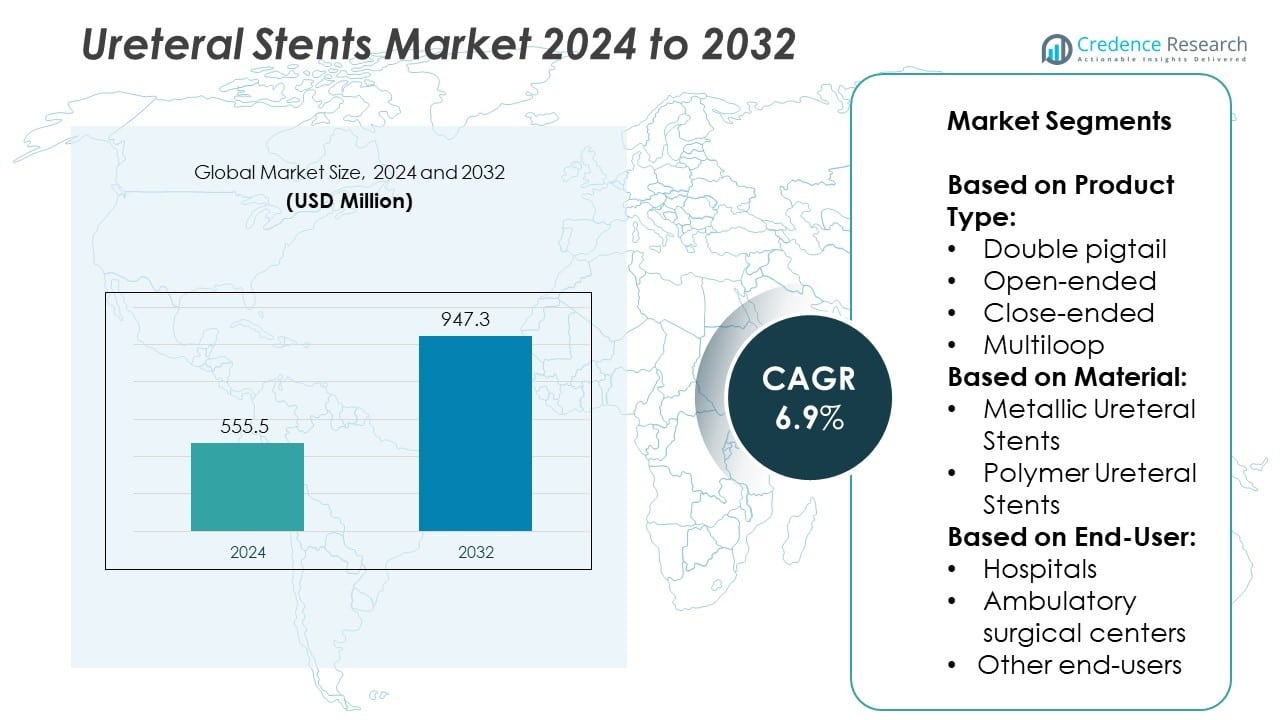
Ureteral Stents Market size was valued at USD 555.5 million in 2024 and is anticipated to reach USD 947.3 million by 2032, at a CAGR of 6.9% during the forecast period.
| REPORT ATTRIBUTE | DETAILS |
|---|---|
| Historical Period | 2020-2024 |
| Base Year | 2024 |
| Forecast Period | 2025-2032 |
| Ureteral Stents Market Size 2024 | USD 555.5 Million |
| Ureteral Stents Market, CAGR | 6.9% |
| Ureteral Stents Market Size 2032 | USD 947.3 Million |
The ureteral stents market grows steadily due to rising incidences of kidney stones, ureteral obstructions, and urological malignancies, especially among the aging population. Hospitals adopt advanced stents with hydrophilic coatings and antimicrobial properties to enhance patient outcomes and minimize complications. Demand strengthens with the shift toward minimally invasive procedures and increased availability of urological care in emerging regions. Technological advancements in biodegradable and drug-eluting stents support product innovation and procedural efficiency.
North America leads the ureteral stents market due to advanced healthcare infrastructure, high adoption of minimally invasive procedures, and strong presence of leading manufacturers. Europe follows closely with widespread use of antimicrobial and biodegradable stents, while Asia-Pacific records rapid growth supported by expanding hospital access and increasing urological disease burden. Latin America and the Middle East & Africa experience steady growth driven by urban healthcare expansion and medical tourism. Key players such as Boston Scientific Corporation, Cook Medical, Olympus Corporation, and Becton, Dickinson and Company focus on product innovation, clinical efficacy, and global distribution strategies to strengthen their competitive position.
Market Insights
- The ureteral stents market was valued at USD 555.5 million in 2024 and is projected to reach USD 947.3 million by 2032, expanding at a CAGR of 6.9% during the forecast period.
- Rising incidence of kidney stones, ureteral obstructions, and urinary tract malignancies drives the demand for ureteral stents, especially in aging populations across developed and developing regions.
- Technological advancements such as the development of biodegradable, antimicrobial-coated, and drug-eluting stents improve patient outcomes, reduce complications, and enhance adoption in minimally invasive procedures.
- Hospitals and ambulatory surgical centers increasingly use preloaded, disposable stent systems to streamline workflows, minimize infection risk, and reduce hospital stays.
- Market players like Boston Scientific Corporation, Olympus Corporation, Cook Medical, and Becton, Dickinson and Company compete through product innovation, clinical partnerships, and global distribution networks.
- Complications such as stent migration, infection, and patient discomfort act as restraints, limiting compliance and increasing the need for post-procedural interventions.
- North America dominates the market due to high procedure volume and advanced care, while Asia-Pacific shows the fastest growth driven by infrastructure expansion and increased access to urology services.
Market Drivers
Rising Incidence of Urological Disorders Driving Product Demand
The growing prevalence of urological conditions, including kidney stones, ureteral obstructions, and urinary tract infections, significantly drives demand for ureteral stents. An aging global population, coupled with lifestyle factors such as poor hydration and sedentary habits, contributes to the rising burden of these disorders. The Ureteral Stents market benefits from the increasing need for temporary and long-term urinary drainage solutions. Hospitals and specialty urology centers consistently adopt stents to prevent complications during surgeries and to support postoperative recovery. Surgeons prefer stents for effective management of ureteral strictures and malignancy-induced blockages. This rising clinical application scope creates a stable demand outlook for stent manufacturers.
- For instance, Allium Medical’s biodegradable ureteral stent demonstrated 88% encrustation-free rates at 4-week follow-up across multiple centers in Europe.
Advancements in Stent Design and Biocompatible Materials
Technological innovation in stent design and biomaterials enhances patient comfort and improves procedural outcomes. Manufacturers develop stents with hydrophilic coatings, anti-reflux valves, and biodegradable polymers to reduce encrustation, migration, and the need for secondary interventions. The Ureteral Stents market responds to increasing physician demand for devices that ensure ease of insertion, minimal complications, and enhanced long-term performance. Leading players invest in R&D to differentiate their offerings through product reliability and innovation. Hospitals seek cost-effective stents that reduce readmission rates and lower post-operative care costs. These material and design enhancements play a critical role in expanding clinical acceptance and global usage.
- For instance, Pnn Medical A/S reported a 21% reduction in pain scores with its Memokath™ 051 stents during a 6-month follow-up trial in 2023.
Expanding Access to Urological Care in Emerging Economies
Healthcare infrastructure development and government-supported health programs in emerging economies enable greater access to urology services. Countries in Asia-Pacific, Latin America, and the Middle East improve procedural volumes through investments in public and private hospitals. It supports broader adoption of ureteral stents in both routine and emergency settings. Urologists in these regions increasingly perform procedures such as ureteroscopy and percutaneous nephrolithotomy, where stents play an essential role. International manufacturers form distribution alliances and expand production capacities to address the regional demand surge. This market expansion across low- and middle-income countries underpins volume growth over the forecast period.
Growing Preference for Minimally Invasive Urological Procedures
The healthcare industry shifts toward minimally invasive techniques that shorten recovery times and reduce procedural risks. Ureteral stents are integral to these approaches, especially in endourological procedures involving stone removal and ureteral dilation. The Ureteral Stents market benefits from hospitals prioritizing technologies that reduce hospital stays and improve patient throughput. Surgeons prefer stents that are compatible with guidewires and flexible scopes, enabling seamless placement and removal. Demand rises for single-use, pre-loaded, and antimicrobial-coated stents that align with infection control protocols. This procedural transition reinforces the role of stents in modern urology practices worldwide.
Market Trends
Increasing Use of Biodegradable and Antimicrobial Stents
Hospitals and surgical centers increasingly adopt biodegradable and antimicrobial-coated ureteral stents to address infection risk and patient discomfort. These stents eliminate the need for secondary removal procedures, reducing patient visits and healthcare costs. Manufacturers develop stents that gradually disintegrate within the body without causing inflammation or blockages. The Ureteral Stents market sees stronger demand for products with hydrophilic and antibacterial coatings that prevent biofilm formation and improve urinary flow. Physicians prefer stents that reduce encrustation and irritation, particularly in long-term use cases. This trend aligns with clinical objectives of lowering complication rates and enhancing patient recovery.
- For instance, B. Braun Melsungen AG allocated €12.6 million in 2024 to expand its regulatory affairs and compliance team for faster EU MDR submissions related to its urological portfolio.
Emphasis on Customization and Patient-Specific Solutions
Medical device manufacturers invest in customizable ureteral stents tailored to individual anatomy and condition severity. Hospitals request varying lengths, diameters, and stiffness profiles to accommodate complex urological needs. It leads to the development of personalized stent solutions that support better clinical outcomes. Urologists now select stents based on patient-specific imaging and procedural requirements, enabling greater precision in treatment. The trend reflects the broader healthcare movement toward personalized medicine and device optimization. Regulatory approvals for specialized stents contribute to diversified portfolios across global markets.
- For instance, Merit Medical Systems received FDA approval for its WRAPSODY endoprosthesis in December 2024, showing 89.8% target lesion primary patency at 6 months in AV fistula cases.
Rising Adoption of Preloaded and Disposable Stent Systems
Preloaded ureteral stent kits and disposable systems gain traction in operating rooms due to their procedural convenience and infection control benefits. These systems reduce setup time and eliminate reprocessing costs, supporting hospital efficiency goals. The Ureteral Stents market integrates these offerings into routine practice across developed regions. Disposable systems align with hygiene protocols in outpatient and ambulatory surgical centers. Demand rises for sterile, single-use solutions that ensure consistent quality and reduce cross-contamination risks. Healthcare providers favor these systems for their ability to streamline workflow and improve patient safety.
Integration of Digital Imaging and Navigation Tools in Stenting Procedures
Digital health integration enhances ureteral stent placement accuracy through real-time imaging and navigation assistance. Hospitals adopt fluoroscopy, ultrasound, and endoscopic visualization tools to guide stent positioning. It supports safer, faster, and less invasive stent deployment in complex anatomical scenarios. Surgeons leverage digital tools to monitor stent behavior post-procedure and detect migration or obstruction. The trend supports training and skill development among urologists using simulation-based platforms. Technology integration strengthens the role of stenting in advanced endourological procedures.
Market Challenges Analysis
High Risk of Stent-Related Complications Affecting Patient Compliance
Ureteral stents often lead to adverse symptoms such as hematuria, pain, infection, encrustation, and urinary frequency, which reduce patient compliance. These complications raise concerns for both patients and healthcare providers, especially during long-term use. The Ureteral Stents market faces limitations due to the discomfort and need for regular monitoring or early stent removal. Physicians must balance therapeutic benefits against the potential for irritation and secondary interventions. Device-related complications increase treatment costs and delay patient recovery timelines. This clinical burden restricts wider acceptance in certain patient populations, particularly in chronic cases.
Regulatory Barriers and Cost Pressures Limiting Innovation
Complex regulatory pathways and lengthy approval cycles restrict the pace of innovation in ureteral stent development. Manufacturers must comply with evolving standards related to safety, biocompatibility, and environmental impact, which adds cost and delays market entry. It constrains small and mid-sized firms that lack robust regulatory infrastructure. Pricing pressures from hospitals and reimbursement uncertainties also affect profitability, especially in price-sensitive markets. Healthcare systems demand value-based solutions, forcing companies to justify premium stent features through clinical evidence. These structural challenges impact R&D investments and slow down the introduction of advanced stent technologies.
Market Opportunities
Emerging Demand for Urological Care in Underserved Regions
Rapid urbanization and expanding healthcare access in low- and middle-income countries create significant growth potential for ureteral stent manufacturers. Government-backed health reforms and rising awareness of urological disorders increase procedural volumes in public hospitals. The Ureteral Stents market benefits from greater availability of diagnostic and surgical infrastructure in Asia-Pacific, Latin America, and parts of Africa. International firms can expand their footprint through strategic partnerships with regional distributors and local production hubs. Demand grows in rural and semi-urban areas as mobile urology units and telehealth consultations become more common. These underserved markets offer untapped opportunities for volume-driven expansion.
Innovation in Smart and Drug-Eluting Stents Enhancing Product Value
Technological advancements in smart stents and drug-eluting devices offer new avenues for clinical differentiation and revenue growth. Companies explore stents with embedded sensors, timed-release medications, and dissolvable materials to address long-standing complications. It creates a platform for value-based care where device performance aligns with improved patient outcomes. Hospitals and specialty clinics show interest in next-generation stents that reduce infection risk and minimize intervention frequency. Smart stents also support post-operative monitoring, allowing clinicians to make timely decisions without invasive follow-ups. These innovation-focused solutions position manufacturers to serve both high-margin and high-need segments effectively.
Market Segmentation Analysis:
By Product Type:
Double pigtail stents hold the largest share due to their strong anchoring design and superior patient tolerance. These stents prevent migration and offer better drainage performance, making them widely adopted in routine urological procedures. Open-ended stents remain essential in short-term postoperative drainage and temporary relief from obstruction. Close-ended variants find niche applications where controlled flow is required. Multiloop stents, although less common, gain interest in complex cases requiring enhanced positioning stability. The Ureteral Stents market continues to expand its product variety to support specific procedural needs.
- For instance, Coloplast's ImaJin® Hydro silicone‑hydrocoated double‑loop stents exhibited significantly lower biofilm (0.93 points vs. 1.24 points) and mineral encrustation (0.78 vs. 1.22) compared to Percuflex™ Plus in a multicenter randomized study after a 21‑day dwell time.
By Material:
Polymer ureteral stents dominate due to their flexibility, lower cost, and biocompatibility. Hospitals and outpatient centers prefer polymer-based stents for ease of placement and reduced patient discomfort. Manufacturers improve polymer formulations to reduce encrustation and extend dwell time. Metallic ureteral stents maintain relevance in long-term applications, particularly in cases of recurrent obstruction or malignancy. These stents offer structural strength and resist compression in challenging anatomical conditions. It supports their usage in oncology and chronic urology cases.
- For instance, a survey of urologists revealed that 80.8% reported using double pigtail stents preferentially-highlighting the widespread adoption in typical clinical routines.
By End-User:
Hospitals lead the market due to high surgical volumes, access to advanced equipment, and the presence of skilled urologists. These facilities perform both emergency and planned stent placements, supporting sustained demand. Ambulatory surgical centers contribute to growth with an increasing number of minimally invasive urological interventions. Their adoption of single-use stents and outpatient models aligns with cost-efficiency goals. Other end-users, including specialty clinics and diagnostic centers, represent a smaller but expanding segment driven by growing point-of-care urology services.
Segments:
Based on Product Type:
- Double pigtail
- Open-ended
- Close-ended
- Multiloop
Based on Material:
- Metallic Ureteral Stents
- Polymer Ureteral Stents
Based on End-User:
- Hospitals
- Ambulatory surgical centers
- Other end-users
Based on the Geography:
- North America
- U.S.
- Canada
- Mexico
- Europe
- UK
- France
- Germany
- Italy
- Spain
- Russia
- Belgium
- Netherlands
- Austria
- Sweden
- Poland
- Denmark
- Switzerland
- Rest of Europe
- Asia Pacific
- China
- Japan
- South Korea
- India
- Australia
- Thailand
- Indonesia
- Vietnam
- Malaysia
- Philippines
- Taiwan
- Rest of Asia Pacific
- Latin America
- Brazil
- Argentina
- Peru
- Chile
- Colombia
- Rest of Latin America
- Middle East
- UAE
- KSA
- Israel
- Turkey
- Iran
- Rest of Middle East
- Africa
- Egypt
- Nigeria
- Algeria
- Morocco
- Rest of Africa
Regional Analysis
North America
North America holds the largest share in the ureteral stents market, accounting for 38.5% of the global revenue. The region benefits from well-established urological care infrastructure, high procedural volumes, and early adoption of advanced stent technologies. A large aging population, coupled with high prevalence of kidney stones and other urological disorders, drives consistent demand. Hospitals and outpatient facilities across the U.S. and Canada routinely use double pigtail and preloaded stents in both elective and emergency cases. Strong presence of leading manufacturers and favorable reimbursement policies further reinforce market leadership. Research institutions and medical universities support ongoing product innovation and clinical validation, strengthening product performance standards.
Europe
Europe contributes 27.1% of the global ureteral stents market and remains a key hub for advanced urological procedures. Countries such as Germany, France, Italy, and the U.K. have highly specialized urology departments with strong adoption of biodegradable and antimicrobial stents. Regulatory bodies in Europe emphasize biocompatibility and safety, influencing continuous product refinement. Demand rises for minimally invasive urology supported by efficient healthcare delivery models. Polymer stents dominate usage, while metallic variants are preferred in oncology and long-term indications. Hospitals and ambulatory care units across the region implement cost-effective procurement strategies without compromising clinical outcomes, ensuring steady market performance.
Asia-Pacific
Asia-Pacific holds 21.6% share of the ureteral stents market and emerges as the fastest-growing region. Expanding access to healthcare, government investments in public hospital infrastructure, and rising urological disease incidence drive strong market momentum. China, India, Japan, and South Korea contribute significantly through large patient populations and increasing surgical volumes. International manufacturers partner with regional distributors to improve supply chain efficiency and address affordability concerns. Surgeons in urban hospitals adopt single-use and preloaded stents to optimize workflow and minimize infection risk. Medical tourism in countries like Thailand and Malaysia adds procedural demand and promotes the uptake of advanced stenting techniques.
Latin America
Latin America accounts for 7.3% of the global ureteral stents market, supported by improving healthcare access and greater awareness of urological conditions. Brazil, Mexico, and Argentina drive regional demand through urban hospital expansions and public health initiatives. Urologists rely primarily on polymer-based stents due to cost advantages and clinical versatility. Training programs and medical congresses promote the adoption of minimally invasive techniques, gradually increasing the use of disposable and hydrophilic-coated stents. It benefits from collaborations with global suppliers aiming to capture emerging market opportunities through competitive pricing and educational outreach.
Middle East & Africa
The Middle East & Africa region holds 5.5% share of the ureteral stents market and shows steady growth in high-income and urban centers. Countries like Saudi Arabia, UAE, and South Africa lead in procedural volumes due to better-equipped hospitals and trained personnel. Market demand remains moderate in rural areas where access to urology care is limited. International manufacturers target this region with preassembled kits and value-based products to address both cost and quality concerns. Increasing prevalence of kidney stones and rising investments in specialty care contribute to long-term market prospects.
Key Player Analysis
- Olympus Corporation
- Cook Medical
- Pnn Medical A/S
- Becton, Dickinson and Company
- Merit Medical Systems, Inc.
- Boston Scientific Corporation
- Allium Medical
- Teleflex Inc.
- Coloplast
- Braun Melsungen AG
Competitive Analysis
The ureteral stents market features strong competition among leading players including Boston Scientific Corporation, Olympus Corporation, Becton, Dickinson and Company, Cook Medical, Coloplast, Teleflex Inc., Merit Medical Systems, Inc., B. Braun Melsungen AG, Allium Medical, and Pnn Medical A/S. These companies focus on innovation, clinical performance, and strategic expansion to strengthen their global presence. They invest in research and development to introduce stents with advanced materials, anti-migration features, hydrophilic coatings, and biodegradable properties that address patient comfort and reduce procedural complications. Product portfolios are diversified to meet the specific needs of hospitals, ambulatory centers, and urology clinics. Global leaders enhance distribution capabilities through acquisitions, regional partnerships, and direct sales channels to improve market penetration, especially in Asia-Pacific and Latin America. Regulatory approvals and strong clinical evidence support product adoption in both public and private healthcare systems. Players also engage in surgeon training, post-marketing studies, and real-world evaluations to reinforce brand credibility. Price sensitivity in emerging markets encourages companies to offer cost-effective solutions without compromising performance. Competitive dynamics remain driven by technology leadership, clinical utility, and operational scale. Companies that align product innovation with evolving care standards and patient needs continue to maintain a strategic advantage in this expanding market.
Recent Developments
- In 2025, Allium Medical published clinical findings on its self-expanding ureteral stents, demonstrating feasibility and effectiveness in treating ureteral strictures.
- In December 2024, The RELIEF ureteral stent became the first stent approved by the FDA to prevent vesicoureteral reflux, a key source of patient discomfort. RELIEF’s unique suture built facilitates both natural closing and opening of the ureteral orifice, consequently mitigating vesicoureteral reflux.
- In 2023, Cook Medical’s Black Silicone Filiform Double Pigtail Ureteral Stent demonstrated leading performance in a study, showing superior resistance to encrustation and extended indwelling time compared to other stents.
Market Concentration & Characteristics
The ureteral stents market exhibits moderate to high market concentration, with a few global players accounting for a significant share of the total revenue. Leading manufacturers maintain competitive advantage through strong R&D pipelines, broad product portfolios, and well-established distribution networks. It features a mix of premium and cost-effective stents catering to varied healthcare settings, from advanced tertiary hospitals to outpatient centers. Market entry remains challenging due to stringent regulatory pathways, device approval requirements, and clinical performance standards. Technological differentiation, such as biodegradable materials, anti-microbial coatings, and preloaded delivery systems, influences purchasing decisions and brand loyalty among healthcare providers. The ureteral stents market operates within a value-driven framework, where product efficacy, patient comfort, and cost-efficiency determine adoption. It shows a steady shift toward single-use and customized stents, supported by procedural growth in minimally invasive urology. Companies that offer clinical training, technical support, and post-sales services secure stronger positions, especially in regions with emerging healthcare infrastructure. Demand remains stable across chronic and acute urological cases, reinforcing consistent product utilization.
Report Coverage
The research report offers an in-depth analysis based on Product Type, Material, End-User and Geography. It details leading market players, providing an overview of their business, product offerings, investments, revenue streams, and key applications. Additionally, the report includes insights into the competitive environment, SWOT analysis, current market trends, as well as the primary drivers and constraints. Furthermore, it discusses various factors that have driven market expansion in recent years. The report also explores market dynamics, regulatory scenarios, and technological advancements that are shaping the industry. It assesses the impact of external factors and global economic changes on market growth. Lastly, it provides strategic recommendations for new entrants and established companies to navigate the complexities of the market.
Future Outlook
- Demand for ureteral stents will rise with the growing global incidence of kidney stones and urological obstructions.
- Hospitals will increasingly adopt biodegradable and drug-eluting stents to reduce the need for secondary procedures.
- Emerging markets will offer new growth opportunities due to healthcare infrastructure expansion and increased patient awareness.
- Technological advancements will focus on improving patient comfort, reducing complications, and enhancing ease of insertion.
- Preloaded and single-use stent systems will gain preference for their efficiency and infection control benefits.
- Global manufacturers will expand regional distribution partnerships to strengthen market presence in Asia-Pacific and Latin America.
- Regulatory compliance and faster product approval processes will remain critical for market entry and expansion.
- Customizable stent designs based on patient anatomy will support the trend toward personalized treatment.
- Competitive pricing and value-based care models will influence purchasing decisions in both public and private sectors.
- Clinical research and post-market surveillance will continue to drive innovation and improve long-term outcomes.

Request a Free Sample
Fill in your details and we'll send you a free sample report.
- Sample data tables & charts
- Research methodology
Market Dynamics
Rising Incidence of Urological Disorders
The increasing prevalence of kidney stones, ureteral obstructions, and urinary tract malignancies, particularly among aging populations, is driving the demand for ureteral stents as essential tools for urinary drainage and post-surgical recovery.
Advancements in Stent Design and Biocompatible Materials
Innovations such as hydrophilic coatings, biodegradable polymers, and anti-reflux valves are improving patient comfort, reducing complications, and supporting the adoption of stents in minimally invasive urological procedures.
Expanding Access to Urological Care in Emerging Economies
Healthcare infrastructure development and government-backed health programs in Asia-Pacific, Latin America, and the Middle East are increasing procedural volumes and broadening the adoption of ureteral stents in both routine and emergency settings.
Growing Preference for Minimally Invasive Urological Procedures
The shift toward minimally invasive techniques in urology is boosting the use of ureteral stents, as these devices are integral to procedures like ureteroscopy and percutaneous nephrolithotomy, which require efficient and safe urinary drainage.
Increasing Adoption of Preloaded and Disposable Stent Systems
Hospitals and ambulatory surgical centers are favoring preloaded and single-use stent systems for their ability to streamline workflows, minimize infection risk, and reduce hospital stays, further fueling market growth.
Need a Custom Version of This Report?
Tailor the scope, geography, or segments to your exact requirements.
- Custom geography or segment scope
- Direct access to our analyst team
Frequently Asked Questions
What is the current market size for Ureteral Stents market, and what is its projected size in 2032?
At what Compound Annual Growth Rate is the Ureteral Stents Market projected to grow between 2025 and 2032?
Which Ureteral Stents market segment held the largest share in 2024?
What are the primary factors fueling the growth of the Ureteral Stents market?
Who are the leading companies in the Ureteral Stents Market?
Which region commanded the largest share of the Ureteral Stents market in 2024?
Table of Content
Chapter 1 Market Segmentation
- 1.1 Segmentation Framework
- 1.1.1 Product and Service Classification
- 1.1.2 Application and End-Use Classification
- 1.1.3 Technology and Solution Classification
- 1.1.4 Customer and Distribution Channel Classification
- 1.1.5 Geographic Segmentation
- 1.1.6 Market Segment Definitions and Boundaries
- 1.2 By End-User
- 1.2.1 Hospitals
- 1.2.2 Ambulatory surgical centers
- 1.2.3 Other end-users
- 1.3 By Material
- 1.3.1 Polymer Ureteral Stents
- 1.3.2 Metallic Ureteral Stents
- 1.4 By Product Type
- 1.4.1 Double pigtail
- 1.4.2 Open-ended
- 1.4.3 Close-ended
- 1.4.4 Multiloop
Chapter 2 Introduction
- 2.1 Report Objectives and Scope
- 2.2 Product Definition and Industry Terminology
- 2.3 Market Inclusions and Exclusions
- 2.4 Research Process
- 2.4.1 Primary Research and Expert Interviews
- 2.4.2 Secondary Research and Source Review
- 2.4.3 Top-Down and Bottom-Up Estimation
- 2.4.4 Data Triangulation and Verification
- 2.5 Market Size Measurement Basis
- 2.5.1 2024: USD 555.5 million → 2032: USD 947.3 million
- 2.6 Historical and Forecast Reference Periods
- 2.6.1 Base Year: 2024
- 2.6.2 Forecast Period: 2024-2032
- 2.7 Research Assumptions and Limitations
Chapter 3 Executive Summary
- 3.1 Market Snapshot and Key Findings
- 3.2 Base-Year Market Size, 2024
- 3.3 Forecast Market Size, 2032
- 3.4 Revenue and Volume Growth Outlook
- 3.5 Key Demand and Supply Indicators
- 3.6 Leading Market Segments
- 3.7 Fastest-Growing Market Opportunities
- 3.8 Regional Performance Highlights
- 3.9 Technology and Industry Transformation
- 3.10 Competitive Landscape Summary
- 3.11 Analyst View and Strategic Implications
Chapter 4 Global Ureteral Stents Market Trends and Developments
- 4.1 Historical Industry Development
- 4.2 Recent Market Trends and Developments
- 4.3 Demand and Customer Behavior Trends
- 4.4 Technology and Product Innovation
- 4.5 Artificial Intelligence, Automation and Digitalization
- 4.6 Local Manufacturing and Supply Chain Realignment
- 4.7 Industry Partnerships, Mergers and Acquisitions
- 4.8 Sustainability and Circular Economy Developments
- 4.9 Government and Private Sector Investment Trends
- 4.10 Emerging Business Models and Commercialization
- 4.11 Industry Developments and Announcements
Chapter 5 Global Ureteral Stents Market Production, Supply and Demand Analysis
- 5.1 Demand Trend and Consumption Analysis
- 5.2 Demand Forecast, 2024-2032
- 5.3 Production and Output Trend
- 5.4 Production and Output Forecast, 2024-2032
- 5.5 Installed Capacity and Capacity Utilization
- 5.6 Company-Wise Production Plants and Statistics
- 5.6.1 Installed Production Capacity
- 5.6.2 Actual Production
- 5.6.3 Planned Capacity and Expansion Targets
- 5.7 Supply Chain Structure and Procurement Trends
- 5.8 Supply-Demand Gap and Bottlenecks
- 5.9 Import Dependence and Sourcing Structure
- 5.10 Contract Manufacturing and Outsourcing
- 5.11 Regional Supply and Demand Concentration
Chapter 6 Global Ureteral Stents Market Pricing Analysis
- 6.1 Pricing Structure and Measurement
- 6.2 Historical Pricing Trends
- 6.3 Pricing Outlook, 2024-2032
- 6.4 Average Selling Price and Unit Economics
- 6.5 Pricing by Product and Market Segment
- 6.6 Geographic Pricing Differences
- 6.7 Key Input, Energy, Labor and Logistics Costs
- 6.8 Contract Pricing and Purchasing Models
- 6.9 Pricing Sensitivity and Competitive Positioning
- 6.10 Price, Margin and Profitability Implications
Chapter 7 Global Ureteral Stents Market Dynamics
- 7.1 Market Growth Drivers
- 7.1.1 Demand-Side Drivers
- 7.1.2 Technology and Innovation Drivers
- 7.1.3 Infrastructure and Investment Drivers
- 7.1.4 Regulatory and Policy Drivers
- 7.2 Market Restraints
- 7.2.1 Cost and Affordability Constraints
- 7.2.2 Technology and Adoption Barriers
- 7.2.3 Supply Chain and Operational Constraints
- 7.3 Market Challenges
- 7.3.1 Competitive Pressure and Margin Erosion
- 7.3.2 Skills, Infrastructure and Implementation Gaps
- 7.4 Emerging Market Opportunities
- 7.5 Market Dynamics Impact and Time-Horizon Assessment
Chapter 8 Global Ureteral Stents Value Chain Analysis
- 8.1 Industry Value Chain Overview
- 8.2 Upstream Suppliers and Critical Inputs
- 8.3 Technology and Component Providers
- 8.4 Manufacturing or Service Delivery
- 8.5 Distribution, Channel Partners and Integrators
- 8.6 Downstream Applications and End Users
- 8.7 Value Addition and Profit Pools
- 8.8 Vertical Integration and Outsourcing
- 8.9 Supplier Concentration and Risk
- 8.10 Supply Chain Localization and Resilience
Chapter 9 Global Ureteral Stents Market Regulations and Policies
- 9.1 Relevant Laws, Standards and Compliance Frameworks
- 9.2 Product, Service, Safety and Quality Requirements
- 9.3 Government Policies, Incentives and Subsidies
- 9.4 Imports, Exports and Trade Barriers
- 9.5 Public Procurement and Local Content Requirements
- 9.6 Environmental and Sustainability Compliance
- 9.7 Upcoming Policy Changes and Market Implications
Chapter 10 Global Ureteral Stents Market Hotspots and Opportunities
- 10.1 Market Opportunity Mapping and Growth Hotspots
- 10.2 High-Growth Applications and Customer Groups
- 10.3 Underserved Markets and White-Space Opportunities
- 10.4 Emerging Technology and Product Opportunities
- 10.5 New Capacity and Investment Hotspots
- 10.6 Market Entry and Expansion Opportunities
- 10.7 Distribution and Partnership Opportunities
- 10.8 Near-Term and Long-Term Commercial Potential
- 10.9 Opportunity Attractiveness and Execution Risks
Chapter 11 Global Ureteral Stents Market Outlook, 2024-2032
- 11.1 Market Size and Analysis
- 11.1.1 Revenue (Market Measurement: 2024: USD 555.5 million → 2032: USD 947.3 million)
- 11.1.2 Market Volume and Quantity Sold
- 11.1.3 Historical Market Size
- 11.1.4 Base-Year Market Size, 2024
- 11.2 Market Forecast, 2024-2032
- 11.2.1 Revenue Forecast to 2032
- 11.2.2 Volume Forecast to 2032
- 11.2.3 CAGR and Year-on-Year Growth
- 11.2.4 Incremental Revenue Opportunity
- 11.3 Forecast Assumptions and Scenario Analysis
- 11.3.1 Base-Case Forecast
- 11.3.2 Optimistic and Conservative Scenarios
- 11.3.3 Technology, Pricing and Policy Sensitivities
- 11.4 Market Attractiveness and Growth Outlook
Chapter 12 Global Ureteral Stents Market Segmentation and Outlook
- 12.1 Segmentation Summary and Market Shares, 2024
- 12.2 Largest and Fastest-Growing Segments
- 12.3 By End-User - Market Size and Forecast, 2024-2032
- 12.3.1 Segment Definition and Scope
- 12.3.2 Historical Market Size
- 12.3.3 Revenue Forecast, 2024-2032
- 12.3.4 Volume Forecast, 2024-2032
- 12.3.5 Base-Year Market Share, 2024
- 12.3.6 Segment CAGR and Growth Drivers
- 12.3.7 Subsegment Market Size and Forecast
- 12.3.7.1 Hospitals
- 12.3.7.2 Ambulatory surgical centers
- 12.3.7.3 Other end-users
- 12.3.8 Subsegment Pricing and Adoption Trends
- 12.3.9 Leading Suppliers and Competition
- 12.3.10 Regional Demand and Opportunities
- 12.4 By Material - Market Size and Forecast, 2024-2032
- 12.4.1 Segment Definition and Scope
- 12.4.2 Historical Market Size
- 12.4.3 Revenue Forecast, 2024-2032
- 12.4.4 Volume Forecast, 2024-2032
- 12.4.5 Base-Year Market Share, 2024
- 12.4.6 Segment CAGR and Growth Drivers
- 12.4.7 Subsegment Market Size and Forecast
- 12.4.7.1 Polymer Ureteral Stents
- 12.4.7.2 Metallic Ureteral Stents
- 12.4.8 Subsegment Pricing and Adoption Trends
- 12.4.9 Leading Suppliers and Competition
- 12.4.10 Regional Demand and Opportunities
- 12.5 By Product Type - Market Size and Forecast, 2024-2032
- 12.5.1 Segment Definition and Scope
- 12.5.2 Historical Market Size
- 12.5.3 Revenue Forecast, 2024-2032
- 12.5.4 Volume Forecast, 2024-2032
- 12.5.5 Base-Year Market Share, 2024
- 12.5.6 Segment CAGR and Growth Drivers
- 12.5.7 Subsegment Market Size and Forecast
- 12.5.7.1 Double pigtail
- 12.5.7.2 Open-ended
- 12.5.7.3 Close-ended
- 12.5.7.4 Multiloop
- 12.5.8 Subsegment Pricing and Adoption Trends
- 12.5.9 Leading Suppliers and Competition
- 12.5.10 Regional Demand and Opportunities
- 12.6 Segment Growth Comparison
- 12.7 Segment Attractiveness and Priority Matrix
Chapter 13 Global Ureteral Stents End-Use and Application Market Outlook
- 13.1 End-Use Industry and Customer Demand Structure
- 13.2 Leading Applications and Customer Groups
- 13.3 End-Use Market Size, Share and Forecast
- 13.4 Major End-Use Industry Deep Dives
- 13.4.1 Customer Requirements and Use Cases
- 13.4.2 Demand and Replacement Cycles
- 13.4.3 Technical and Regulatory Considerations
- 13.4.4 Purchasing and Procurement Models
- 13.4.5 Leading Vendors and Distribution Channels
- 13.4.6 Forecast and Commercial Opportunities
- 13.5 Emerging Applications and Cross-Segment Demand
- 13.6 End-Use Industry Investment Priorities
Chapter 14 Global Ureteral Stents Geographic Market Outlook, 2024-2032
- 14.1 Regional Market Size and Share, 2024
- 14.2 Regional Market Forecast, 2024-2032
- 14.3 Regional Pricing, Production and Demand Differences
- 14.4 North America
- 14.4.1 United States
- 14.4.2 Canada
- 14.4.3 Mexico
- 14.5 Europe
- 14.5.1 Germany
- 14.5.2 France
- 14.5.3 Italy
- 14.5.4 United Kingdom
- 14.5.5 Spain
- 14.5.6 Poland
- 14.5.7 Russia
- 14.5.8 Netherlands
- 14.5.9 Belgium
- 14.5.10 Sweden
- 14.5.11 Denmark
- 14.5.12 Norway
- 14.5.13 Rest of Europe
- 14.6 Asia Pacific
- 14.6.1 China
- 14.6.2 India
- 14.6.3 Japan
- 14.6.4 South Korea
- 14.6.5 Thailand
- 14.6.6 Indonesia
- 14.6.7 Vietnam
- 14.6.8 Malaysia
- 14.6.9 Australia
- 14.6.10 Rest of Asia Pacific
- 14.7 Latin America
- 14.7.1 Brazil
- 14.7.2 Argentina
- 14.7.3 Colombia
- 14.7.4 Chile
- 14.7.5 Rest of Latin America
- 14.8 Middle East
- 14.8.1 Saudi Arabia
- 14.8.2 United Arab Emirates
- 14.8.3 Turkey
- 14.8.4 Israel
- 14.8.5 Iran
- 14.8.6 Rest of the Middle East
- 14.9 Africa
- 14.9.1 South Africa
- 14.9.2 Egypt
- 14.9.3 Nigeria
- 14.9.4 Morocco
- 14.9.5 Rest of Africa
- 14.10 Regional Investment, Policy and Supply Chain Differences
- 14.11 Regional Competitive Landscape
- 14.12 Geographic Growth Hotspots
Chapter 15 Global Ureteral Stents Technology, Innovation and Sustainability Outlook
- 15.1 Technology Landscape and Maturity
- 15.2 Product, Process and Service Innovation
- 15.3 AI, Automation and Digital Tools in the Industry
- 15.4 Technology Adoption and Performance Benchmarking
- 15.5 Innovation Pipeline and R&D Investment
- 15.6 Patent and Intellectual Property Trends
- 15.7 Energy Efficiency and Resource Management
- 15.8 Sustainability, Recycling and Circularity
- 15.9 Technology Roadmap, 2024-2032
- 15.10 Risks of Obsolescence and Technology Substitution
Chapter 16 Global Ureteral Stents Market Key Strategic Imperatives
- 16.1 Growth and Market Entry Priorities
- 16.2 High-Return Products and Segments
- 16.3 Pricing, Profitability and Cost Optimization
- 16.4 Technology Investment and Product Differentiation
- 16.5 Supply Chain Localization and Resilience
- 16.6 Distribution and Customer Acquisition
- 16.7 Partnership, Acquisition and Capacity Strategy
- 16.8 Regional Expansion Priorities
- 16.9 Short-, Medium- and Long-Term Actions
Chapter 17 Competition Outlook
- 17.1 Industry Competition Characteristics
- 17.2 Market Structure and Concentration
- 17.3 Market Share and Competitive Positioning, 2024
- 17.4 Company-Wise Revenue and Product Benchmarking
- 17.5 Production and Service Capacity Benchmarking
- 17.6 Technology, Pricing and Differentiation
- 17.7 Regional Footprint and Distribution Strength
- 17.8 Mergers, Acquisitions and Strategic Alliances
- 17.9 New Entrants and Competitive Threats
- 17.10 Porter's Five Forces and Industry Attractiveness
- 17.11 Competitive Outlook, 2024-2032
Chapter 18 Company Profiles
- 18.1 Company Coverage and Selection Criteria
- 18.2 Boston Scientific Corporation
- 18.2.1 Business Description
- 18.2.2 Company Ownership and Geographic Presence
- 18.2.3 Product and Service Portfolio
- 18.2.4 Manufacturing and Operating Footprint
- 18.2.5 Production Capacity and Expansion Plans
- 18.2.6 Financial Performance and Investment
- 18.2.7 Market Share and Competitive Position
- 18.2.8 Technology and Innovation Capabilities
- 18.2.9 Strategic Alliances or Partnerships
- 18.2.10 Recent Developments
- 18.2.11 Growth Strategy and Outlook
- 18.3 Olympus Corporation
- 18.4 Cook Medical
- 18.5 Becton, Dickinson and Company
- 18.6 Coloplast
- 18.7 Teleflex Inc.
- 18.8 Merit Medical Systems, Inc.
- 18.9 B. Braun Melsungen AG
- 18.10 Allium Medical
- 18.11 Pnn Medical A/S
- 18.12 Other Relevant Market Participants
Note: Every listed company is profiled on the structure shown under the first company. The company list is preliminary and may change based on research findings, market developments, data availability and client requirements.
Chapter 19 Disclaimer
- 19.1 Research and Forecast Disclaimer
- 19.2 Data Source and Estimation Limitations
Note: The depth of individual sections depends on data availability for this market. Volume, capacity, trade and other unit-based metrics are included where applicable.