
Daily gut-health habits keep cultured milk sales growing
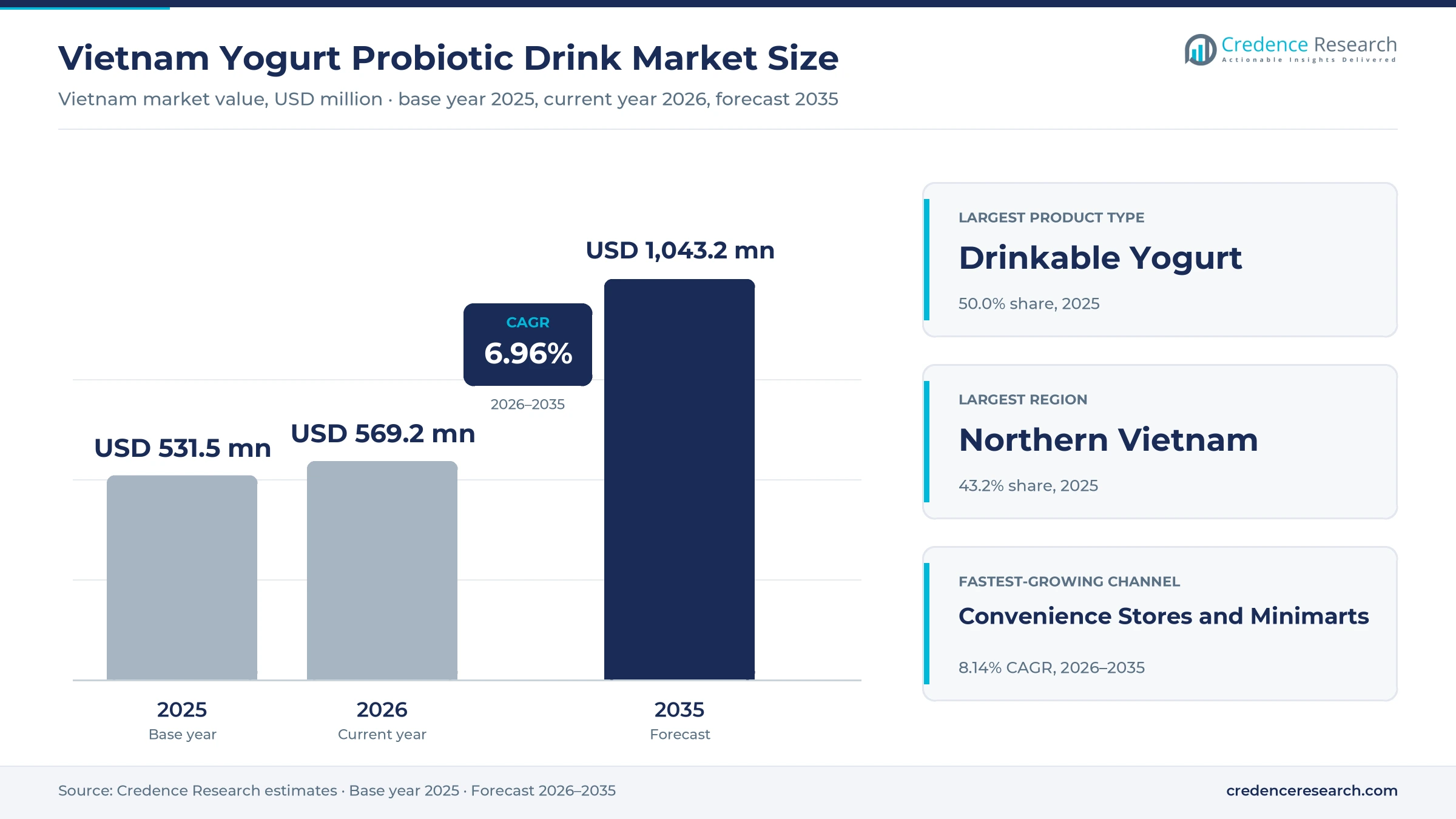
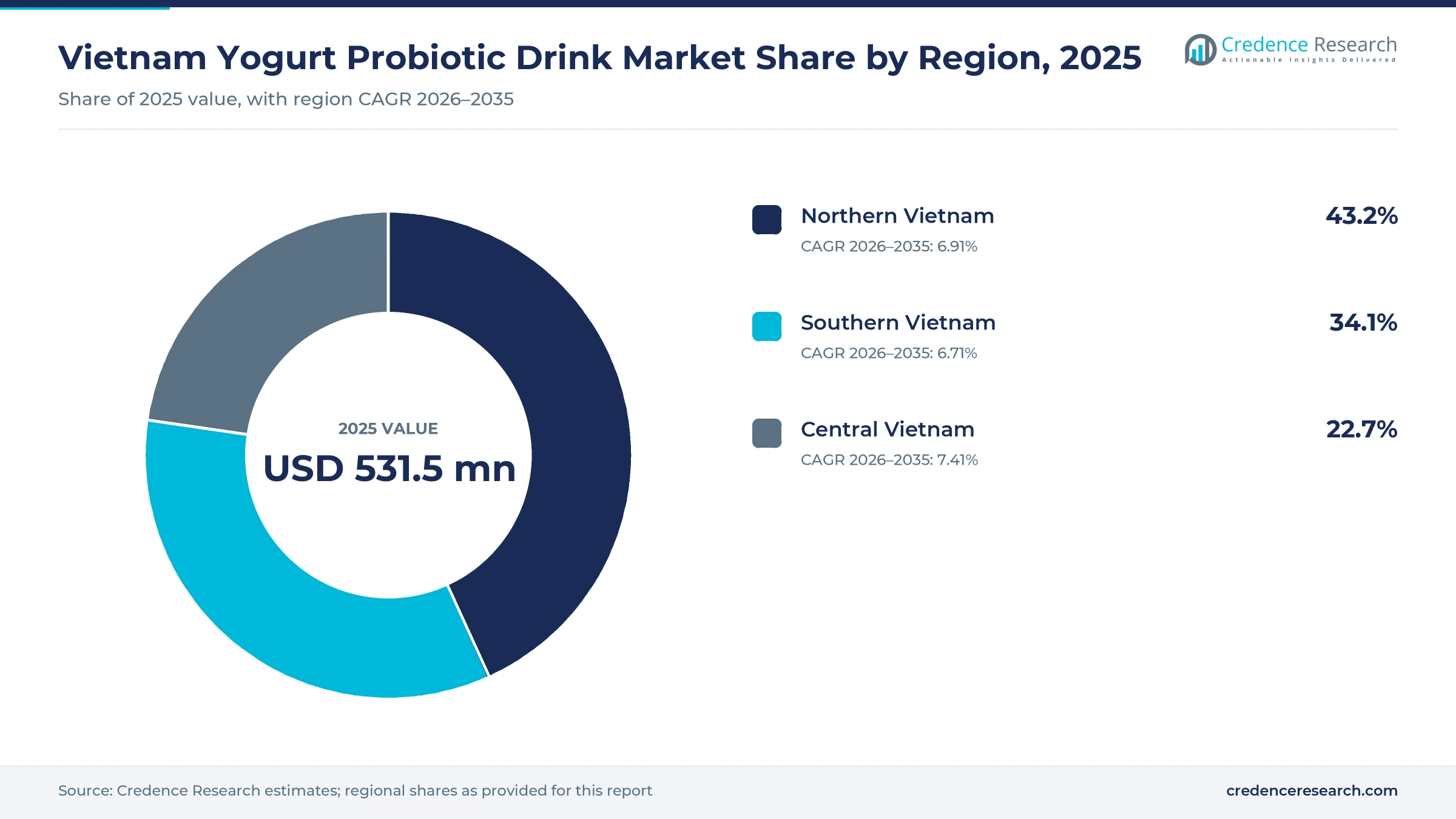
The Vietnam yogurt probiotic drink market was valued at USD 531.5 million in 2025 and is projected to increase from USD 569.2 million in 2026 to USD 1.04 billion by 2035, registering a CAGR of 6.96% during 2026–2035. Demand comes from more than 101 million people, rising incomes and a daily habit of drinking cultured milk for digestion and family nutrition. Northern Vietnam held the largest regional share, 43.2% in 2025, because Hanoi and the Red River Delta form a dense consumer base, while Son La and Ha Nam host large dairy operations. Central Vietnam grows fastest at 7.41% a year, as new minimarts reach provincial towns. The most important commercial change is the fast rollout of small modern stores with chilled shelves, which lets brands sell live-culture drinks far beyond the largest cities.
Which cultured drinks and sales channels does the estimate count?
The estimate measures retail sales value of drinkable yogurt, fermented milk shots, kefir, cultured milk and non-dairy probiotic drinks bought by households in Vietnam. It covers sales through supermarkets, hypermarkets, convenience stores, minimarts, traditional grocery outlets, online stores and direct home delivery. Values are stated in USD million at current prices, converted from dong at average annual exchange rates.
The estimate excludes spoonable yogurt, probiotic capsules and powders, and infant formula with added cultures. It also excludes cultured drinks made in Vietnam for export buyers. The value chain runs from dairy farms, milk powder importers and culture suppliers through processors and brand owners to distributors, retailers and households.
Vietnam Yogurt Probiotic Drink Market Insights
- The Vietnam yogurt probiotic drink market was valued at USD 531.5 million in 2025 and is projected to reach USD 1.04 billion by 2035, registering a CAGR of 6.96% during 2026–2035.
- Northern Vietnam held 43.2% of 2025 value, because Hanoi and the Red River Delta form a dense consumer base for chilled dairy drinks.
- Drinkable yogurt led with 50.0% of 2025 value, as families buy multipacks of cultured milk for children and adults every week.
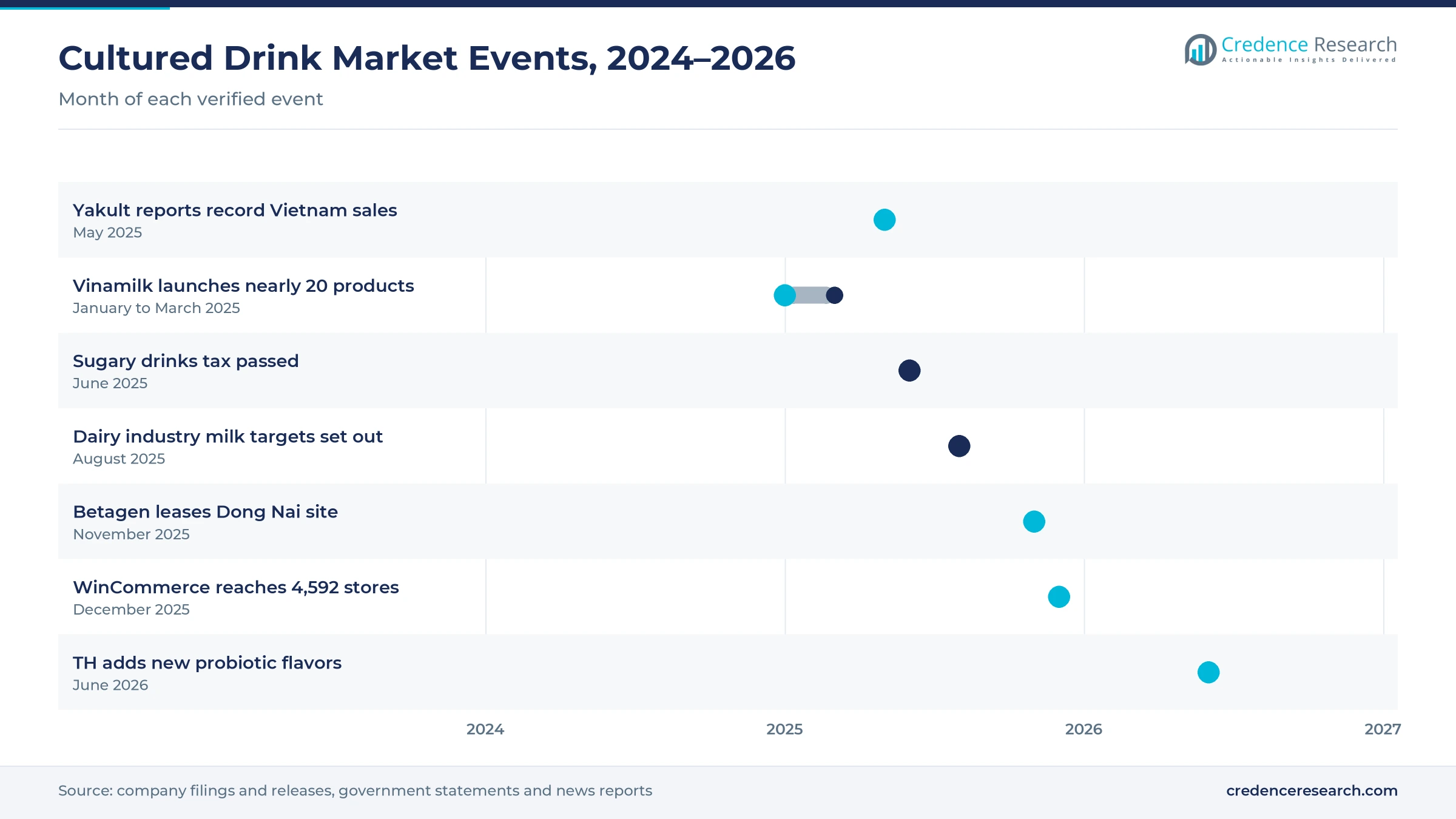
- Yakult sold 1,245 thousand bottles a day in Vietnam in 2024, up from 1,038 thousand in 2023, a record high for the country.
- Convenience stores and minimarts grow fastest at 8.14% a year during 2026–2035, as chains open hundreds of small stores each year.
Drinkable yogurt and digestive health carry the most value
Why does drinkable yogurt lead cultured drink sales?
Based on product type, the market is categorized into drinkable yogurt, fermented milk shots, kefir and cultured milk, and non-dairy probiotic drinks. Drinkable Yogurt led with 50.0% of 2025 value, because families buy multipacks of sweet and low-sugar cultured milk every week. Non-Dairy Probiotic Drinks grow fastest at 8.25% a year, as buyers who avoid lactose try drinks made with plant-based milk and fermented grains.
How do digestive and immune needs shape demand?
Based on application, the market is categorized into digestive health, immune support and everyday nutrition. Digestive Health led with 46.0% of 2025 value, because most buyers drink cultured milk to settle digestion after meals. Immune Support grows fastest at 7.75% a year, as brands now print culture counts and strain names on packs that families compare in stores.
Which channels sell the most cultured drinks?
Based on distribution channel, the market is categorized into supermarkets and hypermarkets, convenience stores and minimarts, traditional grocery and e-commerce and direct delivery. Traditional Grocery led with 31.0% of 2025 value, because small family shops still sell chilled dairy in most neighborhoods. Convenience Stores and Minimarts grow fastest at 8.14% a year, as chains add chilled shelves in towns.
How do age groups differ in buying cultured drinks?
Based on consumer age group, the market is categorized into children, adults and seniors. Adults led with 47.0% of 2025 value, because working adults buy single bottles for daily digestion and energy. Seniors grow fastest at 7.95% a year, as older buyers seek gentle, low-fat drinks that support digestion and immunity. Adults remain the core buyers in Vietnam, while children rely on parents buying multipacks.
| Segment Group | Leading Sub-segment | Share, 2025 | Fastest-growing Sub-segment | CAGR, 2026–2035 |
|---|---|---|---|---|
| By Product Type | Drinkable Yogurt | 50.0% | Non-Dairy Probiotic Drinks | 8.25% |
| By Application | Digestive Health | 46.0% | Immune Support | 7.75% |
| By Distribution Channel | Traditional Grocery | 31.0% | Convenience Stores and Minimarts | 8.14% |
| By Consumer Age Group | Adults | 47.0% | Seniors | 7.95% |
Request a Free Sample
Fill in your details and we'll send you a free sample report.
- Sample data tables & charts
- Research methodology
Store growth, gut-health demand and local dairy lift sales
How does modern retail and convenience-store expansion lift sales?
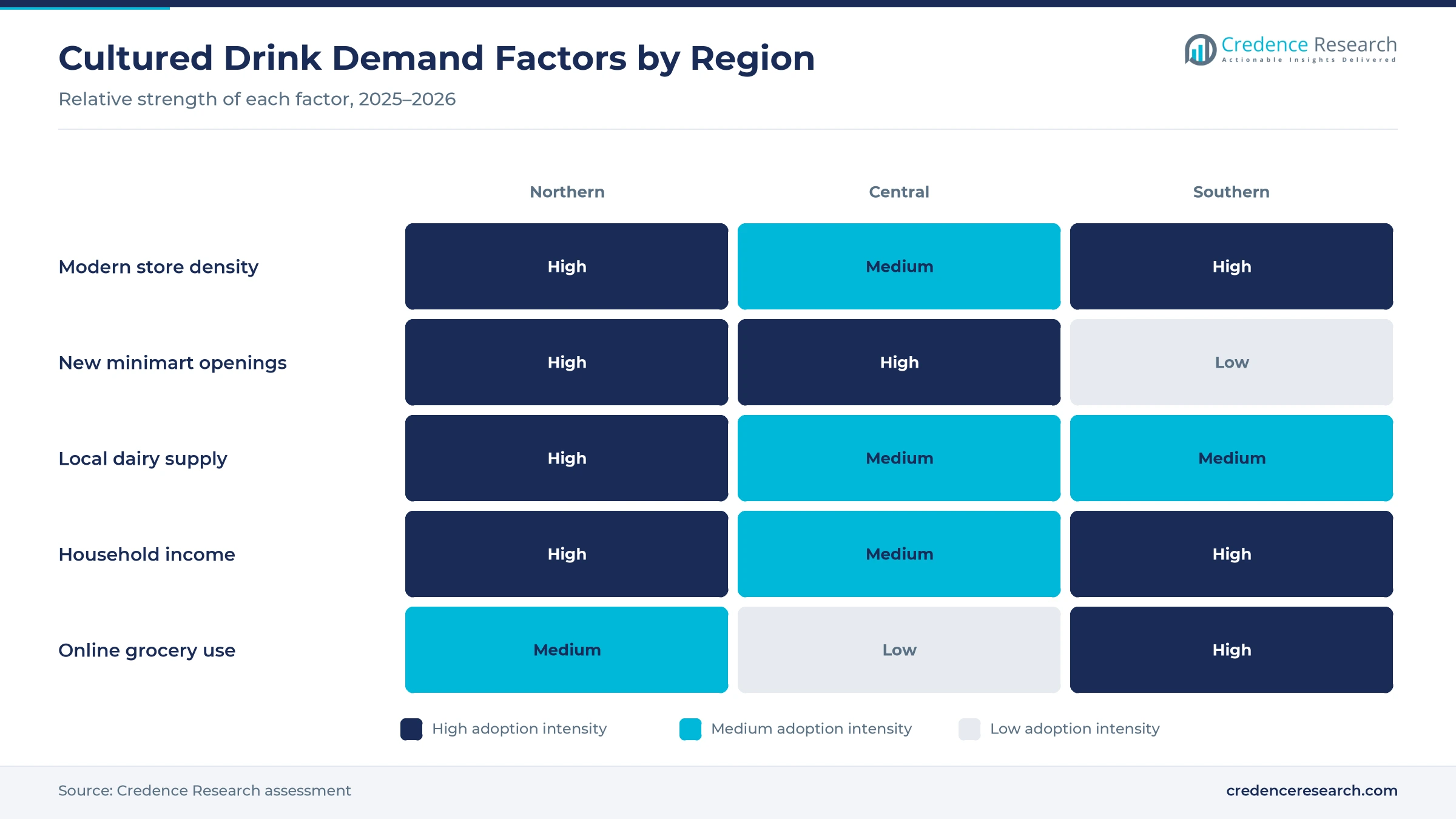
Modern retail and convenience-store expansion lifts sales, because cultured drinks need chilled shelves that small family shops often lack. WinCommerce opened 764 new stores in 2025 and ended the year with 4,592 stores, according to Vietstock. Of those openings, 602 were WinMart+ Rural stores, and northern and central provinces took 409 and 341 new stores. The chain plans to open 1,000 to 1,500 more stores in 2026. Total retail sales of goods and services reached about US$269 billion in 2025, up 9% to 10%, according to the Ministry of Industry and Trade. As a result, convenience stores and minimarts grow at 8.14% a year, the fastest of any channel.
Why do digestive health and everyday functional nutrition drive demand?
Digestive health and everyday functional nutrition drive demand, because many families now treat a cultured drink as a daily habit rather than a treat. Yakult sold 1,245 thousand bottles a day in Vietnam in 2024, up from 1,038 thousand in 2023, according to Yakult Honsha. Vinamilk says its Green Farm drinking yogurt is the only product in Vietnam with six European probiotic strains and 720 million live cultures. TH Group packs about 18 billion probiotics into each 85 ml bottle of TH true YOGURT PROBIOTICS, using two Lactobacillus paracasei strains. Consequently, digestive health holds 46.0% of 2025 value, while immune support grows fastest at 7.75% a year.
How does scaled domestic processing and brand investment support supply?
Scaled domestic processing and brand investment support supply, because cultured drinks need fresh milk, reliable culture handling and fast chilled delivery. Vinamilk runs 17 factories and 15 internationally certified farms and exports to more than 65 countries. Nutifood announced an extra $230 million in November 2025 to expand its farm and factory in Gia Lai Province. Moc Chau Milk and Vinamilk began a dairy complex in Son La in May 2022, with a 4,000-cow farm and a plant designed for 500 tons of milk a day. Betagen also leased nearly 35,000 square meters in Dong Nai for its first local plant. In turn, new dairy processing equipment lines cut lead times for chilled drinks.
Why do rising incomes and urban growth widen the buyer base?
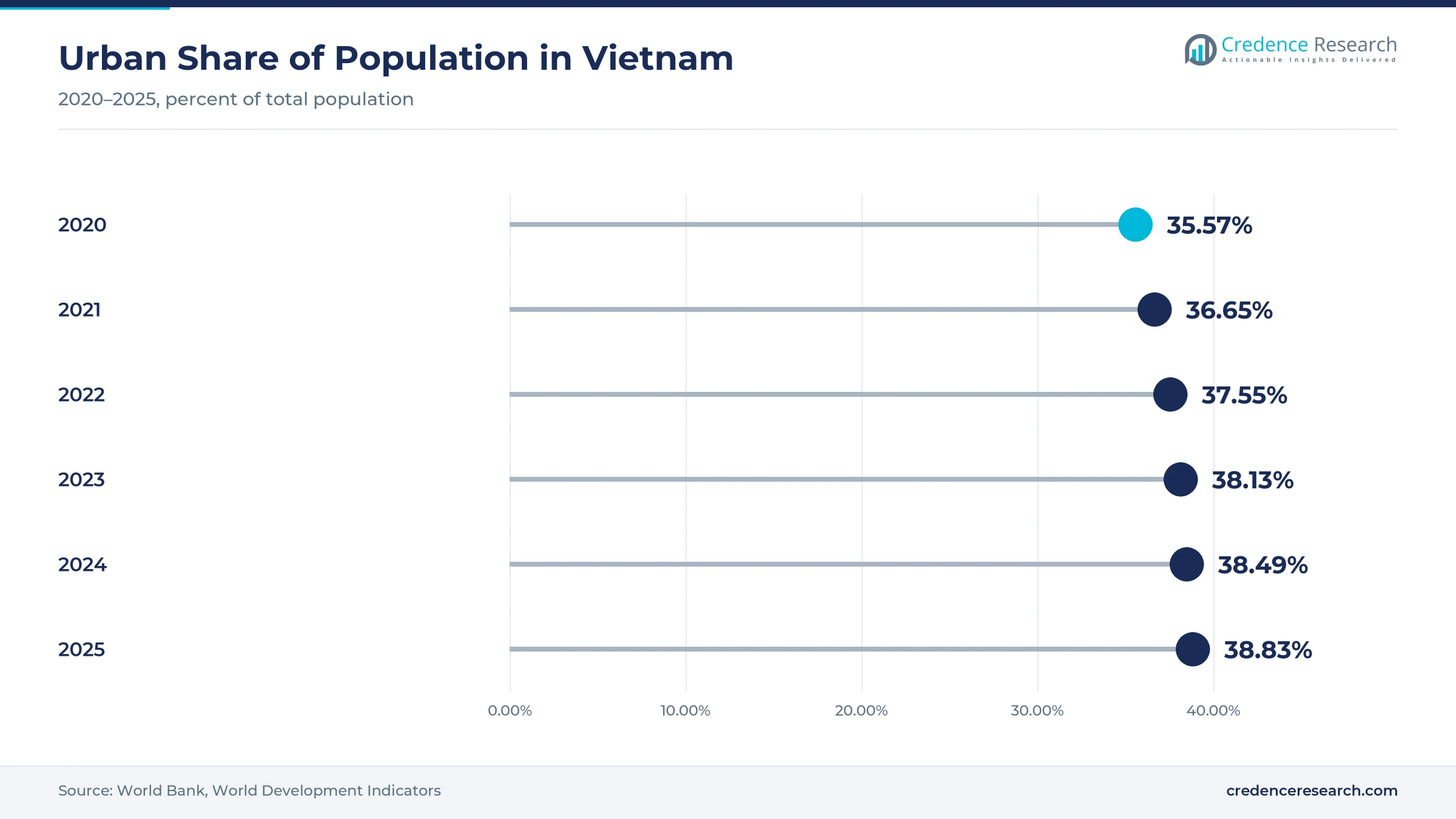
Rising incomes and urban growth widen the buyer base, because city households spend more on packaged dairy and chilled drinks. Vietnam's economy grew 8.02% in 2025, up from 7.09% in 2024, and GDP per capita reached an estimated US$5,026, according to the government. The urban share of the population rose to 38.83% in 2025 from 38.49% in 2024, according to World Bank data. Milk use is still low at 26 to 28 liters per person a year, against a target of 40 liters by 2030, according to Tuoi Tre. The population also passed 101 million people in 2025, according to World Bank estimates. As a result, adults keep the largest age-group share, 47.0% in 2025, while seniors grow fastest.
Low-sugar recipes and new strains reshape the shelf
How is the shift to low-sugar and low-fat recipes playing out?
Brands are shifting toward low-sugar and low-fat recipes, because parents and adults now read labels before they buy cultured drinks for daily use. TH Group sells sugar and low-sugar versions of TH true YOGURT PROBIOTICS, and its drinks contain less than 0.5 grams of fat per 100 ml. Vinamilk launched or relaunched nearly 20 products in the first quarter of 2025 and reported double-digit growth in drinking yogurt. Parliament also passed a sugary drinks tax on June 14, 2025, which raises attention to sugar in every chilled drink. Consequently, low-sugar and fortified products gain shelf space in convenience stores, and brands reformulate sweet lines to keep regular buyers through 2035.
Why are new strains and flavors rising on the shelf?
New strains and flavors are rising on the shelf, because brands compete on clear science claims and on taste for children. TH Group added peach and pineapple flavors to its TH true YOGURT PROBIOTICS range in June 2026. Each 85 ml bottle carries about 18 billion probiotics from two named strains, which the company prints on packs. Vinamilk won the Best Packaging Design award for its plant-based yogurt at the 2025 World Dairy Innovation Awards in Amsterdam. Its Green Farm Greek yogurt also won Best Yogurt at the same 2025 awards, which lifts demand for premium cultured dairy. As a result, non-dairy probiotic drinks grow at 8.25% a year, while health supplements brands watch the same gut-health buyers.
Can higher domestic milk output open room for growth?
Higher domestic milk output opens a clear opportunity, because processors can lower costs and sell more fresh cultured milk if local supply grows. Domestic fresh milk meets only about 40% of demand today, and the plan targets 70% to 72% of processing demand by 2030. The national herd is expected to reach 650,000 to 700,000 cows, with 60% raised on farms. The government also targets 2.6 million metric tons of raw milk by 2030 under its livestock strategy. In turn, processors such as Vinamilk, TH Group and Moc Chau Milk can market fresh-milk cultured drinks at stable prices and win buyers from brands that rely on imported milk powder.
Is there room to grow online and direct delivery sales?
Online and direct delivery sales offer a second opening, because many households already order groceries by phone and accept home delivery of chilled goods. E-commerce sales rose more than 20% in 2025 to about $32 billion, roughly 12% of total retail revenue. The Ministry of Industry and Trade expects online sales to reach $50 billion by 2030. Yakult also had 53,975 Yakult Ladies in Vietnam at the end of 2024, who deliver bottles to homes and offices. Brands that sell packaged food and beverages online can bundle multipacks with subscriptions. Consequently, e-commerce and direct delivery gain share of cultured drink sales through 2035.
Sugar tax, cold chain and milk imports add pressure
How does the new sugary drinks tax affect non-dairy lines?
The new sugary drinks tax affects non-dairy lines, because beverages with more than 5 grams of sugar per 100 ml face excise tax of 8% from 2027 and 10% from 2028, according to The Investor. Milk and dairy products are excluded, so plant-based and juice-style probiotic drinks carry most of the risk. As a result, sweet non-dairy drinks may cost more on the shelf. Brands can reduce sugar, change recipes or shift to dairy bases to limit price rises.
Why does the cold chain limit reach in rural areas?
The cold chain limits reach in rural areas, because live cultures lose strength when drinks are not kept chilled from plant to shelf. Small family shops in villages often have limited refrigerator space for chilled dairy. Consequently, brands sell fewer chilled drinks in remote districts and rely on shelf-stable lines with fewer live cultures. Investments in chilled trucks, store fridges and regional depots help widen reach, although they raise costs for smaller brands.
How does reliance on imported milk raise cost risk?
Reliance on imported milk raises cost risk, because domestic fresh milk covers only part of what processors need. When world milk powder prices rise or the dong weakens, cultured drink makers pay more for inputs. As a result, some brands raise prices or cut pack sizes, which can slow volume among price-sensitive families. Long-term supply contracts, local farm investment and recipe changes help reduce this pressure.
Why do crowded shelves and health claims raise marketing costs?
Crowded shelves and health claims raise marketing costs, because many brands now promise digestion and immune benefits in similar packs. Buyers find it hard to compare culture counts, strains and sugar levels across products. Consequently, brands must spend more on sampling, education and in-store displays to stand out. Clear labels, simple claims and trusted medical advice help buyers choose, while smaller brands struggle to match the reach of large dairies.
The north leads while central provinces grow fastest
| Region | Value, 2025 (USD million) | Share, 2025 | CAGR, 2026–2035 |
|---|---|---|---|
| Northern Vietnam | 229.6 | 43.2% | 6.91% |
| Southern Vietnam | 181.2 | 34.1% | 6.71% |
| Central Vietnam | 120.7 | 22.7% | 7.41% |
Why does Northern Vietnam lead cultured drink sales?
Northern Vietnam held 43.2% of 2025 value and grows at 6.91% a year, because Hanoi and the Red River Delta form a dense consumer base with many modern stores. WinCommerce opened 409 of its 764 new stores in northern provinces in 2025. The region also hosts dairy supply, including the Moc Chau complex in Son La and the FrieslandCampina plant in Ha Nam. As a result, brands can deliver fresh cultured drinks quickly to northern cities and towns.
Why does Central Vietnam grow fastest?
Central Vietnam held 22.7% of 2025 value and grows fastest at 7.41% a year, because modern stores are spreading into provincial towns that had few chilled shelves. WinCommerce opened 341 new stores in central provinces in 2025, most of them rural minimarts. Nutifood is also expanding its farm and factory in Gia Lai Province with an extra $230 million. In turn, more families in the region can buy cultured drinks near home every week.
How does Southern Vietnam sustain high demand?
Southern Vietnam held 34.1% of 2025 value and grows at 6.71% a year, because Ho Chi Minh City and nearby provinces have high incomes and many supermarkets. FrieslandCampina runs a plant in Binh Duong, while Betagen leased land in Dong Nai for its first local plant. Large supermarket chains and online grocers in the city give brands a place to test new flavors before they roll them out to other regions.
New flavors, store openings and a sugar tax
| Development | Status and market relevance |
|---|---|
| In May 2025, Yakult Honsha reported record daily sales of 1,245 thousand bottles in Vietnam for 2024. | Shows strong demand for fermented milk shots |
| In June 2025, the National Assembly passed an excise tax on sugary drinks from 2027, excluding milk and dairy products. | Raises costs for sweet non-dairy drinks |
| In November 2025, Betagen leased nearly 35,000 square meters in Dong Nai for its first Vietnamese plant. | Adds local supply of fermented milk drinks |
| In January 2026, WinCommerce reported 764 new stores in 2025 and a network of 4,592 stores. | Widens chilled shelf space in towns |
| In June 2026, TH Group added peach and pineapple flavors to TH true YOGURT PROBIOTICS. | Broadens choice in drinkable cultured milk |
Strain science, cold chain and packaging change products
- Named probiotic strains such as the two Lactobacillus paracasei strains in TH true YOGURT PROBIOTICS let brands print clear science claims on packs.
- Multi-strain cultures such as the six European strains in Vinamilk Green Farm drinking yogurt aim to support digestion with several bacteria at once.
- Cold chain logistics with dry and cold storage clusters helped WinCommerce cut transport costs by about 11% for general and fresh goods.
- Small single-serve bottles of about 85 ml make daily cultured drinks easy to carry to school or work and help control portions.
Need a Custom Version of This Report?
Tailor the scope, geography, or segments to your exact requirements.
- Custom geography or segment scope
- Direct access to our analyst team
Domestic dairies and foreign culture brands compete
Competition is spread across domestic dairies, foreign culture brands and new plant-based entrants. Vinamilk competes with a wide range of drinking yogurt, its Green Farm line and national distribution through 17 factories. Yakult focuses on fermented milk shots and home delivery, and it set a record for daily sales in Vietnam in 2024. TH Group uses fresh milk from its own farms and adds new flavors and named strains. FrieslandCampina sells Yomost drinking yogurt from plants in Binh Duong and Ha Nam. Nutifood and Moc Chau Milk add local supply, while Betagen is preparing its first local plant. Companies compete on culture counts, taste, sugar levels, pack size, price per bottle and chilled store reach. Retailers also add private labels and promotions that pressure prices for smaller brands.
Companies profiled and their roles in this market
| Company | Type | Role in the market |
|---|---|---|
| Vietnam Dairy Products JSC (Vinamilk) | Domestic dairy | Green Farm drinking yogurt with six European strains; 17 factories |
| Yakult Honsha Co., Ltd. | Fermented milk specialist | Sold 1,245 thousand bottles a day in Vietnam in 2024 |
| TH Group | Domestic dairy | Added peach and pineapple TH true YOGURT PROBIOTICS in June 2026 |
| FrieslandCampina Vietnam | Multinational dairy | Sells Yomost drinking yogurt; plants in Binh Duong and Ha Nam |
| NutiFood Nutrition Food JSC | Domestic nutrition company | Added $230 million for its Gia Lai farm and factory in 2025 |
| Moc Chau Milk JSC | Domestic dairy | Building a 4,000-cow complex in Son La with Vinamilk |
| Betagen Co., Ltd. | Thai fermented milk brand | Leased land in Dong Nai for its first local plant in 2025 |
Credence Research view on steady cultured milk demand
Credence Research's view is that Vietnamese cultured milk drinks will grow steadily through 2035, because daily digestion habits, rising incomes and wider chilled store reach support regular buying. Drinkable yogurt already holds 50.0% of 2025 value, and small modern stores keep adding shelf space. Domestic dairies benefit from fresh milk and national distribution, while foreign brands win with strain science and home delivery. However, the sugar tax, cold chain gaps and imported milk costs could squeeze margins. Central Vietnam should grow faster than the north and south.
How the cultured milk drink estimate was built
The report uses 2025 as the base year, with values in USD million at current prices. Market values come from the Credence Research model, which combines population, dairy consumption, retail store reach and average prices. Regional shares are those set for this report, and segment splits by product type, application, channel and age group are Credence Research estimates. Sources used are government statistics, ministry statements, World Bank data, company filings and announcements and news reports, and no interviews or surveys were used.
Store reach and local milk supply set the path to 2035
The market is expected to reach USD 1.04 billion by 2035, a 6.96% CAGR during 2026–2035, as rising incomes, store expansion and daily gut-health habits lift cultured drink purchases. Growth should be strongest in Central Vietnam, non-dairy drinks and convenience stores, while Northern Vietnam keeps the largest share. Brands that combine fresh milk supply, named strains and low-sugar recipes should win share. In contrast, higher milk powder prices or a sharp rise in sugar taxes on chilled drinks would slow value growth for some makers.
Frequently Asked Questions
How big is the Vietnam yogurt probiotic drink market?
Which region leads cultured drink sales in Vietnam?
Which region grows fastest?
Which product type holds the largest share?
Which sales channel grows fastest?
How does the sugary drinks tax affect the market?
Who are the leading companies in Vietnamese cultured drinks?
What are the main risks to growth?
Table of Content
Chapter 1 Market Segmentation
- 1.1 Segmentation Framework
- 1.1.1 Product and Service Classification
- 1.1.2 Application and End-Use Classification
- 1.1.3 Technology and Solution Classification
- 1.1.4 Customer and Distribution Channel Classification
- 1.1.5 Geographic Segmentation
- 1.1.6 Market Segment Definitions and Boundaries
- 1.2 By Product Type
- 1.2.1 Drinkable Yogurt
- 1.2.2 Fermented Milk Shots
- 1.2.3 Non-Dairy Probiotic Drinks
- 1.2.4 Kefir and Cultured Milk
- 1.3 By Application
- 1.3.1 Digestive Health
- 1.3.2 Everyday Nutrition
- 1.3.3 Immune Support
- 1.4 By Consumer Age Group
- 1.4.1 Adults
- 1.4.2 Children
- 1.4.3 Seniors
Chapter 2 Introduction
- 2.1 Report Objectives and Scope
- 2.2 Product Definition and Industry Terminology
- 2.3 Market Inclusions and Exclusions
- 2.4 Research Process
- 2.4.1 Primary Research and Expert Interviews
- 2.4.2 Secondary Research and Source Review
- 2.4.3 Top-Down and Bottom-Up Estimation
- 2.4.4 Data Triangulation and Verification
- 2.5 Market Size Measurement Basis
- 2.5.1 2025: USD 531.5 million → 2035: USD 1.04 billion
- 2.6 Historical and Forecast Reference Periods
- 2.6.1 Historical Period: 2018-2025
- 2.6.2 Base Year: 2025
- 2.6.3 Forecast Period: 2025-2035
- 2.7 Research Assumptions and Limitations
Chapter 3 Executive Summary
- 3.1 Market Snapshot and Key Findings
- 3.2 Base-Year Market Size, 2025
- 3.3 Forecast Market Size, 2035
- 3.4 Revenue and Volume Growth Outlook
- 3.5 Key Demand and Supply Indicators
- 3.6 Leading Market Segments
- 3.7 Fastest-Growing Market Opportunities
- 3.8 Regional Performance Highlights
- 3.9 Technology and Industry Transformation
- 3.10 Competitive Landscape Summary
- 3.11 Analyst View and Strategic Implications
Chapter 4 Vietnam Yogurt Probiotic Drink Market Trends and Developments
- 4.1 Historical Industry Development, 2018-2025
- 4.2 Recent Market Trends and Developments
- 4.3 Demand and Customer Behavior Trends
- 4.4 Technology and Product Innovation
- 4.5 Artificial Intelligence, Automation and Digitalization
- 4.6 Local Manufacturing and Supply Chain Realignment
- 4.7 Industry Partnerships, Mergers and Acquisitions
- 4.8 Sustainability and Circular Economy Developments
- 4.9 Government and Private Sector Investment Trends
- 4.10 Emerging Business Models and Commercialization
- 4.11 Industry Developments and Announcements
Chapter 5 Vietnam Yogurt Probiotic Drink Market Production, Supply and Demand Analysis
- 5.1 Demand Trend and Consumption Analysis, 2018-2025
- 5.2 Demand Forecast, 2025-2035
- 5.3 Production and Output Trend, 2018-2025
- 5.4 Production and Output Forecast, 2025-2035
- 5.5 Installed Capacity and Capacity Utilization
- 5.6 Company-Wise Production Plants and Statistics
- 5.6.1 Installed Production Capacity
- 5.6.2 Actual Production
- 5.6.3 Planned Capacity and Expansion Targets
- 5.7 Supply Chain Structure and Procurement Trends
- 5.8 Supply-Demand Gap and Bottlenecks
- 5.9 Import Dependence and Sourcing Structure
- 5.10 Contract Manufacturing and Outsourcing
- 5.11 Regional Supply and Demand Concentration
Chapter 6 Vietnam Yogurt Probiotic Drink Market Pricing Analysis
- 6.1 Pricing Structure and Measurement
- 6.2 Historical Pricing Trends, 2018-2025
- 6.3 Pricing Outlook, 2025-2035
- 6.4 Average Selling Price and Unit Economics
- 6.5 Pricing by Product and Market Segment
- 6.6 Geographic Pricing Differences
- 6.7 Key Input, Energy, Labor and Logistics Costs
- 6.8 Contract Pricing and Purchasing Models
- 6.9 Pricing Sensitivity and Competitive Positioning
- 6.10 Price, Margin and Profitability Implications
Chapter 7 Vietnam Yogurt Probiotic Drink Market Dynamics
- 7.1 Market Growth Drivers
- 7.1.1 Demand-Side Drivers
- 7.1.2 Technology and Innovation Drivers
- 7.1.3 Infrastructure and Investment Drivers
- 7.1.4 Regulatory and Policy Drivers
- 7.2 Market Restraints
- 7.2.1 Cost and Affordability Constraints
- 7.2.2 Technology and Adoption Barriers
- 7.2.3 Supply Chain and Operational Constraints
- 7.3 Market Challenges
- 7.3.1 Competitive Pressure and Margin Erosion
- 7.3.2 Skills, Infrastructure and Implementation Gaps
- 7.4 Emerging Market Opportunities
- 7.5 Market Dynamics Impact and Time-Horizon Assessment
Chapter 8 Vietnam Yogurt Probiotic Drink Value Chain Analysis
- 8.1 Industry Value Chain Overview
- 8.2 Upstream Suppliers and Critical Inputs
- 8.3 Technology and Component Providers
- 8.4 Manufacturing or Service Delivery
- 8.5 Distribution, Channel Partners and Integrators
- 8.6 Downstream Applications and End Users
- 8.7 Value Addition and Profit Pools
- 8.8 Vertical Integration and Outsourcing
- 8.9 Supplier Concentration and Risk
- 8.10 Supply Chain Localization and Resilience
Chapter 9 Vietnam Yogurt Probiotic Drink Market Regulations and Policies
- 9.1 Relevant Laws, Standards and Compliance Frameworks
- 9.2 Product, Service, Safety and Quality Requirements
- 9.3 Government Policies, Incentives and Subsidies
- 9.4 Imports, Exports and Trade Barriers
- 9.5 Public Procurement and Local Content Requirements
- 9.6 Environmental and Sustainability Compliance
- 9.7 Upcoming Policy Changes and Market Implications
Chapter 10 Vietnam Yogurt Probiotic Drink Market Hotspots and Opportunities
- 10.1 Market Opportunity Mapping and Growth Hotspots
- 10.2 High-Growth Applications and Customer Groups
- 10.3 Underserved Markets and White-Space Opportunities
- 10.4 Emerging Technology and Product Opportunities
- 10.5 New Capacity and Investment Hotspots
- 10.6 Market Entry and Expansion Opportunities
- 10.7 Distribution and Partnership Opportunities
- 10.8 Near-Term and Long-Term Commercial Potential
- 10.9 Opportunity Attractiveness and Execution Risks
Chapter 11 Vietnam Yogurt Probiotic Drink Market Outlook, 2025-2035
- 11.1 Market Size and Analysis
- 11.1.1 Revenue (Market Measurement: 2025: USD 531.5 million → 2035: USD 1.04 billion)
- 11.1.2 Market Volume and Quantity Sold
- 11.1.3 Historical Market Size, 2018-2025
- 11.1.4 Base-Year Market Size, 2025
- 11.2 Market Forecast, 2025-2035
- 11.2.1 Revenue Forecast to 2035
- 11.2.2 Volume Forecast to 2035
- 11.2.3 CAGR and Year-on-Year Growth
- 11.2.4 Incremental Revenue Opportunity
- 11.3 Forecast Assumptions and Scenario Analysis
- 11.3.1 Base-Case Forecast
- 11.3.2 Optimistic and Conservative Scenarios
- 11.3.3 Technology, Pricing and Policy Sensitivities
- 11.4 Market Attractiveness and Growth Outlook
Chapter 12 Vietnam Yogurt Probiotic Drink Market Segmentation and Outlook
- 12.1 Segmentation Summary and Market Shares, 2025
- 12.2 Largest and Fastest-Growing Segments
- 12.3 By Product Type - Market Size and Forecast, 2025-2035
- 12.3.1 Segment Definition and Scope
- 12.3.2 Historical Market Size, 2018-2025
- 12.3.3 Revenue Forecast, 2025-2035
- 12.3.4 Volume Forecast, 2025-2035
- 12.3.5 Base-Year Market Share, 2025
- 12.3.6 Segment CAGR and Growth Drivers
- 12.3.7 Subsegment Market Size and Forecast
- 12.3.7.1 Drinkable Yogurt
- 12.3.7.2 Fermented Milk Shots
- 12.3.7.3 Non-Dairy Probiotic Drinks
- 12.3.7.4 Kefir and Cultured Milk
- 12.3.8 Subsegment Pricing and Adoption Trends
- 12.3.9 Leading Suppliers and Competition
- 12.3.10 Regional Demand and Opportunities
- 12.4 By Application - Market Size and Forecast, 2025-2035
- 12.4.1 Segment Definition and Scope
- 12.4.2 Historical Market Size, 2018-2025
- 12.4.3 Revenue Forecast, 2025-2035
- 12.4.4 Volume Forecast, 2025-2035
- 12.4.5 Base-Year Market Share, 2025
- 12.4.6 Segment CAGR and Growth Drivers
- 12.4.7 Subsegment Market Size and Forecast
- 12.4.7.1 Digestive Health
- 12.4.7.2 Everyday Nutrition
- 12.4.7.3 Immune Support
- 12.4.8 Subsegment Pricing and Adoption Trends
- 12.4.9 Leading Suppliers and Competition
- 12.4.10 Regional Demand and Opportunities
- 12.5 By Consumer Age Group - Market Size and Forecast, 2025-2035
- 12.5.1 Segment Definition and Scope
- 12.5.2 Historical Market Size, 2018-2025
- 12.5.3 Revenue Forecast, 2025-2035
- 12.5.4 Volume Forecast, 2025-2035
- 12.5.5 Base-Year Market Share, 2025
- 12.5.6 Segment CAGR and Growth Drivers
- 12.5.7 Subsegment Market Size and Forecast
- 12.5.7.1 Adults
- 12.5.7.2 Children
- 12.5.7.3 Seniors
- 12.5.8 Subsegment Pricing and Adoption Trends
- 12.5.9 Leading Suppliers and Competition
- 12.5.10 Regional Demand and Opportunities
- 12.6 Segment Growth Comparison
- 12.7 Segment Attractiveness and Priority Matrix
Chapter 13 Vietnam Yogurt Probiotic Drink End-Use and Application Market Outlook
- 13.1 End-Use Industry and Customer Demand Structure
- 13.2 Leading Applications and Customer Groups
- 13.3 End-Use Market Size, Share and Forecast
- 13.4 Major End-Use Industry Deep Dives
- 13.4.1 Customer Requirements and Use Cases
- 13.4.2 Demand and Replacement Cycles
- 13.4.3 Technical and Regulatory Considerations
- 13.4.4 Purchasing and Procurement Models
- 13.4.5 Leading Vendors and Distribution Channels
- 13.4.6 Forecast and Commercial Opportunities
- 13.5 Emerging Applications and Cross-Segment Demand
- 13.6 End-Use Industry Investment Priorities
Chapter 14 Vietnam Yogurt Probiotic Drink Geographic Market Outlook, 2025-2035
- 14.1 Regional Market Size and Country-Level Shares, 2025
- 14.2 Country Market Size Comparison, 2025
- 14.3 Country Market Forecasts, 2025-2035
- 14.4 Subregional Industrial and Demand Clusters
- 14.5 Intra-Regional Pricing and Cost Differences
- 14.6 Cross-Border Trade and Supply Networks
- 14.7 Regional Supply and Demand Balances
- 14.8 Country Opportunity Comparison and Prioritization
Note: Every listed country is covered on the structure shown under the first country.
Chapter 15 Vietnam Yogurt Probiotic Drink Technology, Innovation and Sustainability Outlook
- 15.1 Technology Landscape and Maturity
- 15.2 Product, Process and Service Innovation
- 15.3 AI, Automation and Digital Tools in the Industry
- 15.4 Technology Adoption and Performance Benchmarking
- 15.5 Innovation Pipeline and R&D Investment
- 15.6 Patent and Intellectual Property Trends
- 15.7 Energy Efficiency and Resource Management
- 15.8 Sustainability, Recycling and Circularity
- 15.9 Technology Roadmap, 2025-2035
- 15.10 Risks of Obsolescence and Technology Substitution
Chapter 16 Vietnam Yogurt Probiotic Drink Market Key Strategic Imperatives
- 16.1 Growth and Market Entry Priorities
- 16.2 High-Return Products and Segments
- 16.3 Pricing, Profitability and Cost Optimization
- 16.4 Technology Investment and Product Differentiation
- 16.5 Supply Chain Localization and Resilience
- 16.6 Distribution and Customer Acquisition
- 16.7 Partnership, Acquisition and Capacity Strategy
- 16.8 Regional Expansion Priorities
- 16.9 Short-, Medium- and Long-Term Actions
Chapter 17 Competition Outlook
- 17.1 Industry Competition Characteristics
- 17.2 Market Structure and Concentration
- 17.3 Market Share and Competitive Positioning, 2025
- 17.4 Company-Wise Revenue and Product Benchmarking
- 17.5 Production and Service Capacity Benchmarking
- 17.6 Technology, Pricing and Differentiation
- 17.7 Regional Footprint and Distribution Strength
- 17.8 Mergers, Acquisitions and Strategic Alliances
- 17.9 New Entrants and Competitive Threats
- 17.10 Porter's Five Forces and Industry Attractiveness
- 17.11 Competitive Outlook, 2025-2035
Chapter 18 Company Profiles
- 18.1 Company Coverage and Selection Criteria
- 18.2 Vietnam Dairy Products JSC (Vinamilk)
- 18.2.1 Business Description
- 18.2.2 Company Ownership and Geographic Presence
- 18.2.3 Product and Service Portfolio
- 18.2.4 Manufacturing and Operating Footprint
- 18.2.5 Production Capacity and Expansion Plans
- 18.2.6 Financial Performance and Investment
- 18.2.7 Market Share and Competitive Position
- 18.2.8 Technology and Innovation Capabilities
- 18.2.9 Strategic Alliances or Partnerships
- 18.2.10 Recent Developments
- 18.2.11 Growth Strategy and Outlook
- 18.3 Yakult Honsha Co., Ltd.
- 18.4 TH Group
- 18.5 FrieslandCampina Vietnam
- 18.6 NutiFood Nutrition Food JSC
- 18.7 International Dairy Products JSC
- 18.8 Moc Chau Milk JSC
- 18.9 VitaDairy Vietnam JSC
- 18.10 Betagen Co., Ltd.
- 18.11 Inner Mongolia Yili Industrial Group Co., Ltd.
- 18.12 Other Relevant Market Participants
Note: Every listed company is profiled on the structure shown under the first company. The company list is preliminary and may change based on research findings, market developments, data availability and client requirements.
Chapter 19 Disclaimer
- 19.1 Research and Forecast Disclaimer
- 19.2 Data Source and Estimation Limitations
Note: The depth of individual sections depends on data availability for this market. Volume, capacity, trade and other unit-based metrics are included where applicable.

