
| REPORT ATTRIBUTE | DETAILS |
|---|---|
| Historical Period | 2020-2023 |
| Base Year | 2024 |
| Forecast Period | 2025-2032 |
| Voice Biometric Solutions Market Size 2024 | USD 2,149.64 million |
| Voice Biometric Solutions Market, CAGR | 12.56% |
| Voice Biometric Solutions Market Size 2032 | USD 5,909.33 million |
Market Overview
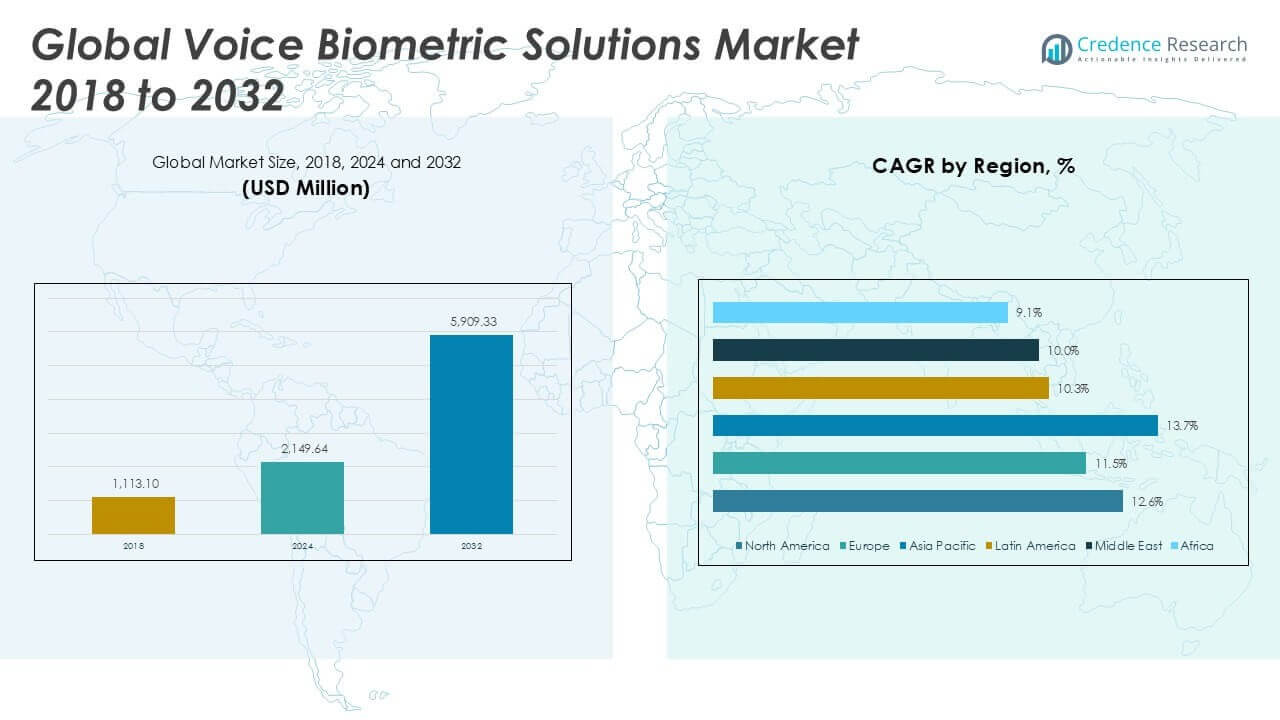
Voice Biometric Solutions Market size was valued at USD 1,113.10 million in 2018 to USD 2,149.64 million in 2024 and is anticipated to reach USD 5,909.33 million by 2032, at a CAGR of 12.56% during the forecast period.
The Voice Biometric Solutions market is expanding rapidly, driven by increasing demand for secure and user-friendly authentication across banking, healthcare, and government sectors. Organizations are prioritizing voice biometrics to address rising cybersecurity threats, reduce fraud, and meet regulatory requirements for strong identity verification. The adoption of mobile banking, remote work, and contactless transactions is accelerating market growth, while advancements in artificial intelligence and deep learning are enhancing accuracy and reliability of voice authentication. Key trends include integration with multi-factor authentication systems, deployment in call centers for fraud prevention, and growing acceptance of cloud-based solutions for scalable, real-time voice verification. Enterprises are investing in seamless user experiences and compliance with data privacy regulations, fueling further adoption of voice biometrics. These dynamics position the market for sustained growth as businesses seek efficient, secure, and accessible authentication solutions.
The Voice Biometric Solutions Market demonstrates strong geographic momentum across North America, Europe, and Asia Pacific, driven by widespread adoption of secure authentication technologies and rising digital transformation initiatives. North America leads in innovation, supported by advanced regulatory frameworks and early adoption in sectors like banking, healthcare, and government. Asia Pacific is quickly emerging as a major growth region, fueled by mobile payments, remote banking, and large-scale government identity programs in countries such as China, India, and Japan. Europe benefits from robust data privacy regulations, which accelerate deployment in financial services and telecom. Key players shaping this market include Nuance Communications, Inc., known for its pioneering speech and voice recognition platforms, ID R&D, specializing in AI-driven voice biometrics, and LumenVox, which provides scalable voice authentication solutions for enterprise clients. These companies continue to set industry benchmarks for innovation, reliability, and compliance.
Market Insights
- The Voice Biometric Solutions Market is projected to grow from USD 2,149.64 million in 2024 to USD 5,909.33 million by 2032, at a CAGR of 12.56%.
- Rapid digital transformation, rising cybersecurity threats, and the demand for secure, user-friendly authentication are fueling market growth.
- Organizations are adopting voice biometrics for multi-factor authentication, fraud prevention, and regulatory compliance, especially in banking, healthcare, and telecom sectors.
- Key trends include integration with cloud and mobile platforms, advancements in liveness detection and anti-spoofing, and expansion into new sectors like retail and public services.
- Leading companies such as Nuance Communications, Inc., ID R&D, and LumenVox are investing in AI-driven innovation, product expansion, and global partnerships to strengthen their market position.
- The market faces restraints including privacy concerns, variable accuracy due to environmental factors, and challenges with regulatory compliance and user acceptance.
- North America, Europe, and Asia Pacific dominate the market due to advanced digital infrastructure and strong investments in identity security, while Latin America, the Middle East, and Africa are showing steady growth with emerging digital initiatives.
Market Drivers
Heightened Need for Secure and Convenient Authentication Boosts Market Demand
The Voice Biometric Solutions Market is witnessing significant growth due to rising concerns about cybersecurity and identity theft across industries. Organizations are shifting from traditional password-based systems to voice biometrics to offer both security and ease of use. It enables seamless user authentication without compromising on data protection, addressing evolving consumer expectations for frictionless digital experiences. Enterprises in banking, healthcare, and telecom sectors are deploying voice biometrics to prevent unauthorized access and safeguard sensitive information. Regulatory mandates for robust authentication further reinforce this trend. The convenience of voice recognition positions it as a preferred solution for multifactor authentication frameworks.
- For instance, the Biometrics Survey 2021 by ID R&D suggests that around 73% of surveyed organizations used biometrics technology to ensure good customer and user experience.
Proliferation of Mobile Devices and Remote Services Expands Adoption
The widespread adoption of smartphones and remote service platforms has accelerated the deployment of voice biometric technologies. The Voice Biometric Solutions Market benefits from the growing popularity of mobile banking, contactless transactions, and digital onboarding processes. It enables organizations to implement secure authentication regardless of user location, supporting flexible and scalable business operations. Mobile applications and cloud-based platforms integrate voice biometrics for both security and user convenience. The shift toward remote work and digital service delivery makes voice authentication essential for safeguarding access and preventing fraud. Enterprises leverage voice biometrics to enhance user engagement while maintaining compliance with global data protection standards.
Technological Advances Enhance Accuracy and Reliability
Rapid progress in artificial intelligence and deep learning has transformed the capabilities of voice biometric solutions. The Voice Biometric Solutions Market is experiencing improvements in voiceprint accuracy, liveness detection, and resistance to spoofing attacks. It drives confidence among enterprises and end-users, supporting broader adoption across mission-critical applications. Advanced algorithms analyze a wide range of vocal characteristics, enabling precise identification even in noisy environments or over compromised channels. These innovations address limitations of earlier systems, making voice biometrics viable for high-security sectors. Technology providers continue to refine their offerings, expanding the range of use cases and integration possibilities.
- For instance, HSBC’s Voice ID system has proven valuable in call centers, where voice biometrics can authenticate customers within seconds while simultaneously detecting potential fraudulent activities.
Regulatory Compliance and Privacy Requirements Propel Market Growth
Stringent regulations governing identity verification and user privacy are encouraging organizations to invest in secure authentication methods. The Voice Biometric Solutions Market is benefiting from compliance mandates in finance, healthcare, and public sector domains, where protecting personal data is paramount. Voice biometrics offer traceability and auditability, supporting adherence to frameworks like GDPR and HIPAA. It provides organizations with the tools to meet regulatory obligations without hindering operational efficiency. Voice authentication also minimizes the risk of social engineering and credential theft, reinforcing trust in digital channels. The regulatory landscape continues to evolve, driving sustained demand for robust and compliant biometric solutions.
Market Trends
Growth in Adoption of Cloud-Based and Mobile Voice Biometric Solutions
Cloud computing and mobile platforms play a pivotal role in shaping the Voice Biometric Solutions Market. Enterprises prefer scalable, on-demand solutions that allow rapid deployment and easy integration with existing IT infrastructure. It encourages the adoption of cloud-based voice authentication for real-time verification, reducing infrastructure costs and supporting remote access needs. Mobile banking and remote work environments further propel the demand for secure, user-friendly voice biometrics on smartphones and tablets. Vendors develop solutions optimized for mobile performance, ensuring reliable operation in varied acoustic settings. The market is seeing increased acceptance of flexible deployment models, supporting digital transformation across sectors.
- For instance, voice biometrics is revolutionizing customer authentication and fraud prevention in the banking and financial services sector.
Integration of Voice Biometrics with Multi-Factor Authentication Solutions
The Voice Biometric Solutions Market is evolving through integration with multi-factor authentication (MFA) platforms to deliver enhanced security for digital transactions and user verification. Organizations incorporate voice biometrics alongside other authentication methods such as passwords, tokens, and facial recognition, creating layered defenses against fraud. It enables businesses to provide seamless and secure experiences across online banking, call centers, and remote access systems. The flexibility of voice authentication supports diverse use cases, helping enterprises meet changing security and regulatory requirements. This trend is accelerating the deployment of voice biometrics within enterprise security frameworks and customer-facing applications. Multi-factor integration enhances both risk management and user confidence in digital services.
Enhanced Liveness Detection and Anti-Spoofing Capabilities
Innovation in liveness detection and anti-spoofing technology marks a significant trend in the Voice Biometric Solutions Market. Providers invest in advanced algorithms to distinguish genuine user voices from recorded or synthetic attempts, enhancing security for sensitive transactions. It strengthens trust in voice authentication, making it suitable for high-risk environments such as financial services and government portals. Ongoing improvements in artificial intelligence and machine learning help address vulnerabilities and ensure compliance with industry standards. Enterprises look for solutions that offer robust defenses against evolving threats. This trend supports the increasing adoption of voice biometrics in applications requiring stringent identity verification.
- For instance, HSBC announced in 2022 that their Voice ID system helped reduce banking fraud by over 50%.
Expansion into New Applications and Industry Verticals
The Voice Biometric Solutions Market is expanding beyond traditional use cases in banking and telecom, reaching new sectors such as healthcare, insurance, retail, and public services. Organizations recognize the value of voice authentication for patient identification, policyholder verification, and secure access to government programs. It drives vendors to customize offerings to industry-specific workflows and regulatory needs. Broader deployment across multiple industries supports overall market growth and innovation in feature sets. The trend toward cross-sector adoption underlines the versatility and growing trust in voice biometric technology. The market is poised to capture new opportunities as enterprises embrace digital identity solutions for both security and convenience
Market Challenges Analysis
Privacy Concerns and Data Security Risks Challenge Market Expansion
The Voice Biometric Solutions Market faces significant challenges from privacy concerns and potential data security breaches. Collecting and storing sensitive voice data raises user apprehensions about misuse, unauthorized access, and identity theft. It places heavy responsibility on vendors and organizations to implement strong encryption, secure storage, and clear consent mechanisms. Failure to address these risks can undermine trust, slow adoption, and expose firms to legal liabilities. The increasing sophistication of cyberattacks further elevates the need for resilient security architectures and ongoing vulnerability assessments. Organizations must continuously adapt security strategies to maintain compliance with evolving data protection regulations and reassure stakeholders.
- For instance, privacy and security issues are major inhibitors in the voice biometrics sector, as government regulations have not evolved quickly enough to address technological advancements.
Variability in Voice Quality and Environmental Factors Affect Performance
The Voice Biometric Solutions Market contends with challenges related to the accuracy and reliability of voice authentication across diverse environments and user populations. Differences in accent, language, illness, and age can affect voice recognition performance, potentially leading to false positives or negatives. It requires vendors to invest in adaptive algorithms capable of handling such diversity and maintaining high verification rates. Background noise, poor audio quality, or device limitations can further degrade system accuracy. Ensuring consistent performance in real-world applications remains a technical hurdle for broad market acceptance. Addressing these issues is essential to delivering reliable, user-friendly solutions that meet enterprise and regulatory expectations.
Market Opportunities
Expansion into New Industry Verticals and Applications Creates Growth Potential
The Voice Biometric Solutions Market offers strong opportunities through expansion into new industry verticals such as healthcare, insurance, retail, and public sector services. Organizations are seeking secure and user-friendly authentication methods for patient identification, customer verification, and access to government programs. It enables vendors to tailor voice biometric solutions to unique regulatory and workflow requirements, supporting broader adoption. Emerging use cases include telemedicine, e-commerce, and smart device integration, fueling demand for flexible and scalable solutions. The ability to customize offerings for sector-specific needs gives providers a distinct competitive advantage. New applications across various industries are set to drive the next phase of market growth.
Integration with Artificial Intelligence and Advanced Analytics Enhances Solution Value
The Voice Biometric Solutions Market stands to benefit from the integration of artificial intelligence and advanced analytics, which elevate both security and user experience. AI-powered algorithms improve accuracy, adapt to changing voice patterns, and strengthen defenses against spoofing attacks. It supports real-time fraud detection, behavioral analysis, and predictive security measures, appealing to enterprises seeking smarter authentication frameworks. Voice biometrics combined with analytics can provide actionable insights into customer behavior and system vulnerabilities. This innovation helps organizations meet evolving security standards while delivering frictionless access to digital services. Vendors who leverage AI and analytics position themselves to capitalize on rising demand for intelligent, future-ready authentication solutions.
Market Segmentation Analysis:
By Component:
The Voice Biometric Solutions Market features a dynamic component landscape that addresses the evolving authentication needs of enterprises. Solutions account for the largest share, driven by robust demand for integrated platforms that enable secure, real-time voice authentication across various channels. Organizations rely on these solutions to streamline access control, fraud prevention, and customer verification processes. Services represent a growing segment as enterprises seek consulting, integration, support, and managed services to ensure effective deployment and ongoing optimization. It enables businesses to maintain high system performance, address technical challenges, and stay ahead of security threats. The combination of tailored solutions and comprehensive services underpins market growth and supports diverse implementation requirements.
By Type:
The Voice Biometric Solutions Market is divided into active and passive voice biometrics. Active voice biometrics requires users to speak specific phrases for verification, providing high accuracy and strong resistance to impersonation. It is favored in environments where security and user interaction are critical, such as banking and financial services. Passive voice biometrics analyzes natural speech during regular conversation without user awareness or effort, supporting seamless customer experiences in contact centers and continuous authentication use cases. This approach is gaining traction due to its unobtrusive nature and suitability for high-volume customer interactions, making it a preferred choice for organizations aiming to reduce friction in service delivery.
By Deployment Mode:
Deployment mode segmentation highlights the industry’s shift toward flexible and scalable authentication frameworks. On-premises deployment appeals to organizations with strict data privacy, regulatory, or customization requirements, giving them direct control over security infrastructure. It remains relevant in sectors such as government and critical infrastructure where compliance is paramount. Cloud deployment is accelerating in popularity, offering cost efficiency, rapid scalability, and ease of integration with existing IT environments. It enables businesses to respond to fluctuating demand and deliver secure voice authentication to remote users across multiple devices. The rise of cloud-based solutions reflects growing enterprise focus on agility and digital transformation in identity management.
Segments:
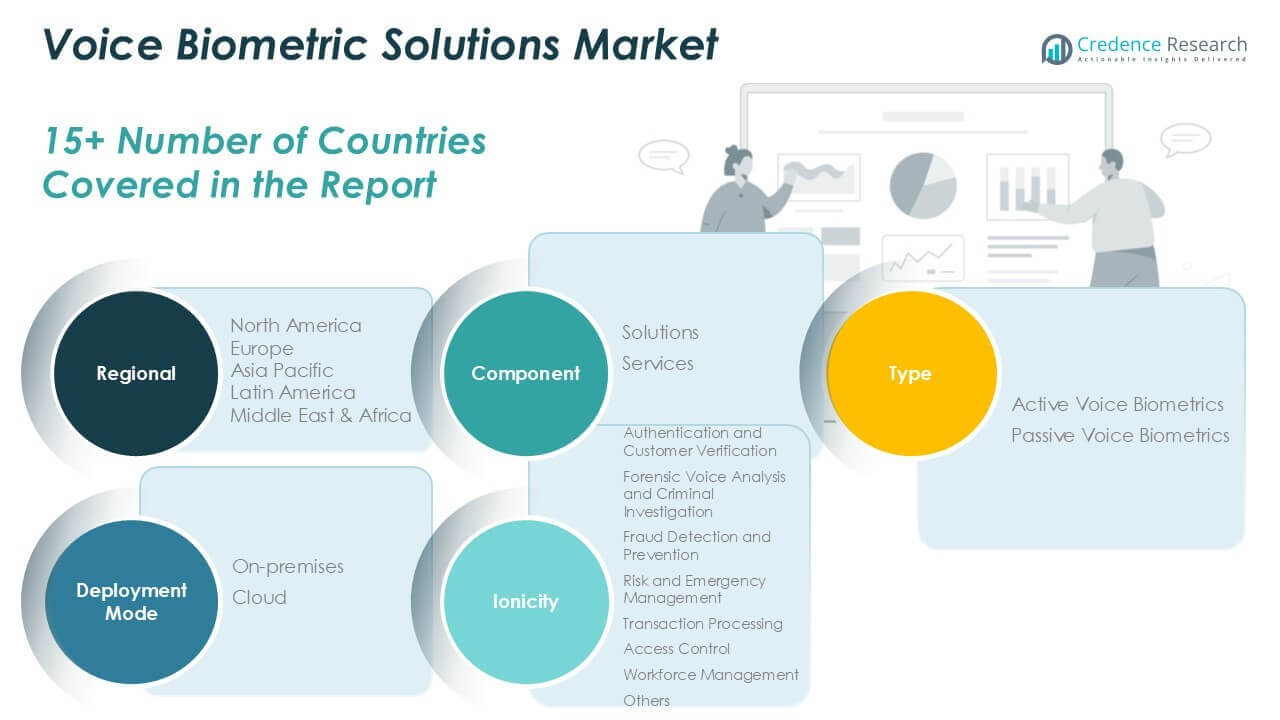
Based on Component:
- Solutions
- Services
Based on Type:
- Active Voice Biometrics
- Passive Voice Biometrics
Based on Deployment Mode:
- On-premises
- Cloud
Based on Application:
- Authentication and Customer Verification
- Forensic Voice Analysis and Criminal Investigation
- Fraud Detection and Prevention
- Risk and Emergency Management
- Transaction Processing
- Access Control
- Workforce Management
- Others
Based on the Geography:
- North America
- U.S.
- Canada
- Mexico
- Europe
- UK
- France
- Germany
- Italy
- Spain
- Russia
- Belgium
- Netherlands
- Austria
- Sweden
- Poland
- Denmark
- Switzerland
- Rest of Europe
- Asia Pacific
- China
- Japan
- South Korea
- India
- Australia
- Thailand
- Indonesia
- Vietnam
- Malaysia
- Philippines
- Taiwan
- Rest of Asia Pacific
- Latin America
- Brazil
- Argentina
- Peru
- Chile
- Colombia
- Rest of Latin America
- Middle East
- UAE
- KSA
- Israel
- Turkey
- Iran
- Rest of Middle East
- Africa
- Egypt
- Nigeria
- Algeria
- Morocco
- Rest of Africa
Regional Analysis
North America Voice Biometric Solutions Market
North America Voice Biometric Solutions Market grew from USD 425.58 million in 2018 to USD 812.15 million in 2024 and is projected to reach USD 2,239.66 million by 2032, reflecting a compound annual growth rate (CAGR) of 12.6%. North America is holding a 38% market share in 2024. The United States leads this region due to advanced digital infrastructure, early adoption of authentication technologies, and strong investments in cybersecurity. Canada follows with growing demand from financial services and government sectors. It benefits from robust regulatory frameworks that mandate secure identity verification. Enterprises in North America prioritize seamless customer experiences and advanced fraud prevention solutions.
Europe Voice Biometric Solutions Market
Europe Voice Biometric Solutions Market grew from USD 254.29 million in 2018 to USD 469.10 million in 2024 and is forecast to reach USD 1,195.00 million by 2032, registering a CAGR of 11.5%. Europe is holding a 22% market share in 2024. The United Kingdom, Germany, and France drive regional demand, supported by strict data privacy regulations and rapid digital transformation in the banking and telecom sectors. It has seen strong adoption in customer verification and fraud detection applications. Vendors compete on compliance, integration, and scalability. The European Union’s regulatory environment supports broad market adoption.
Asia Pacific Voice Biometric Solutions Market
Asia Pacific Voice Biometric Solutions Market grew from USD 346.44 million in 2018 to USD 703.73 million in 2024 and is projected to reach USD 2,097.86 million by 2032, with a CAGR of 13.7%. Asia Pacific holds a 33% market share in 2024, making it a major growth region. China, Japan, and India contribute significantly, driven by a surge in mobile payments, remote banking, and government identity programs. Organizations invest in advanced biometrics for financial services, e-commerce, and public sector applications. It benefits from rapid digitalization and high smartphone penetration. The region fosters innovation and cross-sector adoption.
Latin America Voice Biometric Solutions Market
Latin America Voice Biometric Solutions Market grew from USD 41.28 million in 2018 to USD 78.46 million in 2024 and is expected to reach USD 184.02 million by 2032, reflecting a CAGR of 10.3%. Latin America holds a 4% market share in 2024. Brazil and Mexico are the primary contributors, driven by growing use of voice biometrics in banking, call centers, and public safety. The region faces challenges related to IT infrastructure and regulatory development. It has seen increased adoption as organizations focus on improving security and streamlining customer service. Regional players collaborate with global vendors for advanced solutions.
Middle East Voice Biometric Solutions Market
Middle East Voice Biometric Solutions Market grew from USD 29.64 million in 2018 to USD 52.07 million in 2024 and is forecast to reach USD 119.49 million by 2032, at a CAGR of 10.0%. The Middle East holds a 2% market share in 2024. The United Arab Emirates and Saudi Arabia lead growth through digital transformation initiatives, financial sector innovation, and adoption of e-government services. It requires advanced security and privacy controls. Investments in digital banking and public sector digitalization are accelerating market adoption. The market relies on strong vendor partnerships and regulatory compliance.
Africa Voice Biometric Solutions Market
Africa Voice Biometric Solutions Market grew from USD 15.87 million in 2018 to USD 34.14 million in 2024 and is projected to reach USD 73.28 million by 2032, posting a CAGR of 9.1%. Africa holds a 2% market share in 2024. South Africa and Nigeria drive the regional market, benefiting from investments in telecom, mobile banking, and government identification programs. It faces challenges such as limited digital infrastructure and varying regulatory maturity. The need for secure, scalable authentication drives gradual adoption across sectors. The region presents long-term opportunities as digital transformation continues.
Key Player Analysis
- Nuance Communications, Inc.
- ID R&D
- LumenVox
- AccuraScan
- ValidSoft Group
- Phonexia
- VERIDAS
- Aware, Inc.
- Fortra, LLC.
- 3SC
Competitive Analysis
The Voice Biometric Solutions Market is characterized by active competition among leading players such as Nuance Communications, Inc., ID R&D, LumenVox, AccuraScan, ValidSoft Group, Phonexia, VERIDAS, Aware, Inc., Fortra, LLC., and 3SC. These companies drive industry standards through advanced research, broad product portfolios, and global market reach. Leading companies invest in artificial intelligence, liveness detection, and anti-spoofing technologies to differentiate their offerings and address the rising demand for robust authentication solutions across industries. The market rewards providers that deliver seamless integration with multi-factor authentication systems, support for cloud and mobile deployment, and flexible customization for diverse use cases. Competition is further intensified by the need to comply with evolving regulatory standards and ensure data privacy, driving vendors to enhance transparency and build client trust. Successful players combine operational agility with product innovation, enabling them to serve large enterprises as well as emerging sectors. The emphasis on continuous research and development, combined with global expansion strategies, defines the dynamic and evolving nature of competition within the market.
Recent Developments
- In July 2023, Smartz Solutions, an employee engagement software development firm, announced the launch of a new voice biometric platform to fight the rise of fraud across the world in the BFSI sector.
- In June 2023, Glia and Illuma Labs announced the partnership to streamline voice authentication and identification for customer service interactions, enhance operational efficiency, and prevent fraud in the BFSI sector.
- In April 2023, Biometric Vox and Antolin developed a voice-enabled biometric system for vehicle access. By authorizing the driver, the car can set customized driver settings, such as favorite music and seat placement.
- In March 2023, SK Telecom and Pindrop, a provider of voice security solutions, announced the partnership to introduce voice authentication and liveness detection solutions to the Korean market.
- In December 2022, ValidSoft announced a new digit-based voice biometrics solution to offer robust identity assurance in enterprise remote applications, such as PAM, IAM, and ZTNA.
Market Concentration & Characteristics
The Voice Biometric Solutions Market demonstrates moderate to high concentration, with a select group of established players and innovative startups shaping the competitive landscape. It features strong technological differentiation, with companies investing in advanced AI, liveness detection, and anti-spoofing capabilities to address evolving security requirements. The market is defined by rapid innovation cycles, regulatory compliance demands, and a focus on seamless user experience. Leading vendors prioritize partnerships, product customization, and scalable deployment to meet diverse enterprise needs across sectors such as banking, healthcare, and government. It thrives on the ability to adapt quickly to changing regulatory standards, integrate with multi-factor authentication frameworks, and deliver reliable performance in varied environments. The market rewards providers who combine technological leadership, operational transparency, and proven security to earn client trust and sustain long-term growth.
Report Coverage
The research report offers an in-depth analysis based on Component, Type, Deployment Mode, Application and Geography. It details leading market players, providing an overview of their business, product offerings, investments, revenue streams, and key applications. Additionally, the report includes insights into the competitive environment, SWOT analysis, current market trends, as well as the primary drivers and constraints. Furthermore, it discusses various factors that have driven market expansion in recent years. The report also explores market dynamics, regulatory scenarios, and technological advancements that are shaping the industry. It assesses the impact of external factors and global economic changes on market growth. Lastly, it provides strategic recommendations for new entrants and established companies to navigate the complexities of the market.
Future Outlook
- The adoption of voice biometric solutions will increase as organizations seek secure and user-friendly authentication methods.
- Financial institutions will continue integrating voice biometrics to enhance fraud prevention and streamline customer verification.
- Advancements in AI and machine learning will improve the accuracy and reliability of voice recognition technologies.
- The growing use of voice assistants and smart devices will drive demand for embedded voice biometric capabilities.
- Regulatory compliance requirements will push sectors like healthcare and banking to adopt voice biometrics for identity verification.
- Cloud-based voice biometric solutions will gain popularity due to their scalability and cost-effectiveness.
- The need for contactless and remote authentication will accelerate the adoption of voice biometrics across industries.
- Integration with multi-factor authentication systems will enhance the security framework of digital platforms.
- Voice biometric technologies will increasingly support multiple languages and dialects, expanding their global applicability.
- Partnerships between technology providers and security firms will drive innovation and wider deployment of voice biometric solutions.

Request a Free Sample
Fill in your details and we'll send you a free sample report.
- Sample data tables & charts
- Research methodology
Market Dynamics
Heightened Need for Secure and Convenient Authentication
Organizations are increasingly adopting voice biometrics to replace traditional password-based systems, offering both enhanced security and a seamless user experience. This shift is driven by the need to prevent unauthorized access and address evolving consumer expectations for frictionless digital interactions.
Proliferation of Mobile Devices and Remote Services
The widespread use of smartphones and the rise of remote work have accelerated the deployment of voice biometric technologies, enabling secure authentication regardless of user location. This supports flexible business operations and meets the growing demand for secure mobile banking, contactless transactions, and digital onboarding.
Technological Advances in AI and Deep Learning
Rapid improvements in artificial intelligence and deep learning have significantly enhanced the accuracy, liveness detection, and anti-spoofing capabilities of voice biometric solutions. These advancements make voice authentication more reliable and suitable for high-security applications, driving broader enterprise adoption.
Regulatory Compliance and Privacy Requirements
Stringent regulations in sectors such as finance, healthcare, and government are pushing organizations to adopt robust identity verification methods like voice biometrics. Compliance with frameworks such as GDPR and HIPAA is a key motivator, as voice biometrics offer traceability and auditability while minimizing risks of social engineering and credential theft.
Integration with Multi-Factor Authentication Systems
Voice biometrics are increasingly being integrated into multi-factor authentication frameworks, providing an additional layer of security for digital transactions and user verification. This trend enhances risk management and user confidence, supporting the adoption of voice biometrics across diverse enterprise environments.
Need a Custom Version of This Report?
Tailor the scope, geography, or segments to your exact requirements.
- Custom geography or segment scope
- Direct access to our analyst team
Frequently Asked Questions
What is the current size of the Voice Biometric Solutions Market?
What factors are driving the growth of the Voice Biometric Solutions Market?
What are the key segments within the Voice Biometric Solutions Market?
Who are the major players in the Voice Biometric Solutions Market?
Table of Content
Chapter 1 Market Segmentation
- 1.1 Segmentation Framework
- 1.1.1 Product and Service Classification
- 1.1.2 Application and End-Use Classification
- 1.1.3 Technology and Solution Classification
- 1.1.4 Customer and Distribution Channel Classification
- 1.1.5 Geographic Segmentation
- 1.1.6 Market Segment Definitions and Boundaries
- 1.2 By Type
- 1.2.1 Active Voice Biometrics
- 1.2.2 Passive Voice Biometrics
- 1.3 By Component
- 1.3.1 Solutions
- 1.3.2 Services
- 1.4 By Application
- 1.4.1 Authentication and Customer Verification
- 1.4.2 Forensic Voice Analysis and Criminal Investigation
- 1.4.3 Fraud Detection and Prevention
- 1.4.4 Risk and Emergency Management
- 1.4.5 Transaction Processing
- 1.4.6 Access Control
- 1.4.7 Workforce Management
- 1.4.8 Others
- 1.5 By Deployment Mode
- 1.5.1 On-premises
- 1.5.2 Cloud
Chapter 2 Introduction
- 2.1 Report Objectives and Scope
- 2.2 Product Definition and Industry Terminology
- 2.3 Market Inclusions and Exclusions
- 2.4 Research Process
- 2.4.1 Primary Research and Expert Interviews
- 2.4.2 Secondary Research and Source Review
- 2.4.3 Top-Down and Bottom-Up Estimation
- 2.4.4 Data Triangulation and Verification
- 2.5 Market Size Measurement Basis
- 2.5.1 2024: USD 2,149.64 million → 2032: USD 5,909.33 million
- 2.6 Historical and Forecast Reference Periods
- 2.6.1 Base Year: 2024
- 2.6.2 Forecast Period: 2024-2032
- 2.7 Research Assumptions and Limitations
Chapter 3 Executive Summary
- 3.1 Market Snapshot and Key Findings
- 3.2 Base-Year Market Size, 2024
- 3.3 Forecast Market Size, 2032
- 3.4 Revenue and Volume Growth Outlook
- 3.5 Key Demand and Supply Indicators
- 3.6 Leading Market Segments
- 3.7 Fastest-Growing Market Opportunities
- 3.8 Regional Performance Highlights
- 3.9 Technology and Industry Transformation
- 3.10 Competitive Landscape Summary
- 3.11 Analyst View and Strategic Implications
Chapter 4 Global Voice Biometric Solutions Market Trends and Developments
- 4.1 Historical Industry Development
- 4.2 Recent Market Trends and Developments
- 4.3 Demand and Customer Behavior Trends
- 4.4 Technology and Product Innovation
- 4.5 Artificial Intelligence, Automation and Digitalization
- 4.6 Local Manufacturing and Supply Chain Realignment
- 4.7 Industry Partnerships, Mergers and Acquisitions
- 4.8 Sustainability and Circular Economy Developments
- 4.9 Government and Private Sector Investment Trends
- 4.10 Emerging Business Models and Commercialization
- 4.11 Industry Developments and Announcements
Chapter 5 Global Voice Biometric Solutions Market Production, Supply and Demand Analysis
- 5.1 Demand Trend and Consumption Analysis
- 5.2 Demand Forecast, 2024-2032
- 5.3 Production and Output Trend
- 5.4 Production and Output Forecast, 2024-2032
- 5.5 Installed Capacity and Capacity Utilization
- 5.6 Company-Wise Production Plants and Statistics
- 5.6.1 Installed Production Capacity
- 5.6.2 Actual Production
- 5.6.3 Planned Capacity and Expansion Targets
- 5.7 Supply Chain Structure and Procurement Trends
- 5.8 Supply-Demand Gap and Bottlenecks
- 5.9 Import Dependence and Sourcing Structure
- 5.10 Contract Manufacturing and Outsourcing
- 5.11 Regional Supply and Demand Concentration
Chapter 6 Global Voice Biometric Solutions Market Pricing Analysis
- 6.1 Pricing Structure and Measurement
- 6.2 Historical Pricing Trends
- 6.3 Pricing Outlook, 2024-2032
- 6.4 Average Selling Price and Unit Economics
- 6.5 Pricing by Product and Market Segment
- 6.6 Geographic Pricing Differences
- 6.7 Key Input, Energy, Labor and Logistics Costs
- 6.8 Contract Pricing and Purchasing Models
- 6.9 Pricing Sensitivity and Competitive Positioning
- 6.10 Price, Margin and Profitability Implications
Chapter 7 Global Voice Biometric Solutions Market Dynamics
- 7.1 Market Growth Drivers
- 7.1.1 Demand-Side Drivers
- 7.1.2 Technology and Innovation Drivers
- 7.1.3 Infrastructure and Investment Drivers
- 7.1.4 Regulatory and Policy Drivers
- 7.2 Market Restraints
- 7.2.1 Cost and Affordability Constraints
- 7.2.2 Technology and Adoption Barriers
- 7.2.3 Supply Chain and Operational Constraints
- 7.3 Market Challenges
- 7.3.1 Competitive Pressure and Margin Erosion
- 7.3.2 Skills, Infrastructure and Implementation Gaps
- 7.4 Emerging Market Opportunities
- 7.5 Market Dynamics Impact and Time-Horizon Assessment
Chapter 8 Global Voice Biometric Solutions Value Chain Analysis
- 8.1 Industry Value Chain Overview
- 8.2 Upstream Suppliers and Critical Inputs
- 8.3 Technology and Component Providers
- 8.4 Manufacturing or Service Delivery
- 8.5 Distribution, Channel Partners and Integrators
- 8.6 Downstream Applications and End Users
- 8.7 Value Addition and Profit Pools
- 8.8 Vertical Integration and Outsourcing
- 8.9 Supplier Concentration and Risk
- 8.10 Supply Chain Localization and Resilience
Chapter 9 Global Voice Biometric Solutions Market Regulations and Policies
- 9.1 Relevant Laws, Standards and Compliance Frameworks
- 9.2 Product, Service, Safety and Quality Requirements
- 9.3 Government Policies, Incentives and Subsidies
- 9.4 Imports, Exports and Trade Barriers
- 9.5 Public Procurement and Local Content Requirements
- 9.6 Environmental and Sustainability Compliance
- 9.7 Data Protection, AI and Cybersecurity Compliance
- 9.8 Upcoming Policy Changes and Market Implications
Chapter 10 Global Voice Biometric Solutions Market Hotspots and Opportunities
- 10.1 Market Opportunity Mapping and Growth Hotspots
- 10.2 High-Growth Applications and Customer Groups
- 10.3 Underserved Markets and White-Space Opportunities
- 10.4 Emerging Technology and Product Opportunities
- 10.5 New Capacity and Investment Hotspots
- 10.6 Market Entry and Expansion Opportunities
- 10.7 Distribution and Partnership Opportunities
- 10.8 Near-Term and Long-Term Commercial Potential
- 10.9 Opportunity Attractiveness and Execution Risks
Chapter 11 Global Voice Biometric Solutions Market Outlook, 2024-2032
- 11.1 Market Size and Analysis
- 11.1.1 Revenue (Market Measurement: 2024: USD 2,149.64 million → 2032: USD 5,909.33 million)
- 11.1.2 Market Volume and Quantity Sold
- 11.1.3 Historical Market Size
- 11.1.4 Base-Year Market Size, 2024
- 11.2 Market Forecast, 2024-2032
- 11.2.1 Revenue Forecast to 2032
- 11.2.2 Volume Forecast to 2032
- 11.2.3 CAGR and Year-on-Year Growth
- 11.2.4 Incremental Revenue Opportunity
- 11.3 Forecast Assumptions and Scenario Analysis
- 11.3.1 Base-Case Forecast
- 11.3.2 Optimistic and Conservative Scenarios
- 11.3.3 Technology, Pricing and Policy Sensitivities
- 11.4 Market Attractiveness and Growth Outlook
Chapter 12 Global Voice Biometric Solutions Market Segmentation and Outlook
- 12.1 Segmentation Summary and Market Shares, 2024
- 12.2 Largest and Fastest-Growing Segments
- 12.3 By Type - Market Size and Forecast, 2024-2032
- 12.3.1 Segment Definition and Scope
- 12.3.2 Historical Market Size
- 12.3.3 Revenue Forecast, 2024-2032
- 12.3.4 Volume Forecast, 2024-2032
- 12.3.5 Base-Year Market Share, 2024
- 12.3.6 Segment CAGR and Growth Drivers
- 12.3.7 Subsegment Market Size and Forecast
- 12.3.7.1 Active Voice Biometrics
- 12.3.7.2 Passive Voice Biometrics
- 12.3.8 Subsegment Pricing and Adoption Trends
- 12.3.9 Leading Suppliers and Competition
- 12.3.10 Regional Demand and Opportunities
- 12.4 By Component - Market Size and Forecast, 2024-2032
- 12.4.1 Segment Definition and Scope
- 12.4.2 Historical Market Size
- 12.4.3 Revenue Forecast, 2024-2032
- 12.4.4 Volume Forecast, 2024-2032
- 12.4.5 Base-Year Market Share, 2024
- 12.4.6 Segment CAGR and Growth Drivers
- 12.4.7 Subsegment Market Size and Forecast
- 12.4.7.1 Solutions
- 12.4.7.2 Services
- 12.4.8 Subsegment Pricing and Adoption Trends
- 12.4.9 Leading Suppliers and Competition
- 12.4.10 Regional Demand and Opportunities
- 12.5 By Application - Market Size and Forecast, 2024-2032
- 12.5.1 Segment Definition and Scope
- 12.5.2 Historical Market Size
- 12.5.3 Revenue Forecast, 2024-2032
- 12.5.4 Volume Forecast, 2024-2032
- 12.5.5 Base-Year Market Share, 2024
- 12.5.6 Segment CAGR and Growth Drivers
- 12.5.7 Subsegment Market Size and Forecast
- 12.5.7.1 Authentication and Customer Verification
- 12.5.7.2 Forensic Voice Analysis and Criminal Investigation
- 12.5.7.3 Fraud Detection and Prevention
- 12.5.7.4 Risk and Emergency Management
- 12.5.7.5 Transaction Processing
- 12.5.7.6 Access Control
- 12.5.7.7 Workforce Management
- 12.5.7.8 Others
- 12.5.8 Subsegment Pricing and Adoption Trends
- 12.5.9 Leading Suppliers and Competition
- 12.5.10 Regional Demand and Opportunities
- 12.6 By Deployment Mode - Market Size and Forecast, 2024-2032
- 12.6.1 Segment Definition and Scope
- 12.6.2 Historical Market Size
- 12.6.3 Revenue Forecast, 2024-2032
- 12.6.4 Volume Forecast, 2024-2032
- 12.6.5 Base-Year Market Share, 2024
- 12.6.6 Segment CAGR and Growth Drivers
- 12.6.7 Subsegment Market Size and Forecast
- 12.6.7.1 On-premises
- 12.6.7.2 Cloud
- 12.6.8 Subsegment Pricing and Adoption Trends
- 12.6.9 Leading Suppliers and Competition
- 12.6.10 Regional Demand and Opportunities
- 12.7 Segment Growth Comparison
- 12.8 Segment Attractiveness and Priority Matrix
Chapter 13 Global Voice Biometric Solutions End-Use and Application Market Outlook
- 13.1 End-Use Industry and Customer Demand Structure
- 13.2 Leading Applications and Customer Groups
- 13.3 End-Use Market Size, Share and Forecast
- 13.4 Major End-Use Industry Deep Dives
- 13.4.1 Customer Requirements and Use Cases
- 13.4.2 Demand and Replacement Cycles
- 13.4.3 Technical and Regulatory Considerations
- 13.4.4 Purchasing and Procurement Models
- 13.4.5 Leading Vendors and Distribution Channels
- 13.4.6 Forecast and Commercial Opportunities
- 13.5 Emerging Applications and Cross-Segment Demand
- 13.6 End-Use Industry Investment Priorities
Chapter 14 Global Voice Biometric Solutions Geographic Market Outlook, 2024-2032
- 14.1 Regional Market Size and Share, 2024
- 14.2 Regional Market Forecast, 2024-2032
- 14.3 Regional Pricing, Production and Demand Differences
- 14.4 North America
- 14.4.1 United States
- 14.4.2 Canada
- 14.4.3 Mexico
- 14.5 Europe
- 14.5.1 Germany
- 14.5.2 France
- 14.5.3 Italy
- 14.5.4 United Kingdom
- 14.5.5 Spain
- 14.5.6 Poland
- 14.5.7 Russia
- 14.5.8 Netherlands
- 14.5.9 Belgium
- 14.5.10 Sweden
- 14.5.11 Denmark
- 14.5.12 Norway
- 14.5.13 Rest of Europe
- 14.6 Asia Pacific
- 14.6.1 China
- 14.6.2 India
- 14.6.3 Japan
- 14.6.4 South Korea
- 14.6.5 Thailand
- 14.6.6 Indonesia
- 14.6.7 Vietnam
- 14.6.8 Malaysia
- 14.6.9 Australia
- 14.6.10 Rest of Asia Pacific
- 14.7 Latin America
- 14.7.1 Brazil
- 14.7.2 Argentina
- 14.7.3 Colombia
- 14.7.4 Chile
- 14.7.5 Rest of Latin America
- 14.8 Middle East
- 14.8.1 Saudi Arabia
- 14.8.2 United Arab Emirates
- 14.8.3 Turkey
- 14.8.4 Israel
- 14.8.5 Iran
- 14.8.6 Rest of the Middle East
- 14.9 Africa
- 14.9.1 South Africa
- 14.9.2 Egypt
- 14.9.3 Nigeria
- 14.9.4 Morocco
- 14.9.5 Rest of Africa
- 14.10 Regional Investment, Policy and Supply Chain Differences
- 14.11 Regional Competitive Landscape
- 14.12 Geographic Growth Hotspots
Chapter 15 Global Voice Biometric Solutions Technology, Innovation and Sustainability Outlook
- 15.1 Technology Landscape and Maturity
- 15.2 Product, Process and Service Innovation
- 15.3 AI, Automation and Digital Tools in the Industry
- 15.4 Technology Adoption and Performance Benchmarking
- 15.5 Innovation Pipeline and R&D Investment
- 15.6 Patent and Intellectual Property Trends
- 15.7 Energy Efficiency and Resource Management
- 15.8 Sustainability, Recycling and Circularity
- 15.9 Technology Roadmap, 2024-2032
- 15.10 Risks of Obsolescence and Technology Substitution
Chapter 16 Global Voice Biometric Solutions Market Key Strategic Imperatives
- 16.1 Growth and Market Entry Priorities
- 16.2 High-Return Products and Segments
- 16.3 Pricing, Profitability and Cost Optimization
- 16.4 Technology Investment and Product Differentiation
- 16.5 Supply Chain Localization and Resilience
- 16.6 Distribution and Customer Acquisition
- 16.7 Partnership, Acquisition and Capacity Strategy
- 16.8 Regional Expansion Priorities
- 16.9 Short-, Medium- and Long-Term Actions
Chapter 17 Competition Outlook
- 17.1 Industry Competition Characteristics
- 17.2 Market Structure and Concentration
- 17.3 Market Share and Competitive Positioning, 2024
- 17.4 Company-Wise Revenue and Product Benchmarking
- 17.5 Production and Service Capacity Benchmarking
- 17.6 Technology, Pricing and Differentiation
- 17.7 Regional Footprint and Distribution Strength
- 17.8 Mergers, Acquisitions and Strategic Alliances
- 17.9 New Entrants and Competitive Threats
- 17.10 Porter's Five Forces and Industry Attractiveness
- 17.11 Competitive Outlook, 2024-2032
Chapter 18 Company Profiles
- 18.1 Company Coverage and Selection Criteria
- 18.2 Nuance Communications, Inc.
- 18.2.1 Business Description
- 18.2.2 Company Ownership and Geographic Presence
- 18.2.3 Product and Service Portfolio
- 18.2.4 Manufacturing and Operating Footprint
- 18.2.5 Production Capacity and Expansion Plans
- 18.2.6 Financial Performance and Investment
- 18.2.7 Market Share and Competitive Position
- 18.2.8 Technology and Innovation Capabilities
- 18.2.9 Strategic Alliances or Partnerships
- 18.2.10 Recent Developments
- 18.2.11 Growth Strategy and Outlook
- 18.3 ID R&D
- 18.4 LumenVox
- 18.5 AccuraScan
- 18.6 ValidSoft Group
- 18.7 Phonexia
- 18.8 VERIDAS
- 18.9 Aware, Inc.
- 18.10 Fortra, LLC.
- 18.11 3SC
- 18.12 Other Relevant Market Participants
Note: Every listed company is profiled on the structure shown under the first company. The company list is preliminary and may change based on research findings, market developments, data availability and client requirements.
Chapter 19 Disclaimer
- 19.1 Research and Forecast Disclaimer
- 19.2 Data Source and Estimation Limitations
Note: The depth of individual sections depends on data availability for this market. Volume, capacity, trade and other unit-based metrics are included where applicable.

