Water Desalination Plant Equipment Market Overview:
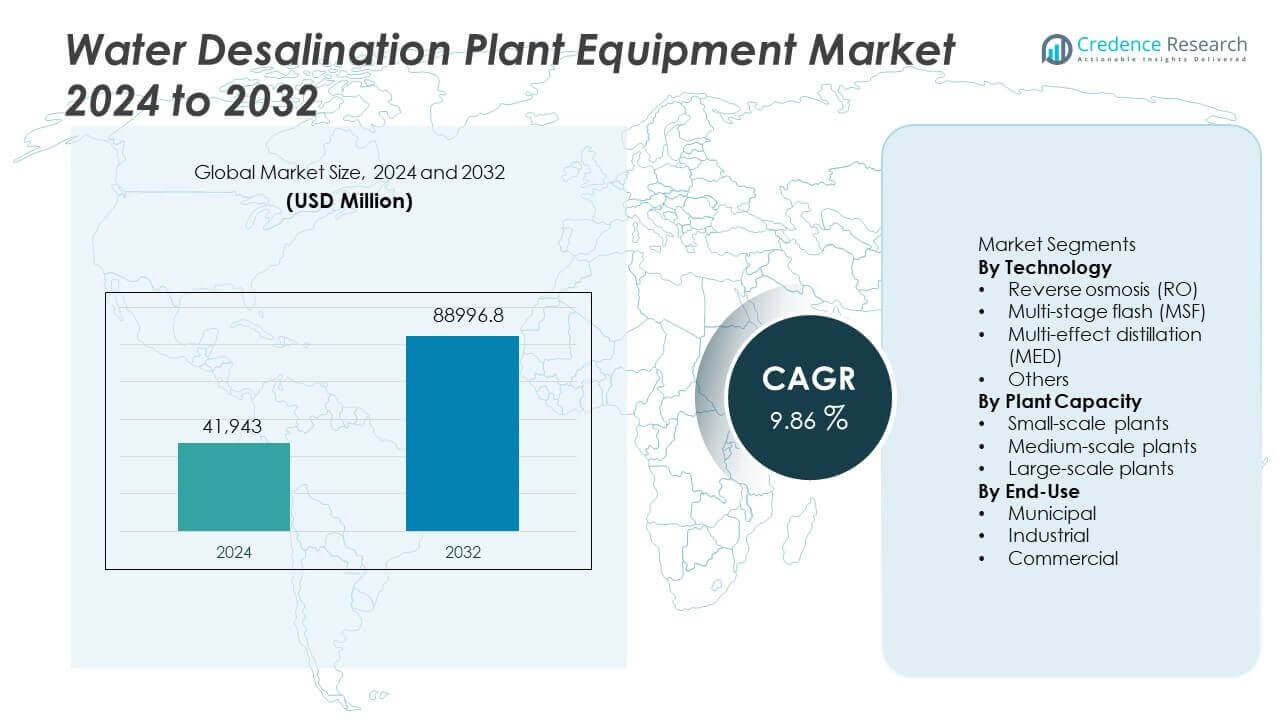
The Water Desalination Plant Equipment market was valued at USD 41,943 million in 2024 and is expected to reach USD 88,996.8 million by 2032, growing at a CAGR of 9.86% during the forecast period.
| REPORT ATTRIBUTE | DETAILS |
|---|---|
| Historical Period | 2020-2023 |
| Base Year | 2024 |
| Forecast Period | 2025-2032 |
| Water Desalination Plant Equipment Market Size 2024 | USD 41,943 million |
| Water Desalination Plant Equipment Market, CAGR | 9.86% |
| Water Desalination Plant Equipment Market Size 2032 | USD 88,996.8 million |
Water Desalination Plant Equipment Market Insights
- Market growth is driven by rising water scarcity, urban population growth, and government investment in long-term water infrastructure, with municipal end use leading at a 54.1% segment share.
- Key market trends include strong adoption of reverse osmosis technology, which holds a 62.4% segment share due to lower energy use, scalability, and suitability for seawater desalination.
- Competitive dynamics show moderate consolidation, with leading players focusing on EPC capabilities, membrane efficiency, and long-term operation contracts, while high capital and energy costs remain key restraints.
- Regionally, Middle East & Africa leads with a 28.5% market share, followed by Asia Pacific at 27.8%, North America at 18.9%, and Europe at 14.6%, reflecting regional water stress levels and infrastructure spending.
Water Desalination Plant Equipment Market Segmentation Analysis:
By Technology
By technology, reverse osmosis (RO) dominates the Water Desalination Plant Equipment market with a market share of 62.4%. This dominance reflects RO’s lower energy consumption, modular design, and suitability for both seawater and brackish water desalination. Governments and utilities increasingly adopt RO systems to meet large-scale freshwater demand. Advances in membrane efficiency and pressure recovery devices further improve operational performance. RO plants require lower capital and operating costs compared to thermal technologies. MSF and MED remain relevant in regions with abundant energy resources, but RO continues to lead due to cost efficiency, scalability, and broad global adoption.
- For instance, IDE Technologies deployed its SWRO system at the Sorek B plant using 16-inch membranes, achieving energy consumption close to 3.0 kWh per cubic meter and single-train capacity exceeding 200,000 cubic meters per day.
By Plant Capacity
By plant capacity, large-scale plants hold the largest share at 48.7%. This leadership is driven by rising urban populations and large municipal water supply projects. Coastal megacities and arid regions invest heavily in high-capacity desalination facilities to ensure long-term water security. Large-scale plants benefit from economies of scale, reducing per-unit water production costs. Government-backed infrastructure projects support this segment. Medium-scale plants follow, serving industrial zones and secondary cities. Small-scale plants cater to remote areas but account for lower volumes. Large-scale capacity remains dominant due to high demand concentration and infrastructure investment.
- For instance, Veolia Environnement S.A. engineered large RO facilities delivering over 600,000 cubic meters per day through multi-train configurations, supported by high-pressure pumps rated above 8 MW per train.
By End-Use
By end-use, municipal applications lead the market with a market share of 54.1%. Municipal authorities deploy desalination equipment to address chronic water scarcity and population growth. Public water utilities prioritize reliable and continuous freshwater supply. Urban expansion and declining groundwater availability strengthen municipal demand. Long-term government contracts support steady equipment procurement. Industrial use follows, driven by power generation, oil and gas, and manufacturing water needs. Commercial use remains smaller, focused on resorts and private developments. Municipal end-use dominates due to scale, public funding support, and critical water supply requirements.
Key Growth Drivers
Rising Global Water Scarcity and Urban Population Growth
Water scarcity remains a critical issue across arid and coastal regions. Rapid urban population growth increases freshwater demand. Traditional water sources face depletion and quality decline. Governments invest in desalination to secure long-term water supply. Municipal utilities prioritize large-scale desalination projects. Climate change intensifies drought frequency and severity. Desalination provides a reliable alternative independent of rainfall. Coastal cities adopt seawater desalination aggressively. Public infrastructure spending supports equipment demand. This driver strongly accelerates market expansion worldwide.
- For instance, ACWA Power developed the Rabigh 3 desalination plant with a production capacity of 600,000 cubic meters per day, supplying water to major urban clusters.
Strong Government Investment in Water Infrastructure
Governments actively support desalination infrastructure development. Public funding enables large municipal desalination plants. Long-term water security policies drive project approvals. Strategic national water plans include desalination capacity expansion. Subsidies and public-private partnerships reduce investment risk. Emerging economies increase infrastructure budgets. Defense and strategic facilities also require reliable water supply. Regulatory backing ensures project continuity. Stable government contracts support equipment procurement. This driver ensures sustained demand across regions.
- For instance, SUEZ delivered desalination infrastructure for public utilities with single-plant capacities above 500,000 cubic meters per day, supported by energy recovery devices rated above 95 efficiency units.
Industrial Demand for Process and Cooling Water
Industries require consistent and high-quality water supply. Power generation, oil and gas, and chemicals depend on desalinated water. Industrial expansion increases water consumption. Coastal industrial zones prefer onsite desalination plants. Process reliability drives equipment upgrades. Regulatory pressure limits freshwater extraction. Desalination ensures operational continuity. Industrial reuse and recycling complement desalination systems. Equipment suppliers benefit from industrial-scale projects. This driver strengthens non-municipal market demand.
Key Trends & Opportunities
Shift Toward Energy-Efficient Desalination Technologies
Energy efficiency gains importance in desalination projects. Reverse osmosis adoption continues to rise. Advanced membranes reduce energy consumption. Pressure recovery systems improve operational efficiency. Renewable-powered desalination gains attention. Solar and wind integration lower operating costs. Energy optimization enhances project viability. Technology upgrades create retrofit opportunities. Equipment manufacturers invest in innovation. This trend improves cost competitiveness and market adoption.
- For instance, DuPont Water Solutions supplies SWRO membranes operating at flux levels above 40 liters per square meter per hour under standard seawater conditions, enabling lower pump loads.
Expansion of Desalination in Emerging Coastal Economies
Emerging economies increase desalination investments. Rapid urbanization strains freshwater resources. Coastal nations expand desalination capacity. Infrastructure development attracts foreign investment. Export-oriented industries require reliable water supply. Tourism-driven regions adopt desalination solutions. Modular plant designs support faster deployment. Regional partnerships accelerate project execution. Equipment suppliers gain new market access. This opportunity supports long-term growth potential.
- For instance, Aquatech International executed large seawater RO projects in Asia and the Middle East with individual train capacities exceeding 110,000 cubic meters per day, using modular skid-based assemblies.
Key Challenges
High Capital and Operating Cost Requirements
Desalination plants require significant upfront investment. Equipment costs remain high for large-scale facilities. Energy consumption increases operating expenses. Financing challenges affect project timelines. Cost recovery depends on water tariffs. Smaller municipalities face budget constraints. Economic feasibility varies by region. Long payback periods limit adoption. This challenge slows market penetration in cost-sensitive areas.
Environmental Concerns and Brine Disposal Issues
Environmental impact remains a major concern. Brine discharge affects marine ecosystems. Regulatory scrutiny increases project complexity. Disposal solutions add operational costs. Coastal permitting processes delay approvals. Environmental compliance requires advanced monitoring. Public opposition can affect project acceptance. Sustainable discharge technologies remain costly. This challenge necessitates careful environmental management and innovation.
Regional Analysis
North America
North America holds a market share of 18.9% in the Water Desalination Plant Equipment market, supported by rising water stress in coastal and arid regions. The United States leads regional demand through investments in seawater and brackish water desalination. Municipal utilities deploy desalination to support urban water supply and drought resilience. Industrial demand from power generation and oil and gas also supports equipment adoption. Technological advancement and strict water quality standards drive upgrades. Government-backed infrastructure programs encourage long-term projects. The region shows stable growth due to regulatory support, technology maturity, and increasing climate-related water challenges.
Europe
Europe accounts for a market share of 14.6%, driven by growing water scarcity in southern regions. Countries such as Spain, Italy, and Greece invest heavily in desalination to support municipal and agricultural needs. Coastal urban centers rely on desalination for water security. Environmental regulations influence technology selection and system efficiency. Reverse osmosis dominates new installations due to lower energy use. Industrial and tourism demand further supports adoption. Public funding and regional water management policies sustain investment. Europe maintains steady growth through sustainability-focused desalination strategies and long-term infrastructure planning.
Asia Pacific
Asia Pacific leads the Water Desalination Plant Equipment market with a market share of 27.8%. Rapid population growth and urbanization drive high freshwater demand. Countries such as China, India, and Australia expand desalination capacity to address water shortages. Coastal megacities invest in large-scale plants. Industrial growth increases process water requirements. Government initiatives support desalination as a strategic water source. Cost-efficient manufacturing strengthens regional equipment supply. Infrastructure development and climate variability sustain demand. Asia Pacific remains the largest market due to scale, investment intensity, and rising water stress.
Latin America
Latin America holds a market share of 10.2%, supported by water scarcity in mining and industrial regions. Chile leads regional adoption due to mining sector demand. Coastal desalination plants support industrial water supply. Municipal use grows gradually in water-stressed cities. Renewable-powered desalination gains interest. Infrastructure investment remains selective but increasing. Government and private partnerships support project development. Environmental considerations influence project planning. The region shows moderate growth potential driven by industrial demand and long-term water security initiatives.
Middle East & Africa
The Middle East & Africa region accounts for the largest market share of 28.5%, driven by chronic water scarcity and arid climate conditions. Gulf countries dominate regional demand through large-scale municipal desalination projects. Governments invest heavily in seawater desalination to secure drinking water supply. Energy availability supports thermal and RO technologies. Africa contributes smaller volumes but shows rising interest in coastal desalination. Long-term national water strategies support continuous expansion. The region leads the market due to sustained infrastructure investment and critical reliance on desalinated water.
Water Desalination Plant Equipment Market Segmentations:
By Technology
- Reverse osmosis (RO)
- Multi-stage flash (MSF)
- Multi-effect distillation (MED)
- Others
By Plant Capacity
- Small-scale plants
- Medium-scale plants
- Large-scale plants
By End-Use
- Municipal
- Industrial
- Commercial
By Geography
- North America
- U.S.
- Canada
- Mexico
- Europe
- Germany
- France
- U.K.
- Italy
- Spain
- Rest of Europe
- Asia Pacific
- China
- Japan
- India
- South Korea
- South-east Asia
- Rest of Asia Pacific
- Latin America
- Brazil
- Argentina
- Rest of Latin America
- Middle East & Africa
- GCC Countries
- South Africa
- Rest of the Middle East and Africa
Competitive Landscape
Competitive landscape analysis of the Water Desalination Plant Equipment market highlights the presence of key players including Veolia Environnement S.A., SUEZ, IDE Technologies, Doosan Enerbility, and ACWA Power. The market shows moderate consolidation, with competition centered on technology efficiency, project execution capability, and long-term operational reliability. Leading players benefit from strong EPC expertise and integrated service offerings covering design, equipment supply, and plant operation. Reverse osmosis technology leadership remains a key differentiator. Companies focus on securing large municipal contracts through public–private partnerships. Regional presence and experience in large-scale projects strengthen competitive positioning. Continuous investment in membrane performance and energy optimization supports cost competitiveness. Overall competition emphasizes scalability, regulatory compliance, and long-term water supply reliability.
Key Player Analysis
- Veolia Environnement S.A.
- SUEZ
- IDE Technologies
- Doosan Enerbility
- ACWA Power
- Toray Industries, Inc.
- DuPont Water Solutions
- Evoqua Water Technologies
- Aquatech International
- Hitachi Zosen Corporation
Recent Developments
- In December 2025, IDE Technologies, secured the EPC award for Mumbai’s Manori SWRO plant. The project is set for 200 million liters/day, with infrastructure designed to double capacity.
- In June 2024, SUEZ, won the contract for Taiwan’s Hsinchu municipal SWRO project. The plant is designed for 100,000 m³/day and targets 1.6 million beneficiaries.
- In April 2024, ACWA Power, reached financial close with DEWA for the Hassyan SWRO IWP. Phase 1 is sized at 180 MIGD.
Report Coverage
The research report offers an in-depth analysis based on Technology, Plant Capacity, End-Use and Geography. It details leading market players, providing an overview of their business, product offerings, investments, revenue streams, and key applications. Additionally, the report includes insights into the competitive environment, SWOT analysis, current market trends, as well as the primary drivers and constraints. Furthermore, it discusses various factors that have driven market expansion in recent years. The report also explores market dynamics, regulatory scenarios, and technological advancements that are shaping the industry. It assesses the impact of external factors and global economic changes on market growth. Lastly, it provides strategic recommendations for new entrants and established companies to navigate the complexities of the market.

Request a Free Sample
Fill in your details and we'll send you a free sample report.
- Sample data tables & charts
- Research methodology
Need a Custom Version of This Report?
Tailor the scope, geography, or segments to your exact requirements.
- Custom geography or segment scope
- Direct access to our analyst team
Frequently Asked Questions
What is the current market size for Water Desalination Plant Equipment market, and what is its projected size in 2032?
At what Compound Annual Growth Rate is the Water Desalination Plant Equipment market projected to grow between 2024 and 2032?
Which Water Desalination Plant Equipment market segment held the largest share in 2024?
What are the primary factors fueling the growth of the Water Desalination Plant Equipment market?
Who are the leading companies in the Water Desalination Plant Equipment market?
Which region commanded the largest share of the Water Desalination Plant Equipment market in 2024?
Table of Content
Chapter 1 Market Segmentation
- 1.1 Segmentation Framework
- 1.1.1 Product and Service Classification
- 1.1.2 Application and End-Use Classification
- 1.1.3 Technology and Solution Classification
- 1.1.4 Customer and Distribution Channel Classification
- 1.1.5 Geographic Segmentation
- 1.1.6 Market Segment Definitions and Boundaries
Chapter 2 Introduction
- 2.1 Report Objectives and Scope
- 2.2 Product Definition and Industry Terminology
- 2.3 Market Inclusions and Exclusions
- 2.4 Research Process
- 2.4.1 Primary Research and Expert Interviews
- 2.4.2 Secondary Research and Source Review
- 2.4.3 Top-Down and Bottom-Up Estimation
- 2.4.4 Data Triangulation and Verification
- 2.5 Market Size Measurement Basis
- 2.5.1 2024: USD 41,943 million → 2032: USD 88,996.8 million
- 2.6 Historical and Forecast Reference Periods
- 2.6.1 Base Year: 2024
- 2.6.2 Forecast Period: 2024-2032
- 2.7 Research Assumptions and Limitations
Chapter 3 Executive Summary
- 3.1 Market Snapshot and Key Findings
- 3.2 Base-Year Market Size, 2024
- 3.3 Forecast Market Size, 2032
- 3.4 Revenue and Volume Growth Outlook
- 3.5 Key Demand and Supply Indicators
- 3.6 Leading Market Segments
- 3.7 Fastest-Growing Market Opportunities
- 3.8 Regional Performance Highlights
- 3.9 Technology and Industry Transformation
- 3.10 Competitive Landscape Summary
- 3.11 Analyst View and Strategic Implications
Chapter 4 Global Water Desalination Plant Equipment Market Trends and Developments
- 4.1 Historical Industry Development
- 4.2 Recent Market Trends and Developments
- 4.3 Demand and Customer Behavior Trends
- 4.4 Technology and Product Innovation
- 4.5 Artificial Intelligence, Automation and Digitalization
- 4.6 Local Manufacturing and Supply Chain Realignment
- 4.7 Industry Partnerships, Mergers and Acquisitions
- 4.8 Sustainability and Circular Economy Developments
- 4.9 Government and Private Sector Investment Trends
- 4.10 Emerging Business Models and Commercialization
- 4.11 Industry Developments and Announcements
Chapter 5 Global Water Desalination Plant Equipment Market Production, Supply and Demand Analysis
- 5.1 Demand Trend and Consumption Analysis
- 5.2 Demand Forecast, 2024-2032
- 5.3 Production and Output Trend
- 5.4 Production and Output Forecast, 2024-2032
- 5.5 Installed Capacity and Capacity Utilization
- 5.6 Company-Wise Production Plants and Statistics
- 5.6.1 Installed Production Capacity
- 5.6.2 Actual Production
- 5.6.3 Planned Capacity and Expansion Targets
- 5.7 Supply Chain Structure and Procurement Trends
- 5.8 Supply-Demand Gap and Bottlenecks
- 5.9 Import Dependence and Sourcing Structure
- 5.10 Contract Manufacturing and Outsourcing
- 5.11 Regional Supply and Demand Concentration
Chapter 6 Global Water Desalination Plant Equipment Market Pricing Analysis
- 6.1 Pricing Structure and Measurement
- 6.2 Historical Pricing Trends
- 6.3 Pricing Outlook, 2024-2032
- 6.4 Average Selling Price and Unit Economics
- 6.5 Pricing by Product and Market Segment
- 6.6 Geographic Pricing Differences
- 6.7 Key Input, Energy, Labor and Logistics Costs
- 6.8 Contract Pricing and Purchasing Models
- 6.9 Pricing Sensitivity and Competitive Positioning
- 6.10 Price, Margin and Profitability Implications
Chapter 7 Global Water Desalination Plant Equipment Market Dynamics
- 7.1 Market Growth Drivers
- 7.1.1 Demand-Side Drivers
- 7.1.2 Technology and Innovation Drivers
- 7.1.3 Infrastructure and Investment Drivers
- 7.1.4 Regulatory and Policy Drivers
- 7.2 Market Restraints
- 7.2.1 Cost and Affordability Constraints
- 7.2.2 Technology and Adoption Barriers
- 7.2.3 Supply Chain and Operational Constraints
- 7.3 Market Challenges
- 7.3.1 Competitive Pressure and Margin Erosion
- 7.3.2 Skills, Infrastructure and Implementation Gaps
- 7.4 Emerging Market Opportunities
- 7.5 Market Dynamics Impact and Time-Horizon Assessment
Chapter 8 Global Water Desalination Plant Equipment Value Chain Analysis
- 8.1 Industry Value Chain Overview
- 8.2 Upstream Suppliers and Critical Inputs
- 8.3 Technology and Component Providers
- 8.4 Manufacturing or Service Delivery
- 8.5 Distribution, Channel Partners and Integrators
- 8.6 Downstream Applications and End Users
- 8.7 Value Addition and Profit Pools
- 8.8 Vertical Integration and Outsourcing
- 8.9 Supplier Concentration and Risk
- 8.10 Supply Chain Localization and Resilience
Chapter 9 Global Water Desalination Plant Equipment Market Regulations and Policies
- 9.1 Relevant Laws, Standards and Compliance Frameworks
- 9.2 Product, Service, Safety and Quality Requirements
- 9.3 Government Policies, Incentives and Subsidies
- 9.4 Imports, Exports and Trade Barriers
- 9.5 Public Procurement and Local Content Requirements
- 9.6 Environmental and Sustainability Compliance
- 9.7 Upcoming Policy Changes and Market Implications
Chapter 10 Global Water Desalination Plant Equipment Market Hotspots and Opportunities
- 10.1 Market Opportunity Mapping and Growth Hotspots
- 10.2 High-Growth Applications and Customer Groups
- 10.3 Underserved Markets and White-Space Opportunities
- 10.4 Emerging Technology and Product Opportunities
- 10.5 New Capacity and Investment Hotspots
- 10.6 Market Entry and Expansion Opportunities
- 10.7 Distribution and Partnership Opportunities
- 10.8 Near-Term and Long-Term Commercial Potential
- 10.9 Opportunity Attractiveness and Execution Risks
Chapter 11 Global Water Desalination Plant Equipment Market Outlook, 2024-2032
- 11.1 Market Size and Analysis
- 11.1.1 Revenue (Market Measurement: 2024: USD 41,943 million → 2032: USD 88,996.8 million)
- 11.1.2 Market Volume and Quantity Sold
- 11.1.3 Historical Market Size
- 11.1.4 Base-Year Market Size, 2024
- 11.2 Market Forecast, 2024-2032
- 11.2.1 Revenue Forecast to 2032
- 11.2.2 Volume Forecast to 2032
- 11.2.3 CAGR and Year-on-Year Growth
- 11.2.4 Incremental Revenue Opportunity
- 11.3 Forecast Assumptions and Scenario Analysis
- 11.3.1 Base-Case Forecast
- 11.3.2 Optimistic and Conservative Scenarios
- 11.3.3 Technology, Pricing and Policy Sensitivities
- 11.4 Market Attractiveness and Growth Outlook
Chapter 12 Global Water Desalination Plant Equipment Market Segmentation and Outlook
- 12.1 Segmentation Summary and Market Shares, 2024
- 12.2 Largest and Fastest-Growing Segments
- 12.3 Segment Growth Comparison
- 12.4 Segment Attractiveness and Priority Matrix
Chapter 13 Global Water Desalination Plant Equipment Geographic Market Outlook, 2024-2032
- 13.1 Regional Market Size and Share, 2024
- 13.2 Regional Market Forecast, 2024-2032
- 13.3 Regional Pricing, Production and Demand Differences
- 13.4 North America
- 13.4.1 United States
- 13.4.2 Canada
- 13.4.3 Mexico
- 13.5 Europe
- 13.5.1 Germany
- 13.5.2 France
- 13.5.3 Italy
- 13.5.4 United Kingdom
- 13.5.5 Spain
- 13.5.6 Poland
- 13.5.7 Russia
- 13.5.8 Netherlands
- 13.5.9 Belgium
- 13.5.10 Sweden
- 13.5.11 Denmark
- 13.5.12 Norway
- 13.5.13 Rest of Europe
- 13.6 Asia Pacific
- 13.6.1 China
- 13.6.2 India
- 13.6.3 Japan
- 13.6.4 South Korea
- 13.6.5 Thailand
- 13.6.6 Indonesia
- 13.6.7 Vietnam
- 13.6.8 Malaysia
- 13.6.9 Australia
- 13.6.10 Rest of Asia Pacific
- 13.7 Latin America
- 13.7.1 Brazil
- 13.7.2 Argentina
- 13.7.3 Colombia
- 13.7.4 Chile
- 13.7.5 Rest of Latin America
- 13.8 Middle East
- 13.8.1 Saudi Arabia
- 13.8.2 United Arab Emirates
- 13.8.3 Turkey
- 13.8.4 Israel
- 13.8.5 Iran
- 13.8.6 Rest of the Middle East
- 13.9 Africa
- 13.9.1 South Africa
- 13.9.2 Egypt
- 13.9.3 Nigeria
- 13.9.4 Morocco
- 13.9.5 Rest of Africa
- 13.10 Regional Investment, Policy and Supply Chain Differences
- 13.11 Regional Competitive Landscape
- 13.12 Geographic Growth Hotspots
Chapter 14 Global Water Desalination Plant Equipment Technology, Innovation and Sustainability Outlook
- 14.1 Technology Landscape and Maturity
- 14.2 Product, Process and Service Innovation
- 14.3 AI, Automation and Digital Tools in the Industry
- 14.4 Technology Adoption and Performance Benchmarking
- 14.5 Innovation Pipeline and R&D Investment
- 14.6 Patent and Intellectual Property Trends
- 14.7 Energy Efficiency and Resource Management
- 14.8 Sustainability, Recycling and Circularity
- 14.9 Technology Roadmap, 2024-2032
- 14.10 Risks of Obsolescence and Technology Substitution
Chapter 15 Global Water Desalination Plant Equipment Market Key Strategic Imperatives
- 15.1 Growth and Market Entry Priorities
- 15.2 High-Return Products and Segments
- 15.3 Pricing, Profitability and Cost Optimization
- 15.4 Technology Investment and Product Differentiation
- 15.5 Supply Chain Localization and Resilience
- 15.6 Distribution and Customer Acquisition
- 15.7 Partnership, Acquisition and Capacity Strategy
- 15.8 Regional Expansion Priorities
- 15.9 Short-, Medium- and Long-Term Actions
Chapter 16 Competition Outlook
- 16.1 Industry Competition Characteristics
- 16.2 Market Structure and Concentration
- 16.3 Market Share and Competitive Positioning, 2024
- 16.4 Company-Wise Revenue and Product Benchmarking
- 16.5 Production and Service Capacity Benchmarking
- 16.6 Technology, Pricing and Differentiation
- 16.7 Regional Footprint and Distribution Strength
- 16.8 Mergers, Acquisitions and Strategic Alliances
- 16.9 New Entrants and Competitive Threats
- 16.10 Porter's Five Forces and Industry Attractiveness
- 16.11 Competitive Outlook, 2024-2032
Chapter 17 Company Profiles
- 17.1 Company Coverage and Selection Criteria
- 17.2 Leading Market Participants – Standard Profile Structure
- 17.2.1 Business Description
- 17.2.2 Company Ownership and Geographic Presence
- 17.2.3 Product and Service Portfolio
- 17.2.4 Manufacturing and Operating Footprint
- 17.2.5 Production Capacity and Expansion Plans
- 17.2.6 Financial Performance and Investment
- 17.2.7 Market Share and Competitive Position
- 17.2.8 Technology and Innovation Capabilities
- 17.2.9 Strategic Alliances or Partnerships
- 17.2.10 Recent Developments
- 17.2.11 Growth Strategy and Outlook
- 17.3 Other Relevant Market Participants
Note: Every listed company is profiled on the structure shown under the first company. The company list is preliminary and may change based on research findings, market developments, data availability and client requirements.
Chapter 18 Disclaimer
- 18.1 Research and Forecast Disclaimer
- 18.2 Data Source and Estimation Limitations
Note: The depth of individual sections depends on data availability for this market. Volume, capacity, trade and other unit-based metrics are included where applicable.