| REPORT ATTRIBUTE | DETAILS |
|---|---|
| Historical Period | 2020-2023 |
| Base Year | 2024 |
| Forecast Period | 2025-2032 |
| Weight Loss App Market Size 2024 | USD 6316 million |
| Weight Loss App Market, CAGR | 7.9% |
| Weight Loss App Market Size 2032 | USD 11604.1 million |
Market Overview:
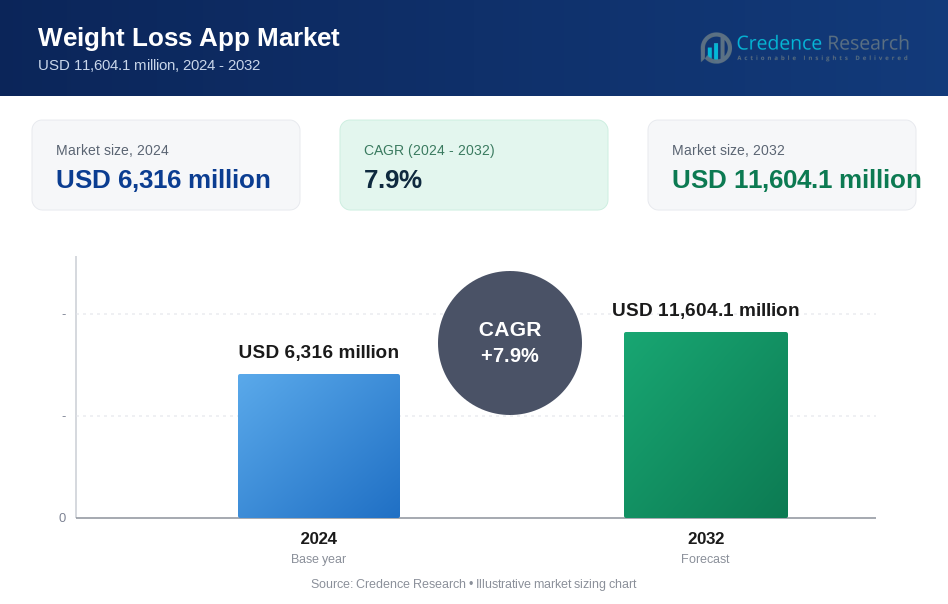
The Weight Loss App Market size was valued at USD 6316 million in 2024 and is anticipated to reach USD 11604.1 million by 2032, at a CAGR of 7.9% during the forecast period (2024-2032).
Market drivers include the surge in lifestyle-related disorders, a growing demand for personalized health solutions, and the availability of advanced app features such as calorie tracking, AI-powered meal recommendations, virtual coaching, and community support. The COVID-19 pandemic significantly accelerated the shift toward digital health tools as consumers sought convenient, at-home solutions to maintain or improve their fitness. Leading weight loss apps now offer integrated platforms that combine nutrition tracking, exercise plans, mindfulness coaching, and progress analytics, catering to diverse user preferences and age groups. The growing integration of wearable devices and real-time health monitoring has also strengthened user engagement and retention. Strategic collaborations between app developers, fitness influencers, and healthcare professionals have further expanded market reach and enhanced user engagement.
Regionally, North America dominates the Weight Loss App Market due to its high smartphone penetration, established digital health infrastructure, and strong consumer focus on fitness and wellness. The United States leads in both revenue and user base, supported by a culture that prioritizes preventive healthcare and digital innovation. Europe follows, driven by increasing health consciousness and supportive regulatory policies. The Asia Pacific region is emerging as a high-growth market, fueled by a rising middle class, increasing obesity rates, and growing awareness of mobile health technologies. A surge in regional investments and partnerships with local healthcare organizations is accelerating market expansion in these countries. Localized app content, language support, and culturally relevant features are key factors driving adoption in these regions, making the global market increasingly competitive and dynamic.
Market Insights:
- The Weight Loss App Market reached USD 6,316 million in 2024 and is expected to grow strongly to USD 11,604.1 million by 2032.
- Growing rates of obesity and lifestyle disorders are driving demand for effective digital weight management tools worldwide.
- Advanced app features-like calorie tracking, AI-driven meal plans, and real-time health monitoring-boost user engagement and satisfaction.
- Integration with wearable devices and partnerships with fitness experts, insurers, and healthcare providers expand the market’s reach and credibility.
- Data privacy concerns and evolving regulations remain key challenges, requiring continuous investment in security and compliance.
- North America leads the market, with Europe and Asia Pacific showing strong growth due to increasing health awareness and supportive local investments.
- Personalization, regional language support, and culturally relevant content are critical for user retention and global market expansion.
Market Drivers:
Rising Incidence of Obesity and Lifestyle Disorders Fuels Digital Intervention Demand
The Weight Loss App Market benefits from the escalating prevalence of obesity and lifestyle-related disorders worldwide. A growing number of consumers seek effective, convenient solutions to manage weight and health risks associated with sedentary habits and poor dietary choices. Governments and health organizations emphasize preventive care, urging individuals to adopt healthier routines. This shift in public awareness is driving demand for digital tools that facilitate daily monitoring and coaching. Weight loss apps deliver accessible support to users across age groups, encouraging them to take proactive control of their well-being. Continuous awareness campaigns further reinforce the need for personalized health management. The increasing health burden has made these platforms a preferred choice for weight management.
Integration of Advanced Technologies Enhances App Capabilities and User Experience
Innovations in technology play a central role in advancing the Weight Loss App Market. Developers now integrate artificial intelligence, machine learning, and data analytics to provide highly personalized user experiences. Features such as real-time calorie tracking, automated meal suggestions, and adaptive workout plans enable users to make informed decisions. Wearable device integration enhances the accuracy of activity monitoring and health data collection. These technologies enable apps to offer tailored recommendations based on user behavior and preferences. User engagement and retention rise due to interactive interfaces and gamified elements. The rapid evolution of mobile and wearable technology ensures ongoing innovation in this sector.
- For instance, WHOOP 4.0 recorded an average heart rate of 135 bpm during a 28-minute bike ride, matching the accuracy of a chest strap monitor.
Changing Consumer Preferences for Health, Convenience, and Personalization
Consumers prioritize convenience and personalization in managing their health goals, prompting rapid adoption of digital health solutions. Weight loss apps cater to diverse needs by offering features such as community forums, progress tracking, virtual coaching, and dietary analysis. It allows users to create customized plans and receive instant feedback, supporting ongoing motivation. Remote access and mobile compatibility appeal to busy professionals and younger generations alike. The demand for holistic wellness, beyond simple calorie counting, fuels the inclusion of mental health and mindfulness features. This adaptability positions these apps as comprehensive tools for sustained lifestyle change. The market continues to grow as users demand seamless integration with other digital platforms.
- For instance, the January V2 app, which leverages AI and continuous glucose monitoring, demonstrated in a published study that users experienced an average weight reduction of 3.3 lbs over 33 days.
Collaboration with Healthcare Providers and Strategic Partnerships Expand Market Reach
Collaborations between app developers, healthcare professionals, and fitness experts are strengthening the credibility and reach of weight loss applications. Medical endorsements and expert-driven content reassure users about the effectiveness and safety of these tools. Strategic partnerships with insurance companies and corporate wellness programs introduce weight loss apps to wider populations. These alliances facilitate evidence-based interventions and improve user adherence to health plans. Marketing campaigns featuring fitness influencers and health advocates boost app visibility and trust. It also supports ongoing user education through webinars and interactive sessions. Such partnerships are vital for long-term user engagement and sustainable market expansion.
Market Trends:
Emphasis on Personalization and AI-Powered Features Drives User Engagement
Personalization has become a central trend in the Weight Loss App Market, with developers leveraging artificial intelligence to deliver individualized experiences. Apps now use algorithms to analyze user data, preferences, and habits, creating tailored meal plans, exercise routines, and daily goals. AI-powered chatbots and virtual coaches offer real-time feedback and motivation, improving user adherence and satisfaction. Gamification elements, such as achievement badges and interactive challenges, further enhance engagement and retention. The ability to synchronize with wearables and health monitoring devices ensures more precise tracking of physical activity and biometrics. This trend underscores a growing demand for data-driven, adaptive solutions that fit seamlessly into diverse lifestyles. It positions leading apps at the forefront of digital health innovation.
- For instance, SlimMe chatbot enabled users to log nutrition, exercise, and receive motivational support, with the system recording 1,007 chatbot responses during a 7-day simulation.
Integration with Broader Wellness Ecosystems Expands Functional Value
Weight loss applications increasingly function within wider digital wellness ecosystems, enabling seamless connectivity with nutrition apps, fitness platforms, and telehealth services. This integration allows users to manage multiple aspects of their health-nutrition, exercise, sleep, and mental well-being-within a single digital environment. Partnerships with healthcare providers and insurers enhance the credibility and accessibility of these platforms, encouraging long-term engagement. The Weight Loss App Market benefits from the expansion of virtual communities, where users share progress, seek support, and participate in group challenges. Multilingual content and region-specific features make these apps more inclusive and relevant for global audiences. It drives strong market growth by responding to evolving consumer expectations for holistic health management.
- For instance, Trainero currently supports 20 distinct languages in its global app interface.
Market Challenges Analysis:
Data Privacy Concerns and Regulatory Compliance Remain Major Barriers
Data privacy and security pose significant challenges for the Weight Loss App Market, given the sensitive nature of health and personal information collected from users. Consumers remain cautious about sharing detailed health data due to fears of unauthorized access, misuse, or data breaches. Evolving regulatory requirements, such as GDPR and HIPAA, impose strict standards for data storage, processing, and user consent. App developers must continuously invest in advanced encryption, transparent privacy policies, and user education to maintain trust. Failure to comply with regulations can result in legal penalties and reputational damage. It creates a complex environment for new entrants and established players alike, requiring ongoing vigilance.
User Retention and Long-Term Engagement Present Ongoing Obstacles
Maintaining sustained user engagement represents another key challenge in the Weight Loss App Market. Many users struggle to maintain motivation, leading to high drop-off rates after initial adoption. The effectiveness of generic programs and content often diminishes over time, prompting users to seek alternative solutions. Competition remains intense, with numerous free and premium apps vying for consumer attention. The market must continuously innovate to provide fresh content, personalized experiences, and meaningful outcomes. It highlights the need for ongoing investment in behavioral insights and adaptive technology to foster lasting loyalty.
Market Opportunities:
Expansion into Corporate Wellness Programs and Preventive Healthcare
The Weight Loss App Market presents strong opportunities through integration with corporate wellness programs and preventive healthcare initiatives. Employers increasingly recognize the value of supporting employee health to improve productivity and reduce healthcare costs. Partnering with organizations and insurers allows weight loss app providers to access large user bases and offer tailored wellness solutions. Customizable platforms can track employee progress, deliver incentives, and promote healthy competition within the workforce. Preventive healthcare initiatives led by governments and private sector players create new avenues for market growth. It enables apps to play a critical role in population health management and early intervention.
Localization and Personalization Drive Adoption in Emerging Markets
Emerging markets offer vast potential for expansion due to rising smartphone penetration and growing awareness of digital health solutions. Localizing app content, language, and features addresses cultural preferences and improves user engagement. Partnerships with regional healthcare providers and influencers can boost credibility and trust among local consumers. The Weight Loss App Market stands to benefit from the development of solutions that cater to unique dietary habits, activity levels, and wellness needs of specific regions. Integration of telehealth services and digital payment options can further enhance adoption. It positions app developers to capitalize on untapped markets and drive global growth.
Market Segmentation Analysis:
By Demographic
By demographic segmentation, the Weight Loss App Market serves adults, teenagers, and seniors with tailored approaches. Adults make up the largest segment, supported by greater health awareness and higher disposable income. Teenagers benefit from age-appropriate content and user-friendly interfaces, while seniors find value in simplified navigation and targeted coaching. Gender-specific content boosts relevance for men and women, offering customized programs and guidance. It ensures inclusive solutions by aligning with distinct needs across age and gender. The market’s demographic range strengthens its reach and user engagement.
- For instance, the I-GENDO app achieved a user satisfaction score of 86 out of 100 for its gender-sensitive, personalized modules, demonstrating strong engagement across diverse demographic groups.
By Behavioral
Behavioral segmentation categorizes users as casual participants, fitness enthusiasts, or medically supervised individuals. Casual users often seek simple calorie tracking and general wellness information. Fitness enthusiasts pursue detailed workout plans, nutrition insights, and community-driven challenges. Medically supervised users require integration with healthcare providers, robust monitoring, and privacy-focused tools for safe clinical use. The Weight Loss App Market adapts by offering flexible subscriptions, interactive features, and goal-tracking solutions. It keeps users motivated through diverse engagement strategies.
By Technographic
Technographic segmentation reflects differences in device ownership, integration demands, and privacy expectations. Users with advanced smartphones or wearables expect seamless connectivity, real-time data syncing, and advanced analytics. Those with basic devices need compatibility and offline functionality. The market’s platforms offer broad support, secure data handling, and regular updates to meet evolving digital habits. It effectively addresses technographic diversity to serve a wide-ranging, global audience.
- For instance, Thryve delivers real-time health data syncing from wearables such as Fitbit, Garmin, and Withings, with data transfer times taking less than 10 seconds from device to cloud in optimal scenarios.
Segmentations:
- By Demographic
- Age Group
- Gender
- Income Level
- Education Level
- By Behavioral
- Casual Users
- Fitness Enthusiasts
- Medically Supervised Individuals
- Consistency of Use
- By Technographic
- Device Type
- App Integration Preferences
- Data Privacy Expectations
- Operating System
- By Motivational
- Weight Loss Goals
- Fitness Improvement
- Health Condition Management
- Social Motivation
- By Psychographic
- Lifestyle Preferences
- Health Consciousness
- Attitude Toward Technology
- Personality Traits
- By Region
- North America
- U.S.
- Canada
- Mexico
- Europe
- Germany
- France
- U.K.
- Italy
- Spain
- Rest of Europe
- Asia Pacific
- China
- Japan
- India
- South Korea
- South-east Asia
- Rest of Asia Pacific
- Latin America
- Brazil
- Argentina
- Rest of Latin America
- Middle East & Africa
- GCC Countries
- South Africa
- Rest of the Middle East and Africa
- North America
Regional Analysis:
North America Maintains Market Leadership Through Innovation and High User Engagement
North America holds a 42% share of the global Weight Loss App Market, reflecting its leadership in digital health solutions. The United States remains at the forefront, supported by widespread smartphone adoption and a strong culture of personal wellness. Continuous investment in innovation and marketing by major players drives high consumer awareness and app penetration. Employers and insurance providers increasingly integrate digital weight loss apps into health and wellness programs. The region benefits from established regulatory frameworks that support digital health advancements and protect user privacy. A focus on preventive care and evidence-based solutions further strengthens its position. It consistently sets industry benchmarks for both user engagement and revenue.
Europe Demonstrates Robust Growth with Emphasis on Holistic Health and Strategic Partnerships
Europe captures a 29% share of the global Weight Loss App Market, securing its position as the second-largest region. Markets in the United Kingdom, Germany, and France exhibit strong demand due to increasing obesity rates and proactive health policies. Collaboration between public health authorities and app developers encourages user education and sustained participation. European consumers favor evidence-based content, leading to integration of medical expertise within app platforms. Regional language adaptation and local partnerships help providers reach a broad and diverse user base. The region’s growing emphasis on holistic wellness and mental health further fuels demand. It remains a highly competitive market with substantial growth potential.
Asia Pacific Emerges as a Dynamic Growth Region Fueled by Rising Health Awareness and Digital Access
Asia Pacific commands a 20% share of the global Weight Loss App Market, highlighting its emergence as a critical driver of industry growth. Rapid expansion in China, India, and Australia is propelled by increasing smartphone penetration and greater awareness of personal health management. Localized features, cultural adaptation, and collaborations with regional influencers enhance user acquisition and retention. Governments and private sector organizations actively promote digital health literacy across the region. Affordable mobile devices and improved internet connectivity accelerate market adoption in both urban and rural settings. It positions Asia Pacific as a major growth engine for the future of digital weight loss solutions.
Key Player Analysis:
- Weight Watchers
- YAZIO
- DailyBu
- My Diet Coach
- MyFitnessPal
- FatSecret
- Fitbit
- Fooducate
- Ideal Weight
- Fitness Buddy
- FitNow
- Noom Coach
- Sworkit
- iTrackBites
- Livestrong
Competitive Analysis:
The Weight Loss App Market features intense competition among established brands and new entrants, each striving to capture a growing digital health audience. Leading companies such as Noom, MyFitnessPal, WW (Weight Watchers), and Lose It! focus on advanced personalization, user-friendly interfaces, and comprehensive tracking tools. These players invest in artificial intelligence, machine learning, and data analytics to enhance engagement and retention. Partnerships with fitness experts, healthcare providers, and corporate wellness programs expand their reach and credibility. New entrants differentiate through niche offerings, targeting specific demographics, health conditions, or unique motivational strategies. The Weight Loss App Market evolves rapidly, with regular updates and feature enhancements aimed at meeting shifting user expectations. Strategic acquisitions and global expansion further intensify competition, compelling all players to innovate and adapt to diverse market needs.
Recent Developments:
- In June 2024, FitNow, in partnership with Cleveland Clinic, launched the Cleveland Clinic Diet app, providing evidence-based nutrition guidance, expert-led courses, and advanced food and fitness tracking for users seeking sustainable lifestyle changes.
- In February 2025, Skybound Entertainment announced the acquisition of Maple Media, the owner of Fooducate, on February 13, 2025.
- In January 2024, iTrackBites launched the “Meal Plans” feature, allowing users to create, share, and customize meal plans within the app.
Market Concentration & Characteristics:
The Weight Loss App Market exhibits moderate concentration, with a few prominent players such as Noom, MyFitnessPal, and WW holding substantial market shares while numerous smaller brands and startups compete for niche segments. It features a dynamic landscape shaped by rapid technological advancements, frequent feature updates, and high user expectations. The market values innovation, personalization, and seamless integration with wearables and digital health platforms. Intense competition drives continuous investment in artificial intelligence, data security, and user engagement strategies. It serves a diverse global audience by adapting to different languages, cultures, and regulatory standards, making flexibility and scalability key characteristics of successful market participants.
Report Coverage:
The research report offers an in-depth analysis based on Demographic, Behavioral, Technographic, Motivational, Psychographic and Region. It details leading market players, providing an overview of their business, product offerings, investments, revenue streams, and key applications. Additionally, the report includes insights into the competitive environment, SWOT analysis, current market trends, as well as the primary drivers and constraints. Furthermore, it discusses various factors that have driven market expansion in recent years. The report also explores market dynamics, regulatory scenarios, and technological advancements that are shaping the industry. It assesses the impact of external factors and global economic changes on market growth. Lastly, it provides strategic recommendations for new entrants and established companies to navigate the complexities of the market.
Future Outlook:
- The Weight Loss App Market will leverage advanced AI to deliver more precise and personalized nutrition and workout plans.
- It will incorporate biometric data from wearables and IoT devices to enable real-time health adjustments and feedback.
- Voice assistants and chatbots will become more interactive, providing users with conversational support and guidance.
- Integration with telehealth services will allow users to consult healthcare professionals directly through the app.
- Gamification features and social challenges will foster stronger community engagement and competitive motivation.
- It will feature enhanced mental health support, including mindfulness exercises and stress management tools.
- Predictive analytics will help identify users at risk of health issues and prompt early intervention measures.
- Offline functionality will expand app accessibility in regions with limited internet connectivity.
- It will support broader language and cultural customization to meet the needs of global users.
- Strategic alliances with insurers, employers, and wellness platforms will extend user reach and embed weight loss apps into broader health ecosystems.
Request a Free Sample
Fill in your details and we'll send you a free sample report.
- Sample data tables & charts
- Research methodology
Market Dynamics
Rising Incidence of Obesity and Lifestyle Disorders
The global increase in obesity and related lifestyle disorders is prompting consumers to seek effective, accessible weight management solutions, driving adoption of digital weight loss apps that offer daily monitoring and coaching.
Integration of Advanced Technologies
The use of artificial intelligence, machine learning, and real-time data analytics enables highly personalized user experiences, such as adaptive meal plans and workout routines, making apps more engaging and effective.
Changing Consumer Preferences for Personalization and Convenience
Consumers increasingly value health solutions that are convenient and tailored to their individual needs, leading to rapid uptake of apps that provide customized plans, instant feedback, and holistic wellness features.
Collaboration with Healthcare Providers and Strategic Partnerships
Partnerships with healthcare professionals, insurers, and fitness experts enhance the credibility and reach of weight loss apps, expanding their user base through integration with wellness programs and evidence-based interventions.
Expansion of Wearable Device Integration
The growing use of wearables and IoT devices allows for real-time health monitoring and seamless data syncing, increasing user engagement and retention by providing more accurate and actionable insights.
Need a Custom Version of This Report?
Tailor the scope, geography, or segments to your exact requirements.
- Custom geography or segment scope
- Direct access to our analyst team
Frequently Asked Questions
What is the current size and growth outlook for the Weight Loss App Market?
How did COVID-19 impact the Weight Loss App Market?
Which regions are leading the Weight Loss App Market?
What trends are shaping the future of weight loss apps?
Table of Content
Chapter 1 Market Segmentation
- 1.1 Segmentation Framework
- 1.1.1 Product and Service Classification
- 1.1.2 Application and End-Use Classification
- 1.1.3 Technology and Solution Classification
- 1.1.4 Customer and Distribution Channel Classification
- 1.1.5 Geographic Segmentation
- 1.1.6 Market Segment Definitions and Boundaries
- 1.2 By Behavioral
- 1.2.1 Casual Users
- 1.2.2 Fitness Enthusiasts
- 1.2.3 Medically Supervised Individuals
- 1.2.4 Consistency of Use
- 1.3 By Demographic
- 1.3.1 Age Group
- 1.3.2 Gender
- 1.3.3 Income Level
- 1.3.4 Education Level
- 1.4 By Technographic
- 1.4.1 Device Type
- 1.4.2 App Integration Preferences
- 1.4.3 Data Privacy Expectations
- 1.4.4 Operating System
Chapter 2 Introduction
- 2.1 Report Objectives and Scope
- 2.2 Product Definition and Industry Terminology
- 2.3 Market Inclusions and Exclusions
- 2.4 Research Process
- 2.4.1 Primary Research and Expert Interviews
- 2.4.2 Secondary Research and Source Review
- 2.4.3 Top-Down and Bottom-Up Estimation
- 2.4.4 Data Triangulation and Verification
- 2.5 Market Size Measurement Basis
- 2.5.1 2024: USD 6,316 million → 2032: USD 11,604.1 million
- 2.6 Historical and Forecast Reference Periods
- 2.6.1 Base Year: 2024
- 2.6.2 Forecast Period: 2024-2032
- 2.7 Research Assumptions and Limitations
Chapter 3 Executive Summary
- 3.1 Market Snapshot and Key Findings
- 3.2 Base-Year Market Size, 2024
- 3.3 Forecast Market Size, 2032
- 3.4 Revenue and Volume Growth Outlook
- 3.5 Key Demand and Supply Indicators
- 3.6 Leading Market Segments
- 3.7 Fastest-Growing Market Opportunities
- 3.8 Regional Performance Highlights
- 3.9 Technology and Industry Transformation
- 3.10 Competitive Landscape Summary
- 3.11 Analyst View and Strategic Implications
Chapter 4 Global Weight Loss App Market Trends and Developments
- 4.1 Historical Industry Development
- 4.2 Recent Market Trends and Developments
- 4.3 Demand and Customer Behavior Trends
- 4.4 Technology and Product Innovation
- 4.5 Artificial Intelligence, Automation and Digitalization
- 4.6 Local Manufacturing and Supply Chain Realignment
- 4.7 Industry Partnerships, Mergers and Acquisitions
- 4.8 Sustainability and Circular Economy Developments
- 4.9 Government and Private Sector Investment Trends
- 4.10 Emerging Business Models and Commercialization
- 4.11 Industry Developments and Announcements
Chapter 5 Global Weight Loss App Market Production, Supply and Demand Analysis
- 5.1 Demand Trend and Consumption Analysis
- 5.2 Demand Forecast, 2024-2032
- 5.3 Production and Output Trend
- 5.4 Production and Output Forecast, 2024-2032
- 5.5 Installed Capacity and Capacity Utilization
- 5.6 Company-Wise Production Plants and Statistics
- 5.6.1 Installed Production Capacity
- 5.6.2 Actual Production
- 5.6.3 Planned Capacity and Expansion Targets
- 5.7 Supply Chain Structure and Procurement Trends
- 5.8 Supply-Demand Gap and Bottlenecks
- 5.9 Import Dependence and Sourcing Structure
- 5.10 Contract Manufacturing and Outsourcing
- 5.11 Regional Supply and Demand Concentration
Chapter 6 Global Weight Loss App Market Pricing Analysis
- 6.1 Pricing Structure and Measurement
- 6.2 Historical Pricing Trends
- 6.3 Pricing Outlook, 2024-2032
- 6.4 Average Selling Price and Unit Economics
- 6.5 Pricing by Product and Market Segment
- 6.6 Geographic Pricing Differences
- 6.7 Key Input, Energy, Labor and Logistics Costs
- 6.8 Contract Pricing and Purchasing Models
- 6.9 Pricing Sensitivity and Competitive Positioning
- 6.10 Price, Margin and Profitability Implications
Chapter 7 Global Weight Loss App Market Dynamics
- 7.1 Market Growth Drivers
- 7.1.1 Demand-Side Drivers
- 7.1.2 Technology and Innovation Drivers
- 7.1.3 Infrastructure and Investment Drivers
- 7.1.4 Regulatory and Policy Drivers
- 7.2 Market Restraints
- 7.2.1 Cost and Affordability Constraints
- 7.2.2 Technology and Adoption Barriers
- 7.2.3 Supply Chain and Operational Constraints
- 7.3 Market Challenges
- 7.3.1 Competitive Pressure and Margin Erosion
- 7.3.2 Skills, Infrastructure and Implementation Gaps
- 7.4 Emerging Market Opportunities
- 7.5 Market Dynamics Impact and Time-Horizon Assessment
Chapter 8 Global Weight Loss App Value Chain Analysis
- 8.1 Industry Value Chain Overview
- 8.2 Upstream Suppliers and Critical Inputs
- 8.3 Technology and Component Providers
- 8.4 Manufacturing or Service Delivery
- 8.5 Distribution, Channel Partners and Integrators
- 8.6 Downstream Applications and End Users
- 8.7 Value Addition and Profit Pools
- 8.8 Vertical Integration and Outsourcing
- 8.9 Supplier Concentration and Risk
- 8.10 Supply Chain Localization and Resilience
Chapter 9 Global Weight Loss App Market Regulations and Policies
- 9.1 Relevant Laws, Standards and Compliance Frameworks
- 9.2 Product, Service, Safety and Quality Requirements
- 9.3 Government Policies, Incentives and Subsidies
- 9.4 Imports, Exports and Trade Barriers
- 9.5 Public Procurement and Local Content Requirements
- 9.6 Environmental and Sustainability Compliance
- 9.7 Upcoming Policy Changes and Market Implications
Chapter 10 Global Weight Loss App Market Hotspots and Opportunities
- 10.1 Market Opportunity Mapping and Growth Hotspots
- 10.2 High-Growth Applications and Customer Groups
- 10.3 Underserved Markets and White-Space Opportunities
- 10.4 Emerging Technology and Product Opportunities
- 10.5 New Capacity and Investment Hotspots
- 10.6 Market Entry and Expansion Opportunities
- 10.7 Distribution and Partnership Opportunities
- 10.8 Near-Term and Long-Term Commercial Potential
- 10.9 Opportunity Attractiveness and Execution Risks
Chapter 11 Global Weight Loss App Market Outlook, 2024-2032
- 11.1 Market Size and Analysis
- 11.1.1 Revenue (Market Measurement: 2024: USD 6,316 million → 2032: USD 11,604.1 million)
- 11.1.2 Market Volume and Quantity Sold
- 11.1.3 Historical Market Size
- 11.1.4 Base-Year Market Size, 2024
- 11.2 Market Forecast, 2024-2032
- 11.2.1 Revenue Forecast to 2032
- 11.2.2 Volume Forecast to 2032
- 11.2.3 CAGR and Year-on-Year Growth
- 11.2.4 Incremental Revenue Opportunity
- 11.3 Forecast Assumptions and Scenario Analysis
- 11.3.1 Base-Case Forecast
- 11.3.2 Optimistic and Conservative Scenarios
- 11.3.3 Technology, Pricing and Policy Sensitivities
- 11.4 Market Attractiveness and Growth Outlook
Chapter 12 Global Weight Loss App Market Segmentation and Outlook
- 12.1 Segmentation Summary and Market Shares, 2024
- 12.2 Largest and Fastest-Growing Segments
- 12.3 By Behavioral - Market Size and Forecast, 2024-2032
- 12.3.1 Segment Definition and Scope
- 12.3.2 Historical Market Size
- 12.3.3 Revenue Forecast, 2024-2032
- 12.3.4 Volume Forecast, 2024-2032
- 12.3.5 Base-Year Market Share, 2024
- 12.3.6 Segment CAGR and Growth Drivers
- 12.3.7 Subsegment Market Size and Forecast
- 12.3.7.1 Casual Users
- 12.3.7.2 Fitness Enthusiasts
- 12.3.7.3 Medically Supervised Individuals
- 12.3.7.4 Consistency of Use
- 12.3.8 Subsegment Pricing and Adoption Trends
- 12.3.9 Leading Suppliers and Competition
- 12.3.10 Regional Demand and Opportunities
- 12.4 By Demographic - Market Size and Forecast, 2024-2032
- 12.4.1 Segment Definition and Scope
- 12.4.2 Historical Market Size
- 12.4.3 Revenue Forecast, 2024-2032
- 12.4.4 Volume Forecast, 2024-2032
- 12.4.5 Base-Year Market Share, 2024
- 12.4.6 Segment CAGR and Growth Drivers
- 12.4.7 Subsegment Market Size and Forecast
- 12.4.7.1 Age Group
- 12.4.7.2 Gender
- 12.4.7.3 Income Level
- 12.4.7.4 Education Level
- 12.4.8 Subsegment Pricing and Adoption Trends
- 12.4.9 Leading Suppliers and Competition
- 12.4.10 Regional Demand and Opportunities
- 12.5 By Technographic - Market Size and Forecast, 2024-2032
- 12.5.1 Segment Definition and Scope
- 12.5.2 Historical Market Size
- 12.5.3 Revenue Forecast, 2024-2032
- 12.5.4 Volume Forecast, 2024-2032
- 12.5.5 Base-Year Market Share, 2024
- 12.5.6 Segment CAGR and Growth Drivers
- 12.5.7 Subsegment Market Size and Forecast
- 12.5.7.1 Device Type
- 12.5.7.2 App Integration Preferences
- 12.5.7.3 Data Privacy Expectations
- 12.5.7.4 Operating System
- 12.5.8 Subsegment Pricing and Adoption Trends
- 12.5.9 Leading Suppliers and Competition
- 12.5.10 Regional Demand and Opportunities
- 12.6 Segment Growth Comparison
- 12.7 Segment Attractiveness and Priority Matrix
Chapter 13 Global Weight Loss App Geographic Market Outlook, 2024-2032
- 13.1 Regional Market Size and Share, 2024
- 13.2 Regional Market Forecast, 2024-2032
- 13.3 Regional Pricing, Production and Demand Differences
- 13.4 North America
- 13.4.1 United States
- 13.4.2 Canada
- 13.4.3 Mexico
- 13.5 Europe
- 13.5.1 Germany
- 13.5.2 France
- 13.5.3 Italy
- 13.5.4 United Kingdom
- 13.5.5 Spain
- 13.5.6 Poland
- 13.5.7 Russia
- 13.5.8 Netherlands
- 13.5.9 Belgium
- 13.5.10 Sweden
- 13.5.11 Denmark
- 13.5.12 Norway
- 13.5.13 Rest of Europe
- 13.6 Asia Pacific
- 13.6.1 China
- 13.6.2 India
- 13.6.3 Japan
- 13.6.4 South Korea
- 13.6.5 Thailand
- 13.6.6 Indonesia
- 13.6.7 Vietnam
- 13.6.8 Malaysia
- 13.6.9 Australia
- 13.6.10 Rest of Asia Pacific
- 13.7 Latin America
- 13.7.1 Brazil
- 13.7.2 Argentina
- 13.7.3 Colombia
- 13.7.4 Chile
- 13.7.5 Rest of Latin America
- 13.8 Middle East
- 13.8.1 Saudi Arabia
- 13.8.2 United Arab Emirates
- 13.8.3 Turkey
- 13.8.4 Israel
- 13.8.5 Iran
- 13.8.6 Rest of the Middle East
- 13.9 Africa
- 13.9.1 South Africa
- 13.9.2 Egypt
- 13.9.3 Nigeria
- 13.9.4 Morocco
- 13.9.5 Rest of Africa
- 13.10 Regional Investment, Policy and Supply Chain Differences
- 13.11 Regional Competitive Landscape
- 13.12 Geographic Growth Hotspots
Chapter 14 Global Weight Loss App Technology, Innovation and Sustainability Outlook
- 14.1 Technology Landscape and Maturity
- 14.2 Product, Process and Service Innovation
- 14.3 AI, Automation and Digital Tools in the Industry
- 14.4 Technology Adoption and Performance Benchmarking
- 14.5 Innovation Pipeline and R&D Investment
- 14.6 Patent and Intellectual Property Trends
- 14.7 Energy Efficiency and Resource Management
- 14.8 Sustainability, Recycling and Circularity
- 14.9 Technology Roadmap, 2024-2032
- 14.10 Risks of Obsolescence and Technology Substitution
Chapter 15 Global Weight Loss App Market Key Strategic Imperatives
- 15.1 Growth and Market Entry Priorities
- 15.2 High-Return Products and Segments
- 15.3 Pricing, Profitability and Cost Optimization
- 15.4 Technology Investment and Product Differentiation
- 15.5 Supply Chain Localization and Resilience
- 15.6 Distribution and Customer Acquisition
- 15.7 Partnership, Acquisition and Capacity Strategy
- 15.8 Regional Expansion Priorities
- 15.9 Short-, Medium- and Long-Term Actions
Chapter 16 Competition Outlook
- 16.1 Industry Competition Characteristics
- 16.2 Market Structure and Concentration
- 16.3 Market Share and Competitive Positioning, 2024
- 16.4 Company-Wise Revenue and Product Benchmarking
- 16.5 Production and Service Capacity Benchmarking
- 16.6 Technology, Pricing and Differentiation
- 16.7 Regional Footprint and Distribution Strength
- 16.8 Mergers, Acquisitions and Strategic Alliances
- 16.9 New Entrants and Competitive Threats
- 16.10 Porter's Five Forces and Industry Attractiveness
- 16.11 Competitive Outlook, 2024-2032
Chapter 17 Company Profiles
- 17.1 Company Coverage and Selection Criteria
- 17.2 Noom
- 17.2.1 Business Description
- 17.2.2 Company Ownership and Geographic Presence
- 17.2.3 Product and Service Portfolio
- 17.2.4 Manufacturing and Operating Footprint
- 17.2.5 Production Capacity and Expansion Plans
- 17.2.6 Financial Performance and Investment
- 17.2.7 Market Share and Competitive Position
- 17.2.8 Technology and Innovation Capabilities
- 17.2.9 Strategic Alliances or Partnerships
- 17.2.10 Recent Developments
- 17.2.11 Growth Strategy and Outlook
- 17.3 MyFitnessPal
- 17.4 WW (Weight Watchers)
- 17.5 Fitbit
- 17.6 YAZIO
- 17.7 FatSecret
- 17.8 Fooducate
- 17.9 FitNow
- 17.10 Sworkit
- 17.11 iTrackBites
- 17.12 Other Relevant Market Participants
Note: Every listed company is profiled on the structure shown under the first company. The company list is preliminary and may change based on research findings, market developments, data availability and client requirements.
Chapter 18 Disclaimer
- 18.1 Research and Forecast Disclaimer
- 18.2 Data Source and Estimation Limitations
Note: The depth of individual sections depends on data availability for this market. Volume, capacity, trade and other unit-based metrics are included where applicable.