
Hansoh Pharma Licenses ADC Portfolio to Roche for $400 Million Upfront in Second Pact
Hansoh Pharmaceutical Group signed its second antibody-drug conjugate agreement with Roche on Oct. 19, 2026, licensing the Swiss drugmaker a portfolio of early-stage cancer programs for $400 million upfront and a further $110 million due on the deal's first anniversary. The Jiangsu-based drugmaker, listed in Hong Kong since 2019, said it is also eligible for more than $15 billion in development, regulatory and commercial milestone payments, plus tiered royalties on any future product sales.
Key developments
- The agreement covers two preclinical antibody-drug conjugate (ADC) programs from Hansoh's pipeline and several additional ADC programs directed at targets proposed by Roche, all built on Hansoh's proprietary ADC technology platform.
- Hansoh will lead early development through completion of global Phase Ia trials, after which Roche takes responsibility for further development worldwide outside the Chinese Mainland, Hong Kong, Macau and Taiwan.
- Hansoh keeps the rights to develop, register and commercialize the programs in those four territories.
- Hansoh may opt in to co-develop up to two programs outside Greater China, in exchange for additional upside tied to U.S. commercialization of those programs.
- Financial terms include $400 million upfront, $110 million at the first anniversary, more than $15 billion in potential milestones and tiered royalties.
How the technology works
An antibody-drug conjugate pairs a monoclonal antibody that recognizes a protein on the surface of tumor cells with a potent cytotoxic payload, joined by a chemical linker. The antibody carries the payload to the cancer cell, where the conjugate is internalized and the drug is released. The design aims to concentrate cell-killing activity in the tumor while limiting exposure of healthy tissue, a trade-off that has historically constrained conventional chemotherapy.
Performance depends on every component: how selectively the target is expressed, how efficiently the antibody is taken into the cell, how stable the linker remains in circulation and how the payload behaves once released. Neither company disclosed the targets, tumor types or payload classes involved in the new portfolio. That is common at the preclinical stage, when target selection itself carries competitive value.
The new deal builds on a narrower agreement announced in October 2025, under which Roche took an exclusive license outside Greater China to HS-20110, a CDH17-directed ADC being studied in colorectal and other solid tumors, according to BioPharm International. That first agreement covered a single clinical asset. The second moves the relationship upstream into discovery-stage work and Roche-selected targets.
Industry implications
The structure signals how large drugmakers are now sourcing oncology innovation. Rather than licensing one molecule at a time, Roche is effectively contracting Hansoh's ADC engineering capability and applying it to targets of its own choosing. That arrangement places greater weight on the reliability of the partner's platform, including conjugation chemistry, linker design and the ability to generate clinical candidates quickly, than on any single program.
The front-loaded payments also stand out. A combined $510 million due within roughly a year of signing, for assets that have not yet entered human testing, indicates that Roche places significant value on early access to Hansoh's pipeline and on speed into the clinic. Most of the headline value, however, sits in contingent milestones that depend on clinical success, regulatory approvals and commercial performance across many years.
For Hansoh, the deal adds to a growing out-licensing record. The company said it has launched seven innovative medicines in China and that innovative and collaborative products now make up more than 80% of its revenue, reflecting a shift away from its historical generic drug base.
Competitive and supply chain implications
ADCs remain one of the most crowded areas in oncology research, with large pharmaceutical companies building internal platforms while also licensing external assets. Chinese developers have become a frequent source of those assets, combining fast early-stage execution with lower development costs. Hansoh itself has previously licensed an ADC targeting B7-H3 to GSK, according to BioPharm International.
The division of labor in this agreement keeps early development and the first global trials with Hansoh, then shifts later-stage clinical work and most global commercialization to Roche. That sequencing concentrates scientific risk early, with the originator, while handing the expensive late-stage trials and worldwide launch infrastructure to the larger partner.
Manufacturing is a practical consideration. ADCs require specialized capabilities in biologics production, highly potent payload handling and conjugation under containment. The companies did not disclose where clinical or commercial supply will be produced, but any program that advances will need qualified capacity across these steps, an area where contract manufacturers and in-house facilities are already under strain.
Regional implications
For China, the agreement is another example of domestic biotech research being monetized through global partnerships, with Chinese developers retaining home-market rights while Western partners fund development elsewhere. Hansoh's retained rights in the Chinese Mainland, Hong Kong, Macau and Taiwan let it build a domestic oncology franchise alongside Roche's global effort.
For the United States, the opt-in clause is notable. Hansoh's option to co-develop up to two programs, in return for additional upside from U.S. commercialization, gives a Chinese company a defined economic stake in the U.S. market. Cross-border licensing between China and Western drugmakers continues to draw attention from U.S. policymakers, and future deals may face closer review of data sharing, clinical trial sites and supply arrangements.
In Europe, the deal reinforces Roche's position at the center of the Basel pharmaceutical cluster as a major buyer of external oncology innovation, with global development decisions likely to be run from its Swiss and U.S. research organizations.
Credence Research analysis
The most significant element of this agreement is its shift from asset licensing to platform access. Roche paid for a defined clinical molecule in 2025 and is now paying a larger upfront sum for preclinical programs and targets it nominates itself. That suggests Roche is prepared to commit to Hansoh's engineering capability before any of the new candidates have produced human data. Investors and competitors should read the upfront and anniversary payments, not the milestone ceiling, as the clearer measure of Roche's conviction.
The deal also shows how China-originated oncology assets are moving earlier in the value chain. Western partners are no longer waiting for Phase I or Phase II data from Chinese developers before signing. The trade-off is greater technical risk for Roche and a longer road to any commercial product. Hansoh's retained Greater China rights and U.S. opt-in give it two potential revenue paths beyond milestones, but those depend on programs clearing early safety and efficacy hurdles that remove many ADC candidates.
What comes next
- Payment of the $400 million upfront fee, followed by the $110 million first-anniversary payment due in October 2027.
- Selection of the Roche-proposed targets and preclinical development of the first candidates on Hansoh's platform.
- Initiation of global Phase Ia trials led by Hansoh; the companies have not provided a timeline for clinical entry.
- Hansoh's decisions on whether to exercise its option to co-develop up to two programs outside Greater China.
- Continued clinical progress of HS-20110 under the companies' first collaboration.
Sources
- Hansoh Pharma: Hansoh Pharma announces strategic collaboration and license agreement with Roche to advance novel ADC portfolio (Oct. 19, 2026)
- BioPharm International: Roche, Hansoh sign second ADC pact covering preclinical and Roche-selected targets
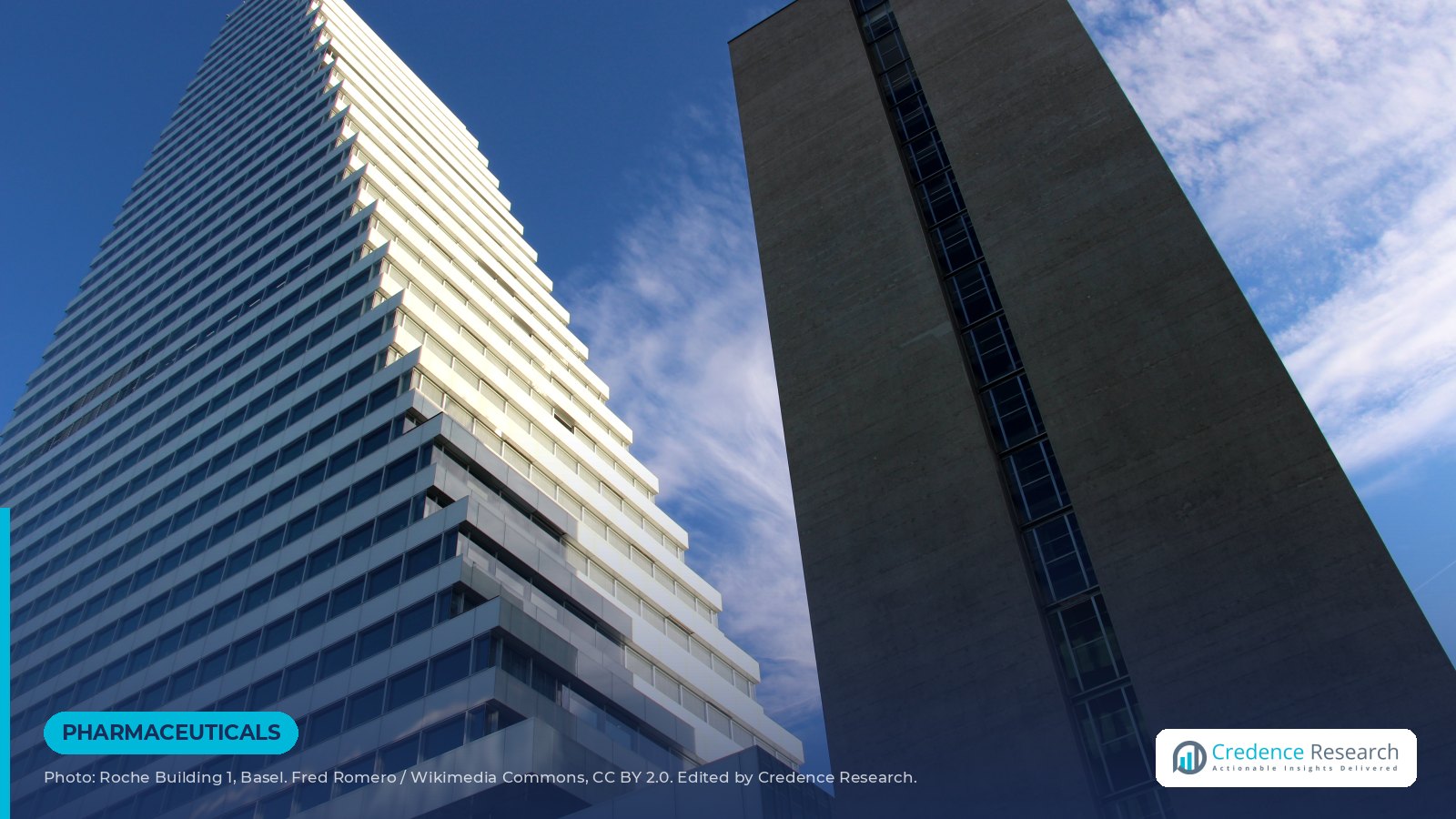
Image: Roche Building 1 in Basel, Switzerland, by Fred Romero via Wikimedia Commons, CC BY 2.0. Cropped and edited by Credence Research.

About the Author

Senior News Editor at Credence Research Inc