
LEGO to Build Automated Factory in Estarreja, Portugal, Creating More Than 1,000 Jobs
The LEGO Group will build its eighth factory worldwide in Estarreja, Portugal, the Danish toymaker announced on Nov. 23, 2026, at an event in the town. The plant, which media reports put at around 1 billion euros over several years, is designed to mould, process and pack LEGO products for Europe, the Middle East and Africa, and is expected to employ more than 1,000 people once fully running. Construction is scheduled to begin in the first half of 2027, with production projected to start in 2030.
Key developments
- LEGO plans a 115,000-square-meter factory in Estarreja, its fourth in Europe and eighth globally, handling end-to-end production from moulding to packing.
- The company says the site will be its most automated and advanced, with production and logistics infrastructure designed to accommodate potential expansions over time.
- Construction is expected to start in the first half of 2027, and production is projected to begin in 2030, creating more than 1,000 jobs.
- LEGO aims to source 100% renewable energy for the plant's annual needs, with about 80% expected from on-site solar panels and battery energy storage.
- Euronews, Investment Monitor and ESG Today reported the investment at about 1 billion euros, on a site of roughly 60 hectares.
Industry background
LEGO has spent the past several years moving production closer to the regions where its sets are sold. Its official announcement notes that a factory in Vietnam opened in April 2025, a new factory and regional distribution center in the United States remain on track for 2027, and an expansion of its plant in Mexico has been announced. Euronews reported that capacity at the company's Hungarian factory rose by 30% in 2025 and that LEGO opened a manufacturing innovation center in Billund, Denmark, in June 2026.
The company's existing European plants are in Denmark, Hungary and the Czech Republic. Estarreja will add a southwestern European node to that network. Euronews noted that the new factory will be less than half the size of the Nyíregyháza plant in Hungary by building area, which suggests the Portuguese site is planned as a focused, highly automated facility rather than a replacement for the larger hubs.
Estarreja sits in the Aveiro district of northern-central Portugal, an area with an established industrial and chemical base and road and port connections to the rest of the Iberian Peninsula. LEGO's chief operations officer, Carsten Rasmussen, said Portugal stood out because of its proximity to markets, access to transport links, commitment to sustainability and skilled local workforce.
Industry implications
The announcement shows how consumer goods manufacturers are treating regional production as a structural choice rather than a temporary hedge. By placing moulding and packing near end markets, LEGO says it can shorten its supply chain and reduce its environmental footprint. For a business that ships high volumes of relatively light but bulky boxed products, cutting long-haul freight and buffer inventory can matter as much as unit production cost.
The emphasis on automation is also notable. Rasmussen described Estarreja as the company's most automated and advanced site. That points to a factory built around high-speed injection moulding, automated material handling and a high-bay warehouse, which Investment Monitor said the plant will include. For equipment suppliers in moulding machinery, robotics, intralogistics and industrial software, multiyear greenfield builds of this kind represent sizable and visible project pipelines.
The energy plan carries its own message for heavy electricity users. Meeting about 80% of annual needs from on-site solar and storage is an ambitious target for a plastics processing plant, and it reflects a broader shift among manufacturers toward owning generation assets rather than relying only on power purchase agreements.
Competitive and supply chain implications
LEGO's network approach gives it multiple production points for each major region. Once Estarreja is running, European demand could be served from four plants, which reduces exposure to disruption at any single site and allows production to be balanced across countries. Competitors in toys and branded consumer products that still depend heavily on long Asian supply chains may face pressure to show similar resilience to retailers.
The project will also create demand for local suppliers in packaging, plastics, tooling maintenance, logistics and construction. Portugal has a sizable moulds and plastics industry, and a large anchor manufacturer can help deepen that supplier base. Over the construction period, the site will draw on contractors for buildings, utilities, solar installations and battery systems. LEGO also cited rainwater harvesting and reuse, pollinator habitats and a goal of LEED Platinum certification, which will shape the specification of building materials and systems.
Regional implications
For Portugal, the factory is one of the larger industrial investments announced in recent years and brings a well-known global brand to a mid-sized municipality. Euronews reported that Prime Minister Luís Montenegro attended the launch and said the government would work to make the land available and speed up construction. More than 1,000 jobs at full operation would be a significant employment addition for the Aveiro region.
For the wider European Union, the project fits a pattern of manufacturers adding capacity on the bloc's periphery, where land, labor and renewable resources can be more accessible. Portugal's strong solar resource supports LEGO's on-site energy plan, and its Atlantic ports and road links to Spain provide routes into Western Europe. The plant's stated remit across Europe, the Middle East and Africa also positions Iberia as a gateway to North African and Middle Eastern markets.
Credence Research analysis
LEGO's decision reflects a consistent strategy: build regional capacity well ahead of demand and design each plant for flexibility. The company did not disclose production capacity, but its statement that infrastructure can accommodate later expansion suggests Estarreja is intended as a long-term platform. A 2030 start also means the plant will be designed around automation, energy and certification standards that are likely to tighten over the decade, which can lower retrofit costs later.
The key execution risks are timing and permitting. The government's stated support for land availability and faster construction is a positive signal, but large greenfield industrial projects in Europe often face delays tied to environmental approvals, grid connection and labor availability. The on-site energy target will depend on securing enough land and grid arrangements for solar and storage. How quickly LEGO moves from announcement to groundbreaking in 2027 will show whether Portugal can deliver the speed that manufacturers increasingly expect.
What comes next
- Land, permitting and site preparation in Estarreja ahead of construction.
- Construction start, expected in the first half of 2027.
- Opening of LEGO's new U.S. factory and distribution center, on track for 2027.
- Recruitment and training as the Estarreja workforce builds toward more than 1,000 people.
- Production start in Portugal, projected for 2030.
Sources
- The LEGO Group: The LEGO Group to build new factory in Estarreja, Portugal
- Euronews: LEGO to build 1bn factory in Portugal, creating more than 1,000 jobs
- Investment Monitor: Denmark's Lego plans 1.1bn factory in Estarreja, Portugal
- ESG Today: LEGO plans new renewables-powered factory in Portugal
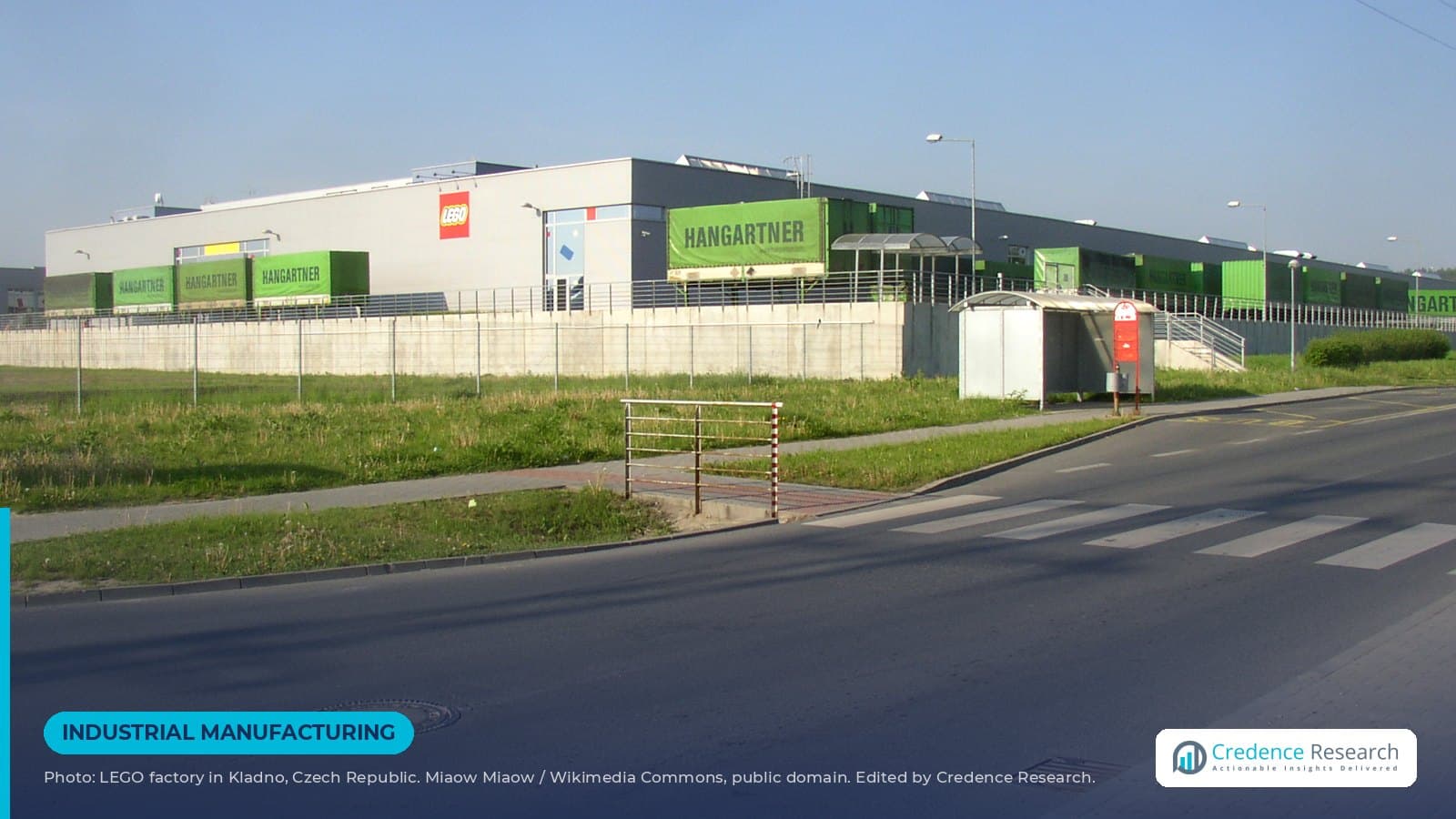
Image: LEGO factory in Kladno, Czech Republic, by Miaow Miaow via Wikimedia Commons, public domain. Cropped and edited by Credence Research.

About the Author

Senior News Editor at Credence Research Inc