
AOI signs four-year hyperscaler deal with $2.2 billion in committed 800G transceiver and laser purchases
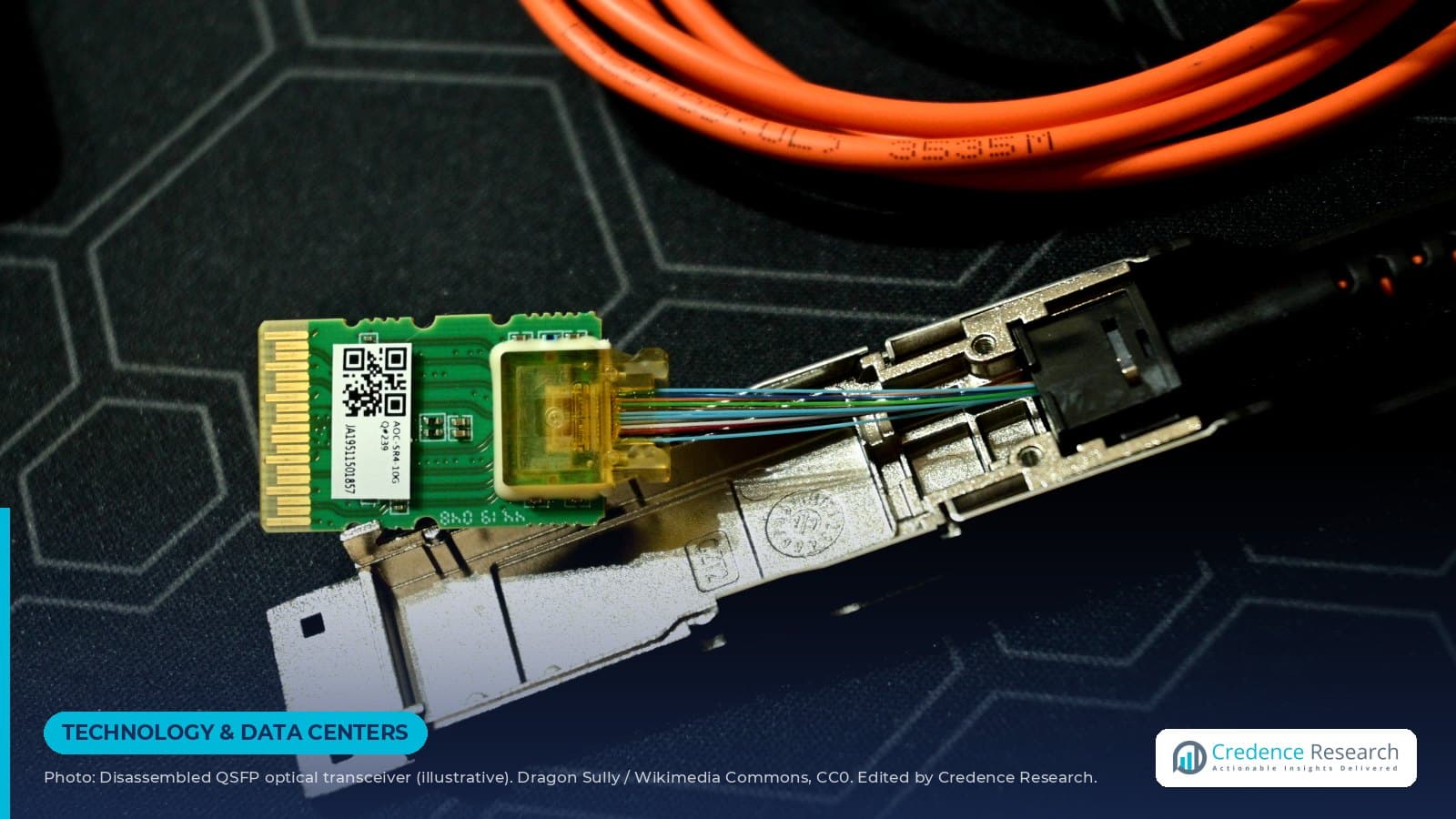
Applied Optoelectronics Inc., the Sugar Land, Texas, maker of optical networking components known as AOI, said Tuesday, Nov. 24, 2026, that it has signed a four-year long-term agreement with an existing Tier-1 hyperscale data center customer. The deal, which runs from December 2026 through December 2030, carries about $2.2 billion in minimum purchase commitments for 800G transceivers and laser diodes, and the company described it as its second such agreement with a separate hyperscale buyer. The customer was not named.
Key developments
- The agreement covers 800G transceivers and laser diodes over four years, December 2026 through December 2030, with room to add other products later.
- Minimum commitments total about $2.2 billion: roughly $1.5 billion of 800G transceivers in 2027 and roughly $0.7 billion of laser diodes across 2028 and 2029.
- Some of the laser diodes are expected to feed co-packaged optics (CPO) designs starting in 2028, and AOI plans to further expand laser manufacturing capacity in Texas.
- AOI committed to ship an agreed quantity of U.S.-made products starting in the first quarter of 2027, ramping through the year.
- The customer made no capital commitment. AOI will absorb a one-time $2 million expense to speed up product qualification.
How the technology works
Optical transceivers are the pluggable modules that convert electrical signals from switches and servers into light for transmission over fiber, then back again. In large AI clusters, thousands of graphics processors must exchange data at very high speed, and the links between racks, rows and buildings increasingly run on 800-gigabit-per-second optics. Each module relies on lasers, photodetectors, driver chips and precision assembly, and laser supply has long been one of the tighter points in the chain.
Co-packaged optics move the optical engine from the front panel of a switch onto the same package as the switch chip, cutting the electrical path and the power it consumes. Many CPO designs separate the high-power laser source from the photonic engine, which turns external lasers into a distinct component that system builders must buy in volume. AOI said its laser supply under the new agreement spans silicon photonics, near-packaged optics and CPO architectures.
AOI is vertically integrated. It makes its own lasers and runs engineering and manufacturing at its Sugar Land headquarters, with additional engineering and manufacturing in Taipei, Taiwan, and Ningbo, China, and research and development in Atlanta. CEO Thompson Lin said the second hyperscale agreement gives the company meaningful long-term revenue and demand visibility, and credited its automated manufacturing and in-house laser technology.
Industry implications
The agreement shows how hyperscale operators are now locking in optical components years ahead, the same way they have secured power, land and accelerator supply. A firm 2027 volume commitment for 800G modules signals that the buyer expects heavy cluster build-outs to continue through that year, while the laser tranche in 2028 and 2029 points to a planned shift toward co-packaged designs at the end of the decade.
AOI also disclosed that, based on long-term discussions with the customer, current demand exceeds $10 billion over the four years of the agreement. Chief Financial Officer Stefan Murry stressed that this figure is not guaranteed. The company said sales above the $2.2 billion floor depend on bringing new capacity online and on securing additional purchase commitments, and that demand estimates are not purchase orders or revenue guidance.
The structure matters as much as the headline number. Because the customer is not funding capacity, AOI carries the capital and execution risk of expansion. That differs from some recent AI infrastructure arrangements in which buyers prepay or co-invest to secure supply.
Competitive and supply chain implications
AOI competes with larger optical module and laser suppliers in the United States and Asia, including Coherent, Lumentum, InnoLight and Eoptolink, many of which have expanded 800G and 1.6T production to serve AI demand. A multi-year minimum commitment gives AOI a firmer planning base than spot purchase orders and may strengthen its hand when ordering equipment and components.
Capacity is the central constraint. In its third-quarter results on Nov. 5, AOI said its total manufacturing equipment capacity was approaching 330,000 units per month. It said it expected enough equipment for more than 500,000 pieces per month of 800G and 1.6T products by the end of 2026 and more than 1 million pieces per month by the end of 2027. In the same release, Murry said the company's 2027 U.S. capacity expansion would take longer to complete because obtaining electrical power was taking longer than expected.
The U.S.-made shipment commitment adds another layer. Hyperscalers have been seeking suppliers that can deliver from outside China as tariffs and export controls reshape electronics sourcing, and AOI's Texas footprint is a selling point in that environment. The company's forward-looking statements list tariffs, supply chain disruption, component availability and qualification timing among the risks to volumes.
Regional implications
For Texas, the deal reinforces Sugar Land, southwest of Houston, as a production site for AI data center optics. AOI said it plans to expand laser manufacturing capacity in the state to meet expected CPO-related demand, though it did not give a capacity target, an investment amount or a timeline for that expansion.
In Asia, the Taipei and Ningbo operations remain part of the manufacturing base, but the commitment to ramp U.S.-made shipments through 2027 suggests a growing share of hyperscale volume will be tied to domestic output. Power availability in Texas, which AOI already cited as a source of delay, will shape how quickly that shift can occur.
Credence Research analysis
The agreement is a meaningful step for a company of AOI's size. The firm reported third-quarter revenue of $269.9 million, including $155.6 million from its datacenter segment, so a $1.5 billion transceiver commitment for 2027 alone would represent a large increase in data center volume if delivered in full. That scale explains why execution, not demand, is the main question. AOI must qualify products with the customer, install equipment, secure power for its U.S. plants and hold yields as it ramps, all while funding expansion itself.
The laser portion may prove more strategically important than the transceiver tranche. Pluggable 800G modules are a crowded field with intense price pressure, while lasers for co-packaged optics are an emerging bottleneck with fewer qualified sources. By securing a laser commitment for 2028 and 2029, AOI positions itself as a component supplier for next-generation switch architectures, not only as a module assembler. The vendor-reported demand figure above the committed floor should be treated as an indicator of customer intent, not confirmed business.
What comes next
- Product qualification with the hyperscale customer, supported by the one-time $2 million expense, ahead of the December 2026 start of the agreement.
- First shipments of U.S.-made products in the first quarter of 2027, ramping through the year.
- Delivery of the roughly $1.5 billion 800G transceiver commitment during 2027.
- Further laser capacity expansion in Texas, with CPO-related laser shipments expected to start in 2028.
- Any additional purchase commitments that would convert part of the reported demand above $2.2 billion into firm orders.
Sources
- AOI: AOI Announces Multi-Year Long-Term Agreement with Tier-1 Hyperscale Datacenter Customer (PR Newswire, Nov. 24, 2026)
- AOI third-quarter 2026 results, Exhibit 99.1 to Form 8-K (SEC, Nov. 5, 2026)
Image: Disassembled QSFP optical transceiver (illustrative), by Dragon Sully via Wikimedia Commons, CC0. Cropped and edited by Credence Research.

About the Author

Senior News Editor at Credence Research Inc