
Merck, Moderna mRNA Therapy Intismeran Cuts Melanoma Recurrence Risk 42% in Phase 3 INTerpath-001
Merck and Moderna presented full Phase 3 results for intismeran autogene, an individualized mRNA neoantigen therapy, at the ESMO Congress 2026 Presidential Symposium I, showing that adding it to Keytruda (pembrolizumab) cut the risk of recurrence or death by 42% in patients with resected high-risk melanoma. The INTerpath-001 data, presented by principal investigator Georgina Long of Melanoma Institute Australia and accepted for publication in The New England Journal of Medicine, make intismeran the first individualized mRNA cancer therapy to succeed in a randomized Phase 3 trial. Moderna published a detailed recap of the results on Oct. 24, and the companies said they are engaging with regulators.
Key developments
- INTerpath-001 enrolled 1,137 patients with completely resected stage IIB to IV cutaneous melanoma, randomized 2:1 to intismeran plus Keytruda or placebo plus Keytruda.
- Recurrence-free survival, the primary endpoint, improved with a hazard ratio of 0.58 (95% CI 0.45-0.75; p<0.001) at a median follow-up of 24.6 months. Two-year RFS was 82.2% versus 70.0%.
- Distant metastasis-free survival improved with a hazard ratio of 0.62 (95% CI 0.45-0.85; p=0.002), with two-year rates of 88.5% versus 80.2%.
- The two arms tracked closely for the first six months; after six months, once the immunization course was underway, the hazard ratio fell to 0.42 in a pre-specified sensitivity analysis.
- Grade 3 to 5 treatment-related adverse events occurred in 14.2% of patients on the combination and 13.4% on Keytruda alone. Overall survival is immature.
How the therapy works
Intismeran (also known as V940 or mRNA-4157) is built for one patient at a time. Tumor and normal DNA are sequenced to find the mutations unique to that cancer, and a design algorithm selects up to 34 neoantigens. Those targets are encoded on a single synthetic mRNA molecule. Once injected, the body produces the neoantigens, and the immune system is trained to recognize and attack tumor cells carrying them. Pairing the therapy with a PD-1 inhibitor such as Keytruda is meant to keep those primed T cells active.
In the trial, patients received 1 mg of intismeran every three weeks for up to nine doses, alongside Keytruda at 400 mg every six weeks for up to nine cycles, or about one year. Moderna said the therapy was successfully manufactured for more than 99% of patients randomized to receive it, a key data point for a product that must be designed and produced from each patient's own tumor sample.
Results were consistent across risk groups. According to data reported by CancerNetwork from the presentation, the RFS hazard ratio was 0.60 in patients with stage IIB to IIIB disease and 0.57 in those with stage IIIC to IV disease. Overall survival showed a hazard ratio of 0.77 (95% CI 0.45-1.31), which did not reach statistical significance at this immature analysis.
Industry implications
For oncology, the result moves individualized neoantigen therapy from concept to Phase 3 evidence. Earlier cancer vaccines repeatedly failed in late-stage trials, and many companies scaled back in the field. A placebo-controlled win in more than 1,100 patients, with a clear separation in both recurrence and distant metastasis endpoints, is likely to draw fresh investment into personalized immunotherapy and the sequencing, bioinformatics and mRNA manufacturing it depends on.
For the mRNA sector, the data give Moderna a late-stage oncology asset at a time when demand for its respiratory vaccines has declined from pandemic levels. Moderna's forward-looking statements point to the potential for approval in 2027. For Merck, intismeran offers a way to extend the Keytruda franchise into combination regimens as the drug's key patents near expiry later this decade.
Safety will matter to adoption. Treatment discontinuation due to treatment-related adverse events was 14.0% with the combination versus 8.7% with Keytruda alone, according to the presented data, while severe event rates were similar. The most common side effects on the combination were fever, injection site pain and fatigue.
Competitive and supply chain implications
The data raise the bar for other individualized cancer vaccine programs, including BioNTech and Genentech's autogene cevumeran, which is in mid-stage trials in pancreatic and colorectal cancer. Rivals will now be judged against a Phase 3 benchmark rather than early-stage signals. Off-the-shelf neoantigen and shared-antigen vaccines also face a sharper comparison on efficacy versus speed and cost.
Individualized therapy creates a supply chain unlike that of a conventional drug. Each dose depends on tumor biopsy collection, rapid sequencing, computational design, small-batch mRNA synthesis, lipid nanoparticle formulation and cold-chain delivery back to the treating center. Turnaround time and manufacturing success rates will determine commercial viability as much as clinical data. The reported manufacturing success above 99% suggests the process can work at Phase 3 scale, but a commercial launch would require far larger throughput.
Suppliers of next-generation sequencing, nucleotides, capping reagents and lipids stand to benefit if the approach expands. Hospital pathology workflows and tissue handling standards may also need to adapt to support routine use.
Regional implications
The trial was global, and approvals would likely be sought first in the United States and Europe, where adjuvant Keytruda is already a standard option for resected high-risk melanoma. Australia, home to the principal investigator and one of the highest melanoma incidence rates in the world, is another priority market.
Health systems will face questions on reimbursement and logistics. Payers in Europe and other single-payer markets typically scrutinize the cost of personalized therapies closely, and access will depend on how quickly centers can ship tumor samples and receive individualized doses within the adjuvant treatment window.
Credence Research analysis
The most telling feature of INTerpath-001 is the shape of the benefit curve. Both arms performed alike for six months, then diverged once patients completed their immunization course. That pattern fits the expected biology of a vaccine that needs time to train T cells, and it lends credibility to the mechanism beyond a single headline hazard ratio. It also suggests that longer follow-up could widen the gap, which will be important as the overall survival analysis matures.
Commercial success now hinges on execution rather than proof of concept. Manufacturing a unique product for each patient at scale, securing reimbursement for a therapy layered on top of an established checkpoint inhibitor, and demonstrating survival benefit are the next hurdles. The three ongoing Phase 3 trials in non-small cell lung cancer will show whether the approach works beyond melanoma, a far larger opportunity for both companies.
What comes next
- Regulatory submissions in the United States and other markets, with the companies citing potential approval in 2027.
- Publication of the full INTerpath-001 results in The New England Journal of Medicine.
- Continued follow-up for overall survival, which was immature at this analysis.
- Readouts from the three ongoing Phase 3 INTerpath trials in non-small cell lung cancer.
- Progress in other INTerpath studies, including perioperative trials in gastric cancer and an early study in pancreatic cancer.
Sources
- Merck: Merck and Moderna will present results from landmark Phase 3 INTerpath-001 trial at ESMO 2026 Presidential Symposium
- Moderna: IR Insights, recapping the Phase 3 INTerpath-001 results
- CancerNetwork: INTerpath-001 data detail survival, subgroup and safety findings in melanoma
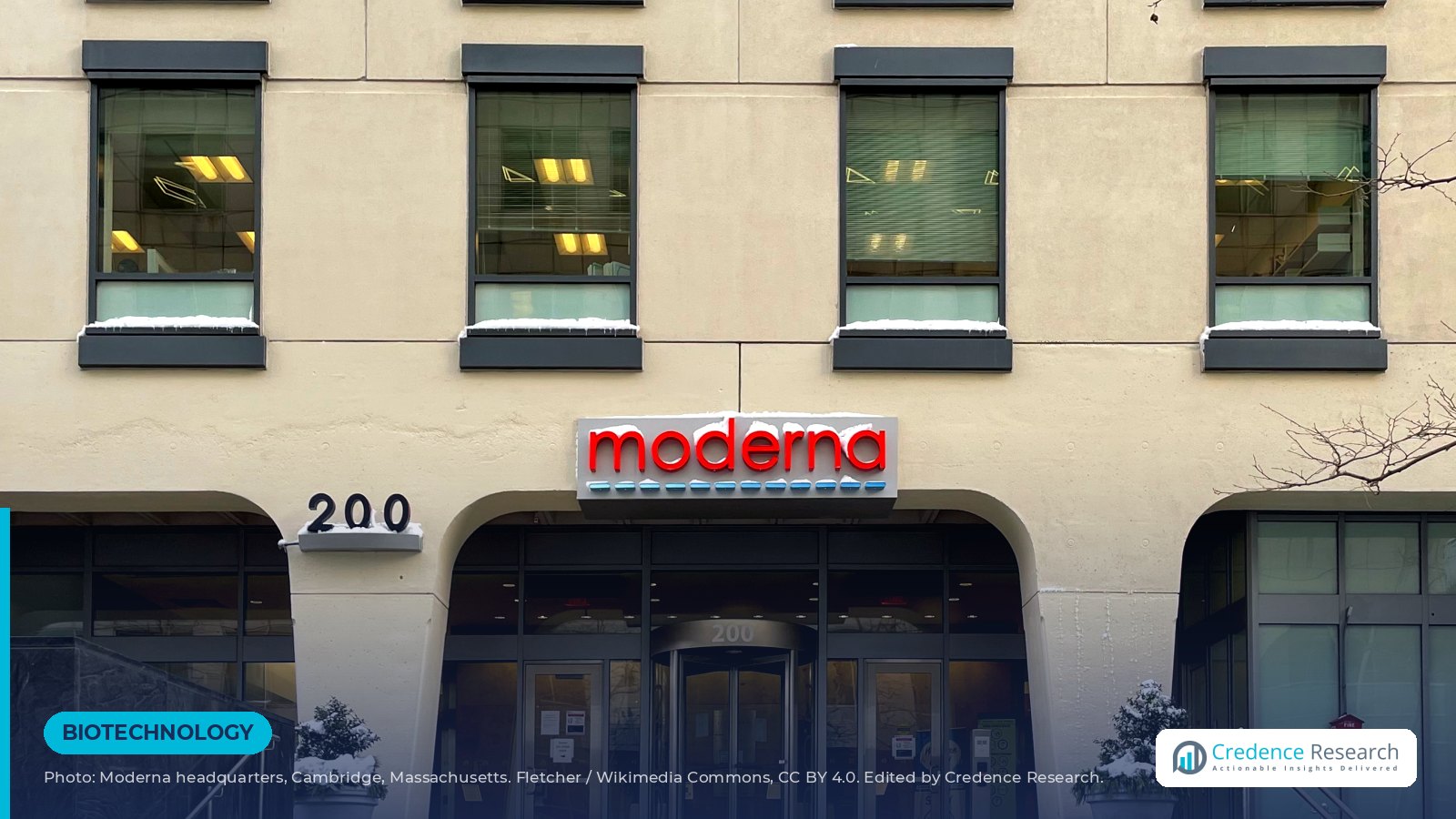
Image: Moderna headquarters in Cambridge, Massachusetts, by Fletcher via Wikimedia Commons, CC BY 4.0. Cropped and edited by Credence Research.

About the Author

Senior News Editor at Credence Research Inc