
Roche's divarasib beats sotorasib and adagrasib on survival in Phase III lung cancer trial
Roche's experimental KRAS G12C inhibitor divarasib extended survival over the two approved drugs in its class in a head-to-head Phase III trial, the Basel-based company said Oct. 25. The Krascendo 1 data were presented in a Presidential Symposium at the 2026 European Society for Medical Oncology (ESMO) Congress in Madrid and published the same day in The New England Journal of Medicine. In 338 adults with previously treated, advanced KRAS G12C-mutated non-small cell lung cancer, divarasib cut the risk of death by 44% versus Amgen's sotorasib or Bristol Myers Squibb's adagrasib.
Key developments
- Median overall survival was about 17.7 months with divarasib versus 12.0 months with sotorasib or adagrasib (hazard ratio 0.56; 95% CI 0.41-0.78; p=0.0005).
- Median progression-free survival by blinded independent central review, the primary endpoint, was 9.8 months versus 5.7 months (HR 0.58; 95% CI 0.44-0.76; p<0.0001). At 12 months, 44% of divarasib patients were progression-free, compared with 24% in the control arm.
- The confirmed objective response rate was 58% versus 32%, and median duration of response was 11.9 months versus 6.9 months.
- Fewer patients stopped treatment because of treatment-related side effects (4.8% versus 11.7%), and serious treatment-related adverse events occurred in 7.8% versus 15.2%.
- Roche said it is working with health authorities on access. Divarasib holds FDA Breakthrough Therapy Designation (2022) and Orphan Drug Designation (2026) for KRAS G12C-mutated lung cancer.
Trial and disease background
KRAS was considered "undruggable" for decades. The G12C variant occurs in roughly one in eight non-small cell lung cancers, according to Roche. It became the first KRAS mutation with approved targeted drugs. In 2021 the FDA granted accelerated approval to sotorasib, sold as Lumakras. Adagrasib, sold as Krazati, followed in 2022. Both are used mainly after patients progress on chemotherapy and immunotherapy. In their confirmatory trials against chemotherapy, the benefit of both drugs showed up mainly in progression-free survival.
Krascendo 1 (NCT06497556) is an open-label, randomized, multicenter study. It enrolled 167 patients to once-daily divarasib and 171 to the investigator's choice of once-daily sotorasib or twice-daily adagrasib. Roche says it is the only global head-to-head trial of a next-generation KRAS G12C inhibitor against the approved first-generation agents. The company disclosed in July that the study had met its progression-free survival endpoint and had shown a statistically significant overall survival gain at an interim analysis. The full numbers stayed under wraps until the ESMO presentation. Ferdinandos Skoulidis of MD Anderson Cancer Center, the lead author, described the drug's "practice-changing potential."
Divarasib was discovered by Roche and its U.S. unit Genentech. The oral drug locks the mutant KRAS protein in its inactive state. Roche said the survival and progression-free survival benefits were consistent across subgroups, including those defined by PD-L1 expression and KEAP1 mutation status.
Industry implications
The trial is unusual in oncology drug development. Most late-stage studies test a new agent against chemotherapy or placebo, not against approved rivals with the same mechanism. A clean survival win in a direct comparison gives regulators, guideline committees and payers a straightforward basis for ranking therapies. Levi Garraway, Roche's chief medical officer, said the data position divarasib as a potential "new standard of care" in previously treated patients.
The tolerability results may matter almost as much as the efficacy figures. KRAS G12C inhibitors carry class side effects, mainly gastrointestinal toxicity and liver enzyme elevations. Divarasib's discontinuation rate was less than half the control arm's, and patients stayed on treatment for a median of 11.3 months versus 5.0 months. Longer time on therapy generally means more drug dispensed per patient, which affects how payers will weigh a likely higher-priced, newer agent.
Competitive and supply chain implications
The results put pressure on Amgen and Bristol Myers Squibb in the second-line KRAS G12C setting. Bristol gained adagrasib through its 2024 purchase of Mirati Therapeutics. Both companies have been moving their drugs into combinations and earlier lines of treatment. Next-generation challengers are also advancing. Eli Lilly presented first-line data for its own KRAS G12C inhibitor, olomorasib, at the same congress, and several Chinese developers have G12C inhibitors approved or in development in China. A head-to-head survival benefit raises the bar for any newcomer seeking to displace the first-generation drugs.
Roche is building a broader franchise around the molecule. Krascendo 2 (NCT06793215) compares divarasib plus Merck's Keytruda with chemotherapy plus Keytruda as a chemotherapy-free first-line regimen. Krascendo 3 (NCT07541170) tests adjuvant divarasib after surgery and chemoimmunotherapy in stage II to IIIB disease. On the supply side, divarasib is a small-molecule oral tablet. That means a simpler manufacturing and distribution chain than the antibody-drug conjugates and bispecific antibodies dominating much of this year's ESMO program.
Regional implications
In the United States, the existing Breakthrough Therapy and Orphan Drug designations could support an expedited review once Roche files. Because the trial ran globally, the dataset is designed to support submissions in Europe and other major markets as well. The sotorasib and adagrasib approvals in Europe came through conditional pathways, and European health technology assessment bodies often favor direct comparative evidence. A head-to-head survival result fits that preference.
In Asia, KRAS G12C is less frequent among lung cancers than in Western populations because EGFR mutations are more common there. Even so, China and Japan remain large lung cancer markets, and domestic Chinese companies have their own G12C inhibitors on the market or in development. Roche has not disclosed filing timelines for any region.
Credence Research analysis
Krascendo 1 is one of the clearest examples of a "second-generation beats first-generation" readout in targeted oncology. A 44% reduction in the risk of death is a wide margin for a trial whose comparator is an active targeted drug rather than chemotherapy. Response rates nearly doubled and treatment-related discontinuations halved, so efficacy and tolerability point the same way. That should make the data hard for guideline panels to discount. The open-label design and the mix of two comparators will draw scrutiny. Neither appears large enough to undercut the survival result, which was measured on a hard endpoint.
The larger commercial question is whether divarasib can repeat this in first-line and adjuvant settings, where more patients are treated and for longer. Krascendo 2 will test whether a chemotherapy-free pairing with Keytruda can compete with chemoimmunotherapy. That bar is higher than beating sotorasib or adagrasib after relapse. For Amgen and Bristol Myers Squibb, the readout shifts the burden to their own combination programs to show a differentiated role. For the class overall, the data suggest that drug-level potency and selectivity, not just the target, now separate competitors.
What comes next
- Regulatory submissions for previously treated KRAS G12C-mutated lung cancer; Roche has not given filing dates.
- Readout of Krascendo 2 in first-line disease with pembrolizumab.
- Progress of the adjuvant Krascendo 3 study in resected stage II to IIIB disease.
- Responses from Amgen and Bristol Myers Squibb on combination strategies for sotorasib and adagrasib.
- Guideline updates from oncology bodies once the NEJM data are reviewed.
Sources
- Roche: Divarasib demonstrated best-in-class efficacy in previously treated KRAS G12C-mutated lung cancer (Oct. 25, 2026)
- Roche: Divarasib shows superiority in head-to-head Phase III trial (July 2, 2026)
- Roche: Pivotal data at ESMO 2026 (Oct. 19, 2026)
- ClinicalTrials.gov: Krascendo 1 (NCT06497556)
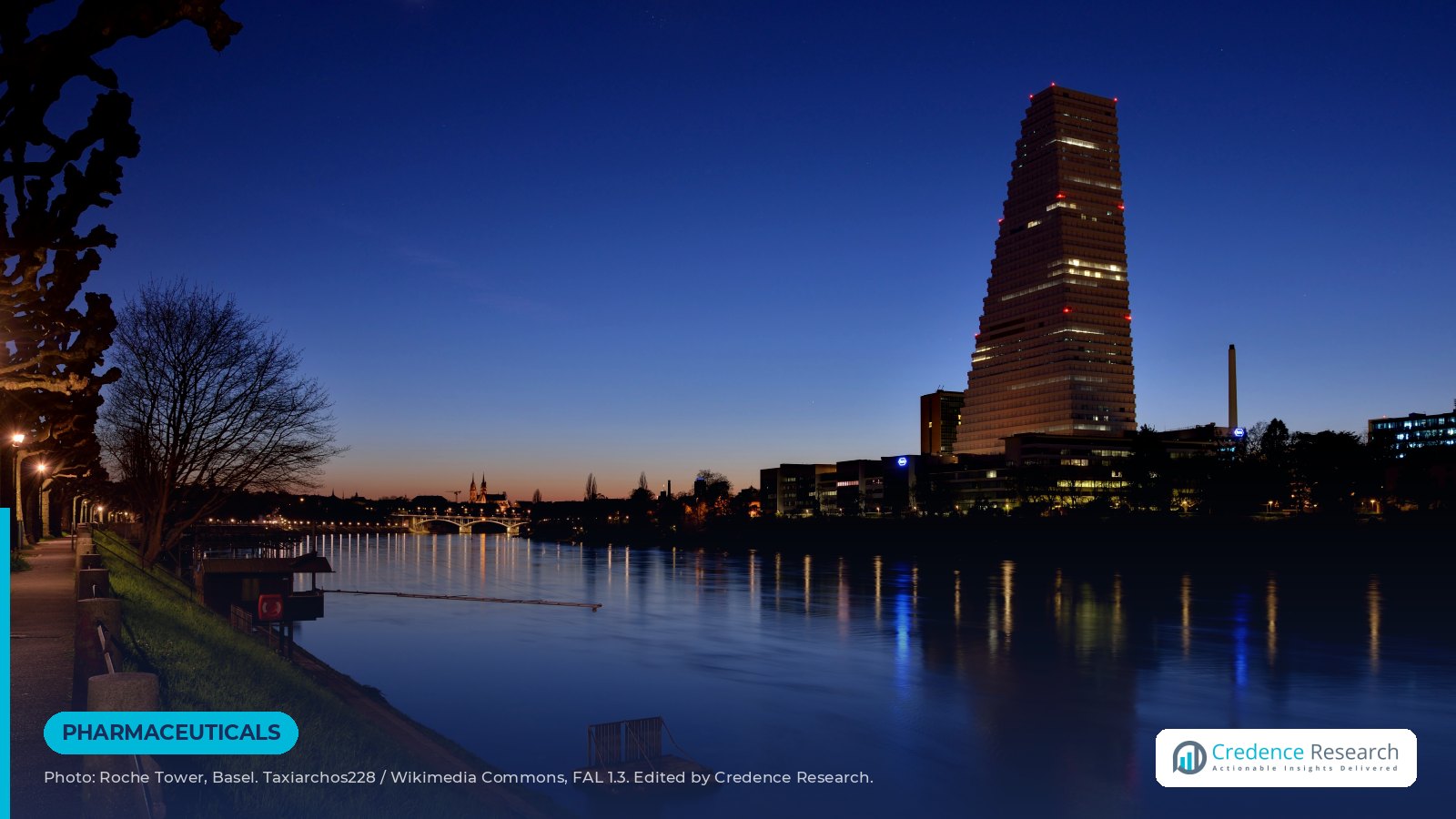
Image: Roche Tower in Basel at dusk, by Taxiarchos228 via Wikimedia Commons, Free Art License 1.3. Cropped and edited by Credence Research.

About the Author

Senior News Editor at Credence Research Inc