North America Anti-Infectives Market Overview:
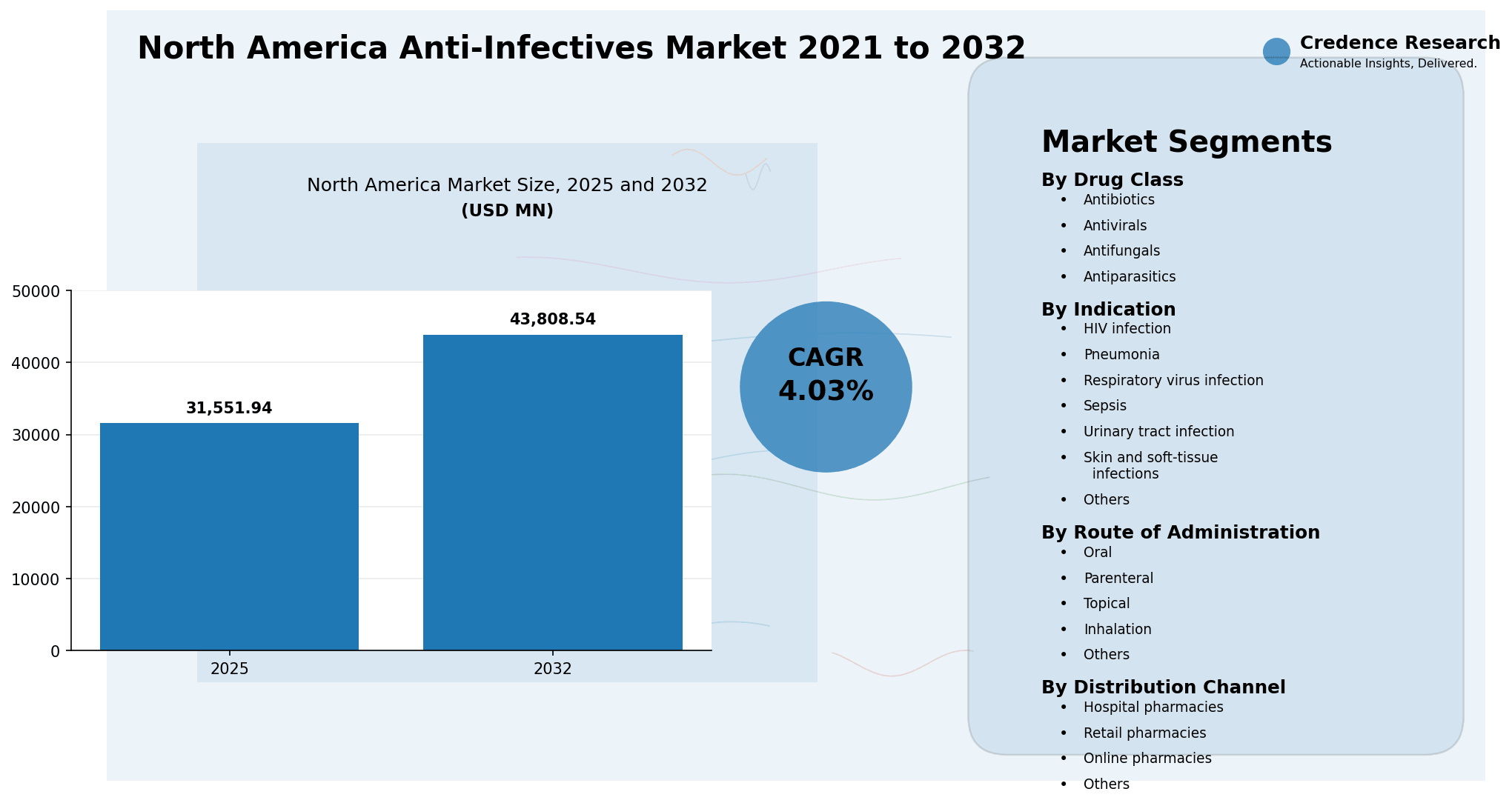
The North America Anti-Infectives Market size was valued at USD 26,431.85 MN in 2021 and reached USD 31,551.94 MN in 2025. It is anticipated to reach USD 43,808.54 MN by 2032, growing at a CAGR of 4.03% during the forecast period.
| REPORT ATTRIBUTE | DETAILS |
|---|---|
| Historical Period | 2021-2024 |
| Base Year | 2025 |
| Forecast Period | 2025-2032 |
| North America Anti-Infectives Market Size 2025 | USD 31,551.94 million |
| North America Anti-Infectives Market, CAGR | 4.03% |
| North America Anti-Infectives Market Size 2032 | USD 43,808.54 million |
North America Anti-Infectives Market Insights
- Market growth is supported by antimicrobial resistance, HIV treatment demand, respiratory virus burden, hospital-acquired infection management, urinary tract infection treatment and broader use of oral and parenteral anti-infective therapies.
- Antibiotics hold a strong position because bacterial infections such as pneumonia, sepsis, urinary tract infections and skin and soft-tissue infections require sustained inpatient and outpatient treatment.
- Antivirals remain a major drug class due to long-term HIV therapy, respiratory virus treatment and demand for COVID-19, influenza and other viral infection management.
- Retail Pharmacies remain a major distribution channel because oral antibiotics, antivirals, antifungals and chronic HIV therapies are frequently dispensed in outpatient settings.
North America Anti-Infectives Market Segment Insights
By drug class
By drug class, Antibiotics held a strong position in 2025 because they remain essential for treating bacterial pneumonia, urinary tract infection, sepsis, skin and soft-tissue infections and other common bacterial conditions. Antivirals support major demand due to chronic HIV therapy, influenza treatment, COVID-19 treatment and other respiratory virus applications. Antifungals remain important for hospital-based care, immunocompromised patients, invasive fungal infections and outpatient dermatologic or mucosal infections. Antiparasitics represent a smaller but clinically relevant category used for parasitic infections, travel-related diseases and selected public health needs. Growth across drug classes will depend on resistance patterns, new drug approvals, stewardship policies and access across hospital, retail and online pharmacy channels.
By indication
By indication, HIV Infection held a strong position in 2025 because patients require continuous antiretroviral therapy and long-term monitoring. Pneumonia and Respiratory Virus Infection support significant demand across inpatient, outpatient and seasonal care settings. Sepsis creates high-value hospital demand because treatment requires urgent parenteral anti-infective therapy and broad-spectrum coverage before organism identification. Urinary Tract Infection remains a major outpatient indication and supports continued antibiotic use, particularly where resistant pathogens limit older treatment options. Skin & Soft-Tissue Infections create steady demand for oral, topical and parenteral anti-infectives. Others include gastrointestinal infections, opportunistic infections, travel-related infections and hospital-acquired infections.
By route of administration
By route of administration, Oral held a strong position in 2025 because many community infections and chronic antiviral therapies are managed outside hospital settings. Oral antibiotics and antivirals are used widely for urinary tract infections, respiratory infections, skin infections and HIV treatment. Parenteral administration remains critical in hospitals for sepsis, severe pneumonia, invasive fungal infections and complicated bacterial infections. Topical therapies support dermatologic, ophthalmic, otic and mucosal infections. Inhalation remains more specialized but relevant in selected respiratory and antifungal therapies. Others include intramuscular, long-acting injectable and specialty delivery formats. Route growth will depend on severity, drug class, patient setting and adherence needs.
By distribution channel
By distribution channel, Retail Pharmacies held a strong position in 2025 because anti-infectives are frequently prescribed in outpatient care. Patients rely on retail pharmacies for oral antibiotics, antivirals, antifungals, topical therapies and chronic HIV medication refills. Hospital Pharmacies remain essential for severe infections, parenteral therapy, antimicrobial stewardship, ICU use and inpatient infectious disease management. Online Pharmacies are gaining traction through digital refills, home delivery and convenience for chronic therapies. Others include specialty pharmacies, mail-order channels, government procurement systems and integrated payer-provider pharmacy networks. Distribution growth will favor channels that improve rapid access, adherence and responsible antimicrobial use.
Key market drivers
Antimicrobial resistance and need for newer antibiotics
Antimicrobial resistance and the need for newer antibiotics represent major growth drivers for the North America Anti-Infectives Market. Resistant bacterial infections increase the need for differentiated antibiotics, susceptibility-guided prescribing and hospital stewardship programs. Demand is strongest across Pneumonia, Sepsis, Urinary Tract Infection and Skin & Soft-Tissue Infections because treatment failure can increase hospitalization risk and clinical cost.
CDC reports that more than 2.8 million antimicrobial-resistant infections occur each year in the U.S. and more than 35,000 people die as a result, while a 2025 CDC report highlighted a sharp rise in NDM-producing carbapenem-resistant Enterobacterales. This driver supports continued demand for new oral and parenteral antibacterial therapies across hospital and retail channels.
HIV treatment and prevention therapy expansion
HIV treatment and prevention therapy expansion supports strong antiviral demand across North America. HIV Infection requires long-term medication use, adherence support and continued product innovation across treatment and prevention. Antivirals benefit from chronic prescription demand, retail pharmacy refills, specialty pharmacy support and long-acting innovation.
Gilead reported full-year 2025 product sales of USD 28.9 billion, driven partly by higher HIV product sales, while Biktarvy sales increased 7% to USD 14.3 billion; the company also reported FDA approval of Yeztugo as the first twice-yearly HIV prevention option in the U.S. This driver will remain important as treatment continuity, prevention access and long-acting therapies reshape the antiviral segment.
Respiratory infection and seasonal viral burden
Respiratory infection and seasonal viral burden continue to strengthen anti-infective demand. Influenza, COVID-19, RSV and bacterial respiratory infections create recurring demand for antivirals, antibiotics, diagnostics-linked prescribing and hospital-based care during seasonal peaks. Respiratory virus burden also affects high-risk groups such as older adults, children and immunocompromised patients.
CDC’s 2024–2025 influenza season summary estimated 43 million to 73 million symptomatic flu illnesses, 19 million to 32 million medical visits, 560,000 to 1.1 million hospitalizations and 38,000 to 99,000 deaths in the U.S. This disease burden supports demand for antivirals, antibiotics for secondary bacterial infection and hospital pharmacy anti-infective management.
Urinary tract infection treatment innovation
Urinary tract infection treatment innovation supports market growth because UTIs remain common and resistance can limit older oral antibiotic options. Oral antibiotics are especially important in outpatient care because they allow treatment outside hospitals and reduce reliance on parenteral therapy.
FDA approved Blujepa in March 2025 based on two clinical trials involving 3,136 adult and adolescent female patients with uncomplicated UTI, while GSK said Blujepa was approved for female adults and pediatric patients aged 12 years and older with uncomplicated UTIs caused by specified susceptible microorganisms. This driver strengthens demand for newer oral antibiotics and retail pharmacy dispensing.
Key Trends and Opportunities
Oral anti-infective innovation gains traction
Oral anti-infective innovation is becoming a major opportunity because it supports outpatient treatment, earlier discharge and reduced hospital resource use. New oral antibiotics for urinary tract infections, chronic antivirals for HIV and oral therapies for selected fungal or respiratory infections strengthen outpatient care pathways. FDA’s 2025 novel drug approvals list included Blujepa for uncomplicated urinary tract infections, showing continued regulatory momentum for oral anti-infective innovation. Oral therapies also support Retail Pharmacies and Online Pharmacies because they can be dispensed through community-based channels. Growth will depend on resistance coverage, safety, affordability and stewardship alignment.
Long-acting antiviral therapy expands
Long-acting antiviral therapy is expanding as manufacturers seek to improve adherence, convenience and prevention coverage. HIV treatment and prevention are leading this shift, with injectable and longer-duration approaches reducing dosing burden compared with daily oral regimens. Gilead’s Yeztugo approval created the first twice-yearly HIV prevention option in the U.S., highlighting how delivery innovation can reshape antiviral access. Long-acting formats can improve patient persistence but require health care provider administration, follow-up testing and reimbursement coordination. This opportunity will favor companies that combine strong clinical efficacy with practical access programs.
Hospital stewardship and diagnostics-linked prescribing rise
Hospital stewardship and diagnostics-linked prescribing are rising as health systems manage resistance, treatment cost and patient safety. Hospitals increasingly use antimicrobial stewardship programs, susceptibility testing and infectious disease consultation to optimize antibiotic selection. This trend supports Parenteral therapies, hospital pharmacy oversight and diagnostic-guided use of broad-spectrum agents. It can also limit unnecessary prescribing, making evidence-based differentiation more important for new anti-infectives. Companies that provide data on resistance coverage, safety and appropriate-use protocols will gain stronger hospital acceptance. Stewardship-aligned commercialization will become central to sustainable antibiotic adoption.
Key Market Challenges
Stewardship pressure and restricted prescribing
Stewardship pressure and restricted prescribing remain key challenges for the North America Anti-Infectives Market. Hospitals and payers often restrict use of broad-spectrum or newer antibiotics to preserve effectiveness and limit resistance development. This can reduce commercial volume even when clinical need is strong. Antimicrobial stewardship programs may require infectious disease approval, culture confirmation or resistance-based criteria before use. Manufacturers must balance appropriate-use messaging with revenue growth. This challenge is especially important for premium antibiotics used in resistant infections and severe hospital settings.
Generic competition and pricing pressure
Generic competition and pricing pressure affect many anti-infective categories. Established antibiotics, antivirals, antifungals and antiparasitics often face low-cost generic competition, which limits branded revenue growth. Retail pharmacy channels are especially price-sensitive because many short-course infections are treated with generic oral drugs. Payers may prefer generics unless newer agents show clear resistance coverage, safety advantage or adherence benefit. Manufacturers must invest in differentiated products, new mechanisms and specialty indications to protect value. Pricing pressure will remain a major constraint through 2032.
Supply chain and shortage risks
Supply chain and shortage risks can affect anti-infective access because many products depend on global active pharmaceutical ingredient supply, sterile manufacturing and quality-controlled distribution. Hospital anti-infectives are especially sensitive because parenteral antibiotics and antifungals are critical in severe infections. Shortages can force substitutions, complicate stewardship decisions and increase clinical risk. Retail channels can also face disruption when seasonal infection demand rises quickly. Companies with resilient manufacturing, diversified sourcing and transparent supply planning will have an advantage. Supply reliability will become a key procurement factor for hospitals and payers.
Regional Analysis
United States
The United States leads the North America Anti-Infectives Market due to its large treated patient population, high drug spending, hospital-based infectious disease infrastructure and strong retail pharmacy network. Demand is strong across Antibiotics, Antivirals, Antifungals and selected Antiparasitics. HIV Infection, Pneumonia, Respiratory Virus Infection, Sepsis, Urinary Tract Infection and Skin & Soft-Tissue Infections create broad therapy demand. Hospital Pharmacies remain central for parenteral therapy, sepsis care, resistant infections and antimicrobial stewardship, while Retail Pharmacies support oral anti-infectives and chronic antiviral refills. The U.S. also drives new drug approvals and commercial launches, making it the primary revenue contributor through 2032.
Canada
Canada represents a steady anti-infectives market supported by public health systems, hospital infectious disease programs, retail pharmacy access and antimicrobial stewardship policies. Demand is concentrated across respiratory infections, urinary tract infections, HIV treatment, pneumonia, sepsis and skin infections. Hospital Pharmacies play a major role in parenteral therapy, inpatient stewardship and severe infection management. Retail Pharmacies support oral antibiotics, antivirals, antifungals and chronic medication refills. Market access depends on reimbursement, provincial formularies and clinical guidelines. Growth will remain steady as Canada balances infection management with responsible antimicrobial use.
Mexico
Mexico offers a smaller but expanding opportunity within North America. Demand is supported by respiratory infections, urinary tract infections, skin infections, HIV treatment access and growing private health care use. Retail Pharmacies remain important because oral anti-infectives are frequently accessed through outpatient channels. Hospital Pharmacies support severe infections, surgery-related infection control and inpatient antimicrobial use. Affordability and appropriate-use challenges shape treatment patterns. Online Pharmacies are emerging gradually as digital ordering and delivery models expand. Growth will depend on diagnosis quality, physician prescribing, public health programs and access to newer branded therapies.
Report Attribute Details
| Report Attribute | Details |
| Historical Period | 2021–2024 |
| Base Year | 2025 |
| Forecast Period | 2025–2032 |
| Market Size in 2021 | USD 26,431.85 MN |
| Market Size in 2025 | USD 31,551.94 MN |
| Market Size in 2032 | USD 43,808.54 MN |
| CAGR | 4.03% |
| Segments Covered | Drug Class, Indication, Route of Administration, Distribution Channel and Geography |
| Key Companies Covered | Abbott Laboratories, Astellas Pharma Inc, Bayer AG, Bristol-Myers Squibb Co., Gilead Sciences Inc., GlaxoSmithKline plc, Merck & Co. Inc., Novartis AG, Pfizer Inc., Sanofi SA, Lupin Ltd., Dr. Reddy’s Laboratories Ltd. and Glenmark Pharmaceuticals Ltd. |
North America Anti-Infectives Market Segmentations
By Drug Class
- Antibiotics
- Antivirals
- Antifungals
- Antiparasitics
By Indication
- HIV Infection
- Pneumonia
- Respiratory Virus Infection
- Sepsis
- Urinary Tract Infection
- Skin & Soft-Tissue Infections
- Others
By Route of Administration
- Oral
- Parenteral
- Topical
- Inhalation
- Others
By Distribution Channel
- Hospital Pharmacies
- Retail Pharmacies
- Online Pharmacies
- Others
Key Players
- Abbott Laboratories
- Astellas Pharma Inc
- Bayer AG
- Bristol-Myers Squibb Co.
- Gilead Sciences Inc.
- GlaxoSmithKline plc
- Merck & Co. Inc.
- Novartis AG
- Pfizer Inc.
- Sanofi SA
- Lupin Ltd.
- Reddy’s Laboratories Ltd.
- Glenmark Pharmaceuticals Ltd.
Recent Developments
- In March 2025, FDA approved GSK’s Blujepa for uncomplicated urinary tract infections in female adults and pediatric patients aged 12 years and older, supported by two clinical trials involving 3,136 patients.
- In June 2025, Gilead announced FDA approval of Yeztugo, a twice-yearly injectable HIV-1 capsid inhibitor for PrEP in adults and adolescents weighing at least 35 kg.
- In 2025, Gilead reported Biktarvy sales of USD 14.3 billion, up 7%, and total product sales of USD 28.9 billion, supported partly by higher HIV product sales.
- In 2025, FDA listed Blujepa among novel drug approvals for uncomplicated urinary tract infections, supporting continued regulatory momentum for anti-infective innovation.
Report Coverage
The research report offers an in-depth analysis based on drug class, indication, route of administration, distribution channel and geography. It details leading market players, providing an overview of their business positioning, anti-infective portfolios, antiviral franchises, antibiotic strategies, generic presence and strategic role in the North America Anti-Infectives Market. The report includes insights into the competitive environment, market trends, growth drivers, restraints and opportunities. It also examines antimicrobial resistance, HIV therapy demand, respiratory infection burden, UTI innovation, hospital stewardship, oral therapy adoption and pharmacy channel evolution as major factors shaping market development. The report assesses the impact of stewardship restrictions, generic pricing pressure, supply chain risks and resistance patterns on market growth. It provides strategic recommendations for pharmaceutical companies, hospital systems, retail pharmacy networks, online pharmacies, payers, distributors, investors and new entrants seeking to navigate North America’s anti-infectives ecosystem.
Future Outlook
- Demand for anti-infectives will continue to rise as bacterial, viral, fungal and parasitic infections require sustained treatment across inpatient and outpatient settings.
- Antibiotics will remain a leading drug class due to demand across pneumonia, sepsis, urinary tract infections and skin and soft-tissue infections.
- Antivirals will remain a major category due to chronic HIV therapy, long-acting prevention innovation and recurring respiratory virus treatment needs.
- Antifungals will gain importance in hospitals due to immunocompromised patient populations and invasive infection risk.
- Oral therapies will remain central to outpatient infection management and retail pharmacy dispensing.
- Parenteral therapies will remain critical in severe infections, sepsis, resistant pathogens and hospital-based care.
- Retail Pharmacies will remain a major distribution channel for oral anti-infectives and chronic antiviral refills.
- Hospital Pharmacies will remain essential for stewardship, parenteral anti-infectives, resistant infections and ICU care.
- Online Pharmacies will gain relevance through refill convenience, home delivery and chronic antiviral access.
- Competition will increase as companies compete on resistance coverage, dosing convenience, safety profile, affordability, stewardship alignment and supply reliability.

Request a Free Sample
Fill in your details and we'll send you a free sample report.
- Sample data tables & charts
- Research methodology
Need a Custom Version of This Report?
Tailor the scope, geography, or segments to your exact requirements.
- Custom geography or segment scope
- Direct access to our analyst team
Frequently Asked Questions
What is the current market size for the North America Anti-Infectives Market and what is its projected size in 2032?
At what CAGR is the North America Anti-Infectives Market projected to grow?
Which drug class segment is expected to lead the market?
Which indication supports strong market demand?
Which route of administration holds strong demand?
Who are the leading companies in the market?
Which geography leads the North America market?
Table of Content
Chapter 1 Market Segmentation
- 1.1 Segmentation Framework
- 1.1.1 Product and Service Classification
- 1.1.2 Application and End-Use Classification
- 1.1.3 Technology and Solution Classification
- 1.1.4 Customer and Distribution Channel Classification
- 1.1.5 Geographic Segmentation
- 1.1.6 Market Segment Definitions and Boundaries
Chapter 2 Introduction
- 2.1 Report Objectives and Scope
- 2.2 Product Definition and Industry Terminology
- 2.3 Market Inclusions and Exclusions
- 2.4 Research Process
- 2.4.1 Primary Research and Expert Interviews
- 2.4.2 Secondary Research and Source Review
- 2.4.3 Top-Down and Bottom-Up Estimation
- 2.4.4 Data Triangulation and Verification
- 2.5 Market Size Measurement Basis
- 2.5.1 2025: USD 31,551.94 MN → 2032: USD 43,808.54 MN
- 2.6 Historical and Forecast Reference Periods
- 2.6.1 Base Year: 2025
- 2.6.2 Forecast Period: 2025-2032
- 2.7 Research Assumptions and Limitations
Chapter 3 Executive Summary
- 3.1 Market Snapshot and Key Findings
- 3.2 Base-Year Market Size, 2025
- 3.3 Forecast Market Size, 2032
- 3.4 Revenue and Volume Growth Outlook
- 3.5 Key Demand and Supply Indicators
- 3.6 Leading Market Segments
- 3.7 Fastest-Growing Market Opportunities
- 3.8 Regional Performance Highlights
- 3.9 Technology and Industry Transformation
- 3.10 Competitive Landscape Summary
- 3.11 Analyst View and Strategic Implications
Chapter 4 North America Anti-Infectives Market Trends and Developments
- 4.1 Historical Industry Development
- 4.2 Recent Market Trends and Developments
- 4.3 Demand and Customer Behavior Trends
- 4.4 Technology and Product Innovation
- 4.5 Artificial Intelligence, Automation and Digitalization
- 4.6 Local Manufacturing and Supply Chain Realignment
- 4.7 Industry Partnerships, Mergers and Acquisitions
- 4.8 Sustainability and Circular Economy Developments
- 4.9 Government and Private Sector Investment Trends
- 4.10 Emerging Business Models and Commercialization
- 4.11 Industry Developments and Announcements
Chapter 5 North America Anti-Infectives Market Production, Supply and Demand Analysis
- 5.1 Demand Trend and Consumption Analysis
- 5.2 Demand Forecast, 2025-2032
- 5.3 Production and Output Trend
- 5.4 Production and Output Forecast, 2025-2032
- 5.5 Installed Capacity and Capacity Utilization
- 5.6 Company-Wise Production Plants and Statistics
- 5.6.1 Installed Production Capacity
- 5.6.2 Actual Production
- 5.6.3 Planned Capacity and Expansion Targets
- 5.7 Supply Chain Structure and Procurement Trends
- 5.8 Supply-Demand Gap and Bottlenecks
- 5.9 Import Dependence and Sourcing Structure
- 5.10 Contract Manufacturing and Outsourcing
- 5.11 Regional Supply and Demand Concentration
Chapter 6 North America Anti-Infectives Market Pricing Analysis
- 6.1 Pricing Structure and Measurement
- 6.2 Historical Pricing Trends
- 6.3 Pricing Outlook, 2025-2032
- 6.4 Average Selling Price and Unit Economics
- 6.5 Pricing by Product and Market Segment
- 6.6 Geographic Pricing Differences
- 6.7 Key Input, Energy, Labor and Logistics Costs
- 6.8 Contract Pricing and Purchasing Models
- 6.9 Pricing Sensitivity and Competitive Positioning
- 6.10 Price, Margin and Profitability Implications
Chapter 7 North America Anti-Infectives Market Dynamics
- 7.1 Market Growth Drivers
- 7.1.1 Demand-Side Drivers
- 7.1.2 Technology and Innovation Drivers
- 7.1.3 Infrastructure and Investment Drivers
- 7.1.4 Regulatory and Policy Drivers
- 7.2 Market Restraints
- 7.2.1 Cost and Affordability Constraints
- 7.2.2 Technology and Adoption Barriers
- 7.2.3 Supply Chain and Operational Constraints
- 7.3 Market Challenges
- 7.3.1 Competitive Pressure and Margin Erosion
- 7.3.2 Skills, Infrastructure and Implementation Gaps
- 7.4 Emerging Market Opportunities
- 7.5 Market Dynamics Impact and Time-Horizon Assessment
Chapter 8 North America Anti-Infectives Value Chain Analysis
- 8.1 Industry Value Chain Overview
- 8.2 Upstream Suppliers and Critical Inputs
- 8.3 Technology and Component Providers
- 8.4 Manufacturing or Service Delivery
- 8.5 Distribution, Channel Partners and Integrators
- 8.6 Downstream Applications and End Users
- 8.7 Value Addition and Profit Pools
- 8.8 Vertical Integration and Outsourcing
- 8.9 Supplier Concentration and Risk
- 8.10 Supply Chain Localization and Resilience
Chapter 9 North America Anti-Infectives Market Regulations and Policies
- 9.1 Relevant Laws, Standards and Compliance Frameworks
- 9.2 Product, Service, Safety and Quality Requirements
- 9.3 Government Policies, Incentives and Subsidies
- 9.4 Imports, Exports and Trade Barriers
- 9.5 Public Procurement and Local Content Requirements
- 9.6 Environmental and Sustainability Compliance
- 9.7 Upcoming Policy Changes and Market Implications
Chapter 10 North America Anti-Infectives Market Hotspots and Opportunities
- 10.1 Market Opportunity Mapping and Growth Hotspots
- 10.2 High-Growth Applications and Customer Groups
- 10.3 Underserved Markets and White-Space Opportunities
- 10.4 Emerging Technology and Product Opportunities
- 10.5 New Capacity and Investment Hotspots
- 10.6 Market Entry and Expansion Opportunities
- 10.7 Distribution and Partnership Opportunities
- 10.8 Near-Term and Long-Term Commercial Potential
- 10.9 Opportunity Attractiveness and Execution Risks
Chapter 11 North America Anti-Infectives Market Outlook, 2025-2032
- 11.1 Market Size and Analysis
- 11.1.1 Revenue (Market Measurement: 2025: USD 31,551.94 MN → 2032: USD 43,808.54 MN)
- 11.1.2 Market Volume and Quantity Sold
- 11.1.3 Historical Market Size
- 11.1.4 Base-Year Market Size, 2025
- 11.2 Market Forecast, 2025-2032
- 11.2.1 Revenue Forecast to 2032
- 11.2.2 Volume Forecast to 2032
- 11.2.3 CAGR and Year-on-Year Growth
- 11.2.4 Incremental Revenue Opportunity
- 11.3 Forecast Assumptions and Scenario Analysis
- 11.3.1 Base-Case Forecast
- 11.3.2 Optimistic and Conservative Scenarios
- 11.3.3 Technology, Pricing and Policy Sensitivities
- 11.4 Market Attractiveness and Growth Outlook
Chapter 12 North America Anti-Infectives Market Segmentation and Outlook
- 12.1 Segmentation Summary and Market Shares, 2025
- 12.2 Largest and Fastest-Growing Segments
- 12.3 Segment Growth Comparison
- 12.4 Segment Attractiveness and Priority Matrix
Chapter 13 North America Anti-Infectives Geographic Market Outlook, 2025-2032
- 13.1 Regional Market Size and Country-Level Shares, 2025
- 13.2 Country Market Size Comparison, 2025
- 13.3 Country Market Forecasts, 2025-2032
- 13.4 Subregional Industrial and Demand Clusters
- 13.5 Intra-Regional Pricing and Cost Differences
- 13.6 Cross-Border Trade and Supply Networks
- 13.7 Regional Supply and Demand Balances
- 13.8 Country Opportunity Comparison and Prioritization
Note: Every listed country is covered on the structure shown under the first country.
Chapter 14 North America Anti-Infectives Technology, Innovation and Sustainability Outlook
- 14.1 Technology Landscape and Maturity
- 14.2 Product, Process and Service Innovation
- 14.3 AI, Automation and Digital Tools in the Industry
- 14.4 Technology Adoption and Performance Benchmarking
- 14.5 Innovation Pipeline and R&D Investment
- 14.6 Patent and Intellectual Property Trends
- 14.7 Energy Efficiency and Resource Management
- 14.8 Sustainability, Recycling and Circularity
- 14.9 Technology Roadmap, 2025-2032
- 14.10 Risks of Obsolescence and Technology Substitution
Chapter 15 North America Anti-Infectives Market Key Strategic Imperatives
- 15.1 Growth and Market Entry Priorities
- 15.2 High-Return Products and Segments
- 15.3 Pricing, Profitability and Cost Optimization
- 15.4 Technology Investment and Product Differentiation
- 15.5 Supply Chain Localization and Resilience
- 15.6 Distribution and Customer Acquisition
- 15.7 Partnership, Acquisition and Capacity Strategy
- 15.8 Regional Expansion Priorities
- 15.9 Short-, Medium- and Long-Term Actions
Chapter 16 Competition Outlook
- 16.1 Industry Competition Characteristics
- 16.2 Market Structure and Concentration
- 16.3 Market Share and Competitive Positioning, 2025
- 16.4 Company-Wise Revenue and Product Benchmarking
- 16.5 Production and Service Capacity Benchmarking
- 16.6 Technology, Pricing and Differentiation
- 16.7 Regional Footprint and Distribution Strength
- 16.8 Mergers, Acquisitions and Strategic Alliances
- 16.9 New Entrants and Competitive Threats
- 16.10 Porter's Five Forces and Industry Attractiveness
- 16.11 Competitive Outlook, 2025-2032
Chapter 17 Company Profiles
- 17.1 Company Coverage and Selection Criteria
- 17.2 Leading Market Participants – Standard Profile Structure
- 17.2.1 Business Description
- 17.2.2 Company Ownership and Geographic Presence
- 17.2.3 Product and Service Portfolio
- 17.2.4 Manufacturing and Operating Footprint
- 17.2.5 Production Capacity and Expansion Plans
- 17.2.6 Financial Performance and Investment
- 17.2.7 Market Share and Competitive Position
- 17.2.8 Technology and Innovation Capabilities
- 17.2.9 Strategic Alliances or Partnerships
- 17.2.10 Recent Developments
- 17.2.11 Growth Strategy and Outlook
- 17.3 Other Relevant Market Participants
Note: Every listed company is profiled on the structure shown under the first company. The company list is preliminary and may change based on research findings, market developments, data availability and client requirements.
Chapter 18 Disclaimer
- 18.1 Research and Forecast Disclaimer
- 18.2 Data Source and Estimation Limitations
Note: The depth of individual sections depends on data availability for this market. Volume, capacity, trade and other unit-based metrics are included where applicable.