
Microsoft Picks Intel Foundry EMIB Packaging for Azure Silicon, Secures Multi-Year Xeon Supply
Microsoft will use Intel Foundry's EMIB advanced packaging for its own Azure silicon, becoming the first company to publicly announce that choice, under an expanded long-term infrastructure agreement the two companies disclosed Nov. 18 from Redmond, Washington, and Santa Clara, California. The deal also secures multi-year supply of Intel Xeon server processors for Azure, including the next-generation chips code-named Diamond Rapids, and extends joint work on memory expansion, data acceleration and confidential computing in Microsoft's cloud.
Key developments
- Microsoft is the first company to announce that it will use Intel Foundry's Embedded Multi-die Interconnect Bridge (EMIB) packaging for Azure first-party silicon.
- The agreement covers multi-year Intel Xeon supply capacity for Azure, including next-generation Diamond Rapids server CPUs.
- Azure M-series v4 virtual machines pair Xeon 6 processors with Compute Express Link (CXL) memory, which the companies said delivers up to 2.3 times greater performance and memory flexibility in internal testing.
- Azure is offering what the companies described as the first cloud virtual machines enabled with Intel QuickAssist Technology, with up to 2.5 times faster SQL Server backups in vendor tests.
- The same day, Intel CEO Lip-Bu Tan said the company had signed its first outside customer for its 18A manufacturing process, without naming it, CNBC reported.
How EMIB packaging works
EMIB connects several chips, or chiplets, inside one package through a very small silicon bridge set into a cavity in the package substrate. Competing 2.5D approaches typically place all dies on a large silicon interposer. Intel's bridge carries dense wiring only where neighboring dies meet, which lets the rest of the package use conventional substrate routing. Intel says the technology has been in high-volume manufacturing since 2017.
Intel has since added variants aimed at artificial intelligence hardware. EMIB-M adds metal-insulator-metal capacitors to the bridge to steady power delivery, while EMIB-T adds through-silicon vias that carry power vertically, a feature designed for chips that sit beside high-bandwidth memory stacks. In a July 29 update, Intel said its packaging technologies can already build packages eight times the industry-standard reticle limit, and it described Fab 9 in Rio Rancho, New Mexico, as a U.S. advanced packaging hub with 2,700 employees and 500 suppliers.
The Microsoft relationship with Intel Foundry is not new. At Intel Foundry Direct Connect in February 2024, Microsoft Chairman and CEO Satya Nadella said Microsoft had chosen a chip design it planned to produce on the Intel 18A process. The Nov. 18 announcement is the first time Microsoft has publicly committed Azure silicon to Intel's packaging lines.
Industry implications
Hyperscale cloud providers are designing more of their own accelerators and processors, and advanced packaging has become a gating step in turning those designs into shipped hardware. Large AI chips now combine compute dies, input/output dies and memory stacks in a single package, so access to packaging capacity can matter as much as access to leading-edge wafers. A named hyperscaler customer gives Intel Foundry a reference account in the part of its business that can serve chips built on other companies' wafers.
The CPU side of the agreement carries its own weight. Multi-year Diamond Rapids capacity commits Azure to Intel's next server generation at a time when cloud providers also deploy Arm-based designs, including Microsoft's own processors. The CXL, QuickAssist and Trust Domain Extensions work shows Intel competing on platform features that cut memory cost and offload routine data tasks, not on core counts alone. Intel TDX encrypts virtual machine memory and CPU register state as confidential workloads move between hosts.
Competitive and supply chain implications
Advanced packaging for AI chips has been concentrated among a small group of foundries and outsourced assembly and test providers in Asia. Microsoft's EMIB selection adds a U.S.-based option to its supply base, though neither company disclosed which Azure chips, volumes or production sites are involved. For chip designers, a second qualified packaging route can reduce exposure to capacity shortages and to single-region disruptions.
Tan's comments added a second signal for Intel's foundry unit. Speaking at the TomorrowX Summit in Austin, Texas, he said Intel had just signed its first external 18A customer, CNBC reported. Intel technology chief Pushkar Ranade said on X that the customer signed for the 18A-P variant, which entered risk production in June, according to the same report. Intel did not identify the customer, and the companies did not link the 18A agreement to Microsoft's packaging decision.
CNBC also noted that the U.S. government took a 10% stake in Intel in August 2025 and that Nvidia invested $5 billion in the company. Those ties, together with Microsoft's commitment, give Intel Foundry several large stakeholders with an interest in a domestic manufacturing alternative.
Regional implications
In the United States, the agreement supports Intel's case that it can supply both leading-edge logic and advanced packaging onshore, a goal of federal chip policy since the 2022 CHIPS and Science Act. Intel's packaging operations in New Mexico and Arizona, along with its Oregon development sites, are positioned to benefit if EMIB orders scale, although the companies did not say where Microsoft's parts will be assembled.
For Asia, the effect is more gradual. Taiwan remains the center of AI chip production and packaging, and a single hyperscaler adding a U.S. packaging source does not change that balance in the near term. It does indicate that large buyers are qualifying alternatives, which Asian suppliers will weigh as they plan their own capacity. In Europe, Azure customers stand to gain from the confidential computing and memory features as they roll out across Microsoft's regional data centers.
Credence Research analysis
The packaging award is the more consequential half of this agreement. Xeon supply deals between Intel and the large clouds are routine, but a hyperscaler committing in-house silicon to Intel's packaging lines is the kind of external validation Intel Foundry has needed. Because EMIB can package dies made elsewhere, it offers Intel a path to foundry revenue that does not depend on winning every wafer decision, and it gives Microsoft supply flexibility without moving its entire chip program to a single process.
The open questions are scale and timing. The companies disclosed no financial terms, contract length, product names or delivery schedule, and the performance figures come from vendor-run tests. Tan's unnamed 18A customer is encouraging for Intel's manufacturing roadmap, but until that customer is identified and volumes ship, it remains a signal rather than proof. Investors and chip buyers will judge the agreement by whether Azure parts packaged on EMIB reach production in meaningful quantities.
What comes next
- Identification of the Azure first-party chips that will use EMIB packaging and their production timing.
- Deployment of Diamond Rapids Xeon processors in Azure under the multi-year supply agreement.
- Wider availability of CXL-equipped M-series v4 and QuickAssist-enabled virtual machines across Azure regions.
- Disclosure of the first external Intel 18A-P customer and its production ramp.
- Further foundry and packaging customer announcements as Intel builds out EMIB-T for high-bandwidth memory designs.
Sources
- Intel: Microsoft and Intel deepen collaboration to deliver differentiated Azure infrastructure
- Microsoft Source: Microsoft and Intel deepen collaboration
- Intel: Intel Launches World's First Systems Foundry Designed for the AI Era (February 2024)
- CNBC: Intel signs first external customer for advanced 18A chips
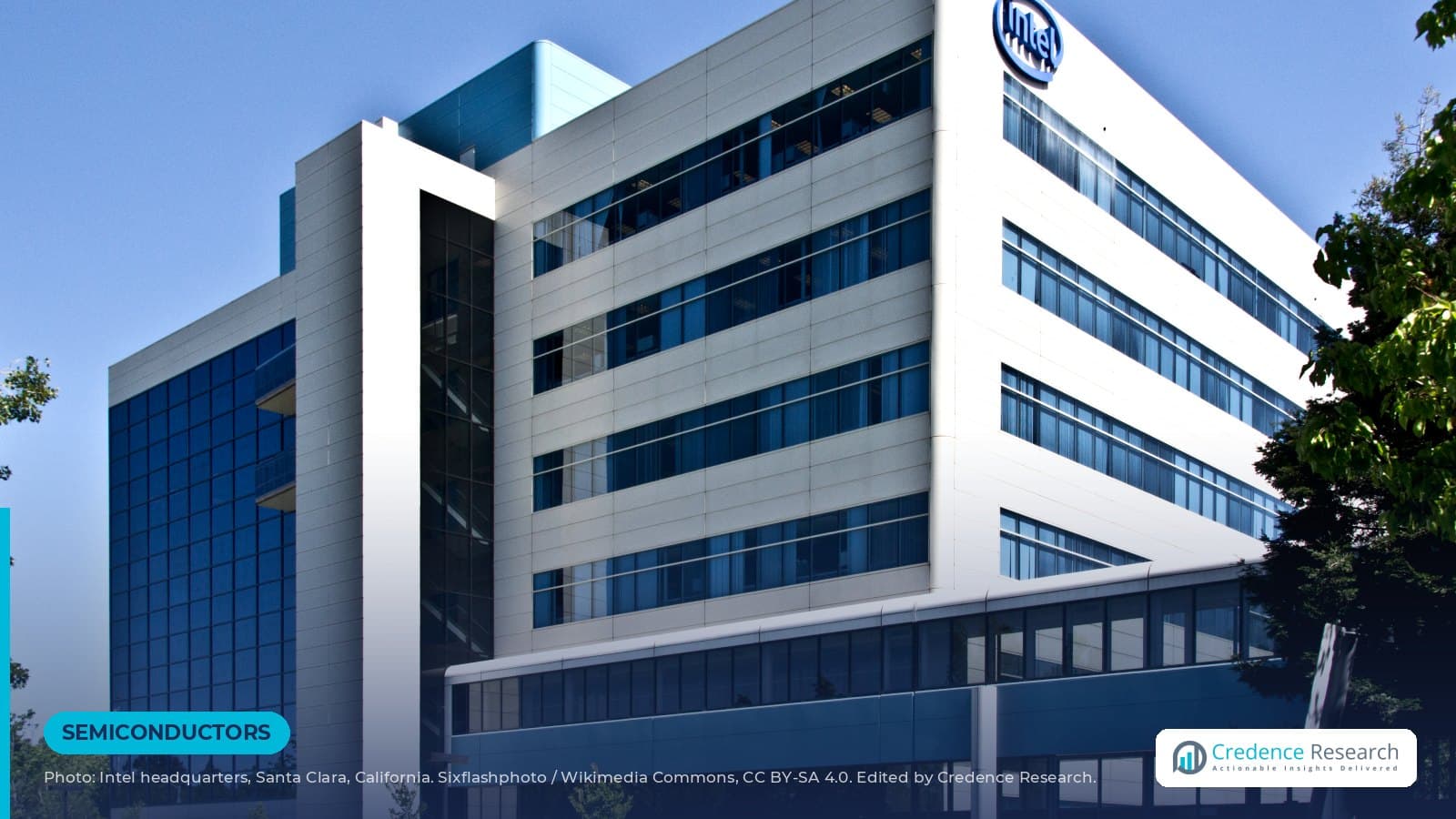
Image: Intel headquarters in Santa Clara, California, by Sixflashphoto via Wikimedia Commons, CC BY-SA 4.0. Cropped and edited by Credence Research.

About the Author

Senior News Editor at Credence Research Inc