
| REPORT ATTRIBUTE | DETAILS |
|---|---|
| Historical Period | 2020-2023 |
| Base Year | 2024 |
| Forecast Period | 2025-2032 |
| USB 3.0 Flash Drives Market Size 2024 | USD 11,487.69 million |
| USB 3.0 Flash Drives Market, CAGR | 6.32% |
| USB 3.0 Flash Drives Market Size 2032 | USD 18,728.90 million |
Market Overview:
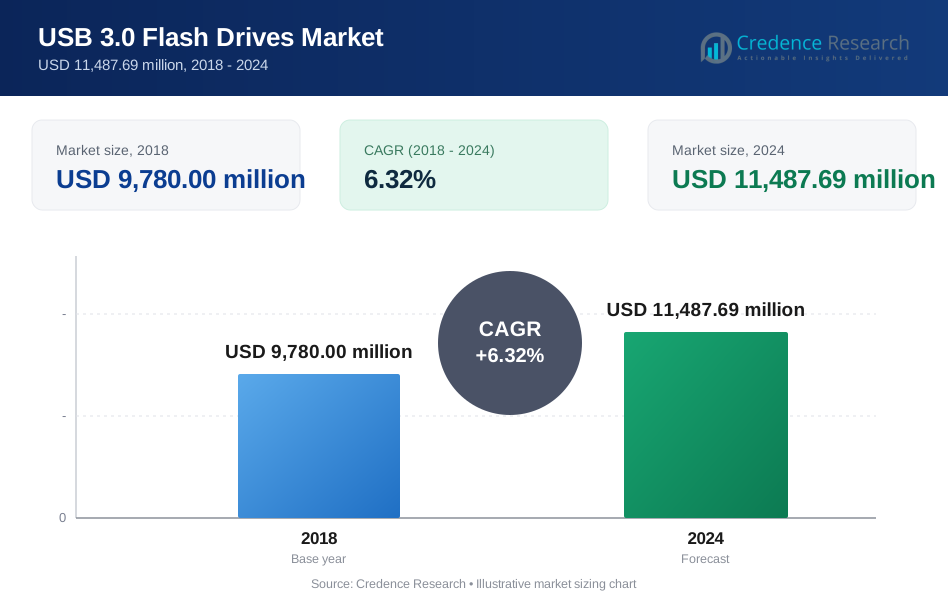
The USB 3.0 Flash Drives Market size was valued at USD 9,780.00 million in 2018 to USD 11,487.69 million in 2024 and is anticipated to reach USD 18,728.90 million by 2032, at a CAGR of 6.32% during the forecast period.
Several factors are propelling the expansion of the USB 3.0 flash drive market. The primary driver is the escalating need for faster data transfer speeds, with USB 3.0 offering up to ten times the speed of its predecessor, USB 2.0. This enhancement is crucial for applications requiring rapid data access and transfer, such as media production and large-scale data analytics. Additionally, the proliferation of digital content and the increasing reliance on portable storage solutions for personal and professional use are contributing to market growth. The adoption of USB 3.0 technology in various industries, including education, IT, and media, further fuels this demand. Moreover, advancements in flash memory technology and the integration of security features like encryption are enhancing the appeal of USB 3.0 flash drives, addressing concerns related to data security and integrity.
Regionally, North America holds a significant share of the USB 3.0 flash drive market, driven by robust technological infrastructure, high adoption rates of digital solutions, and the presence of key industry players. The United States, in particular, exhibits strong demand across sectors such as IT, education, and media. Europe follows, with countries like Germany, the UK, and France contributing to the market's expansion due to their advanced technological landscapes and increasing digitalization efforts. The Asia-Pacific region is witnessing rapid growth, propelled by the burgeoning consumer electronics market in countries like China, India, and Japan. The presence of major manufacturers and the rising middle-class population in these countries are pivotal factors in this growth. Emerging markets in Latin America, the Middle East, and Africa are also showing potential, albeit at a slower pace, as digital infrastructure improves and demand for portable storage solutions increases

Market Insights:
- The USB 3.0 Flash Drives Market size was valued at USD 9,780.00 million in 2018 and is projected to reach USD 11,487.69 million by 2024, growing at a CAGR of 6.32%, with an anticipated value of USD 18,728.90 million by 2032.
- The demand for faster data transfer speeds drives the market, as USB 3.0 offers up to 10 times faster speeds than USB 2.0, which benefits sectors like media production, data analytics, and software development.
- The expansion of digital content creation and consumption is contributing to market growth, with USB 3.0 flash drives providing a reliable, compact storage solution for transferring and storing large files, such as videos and software applications.
- Technological advancements in flash memory are increasing storage capacities in smaller formats, with enhanced encryption and durability features, making USB 3.0 flash drives an attractive choice for secure and efficient data storage.
- The growing use of mobile devices, laptops, and tablets is increasing the demand for portable storage solutions, and USB 3.0 flash drives offer a secure alternative to cloud storage for offline data access and file transfers.
- Competition from cloud storage solutions poses a challenge, as users opt for cloud services to access data seamlessly across devices, reducing reliance on physical storage devices like USB 3.0 flash drives.
- Despite improvements in encryption and security features, concerns over data protection and potential data breaches remain significant, and manufacturers must address these issues to maintain market growth and confidence.
Market Drivers:
Increasing Demand for Faster Data Transfer
The demand for faster data transfer speeds plays a pivotal role in driving the USB 3.0 flash drive market. USB 3.0 technology offers transfer speeds up to ten times faster than its predecessor, USB 2.0, which is a major advantage for users handling large files such as high-definition videos, software, and databases. The ability to quickly transfer and access data enhances productivity, especially in sectors like media production, graphic design, and data analytics. Professionals and organizations are increasingly adopting USB 3.0 flash drives for their efficient data handling capabilities. With this technology, users benefit from reduced wait times and improved workflow. It meets the growing need for efficient and reliable data management across various applications.
- For example, Kingston’s DataTraveler 100 G3 USB 3.0 flash drive is officially rated for read speeds up to 130 MB/s (megabytes per second), enabling users to transfer a 1 GB file in under 10 seconds under optimal conditions-significantly reducing wait times for large file transfers.
Surge in Digital Content Creation and Consumption
The expansion of digital content creation and consumption has contributed significantly to the growth of the USB 3.0 flash drive market. With the rise of digital media platforms, online content, and multimedia files, individuals and businesses require faster and more reliable storage options. USB 3.0 flash drives provide a compact and portable solution for managing, transferring, and storing large media files, such as videos, images, and software applications. As content creation becomes more mainstream, from social media influencers to large-scale media productions, the need for high-performance flash drives continues to grow. USB 3.0’s ability to handle these demands efficiently makes it a go-to choice for creators and professionals alike.
Technological Advancements in Flash Memory
Ongoing advancements in flash memory technology are another key driver for the USB 3.0 flash drive market. Manufacturers are consistently improving memory capacities, allowing for higher data storage in smaller physical formats. This improvement has expanded the utility of USB 3.0 flash drives, making them suitable for users who require significant storage space on the go. Enhanced durability and the integration of advanced encryption features also boost their appeal. USB 3.0 flash drives provide a secure solution for individuals and organizations concerned about data protection. These advancements position USB 3.0 as an essential tool in an increasingly digital and data-driven world.
Rising Adoption of Portable Storage Solutions
The growing need for portable storage solutions drives the USB 3.0 flash drive market. As mobile devices, laptops, and tablets become increasingly prevalent, the demand for compact and easy-to-use storage devices rises. USB 3.0 flash drives meet this need by offering a high-capacity solution in a portable format. Professionals, students, and casual users alike rely on these devices to store and transport their important files. With the increasing reliance on cloud services, USB 3.0 flash drives still offer a more tangible, secure option for users who prefer offline storage or need access to files without internet connectivity. The combination of portability, speed, and storage capacity ensures the sustained growth of the USB 3.0 flash drive market.
- For example, Corsair’s Flash Survivor Stealth USB 3.0 drive is rated for water resistance up to 200 meters and offers shock protection through an anodized aircraft-grade aluminum housing, as specified in Corsair’s technical datasheet.
Market Trends:
Increasing Focus on Data Security and Encryption
One of the prominent trends in the USB 3.0 flash drive market is the growing emphasis on data security and encryption. With data breaches becoming more frequent, consumers and businesses are prioritizing secure storage solutions. Manufacturers are integrating advanced encryption technologies to protect sensitive information stored on flash drives. USB 3.0 flash drives are increasingly equipped with hardware-based encryption, ensuring that data remains safe even if the device is lost or stolen. This trend is particularly important for industries such as healthcare, finance, and government, where data protection is critical. As data security becomes a significant concern, it drives demand for USB 3.0 flash drives that offer robust security features.
- For example, DataLocker’s Sentry K350 features AES 256-bit encryption, FIPS 140-2 Level 3 certification, and a built-in keypad for password entry, ensuring standalone, software-free access to encrypted data. The Sentry K350 also supports SafeConsole centralized management, enabling remote policy enforcement and secure device wipes for lost or stolen drives.
Shift Toward Higher Storage Capacities
The demand for USB 3.0 flash drives with higher storage capacities is another key trend influencing the market. As data consumption continues to grow, users require larger storage solutions to accommodate high-resolution videos, large databases, and extensive files. Flash drives with capacities ranging from 128GB to 1TB are becoming more common, offering a solution for users who need substantial storage in a portable format. This trend is driven by the increased usage of multimedia content, cloud storage alternatives, and the need for large file transfers across industries. The move towards higher storage capacities helps make USB 3.0 flash drives a more viable option for professional users, including graphic designers, content creators, and data analysts.
- For instance, Samsung’s BAR Plus USB 3.0/3.1/3.2 Gen1 flash drives are available in 64GB, 128GB, 256GB, and 512GB variants, delivering sequential read speeds up to 400MB/s for the 128GB and higher models.
Miniaturization and Improved Durability
Miniaturization is a significant trend in the USB 3.0 flash drive market, with manufacturers focusing on creating smaller yet more durable devices. Compact designs that do not sacrifice performance are gaining popularity as users demand portable storage options that are easy to carry and store. In response, flash drive manufacturers are reducing the size of USB 3.0 devices while improving their resistance to water, shock, and dust. This durability makes USB 3.0 flash drives more reliable in various environments, particularly for travelers, field workers, and professionals in harsh conditions. It enhances the overall appeal of USB 3.0 flash drives by combining convenience with reliability and ruggedness.
Integration with Cloud and Hybrid Storage Solutions
Another significant trend in the USB 3.0 flash drive market is its integration with cloud and hybrid storage solutions. As more businesses and consumers turn to cloud storage for convenience and accessibility, USB 3.0 flash drives are becoming part of a broader data management ecosystem. Hybrid storage solutions that combine physical storage devices with cloud storage offer users flexibility, allowing them to access data both offline and online. Manufacturers are increasingly developing USB 3.0 flash drives with cloud synchronization features, enabling users to back up and access files from multiple platforms. This integration helps users manage data efficiently, enhancing the functionality of USB 3.0 flash drives in modern data storage workflows.
Market Challenges Analysis:
Competition from Alternative Storage Solutions
One of the key challenges facing the USB 3.0 flash drive market is the increasing competition from alternative storage solutions. With the rise of cloud storage, users can store and access data remotely without relying on physical devices. This shift towards cloud services is particularly evident in industries like technology, media, and education, where seamless access to data across multiple devices is essential. While USB 3.0 flash drives remain popular for their portability and offline functionality, the growing preference for cloud storage options may limit the demand for physical storage devices. The convenience of cloud-based storage, combined with the increasing availability of high-speed internet, presents a challenge for traditional storage solutions like USB 3.0 flash drives.
Data Loss and Security Concerns
Data loss and security concerns remain significant challenges for the USB 3.0 flash drive market. While advances in encryption and security features help mitigate risks, the physical nature of these devices makes them vulnerable to loss or theft. In industries where sensitive information is stored, the potential for data breaches from lost or compromised devices poses a considerable risk. Despite advancements in security, concerns over data protection continue to hinder widespread adoption, particularly among users handling highly confidential data. As the need for data protection increases, users expect higher security standards from storage devices, and manufacturers must address these concerns to maintain market relevance.

Market Opportunities:
Expanding Demand for High-Capacity Flash Drives
The growing need for higher storage capacities presents a significant opportunity for the USB 3.0 flash drive market. With the increasing volume of data being generated, especially in industries such as media, healthcare, and research, there is a rising demand for high-capacity portable storage solutions. USB 3.0 flash drives with capacities ranging from 128GB to 1TB are gaining popularity, providing users with ample space for large files and backup purposes. This trend opens new avenues for manufacturers to introduce flash drives with larger storage capacities while maintaining performance and portability, allowing them to cater to professionals and businesses that require extensive data storage on-the-go.
Integration with Emerging Technologies
The USB 3.0 flash drive market can also capitalize on the integration of emerging technologies such as IoT and AI. As industries adopt smart devices and systems, the need for fast, reliable, and secure data storage grows. USB 3.0 flash drives can integrate seamlessly with IoT devices, offering a portable and efficient solution for data storage and transfer. By incorporating advanced technologies such as real-time data synchronization and enhanced security features, manufacturers can position USB 3.0 flash drives as key components in the evolving digital ecosystem, expanding their application across various sectors.
Market Segmentation Analysis:
The USB 3.0 Flash Drives Market is driven by diverse segments, each catering to specific user needs.
By Product Type, the market features standard USB flash drives, rugged and waterproof options, custom-shaped models, encrypted drives, and high-capacity drives (256GB and above). High-capacity drives are increasingly sought after for large data storage, while encrypted drives cater to industries needing secure data transfer.
- For instance, Kanguru’s Defender 3000 series provides IP68-rated waterproof and dustproof protection, hardware-based AES 256-bit encryption, and tamper-resistant features, targeting users requiring durability and security in harsh environments.
By End-Use Application, consumer electronics lead the demand, with businesses, educational institutions, healthcare, and government sectors also contributing significantly. Corporate and business use drives demand for portable, secure storage, while the healthcare sector focuses on encrypted devices for medical data. Education relies on affordable and portable storage solutions.
By Storage Capacity, the market spans from less than 16GB to over 1TB, with increasing popularity of drives offering 128GB to 1TB and above for professional and enterprise use. These larger capacities accommodate growing data needs across various industries.
By Distribution Channel, USB 3.0 flash drives are sold through online retailers, direct sales, electronics retail stores, wholesale distributors, and specialty stores. Online platforms dominate due to convenience and wider reach, while electronics stores cater to in-person purchases. Each distribution channel supports growth by providing customers with easy access to USB 3.0 flash drives tailored to their specific requirements.
- For instance, Amazon and Newegg dominate sales of USB 3.0 flash drives, offering extensive product selections including encrypted and high-capacity models with customer reviews aiding purchase decisions.
Segmentation:
By Product Type:
- Standard USB Flash Drives
- Rugged and Waterproof Flash Drives
- Custom-Shaped Flash Drives
- Encrypted Flash Drives
- High-Capacity Drives (e.g., 256GB and above)
By End-Use Application:
- Consumer Electronics
- Corporate and Business Use
- Education and Academic Institutions
- Healthcare and Medical Applications
- Government and Defense
By Storage Capacity:
- Less than 16GB
- 16GB to 32GB
- 32GB to 64GB
- 64GB to 128GB
- 128GB to 1TB and above
By Distribution Channel:
- Online Retailers
- Direct Sales (Manufacturer to Consumer)
- Electronics Retail Stores
- Wholesale Distributors
- Specialty and Niche Stores
By Region:
- North America
- U.S.
- Canada
- Mexico
- Europe
- UK
- France
- Germany
- Italy
- Spain
- Russia
- Rest of Europe
- Asia Pacific
- China
- Japan
- South Korea
- India
- Australia
- Southeast Asia
- Rest of Asia Pacific
- Latin America
- Brazil
- Argentina
- Rest of Latin America
- Middle East
- GCC Countries
- Israel
- Turkey
- Rest of Middle East
- Africa
- South Africa
- Egypt
- Rest of Africa
Regional Analysis:
North America USB 3.0 Flash Drives Market
The North America USB 3.0 Flash Drives Market size was valued at USD 3,247.94 million in 2018, projected to reach USD 3,780.48 million in 2024, and anticipated to grow to USD 6,142.41 million by 2032, at a CAGR of 6.30% during the forecast period. North America holds a significant share of the global market, driven by high technological adoption, strong demand for data storage solutions, and the increasing reliance on portable devices for both personal and professional use. The presence of major manufacturers and high disposable income contribute to the region’s market dominance. Additionally, sectors such as IT, healthcare, and media are increasingly incorporating USB 3.0 flash drives for their fast and reliable data transfer needs. The growing trend toward high-capacity drives is further propelling the market growth in this region. As more industries digitize, demand for secure, fast storage solutions continues to rise, ensuring a robust future for the North American market.
Europe USB 3.0 Flash Drives Market
The Europe USB 3.0 Flash Drives Market size was valued at USD 2,489.99 million in 2018, expected to reach USD 2,807.28 million in 2024, and is projected to grow to USD 4,277.17 million by 2032, at a CAGR of 5.40%. Europe is witnessing steady growth in the USB 3.0 flash drive market, driven by strong demand for portable storage solutions across various sectors. The region's focus on data security and its high standards for data protection have fueled the adoption of advanced USB 3.0 devices with encryption capabilities. Key markets in Europe, such as Germany, the UK, and France, are leading the charge, with high technological integration in industries like IT, finance, and government. Moreover, the region's push towards digitization in education, retail, and healthcare also supports market expansion.
Asia Pacific USB 3.0 Flash Drives Market
The Asia Pacific USB 3.0 Flash Drives Market size was valued at USD 2,954.54 million in 2018, expected to reach USD 3,559.34 million in 2024, and anticipated to grow to USD 6,437.28 million by 2032, at a CAGR of 7.80%. The Asia Pacific region is expected to witness the fastest growth in the USB 3.0 flash drive market due to the rapid expansion of digital infrastructure, increasing consumer demand for portable storage, and a large base of tech-savvy consumers. Countries like China, Japan, and India are significant contributors to market growth, driven by the adoption of digital content creation, mobile devices, and online gaming. Additionally, the growing middle class and the increasing trend of e-commerce further propel the demand for high-performance storage solutions. The region’s strong manufacturing sector and rising technological capabilities position it as a key market for USB 3.0 flash drives.
Latin America USB 3.0 Flash Drives Market
The Latin America USB 3.0 Flash Drives Market size was valued at USD 500.74 million in 2018, expected to reach USD 581.16 million in 2024, and projected to grow to USD 847.11 million by 2032, at a CAGR of 4.80%. In Latin America, the USB 3.0 flash drive market is gradually expanding, supported by increasing smartphone and laptop penetration. Countries such as Brazil and Mexico are experiencing growing demand for portable storage devices, particularly for data backup and file transfer purposes. Although the region is still catching up with North America and Europe in terms of technological adoption, rising disposable income and digital transformation initiatives in businesses are expected to drive further market growth. The shift towards cloud storage is a challenge, but USB 3.0 flash drives still remain essential in areas where reliable offline storage is necessary.
Middle East USB 3.0 Flash Drives Market
The Middle East USB 3.0 Flash Drives Market size was valued at USD 239.61 million in 2018, expected to reach USD 253.80 million in 2024, and projected to grow to USD 338.87 million by 2032, at a CAGR of 3.70%. The market in the Middle East is relatively smaller compared to other regions, but it is steadily growing, driven by increasing technological adoption and a growing need for data storage solutions. Major markets in this region include the UAE, Saudi Arabia, and Qatar, where digital infrastructure improvements and an increase in digital content consumption are driving demand. The region’s reliance on secure data storage for various sectors such as banking, government, and healthcare continues to support the growth of USB 3.0 flash drives, particularly for mobile and portable storage applications.
Africa USB 3.0 Flash Drives Market
The Africa USB 3.0 Flash Drives Market size was valued at USD 347.19 million in 2018, expected to reach USD 505.63 million in 2024, and projected to grow to USD 686.07 million by 2032, at a CAGR of 3.20%. The African market for USB 3.0 flash drives is expected to see gradual growth, influenced by rising smartphone and laptop penetration, particularly in countries like South Africa and Nigeria. While internet access and cloud storage adoption are increasing, many consumers and businesses still rely on physical storage solutions due to concerns over data security, offline access, and internet infrastructure limitations. As more sectors in Africa, including education and healthcare, digitize their operations, the demand for reliable, cost-effective data storage options such as USB 3.0 flash drives is likely to rise.
Key Player Analysis:
- ADATA Technology Co., Ltd.
- HP Inc.
- Kingston Technology Corporation
- Lenovo Group Ltd.
- SanDisk Corporation (Western Digital)
- Toshiba
- Verbatim Corporation, Inc.
- Transcend Information, Inc.
- Emtec Inc.
- Monster Digital
- Micron Consumer Products Group, Inc. (Lexar)
- Samsung Group
- Sony Corporation
- Toshiba Corporation
Competitive Analysis:
The USB 3.0 Flash Drives Market is highly competitive, with several key players driving innovation and expanding their market share. Prominent companies such as SanDisk (Western Digital), Kingston Technology, and Transcend Information dominate the market, offering a wide range of USB 3.0 flash drives catering to both consumer and enterprise needs. These players focus on delivering high-performance drives with varying storage capacities and enhanced security features. Smaller players and regional manufacturers are also gaining ground by offering cost-effective solutions tailored to specific consumer needs. The market is marked by continuous technological advancements, with companies investing in research and development to improve transfer speeds, storage capacities, and durability. The growing demand for portable storage, driven by digital content creation and data security concerns, intensifies competition. As companies strive to meet consumer demands, they focus on differentiating their products through quality, innovation, and pricing strategies.
Recent Developments:
- In February 2025, HP Inc. announced the acquisition of software and intellectual property assets from Humane, an AI consumer electronics company, for $116 million. This deal includes Humane’s AI-powered Cosmos platform and over 300 related patents, with the integration aimed at enhancing HP’s product ecosystem including PCs, printers, and accessories by embedding advanced AI functionality. The acquisition is expected to close by the end of February 2025.
Market Concentration & Characteristics:
The USB 3.0 Flash Drives Market is moderately concentrated, with a few dominant players holding significant market share. Leading companies such as SanDisk (Western Digital), Kingston Technology, and Transcend Information command a large portion of the market due to their established brand presence, extensive distribution networks, and diverse product offerings. However, the market also features numerous smaller manufacturers that cater to niche segments, providing competitive pricing and specialized features. The market is characterized by constant innovation, with companies focusing on improving data transfer speeds, storage capacities, and security features to meet the evolving demands of consumers and businesses. Pricing remains a key factor in competition, with manufacturers offering products across various price points to appeal to different customer groups. The increasing use of USB 3.0 flash drives in sectors like media, education, and IT further fuels market activity and competition.
Report Coverage:
The research report offers an in-depth analysis based on Product Type, End-Use Application, Storage Capacity and Distribution Channel. It details leading market players, providing an overview of their business, product offerings, investments, revenue streams, and key applications. Additionally, the report includes insights into the competitive environment, SWOT analysis, current market trends, as well as the primary drivers and constraints. Furthermore, it discusses various factors that have driven market expansion in recent years. The report also explores market dynamics, regulatory scenarios, and technological advancements that are shaping the industry. It assesses the impact of external factors and global economic changes on market growth. Lastly, it provides strategic recommendations for new entrants and established companies to navigate the complexities of the market.
Future Outlook:
- The USB 3.0 Flash Drives Market will continue to grow as data transfer speed and storage capacity requirements rise across industries.
- The increasing need for secure, encrypted storage solutions will drive demand for USB 3.0 drives with advanced security features.
- Smaller, more portable flash drives with higher durability will become more popular due to increasing mobility demands.
- Emerging economies, particularly in Asia-Pacific, will contribute significantly to the market's growth as digital infrastructure improves.
- The shift towards cloud storage will not significantly impact USB 3.0 drives, as offline storage remains crucial in many sectors.
- The integration of USB 3.0 flash drives with IoT and AI devices will expand their application in emerging technologies.
- Consumer preferences for high-capacity USB 3.0 drives will lead to innovations in storage options, including drives up to 1TB and beyond.
- Companies will focus on reducing manufacturing costs to offer competitively priced options in price-sensitive markets.
- The education and healthcare sectors will increasingly adopt USB 3.0 flash drives for their data management and storage needs.
- Strategic partnerships and acquisitions will increase, allowing companies to broaden their product offerings and improve market positioning.
Request a Free Sample
Fill in your details and we'll send you a free sample report.
- Sample data tables & charts
- Research methodology
Market Dynamics
Escalating Need for Faster Data Transfer
USB 3.0 flash drives offer up to ten times the speed of USB 2.0, making them essential for applications that require rapid data access and transfer, such as media production, large-scale analytics, and software development.
Expansion of Digital Content Creation and Consumption
The surge in digital media, online content, and multimedia files is driving demand for portable, high-speed storage solutions, with USB 3.0 flash drives providing a reliable means to transfer and store large files efficiently.
Technological Advancements in Flash Memory
Continuous improvements in flash memory technology are enabling higher storage capacities, enhanced durability, and advanced encryption features, making USB 3.0 flash drives more attractive for secure and efficient data storage.
Rising Adoption of Portable Storage Solutions
The proliferation of mobile devices, laptops, and tablets is increasing the need for compact, offline storage options, with USB 3.0 flash drives offering a tangible and secure alternative to cloud storage for users needing reliable file access without internet connectivity.
Growing Emphasis on Data Security and Encryption
With increasing concerns over data breaches and information security, demand is rising for USB 3.0 flash drives equipped with advanced encryption and security features, particularly in sectors like healthcare, finance, and government.
Need a Custom Version of This Report?
Tailor the scope, geography, or segments to your exact requirements.
- Custom geography or segment scope
- Direct access to our analyst team
Frequently Asked Questions
What is the current size of the USB 3.0 Flash Drives Market?
What factors are driving the growth of the USB 3.0 Flash Drives Market?
What are some challenges faced by the USB 3.0 Flash Drives Market?
Who are the major players in this market?
Table of Content
Chapter 1 Market Segmentation
- 1.1 Segmentation Framework
- 1.1.1 Product and Service Classification
- 1.1.2 Application and End-Use Classification
- 1.1.3 Technology and Solution Classification
- 1.1.4 Customer and Distribution Channel Classification
- 1.1.5 Geographic Segmentation
- 1.1.6 Market Segment Definitions and Boundaries
- 1.2 By Product Type
- 1.2.1 Standard USB Flash Drives
- 1.2.2 Rugged and Waterproof Flash Drives
- 1.2.3 Custom-Shaped Flash Drives
- 1.2.4 Encrypted Flash Drives
- 1.2.5 High-Capacity Drives (256GB and above)
- 1.3 By Storage Capacity
- 1.3.1 Less than 16GB
- 1.3.2 16GB to 32GB
- 1.3.3 32GB to 64GB
- 1.3.4 64GB to 128GB
- 1.3.5 128GB to 1TB and above
- 1.4 By End-Use Application
- 1.4.1 Consumer Electronics
- 1.4.2 Corporate and Business Use
- 1.4.3 Education and Academic Institutions
- 1.4.4 Healthcare and Medical Applications
- 1.4.5 Government and Defense
Chapter 2 Introduction
- 2.1 Report Objectives and Scope
- 2.2 Product Definition and Industry Terminology
- 2.3 Market Inclusions and Exclusions
- 2.4 Research Process
- 2.4.1 Primary Research and Expert Interviews
- 2.4.2 Secondary Research and Source Review
- 2.4.3 Top-Down and Bottom-Up Estimation
- 2.4.4 Data Triangulation and Verification
- 2.5 Market Size Measurement Basis
- 2.5.1 2018: USD 9,780.00 million → 2024: USD 11,487.69 million
- 2.6 Historical and Forecast Reference Periods
- 2.6.1 Base Year: 2018
- 2.6.2 Forecast Period: 2018-2024
- 2.7 Research Assumptions and Limitations
Chapter 3 Executive Summary
- 3.1 Market Snapshot and Key Findings
- 3.2 Base-Year Market Size, 2018
- 3.3 Forecast Market Size, 2024
- 3.4 Revenue and Volume Growth Outlook
- 3.5 Key Demand and Supply Indicators
- 3.6 Leading Market Segments
- 3.7 Fastest-Growing Market Opportunities
- 3.8 Regional Performance Highlights
- 3.9 Technology and Industry Transformation
- 3.10 Competitive Landscape Summary
- 3.11 Analyst View and Strategic Implications
Chapter 4 Global USB 3.0 Flash Drives Market Trends and Developments
- 4.1 Historical Industry Development
- 4.2 Recent Market Trends and Developments
- 4.3 Demand and Customer Behavior Trends
- 4.4 Technology and Product Innovation
- 4.5 Artificial Intelligence, Automation and Digitalization
- 4.6 Local Manufacturing and Supply Chain Realignment
- 4.7 Industry Partnerships, Mergers and Acquisitions
- 4.8 Sustainability and Circular Economy Developments
- 4.9 Government and Private Sector Investment Trends
- 4.10 Emerging Business Models and Commercialization
- 4.11 Industry Developments and Announcements
Chapter 5 Global USB 3.0 Flash Drives Market Production, Supply and Demand Analysis
- 5.1 Demand Trend and Consumption Analysis
- 5.2 Demand Forecast, 2018-2024
- 5.3 Production and Output Trend
- 5.4 Production and Output Forecast, 2018-2024
- 5.5 Installed Capacity and Capacity Utilization
- 5.6 Company-Wise Production Plants and Statistics
- 5.6.1 Installed Production Capacity
- 5.6.2 Actual Production
- 5.6.3 Planned Capacity and Expansion Targets
- 5.7 Supply Chain Structure and Procurement Trends
- 5.8 Supply-Demand Gap and Bottlenecks
- 5.9 Import Dependence and Sourcing Structure
- 5.10 Contract Manufacturing and Outsourcing
- 5.11 Regional Supply and Demand Concentration
Chapter 6 Global USB 3.0 Flash Drives Market Pricing Analysis
- 6.1 Pricing Structure and Measurement
- 6.2 Historical Pricing Trends
- 6.3 Pricing Outlook, 2018-2024
- 6.4 Average Selling Price and Unit Economics
- 6.5 Pricing by Product and Market Segment
- 6.6 Geographic Pricing Differences
- 6.7 Key Input, Energy, Labor and Logistics Costs
- 6.8 Contract Pricing and Purchasing Models
- 6.9 Pricing Sensitivity and Competitive Positioning
- 6.10 Price, Margin and Profitability Implications
Chapter 7 Global USB 3.0 Flash Drives Market Dynamics
- 7.1 Market Growth Drivers
- 7.1.1 Demand-Side Drivers
- 7.1.2 Technology and Innovation Drivers
- 7.1.3 Infrastructure and Investment Drivers
- 7.1.4 Regulatory and Policy Drivers
- 7.2 Market Restraints
- 7.2.1 Cost and Affordability Constraints
- 7.2.2 Technology and Adoption Barriers
- 7.2.3 Supply Chain and Operational Constraints
- 7.3 Market Challenges
- 7.3.1 Competitive Pressure and Margin Erosion
- 7.3.2 Skills, Infrastructure and Implementation Gaps
- 7.4 Emerging Market Opportunities
- 7.5 Market Dynamics Impact and Time-Horizon Assessment
Chapter 8 Global USB 3.0 Flash Drives Value Chain Analysis
- 8.1 Industry Value Chain Overview
- 8.2 Upstream Suppliers and Critical Inputs
- 8.3 Technology and Component Providers
- 8.4 Manufacturing or Service Delivery
- 8.5 Distribution, Channel Partners and Integrators
- 8.6 Downstream Applications and End Users
- 8.7 Value Addition and Profit Pools
- 8.8 Vertical Integration and Outsourcing
- 8.9 Supplier Concentration and Risk
- 8.10 Supply Chain Localization and Resilience
Chapter 9 Global USB 3.0 Flash Drives Market Regulations and Policies
- 9.1 Relevant Laws, Standards and Compliance Frameworks
- 9.2 Product, Service, Safety and Quality Requirements
- 9.3 Government Policies, Incentives and Subsidies
- 9.4 Imports, Exports and Trade Barriers
- 9.5 Public Procurement and Local Content Requirements
- 9.6 Environmental and Sustainability Compliance
- 9.7 Upcoming Policy Changes and Market Implications
Chapter 10 Global USB 3.0 Flash Drives Market Hotspots and Opportunities
- 10.1 Market Opportunity Mapping and Growth Hotspots
- 10.2 High-Growth Applications and Customer Groups
- 10.3 Underserved Markets and White-Space Opportunities
- 10.4 Emerging Technology and Product Opportunities
- 10.5 New Capacity and Investment Hotspots
- 10.6 Market Entry and Expansion Opportunities
- 10.7 Distribution and Partnership Opportunities
- 10.8 Near-Term and Long-Term Commercial Potential
- 10.9 Opportunity Attractiveness and Execution Risks
Chapter 11 Global USB 3.0 Flash Drives Market Outlook, 2018-2024
- 11.1 Market Size and Analysis
- 11.1.1 Revenue (Market Measurement: 2018: USD 9,780.00 million → 2024: USD 11,487.69 million)
- 11.1.2 Market Volume and Quantity Sold
- 11.1.3 Historical Market Size
- 11.1.4 Base-Year Market Size, 2018
- 11.2 Market Forecast, 2018-2024
- 11.2.1 Revenue Forecast to 2024
- 11.2.2 Volume Forecast to 2024
- 11.2.3 CAGR and Year-on-Year Growth
- 11.2.4 Incremental Revenue Opportunity
- 11.3 Forecast Assumptions and Scenario Analysis
- 11.3.1 Base-Case Forecast
- 11.3.2 Optimistic and Conservative Scenarios
- 11.3.3 Technology, Pricing and Policy Sensitivities
- 11.4 Market Attractiveness and Growth Outlook
Chapter 12 Global USB 3.0 Flash Drives Market Segmentation and Outlook
- 12.1 Segmentation Summary and Market Shares, 2018
- 12.2 Largest and Fastest-Growing Segments
- 12.3 By Product Type - Market Size and Forecast, 2018-2024
- 12.3.1 Segment Definition and Scope
- 12.3.2 Historical Market Size
- 12.3.3 Revenue Forecast, 2018-2024
- 12.3.4 Volume Forecast, 2018-2024
- 12.3.5 Base-Year Market Share, 2018
- 12.3.6 Segment CAGR and Growth Drivers
- 12.3.7 Subsegment Market Size and Forecast
- 12.3.7.1 Standard USB Flash Drives
- 12.3.7.2 Rugged and Waterproof Flash Drives
- 12.3.7.3 Custom-Shaped Flash Drives
- 12.3.7.4 Encrypted Flash Drives
- 12.3.7.5 High-Capacity Drives (256GB and above)
- 12.3.8 Subsegment Pricing and Adoption Trends
- 12.3.9 Leading Suppliers and Competition
- 12.3.10 Regional Demand and Opportunities
- 12.4 By Storage Capacity - Market Size and Forecast, 2018-2024
- 12.4.1 Segment Definition and Scope
- 12.4.2 Historical Market Size
- 12.4.3 Revenue Forecast, 2018-2024
- 12.4.4 Volume Forecast, 2018-2024
- 12.4.5 Base-Year Market Share, 2018
- 12.4.6 Segment CAGR and Growth Drivers
- 12.4.7 Subsegment Market Size and Forecast
- 12.4.7.1 Less than 16GB
- 12.4.7.2 16GB to 32GB
- 12.4.7.3 32GB to 64GB
- 12.4.7.4 64GB to 128GB
- 12.4.7.5 128GB to 1TB and above
- 12.4.8 Subsegment Pricing and Adoption Trends
- 12.4.9 Leading Suppliers and Competition
- 12.4.10 Regional Demand and Opportunities
- 12.5 By End-Use Application - Market Size and Forecast, 2018-2024
- 12.5.1 Segment Definition and Scope
- 12.5.2 Historical Market Size
- 12.5.3 Revenue Forecast, 2018-2024
- 12.5.4 Volume Forecast, 2018-2024
- 12.5.5 Base-Year Market Share, 2018
- 12.5.6 Segment CAGR and Growth Drivers
- 12.5.7 Subsegment Market Size and Forecast
- 12.5.7.1 Consumer Electronics
- 12.5.7.2 Corporate and Business Use
- 12.5.7.3 Education and Academic Institutions
- 12.5.7.4 Healthcare and Medical Applications
- 12.5.7.5 Government and Defense
- 12.5.8 Subsegment Pricing and Adoption Trends
- 12.5.9 Leading Suppliers and Competition
- 12.5.10 Regional Demand and Opportunities
- 12.6 Segment Growth Comparison
- 12.7 Segment Attractiveness and Priority Matrix
Chapter 13 Global USB 3.0 Flash Drives End-Use and Application Market Outlook
- 13.1 End-Use Industry and Customer Demand Structure
- 13.2 Leading Applications and Customer Groups
- 13.3 End-Use Market Size, Share and Forecast
- 13.4 Major End-Use Industry Deep Dives
- 13.4.1 Customer Requirements and Use Cases
- 13.4.2 Demand and Replacement Cycles
- 13.4.3 Technical and Regulatory Considerations
- 13.4.4 Purchasing and Procurement Models
- 13.4.5 Leading Vendors and Distribution Channels
- 13.4.6 Forecast and Commercial Opportunities
- 13.5 Emerging Applications and Cross-Segment Demand
- 13.6 End-Use Industry Investment Priorities
Chapter 14 Global USB 3.0 Flash Drives Geographic Market Outlook, 2018-2024
- 14.1 Regional Market Size and Share, 2018
- 14.2 Regional Market Forecast, 2018-2024
- 14.3 Regional Pricing, Production and Demand Differences
- 14.4 North America
- 14.4.1 United States
- 14.4.2 Canada
- 14.4.3 Mexico
- 14.5 Europe
- 14.5.1 Germany
- 14.5.2 France
- 14.5.3 Italy
- 14.5.4 United Kingdom
- 14.5.5 Spain
- 14.5.6 Poland
- 14.5.7 Russia
- 14.5.8 Netherlands
- 14.5.9 Belgium
- 14.5.10 Sweden
- 14.5.11 Denmark
- 14.5.12 Norway
- 14.5.13 Rest of Europe
- 14.6 Asia Pacific
- 14.6.1 China
- 14.6.2 India
- 14.6.3 Japan
- 14.6.4 South Korea
- 14.6.5 Thailand
- 14.6.6 Indonesia
- 14.6.7 Vietnam
- 14.6.8 Malaysia
- 14.6.9 Australia
- 14.6.10 Rest of Asia Pacific
- 14.7 Latin America
- 14.7.1 Brazil
- 14.7.2 Argentina
- 14.7.3 Colombia
- 14.7.4 Chile
- 14.7.5 Rest of Latin America
- 14.8 Middle East
- 14.8.1 Saudi Arabia
- 14.8.2 United Arab Emirates
- 14.8.3 Turkey
- 14.8.4 Israel
- 14.8.5 Iran
- 14.8.6 Rest of the Middle East
- 14.9 Africa
- 14.9.1 South Africa
- 14.9.2 Egypt
- 14.9.3 Nigeria
- 14.9.4 Morocco
- 14.9.5 Rest of Africa
- 14.10 Regional Investment, Policy and Supply Chain Differences
- 14.11 Regional Competitive Landscape
- 14.12 Geographic Growth Hotspots
Chapter 15 Global USB 3.0 Flash Drives Technology, Innovation and Sustainability Outlook
- 15.1 Technology Landscape and Maturity
- 15.2 Product, Process and Service Innovation
- 15.3 AI, Automation and Digital Tools in the Industry
- 15.4 Technology Adoption and Performance Benchmarking
- 15.5 Innovation Pipeline and R&D Investment
- 15.6 Patent and Intellectual Property Trends
- 15.7 Energy Efficiency and Resource Management
- 15.8 Sustainability, Recycling and Circularity
- 15.9 Technology Roadmap, 2018-2024
- 15.10 Risks of Obsolescence and Technology Substitution
Chapter 16 Global USB 3.0 Flash Drives Market Key Strategic Imperatives
- 16.1 Growth and Market Entry Priorities
- 16.2 High-Return Products and Segments
- 16.3 Pricing, Profitability and Cost Optimization
- 16.4 Technology Investment and Product Differentiation
- 16.5 Supply Chain Localization and Resilience
- 16.6 Distribution and Customer Acquisition
- 16.7 Partnership, Acquisition and Capacity Strategy
- 16.8 Regional Expansion Priorities
- 16.9 Short-, Medium- and Long-Term Actions
Chapter 17 Competition Outlook
- 17.1 Industry Competition Characteristics
- 17.2 Market Structure and Concentration
- 17.3 Market Share and Competitive Positioning, 2018
- 17.4 Company-Wise Revenue and Product Benchmarking
- 17.5 Production and Service Capacity Benchmarking
- 17.6 Technology, Pricing and Differentiation
- 17.7 Regional Footprint and Distribution Strength
- 17.8 Mergers, Acquisitions and Strategic Alliances
- 17.9 New Entrants and Competitive Threats
- 17.10 Porter's Five Forces and Industry Attractiveness
- 17.11 Competitive Outlook, 2018-2024
Chapter 18 Company Profiles
- 18.1 Company Coverage and Selection Criteria
- 18.2 SanDisk (Western Digital)
- 18.2.1 Business Description
- 18.2.2 Company Ownership and Geographic Presence
- 18.2.3 Product and Service Portfolio
- 18.2.4 Manufacturing and Operating Footprint
- 18.2.5 Production Capacity and Expansion Plans
- 18.2.6 Financial Performance and Investment
- 18.2.7 Market Share and Competitive Position
- 18.2.8 Technology and Innovation Capabilities
- 18.2.9 Strategic Alliances or Partnerships
- 18.2.10 Recent Developments
- 18.2.11 Growth Strategy and Outlook
- 18.3 Kingston Technology Corporation
- 18.4 Transcend Information, Inc.
- 18.5 ADATA Technology Co., Ltd.
- 18.6 HP Inc.
- 18.7 Samsung Group
- 18.8 Sony Corporation
- 18.9 Verbatim Corporation, Inc.
- 18.10 Toshiba Corporation
- 18.11 Micron Consumer Products Group, Inc. (Lexar)
- 18.12 Other Relevant Market Participants
Note: Every listed company is profiled on the structure shown under the first company. The company list is preliminary and may change based on research findings, market developments, data availability and client requirements.
Chapter 19 Disclaimer
- 19.1 Research and Forecast Disclaimer
- 19.2 Data Source and Estimation Limitations
Note: The depth of individual sections depends on data availability for this market. Volume, capacity, trade and other unit-based metrics are included where applicable.

