
| REPORT ATTRIBUTE | DETAILS |
|---|---|
| Historical Period | 2020-2023 |
| Base Year | 2024 |
| Forecast Period | 2025-2032 |
| Smart Irrigation Market Size 2024 | USD 2,025.2 million |
| Smart Irrigation Market, CAGR | 12.58% |
| Smart Irrigation Market Size 2032 | USD 5,225.8 million |
Market Overview:
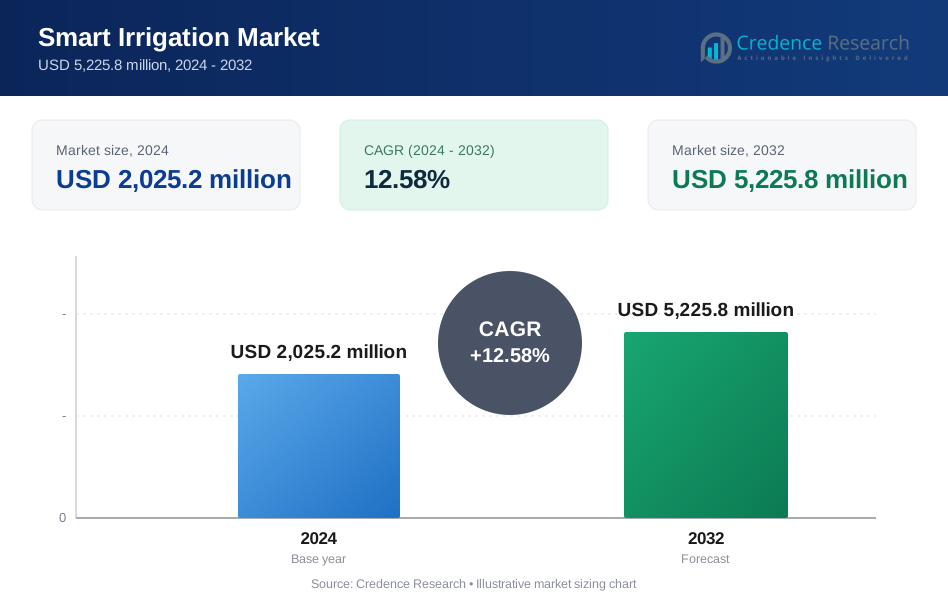
The Smart Irrigation Market is projected to grow from USD 2,025.2 million in 2024 to USD 5,225.8 million by 2032, registering a CAGR of 12.58% during the forecast period.
The Smart Irrigation Market is gaining momentum due to the increasing need for water conservation, rising adoption of precision agriculture, and growing concerns over climate change. Governments and environmental agencies are implementing regulations and incentives to promote efficient irrigation systems, encouraging farmers to shift from traditional methods to smart technologies. Integration of IoT, wireless sensors, and weather-based controllers enhances real-time monitoring, leading to optimal water usage and reduced operational costs. The expansion of smart city initiatives and the deployment of cloud-based irrigation platforms further support market growth. The trend of automation in agriculture, coupled with the rise in demand for food production due to population growth, drives the adoption of data-driven irrigation systems. Advancements in machine learning and data analytics are also transforming irrigation strategies by enabling predictive maintenance and decision-making. Market players are focusing on product innovation, strategic partnerships, and remote connectivity features to offer scalable, efficient, and sustainable irrigation solutions across commercial and residential sectors.
The Smart Irrigation Market shows diverse regional performance, with North America leading due to advanced technology adoption, strong government support, and well-established infrastructure. Europe holds the second-largest share, driven by strict environmental regulations and a strong focus on sustainable agriculture. Asia Pacific is the fastest-growing region, supported by expanding agricultural activities, rising food demand, and government initiatives in countries like India, China, and Australia. Latin America and the Middle East & Africa are emerging markets, gaining momentum through increased awareness of water conservation and modernization efforts in agriculture. Key players in the Smart Irrigation Market include The Toro Company, Netafim, Hunter Industries, Rain Bird Corporation, HydroPoint, Rachio, Banyan Water, Rain Machine, ET Water, Galcon, Weathermatic, and Skydrop. These companies focus on innovation, partnerships, and region-specific solutions to strengthen their global presence and meet varying irrigation needs.
Market Insights:
- The market is growing due to rising concerns over water scarcity and the global push for efficient water management solutions.
- Governments are offering incentives and enforcing regulations that promote the adoption of smart irrigation systems.
- Integration of IoT, cloud platforms, and wireless sensors enhances real-time monitoring and remote control capabilities.
- Expansion of smart cities and increased use of automation in agriculture are driving the demand for smart irrigation solutions.
- High initial costs and limited awareness in emerging economies remain major challenges to wider adoption.
- North America leads the market with 39% share, followed by Europe at 25%, and Asia Pacific at 21%, with the latter showing the fastest growth.
- Key players such as The Toro Company, Netafim, Hunter Industries, and Rain Bird focus on innovation and regional strategies to meet diverse market needs.
Market Drivers:
Increasing Water Scarcity and the Need for Efficient Irrigation:
The growing threat of water scarcity is pushing the agricultural and landscaping sectors to adopt more efficient water management solutions. Traditional irrigation methods often lead to overwatering or water wastage, which exacerbates the global water crisis. The Smart Irrigation Market is expanding as end-users prioritize systems that minimize water usage while maintaining crop health and landscape quality. Smart systems use real-time data to optimize watering schedules, reducing water consumption without compromising output. These solutions are especially critical in arid and semi-arid regions where water is limited. Governments and environmental agencies are promoting smart irrigation to address resource constraints and ensure long-term sustainability.
- For instance, Ipswich City Council in Australia piloted an automated soil-moisture monitoring system from MAIT Industries for its sports fields, which led to water savings of 11.8 megaliters over 11.3 hectares and a reduction of $20,639 in water costs within just six months, even during severe drought restrictions.
Technological Advancements in IoT and Sensor Integration:
The integration of IoT technologies and advanced sensors is transforming irrigation management by enabling real-time monitoring and control. Sensors placed in soil or weather stations collect data on moisture levels, temperature, and rainfall, which smart systems use to automate irrigation. The Smart Irrigation Market benefits from the accuracy and reliability of these innovations, which reduce human error and labor requirements. Cloud-based platforms and mobile applications further enhance user convenience by offering remote system control. This shift toward automation supports precision agriculture practices and enhances crop yields. Technology providers continue to invest in R&D to improve device interoperability and performance.
- For instance, Qantec Automation deployed an IoT-powered irrigation system using UG67 LoRaWAN® gateways and solar panels, allowing farmers to remotely monitor and control irrigation via mobile apps; this system tracks soil moisture, humidity, and other environmental factors, optimizing water use and improving crop yields.
Government Support and Regulatory Mandates:
Government policies encouraging sustainable agriculture and water conservation are significantly influencing the Smart Irrigation Market. Various national and local programs provide subsidies, rebates, or tax incentives for smart irrigation system installation. Regulatory mandates related to efficient water use are prompting public agencies, municipalities, and commercial property owners to upgrade legacy systems. It aligns with broader environmental goals, including carbon footprint reduction and sustainable urban development. Public-private collaborations are also driving system deployment in both urban and rural settings. These efforts create a favorable environment for market expansion across regions.
Growing Demand for Precision Agriculture and Crop Yield Optimization:
Farmers are increasingly adopting smart irrigation solutions to support precision farming practices. The Smart Irrigation Market is growing as stakeholders recognize the value of data-driven decision-making in managing water inputs effectively. These systems help farmers tailor irrigation schedules to specific crop requirements and soil conditions. By doing so, they achieve higher yields, lower input costs, and improved soil health. Rising food demand driven by population growth further strengthens the need for efficient irrigation. Agri-tech companies are responding by offering scalable and customizable solutions suited for various farm sizes and crop types.
Market Trends:
Adoption of IoT and Cloud-Based Irrigation Platforms:
IoT integration is reshaping irrigation management by enabling real-time control, remote monitoring, and data-driven insights. Cloud-based platforms allow users to access irrigation data and control systems from mobile devices or computers, improving convenience and efficiency. The Smart Irrigation Market is witnessing increased adoption of these technologies due to their ability to reduce manual intervention and enhance precision. Systems that incorporate IoT devices and cloud connectivity can automatically adjust watering schedules based on real-time weather data and soil moisture levels. This trend is driving the shift toward more autonomous and efficient irrigation practices. It supports cost reduction and sustainable water management across agriculture and landscaping.
- For instance, CultYvate deployed its IoT-based irrigation advisory system for tobacco farmers in Andhra Pradesh, enabling automated scheduling and real-time monitoring. This solution helped farmers earn ₹43,000 more per acre by improving yield and reducing water and energy expenses.
Expansion of Smart Cities and Sustainable Infrastructure Projects:
Smart city initiatives are fostering the deployment of smart irrigation systems in public parks, roadways, and urban green spaces. Municipalities are integrating these solutions to reduce water waste and support environmental goals. The Smart Irrigation Market benefits from such infrastructure projects that promote connected and sustainable urban ecosystems. Smart irrigation contributes to better landscape management and aligns with broader goals of energy efficiency and resource conservation. This trend reflects a shift toward eco-friendly urban planning. Governments and city planners are actively partnering with tech providers to integrate irrigation systems into wider smart city frameworks.
Increased Use of AI and Predictive Analytics in Irrigation Systems:
Artificial intelligence and predictive analytics are gaining traction in irrigation management by enabling more accurate and proactive decision-making. AI-driven systems analyze historical and real-time data to forecast irrigation needs, improving timing and reducing resource waste. The Smart Irrigation Market is evolving as AI becomes a key enabler of system intelligence and responsiveness. These tools allow users to optimize irrigation schedules based on patterns in weather, crop needs, and soil behavior. Farmers and landscapers benefit from improved outcomes and minimized input costs. Companies are investing in AI to create next-generation platforms that learn and adapt continuously.
- For instance, Arable, an agricultural technology company, has developed an AI-driven smart irrigation system that analyzes real-time weather and soil moisture data, helping farmers reduce water consumption by up to 50% while maintaining healthy crop growth.
Customization and Scalability of Smart Irrigation Solutions:
The demand for scalable and customizable systems is rising across agricultural, commercial, and residential applications. End-users seek solutions that match their specific land size, crop type, and environmental conditions. The Smart Irrigation Market is responding with modular systems that can be easily upgraded or expanded. This trend is making smart irrigation accessible to smallholders and large enterprises alike. Vendors are designing flexible product portfolios to cater to diverse user requirements. It reflects a growing preference for adaptable, user-friendly, and future-ready irrigation technologies.
Market Challenges Analysis:
High Initial Investment and Limited Awareness in Emerging Economies:
The high upfront cost of smart irrigation systems remains a significant barrier to widespread adoption, particularly among small and medium-scale farmers. Many growers in emerging economies lack the financial resources to invest in advanced technologies, even when long-term savings are evident. The Smart Irrigation Market faces resistance in these regions due to limited awareness and inadequate access to financing options. Farmers often rely on conventional irrigation practices because they are more familiar and less capital-intensive. Government subsidies and support programs are not always sufficient or accessible. It restricts market penetration and slows the shift toward smart water management solutions.
Technical Complexity and Integration Challenges:
Smart irrigation systems require stable connectivity, skilled labor, and integration with other digital farming tools, which can complicate deployment. The Smart Irrigation Market must address these issues to ensure ease of use and broader acceptance. Poor network infrastructure and lack of technical expertise create operational inefficiencies, especially in remote or rural areas. Users often face difficulties in system setup, maintenance, and data interpretation. Compatibility between hardware and software components can vary, leading to inconsistent performance. It highlights the need for intuitive, interoperable systems and better user training programs to overcome technical barriers.
- For instance, Rain Bird Corporation launched its Flow-Indicating Basket Filter, a product designed to simplify installation and maintenance by integrating flow measurement and pressure regulation, directly addressing common technical and compatibility challenges faced during deployment.
Market Opportunities:
Growing Demand for Sustainable Agriculture and Food Security:
The rising global demand for food is creating strong opportunities for smart irrigation solutions that optimize water use and improve crop yields. Governments and organizations are encouraging sustainable farming practices to address environmental concerns and ensure long-term productivity. The Smart Irrigation Market is well-positioned to support these goals by offering technologies that reduce water waste and enhance precision in resource application. Farmers adopting smart systems can meet both environmental standards and consumer expectations for sustainable produce. This shift opens avenues for market expansion across developing regions with large agricultural bases. It strengthens the case for smart irrigation as a strategic tool in modern agriculture.
Rising Investments in Smart Infrastructure and Agri-Tech Startups:
Smart infrastructure projects and the growing number of agri-tech startups are driving innovation and investment in smart irrigation technologies. The Smart Irrigation Market stands to benefit from increased funding, research collaborations, and public-private partnerships focused on sustainable urban and rural development. Startups are introducing cost-effective, scalable solutions tailored to local needs, improving accessibility for a wider user base. Smart cities are integrating intelligent irrigation systems to manage public green spaces efficiently. Technological advances in sensors, automation, and AI continue to expand the functionality and appeal of these systems. It creates a dynamic market environment with high potential for growth and diversification.
Market Segmentation Analysis:
By Components
The Smart Irrigation Market, segmented by components, includes controllers, sensors, water flow meters, and others. Controllers hold a significant share due to their central role in automating irrigation schedules based on environmental inputs. Sensors are witnessing strong growth, driven by the demand for real-time soil moisture and weather data. Water flow meters help track usage, enabling better resource management and supporting regulatory compliance. The integration of these components allows for precise and efficient irrigation, appealing to both agricultural and landscaping users. It reflects the market’s move toward fully integrated and data-driven irrigation systems.
By System Type
The market by system type is divided into weather-based controller systems and sensor-based controller systems. Weather-based systems dominate due to their ability to adjust watering schedules based on local climatic conditions. These systems help conserve water and are widely used in urban landscaping and golf courses. Sensor-based systems are gaining traction in precision agriculture, where soil moisture and crop needs vary frequently. The Smart Irrigation Market benefits from the complementary use of both systems, with end-users selecting solutions based on their specific environmental and operational requirements. It supports better customization and scalability across applications.
By Applications
In terms of application, the market is categorized into agricultural and non-agricultural segments. Agriculture represents the largest share due to rising demand for efficient water use and higher crop productivity. Non-agricultural applications such as commercial landscaping, residential gardens, and sports grounds are growing steadily with the expansion of smart cities. The Smart Irrigation Market addresses both segments by offering adaptable systems suited for different land types and usage patterns. It continues to gain momentum across sectors seeking sustainable irrigation solutions.
Segments:
Based on Components
- Controllers
- Sensors
- Water Flow Meters
- Others
Based on System Type
- Weather-Based Controller Systems
- Sensor-Based Controller Systems
Based on Applications
- Agricultural
- Non-Agricultural
Based on the Geography:
- North America
- U.S.
- Canada
- Mexico
- Europe
- Germany
- France
- U.K.
- Italy
- Spain
- Rest of Europe
- Asia Pacific
- China
- Japan
- India
- South Korea
- South-east Asia
- Rest of Asia Pacific
- Latin America
- Brazil
- Argentina
- Rest of Latin America
- Middle East & Africa
- GCC Countries
- South Africa
- Rest of the Middle East and Africa
Regional Analysis:
North America
North America holds the largest share in the Smart Irrigation Market with 39% of the global revenue. The region benefits from widespread adoption of advanced technologies, strong government incentives, and a well-established infrastructure for precision agriculture. The United States leads market growth due to its extensive commercial farming operations and emphasis on water conservation. Federal and state-level rebate programs encourage farmers and municipalities to install smart irrigation systems. Urban landscaping and smart city projects further boost demand for weather-based and sensor-based systems. It remains a key region for innovation and early adoption of connected irrigation solutions.
Europe
Europe accounts for 25% of the Smart Irrigation Market, propelled by strict environmental regulations and an ongoing focus on sustainable farming. Countries like Germany, France, and the Netherlands invest in water-efficient technologies to meet policy goals under the European Green Deal and Common Agricultural Policy. Precision irrigation is gaining popularity among European farmers seeking to reduce input costs and increase efficiency. Rising water prices and climate variability are encouraging the use of weather- and soil-based irrigation systems. Collaborative efforts between agri-tech companies and research institutions support tailored innovation. It reflects the region’s commitment to environmental stewardship and smart resource use.
Asia Pacific
Asia Pacific holds a 21% share in the Smart Irrigation Market and is the fastest-growing regional segment. The region’s growth is driven by rising food demand, expanding farmland, and government support for smart agriculture initiatives. Countries such as China, India, and Australia are investing in irrigation modernization to improve crop yields and reduce water waste. Affordable smartphone access and mobile apps are making smart systems more accessible to small and mid-sized farmers. Regional startups and international players are entering the market with low-cost, scalable solutions. It strengthens Asia Pacific’s role as a key growth engine for smart irrigation technologies.
Key Player Analysis:
- Galcon
- HydroPoint
- Rain Bird Corporation
- Rain Machine
- Rachio
- Skydrop
- Weathermatic
- The Toro Company
- Netafim
- Banyan Water
- ET Water
- Hunter Industries
Competitive Analysis:
The Smart Irrigation Market is highly competitive, with key players focusing on innovation, strategic partnerships, and product differentiation to strengthen their market position. Companies such as The Toro Company, Netafim, Rain Bird Corporation, and Hunter Industries lead the market through strong global distribution networks and comprehensive product portfolios. It is witnessing increased participation from technology-driven firms like HydroPoint, Rachio, and Banyan Water, which emphasize IoT-enabled and cloud-based irrigation systems. Players invest in research and development to improve system integration, energy efficiency, and user interface capabilities. Emerging companies such as Rain Machine, Skydrop, and ET Water offer scalable, cost-effective solutions targeting residential and small-scale agricultural users. Global expansion, mergers, and smart city collaborations also shape the competitive landscape. The Smart Irrigation Market continues to evolve as companies compete to deliver precision, sustainability, and automation across diverse applications in agriculture, landscaping, and urban infrastructure.
Recent Developments:
- In December 2024, Galcon's GSI web-based smart irrigation system was selected by a major municipality in Shandong province, China, to manage irrigation for public landscapes and green belts, covering 800,000 square meters and featuring weather-based automation and remote alerts.
- In April 2025, Rain Bird Corporation acquired OtO Inc., a Toronto-based smart lawn care company known for its solar-powered, app-controlled sprinkler system. This acquisition expands Rain Bird’s offerings for homeowners seeking automated, weather-responsive irrigation without underground installation.
- In February 2025, Weathermatic launched "SmartLink Connect," a new product line enabling landscape professionals to remotely manage non-Weathermatic controllers, including complex 2-wire systems, via the SmartLink cloud platform.
- On October 30, 2024, Netafim unveiled two major innovations at EIMA 2024: GrowSphere™, an all-in-one irrigation operating system, and Orion PC™, the industry’s first thin-wall, pressure-compensated dripline for single crop cycle growers.
Market Concentration & Characteristics:
The Smart Irrigation Market exhibits moderate to high market concentration, with a mix of established global players and emerging technology-driven companies shaping its competitive structure. It features strong participation from agricultural equipment manufacturers and IoT solution providers, leading to continuous innovation in automation, cloud connectivity, and sensor integration. The market favors companies with robust distribution networks, advanced R&D capabilities, and the ability to offer scalable solutions across agricultural and non-agricultural applications. It maintains a dynamic character influenced by regional regulations, climate conditions, and digital infrastructure readiness. Customization, interoperability, and energy efficiency define product differentiation in the market. The Smart Irrigation Market continues to attract investment as sustainability, water conservation, and precision agriculture gain global priority. Emerging trends include AI-driven analytics, drone-enabled monitoring, and blockchain-based data security. Integration with farm management platforms and strategic alliances between hardware and software providers accelerate adoption across diverse crops and commercial landscaping applications.
Report Coverage:
The research report offers an in-depth analysis based on Components, System Type, Application and Geography. It details leading market players, providing an overview of their business, product offerings, investments, revenue streams, and key applications. Additionally, the report includes insights into the competitive environment, SWOT analysis, current market trends, as well as the primary drivers and constraints. Furthermore, it discusses various factors that have driven market expansion in recent years. The report also explores market dynamics, regulatory scenarios, and technological advancements that are shaping the industry. It assesses the impact of external factors and global economic changes on market growth. Lastly, it provides strategic recommendations for new entrants and established companies to navigate the complexities of the market.
Future Outlook:
- Smart irrigation systems will become more affordable and accessible to small and medium-scale farmers.
- Demand for automated and remote-controlled irrigation solutions will increase across all end-user segments.
- Integration of AI and machine learning will enhance predictive irrigation capabilities.
- Governments will expand support through subsidies and policies promoting efficient water use.
- Cloud-based platforms and mobile applications will drive user engagement and system efficiency.
- Urban infrastructure projects will incorporate smart irrigation for sustainable landscaping.
- IoT-enabled sensors and devices will become standard components in modern irrigation systems.
- Manufacturers will focus on developing region-specific solutions tailored to local climatic conditions.
- Collaborations between agri-tech startups and traditional equipment providers will grow.
- Awareness of water conservation and climate resilience will strengthen adoption in developing regions.
Request a Free Sample
Fill in your details and we'll send you a free sample report.
- Sample data tables & charts
- Research methodology
Market Dynamics
Increasing Water Scarcity and Need for Efficient Irrigation
Growing concerns over water scarcity and the need to optimize water usage are pushing agricultural and landscaping sectors to adopt smart irrigation systems that minimize waste and ensure sustainable resource management.
Technological Advancements in IoT and Sensor Integration
The integration of IoT, wireless sensors, and cloud-based platforms enables real-time monitoring and automated control of irrigation, improving precision and reducing labor costs, which accelerates market adoption.
Government Support and Regulatory Mandates
Government incentives, subsidies, and regulatory requirements for efficient water use are encouraging farmers, municipalities, and commercial property owners to upgrade to smart irrigation systems, driving market growth.
Expansion of Smart Cities and Sustainable Infrastructure
Smart city initiatives and sustainable urban development projects are increasingly incorporating smart irrigation solutions for public landscapes and green spaces, broadening the market beyond traditional agriculture.
Growing Demand for Precision Agriculture and Crop Yield Optimization
Farmers are adopting smart irrigation to support precision agriculture, enabling data-driven decisions that optimize irrigation schedules, improve crop yields, and reduce input costs in response to rising food demand.
Need a Custom Version of This Report?
Tailor the scope, geography, or segments to your exact requirements.
- Custom geography or segment scope
- Direct access to our analyst team
Frequently Asked Questions
What is the current size of the Smart Irrigation Market?
What factors are driving the growth of the Smart Irrigation Market?
What are some challenges faced by the Smart Irrigation Market?
Who are the major players in the global smart irrigation market?
Table of Content
Chapter 1 Market Segmentation
- 1.1 Segmentation Framework
- 1.1.1 Product and Service Classification
- 1.1.2 Application and End-Use Classification
- 1.1.3 Technology and Solution Classification
- 1.1.4 Customer and Distribution Channel Classification
- 1.1.5 Geographic Segmentation
- 1.1.6 Market Segment Definitions and Boundaries
- 1.2 By Components
- 1.2.1 Controllers
- 1.2.2 Sensors
- 1.2.3 Water Flow Meters
- 1.2.4 Others
- 1.3 By System Type
- 1.3.1 Weather-Based Controller Systems
- 1.3.2 Sensor-Based Controller Systems
- 1.4 By Applications
- 1.4.1 Agricultural
- 1.4.2 Non-Agricultural
Chapter 2 Introduction
- 2.1 Report Objectives and Scope
- 2.2 Product Definition and Industry Terminology
- 2.3 Market Inclusions and Exclusions
- 2.4 Research Process
- 2.4.1 Primary Research and Expert Interviews
- 2.4.2 Secondary Research and Source Review
- 2.4.3 Top-Down and Bottom-Up Estimation
- 2.4.4 Data Triangulation and Verification
- 2.5 Market Size Measurement Basis
- 2.5.1 2024: USD 2,025.2 million → 2032: USD 5,225.8 million
- 2.6 Historical and Forecast Reference Periods
- 2.6.1 Base Year: 2024
- 2.6.2 Forecast Period: 2024-2032
- 2.7 Research Assumptions and Limitations
Chapter 3 Executive Summary
- 3.1 Market Snapshot and Key Findings
- 3.2 Base-Year Market Size, 2024
- 3.3 Forecast Market Size, 2032
- 3.4 Revenue and Volume Growth Outlook
- 3.5 Key Demand and Supply Indicators
- 3.6 Leading Market Segments
- 3.7 Fastest-Growing Market Opportunities
- 3.8 Regional Performance Highlights
- 3.9 Technology and Industry Transformation
- 3.10 Competitive Landscape Summary
- 3.11 Analyst View and Strategic Implications
Chapter 4 Global Smart Irrigation Market Trends and Developments
- 4.1 Historical Industry Development
- 4.2 Recent Market Trends and Developments
- 4.3 Demand and Customer Behavior Trends
- 4.4 Technology and Product Innovation
- 4.5 Artificial Intelligence, Automation and Digitalization
- 4.6 Local Manufacturing and Supply Chain Realignment
- 4.7 Industry Partnerships, Mergers and Acquisitions
- 4.8 Sustainability and Circular Economy Developments
- 4.9 Government and Private Sector Investment Trends
- 4.10 Emerging Business Models and Commercialization
- 4.11 Industry Developments and Announcements
Chapter 5 Global Smart Irrigation Market Production, Supply and Demand Analysis
- 5.1 Demand Trend and Consumption Analysis
- 5.2 Demand Forecast, 2024-2032
- 5.3 Production and Output Trend
- 5.4 Production and Output Forecast, 2024-2032
- 5.5 Installed Capacity and Capacity Utilization
- 5.6 Company-Wise Production Plants and Statistics
- 5.6.1 Installed Production Capacity
- 5.6.2 Actual Production
- 5.6.3 Planned Capacity and Expansion Targets
- 5.7 Supply Chain Structure and Procurement Trends
- 5.8 Supply-Demand Gap and Bottlenecks
- 5.9 Import Dependence and Sourcing Structure
- 5.10 Contract Manufacturing and Outsourcing
- 5.11 Regional Supply and Demand Concentration
Chapter 6 Global Smart Irrigation Market Pricing Analysis
- 6.1 Pricing Structure and Measurement
- 6.2 Historical Pricing Trends
- 6.3 Pricing Outlook, 2024-2032
- 6.4 Average Selling Price and Unit Economics
- 6.5 Pricing by Product and Market Segment
- 6.6 Geographic Pricing Differences
- 6.7 Key Input, Energy, Labor and Logistics Costs
- 6.8 Contract Pricing and Purchasing Models
- 6.9 Pricing Sensitivity and Competitive Positioning
- 6.10 Price, Margin and Profitability Implications
Chapter 7 Global Smart Irrigation Market Dynamics
- 7.1 Market Growth Drivers
- 7.1.1 Demand-Side Drivers
- 7.1.2 Technology and Innovation Drivers
- 7.1.3 Infrastructure and Investment Drivers
- 7.1.4 Regulatory and Policy Drivers
- 7.2 Market Restraints
- 7.2.1 Cost and Affordability Constraints
- 7.2.2 Technology and Adoption Barriers
- 7.2.3 Supply Chain and Operational Constraints
- 7.3 Market Challenges
- 7.3.1 Competitive Pressure and Margin Erosion
- 7.3.2 Skills, Infrastructure and Implementation Gaps
- 7.4 Emerging Market Opportunities
- 7.5 Market Dynamics Impact and Time-Horizon Assessment
Chapter 8 Global Smart Irrigation Value Chain Analysis
- 8.1 Industry Value Chain Overview
- 8.2 Upstream Suppliers and Critical Inputs
- 8.3 Technology and Component Providers
- 8.4 Manufacturing or Service Delivery
- 8.5 Distribution, Channel Partners and Integrators
- 8.6 Downstream Applications and End Users
- 8.7 Value Addition and Profit Pools
- 8.8 Vertical Integration and Outsourcing
- 8.9 Supplier Concentration and Risk
- 8.10 Supply Chain Localization and Resilience
Chapter 9 Global Smart Irrigation Market Regulations and Policies
- 9.1 Relevant Laws, Standards and Compliance Frameworks
- 9.2 Product, Service, Safety and Quality Requirements
- 9.3 Government Policies, Incentives and Subsidies
- 9.4 Imports, Exports and Trade Barriers
- 9.5 Public Procurement and Local Content Requirements
- 9.6 Environmental and Sustainability Compliance
- 9.7 Upcoming Policy Changes and Market Implications
Chapter 10 Global Smart Irrigation Market Hotspots and Opportunities
- 10.1 Market Opportunity Mapping and Growth Hotspots
- 10.2 High-Growth Applications and Customer Groups
- 10.3 Underserved Markets and White-Space Opportunities
- 10.4 Emerging Technology and Product Opportunities
- 10.5 New Capacity and Investment Hotspots
- 10.6 Market Entry and Expansion Opportunities
- 10.7 Distribution and Partnership Opportunities
- 10.8 Near-Term and Long-Term Commercial Potential
- 10.9 Opportunity Attractiveness and Execution Risks
Chapter 11 Global Smart Irrigation Market Outlook, 2024-2032
- 11.1 Market Size and Analysis
- 11.1.1 Revenue (Market Measurement: 2024: USD 2,025.2 million → 2032: USD 5,225.8 million)
- 11.1.2 Market Volume and Quantity Sold
- 11.1.3 Historical Market Size
- 11.1.4 Base-Year Market Size, 2024
- 11.2 Market Forecast, 2024-2032
- 11.2.1 Revenue Forecast to 2032
- 11.2.2 Volume Forecast to 2032
- 11.2.3 CAGR and Year-on-Year Growth
- 11.2.4 Incremental Revenue Opportunity
- 11.3 Forecast Assumptions and Scenario Analysis
- 11.3.1 Base-Case Forecast
- 11.3.2 Optimistic and Conservative Scenarios
- 11.3.3 Technology, Pricing and Policy Sensitivities
- 11.4 Market Attractiveness and Growth Outlook
Chapter 12 Global Smart Irrigation Market Segmentation and Outlook
- 12.1 Segmentation Summary and Market Shares, 2024
- 12.2 Largest and Fastest-Growing Segments
- 12.3 By Components - Market Size and Forecast, 2024-2032
- 12.3.1 Segment Definition and Scope
- 12.3.2 Historical Market Size
- 12.3.3 Revenue Forecast, 2024-2032
- 12.3.4 Volume Forecast, 2024-2032
- 12.3.5 Base-Year Market Share, 2024
- 12.3.6 Segment CAGR and Growth Drivers
- 12.3.7 Subsegment Market Size and Forecast
- 12.3.7.1 Controllers
- 12.3.7.2 Sensors
- 12.3.7.3 Water Flow Meters
- 12.3.7.4 Others
- 12.3.8 Subsegment Pricing and Adoption Trends
- 12.3.9 Leading Suppliers and Competition
- 12.3.10 Regional Demand and Opportunities
- 12.4 By System Type - Market Size and Forecast, 2024-2032
- 12.4.1 Segment Definition and Scope
- 12.4.2 Historical Market Size
- 12.4.3 Revenue Forecast, 2024-2032
- 12.4.4 Volume Forecast, 2024-2032
- 12.4.5 Base-Year Market Share, 2024
- 12.4.6 Segment CAGR and Growth Drivers
- 12.4.7 Subsegment Market Size and Forecast
- 12.4.7.1 Weather-Based Controller Systems
- 12.4.7.2 Sensor-Based Controller Systems
- 12.4.8 Subsegment Pricing and Adoption Trends
- 12.4.9 Leading Suppliers and Competition
- 12.4.10 Regional Demand and Opportunities
- 12.5 By Applications - Market Size and Forecast, 2024-2032
- 12.5.1 Segment Definition and Scope
- 12.5.2 Historical Market Size
- 12.5.3 Revenue Forecast, 2024-2032
- 12.5.4 Volume Forecast, 2024-2032
- 12.5.5 Base-Year Market Share, 2024
- 12.5.6 Segment CAGR and Growth Drivers
- 12.5.7 Subsegment Market Size and Forecast
- 12.5.7.1 Agricultural
- 12.5.7.2 Non-Agricultural
- 12.5.8 Subsegment Pricing and Adoption Trends
- 12.5.9 Leading Suppliers and Competition
- 12.5.10 Regional Demand and Opportunities
- 12.6 Segment Growth Comparison
- 12.7 Segment Attractiveness and Priority Matrix
Chapter 13 Global Smart Irrigation End-Use and Application Market Outlook
- 13.1 End-Use Industry and Customer Demand Structure
- 13.2 Leading Applications and Customer Groups
- 13.3 End-Use Market Size, Share and Forecast
- 13.4 Major End-Use Industry Deep Dives
- 13.4.1 Customer Requirements and Use Cases
- 13.4.2 Demand and Replacement Cycles
- 13.4.3 Technical and Regulatory Considerations
- 13.4.4 Purchasing and Procurement Models
- 13.4.5 Leading Vendors and Distribution Channels
- 13.4.6 Forecast and Commercial Opportunities
- 13.5 Emerging Applications and Cross-Segment Demand
- 13.6 End-Use Industry Investment Priorities
Chapter 14 Global Smart Irrigation Geographic Market Outlook, 2024-2032
- 14.1 Regional Market Size and Share, 2024
- 14.2 Regional Market Forecast, 2024-2032
- 14.3 Regional Pricing, Production and Demand Differences
- 14.4 North America
- 14.4.1 United States
- 14.4.2 Canada
- 14.4.3 Mexico
- 14.5 Europe
- 14.5.1 Germany
- 14.5.2 France
- 14.5.3 Italy
- 14.5.4 United Kingdom
- 14.5.5 Spain
- 14.5.6 Poland
- 14.5.7 Russia
- 14.5.8 Netherlands
- 14.5.9 Belgium
- 14.5.10 Sweden
- 14.5.11 Denmark
- 14.5.12 Norway
- 14.5.13 Rest of Europe
- 14.6 Asia Pacific
- 14.6.1 China
- 14.6.2 India
- 14.6.3 Japan
- 14.6.4 South Korea
- 14.6.5 Thailand
- 14.6.6 Indonesia
- 14.6.7 Vietnam
- 14.6.8 Malaysia
- 14.6.9 Australia
- 14.6.10 Rest of Asia Pacific
- 14.7 Latin America
- 14.7.1 Brazil
- 14.7.2 Argentina
- 14.7.3 Colombia
- 14.7.4 Chile
- 14.7.5 Rest of Latin America
- 14.8 Middle East
- 14.8.1 Saudi Arabia
- 14.8.2 United Arab Emirates
- 14.8.3 Turkey
- 14.8.4 Israel
- 14.8.5 Iran
- 14.8.6 Rest of the Middle East
- 14.9 Africa
- 14.9.1 South Africa
- 14.9.2 Egypt
- 14.9.3 Nigeria
- 14.9.4 Morocco
- 14.9.5 Rest of Africa
- 14.10 Regional Investment, Policy and Supply Chain Differences
- 14.11 Regional Competitive Landscape
- 14.12 Geographic Growth Hotspots
Chapter 15 Global Smart Irrigation Technology, Innovation and Sustainability Outlook
- 15.1 Technology Landscape and Maturity
- 15.2 Product, Process and Service Innovation
- 15.3 AI, Automation and Digital Tools in the Industry
- 15.4 Technology Adoption and Performance Benchmarking
- 15.5 Innovation Pipeline and R&D Investment
- 15.6 Patent and Intellectual Property Trends
- 15.7 Energy Efficiency and Resource Management
- 15.8 Sustainability, Recycling and Circularity
- 15.9 Technology Roadmap, 2024-2032
- 15.10 Risks of Obsolescence and Technology Substitution
Chapter 16 Global Smart Irrigation Market Key Strategic Imperatives
- 16.1 Growth and Market Entry Priorities
- 16.2 High-Return Products and Segments
- 16.3 Pricing, Profitability and Cost Optimization
- 16.4 Technology Investment and Product Differentiation
- 16.5 Supply Chain Localization and Resilience
- 16.6 Distribution and Customer Acquisition
- 16.7 Partnership, Acquisition and Capacity Strategy
- 16.8 Regional Expansion Priorities
- 16.9 Short-, Medium- and Long-Term Actions
Chapter 17 Competition Outlook
- 17.1 Industry Competition Characteristics
- 17.2 Market Structure and Concentration
- 17.3 Market Share and Competitive Positioning, 2024
- 17.4 Company-Wise Revenue and Product Benchmarking
- 17.5 Production and Service Capacity Benchmarking
- 17.6 Technology, Pricing and Differentiation
- 17.7 Regional Footprint and Distribution Strength
- 17.8 Mergers, Acquisitions and Strategic Alliances
- 17.9 New Entrants and Competitive Threats
- 17.10 Porter's Five Forces and Industry Attractiveness
- 17.11 Competitive Outlook, 2024-2032
Chapter 18 Company Profiles
- 18.1 Company Coverage and Selection Criteria
- 18.2 The Toro Company
- 18.2.1 Business Description
- 18.2.2 Company Ownership and Geographic Presence
- 18.2.3 Product and Service Portfolio
- 18.2.4 Manufacturing and Operating Footprint
- 18.2.5 Production Capacity and Expansion Plans
- 18.2.6 Financial Performance and Investment
- 18.2.7 Market Share and Competitive Position
- 18.2.8 Technology and Innovation Capabilities
- 18.2.9 Strategic Alliances or Partnerships
- 18.2.10 Recent Developments
- 18.2.11 Growth Strategy and Outlook
- 18.3 Netafim
- 18.4 Hunter Industries
- 18.5 Rain Bird Corporation
- 18.6 HydroPoint
- 18.7 Rachio
- 18.8 Banyan Water
- 18.9 Galcon
- 18.10 Weathermatic
- 18.11 ET Water
- 18.12 Other Relevant Market Participants
Note: Every listed company is profiled on the structure shown under the first company. The company list is preliminary and may change based on research findings, market developments, data availability and client requirements.
Chapter 19 Disclaimer
- 19.1 Research and Forecast Disclaimer
- 19.2 Data Source and Estimation Limitations
Note: The depth of individual sections depends on data availability for this market. Volume, capacity, trade and other unit-based metrics are included where applicable.

