
Quick answer
An avocado processing plant ripens, grades and packs avocados and turns lower-grade fruit into frozen pulp and guacamole. A representative integrated unit handles 5 tonnes of fruit a day, or 1,500 tonnes a year. Total CapEx is estimated at USD 0.6–1.1 million for an import-market ripening hub (South Asian cost basis), gross margin at 12–22% and payback at 3–6 years, with fruit cost and ripening shrink as the main swing factors.
Viable near a port or major ripening hub with steady Hass supply and foodservice buyers for pulp; weak where fruit must be bought at retail-grade prices only.
Avocado plant: key highlights
| Parameter | Indicative value | Note |
|---|---|---|
| Plant capacity | 5 tonnes of fruit per day | 1,500 tonnes a year; about 75% sold fresh, 25% to pulp and guacamole |
| Total CapEx | USD 0.6–1.1 million | Import-market ripening hub (South Asian cost basis); U.S. or EU builds run higher |
| Raw material share of operating cost | 75–82% | Mostly Hass fruit, bought by origin and season |
| Gross margin | 12–22% | Blended fresh and processed sales at 85% utilization |
| Payback period | 3–6 years | Before grants; includes a one-year ramp-up |
| IRR | Available in report | Post-tax, 10-year model |
| Break-even | Available in report | Capacity utilization basis |
Ranges assume a 5-tonne-per-day fruit intake (1,500 tonnes a year), a 2,000-square-meter greenfield site at an import-market ripening hub (South Asian cost basis), 2026 prices, 85% utilization, 75% fruit sold fresh and 25% made into frozen pulp and guacamole, HPP excluded, and Indian benchmarks converted at 88 rupees per U.S. dollar. U.S. or EU sites cost more. Customizable to any country.
What is avocado processing?
Avocado (Persea americana) is a climacteric fruit that does not soften on the tree, so its commercial value depends on controlled ripening after harvest. An avocado processing plant receives mature, hard fruit, ripens it with ethylene at set temperatures, grades and packs ready-to-eat fruit, and converts soft or cosmetically flawed fruit into pulp, guacamole and frozen chunks. Hass, with dark pebbly skin and oil content above 18%, is the benchmark variety for both retail and processing, while green-skinned Indian seedling types carry closer to 12% oil and turn watery when mashed.
Fresh and dried avocados fall under Harmonized System code 0804.40, frozen uncooked pulp under 0811.90 and prepared guacamole under 2008.99. Buyers include modern retail and quick-commerce platforms for ripe fruit, and hotels, cafes, quick-service restaurants and sandwich chains for pulp and guacamole. This page covers the fruit processing chain only; avocado oil extraction is a separate project with different equipment and economics.
Avocado market overview and global demand
Credence Research estimates the global avocado market at USD 18.27 billion in 2025, growing at a CAGR of 7.2% to about USD 29.73 billion by 2032, as detailed in the global avocado market report. Value-added formats such as pulp and guacamole are tracked in the avocado puree market study.
Supply is concentrated in the Americas. World production reached about 9.04 million tons in 2022, with Mexico alone at 2.53 million tons, followed by Colombia, Peru, the Dominican Republic, Kenya, Indonesia and Brazil. Global exports rose about 10% to 2.91 million tons in 2023, led by Mexico at 1.22 million tons and Peru at 598,000 tons, with Spain, Kenya, Colombia, Chile, Israel and South Africa next.
The United States is the largest import market, supplied mainly from Mexico, followed by Europe, where the Netherlands and Spain act as ripening and distribution hubs, and by China and Japan. Newer import markets are growing fast: India, with almost no commercial Hass production, received an estimated 19,120 tons in 2025, mainly from Tanzania.
Processing follows the fruit, and Mexico dominates exports of guacamole and frozen pulp because packhouses there reject a steady share of sound but cosmetically flawed fruit, which becomes cheap pulp feedstock, and Peru, Chile and Kenya are adding capacity on the same logic. In import markets, ripening centers create the opportunity: they sell ripe fruit to retailers and online grocers and divert soft fruit to pulp for cafes, quick-service chains and sandwich makers. Prices swing with origin gluts, so plants with both outlets absorb oversupply better than pure packers.
Avocado processing plant manufacturing process
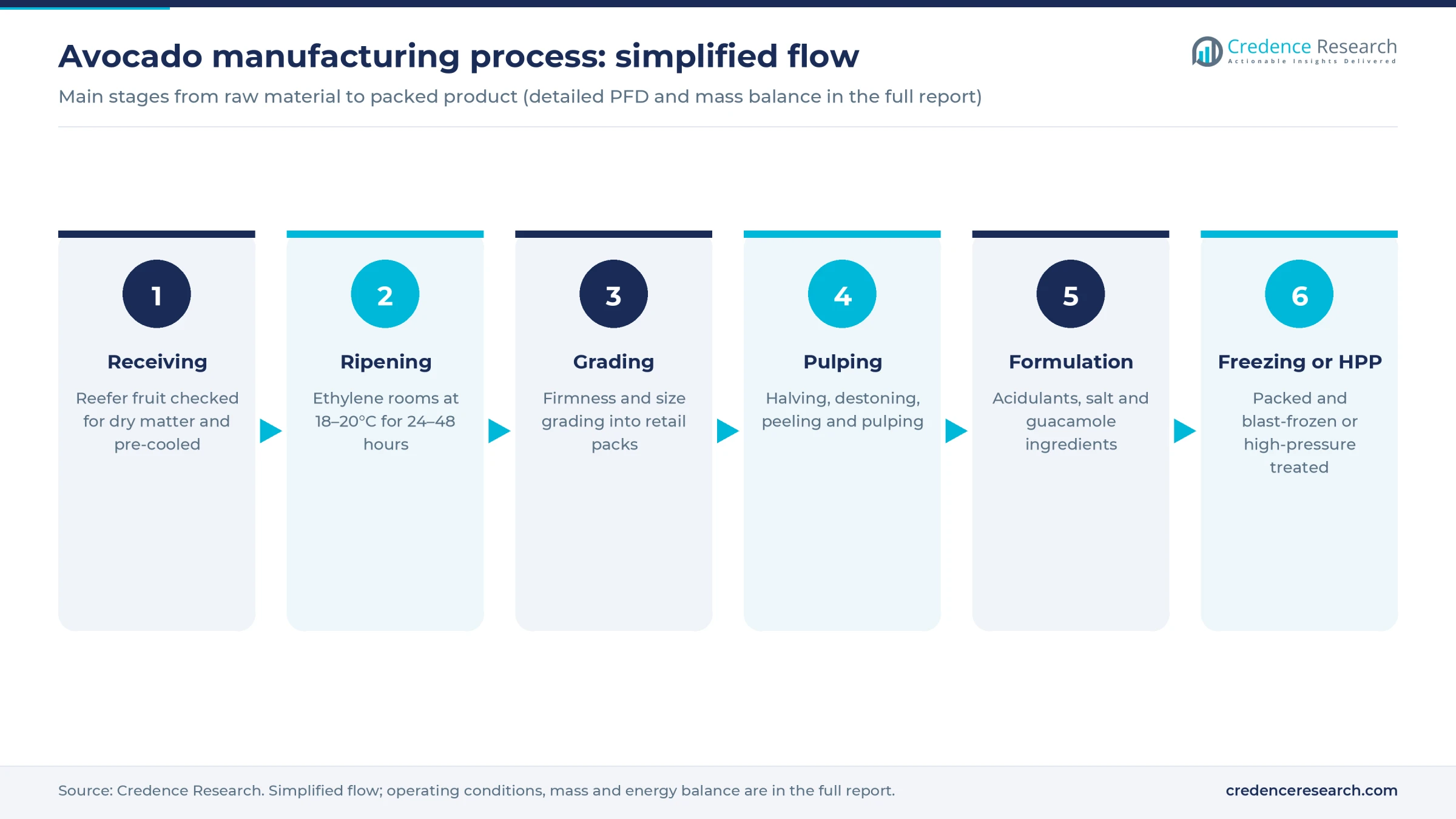
The plant runs two linked streams: a ripening and packing line for fresh fruit and a pulp line that adds value to fruit unfit for retail sale.
- Receiving and pre-cooling. Reefer containers arrive at 5–7°C; pallets are checked for dry matter, the industry's maturity index, and firmness, then held in staging cold rooms.
- Ethylene ripening. Fruit is conditioned in pressurized ripening rooms at 18–20°C with about 100 ppm ethylene for 24–48 hours, then ventilated to remove carbon dioxide. Room schedules target delivery stages such as ready in two days or ready to eat.
- Grading and packing. Firmness testers and optical sizers split fruit into retail grades; premium fruit goes into punnets and two-packs, while soft, bruised or undersized fruit moves to processing.
- Pulping. Fruit is washed, halved, destoned and peeled, often by hand at small scale, and the flesh is scooped and pulped or cut into chunks.
- Formulation. Pulp is mixed with ascorbic and citric acid and salt, plus onion, chili, lime and cilantro for guacamole. Speed matters because polyphenol oxidase browns exposed flesh within minutes.
- Preservation. Product is vacuum or nitrogen packed, then blast-frozen to minus 18°C or below, or treated by high-pressure processing (HPP) at about 600 MPa for chilled shelf life.
Yield drives the economics because recoverable flesh is only about 60–65% of fruit weight after skin and seed removal, so each kilogram of pulp consumes roughly 1.6 kg of fruit. Ripening losses of 5–10% from uneven softening and chilling injury are the other main leakage. HPP keeps guacamole green and fresh-tasting without freezing, but a production-scale vessel typically costs about USD 1 million or more, so small plants usually start with blast freezing and add HPP in a second phase. Equipment options are reviewed in the high pressure processing equipment market report.
Avocado processing plant setup cost
The cost model assumes an integrated unit receiving 5 tonnes of fruit a day, or 1,500 tonnes a year over 300 days. About three-quarters is sold as ripe, packed fruit, and one-quarter becomes roughly 230 tons of frozen pulp and guacamole. On that basis, total project cost is estimated at USD 0.6–1.1 million for a greenfield site at an import-market ripening hub (South Asian cost basis), including working capital margin. Comparable U.S. or EU builds typically cost 1.5–2 times more because of land, construction and refrigeration labor, an assumed multiple that the full report adjusts by country.
The range is scaled from Indian National Horticulture Board cost norms for ripening chambers, integrated pack houses and staging cold rooms, uplifted 30–60% for current prices and converted at 88 rupees per U.S. dollar. The pulp line, blast freezer and frozen store are priced separately because the norms do not cover them.
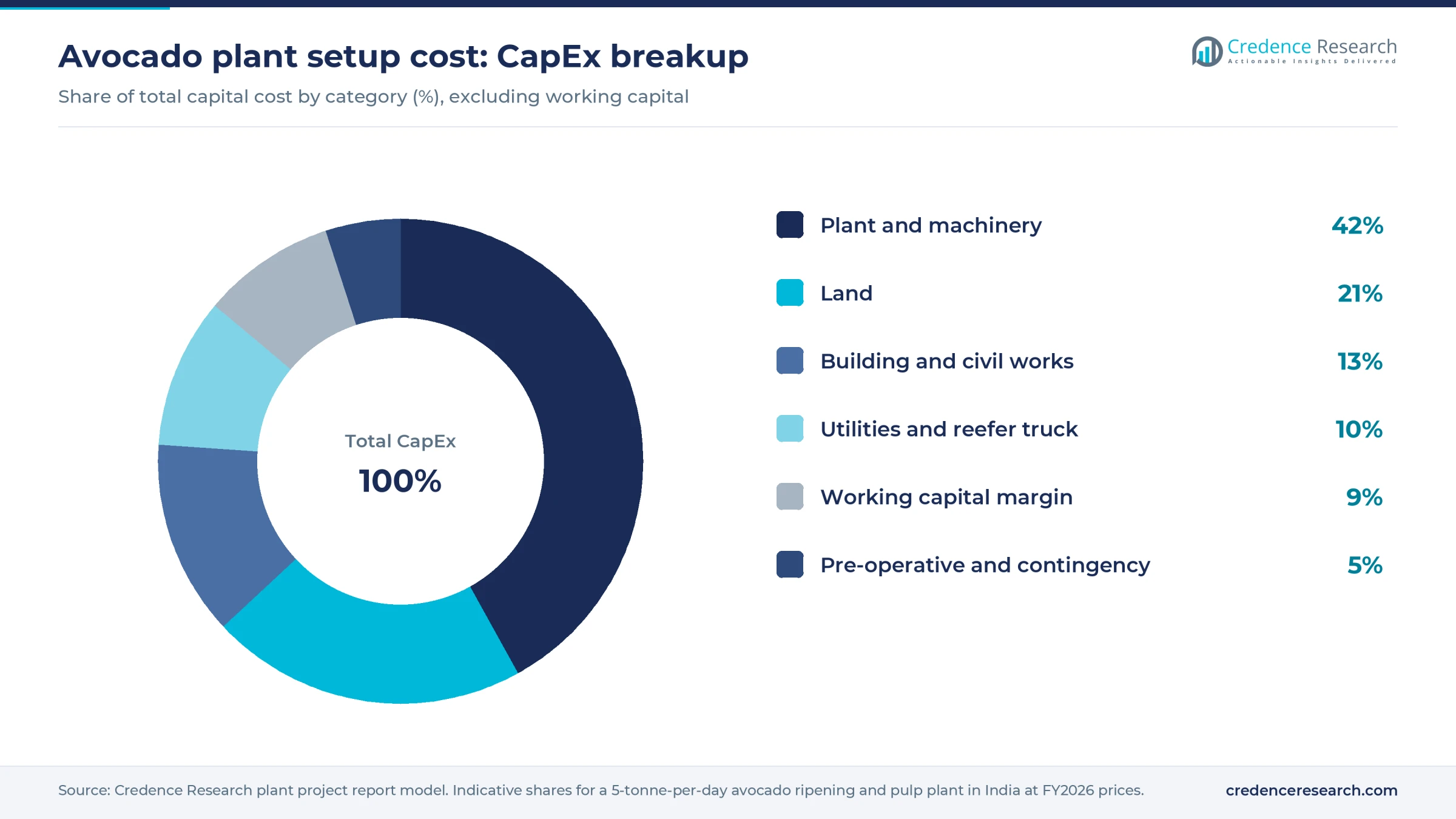
Plant and machinery takes about 42% of CapEx, led by the pulp line and blast freezer, followed by ripening rooms, the pack house and cold rooms. Land takes about 21%, building and insulated civil works 13%, utilities and a refrigerated truck 10%, working capital margin 9%, and pre-operative costs with contingency 5%.
Worked example, land: the unit needs a plot of about 2,000 square meters for ripening rooms, a pack hall, a processing room, frozen storage, truck docks and wastewater treatment. Public industrial allotment rates in Maharashtra range from about USD 42 per square meter at an inland estate to USD 138 near a container port, putting land at USD 85,000–275,000. Sites near U.S. or European ports can cost several times more, while leasing a cold-chain shed removes most of the outlay but adds rent.
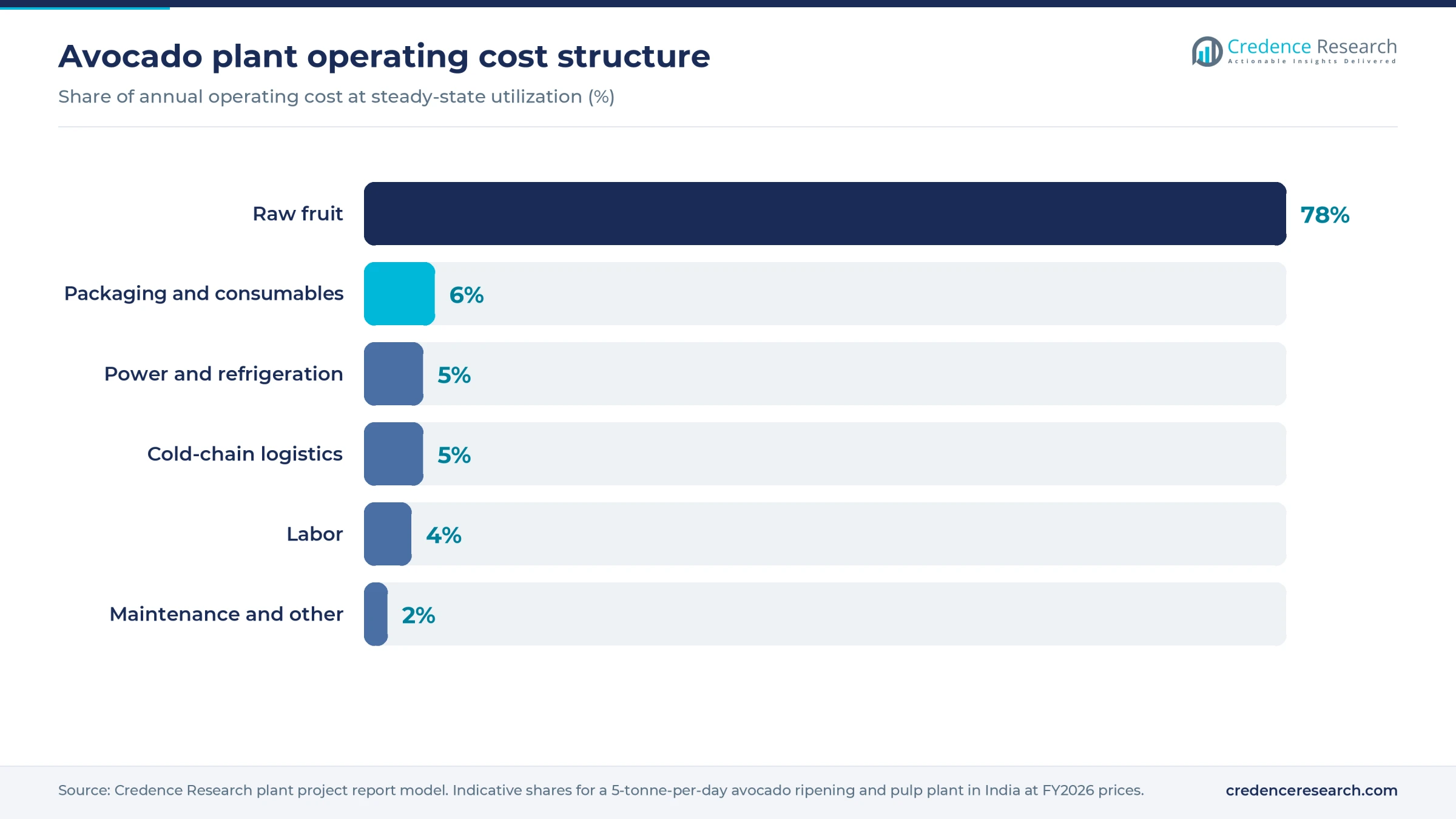
Fruit dominates operating cost at 75–82% of the total. Packaging and ripening consumables take about 6%, refrigeration power 5%, cold-chain logistics 5%, labor 4%, and maintenance, insurance and other costs about 2%. Fruit is usually paid for before it ripens and sold on 15–30-day retail credit, so working capital needs exceed those of a typical fruit pulp unit.
Machinery and raw materials for an avocado processing plant
Main equipment for a 5-tonne-per-day unit includes the following items.
- Pressurized ethylene ripening rooms with dosing, carbon dioxide scrubbing and temperature control
- Staging cold rooms at 5–7°C and a minus 20°C frozen store
- Firmness tester, dry matter meter and optical size grader
- Packing tables, punnet sealers and a labeling line
- Halving, destoning and peeling stations, pulper, chunk cutter and ribbon mixer
- Vacuum or nitrogen-flush tray sealer, blast freezer and metal detector
- Refrigerated truck, generator and water treatment
Ripening room design choices are compared in the fruit ripening system market report.
Hass supply rotates by origin through the year. Mexico, centered on Michoacan and Jalisco, ships almost year-round; Peru and Chile peak in the Southern Hemisphere season; Colombia adds a second year-round source; and Kenya, Tanzania and South Africa supply Europe, the Middle East and Asia. Spain and Israel cover the European winter. A plant near an import port buys whole containers and depends on sea freight of three to five weeks, while a plant at origin buys processing-grade fruit rejected by export packhouses at a steep discount. That price gap explains why most pulp and guacamole capacity sits in Mexico, Peru and Kenya. Regions with seedling orchards, such as southern India, offer low-oil fruit better suited to pulp blends than to retail packs.
Avocado processing business profit margin and ROI
Gross margin is estimated at 12–22% at 85% utilization. Ripe fruit sold to retailers and online grocers at an assumed average of USD 3.30–4.00 per kg across the year, glut weeks included, against landed fruit at USD 2.40–2.85 per kg leaves a moderate spread after 8–12% shrink and packing costs. Landed cost is built up from Tanzanian export unit values of about EUR 1.40–1.50 per kg in 2026, plus sea freight and import duty where it applies. Pulp and guacamole, assumed at USD 5.10–6.80 per kg to undercut imported Mexican product, lift the blend because processing-grade fruit costs about USD 1.40–2.00 per kg.
Payback is estimated at 3–6 years, including a one-year ramp-up, based on steady-state cash profit of about USD 170,000–340,000 after overheads and tax. Three variables decide where a project lands: fruit cost, which moves with currency and origin supply; ripening shrink; and the share of fruit sold fresh rather than discounted. Sensitivity: a fall of USD 0.25 per kg in the ripe fruit selling price cuts gross margin by about 5 percentage points, and glut weeks show the risk is real.
| Metric | Value |
|---|---|
| IRR (post-tax) | Available in report |
| NPV | Available in report |
| ROI | Available in report |
| DSCR | Available in report |
| Break-even utilization | Available in report |
How to start an avocado processing business, licenses and approvals
An avocado ripening and pulp plant typically needs the following approvals in most markets.
- Business registration and tax registration
- Land use or zoning clearance, building permit and fire safety approval, including ethylene and refrigerant handling
- Environmental permit or consent for process wastewater and solid waste from skins and seeds
- Food facility registration or license and a food safety plan; retail buyers usually also require GFSI-benchmarked certification such as BRCGS or SQF
- Plant health import permits and phytosanitary certificates for imported fresh fruit
- Labeling and weights-and-measures compliance for prepacked fruit and guacamole
Examples by market:
| Market | Food safety | Fruit imports and other |
|---|---|---|
| United States | FDA food facility registration and the Preventive Controls for Human Food rule, 21 CFR Part 117 | USDA APHIS fruit and vegetable import rules, 7 CFR 319.56; state health and environmental permits |
| European Union | Food business operator registration with the national authority under Regulation (EC) No 852/2004 | Plant health rules under Regulation (EU) 2016/2031 and marketing standards under Regulation (EU) 2023/2429 |
| India | FSSAI central license, required for direct imports and for capacity above 2 tonnes a day | Plant quarantine import permit under the Plant Quarantine Order, 2003; Orange category pollution board consent |
Ripening and cold-chain assets often qualify for agricultural infrastructure grants or concessional loans, such as India's 35% horticulture subsidy for ripening chambers, so the full report checks incentives country by country.
Key avocado processors, packers and recent developments
The industry splits into global packer-ripeners, which control fruit, and processors, which turn surplus fruit into pulp and guacamole.
- Mission Produce, based in California, runs packhouses and ripening centers across the Americas and Europe and opened a packhouse in Guatemala in 2025.
- Westfalia Fruit grows, ripens and processes avocados on several continents, with guacamole, pulp and IQF products.
- MegaMex Foods sells high-pressure-processed Wholly Guacamole in North America.
- J.R. Simplot supplies frozen avocado pulp to foodservice buyers.
- Regional importers such as Abacate International in India run ripening chambers in several cities.
Recent developments:
- August 2026: Westfalia Fruit Perú inaugurated a frozen and HPP plant in Lambayeque with 15,000 tonnes a year of capacity for avocado, mango and blueberry products.
- December 2025: India and New Zealand concluded a free trade agreement, signed in April 2026, under which New Zealand avocados move to duty-free access over 10 years.
What's inside the Avocado project report PDF
The report runs to 21 chapters. Open a chapter to see its sections.
1. Preface
2. Scope and Methodology
- 2.1 Objectives of the Study
- 2.2 Stakeholders
- 2.3 Research Methodology
- 2.4 Data Sources and Key Assumptions
3. Executive Summary
- 3.1 Market Snapshot
- 3.2 Project at a Glance (Capacity, CapEx, OpEx)
- 3.3 Key Financial Indicators (IRR, NPV, Payback, Break-even)
- 3.4 Feasibility Verdict
4. Product Overview
- 4.1 Avocado Definition and Properties
- 4.2 Grades and Specifications (BIS / ISO / ASTM)
- 4.3 HS Code and Classification
- 4.4 Key Applications
- 4.5 Substitutes
5. Global Avocado Market
- 5.1 Market Overview
- 5.2 Historical and Current Market Performance (Volume and Value)
- 5.3 Market Breakup by Grade / Type
- 5.4 Market Breakup by End-Use Industry
- 5.5 Market Breakup by Region
- 5.6 Market Drivers, Restraints and Trends
- 5.7 Value Chain Analysis
- 5.8 Market Forecast
6. Target Country Avocado Market Analysis
- 6.1 Demand and Supply Analysis
- 6.2 Installed Capacity vs Demand Gap
- 6.3 Import Dependence
- 6.4 Demand Forecast by End-Use
7. Trade Analysis
- 7.1 Imports by Volume, Value and Country
- 7.2 Exports by Volume, Value and Country
- 7.3 Trade Balance and Opportunities
8. Price Analysis
- 8.1 Historical Avocado Price Trends by Region
- 8.2 Raw Material / Feedstock Price Trends and Linkage
- 8.3 Price Forecast
- 8.4 Margins Across the Value Chain
9. Competitive Landscape
- 9.1 Market Structure
- 9.2 Key Players and Installed Capacities
- 9.3 Profiles of Key Players
- 9.4 Recent Developments (Expansions, M&A, New Plants)
10. Manufacturing Process and Technology
- 10.1 Comparison of Technology Routes
- 10.2 Selected Route and Process Flow Diagram
- 10.3 Unit Operations Involved
- 10.4 Chemical Reactions Involved
- 10.5 Mass Balance and Raw Material Requirements
- 10.6 Energy Balance
- 10.7 Quality Assurance Criteria and Technical Tests
- 10.8 By-products and Waste Handling
- 10.9 Technology Licensors / Providers
11. Project Details, Requirements and Costs
- 11.1 Land, Location and Site Development
- 11.1.1 Site Selection Criteria
- 11.1.2 Location Analysis
- 11.1.3 Land Requirement and Costs
- 11.1.4 Site Development Costs
- 11.2 Plant Layout
- 11.2.1 Layout Principles
- 11.2.2 Proposed Layout
- 11.2.3 Factors Influencing Layout
- 11.3 Civil Works and Buildings
- 11.4 Plant Machinery
- 11.4.1 Machinery Requirements and Specifications
- 11.4.2 Machinery Costs
- 11.4.3 Machinery Suppliers
- 11.5 Raw Materials
- 11.5.1 Requirements per Tonne of Output
- 11.5.2 Procurement and Sourcing
- 11.5.3 Costs
- 11.5.4 Suppliers
- 11.6 Packaging
- 11.6.1 Packaging Requirements
- 11.6.2 Packaging Costs
- 11.6.3 Packaging Suppliers
- 11.7 Storage and Material Handling
- 11.8 Transportation Requirements and Costs
- 11.9 Utilities
- 11.9.1 Power Requirements and Costs
- 11.9.2 Water Requirements and Costs
- 11.9.3 Steam, Fuel and Other Utilities
- 11.10 Manpower Requirements and Wages
12. Environment, Health, Safety and Sustainability
- 12.1 Effluent and Emissions Management
- 12.2 Hazard Classification and Safety Measures
- 12.3 Carbon Footprint
- 12.4 Green / Low-Carbon Process Options
13. Regulatory Procedures, Approvals and Certifications
- 13.1 Licences and Registrations
- 13.2 Environmental Clearances
- 13.3 Product Certifications (BIS, REACH, etc.)
- 13.4 Approval Timeline
14. Project Implementation Schedule
15. Project Economics
- 15.1 Capital Cost of the Project
- 15.2 Techno-Economic Parameters
- 15.3 Capacity Utilization and Ramp-up
- 15.4 Product Pricing and Margins
- 15.5 Income Projections
- 15.6 Expenditure Projections
- 15.7 Working Capital Requirement
- 15.8 Taxation
- 15.9 Depreciation
16. Financial Analysis
- 16.1 Projected Profit and Loss Account
- 16.2 Projected Cash Flow Statement
- 16.3 Projected Balance Sheet
- 16.4 Liquidity Analysis
- 16.5 Profitability Analysis (Payback, NPV, IRR, ROI)
- 16.6 Break-even Analysis
- 16.7 Debt Service Coverage Ratio (DSCR)
- 16.8 Sensitivity Analysis
- 16.9 Scenario and Uncertainty Analysis
17. Funding and Incentives
- 17.1 Means of Finance and Debt-Equity Structure
- 17.2 Loans and Financial Assistance
- 17.3 Government Schemes and Subsidies (PLI, State Policies)
18. Risk Assessment
- 18.1 Key Success Factors
- 18.2 Key Risk Factors
- 18.3 Risk Mitigation
19. Strategic Recommendations
20. Case Study of a Successful Venture
21. Appendix
- 21.1 Detailed Assumptions
- 21.2 Abbreviations
- 21.3 List of Tables and Figures
- 21.4 Sources
This page vs. the full report
| Data point | On this page (free) | In the full report |
|---|---|---|
| Total CapEx | One rounded range at one capacity | Exact figure at three capacities with a line-item breakup |
| CapEx breakup | Category shares (%) only | Cost, quantity and supplier for every machine |
| Operating cost | Share of raw materials, utilities and labor | Per-unit cost sheet with each input price and consumption |
| Profitability | Gross margin range and payback band | Exact IRR, NPV, ROI, break-even and DSCR |
| Financial statements | List of what is included | 10-year P&L, cash flow, balance sheet and Excel model |
| Sensitivity | One directional line | Full sensitivity and scenario tables |
| Process | Simplified flow diagram | Detailed process flow, mass and energy balance, operating conditions |
| Machinery | Names of the main machines | Specifications, capacity, cost and supplier list |
| Market | Headline size, growth and India demand trend | Segment, region, trade and price forecast tables |
| Suppliers and buyers | Supplier types and sourcing hubs | Named suppliers and buyers |
Avocado project report: FAQs
How much does it cost to set up an avocado processing plant?
What is the profit margin in avocado processing?
Where is avocado processing concentrated?
What products can an avocado processing plant make?
Which licenses are needed to start an avocado processing business?
Why is HPP used for guacamole instead of heat?
What is the payback period for an avocado processing plant?

About the analyst
Nisha Gupta, Senior Research Analyst
Nisha Gupta is a Senior Research Analyst at Credence Research Inc. who works across industry domains, including packaging, automotive parts and machinery. Her focus is the modelling engine behind each study: she builds quantitative market databases and econometric forecasting frameworks, and developed automated Excel-based market modelling templates that cut client turnaround time by 30%.
Related market research
- Avocado Market Size, Share, Growth, Trends and Forecast 2032
- Avocado Puree Market Size, Growth, Share and Forecast 2032
- Fruit Ripening System Market Size, Growth and Forecast 2032
- Frozen Fruits And Vegetables Market Size, Share & Forecast 2032
- Dips And Spreads Market Size, Growth, Share and Forecast 2032
- High Pressure Processing Equipment Market Size and Share 2032
More plant project reports
- Potato Processing Plant Prefeasibility Report 2026
- Corn Starch Manufacturing Plant Project Report (DPR) 2026
- Copper Sulphate Manufacturing Plant Project Report (DPR) 2026
- Ceiling Fan Manufacturing Plant Project Report (DPR) 2026
- Cassava Starch Manufacturing Plant Project Report (DPR) 2026
- Cassava Processing Plant Project Report (DPR) 2026