
Garden Watering Systems Market Overview:
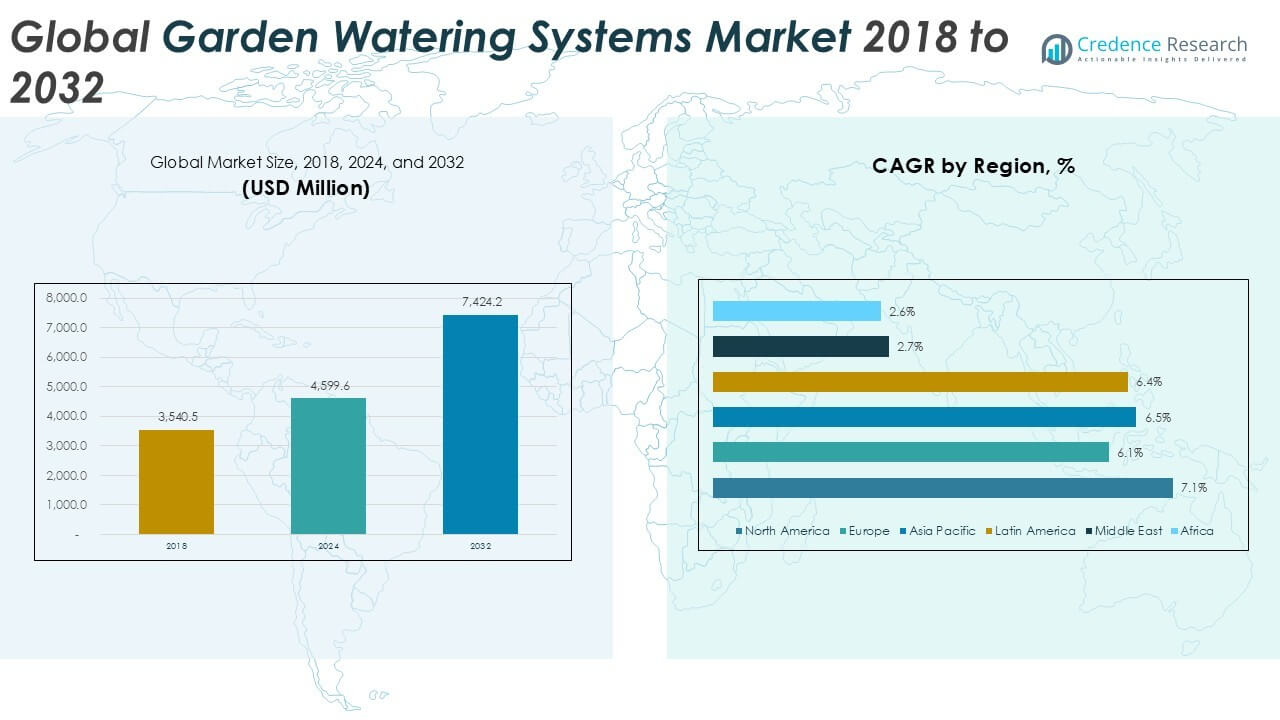
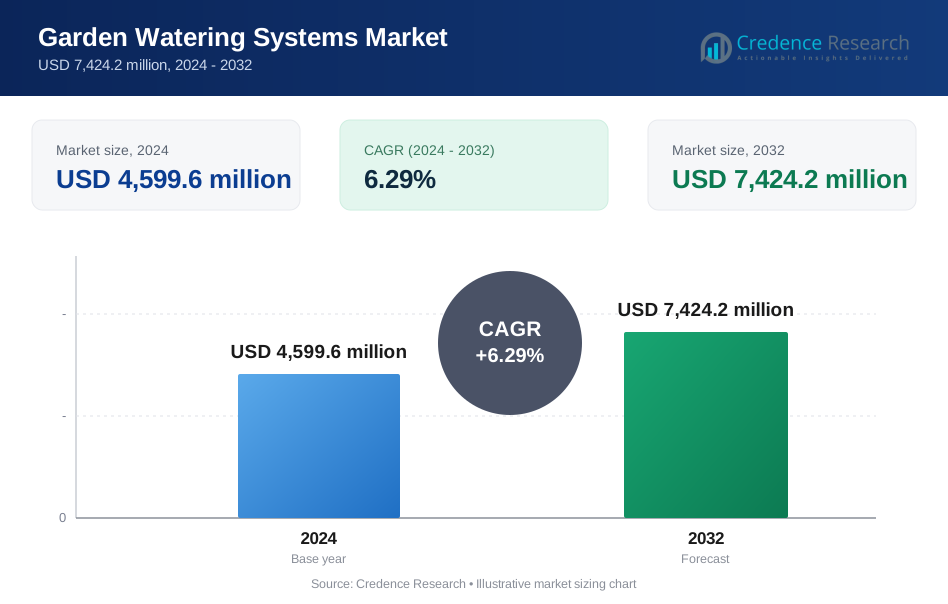
The Global Garden Watering Systems Market size was valued at USD 3,540.5 million in 2018 to USD 4,599.6 million in 2024 and is anticipated to reach USD 7,424.2 million by 2032, at a CAGR of 6.29% during the forecast period.
| REPORT ATTRIBUTE | DETAILS |
|---|---|
| Historical Period | 2020-2023 |
| Base Year | 2024 |
| Forecast Period | 2025-2032 |
| Garden Watering Systems Market Size 2024 | USD 4,599.6 million |
| Garden Watering Systems Market, CAGR | 6.29% |
| Garden Watering Systems Market Size 2032 | USD 7,424.2million |
The global garden watering systems market is led by key players such as GARDENA, Hozelock Ltd, Claber, Netafim, Galcon, and AUTOMAT Industries. These companies maintain strong brand presence through diversified product portfolios, innovation in smart irrigation technologies, and extensive retail and online distribution. GARDENA holds a dominant position in automated systems, while Netafim leads in water-efficient drip irrigation solutions. Europe is the leading region in 2024, commanding a 26.2% market share, driven by widespread adoption of sustainable landscaping practices and strict water conservation regulations. Asia Pacific closely follows, supported by rapid urbanization and a 32.5% share of total market value. Competitive dynamics are shaped by regional customization, product innovation, and strategic partnerships.
Garden Watering Systems Market Insights
- The global garden watering systems market was valued at USD 4,599.6 million in 2024 and is projected to reach USD 7,424.2 million by 2032, growing at a CAGR of 6.29% during the forecast period.
- Rising adoption of smart irrigation systems and increasing residential landscaping activities are key drivers fueling market demand.
- Trends such as integration of IoT and mobile-controlled watering devices are reshaping consumer preferences toward automated, energy-efficient systems.
- The market is highly competitive, with leading players like GARDENA, Netafim, and Hozelock investing in innovation and expanding their global footprints through partnerships and retail networks.
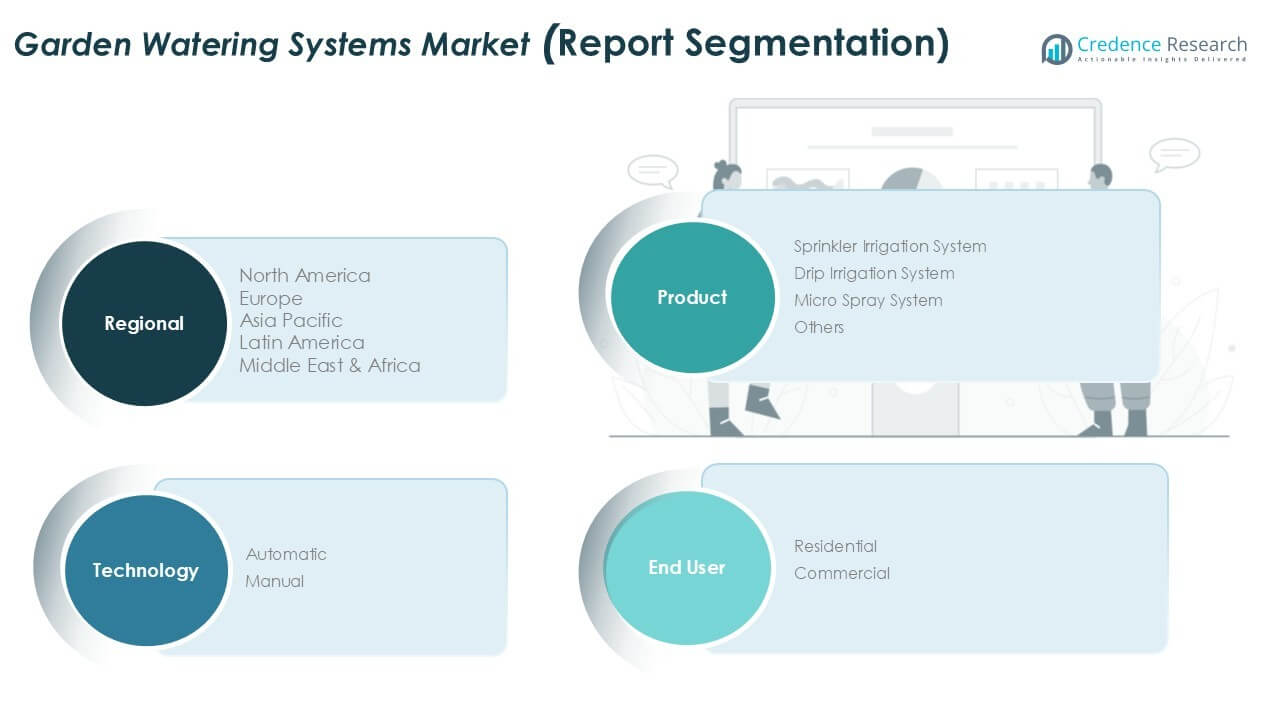
- Europe leads the market with a 26.2% share in 2024, followed by Asia Pacific at 32.5%; by product, sprinkler irrigation systems dominate with a 48% share, while automatic systems lead the technology segment due to convenience and precision watering.
Garden Watering Systems Market Segmentation Analysis:
By Technology
The automatic garden watering systems segment dominates the market, accounting for over 65% of the global share in 2024. Growth is driven by increasing demand for smart irrigation, time-saving solutions, and precision water delivery. Integration with timers, soil sensors, and app-based controllers enhances ease of use for consumers. Rising urbanization and shrinking lawn maintenance time also support adoption. Manual systems continue to serve cost-sensitive consumers but face slower growth. The trend toward connected home devices further reinforces the shift to automatic watering solutions.
- For instance, the company Netafim’s drip irrigation technology has been used in over 100,000 hectares of farmland worldwide with precise automated emitters and controllers.
By Product Segment
Sprinkler irrigation systems lead the product segment, holding nearly 48% of the market share in 2024. These systems are favored for their wide coverage, ease of installation, and suitability for large lawns and gardens. Increased adoption in both residential and commercial landscapes has fueled segment dominance. However, drip irrigation systems are gaining traction due to their water efficiency and suitability for targeted watering in smaller garden spaces. Micro spray systems and other niche formats cater to specialty gardens but represent a smaller share of the market.
- For instance, smart sprinkler products can water areas up to 4,300 square feet, like the Aiper IrriSense Smart Irrigation Sprinkler featured at CES 2025 with app‑guided
By End User
The residential segment holds the largest share, exceeding 70% of the global garden watering systems market in 2024. This is driven by rising interest in home gardening, landscape beautification, and lawn maintenance. Suburban housing developments and DIY irrigation installations contribute significantly to market penetration. Commercial end users, including public parks, golf courses, and resorts, also adopt advanced systems but at a slower pace. Growth in the residential segment is further propelled by the availability of affordable smart irrigation kits tailored for home use.
Garden Watering Systems Market Key Growth Drivers
Rising Adoption of Smart and Automated Irrigation Solutions
The growing integration of smart technologies in garden watering systems is a major driver. Consumers increasingly prefer automated systems with features like Wi-Fi connectivity, weather-based scheduling, and app-based control. These systems reduce water waste and ensure precise irrigation, aligning with sustainability goals. Homeowners adopt smart controllers to simplify lawn and garden care, while commercial users seek efficiency and compliance with local watering regulations. Companies offer systems with real-time soil moisture monitoring and AI-based scheduling. This demand for convenience and water conservation continues to fuel growth, especially in urban and developed regions where water bills and environmental awareness are high. Government incentives for water-efficient irrigation products also contribute to the widespread adoption of smart solutions across residential and commercial landscapes.
- For instance, the Inkbird IIC‑800‑WIFI 8‑Zone Smart Irrigation Sprinkler Controller lets users control eight watering zones via Wi‑Fi and smartphone apps for precision irrigation.
Growing Demand from Residential Landscaping and Home Gardening
The surge in home gardening and outdoor landscaping activities has significantly increased demand for garden watering systems. Residential users drive the bulk of market revenues due to expanding urban and suburban housing. Post-pandemic lifestyle shifts, including remote work and more time spent at home, have led to greater investment in backyard and home garden upgrades. Property owners now prioritize aesthetic value and sustainable maintenance, resulting in higher adoption of automated watering systems. Do-it-yourself (DIY) garden kits featuring drip and sprinkler systems are readily available through online and retail channels, encouraging user-friendly installation. The rise of vertical gardens and balcony gardening in space-constrained homes further strengthens demand for compact and efficient irrigation systems. These trends are expected to sustain market momentum through the forecast period.
- For instance, homeowners use the XPR3SS Smart WiFi Remote Control Automatic Irrigation Water Timer to automate watering for balconies and backyard gardens.
Government Regulations Promoting Water Conservation Practices
Government policies promoting efficient water use are a key driver in shaping the garden watering systems market. Water scarcity concerns and climate change pressures have led to stricter regulations in many regions. Authorities now mandate the use of low-flow irrigation systems and impose restrictions on excessive water usage, especially in drought-prone areas. As a result, both residential and commercial users are shifting to water-saving technologies such as drip and micro-spray systems. Rebates, subsidies, and awareness campaigns further incentivize consumers to adopt smart watering solutions. Municipal programs in countries like the U.S., Australia, and Spain promote efficient lawn irrigation through certified products. These regulations not only ensure compliance but also accelerate innovation and adoption of environmentally friendly garden watering systems.
Garden Watering Systems Market Key Trends & Opportunities
Integration of IoT and AI Technologies in Irrigation Systems
The incorporation of IoT and AI in garden watering systems presents a strong growth opportunity. Smart irrigation devices now offer remote access, predictive analytics, and adaptive watering schedules based on real-time weather or soil conditions. Leading manufacturers develop solutions that optimize water use by learning user habits and adjusting schedules accordingly. This shift toward intelligent automation enhances user experience and reduces water consumption. The ability to monitor and control irrigation via smartphones or voice assistants further appeals to tech-savvy homeowners. In commercial applications, predictive maintenance and centralized control systems improve operational efficiency. As urban areas embrace smart home ecosystems, the demand for connected and AI-enhanced garden watering systems is expected to rise sharply, opening new revenue streams for technology-driven providers.
- For instance, the Inkbird IIC‑800‑WIFI 8‑Zone Smart Irrigation Sprinkler Controller links Wi‑Fi control with irrigation scheduling across eight zones, enabling remote water management from mobile apps.
Expansion in Developing Markets with Growing Urbanization
Rapid urban development and infrastructure growth in emerging economies present new opportunities for garden watering systems. Expanding residential construction and rising disposable incomes in countries like India, China, Brazil, and South Africa are driving demand for organized lawn care and landscape irrigation. With growing awareness of water conservation and aesthetic landscaping, consumers in these regions are investing in modern irrigation tools. Government initiatives promoting sustainable urban green spaces also create favorable conditions for market expansion. Suppliers offering cost-effective and easy-to-install solutions can capture significant market share in these areas. Retail chains and e-commerce platforms further facilitate product availability and reach. This untapped potential in developing markets is expected to become a key contributor to global revenue growth in the coming years.
Garden Watering Systems Market Key Challenges
High Initial Cost of Smart Irrigation Systems
One of the primary challenges in the garden watering systems market is the high upfront cost of smart and automated systems. Advanced products often require significant investment in controllers, sensors, valves, and software platforms. For many residential consumers, especially in price-sensitive markets, the initial capital outlay may outweigh perceived benefits. Although these systems offer long-term savings through reduced water usage, the return on investment can be gradual. In developing regions, lack of awareness and affordability limit the uptake of advanced technologies. Manufacturers face pressure to balance product innovation with cost competitiveness. Limited financial support or incentives in some areas further hinders broader adoption, posing a barrier to market penetration in mid- and low-income households.
Complex Installation and Maintenance Requirements
The installation and upkeep of advanced irrigation systems often require professional expertise, which can deter some users. Smart systems with multiple zones, timers, or moisture sensors may involve complex setup processes, wiring, or connectivity troubleshooting. Inexperienced users may struggle with configuration, resulting in improper watering schedules or inefficiencies. Regular maintenance such as checking leaks, cleaning filters, and updating software is essential to ensure optimal performance. For commercial users managing large areas, system malfunctions or downtimes can disrupt operations. Service availability, lack of skilled technicians, and inconsistent after-sales support in some regions further complicate system management. These technical and operational challenges may slow adoption, particularly in non-urban or underserved areas.
Garden Watering Systems Market Regional Analysis
North America
North America accounted for approximately 24.8% of the global garden watering systems market in 2024, reaching a value of USD 1,141.36 million, up from USD 838.04 million in 2018. The market is projected to reach USD 1,955.53 million by 2032, growing at a CAGR of 7.1%. The region benefits from strong adoption of smart home technologies, rising interest in residential landscaping, and stringent water usage regulations. The U.S. leads due to widespread suburban housing, high spending on outdoor upgrades, and advanced product availability. Government rebates for efficient irrigation solutions further enhance market penetration.
Europe
Europe held around 26.2% of the global market share in 2024, with a value of USD 1,203.39 million, rising from USD 936.46 million in 2018. The market is forecast to reach USD 1,913.95 million by 2032, registering a CAGR of 6.1%. Demand is driven by eco-conscious consumers, water conservation mandates, and increasing use of automation in residential and commercial irrigation. Countries like Germany, France, and the UK are early adopters of precision watering tools. Sustainable landscaping practices and strong DIY trends contribute to regional growth, supported by technological innovation and smart irrigation awareness campaigns.
Asia Pacific
Asia Pacific led the global garden watering systems market in 2024 with a dominant 32.5% share, valued at USD 1,496.51 million, up from USD 1,137.21 million in 2018. The market is expected to grow to USD 2,456.66 million by 2032, at a CAGR of 6.5%. Rapid urbanization, expanding residential infrastructure, and growing disposable income drive adoption. Countries such as China, Japan, and Australia lead regional demand due to increasing awareness of sustainable water use and smart home integration. E-commerce and retail expansion also support market accessibility, making APAC a key growth engine globally.
Latin America
Latin America represented about 9.1% of the global market in 2024, reaching USD 420.73 million from USD 322.19 million in 2018. The market is projected to hit USD 683.77 million by 2032, growing at a CAGR of 6.4%. Rising demand for residential irrigation systems and growing urban landscaping trends fuel market growth. Brazil and Mexico are key contributors, supported by increasing real estate development and infrastructure modernization. While penetration of smart systems remains limited, manual and semi-automatic solutions dominate due to cost considerations. Expansion in middle-income households creates new opportunities for basic and mid-range products.
Middle East
The Middle East held approximately 4.1% of the global market in 2024, with revenue reaching USD 186.74 million, up from USD 169.24 million in 2018. The market is anticipated to reach USD 230.15 million by 2032, reflecting a CAGR of 2.7%. Despite its arid climate, adoption is restrained by high water costs and limited public awareness. However, select countries like the UAE and Saudi Arabia are advancing sustainable landscaping practices in urban developments and resorts. Government initiatives promoting water conservation may slowly boost demand for drip and micro-irrigation systems in the coming years.
Africa
Africa accounted for nearly 3.3% of the global market in 2024, reaching USD 150.87 million from USD 137.37 million in 2018. The market is projected to reach USD 184.12 million by 2032, at a CAGR of 2.6%. Growth remains modest due to limited irrigation infrastructure, affordability issues, and low awareness of modern watering systems. Manual watering methods dominate, especially in rural and semi-urban areas. However, increasing urbanization and efforts to promote sustainable landscaping in cities such as Nairobi, Lagos, and Johannesburg present long-term potential. Government and NGO support may help improve access to efficient irrigation solutions.
Garden Watering Systems Market Segmentations:
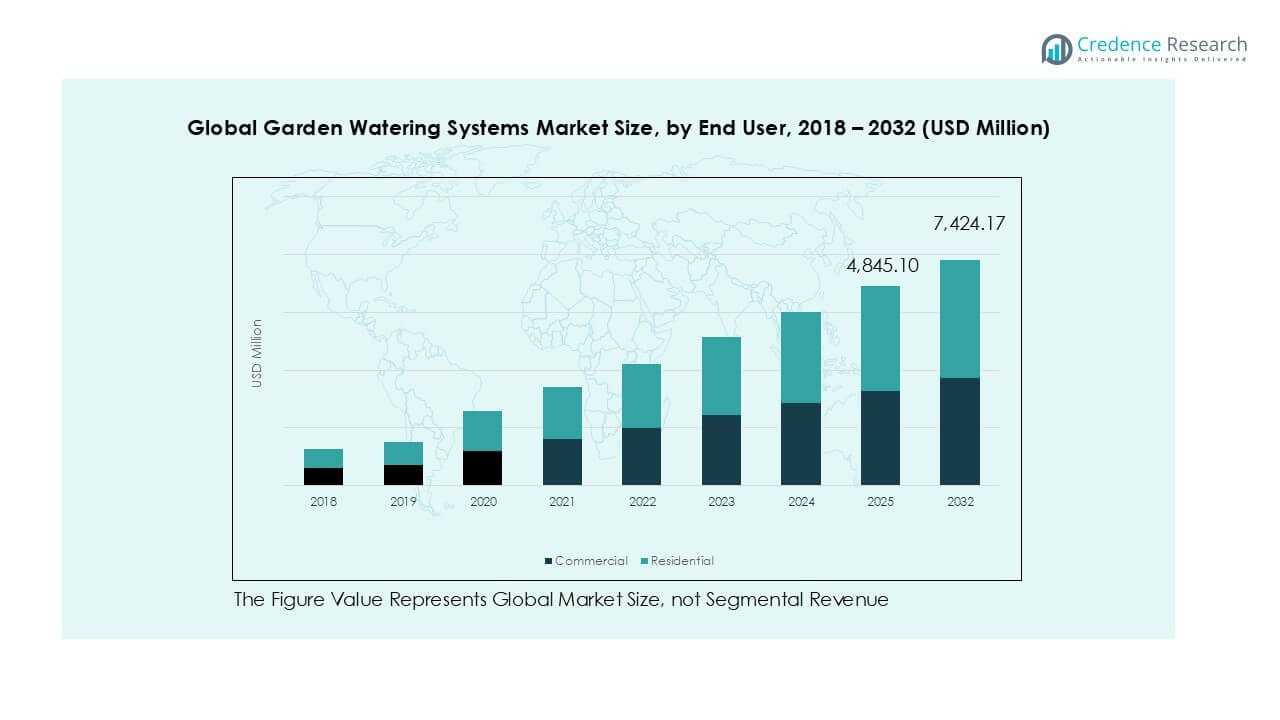
By Technology
- Automatic
- Manual
By Product Segment
- Sprinkler Irrigation System
- Drip Irrigation System
- Micro Spray System
- Others
By End User
- Residential
- Commercial
By Geography
- North America
- U.S.
- Canada
- Mexico
- Europe
- Germany
- France
- U.K.
- Italy
- Spain
- Rest of Europe
- Asia Pacific
- China
- Japan
- India
- South Korea
- South-east Asia
- Rest of Asia Pacific
- Latin America
- Brazil
- Argentina
- Rest of Latin America
- Middle East & Africa
- GCC Countries
- South Africa
- Rest of the Middle East and Africa
Garden Watering Systems Market Competitive Landscape
The global garden watering systems market features a mix of multinational corporations and regional players competing on innovation, product range, and pricing. Companies like GARDENA (a Husqvarna brand), Hozelock Ltd, Claber, Netafim, and Galcon lead the market through strong brand recognition and wide product portfolios. GARDENA dominates the premium segment with smart irrigation solutions integrated into smart home ecosystems. Netafim, a pioneer in drip technology, focuses on water-efficient systems for both residential and commercial applications. Regional firms such as AUTOMAT Industries and Grupo Chamartín offer cost-effective solutions tailored to local preferences. Product innovation especially in automation, IoT integration, and eco-friendly designs is a key differentiator. Strategic moves such as mergers, acquisitions, and geographic expansion remain common, while companies also invest in e-commerce and DIY retail channels to strengthen market presence. Competitive intensity continues to rise, driven by consumer demand for smart, efficient, and easy-to-use irrigation products across developed and emerging markets.
Key Player Analysis
- GARDENA
- Hozelock Ltd
- Claber
- AUTOMAT Industries Private Limited
- Galcon
- Wetta Industries
- Siroflex
- Grupo Chamartín
- Netafim
- Other Key Players
Recent Developments
- In 2025, Husqvarna (SE) expanded its product line to include solar-powered irrigation systems, marking a significant step towards sustainability. This move not only aligns with global trends towards renewable energy but also enhances Husqvarna's reputation as an environmentally responsible brand. The introduction of solar technology into their offerings could potentially attract a new customer base that prioritizes eco-friendly solutions.
- In August 2025, Toro (US) announced a partnership with a leading technology firm to develop an AI-driven irrigation management system. This strategic move is expected to enhance the efficiency of water usage in landscaping, aligning with the growing trend towards smart gardening solutions. The integration of AI technology not only positions Toro as a leader in innovation but also addresses the increasing consumer demand for sustainable practices in lawn care.
- In 2022, Ceres Imaging, an Oakland, California-based provider of high-resolution imagery analytics with support for precision agriculture, and Lindsay Corporation, a major international manufacturer and distributor of irrigation and infrastructure equipment and technology, announced a strategic partnership.
Report Coverage
The research report offers an in-depth analysis based on Technology, Product Segment, End-User and Geography. It details leading market players, providing an overview of their business, product offerings, investments, revenue streams, and key applications. Additionally, the report includes insights into the competitive environment, SWOT analysis, current market trends, as well as the primary drivers and constraints. Furthermore, it discusses various factors that have driven market expansion in recent years. The report also explores market dynamics, regulatory scenarios, and technological advancements that are shaping the industry. It assesses the impact of external factors and global economic changes on market growth. Lastly, it provides strategic recommendations for new entrants and established companies to navigate the complexities of the market.
Future Outlook
- Smart irrigation systems will see increased adoption due to rising demand for water-efficient solutions.
- Integration of AI and weather-based controllers will improve precision and reduce manual intervention.
- Residential landscaping and DIY gardening trends will continue driving product innovation.
- E-commerce platforms will expand market access across developing and rural regions.
- Companies will focus on modular and customizable systems for small and irregular garden spaces.
- Public awareness campaigns around sustainable water use will influence consumer behavior.
- Government incentives for water-saving products will support growth in drought-prone areas.
- Drip and micro-spray systems will gain popularity for their efficiency in targeted watering.
- Strategic partnerships and product bundling with smart home devices will become common.
- Emerging markets in Asia and Latin America will offer strong growth potential through urban expansion.
Request a Free Sample
Fill in your details and we'll send you a free sample report.
- Sample data tables & charts
- Research methodology
Need a Custom Version of This Report?
Tailor the scope, geography, or segments to your exact requirements.
- Custom geography or segment scope
- Direct access to our analyst team
Frequently Asked Questions
What is the current market size for the Global Garden Watering Systems market, and what is its projected size in 2032?
At what Compound Annual Growth Rate is the Global Garden Watering Systems market projected to grow between 2024 and 2032?
Which Global Garden Watering Systems market segment held the largest share in 2024?
What are the primary factors fueling the growth of the Global Garden Watering Systems market?
Who are the leading companies in the Global Garden Watering Systems market?
Which region commanded the largest share of the Global Garden Watering Systems market in 2024?
Table of Content
Chapter 1 Market Segmentation
- 1.1 Segmentation Framework
- 1.1.1 Product and Service Classification
- 1.1.2 Application and End-Use Classification
- 1.1.3 Technology and Solution Classification
- 1.1.4 Customer and Distribution Channel Classification
- 1.1.5 Geographic Segmentation
- 1.1.6 Market Segment Definitions and Boundaries
Chapter 2 Introduction
- 2.1 Report Objectives and Scope
- 2.2 Product Definition and Industry Terminology
- 2.3 Market Inclusions and Exclusions
- 2.4 Research Process
- 2.4.1 Primary Research and Expert Interviews
- 2.4.2 Secondary Research and Source Review
- 2.4.3 Top-Down and Bottom-Up Estimation
- 2.4.4 Data Triangulation and Verification
- 2.5 Market Size Measurement Basis
- 2.5.1 2024: USD 4,599.6 million → 2032: USD 7,424.2 million
- 2.6 Historical and Forecast Reference Periods
- 2.6.1 Base Year: 2024
- 2.6.2 Forecast Period: 2024-2032
- 2.7 Research Assumptions and Limitations
Chapter 3 Executive Summary
- 3.1 Market Snapshot and Key Findings
- 3.2 Base-Year Market Size, 2024
- 3.3 Forecast Market Size, 2032
- 3.4 Revenue and Volume Growth Outlook
- 3.5 Key Demand and Supply Indicators
- 3.6 Leading Market Segments
- 3.7 Fastest-Growing Market Opportunities
- 3.8 Regional Performance Highlights
- 3.9 Technology and Industry Transformation
- 3.10 Competitive Landscape Summary
- 3.11 Analyst View and Strategic Implications
Chapter 4 Global Garden Watering Systems Market Trends and Developments
- 4.1 Historical Industry Development
- 4.2 Recent Market Trends and Developments
- 4.3 Demand and Customer Behavior Trends
- 4.4 Technology and Product Innovation
- 4.5 Artificial Intelligence, Automation and Digitalization
- 4.6 Local Manufacturing and Supply Chain Realignment
- 4.7 Industry Partnerships, Mergers and Acquisitions
- 4.8 Sustainability and Circular Economy Developments
- 4.9 Government and Private Sector Investment Trends
- 4.10 Emerging Business Models and Commercialization
- 4.11 Industry Developments and Announcements
Chapter 5 Global Garden Watering Systems Market Production, Supply and Demand Analysis
- 5.1 Demand Trend and Consumption Analysis
- 5.2 Demand Forecast, 2024-2032
- 5.3 Production and Output Trend
- 5.4 Production and Output Forecast, 2024-2032
- 5.5 Installed Capacity and Capacity Utilization
- 5.6 Company-Wise Production Plants and Statistics
- 5.6.1 Installed Production Capacity
- 5.6.2 Actual Production
- 5.6.3 Planned Capacity and Expansion Targets
- 5.7 Supply Chain Structure and Procurement Trends
- 5.8 Supply-Demand Gap and Bottlenecks
- 5.9 Import Dependence and Sourcing Structure
- 5.10 Contract Manufacturing and Outsourcing
- 5.11 Regional Supply and Demand Concentration
Chapter 6 Global Garden Watering Systems Market Pricing Analysis
- 6.1 Pricing Structure and Measurement
- 6.2 Historical Pricing Trends
- 6.3 Pricing Outlook, 2024-2032
- 6.4 Average Selling Price and Unit Economics
- 6.5 Pricing by Product and Market Segment
- 6.6 Geographic Pricing Differences
- 6.7 Key Input, Energy, Labor and Logistics Costs
- 6.8 Contract Pricing and Purchasing Models
- 6.9 Pricing Sensitivity and Competitive Positioning
- 6.10 Price, Margin and Profitability Implications
Chapter 7 Global Garden Watering Systems Market Dynamics
- 7.1 Market Growth Drivers
- 7.1.1 Demand-Side Drivers
- 7.1.2 Technology and Innovation Drivers
- 7.1.3 Infrastructure and Investment Drivers
- 7.1.4 Regulatory and Policy Drivers
- 7.2 Market Restraints
- 7.2.1 Cost and Affordability Constraints
- 7.2.2 Technology and Adoption Barriers
- 7.2.3 Supply Chain and Operational Constraints
- 7.3 Market Challenges
- 7.3.1 Competitive Pressure and Margin Erosion
- 7.3.2 Skills, Infrastructure and Implementation Gaps
- 7.4 Emerging Market Opportunities
- 7.5 Market Dynamics Impact and Time-Horizon Assessment
Chapter 8 Global Garden Watering Systems Value Chain Analysis
- 8.1 Industry Value Chain Overview
- 8.2 Upstream Suppliers and Critical Inputs
- 8.3 Technology and Component Providers
- 8.4 Manufacturing or Service Delivery
- 8.5 Distribution, Channel Partners and Integrators
- 8.6 Downstream Applications and End Users
- 8.7 Value Addition and Profit Pools
- 8.8 Vertical Integration and Outsourcing
- 8.9 Supplier Concentration and Risk
- 8.10 Supply Chain Localization and Resilience
Chapter 9 Global Garden Watering Systems Market Regulations and Policies
- 9.1 Relevant Laws, Standards and Compliance Frameworks
- 9.2 Product, Service, Safety and Quality Requirements
- 9.3 Government Policies, Incentives and Subsidies
- 9.4 Imports, Exports and Trade Barriers
- 9.5 Public Procurement and Local Content Requirements
- 9.6 Environmental and Sustainability Compliance
- 9.7 Upcoming Policy Changes and Market Implications
Chapter 10 Global Garden Watering Systems Market Hotspots and Opportunities
- 10.1 Market Opportunity Mapping and Growth Hotspots
- 10.2 High-Growth Applications and Customer Groups
- 10.3 Underserved Markets and White-Space Opportunities
- 10.4 Emerging Technology and Product Opportunities
- 10.5 New Capacity and Investment Hotspots
- 10.6 Market Entry and Expansion Opportunities
- 10.7 Distribution and Partnership Opportunities
- 10.8 Near-Term and Long-Term Commercial Potential
- 10.9 Opportunity Attractiveness and Execution Risks
Chapter 11 Global Garden Watering Systems Market Outlook, 2024-2032
- 11.1 Market Size and Analysis
- 11.1.1 Revenue (Market Measurement: 2024: USD 4,599.6 million → 2032: USD 7,424.2 million)
- 11.1.2 Market Volume and Quantity Sold
- 11.1.3 Historical Market Size
- 11.1.4 Base-Year Market Size, 2024
- 11.2 Market Forecast, 2024-2032
- 11.2.1 Revenue Forecast to 2032
- 11.2.2 Volume Forecast to 2032
- 11.2.3 CAGR and Year-on-Year Growth
- 11.2.4 Incremental Revenue Opportunity
- 11.3 Forecast Assumptions and Scenario Analysis
- 11.3.1 Base-Case Forecast
- 11.3.2 Optimistic and Conservative Scenarios
- 11.3.3 Technology, Pricing and Policy Sensitivities
- 11.4 Market Attractiveness and Growth Outlook
Chapter 12 Global Garden Watering Systems Market Segmentation and Outlook
- 12.1 Segmentation Summary and Market Shares, 2024
- 12.2 Largest and Fastest-Growing Segments
- 12.3 Segment Growth Comparison
- 12.4 Segment Attractiveness and Priority Matrix
Chapter 13 Global Garden Watering Systems Geographic Market Outlook, 2024-2032
- 13.1 Regional Market Size and Share, 2024
- 13.2 Regional Market Forecast, 2024-2032
- 13.3 Regional Pricing, Production and Demand Differences
- 13.4 North America
- 13.4.1 United States
- 13.4.2 Canada
- 13.4.3 Mexico
- 13.5 Europe
- 13.5.1 Germany
- 13.5.2 France
- 13.5.3 Italy
- 13.5.4 United Kingdom
- 13.5.5 Spain
- 13.5.6 Poland
- 13.5.7 Russia
- 13.5.8 Netherlands
- 13.5.9 Belgium
- 13.5.10 Sweden
- 13.5.11 Denmark
- 13.5.12 Norway
- 13.5.13 Rest of Europe
- 13.6 Asia Pacific
- 13.6.1 China
- 13.6.2 India
- 13.6.3 Japan
- 13.6.4 South Korea
- 13.6.5 Thailand
- 13.6.6 Indonesia
- 13.6.7 Vietnam
- 13.6.8 Malaysia
- 13.6.9 Australia
- 13.6.10 Rest of Asia Pacific
- 13.7 Latin America
- 13.7.1 Brazil
- 13.7.2 Argentina
- 13.7.3 Colombia
- 13.7.4 Chile
- 13.7.5 Rest of Latin America
- 13.8 Middle East
- 13.8.1 Saudi Arabia
- 13.8.2 United Arab Emirates
- 13.8.3 Turkey
- 13.8.4 Israel
- 13.8.5 Iran
- 13.8.6 Rest of the Middle East
- 13.9 Africa
- 13.9.1 South Africa
- 13.9.2 Egypt
- 13.9.3 Nigeria
- 13.9.4 Morocco
- 13.9.5 Rest of Africa
- 13.10 Regional Investment, Policy and Supply Chain Differences
- 13.11 Regional Competitive Landscape
- 13.12 Geographic Growth Hotspots
Chapter 14 Global Garden Watering Systems Technology, Innovation and Sustainability Outlook
- 14.1 Technology Landscape and Maturity
- 14.2 Product, Process and Service Innovation
- 14.3 AI, Automation and Digital Tools in the Industry
- 14.4 Technology Adoption and Performance Benchmarking
- 14.5 Innovation Pipeline and R&D Investment
- 14.6 Patent and Intellectual Property Trends
- 14.7 Energy Efficiency and Resource Management
- 14.8 Sustainability, Recycling and Circularity
- 14.9 Technology Roadmap, 2024-2032
- 14.10 Risks of Obsolescence and Technology Substitution
Chapter 15 Global Garden Watering Systems Market Key Strategic Imperatives
- 15.1 Growth and Market Entry Priorities
- 15.2 High-Return Products and Segments
- 15.3 Pricing, Profitability and Cost Optimization
- 15.4 Technology Investment and Product Differentiation
- 15.5 Supply Chain Localization and Resilience
- 15.6 Distribution and Customer Acquisition
- 15.7 Partnership, Acquisition and Capacity Strategy
- 15.8 Regional Expansion Priorities
- 15.9 Short-, Medium- and Long-Term Actions
Chapter 16 Competition Outlook
- 16.1 Industry Competition Characteristics
- 16.2 Market Structure and Concentration
- 16.3 Market Share and Competitive Positioning, 2024
- 16.4 Company-Wise Revenue and Product Benchmarking
- 16.5 Production and Service Capacity Benchmarking
- 16.6 Technology, Pricing and Differentiation
- 16.7 Regional Footprint and Distribution Strength
- 16.8 Mergers, Acquisitions and Strategic Alliances
- 16.9 New Entrants and Competitive Threats
- 16.10 Porter's Five Forces and Industry Attractiveness
- 16.11 Competitive Outlook, 2024-2032
Chapter 17 Company Profiles
- 17.1 Company Coverage and Selection Criteria
- 17.2 Leading Market Participants – Standard Profile Structure
- 17.2.1 Business Description
- 17.2.2 Company Ownership and Geographic Presence
- 17.2.3 Product and Service Portfolio
- 17.2.4 Manufacturing and Operating Footprint
- 17.2.5 Production Capacity and Expansion Plans
- 17.2.6 Financial Performance and Investment
- 17.2.7 Market Share and Competitive Position
- 17.2.8 Technology and Innovation Capabilities
- 17.2.9 Strategic Alliances or Partnerships
- 17.2.10 Recent Developments
- 17.2.11 Growth Strategy and Outlook
- 17.3 Other Relevant Market Participants
Note: Every listed company is profiled on the structure shown under the first company. The company list is preliminary and may change based on research findings, market developments, data availability and client requirements.
Chapter 18 Disclaimer
- 18.1 Research and Forecast Disclaimer
- 18.2 Data Source and Estimation Limitations
Note: The depth of individual sections depends on data availability for this market. Volume, capacity, trade and other unit-based metrics are included where applicable.
