
Quick answer
Naphthalene balls are mothballs pressed from refined naphthalene and sold as a moth repellent and deodorizer, a product regulated as a pesticide in the U.S. and banned in the EU. A greenfield plant pressing 2,400 tonnes a year needs an estimated USD 1.2–5.5 million of CapEx, excluding working capital. Gross margin runs about 17–32%, with payback in about 2–8 years. Naphthalene flake prices and product registrations decide most outcomes.
Feasible as a low-capital pressing and packing business for Asian, Middle Eastern, African and North American markets with registrations in hand; the EU is closed, and thin bulk-ball margins or a high-cost build are the main ways it fails.
Naphthalene Balls plant: key highlights
| Parameter | Indicative value | Note |
|---|---|---|
| Plant capacity | 2,400 tonnes per year | Pressed balls, about 8 tonnes a day over 300 operating days on two shifts |
| Total CapEx | USD 1.2–5.5 million | Greenfield, excluding working capital; buys refined naphthalene flakes |
| Raw material share of operating cost | 60–66% | Refined naphthalene and minor fragrance, before packaging |
| Gross margin | 17–32% | At an assumed blended ex-factory price of USD 1,800–2,200 per tonne |
| Payback period | 2–8 years | From commissioning, including about six months of ramp-up |
| IRR | Available in report | Post-tax, 10-year model |
| Break-even | Available in report | Capacity utilization basis |
Ranges assume 2,400 tonnes a year of pressed balls, purchased refined naphthalene at an assumed USD 850–1,000 a tonne, a greenfield site from an Asian industrial park to a U.S. location, 2026 prices, 85% utilization, an assumed blended ex-factory price of USD 1,800–2,200 a tonne with about two-thirds sold in consumer packs. Excludes working capital and brand marketing. The full report can be customized to any country or region.
What are naphthalene balls?
Naphthalene balls, widely sold as mothballs, are small white spheres of compressed or cast naphthalene, a two-ring aromatic hydrocarbon that slowly turns from solid to vapor at room temperature. The vapor kills or repels clothes moths, carpet beetles and their larvae in closed storage, which is why the balls go into airtight chests, garment bags and wardrobes. Commercial grades are usually 99% or purer naphthalene, sometimes with a trace of fragrance, and are sold in 100–500 gram consumer packs, in bulk cartons and, across parts of Asia, the Middle East and Africa, as deodorizing balls for urinals and drains.
In most regulated markets the product is a pesticide rather than a general household chemical. Swallowing balls or breathing heavy vapor can cause hemolytic anemia, with small children and people with an inherited G6PD enzyme deficiency most at risk, and the World Health Organization's cancer agency classifies naphthalene as possibly carcinogenic to humans. Paradichlorobenzene, cedar and pyrethroid strips are the main substitutes.
In trade, mothballs put up for retail sale fall under HS 3808.91, insecticides, which replaced subheading 3808.10 in the 2007 Harmonized System. Refined naphthalene flakes, the main input, fall under HS 2902.90, and crude coal tar naphthalene under 2707.40.
Naphthalene balls market overview and global demand
Naphthalene balls are a small, mature outlet for a much larger chemical. Credence Research's refined naphthalene market analysis puts the feedstock at about USD 1.71 billion in 2025, based on its USD 1.62 billion for 2024 and a 5.69% CAGR through 2032, with most volume going to phthalic anhydride, naphthalene sulfonate concrete admixtures and dye intermediates rather than moth control. On the shelf, mothballs compete within a household pest category that the company's household insecticides report values at USD 18.3 billion in 2024.
Physical volumes show how niche moth control has become in high-income markets. An International Agency for Research on Cancer monograph estimated that only about 6,500 tonnes of naphthalene went into moth-proofing and fumigation in 2000, including 5,000 tonnes in Europe, 1,100 in Japan and 450 in the United States, against world naphthalene output of around 1 million tonnes in the late 1980s. The European share has since vanished, because naphthalene moth repellents have been prohibited across the European Union and the United Kingdom since 2008.
Demand now rests on three pillars. The United States keeps a regulated, brand-led market of EPA-registered products. South Asia, Southeast Asia, the Middle East, Africa and Latin America buy far more by volume, often low-priced loose or bagged balls used in wardrobes, bathrooms and drains. Exporters in China and India supply private-label packers across these regions.
Feedstock is tightening in the West. Most naphthalene is distilled from coal tar produced by steel-industry coke ovens, and Koppers cited declining coal tar availability when it decided to end phthalic anhydride output at Stickney, Illinois, in 2025. Supply is moving toward Asian distillers tied to coke output in China and India.
Naphthalene balls manufacturing process
Ball making is a physical conversion, not a chemical synthesis. Most new plants buy refined naphthalene flakes and shape them, either by compression in rotary presses or by melting and casting in molds. This overview models compression, which gives harder, glossier balls with less vapor loss and avoids handling molten naphthalene, whose flash point of about 79 °C sits just below its melting point of about 80 °C.
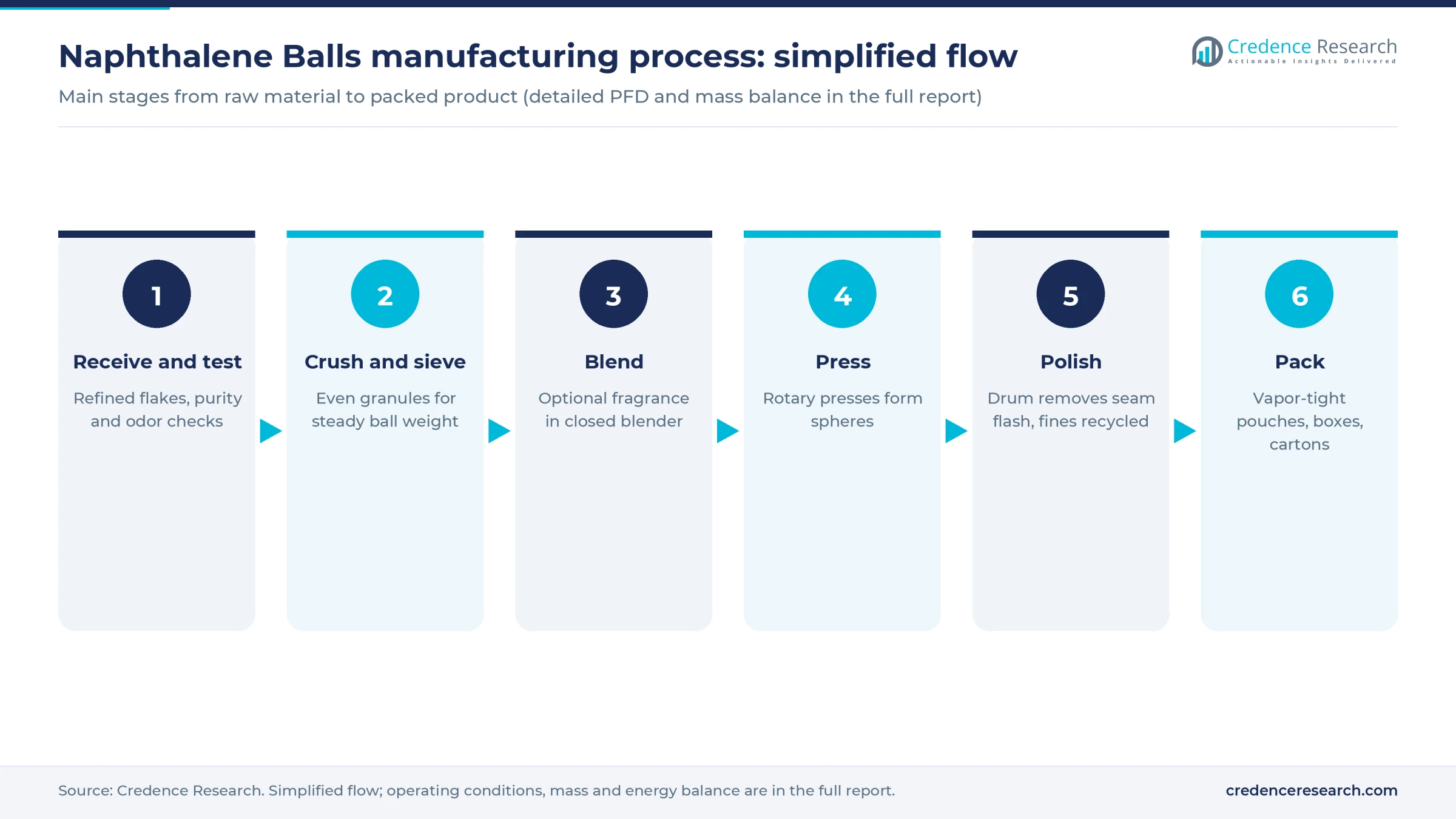
- Receiving and testing. Flakes arrive in lined 25-kilogram sacks or jumbo bags and are checked for purity, melting point, color and sulfur-bearing impurities such as thionaphthene, which spoil odor.
- Crushing and sieving. Lumps that form in storage are broken in a low-speed crusher and screened, so the presses receive granules of even size, which keeps ball weight consistent.
- Blending. For scented grades, a small dose of fragrance, such as a cedar or lavender note, is mixed in a closed ribbon blender.
- Pressing. Multi-station rotary presses with hemispherical punches compact the granules into spheres of a few grams each. Operators check weight, hardness and surface finish every shift.
- Polishing. A rotating drum removes the seam flash and dust left by the press, and the fines return to the feed hopper.
- Packing. Balls go into vapor-tight pouches, boxes or blister cards with tamper-evident seals, then into cartons and onto pallets.
Design turns on safety and vapor loss. First, naphthalene dust and vapor are flammable and toxic, so the building needs local exhaust ventilation with activated-carbon or scrubber treatment, explosion-proof motors, grounding against static and strict hot-work control. Second, product escapes to the air at every step, so closed transfers, sealed storage and fast packing protect both margin and workers. Some small South Asian units still melt flakes at about 88 °C and pour them into molds, as an Indian government micro-enterprise profile describes, but cast balls crack more easily and the open melt raises exposure.
Naphthalene balls plant setup cost
This overview models a greenfield plant pressing 2,400 tonnes of naphthalene balls a year, about 8 tonnes a day over 300 days, at an estimated CapEx of USD 1.2–5.5 million excluding working capital. The low end reflects Chinese-built presses and a basic shed in an Asian industrial park. The high end reflects a new building with full vapor and dust control at a U.S. site.
Supplier listings anchor the estimate, showing small rotary presses able to make camphor and naphthalene balls at about USD 3,200 a set, with 21-station industrial models rated at 15,000–45,000 pieces an hour. At an assumed 4 grams a ball and a practical 20,000 pieces an hour, one press makes about 80 kilograms an hour, so the plant needs six to seven presses on two shifts. At an assumed USD 10,000–25,000 per industrial press, pressing costs only USD 70,000–175,000. Most CapEx goes into the building, ventilation and packing lines, which is why site choice moves the total more than machinery does.
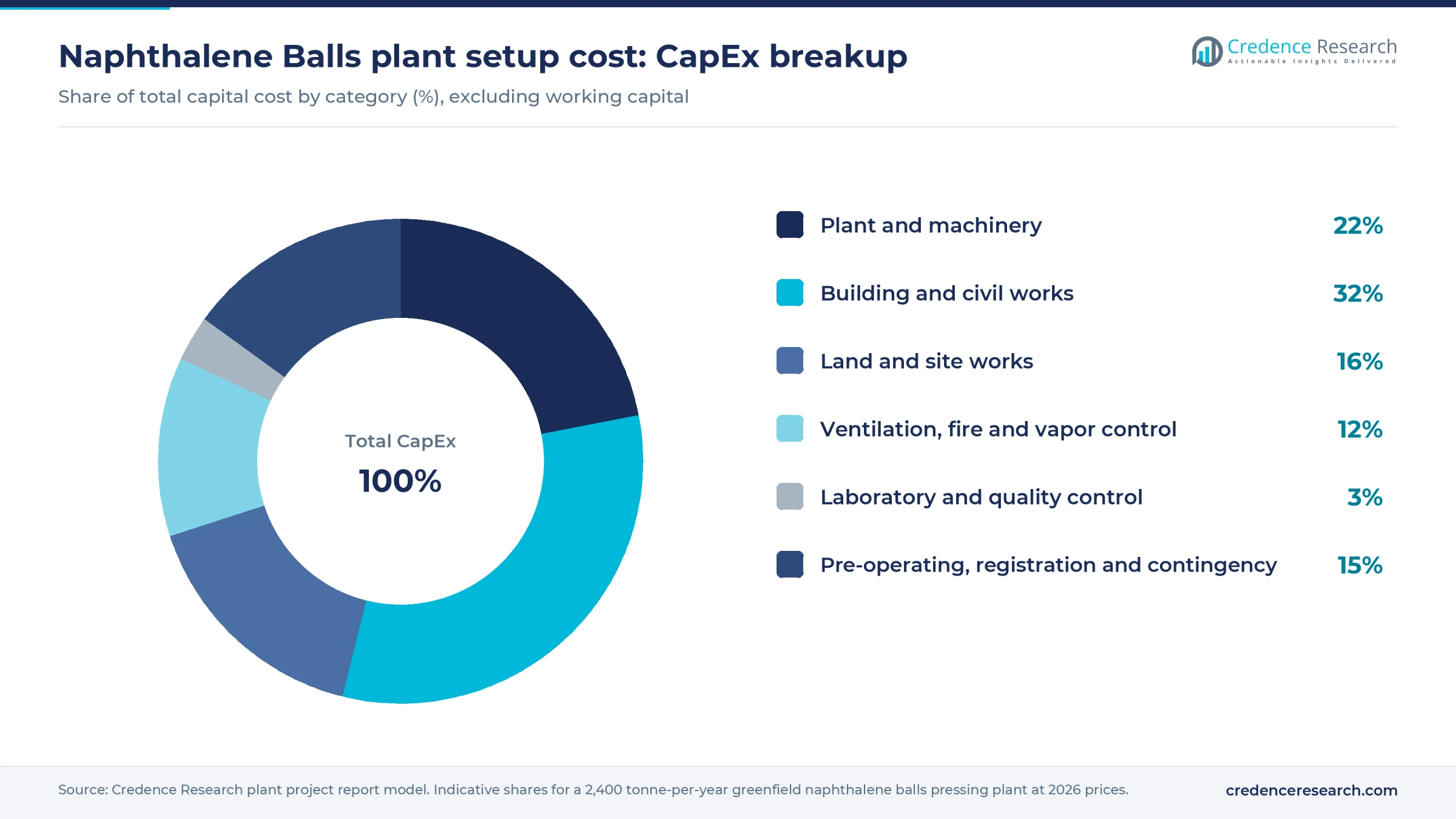
Worked example, land and site development. The model uses an assumed 5,000–8,000 square meters for the press hall, flake store, finished goods warehouse and truck access. At an assumed USD 30–80 per square meter in an Asian industrial park, the plot costs about USD 150,000–640,000, and at an assumed USD 60–200 at a U.S. site, about USD 300,000–1.6 million. That puts land at roughly 12–29% of CapEx, a large share because the process plant itself is light.
Working capital adds an estimated USD 0.8–1.2 million, mostly about two months of naphthalene stock and 60 days of receivables from distributors. Product registration and label approval costs, which vary sharply by market, sit inside pre-operating expenses.
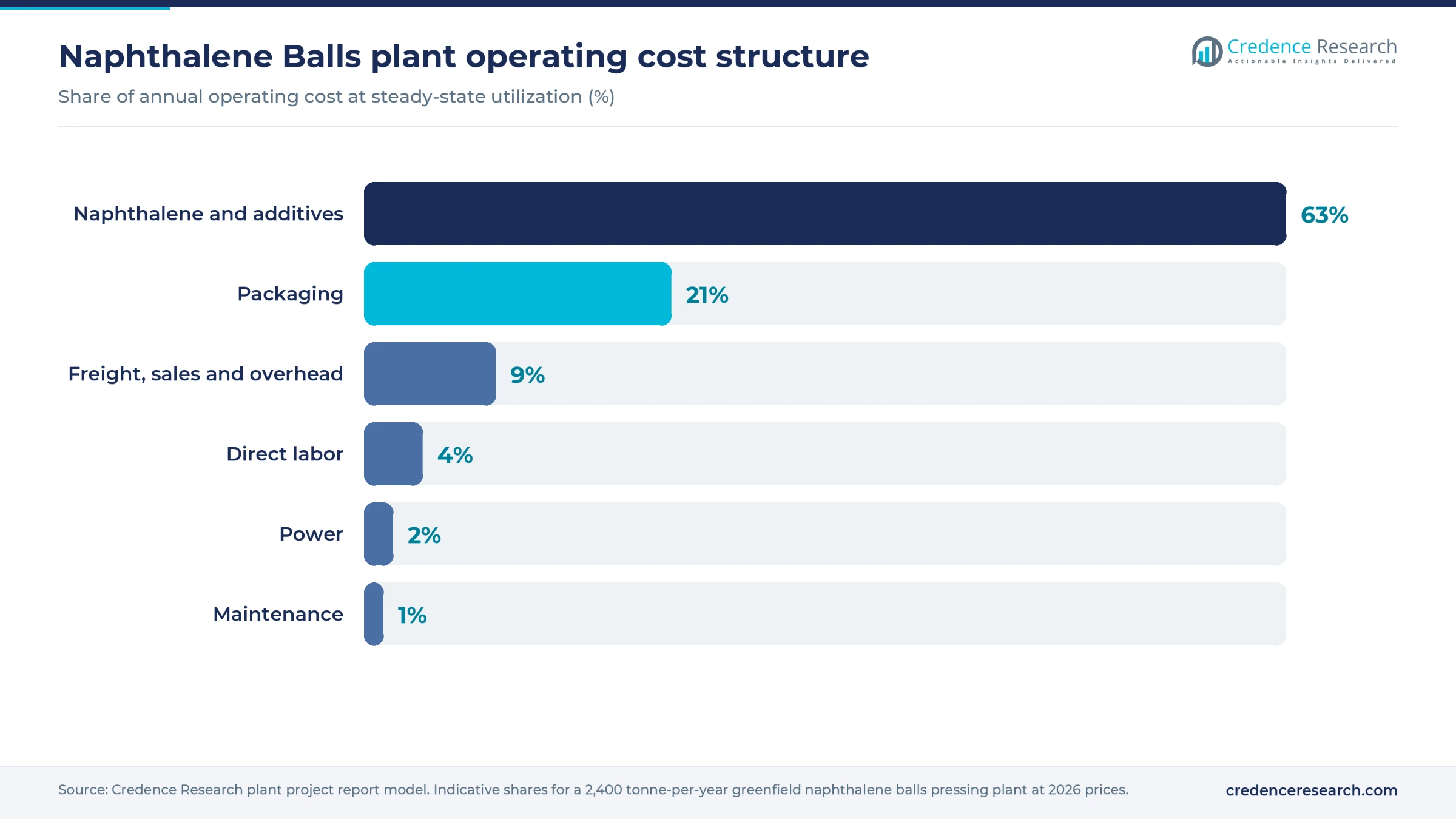
Naphthalene flakes make up about three-fifths of operating cost, and a 10% rise in their price takes about 5 points off gross margin at the mid-range selling price. A long-term supply contract with a coal tar distiller therefore matters more than any other line. The full report can be customized to any country or region.
Machinery and raw materials for a naphthalene balls plant
Core equipment includes a dry flake store with racking, a jumbo-bag discharge station, a low-speed lump crusher, a vibrating sifter, enclosed screw or bucket conveyors, a ribbon blender for scented grades, six to seven multi-station rotary presses with hemispherical tooling, a polishing drum, check-weighers and a metal detector. Packing lines combine vertical form-fill-seal machines for pouches, cartoners or blister sealers, a shrink-wrapper and a palletizer. Safety systems carry unusual weight here, including local exhaust hoods, activated-carbon vapor filters, a dust collector rated for combustible dust, explosion-proof motors and lighting, sprinklers and a laboratory with a melting-point apparatus and gas chromatograph.
The raw material is refined naphthalene, and its supply follows the steel industry. Most is recovered by distilling tar from metallurgical coke ovens, so the main producing regions are China, India, Japan, South Korea, Russia and Central and Eastern Europe, with large distillers also in Western Europe and Australia. Distillers sell naphthalene alongside binder pitch, covered in Credence Research's coal tar pitch market study. A smaller volume is recovered from heavy aromatic petroleum streams. Crude naphthalene from coke-oven by-product plants is cheaper but must be refined to about 99% before it presses into odor-acceptable balls. Films, cartons and fragrances are sourced locally.
Naphthalene balls business profit margin and ROI
Margins depend on how much output leaves as branded or private-label consumer packs rather than loose bulk balls. At an assumed blended ex-factory price of USD 1,800–2,200 per tonne, with about two-thirds sold in consumer packs, and assumed materials, packaging and direct conversion of USD 1,300–1,500 per tonne, gross margin runs about 17–32%. Flakes are costed at an assumed USD 850–1,000 per tonne, in line with late-2025 Asian spot levels of about USD 860–950 per tonne.
Bulk balls sold by weight to traders earn only a few points above cost, while consumer packs carry more margin but need registrations, label approvals and retailer listings.
At 85% utilization, the plant sells about 2,040 tonnes a year. After freight, selling costs and an assumed USD 120,000 of fixed administration, estimated post-tax cash generation of about USD 0.2–0.8 million supports a payback of about 2–8 years, including six months of ramp-up. A low-cost Asian build recovers its capital in two to three years at mid-range margins, while a top-of-range U.S. build needs the upper end of the margin range to stay inside eight years. Main risks are naphthalene price spikes when coal tar supply tightens, regulatory change, liability from child poisonings and competition from substitutes across the wider pest control products market.
| Metric | Value |
|---|---|
| IRR | Available in report |
| NPV | Available in report |
| ROI | Available in report |
| DSCR | Available in report |
How to start a naphthalene balls business, licenses and approvals
Because naphthalene balls are a pesticide in most regulated markets, product approval, rather than the factory permit, usually sets the timeline. A plant needs business and tax registration; land use, zoning and building permits; an air permit covering naphthalene vapor and dust, which the United States lists as a hazardous air pollutant; fire approval for a flammable solid; occupational safety compliance with exposure limits; pesticide product registration and label approval in each market served; packaging rules aimed at child safety; and export or import registration.
| Market | Product rules | Plant permits |
|---|---|---|
| United States | EPA registration of each product and label under the Federal Insecticide, Fungicide, and Rodenticide Act, as for Enoz moth balls, EPA Reg. No. 1475-120; state pesticide product registration; label directions limiting use to airtight containers | EPA pesticide-producing establishment registration under FIFRA section 7, with annual production reports; state air permit under the Clean Air Act; OSHA exposure limit of 10 ppm |
| Canada | Registration as a pest control product under the Pest Control Products Act, administered by Health Canada's Pest Management Regulatory Agency; under 2012 requirements that followed a re-evaluation, lower maximum rates, indoor use only in airtight containers and packaging that discourages children from eating loose balls | Provincial environmental approval for air emissions; provincial occupational health and safety rules; WHMIS hazard communication |
| European Union | Naphthalene is not an approved active substance under the Biocidal Products Regulation (EU) No 528/2012, so naphthalene moth repellents cannot be placed on the market, and UK trading standards note a ban in place since 2008 | No consumer market; naphthalene itself remains REACH-registered for industrial uses, and UK regulators recalled Chinese-made naphthalene mothballs in September 2024 |
Rules in Asian, Middle Eastern and African markets vary by country and are mapped in the full report.
Key naphthalene balls manufacturers and recent developments
The ball business is fragmented, but its feedstock is concentrated. Refined naphthalene comes from coal tar distillers such as Koppers, Rain Carbon, Deza in the Czech Republic, JFE Chemical in Japan and, in India, Himadri Speciality Chemical and Epsilon Carbon. Mothball makers are mostly regional packers. In the United States, Willert Home Products of St. Louis sells EPA-registered naphthalene moth balls under the Enoz brand, while numerous small and midsize producers in India, China and Southeast Asia pack loose balls and private labels for domestic and export buyers.
- January 2026. The EPA issued a letter on the registered label of Willert's Enoz Cedar Pine Moth Balls, 99.85% naphthalene, a product whose label limits use to wool items sealed in airtight containers for at least seven days.
- May 2026. Koppers announced a conditional plan to end coal tar distillation and chemical production at Stickney, Illinois, by Dec. 31, 2026, shifting output to its plant in Nyborg, Denmark.
- August 2026. Epsilon Carbon announced the commissioning of a 300,000-tonne-a-year specialty carbon facility at Vijayanagar, Karnataka, whose products include crude and refined naphthalene.
Naphthalene supply is consolidating in Asia as North American coal tar capacity shrinks.
What's inside the Naphthalene Balls project report PDF
The report runs to 21 chapters. Open a chapter to see its sections.
1. Preface
2. Scope and Methodology
- 2.1 Objectives of the Study
- 2.2 Stakeholders
- 2.3 Research Methodology
- 2.4 Data Sources and Key Assumptions
3. Executive Summary
- 3.1 Market Snapshot
- 3.2 Project at a Glance (Capacity, CapEx, OpEx)
- 3.3 Key Financial Indicators (IRR, NPV, Payback, Break-even)
- 3.4 Feasibility Verdict
4. Product Overview
- 4.1 Naphthalene Balls Definition and Properties
- 4.2 Grades and Specifications (BIS / ISO / ASTM)
- 4.3 HS Code and Classification
- 4.4 Key Applications
- 4.5 Substitutes
5. Global Naphthalene Balls Market
- 5.1 Market Overview
- 5.2 Historical and Current Market Performance (Volume and Value)
- 5.3 Market Breakup by Grade / Type
- 5.4 Market Breakup by End-Use Industry
- 5.5 Market Breakup by Region
- 5.6 Market Drivers, Restraints and Trends
- 5.7 Value Chain Analysis
- 5.8 Market Forecast
6. Target Country Naphthalene Balls Market Analysis
- 6.1 Demand and Supply Analysis
- 6.2 Installed Capacity vs Demand Gap
- 6.3 Import Dependence
- 6.4 Demand Forecast by End-Use
7. Trade Analysis
- 7.1 Imports by Volume, Value and Country
- 7.2 Exports by Volume, Value and Country
- 7.3 Trade Balance and Opportunities
8. Price Analysis
- 8.1 Historical Naphthalene Balls Price Trends by Region
- 8.2 Raw Material / Feedstock Price Trends and Linkage
- 8.3 Price Forecast
- 8.4 Margins Across the Value Chain
9. Competitive Landscape
- 9.1 Market Structure
- 9.2 Key Players and Installed Capacities
- 9.3 Profiles of Key Players
- 9.4 Recent Developments (Expansions, M&A, New Plants)
10. Manufacturing Process and Technology
- 10.1 Comparison of Technology Routes
- 10.2 Selected Route and Process Flow Diagram
- 10.3 Unit Operations Involved
- 10.4 Chemical Reactions Involved
- 10.5 Mass Balance and Raw Material Requirements
- 10.6 Energy Balance
- 10.7 Quality Assurance Criteria and Technical Tests
- 10.8 By-products and Waste Handling
- 10.9 Technology Licensors / Providers
11. Project Details, Requirements and Costs
- 11.1 Land, Location and Site Development
- 11.1.1 Site Selection Criteria
- 11.1.2 Location Analysis
- 11.1.3 Land Requirement and Costs
- 11.1.4 Site Development Costs
- 11.2 Plant Layout
- 11.2.1 Layout Principles
- 11.2.2 Proposed Layout
- 11.2.3 Factors Influencing Layout
- 11.3 Civil Works and Buildings
- 11.4 Plant Machinery
- 11.4.1 Machinery Requirements and Specifications
- 11.4.2 Machinery Costs
- 11.4.3 Machinery Suppliers
- 11.5 Raw Materials
- 11.5.1 Requirements per Tonne of Output
- 11.5.2 Procurement and Sourcing
- 11.5.3 Costs
- 11.5.4 Suppliers
- 11.6 Packaging
- 11.6.1 Packaging Requirements
- 11.6.2 Packaging Costs
- 11.6.3 Packaging Suppliers
- 11.7 Storage and Material Handling
- 11.8 Transportation Requirements and Costs
- 11.9 Utilities
- 11.9.1 Power Requirements and Costs
- 11.9.2 Water Requirements and Costs
- 11.9.3 Steam, Fuel and Other Utilities
- 11.10 Manpower Requirements and Wages
12. Environment, Health, Safety and Sustainability
- 12.1 Effluent and Emissions Management
- 12.2 Hazard Classification and Safety Measures
- 12.3 Carbon Footprint
- 12.4 Green / Low-Carbon Process Options
13. Regulatory Procedures, Approvals and Certifications
- 13.1 Licences and Registrations
- 13.2 Environmental Clearances
- 13.3 Product Certifications (BIS, REACH, etc.)
- 13.4 Approval Timeline
14. Project Implementation Schedule
15. Project Economics
- 15.1 Capital Cost of the Project
- 15.2 Techno-Economic Parameters
- 15.3 Capacity Utilization and Ramp-up
- 15.4 Product Pricing and Margins
- 15.5 Income Projections
- 15.6 Expenditure Projections
- 15.7 Working Capital Requirement
- 15.8 Taxation
- 15.9 Depreciation
16. Financial Analysis
- 16.1 Projected Profit and Loss Account
- 16.2 Projected Cash Flow Statement
- 16.3 Projected Balance Sheet
- 16.4 Liquidity Analysis
- 16.5 Profitability Analysis (Payback, NPV, IRR, ROI)
- 16.6 Break-even Analysis
- 16.7 Debt Service Coverage Ratio (DSCR)
- 16.8 Sensitivity Analysis
- 16.9 Scenario and Uncertainty Analysis
17. Funding and Incentives
- 17.1 Means of Finance and Debt-Equity Structure
- 17.2 Loans and Financial Assistance
- 17.3 Government Schemes and Subsidies (PLI, State Policies)
18. Risk Assessment
- 18.1 Key Success Factors
- 18.2 Key Risk Factors
- 18.3 Risk Mitigation
19. Strategic Recommendations
20. Case Study of a Successful Venture
21. Appendix
- 21.1 Detailed Assumptions
- 21.2 Abbreviations
- 21.3 List of Tables and Figures
- 21.4 Sources
This page vs. the full report
| Data point | On this page (free) | In the full report |
|---|---|---|
| Total CapEx | One rounded range at one capacity | Exact figure at three capacities with a line-item breakup |
| CapEx breakup | Category shares (%) only | Cost, quantity and supplier for every machine |
| Operating cost | Share of raw materials, utilities and labor | Per-unit cost sheet with each input price and consumption |
| Profitability | Gross margin range and payback band | Exact IRR, NPV, ROI, break-even and DSCR |
| Financial statements | List of what is included | 10-year P&L, cash flow, balance sheet and Excel model |
| Sensitivity | One directional line | Full sensitivity and scenario tables |
| Process | Simplified flow diagram | Detailed process flow, mass and energy balance, operating conditions |
| Machinery | Names of the main machines | Specifications, capacity, cost and supplier list |
| Market | Headline size, growth and global demand | Segment, region, trade and price forecast tables |
| Suppliers and buyers | Supplier types and sourcing hubs | Named suppliers and buyers |
Naphthalene Balls project report: FAQs
How much does it cost to set up a naphthalene balls plant?
What profit margin does a naphthalene balls business make?
How long is the payback on a naphthalene balls plant?
Are naphthalene mothballs legal to sell?
What are the health risks of naphthalene balls?
Where does the raw material for naphthalene balls come from?

About the analyst
Nisha Gupta, Senior Research Analyst
Nisha Gupta is a Senior Research Analyst at Credence Research Inc. who works across industry domains, including packaging, automotive parts and machinery. Her focus is the modelling engine behind each study: she builds quantitative market databases and econometric forecasting frameworks, and developed automated Excel-based market modelling templates that cut client turnaround time by 30%.
Related market research
More plant project reports
- Recycled Plastic Manufacturing Plant Project Report (DPR) 2026
- Grease Manufacturing Plant Project Report (DPR) 2026
- Glycerin Manufacturing Plant Project Report (DPR) 2026
- Formaldehyde Manufacturing Plant Project Report (DPR) 2026
- Sulfuric Acid Manufacturing Plant Project Report (DPR) 2026
- Engine Oil Manufacturing Plant Project Report (DPR) 2026