
Quick answer
A sulfuric acid plant burns sulfur, converts the gas over a vanadium catalyst and absorbs it into strong acid used mainly for phosphate fertilizers and metal leaching. A greenfield double-absorption unit of 1,000 metric tons a day needs an estimated USD 70–130 million of CapEx. Sulfur is roughly 70% of operating cost, so gross margin of 25–50% tracks the acid-sulfur spread and the steam credit. Payback is about 5–14 years at mid-range CapEx.
Viable when tied to a fertilizer, leaching or chemical buyer within short freight distance and backed by a sulfur contract, but exposed as a pure merchant plant when sulfur spikes.
Sulfuric Acid plant: key highlights
| Parameter | Indicative value | Note |
|---|---|---|
| Plant capacity | 1,000 metric tons per day | About 330,000 tons a year, sulfur-burning double contact, double absorption route |
| Total CapEx | USD 70–130 million | Greenfield; low end reflects an Asian site and contractor, top end a U.S. or EU site |
| Raw material share of operating cost | 68–77% | Elemental sulfur at an assumed USD 240–280 per ton delivered |
| Gross margin | 25–50% | Acid price plus steam credit, minus sulfur and direct conversion cost |
| Payback period | 5–14 years | 90% utilization, mid-range CapEx of USD 100 million; under four years for a low-cost build in a strong year |
| IRR | Available in report | Post-tax, 10-year model |
| Break-even | Available in report | Capacity utilization basis |
Ranges assume a 1,000-ton-a-day sulfur-burning greenfield plant, Asian to U.S. or EU sites, 2026 prices, 90% utilization, an assumed ex-works acid price of USD 135–155 per ton, delivered sulfur at an assumed USD 240–280 per ton and steam credited at an assumed USD 18–22 per ton. CapEx is scaled from 2025–2026 projects with a 0.6 exponent, at assumed rates of 512 tenge and 86 rupees per dollar. Customizable to any country.
What is sulfuric acid?
Sulfuric acid (H2SO4) is a dense, colorless, strongly acidic liquid and one of the most widely produced industrial chemicals by volume. Plants sell it at 93% to 98.5% strength, as oleum, in which sulfur trioxide is dissolved in the acid, and as purer battery, electronic and reagent grades. Because it is cheap per ton but heavy and corrosive, most output is used on site or within a few hundred kilometers.
Three feed routes dominate: burning elemental sulfur recovered from oil refining and gas processing, capturing sulfur dioxide from copper, zinc and nickel smelters, and regenerating spent acid from refinery alkylation units. A sulfur-burning plant also yields high-pressure steam, a by-product that often decides project returns.
Sulfuric acid and oleum share Harmonized System subheading 2807.00. The main outlet is phosphoric acid for phosphate fertilizers. Other uses include leaching of copper, uranium and nickel ores, titanium dioxide pigment, caprolactam and other chemical intermediates, refinery alkylation, water treatment, lead-acid batteries and battery-metal sulfates. For transport, concentrated acid moves as UN1830, Class 8.
Sulfuric acid market overview and global demand
Credence Research values the global sulfuric acid market at about USD 16.8 billion in 2025, based on its USD 15.55 billion estimate for 2024 and a 7.9% CAGR, and projects USD 28.58 billion by 2032. Supply follows feedstock, and the U.S. Geological Survey puts world sulfur output at about 84 million metric tons in 2025, led by China at 19 million, followed by the United States, Russia, Saudi Arabia, the United Arab Emirates, Canada and Kazakhstan. In the United States, about 90% of sulfur consumed is used in the form of sulfuric acid.
Trade is a small slice of output, since most acid is made where it is used. UN Comtrade data for HS 280700 show reported exports of about USD 1.8 billion in 2025, up from about USD 1.35 billion in 2024. China shipped about 4.7 million tons, up from about 2.7 million, at near USD 62 per ton. Japan and South Korea exported about 3.1 million and 2.4 million tons of largely smelter acid at USD 37–49, while Canada, Germany and Peru sold at about USD 120–140 per ton. The United States imported about 1.1 million tons in 2025, according to the USGS.
Demand is concentrated in phosphate fertilizer complexes in Morocco, Saudi Arabia, China, the United States and India, followed by copper leaching in Chile, Peru and Central Africa, uranium in-situ recovery in Kazakhstan and high-pressure acid leaching of nickel in Indonesia. The USGS expects nickel leaching for battery materials and new fertilizer capacity in Africa and West Asia to lift sulfur demand. Prices are volatile: Tampa contract sulfur rose from USD 116 to USD 310 per long ton during 2025, which pushes acid prices up and rewards producers with secure sulfur or smelter gas.
Sulfuric acid manufacturing process
New sulfur-burning plants use the double contact, double absorption process. The chemistry has three stages: sulfur burns to sulfur dioxide, sulfur dioxide oxidizes to sulfur trioxide over a vanadium catalyst, and sulfur trioxide is absorbed in strong acid. Theoretical sulfur use is about 0.327 ton per ton of 100% acid.
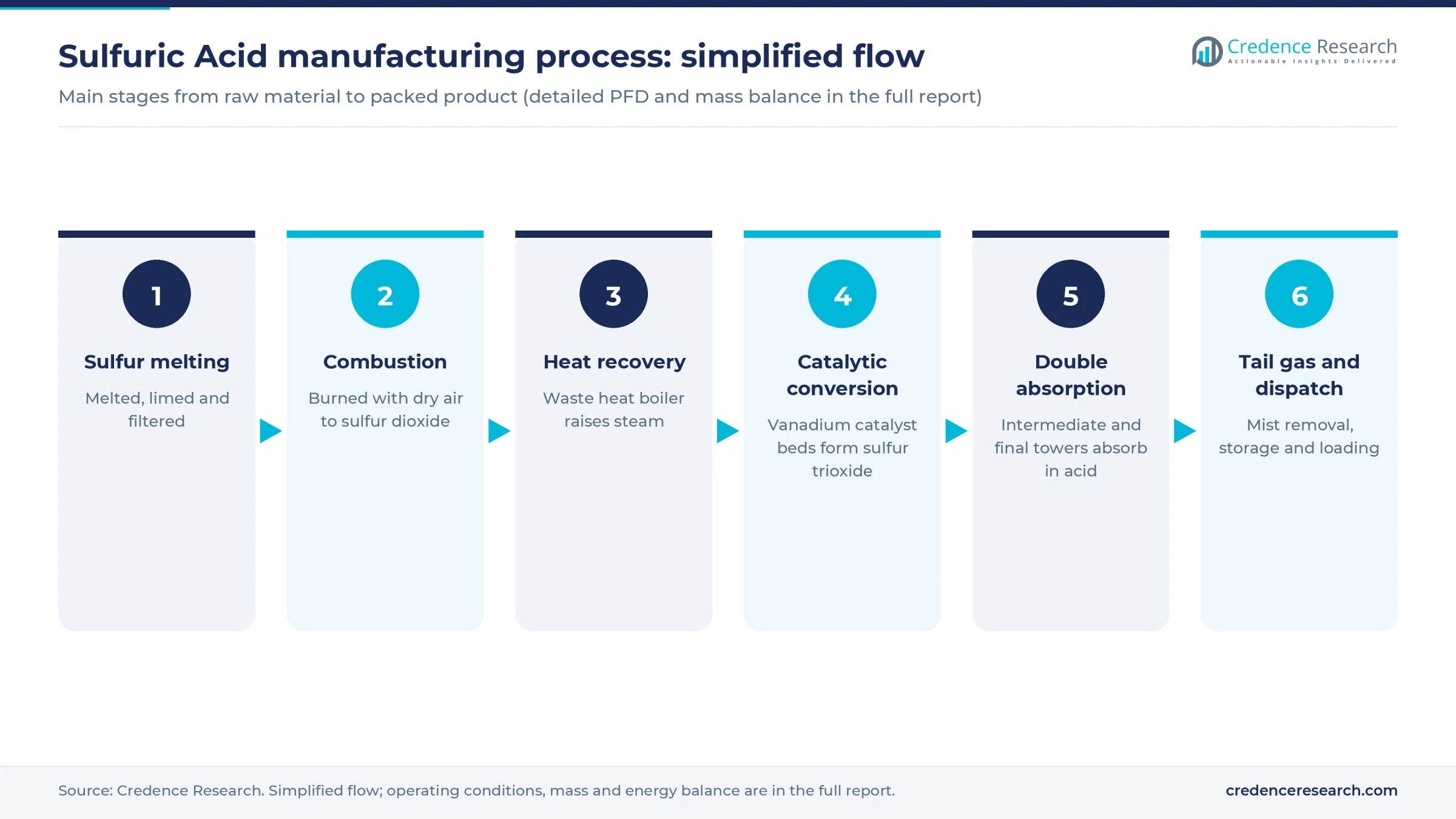
- Sulfur melting and filtration. Solid sulfur is melted with steam coils at about 130–150 degrees Celsius, dosed with lime to neutralize acidity and filtered to remove ash that would plug the catalyst.
- Combustion. Liquid sulfur is sprayed into a refractory-lined furnace with dried air, producing gas of about 10–12% sulfur dioxide at roughly 1,000–1,100 degrees Celsius.
- Heat recovery. A waste heat boiler cools the gas to about 420 degrees Celsius and raises high-pressure steam, which a turbine can turn into power.
- Catalytic conversion. Gas passes through four or five catalyst beds, with coolers between beds because the equilibrium shifts against conversion as temperature rises.
- Intermediate and final absorption. After three beds, an intermediate tower absorbs sulfur trioxide in 98.5% acid. Remaining gas returns to the last beds and a final tower, lifting overall conversion to about 99.7–99.9%. Water is added to hold strength, and oleum is made in a separate tower.
- Tail gas and dispatch. Candle filters capture acid mist, and a scrubber can trim residual sulfur dioxide before the stack. Acid is cooled, stored in steel tanks and loaded to rail, truck, ship or pipeline.
Drying the combustion air is essential, because moisture forms corrosive mist that damages equipment and threatens stack compliance. Smelter acid plants skip combustion but need extensive gas cleaning to remove dust, arsenic and mercury, which is why they cost more per ton of acid.
Sulfuric acid plant setup cost
The reference plant is a sulfur-burning unit of 1,000 metric tons a day, or about 330,000 tons a year over 330 operating days. Total CapEx is estimated at USD 70–130 million, including land, sulfur handling, the acid and steam islands, storage and loading, a steam turbine, utilities, preoperative costs and a working capital margin.
Three recent projects anchor the range. In February 2026, Indo-Jordan Chemicals signed a USD 193 million contract with a Chinese engineering firm for a 900,000-ton-a-year plant in Jordan. Kazatomprom budgeted about 113 billion tenge, or about USD 220 million at an assumed 512 tenge per dollar, for an 800,000-ton plant in Kazakhstan. Paradeep Phosphates spent about USD 28 million, converted at an assumed 86 rupees per dollar, on a 300-ton-a-day brownfield unit in India. Scaling each to 330,000 tons with a 0.6 capacity exponent gives about USD 106 million for the Jordan contract before owner's costs, USD 130 million for Kazakhstan and USD 58 million for India before greenfield site works. A smelter-gas project in central Kazakhstan, put at USD 200 million to lift output from 80,000 to 300,000 tons, shows how gas cleaning raises cost.
For the land row, the plant needs about 50,000 square meters for sulfur storage, the process block, the acid tank farm and loading. At an assumed USD 15–60 per square meter, land costs USD 750,000 to USD 3 million, about 2% of CapEx at the midpoint. U.S. and EU sites sit at the top, where construction labor can also push the total above the range.
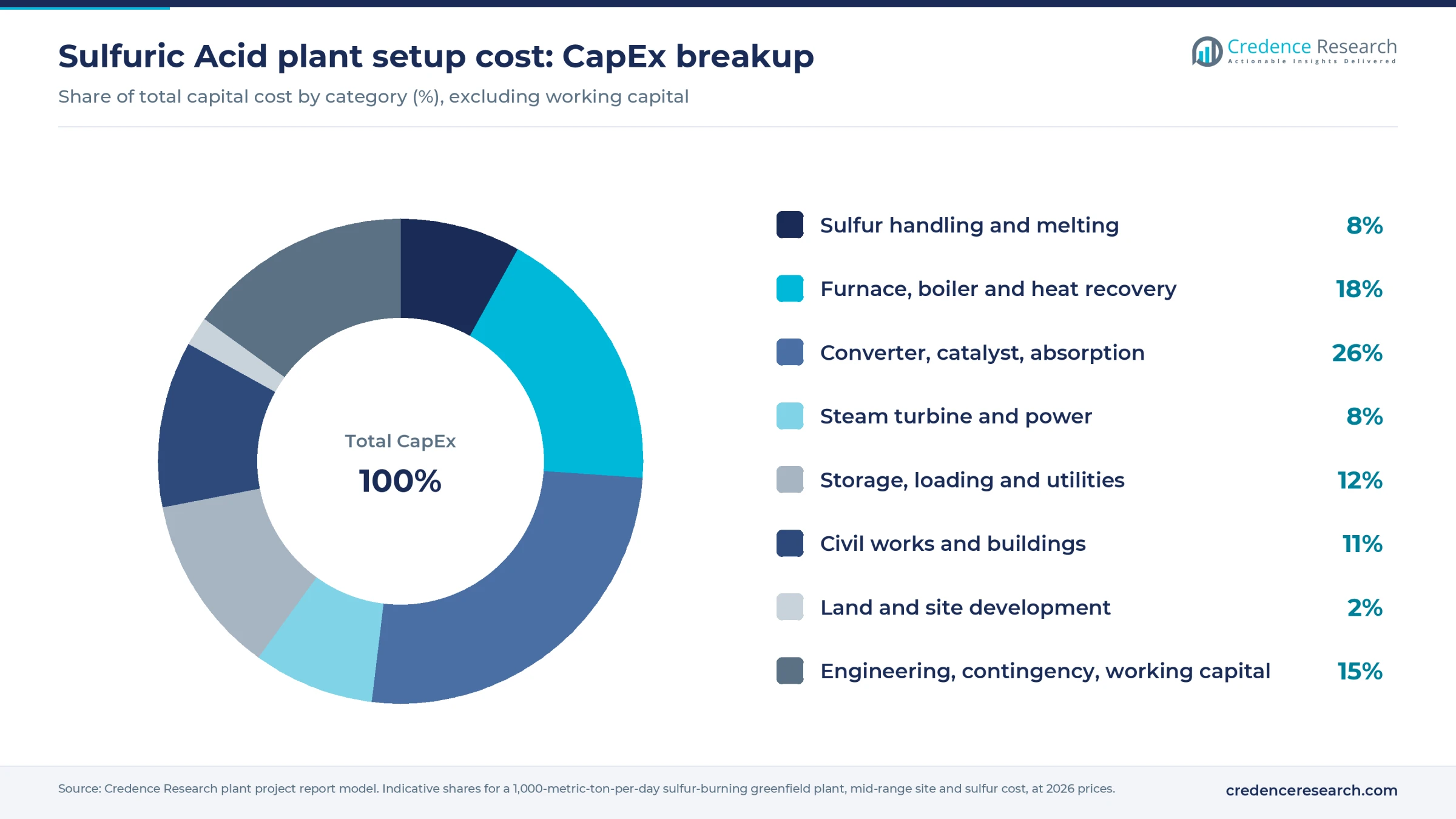
The converter, catalyst and absorption trains take about a quarter of CapEx, and heat recovery with power generation takes another quarter. Running cost is dominated by one input.
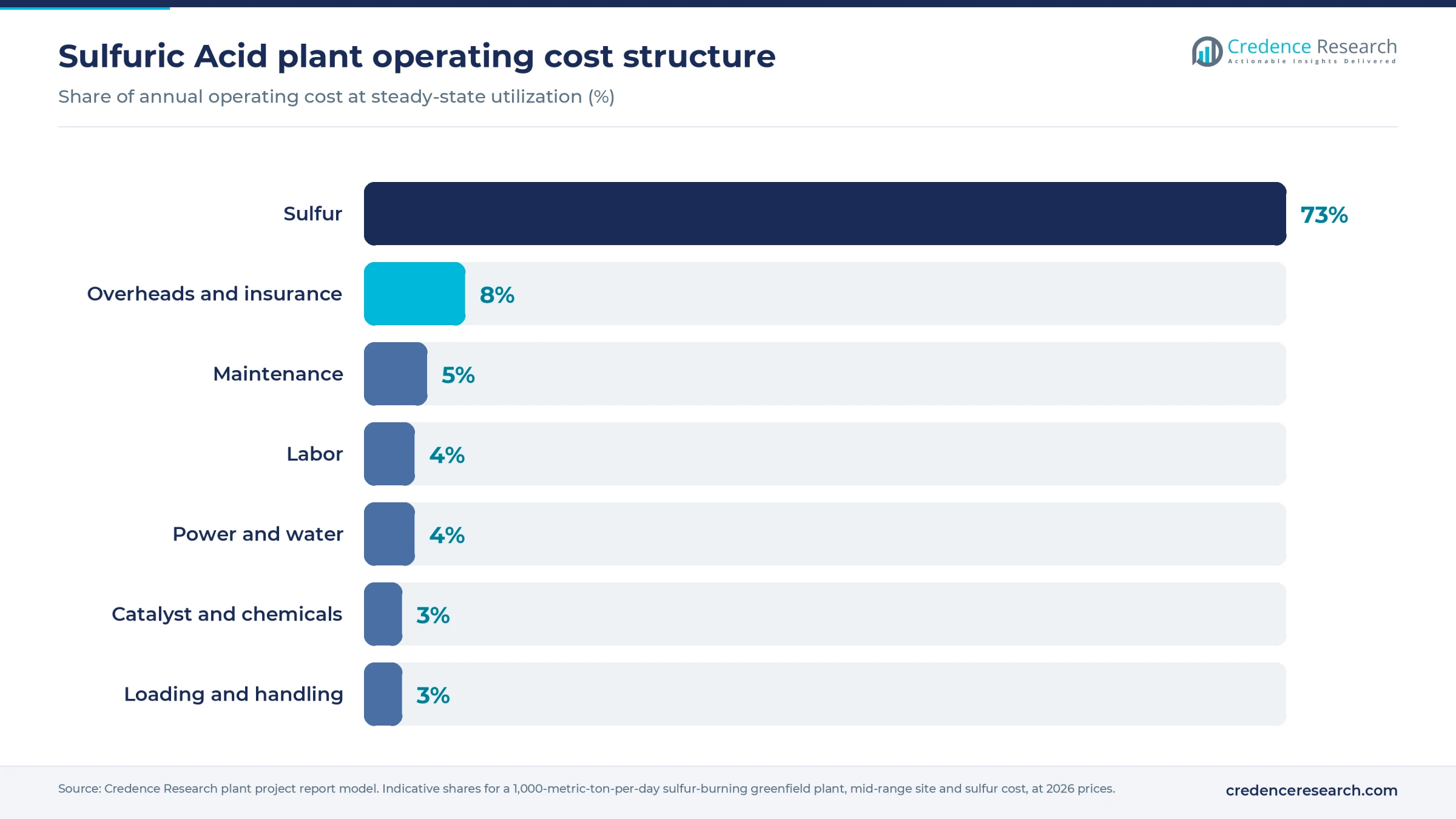
Sulfur makes up about 73% of operating cost at the central case, so a long-term sulfur contract matters more than any equipment choice. The full report can be customized to any country or region.
Machinery and raw materials for a sulfuric acid plant
The main equipment groups are listed below; ratings, makes and the full schedule are in the report.
- Sulfur receiving and storage, steam-jacketed melters, lime dosing and pressure leaf filters
- Air filter, drying tower and main blower, often turbine-driven
- Sulfur furnace and burners, waste heat boiler, superheater and economizers
- Multi-bed converter with vanadium pentoxide catalyst and gas-to-gas heat exchangers
- Drying, intermediate and final absorption towers, acid pump tanks and acid coolers
- Mist eliminators, tail gas scrubber and continuous emission monitors
- Steam turbine generator, deaerator, water treatment and cooling towers
- Lined storage tanks, optional oleum tower, loading arms, laboratory and control system
The reference plant needs about 98,000 tons of sulfur a year at 0.33 ton per ton of acid and 90% utilization. Most solid and liquid sulfur is recovered from sour gas and refinery streams, so the main export sources are the Middle East, Kazakhstan, Russia, Canada and the United States. Comtrade data put 2025 export unit values at about USD 250–290 per ton from Canada, the United States and India, against roughly USD 100 in 2024. Wider use of sulfur recovery technology at refineries and gas plants is expected to add supply. Coastal sites can take bulk cargoes, while inland sites pay rail freight that can add a large share of the sulfur price.
Sulfuric acid business profit margin and ROI
Gross margin is estimated at 25–50%, measured as the acid price plus steam credit, minus sulfur and direct conversion cost, as a share of the acid price. The build uses an assumed ex-works acid price of USD 135–155 per ton, near 2025 Comtrade export unit values of about USD 120–140 from Canada, Germany and Peru, and delivered sulfur at an assumed USD 240–280 per ton, or about USD 79–92 per ton of acid. Direct conversion cost is assumed at USD 20–24 per ton. Steam export of about one ton per ton of acid, in line with Paradeep's reported 105,000 tons a year from its 300-ton-a-day unit, is credited at an assumed USD 18–22 per ton.
At 90% utilization, or about 297,000 tons, acid revenue is near USD 43 million. Annual cash profit after an assumed USD 2.5–3.5 million of overheads is about USD 7–21 million, which puts payback at about 5–14 years on mid-range CapEx of USD 100 million. A low-cost Asian build in a strong year can recover its cost in under four years.
The key sensitivity is the spread between acid and sulfur. Each USD 10 per ton change in sulfur moves cost by about USD 3.30 per ton of acid, or about USD 1 million a year. Captive plants feeding their own phosphoric acid or leaching units avoid freight and price swings.
| Metric | Value |
|---|---|
| Gross margin | 25–50% |
| Payback period | 5–14 years |
| IRR (post-tax) | Available in report |
| NPV | Available in report |
| Return on investment | Available in report |
| DSCR | Available in report |
| Break-even utilization | Available in report |
How to start a sulfuric acid business, licenses and approvals
Approval steps follow a common path: company and tax registration, industrial zoning and building permits, an air permit setting sulfur dioxide and acid mist limits, wastewater and stormwater discharge approval, boiler and pressure vessel certification, fire and occupational safety clearances for corrosive storage, chemical registration, dangerous goods transport compliance and import registration for equipment. Because sulfuric acid is also a precursor for illicit drugs and homemade explosives, several markets add customer screening and reporting duties.
| Market | Key approvals for a sulfuric acid plant |
|---|---|
| United States | State air construction permit and Title V operating permit, with federal standards in 40 CFR 60 Subpart H capping sulfur dioxide at 2 kg and acid mist at 0.075 kg per metric ton of acid; NPDES discharge permit; OSHA process safety management and EPA risk management plans where oleum or sulfur trioxide inventories cross thresholds; EPCRA toxic release reporting for acid aerosols; DOT hazardous materials rules; DEA List II chemical rules for imports and exports |
| European Union | Integrated permit under the Industrial Emissions Directive, applying best available techniques for large volume inorganic chemicals; REACH registration and CLP labeling; Seveso III screening of hazardous inventories; Category 3 drug precursor rules under Regulations (EC) 273/2004 and 111/2005; suspicious transaction reporting under Regulation (EU) 2019/1148 on explosives precursors |
| India | Consent to establish and operate from the state pollution control board, with sulfuric acid plants in the red category; Central Pollution Control Board emission standards under the Environment (Protection) Rules; factory license; boiler registration with the state boiler inspectorate; hazardous chemical storage duties under the MSIHC Rules 1989 |
The air permit usually sets the timeline, because regulators model stack sulfur dioxide and often require continuous monitoring from startup.
Key sulfuric acid manufacturers and recent developments
Most sulfuric acid is made by fertilizer and mining companies for their own use. OCP in Morocco, Ma'aden in Saudi Arabia, Mosaic and Nutrien in North America, PhosAgro and EuroChem, and Chinese phosphate groups such as Yuntianhua run some of the largest sulfur-burning fleets. Smelters including Codelco, Aurubis, Boliden and Korea Zinc supply large volumes of smelter acid, while Chemtrade Logistics and Ecovyst are major North American merchant and regeneration suppliers. Indian makers include Paradeep Phosphates, GSFC and Hindalco.
- February 2026: Indo-Jordan Chemicals, a Jordan Phosphate Mines subsidiary, awarded a USD 193 million contract for a 900,000-ton-a-year plant at Shidiya, due within 30 months.
- March 2026: Paradeep Phosphates commissioned a 300-ton-a-day plant at its Mangalore unit, lifting site capacity to 400 tons a day and cutting reliance on imported acid.
- May 2026: EuroChem started up an 800,000-ton-a-year plant in Kazakhstan's Zhambyl region to supply its chemical complex under construction and domestic buyers, part of a program above USD 1 billion.
In October 2026, GSFC's board also approved a 1,800-ton-a-day sulfuric acid plant and a 600-ton-a-day phosphoric acid plant at Sikka. The pattern favors plants tied to fertilizer or mining demand, with merchant sellers competing on freight.
What's inside the Sulfuric Acid project report PDF
The report runs to 21 chapters. Open a chapter to see its sections.
1. Preface
2. Scope and Methodology
- 2.1 Objectives of the Study
- 2.2 Stakeholders
- 2.3 Research Methodology
- 2.4 Data Sources and Key Assumptions
3. Executive Summary
- 3.1 Market Snapshot
- 3.2 Project at a Glance (Capacity, CapEx, OpEx)
- 3.3 Key Financial Indicators (IRR, NPV, Payback, Break-even)
- 3.4 Feasibility Verdict
4. Product Overview
- 4.1 Sulfuric Acid Definition and Properties
- 4.2 Grades and Specifications (BIS / ISO / ASTM)
- 4.3 HS Code and Classification
- 4.4 Key Applications
- 4.5 Substitutes
5. Global Sulfuric Acid Market
- 5.1 Market Overview
- 5.2 Historical and Current Market Performance (Volume and Value)
- 5.3 Market Breakup by Grade / Type
- 5.4 Market Breakup by End-Use Industry
- 5.5 Market Breakup by Region
- 5.6 Market Drivers, Restraints and Trends
- 5.7 Value Chain Analysis
- 5.8 Market Forecast
6. Target Country Sulfuric Acid Market Analysis
- 6.1 Demand and Supply Analysis
- 6.2 Installed Capacity vs Demand Gap
- 6.3 Import Dependence
- 6.4 Demand Forecast by End-Use
7. Trade Analysis
- 7.1 Imports by Volume, Value and Country
- 7.2 Exports by Volume, Value and Country
- 7.3 Trade Balance and Opportunities
8. Price Analysis
- 8.1 Historical Sulfuric Acid Price Trends by Region
- 8.2 Raw Material / Feedstock Price Trends and Linkage
- 8.3 Price Forecast
- 8.4 Margins Across the Value Chain
9. Competitive Landscape
- 9.1 Market Structure
- 9.2 Key Players and Installed Capacities
- 9.3 Profiles of Key Players
- 9.4 Recent Developments (Expansions, M&A, New Plants)
10. Manufacturing Process and Technology
- 10.1 Comparison of Technology Routes
- 10.2 Selected Route and Process Flow Diagram
- 10.3 Unit Operations Involved
- 10.4 Chemical Reactions Involved
- 10.5 Mass Balance and Raw Material Requirements
- 10.6 Energy Balance
- 10.7 Quality Assurance Criteria and Technical Tests
- 10.8 By-products and Waste Handling
- 10.9 Technology Licensors / Providers
11. Project Details, Requirements and Costs
- 11.1 Land, Location and Site Development
- 11.1.1 Site Selection Criteria
- 11.1.2 Location Analysis
- 11.1.3 Land Requirement and Costs
- 11.1.4 Site Development Costs
- 11.2 Plant Layout
- 11.2.1 Layout Principles
- 11.2.2 Proposed Layout
- 11.2.3 Factors Influencing Layout
- 11.3 Civil Works and Buildings
- 11.4 Plant Machinery
- 11.4.1 Machinery Requirements and Specifications
- 11.4.2 Machinery Costs
- 11.4.3 Machinery Suppliers
- 11.5 Raw Materials
- 11.5.1 Requirements per Tonne of Output
- 11.5.2 Procurement and Sourcing
- 11.5.3 Costs
- 11.5.4 Suppliers
- 11.6 Packaging
- 11.6.1 Packaging Requirements
- 11.6.2 Packaging Costs
- 11.6.3 Packaging Suppliers
- 11.7 Storage and Material Handling
- 11.8 Transportation Requirements and Costs
- 11.9 Utilities
- 11.9.1 Power Requirements and Costs
- 11.9.2 Water Requirements and Costs
- 11.9.3 Steam, Fuel and Other Utilities
- 11.10 Manpower Requirements and Wages
12. Environment, Health, Safety and Sustainability
- 12.1 Effluent and Emissions Management
- 12.2 Hazard Classification and Safety Measures
- 12.3 Carbon Footprint
- 12.4 Green / Low-Carbon Process Options
13. Regulatory Procedures, Approvals and Certifications
- 13.1 Licences and Registrations
- 13.2 Environmental Clearances
- 13.3 Product Certifications (BIS, REACH, etc.)
- 13.4 Approval Timeline
14. Project Implementation Schedule
15. Project Economics
- 15.1 Capital Cost of the Project
- 15.2 Techno-Economic Parameters
- 15.3 Capacity Utilization and Ramp-up
- 15.4 Product Pricing and Margins
- 15.5 Income Projections
- 15.6 Expenditure Projections
- 15.7 Working Capital Requirement
- 15.8 Taxation
- 15.9 Depreciation
16. Financial Analysis
- 16.1 Projected Profit and Loss Account
- 16.2 Projected Cash Flow Statement
- 16.3 Projected Balance Sheet
- 16.4 Liquidity Analysis
- 16.5 Profitability Analysis (Payback, NPV, IRR, ROI)
- 16.6 Break-even Analysis
- 16.7 Debt Service Coverage Ratio (DSCR)
- 16.8 Sensitivity Analysis
- 16.9 Scenario and Uncertainty Analysis
17. Funding and Incentives
- 17.1 Means of Finance and Debt-Equity Structure
- 17.2 Loans and Financial Assistance
- 17.3 Government Schemes and Subsidies (PLI, State Policies)
18. Risk Assessment
- 18.1 Key Success Factors
- 18.2 Key Risk Factors
- 18.3 Risk Mitigation
19. Strategic Recommendations
20. Case Study of a Successful Venture
21. Appendix
- 21.1 Detailed Assumptions
- 21.2 Abbreviations
- 21.3 List of Tables and Figures
- 21.4 Sources
This page vs. the full report
| Data point | On this page (free) | In the full report |
|---|---|---|
| Total CapEx | One rounded range at one capacity | Exact figure at three capacities with a line-item breakup |
| CapEx breakup | Category shares (%) only | Cost, quantity and supplier for every machine |
| Operating cost | Share of raw materials, utilities and labor | Per-unit cost sheet with each input price and consumption |
| Profitability | Gross margin range and payback band | Exact IRR, NPV, ROI, break-even and DSCR |
| Financial statements | List of what is included | 10-year P&L, cash flow, balance sheet and Excel model |
| Sensitivity | One directional line | Full sensitivity and scenario tables |
| Process | Simplified flow diagram | Detailed process flow, mass and energy balance, operating conditions |
| Machinery | Names of the main machines | Specifications, capacity, cost and supplier list |
| Market | Headline size, growth and global demand | Segment, region, trade and price forecast tables |
| Suppliers and buyers | Supplier types and sourcing hubs | Named suppliers and buyers |
Sulfuric Acid project report: FAQs
How much does it cost to set up a sulfuric acid plant?
What capacity suits a new sulfuric acid plant?
Why does the sulfur price matter so much?
What is the profit margin in sulfuric acid manufacturing?
What is the payback period for a sulfuric acid plant?
Which approvals does a sulfuric acid plant need?

About the analyst
Nisha Gupta, Senior Research Analyst
Nisha Gupta is a Senior Research Analyst at Credence Research Inc. who works across industry domains, including packaging, automotive parts and machinery. Her focus is the modelling engine behind each study: she builds quantitative market databases and econometric forecasting frameworks, and developed automated Excel-based market modelling templates that cut client turnaround time by 30%.
Related market research
- Sulfuric Acid Market Size, Growth, Share and Forecast 2032
- Solid and Liquid Sulfur Market Size, Growth and Forecast 2032
- Sulfur Recovery Technology Market Size, Share and Forecast 2032
- Europe Phosphate Fertilizers Market Size, Share and Forecast 2032
- Ammonium Sulfate Food Grade Market Size, Share and Forecast 2032
More plant project reports
- Formaldehyde Manufacturing Plant Project Report (DPR) 2026
- Engine Oil Manufacturing Plant Project Report (DPR) 2026
- Ferrous Sulphate Manufacturing Plant Project Report (DPR) 2026
- Acetonitrile Manufacturing Plant Project Report (DPR) 2026
- Sodium Chloride Manufacturing Plant Project Report (DPR) 2026
- Sodium Chlorate Manufacturing Plant Project Report (DPR) 2026