
Market Overview
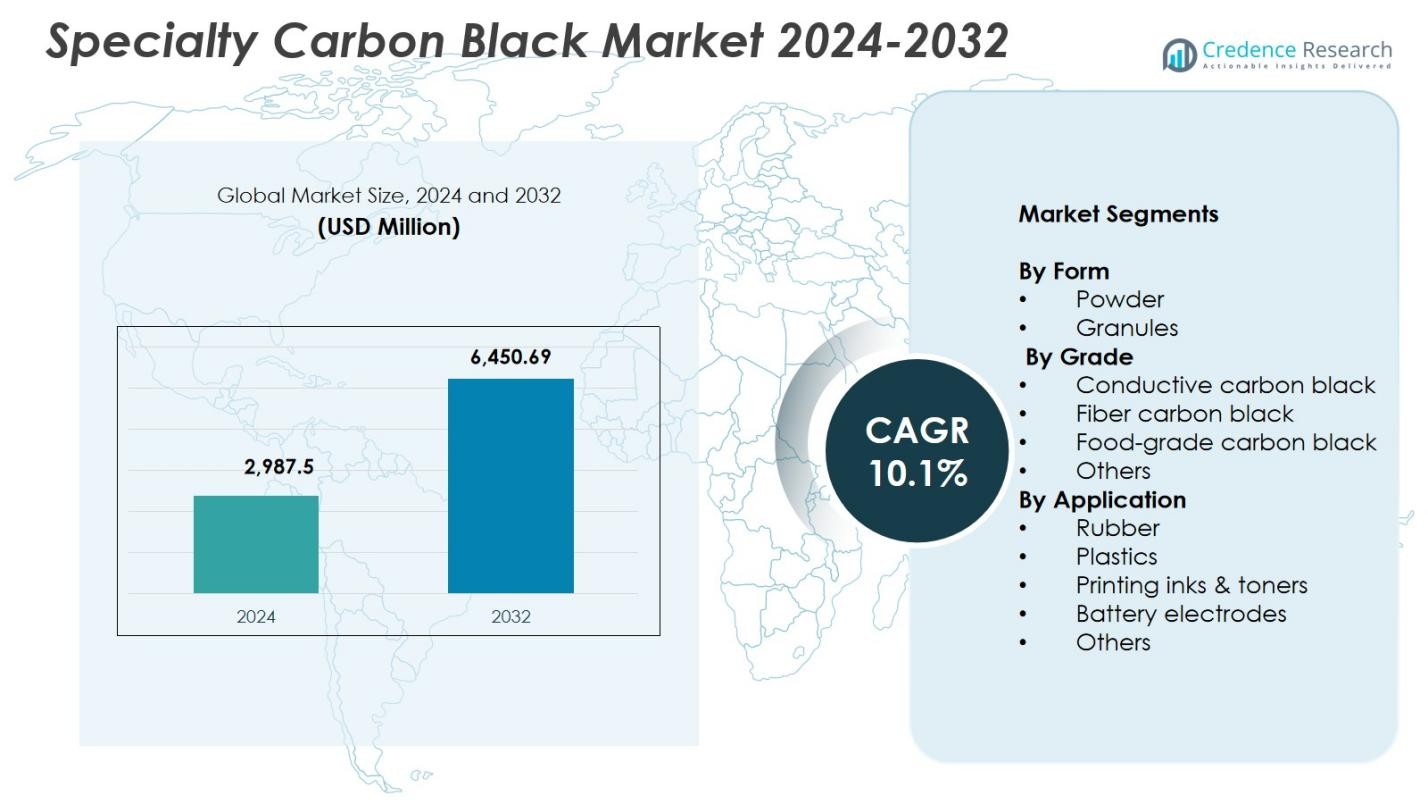
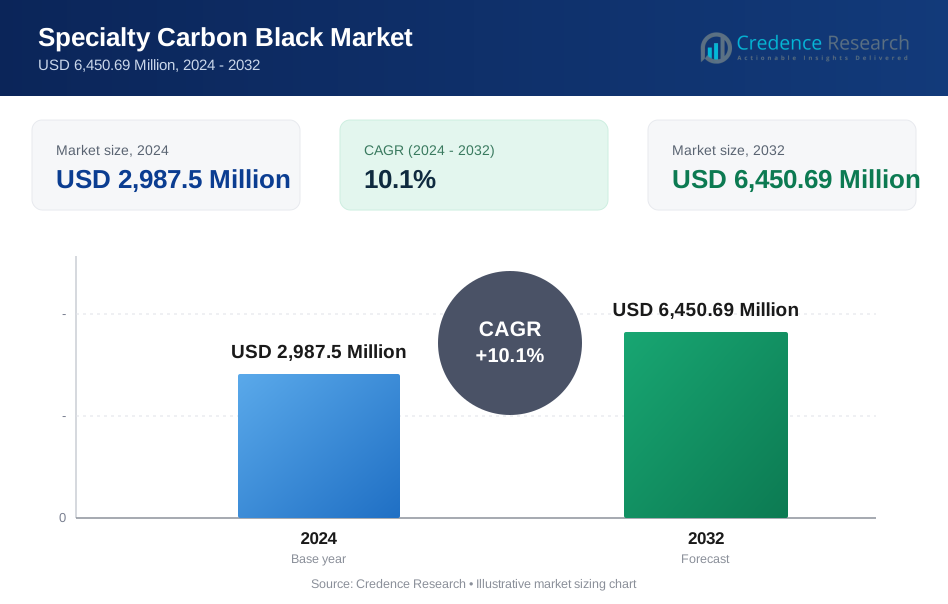
Specialty Carbon Black Market size was valued at USD 2,987.5 Million in 2024 and is anticipated to reach USD 6,450.69 Million by 2032, at a CAGR of 10.1% during the forecast period.
| REPORT ATTRIBUTE | DETAILS |
|---|---|
| Historical Period | 2020-2023 |
| Base Year | 2024 |
| Forecast Period | 2025-2032 |
| Specialty Carbon Black Market Size 2024 | USD 2,987.5 Million |
| Specialty Carbon Black Market , CAGR | 10.1% |
| Specialty Carbon Black Market Size 2032 | USD 6,450.69 Million |
Specialty Carbon Black Market features prominent players such as OMSK Carbon Group Limited, Atlas Organics Pvt. Ltd., Orion Engineered Carbon GmbH, Mitsubishi Chemical Corporation, Ampacet Corporation, Denka Company Limited, Birla Carbon, Cabot Corporation, Himadri Speciality Chemical Ltd., and Continental Carbon Company. These companies strengthen market growth through advancements in conductive, high-dispersion, and specialty-grade formulations serving plastics, inks, coatings, and battery applications. Regionally, Asia-Pacific led the market with **36.9% share in 2024**, driven by strong manufacturing activity, expanding automotive production, and rising demand for specialty polymers and electronics. North America and Europe followed, supported by technological innovation and stringent quality standards across industrial and automotive sectors.
Market Insights
- The Specialty Carbon Black Market reached USD 2,987.5 Million in 2024 and will grow at a CAGR of 10.1% through 2032.
- Strong market drivers include rising adoption in high-performance plastics, coatings, and battery electrodes, with the Powder form leading at 4% share and Conductive grade dominating at 41.8% share due to growing EV and electronics demand.
- Key trends focus on sustainable low-emission production, high-purity conductive materials, and increasing application in advanced electronics, printing inks, and premium packaging.
- Major players expand capacity, invest in R&D, and strengthen technology capabilities to serve automotive, electronics, and industrial sectors, enhancing product performance and global supply reliability.
- Asia-Pacific led with 9% share, followed by North America at 28.6% and Europe at 24.1%, while Latin America and Middle East & Africa showed steady growth driven by rubber, packaging, and infrastructure applications.
Market Segmentation Analysis:
By Form:
In the Specialty Carbon Black Market, the Powder segment held the dominant position in 2024 with 62.4% share, driven by its superior dispersion properties, high surface area, and suitability for performance-critical applications. Powder-grade carbon black is widely used in conductive plastics, coatings, and high-quality inks due to its ability to enhance tinting strength, UV resistance, and surface smoothness. The Granules segment accounted for 37.6% share, supported by its ease of handling, reduced dust generation, and increasing adoption in masterbatches and rubber compounding where cleaner processing and bulk handling efficiency are essential.
- For instance, Birla Carbon's Conductex powder carbon blacks provide conductivity for electrostatic discharge (ESD) protection in conductive plastics, such as IC carrier tapes, trays, and anti-static flooring, thanks to their tailored morphology, low ionic impurities, and superior dispersibility in resin systems.
By Grade:
The Conductive carbon black segment dominated the market with 41.8% share in 2024, propelled by rising demand in lithium-ion batteries, antistatic packaging, and conductive polymer applications where high electrical conductivity and superior charge transport are critical. Fiber carbon black held 23.6% share, benefiting from its use in reinforcing synthetic fibers and enhancing tensile strength. Food-grade carbon black contributed 18.9% share, driven by regulatory approvals for coloring and safety compliance. The Others category captured 15.7% share, supported by niche applications requiring customized performance characteristics.
- For instance, Orion Engineered Carbons' PRINTEX kappa 100 provides high electrical and thermal conductivity for lithium-ion batteries, forming a strong percolation network across cathodes to boost power density and extend battery life.
By Application:
The Rubber segment led the Specialty Carbon Black Market in 2024 with 46.3% share, primarily attributed to its essential role in improving abrasion resistance, tensile strength, and durability in tires, industrial rubber goods, and mechanical components. The Plastics segment accounted for 28.4% share, fueled by demand for UV stabilization, pigmentation, and conductivity enhancement in automotive and packaging products. Printing inks & toners represented 14.2% share, supported by growth in digital and flexographic printing technologies. Battery electrodes held 6.8% share, reflecting rising adoption in EV batteries, while Others captured 4.3% share across specialty uses.
Key Growth Drivers
Rising Demand for High-Performance Plastics and Polymers
The Specialty Carbon Black Market grows significantly due to increasing consumption of high-performance plastics across automotive, electronics, and packaging industries. Manufacturers rely on specialty carbon black to enhance conductivity, UV protection, tinting strength, and mechanical durability in engineered polymers. Its ability to meet stringent performance specifications, especially in lightweight automotive components and advanced electronic housings, accelerates adoption. Additionally, the shift toward premium packaging materials with superior aesthetics and protection further amplifies demand, positioning specialty carbon black as a critical functional additive in high-value plastic formulations.
- For instance, Cabot Corporation's VULCAN XC615 specialty carbon black provides conductivity at low loadings for electrostatic discharge protection in injected automotive housings and electronic packaging, while enabling low compound moisture absorption to prevent defects in moisture-sensitive applications.
Expansion of Electric Vehicles and Battery Technologies
Rapid growth in electric vehicles (EVs) and energy storage systems drives strong demand for specialty carbon black used in lithium-ion battery electrodes. Its high conductivity and optimized surface structure improve electron transfer, charge acceptance, and overall battery efficiency. As global EV production expands and OEMs increase investment in next-generation battery chemistries, conductive carbon black becomes essential for achieving higher energy density and extended battery life. The rise of battery gigafactories and government incentives for clean mobility further strengthens usage across anode, cathode, and conductive additive applications.
- For instance, Birla Carbon's Conductex i14 serves as a conductive additive with very high structure and purity for Li-ion batteries, increasing electrical conductivity and enabling higher solids content in electrode slurries to boost manufacturing throughput.
Growth of Printing, Packaging, and High-End Coatings
Specialty carbon black plays a vital role in premium printing inks, toners, and high-end coatings due to its deep jetness, dispersibility, and controlled particle morphology. The expansion of digital printing, e-commerce packaging, and premium branding strengthens demand for carbon-black-based inks that deliver sharper contrast and enhanced durability. In industrial coatings, the material improves UV resistance, conductivity, and color stability, supporting adoption in automotive parts, appliances, and architectural applications. Growing consumer preference for high-quality visual finishes and protective coatings significantly boosts market growth.
Key Trends & Opportunities
Adoption of Sustainable and Low-Emission Production Technologies
A major emerging trend is the industry's shift toward sustainable specialty carbon black produced through cleaner processes, including methane-based feedstocks, circular gas utilization, and reduced VOC emissions. Manufacturers increasingly adopt energy-efficient reactors and carbon-capture-enabled processes to meet global decarbonization goals. This trend creates strong opportunities for suppliers offering eco-certified products for automotive, electronics, and packaging applications. Regulatory pressure, ESG commitments, and corporate sustainability programs further accelerate demand for low-carbon specialty carbon black, opening avenues for innovation across the value chain.
- For instance, Birla Carbon develops Continua™ sustainable carbonaceous materials from circular sources to enhance product sustainability in tires, coatings, and inks, integrating these into global operations to support net-zero aspirations.
Growing Use in Advanced Electronics and Semiconductor Applications
Rising miniaturization of electronic components and the need for reliable conductive materials present significant opportunities for specialty carbon black. Its use in EMI shielding, conductive polymers, antistatic layers, and high-precision components expands as consumer electronics become more compact and powerful. The semiconductor industry leverages ultra-high-purity grades for improved stability and performance in sensitive environments. With accelerating demand for wearables, IoT devices, and smart home technologies, specialty carbon black finds increased relevance in electronic materials requiring conductivity, heat dissipation, and structural enhancement.
- For instance, Imerys' ENSACO conductive carbon blacks provide high electrical conductivity at low filler content for EMI shielding in electronics housings, antennas, and sensors, supporting lightweight polymer solutions that reflect and absorb electromagnetic waves.
Key Challenges
Volatility in Raw Material Prices and Supply Constraints
The Specialty Carbon Black Market faces challenges from fluctuations in feedstock prices, particularly petroleum-derived raw materials such as coal tar and heavy aromatic oils. Supply disruptions, geopolitical tensions, and refinery shutdowns can lead to unpredictable cost swings, directly affecting production economics. Manufacturers often struggle to maintain stable pricing and profitability, especially in regions with limited raw material availability. This volatility forces companies to invest in alternative feedstocks, long-term supply contracts, and optimized production processes to mitigate operational and financial risks.
Stringent Environmental Regulations Impacting Production
Tightening emission standards and environmental regulations impose compliance challenges for specialty carbon black producers. Regulatory frameworks targeting particulate emissions, SOx/NOx levels, and carbon footprints require major investments in advanced filtration, clean-energy technologies, and plant modernization. Smaller manufacturers frequently face difficulties managing compliance costs, resulting in market consolidation. Additionally, the transition toward greener specialty carbon black alternatives pressures traditional production methods. Companies must balance operational efficiency with regulatory compliance while ensuring consistent product quality and competitive cost structures.
Regional Analysis
North America
North America accounted for 28.6% share of the Specialty Carbon Black Market in 2024, driven by strong demand from the automotive, electronics, and advanced plastics industries. The region benefits from well-established manufacturing capabilities, high adoption of conductive polymers, and rising investments in EV battery production. Growth in digital printing, premium packaging, and high-performance coatings further strengthens market expansion. The U.S. leads the regional market due to sustained technological innovation, while Canada supports demand through industrial rubber and infrastructure applications. Increasing preference for sustainable and low-emission specialty carbon black grades also contributes to regional growth.
Europe
Europe held 24.1% share in 2024, supported by the region’s stringent regulatory standards and rising consumption of high-quality specialty plastics, inks, and coatings. The market benefits from strong automotive production, particularly in Germany, where specialty carbon black is essential for lightweight components and conductive applications. The region’s growing focus on circular economy initiatives and carbon-neutral manufacturing encourages adoption of eco-engineered carbon black grades. Demand from advanced electronics, industrial rubber, and architectural coatings also contributes to growth. Manufacturers expand R&D efforts to develop high-purity and sustainable grades to meet evolving regulatory and performance requirements.
Asia-Pacific
Asia-Pacific dominated the Specialty Carbon Black Market in 2024 with 36.9% share, driven by large-scale manufacturing activity, expanding automotive production, and rising demand for plastics and rubber products. China, India, and Japan anchor growth through extensive use in tires, industrial rubber goods, and conductive applications for electronics. Rapid urbanization and infrastructure development fuel consumption of specialty coatings and printing materials. The region also benefits from increasing investments in EV production and battery technologies, boosting demand for conductive carbon black. Competitive manufacturing costs and rising technological advancements further strengthen Asia-Pacific’s leading position.
Latin America
Latin America accounted for 5.7% share in 2024, with demand primarily driven by the automotive aftermarket, construction, and packaging sectors. Brazil and Mexico remain the key contributors due to their growing plastics, rubber, and printing industries. Infrastructure development and rising consumer spending support the adoption of specialty carbon black in coatings and premium packaging. The region is gradually expanding its electronics manufacturing base, presenting new opportunities for conductive grades. Despite supply chain constraints and varying regulatory frameworks, steady industrialization and increasing interest in high-performance materials sustain market growth across Latin America.
Middle East & Africa
The Middle East & Africa region held 4.7% share in 2024, supported by rising investments in construction, packaging, and industrial manufacturing. Demand for specialty carbon black grows as regional producers diversify into advanced plastics, high-durability coatings, and automotive components. Countries such as the UAE and Saudi Arabia increasingly adopt specialty materials to support infrastructure and industrial modernization initiatives. Africa contributes through expanding rubber processing and consumer goods sectors. While the region faces challenges related to technology access and production capacity, growing interest in high-performance and conductive formulations continues to drive market expansion.
Market Segmentations:
By Form
- Powder
- Granules
By Grade
- Conductive carbon black
- Fiber carbon black
- Food-grade carbon black
- Others
By Application
- Rubber
- Plastics
- Printing inks & toners
- Battery electrodes
- Others
By Geography
- North America
- U.S.
- Canada
- Mexico
- Europe
- Germany
- France
- U.K.
- Italy
- Spain
- Rest of Europe
- Asia Pacific
- China
- Japan
- India
- South Korea
- South-east Asia
- Rest of Asia Pacific
- Latin America
- Brazil
- Argentina
- Rest of Latin America
- Middle East & Africa
- GCC Countries
- South Africa
- Rest of the Middle East and Africa
Competitive Landscape
Competitive landscape in the Specialty Carbon Black Market features leading players such as OMSK Carbon Group Limited, Atlas Organics Pvt. Ltd., Orion Engineered Carbon GmbH, Mitsubishi Chemical Corporation, Ampacet Corporation, Denka Company Limited, Birla Carbon, Cabot Corporation, Himadri Speciality Chemical Ltd., and Continental Carbon Company. These companies strengthen their positions through continuous capacity expansions, technological advancements, and development of high-performance conductive, food-grade, and specialty polymer grades. Major manufacturers focus on low-emission and sustainable production technologies to meet stringent regulatory norms and customer sustainability goals. Strategic initiatives, including collaborations with battery producers, acquisition of niche technology providers, and investment in R&D for high-dispersion and ultra-high-purity grades, enhance market presence. Growing demand from EV batteries, high-end plastics, and coatings encourages companies to optimize supply chains and expand geographically. Competitive intensity remains high as global and regional players differentiate through product innovation, performance consistency, and value-added technical services.
Key Player Analysis
- OMSK Carbon Group Limite
- Atlas Organics Pvt. Ltd.
- Orion Engineered Carbon GmbH
- Mitsubishi Chemical Corporation
- Ampacet Corporation
- Denka Company Limited
- Birla Carbon (Aditya Birla Group)
- Cabot Corporation
- Himadri Speciality Chemical Ltd.
- Continental Carbon Company (CSRC USA Corp.)
Recent Developments
- In July 2025, Orion S.A. announced plans to rationalize operations by discontinuing production on three to five carbon black lines in the Americas and EMEA by end of 2025.
- In August 2025, Cabot Corporation signed a definitive agreement to acquire Mexico Carbon Manufacturing S.A. de C.V. from Bridgestone Corporation, expanding its reinforcing-carbon manufacturing capacity.
- In November 2025, Birla Carbon announced that its circular-material line, Continua™ Sustainable Carbonaceous Material (SCM), is set to scale up globally potentially accounting for up to 10% of its product portfolio.
Report Coverage
The research report offers an in-depth analysis based on Form, Grade, Application and Geography. It details leading market players, providing an overview of their business, product offerings, investments, revenue streams, and key applications. Additionally, the report includes insights into the competitive environment, SWOT analysis, current market trends, as well as the primary drivers and constraints. Furthermore, it discusses various factors that have driven market expansion in recent years. The report also explores market dynamics, regulatory scenarios, and technological advancements that are shaping the industry. It assesses the impact of external factors and global economic changes on market growth. Lastly, it provides strategic recommendations for new entrants and established companies to navigate the complexities of the market.
Future Outlook
- The market will expand steadily as demand rises for high-performance plastics, coatings, and conductive applications.
- EV battery growth will significantly increase the adoption of conductive specialty carbon black grades.
- Manufacturers will invest more in sustainable, low-emission production technologies.
- Advanced electronics and semiconductor applications will create new opportunities for ultra-high-purity grades.
- Digital printing advancements will strengthen demand for high-jetness inks and toners.
- Regulatory pressure will accelerate the shift toward eco-certified and low-carbon carbon black products.
- Capacity expansions in Asia-Pacific will reinforce the region’s dominant supply position.
- Strategic partnerships between carbon black producers and battery manufacturers will accelerate innovation.
- Market consolidation will increase as companies seek stronger technological and supply chain capabilities.
- Growing adoption of lightweight automotive materials will elevate demand for specialty carbon black worldwide.
Request a Free Sample
Fill in your details and we'll send you a free sample report.
- Sample data tables & charts
- Research methodology
Need a Custom Version of This Report?
Tailor the scope, geography, or segments to your exact requirements.
- Custom geography or segment scope
- Direct access to our analyst team
Frequently Asked Questions
What is the current market size for Specialty Carbon Black Market, and what is its projected size in 2032?
At what Compound Annual Growth Rate is the Specialty Carbon Black Market projected to grow between 2024 and 2032?
Which Specialty Carbon Black Market segment held the largest share in 2024?
What are the primary factors fueling the growth of the Specialty Carbon Black Market?
Who are the leading companies in the Specialty Carbon Black Market?
Which region commanded the largest share of the Specialty Carbon Black Market in 2024?
Table of Content
Chapter 1. Report Introduction
- 1.1 Report Description & Purpose
- 1.1.1 Report Title & Market Definition
- 1.1.2 Unique Selling Propositions (USP) & Key Differentiators
- 1.1.3 Value Proposition for Stakeholders
- 1.2 Research Objectives
- 1.2.1 Market Sizing Objectives (Volume & Revenue)
- 1.2.2 Segmentation Objectives
- 1.2.3 Competitive Intelligence Objectives
- 1.2.4 Forecast & Scenario Objectives
- 1.3 Report Scope
- 1.3.1 Specialty Carbon Black Scope – Types & Subtypes Covered
- 1.3.2 Geographic Scope – Regions & Countries Covered
- 1.3.3 Historical Period, Base Year & Forecast Period (2024; forecast to 2032)
- 1.3.4 Inclusions & Exclusions
- 1.4 HS Code & Classification Framework
- 1.5 Currency, Units & Pricing Basis
- 1.6 Target Stakeholders
- 1.7 Limitations & Assumptions
Chapter 2. Executive Summary
- 2.1 Global Specialty Carbon Black Market Snapshot
- 2.1.1 Market Size – Historical (2024) & Forecast (2024-2032) (2024: USD 2,987.5 Million → 2032: USD 6,450.69 Million)
- 2.1.2 Volume & Revenue – Global Totals
- 2.1.3 Key Market Highlights – Top Five Facts
- 2.2 Specialty Carbon Black Market Segmentation Snapshot
- 2.2.1 Market Split by Region – 2024 vs. 2032
- 2.3 Competitive Snapshot
- 2.3.1 Top 10 Players by Revenue Share – 2024
- 2.3.2 Top 10 Players by Volume Share – 2024
- 2.3.3 Recent Strategic Developments (18-Month Summary)
- 2.4 Key Investment Highlights & Strategic Conclusions
Chapter 3. Specialty Carbon Black Market Dynamics & Industry Analysis
- 3.1 Market Overview & Context
- 3.1.1 Specialty Carbon Black Market Position in the Broader Automotive Value Chain
- 3.1.2 OEM vs. Replacement Market Dynamics
- 3.1.3 Market Maturity & Development Stage by Region
- 3.2 Specialty Carbon Black Market Drivers
- 3.3 Specialty Carbon Black Market Restraints & Challenges
- 3.4 Specialty Carbon Black Market Opportunities
- 3.5 Porter's Five Forces Analysis
- 3.5.1 Threat of New Entrants
- 3.5.2 Bargaining Power of Suppliers
- 3.5.3 Bargaining Power of Buyers
- 3.5.4 Threat of Substitutes
- 3.5.5 Competitive Rivalry – Intensity Assessment
- 3.6 Specialty Carbon Black Value Chain Analysis
- 3.6.1 Upstream – Raw Material/Input Suppliers
- 3.6.1.1 Raw Material/Input 1
- 3.6.1.2 Raw Material/Input 2
- 3.6.1.3 Raw Material/Input 3
- 3.6.2 Midstream – Production/Manufacturing/Service Delivery
- 3.6.2.1 Production/Process Overview
- 3.6.2.2 Key Facility Locations & Capacity by Manufacturer
- 3.6.3 Downstream – Distribution & End Consumer
- 3.6.3.1 Primary Channel – B2B/OEM
- 3.6.3.2 Secondary Channels – Dealer, Retail, Online, Direct
- 3.6.4 Value Chain Profitability Analysis
- 3.6.1 Upstream – Raw Material/Input Suppliers
- 3.7 PESTEL Analysis
- 3.7.1 Political Factors
- 3.7.2 Economic Factors
- 3.7.3 Social Factors
- 3.7.4 Technological Factors
- 3.7.5 Environmental Factors
- 3.7.6 Legal Factors
- 3.8 Specialty Carbon Black Supply Chain Analysis
- 3.8.1 Raw Material/Input Supply Risk Assessment
- 3.8.2 Manufacturing Concentration Risk (Geographic Exposure)
- 3.8.3 Trade Disruption Impact Analysis
- 3.9 Regulatory & Policy Landscape
Note: The regulatory and policy landscape section covers regulations based on their applicability to the market, Specialty Carbon Black category, geography, and scope of the study. Only regulatory frameworks with a material impact on operations, compliance, trade, sustainability, or market access are analyzed in detail.
Chapter 4. Key Investment Pockets & Opportunity Analysis
- 4.1 Specialty Carbon Black Market Attractiveness Analysis
- 4.1.1 By Region – Investment Attractiveness Matrix (Volume × CAGR)
- 4.2 Absolute Revenue Growth Opportunity
- 4.2.1 By Region – Absolute USD Growth Through 2032
- 4.3 Incremental Volume Opportunity
- 4.3.1 By Region – Incremental Volume Through 2032
- 4.3.2 Segment – Incremental Volume
- 4.4 Emerging Submarket Opportunity Deep Dive (Subject to Applicability)
- 4.5 Emerging Market Opportunity Scorecards
- 4.5.1 United States
- 4.5.2 Europe
- 4.5.3 Asia
- 4.5.4 Middle East & Africa
Note: Emerging Market Opportunity Scorecards will be included based on relevance and strategic importance. Regions listed are indicative and may vary depending on data availability and market dynamics.
Chapter 5. Specialty Carbon Black Import-Export Analysis & Trade Flows
- 5.1 Global Trade Overview
- 5.1.1 Global Export Value by Country (2024)
- 5.1.2 Global Export Volume by Country (2024)
- 5.1.3 Global Import Value by Country (2024)
- 5.1.4 Global Import Volume by Country (2024)
- 5.1.5 Net Trade Balance by Country (2024)
- 5.2 Export Analysis – Segment
- 5.2.1 Type 1 (HS Code)
- 5.2.2 Type 2 (HS Code)
- 5.2.3 Type 3 (HS Code)
- 5.2.4 Type 4 (HS Code)
- 5.2.5 Type 5 (HS Code)
- 5.3 Import Analysis – Segment
- 5.3.1 Type 1 (HS Code)
- 5.3.2 Type 2 (HS Code)
- 5.3.3 Type 3 (HS Code)
- 5.3.4 Type 4 (HS Code)
- 5.3.5 Type 5 (HS Code)
- 5.4 Average Unit Trade Prices
- 5.4.1 Average Export Price – Segment & Country
- 5.4.2 Average Import Price – Segment & Source Country
- 5.4.3 Price Trends (2024)
- 5.5 Key Trade Route Analysis
- 5.5.1 Trade Route 1
- 5.5.2 Trade Route 2
- 5.5.3 Trade Route 3
- 5.5.4 Trade Route 4
- 5.5.5 Trade Route 5
- 5.6 Trade Policy Impact Assessment
- 5.6.1 US Anti-Dumping & Section 301 Tariffs
- 5.6.2 EU Customs Union Impact
- 5.6.3 Major Free Trade Agreements
- 5.6.4 USMCA Rules of Origin
Note: Trade policy analysis will be included only where relevant to the Specialty Carbon Black market.
Chapter 6. Competitive Landscape & Company Benchmarking
- 6.1 Specialty Carbon Black Market Concentration & Structure
- 6.1.1 Herfindahl-Hirschman Index (HHI) – vs. 2024
- 6.1.2 Tier 1, Tier 2 & Tier 3 Market Structure
- 6.1.3 Global, Regional & Local Player Dynamics
- 6.2 Specialty Carbon Black Market Share Analysis – 2024
- 6.2.1 Global Revenue Share by Company
- 6.2.2 Global Volume Share by Company
- 6.2.3 Regional Revenue Share
- 6.2.4 Market Share Evolution ( vs. 2024)
- 6.2.5 OEM Segment Share by Company
- 6.2.6 Replacement Segment Share by Company
- 6.3 Production/Delivery Capacity & Facility Analysis
- 6.3.1 Global Installed Capacity
- 6.3.2 Capacity Utilization Rates
- 6.3.3 Production/Output Volume
- 6.3.4 Facility Locations & Capacity Map
- 6.3.5 Planned Capacity Additions
- 6.4 Specialty Carbon Black Competitive Benchmarking Matrix
- 6.4.1 Revenue, Volume, CAGR & Profitability Comparison
- 6.4.2 Channel Revenue Mix
- 6.4.3 Geographic Revenue Exposure
- 6.4.4 R&D Intensity
- 6.4.5 Sustainability Maturity
- 6.5 Strategic Developments in Specialty Carbon Black (Last 24 Months)
- 6.5.1 Mergers, Acquisitions & Divestments
- 6.5.2 New Specialty Carbon Black Launches
- 6.5.3 Facility Expansions
- 6.5.4 Strategic Alliances, Joint Ventures & Partnerships
- 6.5.5 Distribution Expansion & Market Entry
- 6.5.6 Sustainability & ESG Initiatives
- 6.6 Competitive Strategy Mapping
- 6.6.1 Leader, Challenger, Follower & Niche Classification
- 6.6.2 Pricing Strategy Comparison
- 6.6.3 Channel Strategy Matrix
Note: Strategic developments are included based on their materiality and the availability of reliable information.
Chapter 7. Global Specialty Carbon Black Market – By Distribution Channel
- 7.1 Segment Overview
- 7.1.1 Volume & Revenue Split by Channel (2024 & 2032)
- 7.1.2 Channel Mix Evolution (2024-2032)
Chapter 8. Regional Market Analysis – Global Overview
- 8.1 Global Regional Overview
- 8.1.1 Regional Volume Share
- 8.1.2 Regional Revenue Share
- 8.1.3 Regional Volume by Region
- 8.1.4 Regional Revenue by Region
- 8.1.5 Regional Forecast Through 2032
- 8.2 Cross-Regional Segment Analysis
- 8.2.1 By Distribution Channel
- 8.2.2 By Brand/Price Tier
Chapter 9. North America Specialty Carbon Black Market
- 9.1 United States
- 9.2 Canada
- 9.3 Mexico
Chapter 10. Europe Specialty Carbon Black Market
- 10.1 Germany
- 10.2 France
- 10.3 Italy
- 10.4 United Kingdom
- 10.5 Spain
- 10.6 Poland
- 10.7 Russia
- 10.8 Netherlands
- 10.9 Belgium
- 10.10 Sweden
- 10.11 Denmark
- 10.12 Norway
- 10.13 Rest of Europe
Chapter 11. Asia Pacific Specialty Carbon Black Market
- 11.1 China
- 11.2 India
- 11.3 Japan
- 11.4 South Korea
- 11.5 Thailand
- 11.6 Indonesia
- 11.7 Vietnam
- 11.8 Malaysia
- 11.9 Australia
- 11.10 Rest of Asia Pacific
Chapter 12. Latin America Specialty Carbon Black Market
- 12.1 Brazil
- 12.2 Argentina
- 12.3 Colombia
- 12.4 Chile
- 12.5 Rest of Latin America
Chapter 13. Middle East Specialty Carbon Black Market
- 13.1 Saudi Arabia
- 13.2 United Arab Emirates
- 13.3 Turkey
- 13.4 Israel
- 13.5 Iran
- 13.6 Rest of the Middle East
Chapter 14. Africa Specialty Carbon Black Market
- 14.1 South Africa
- 14.2 Egypt
- 14.3 Nigeria
- 14.4 Morocco
- 14.5 Rest of Africa
Chapter 15. Specialty Carbon Black Company Profiles
- 15.1 [Company 01]
- 15.1.1 Company Overview
- 15.1.2 Key Management Personnel
- 15.1.3 Products & Services Portfolio
- 15.1.4 Financial Performance
- 15.1.5 Key Market Focus & Geographic Presence
- 15.1.6 Recent Developments & Strategic Initiatives
Note: The company profile list is preliminary and may change based on research findings, market developments, data availability, and client requirements.
Chapter 16. Appendices
- Appendix A – List of Abbreviations & Acronyms
- Appendix B – Industry Classification Code Reference – Full Series
- Appendix C – Production & Capacity Data Tables
- Appendix D – End-Use & Demand Base Tables
- Appendix E – Consumption & Replacement Rate Assumptions
- Appendix F – ASP Reference Tables
- Appendix G – Manufacturing & Facility Database
- Appendix H – Import-Export Data Tables
- Appendix I – Regulatory Summary Tables
- Appendix J – Primary Research Participant List (Anonymized)
- Appendix K – Primary Research Questionnaire Framework
- Appendix L – Data Sources & Bibliography
- Appendix M – Market Size Divergence & Source Comparison
Chapter 17. Research Methodology
- 17.1 Research Framework & Philosophy
- 17.2 Secondary Research – Sources, Hierarchy & Data Extraction
- 17.3 Data Modeling – Bottom-Up & Top-Down Market Sizing
- 17.4 Primary Research – Stakeholder Framework, LOI & Sample Sizes
- 17.5 Forecast Methodology – Regression, Scenario & Sensitivity Analysis
- 17.6 Quality Control – Four-Layer Validation Framework
- 17.7 Limitations & Standard Assumptions
- 17.8 Disclaimer
