
Quick answer
Unsaturated polyester resin (UPR) is a styrene-thinned thermoset made from glycols and maleic and phthalic anhydrides, sold to fiberglass composite molders. A 30,000-metric-ton-a-year greenfield batch plant needs an estimated USD 18–40 million of CapEx, low in an Asian industrial park and high at a U.S. or EU site. Gross margin is about 12–24%, and payback is about 2–5 years for a specialty-weighted product mix, far longer for commodity resin.
Viable for an investor with a specialty grade mix, gelcoat or isophthalic capacity and regional customers, but weak as a general-purpose resin plant facing Chinese oversupply.
Unsaturated Polyester Resin plant: key highlights
| Parameter | Indicative value | Note |
|---|---|---|
| Plant capacity | 30,000 metric tons per year | Batch polycondensation, orthophthalic, isophthalic and specialty grades |
| Total CapEx | USD 18–40 million | Low end an Asian industrial park, top end a U.S. or EU site |
| Raw material share of operating cost | 84–88% | Styrene alone is about one-third |
| Gross margin | 12–24% | Commodity resin case to a specialty-weighted mix, assumed prices |
| Payback period | 2–5 years | Specialty-mix case, 80% utilization, simple pre-tax; about 16 years for commodity resin |
| IRR | Available in report | Post-tax, 10-year model |
| Break-even | Available in report | Capacity utilization basis |
Ranges assume a 30,000-metric-ton batch plant, Asian to U.S. or EU sites, 2026 prices and 80% utilization. CapEx is scaled per ton from a disclosed Chinese resin project at an assumed CNY 7.1 per USD, with assumed small-plant and location factors. Selling prices, feed prices other than styrene, land and overhead are assumed. Customizable to any country or region.
What is unsaturated polyester resin?
Unsaturated polyester resin is a liquid thermoset made by reacting glycols with an unsaturated acid, almost always maleic anhydride, and usually a saturated acid such as phthalic anhydride or isophthalic acid. The polymer is dissolved in styrene, which acts both as a thinner and as the cross-linking partner. When a molder adds an organic peroxide, the double bonds in the chain and in the styrene link into a rigid network that will not melt again.
Grades are named by their saturated acid or modifier. Orthophthalic resins are the low-cost workhorse for general laminates, isophthalic grades resist water and chemicals better, and dicyclopentadiene (DCPD) types cut styrene use and shrinkage. Fire-retardant, low-styrene-emission, gelcoat and casting grades sit at the specialty end of the range.
Customs classify the product under Harmonized System subheading 3907.91, unsaturated polyesters in primary forms.
Most output is reinforced with glass fiber to make fiber-reinforced polymer composites: boats, bathtubs and shower trays, pipes and tanks, roofing sheets, truck panels, cooling tower parts and wind blade components. Unreinforced uses include synthetic marble, buttons, putties and polymer concrete.
Unsaturated polyester resin market overview and global demand
Demand follows construction, marine, transport and water infrastructure, where composites replace steel, concrete or wood because they do not rust and are light to install. Credence Research values the global unsaturated polyester resins market at about USD 12.7 billion in 2025, based on its USD 12.08 billion for 2024 and a 5.2% CAGR to 2032.
Asia dominates volume, and China is both the largest user and a source of surplus. Mysteel reported in July 2026 that Chinese capacity will reach 7.36 million tons a year by the end of 2026, while first-half output fell 8.9% to 1.44 million tons and operating rates dropped to 31%. That gap explains why Chinese merchant producers ran at a loss in August 2026, at about CNY 195 per ton.
Trade is regional because the styrene-thinned liquid has a limited shelf life and ships as flammable cargo. UN Comtrade data show 2025 exports led by Italy at USD 318 million, China at USD 308 million for about 210,000 tons and the United States at USD 278 million. Turkey, France and Saudi Arabia followed. Germany, Spain, the United States, Canada and Poland were the largest importers.
Unit values show the price ladder a new plant faces. Chinese and Turkish exports averaged about USD 1,460 per ton in 2025, while U.S. exports averaged about USD 2,830, reflecting a richer specialty mix. Europe and North America are mature, while India, Southeast Asia, the Middle East and Africa are growing outlets for pipes, tanks and roofing.
Unsaturated polyester resin manufacturing process
Resin is made in batches because each grade needs its own recipe, end point and inhibitor package, and a single reactor may run several grades a week. The reference plant uses stainless steel reactors with jacket and coil heating from a thermal oil system, a nitrogen blanket and a packed column that returns glycol to the batch.
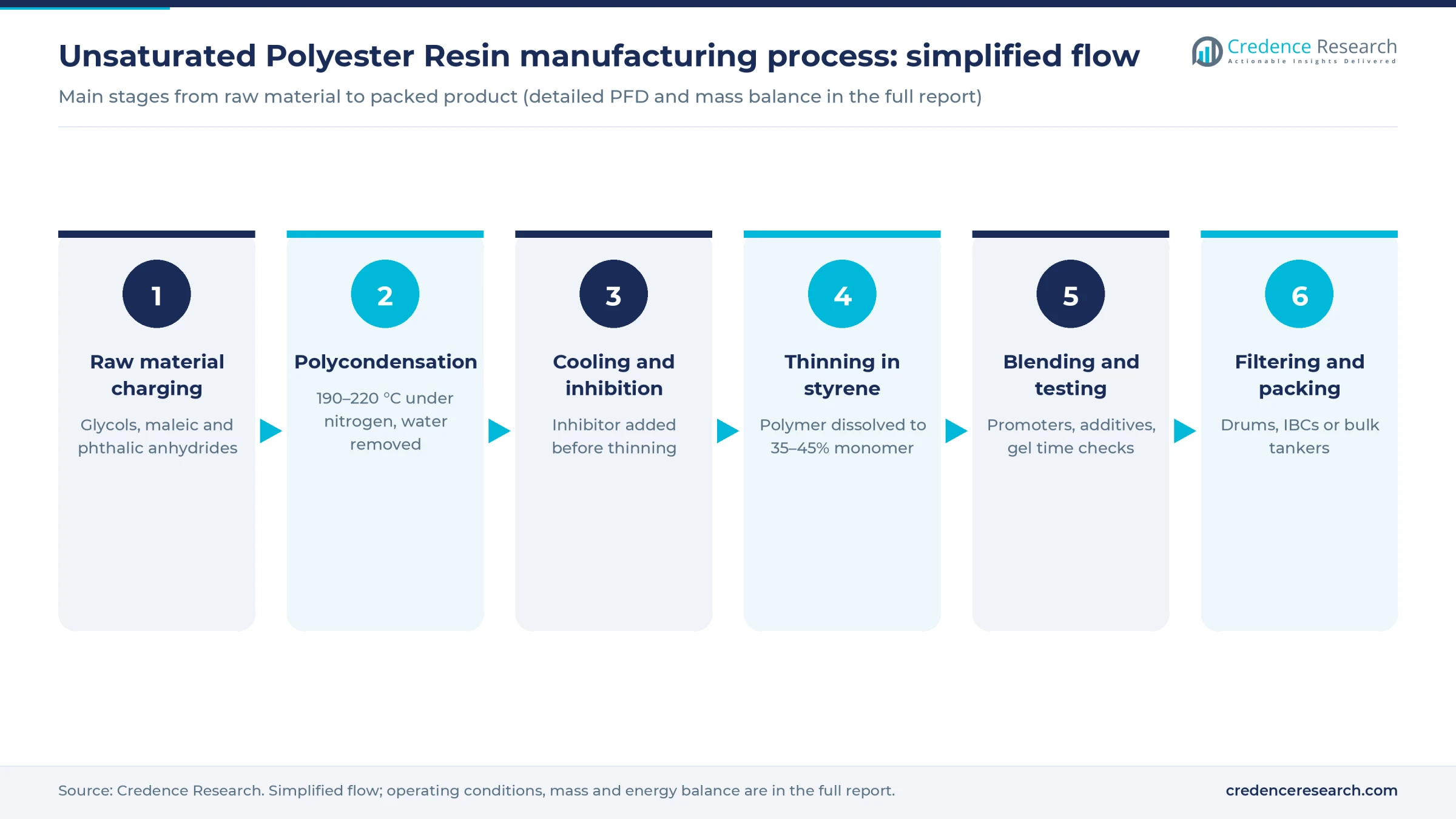
- Raw material charging. Propylene glycol, diethylene glycol and some ethylene glycol are pumped in first, followed by molten or flaked maleic and phthalic anhydrides. Isophthalic grades start with isophthalic acid and glycol in a first stage before maleic anhydride is added.
- Polycondensation. The batch is heated to about 190–220 degrees Celsius under nitrogen. Water of reaction leaves through a partial condenser held near 100–105 degrees, which keeps glycol in the reactor. Operators follow acid value and viscosity until the target is reached, typically over 10–20 hours.
- Cooling and inhibition. The polyester is cooled and dosed with an inhibitor such as hydroquinone so it will not gel during thinning and storage.
- Thinning in styrene. The hot polymer is dropped into a stirred dissolver that already holds chilled styrene, giving a resin with about 35–45% monomer. Temperature control at this step is a key safety point.
- Blending and testing. Promoters such as cobalt or amine accelerators, thixotropes, fillers or fire retardants are added for customer grades. The lab checks viscosity, gel time, acid value, solids and color.
- Filtering and packing. Resin is filtered and filled into drums, intermediate bulk containers or bulk tankers.
Yield and cycle time drive conversion cost. About 1.03–1.06 tons of raw materials are needed per ton of resin because the condensation water is removed. Styrene vapor from the dissolver and tank vents usually goes to a thermal oxidizer, and the reaction water carries organics that need treatment.
Unsaturated polyester resin plant setup cost
The reference plant makes 30,000 metric tons a year, similar to the 25,000–30,000-ton plant Polynt built near Johor Bahru, Malaysia, to serve a regional market. Total CapEx is estimated at USD 18–40 million, covering land, reactor trains, dissolvers, a tank farm for styrene and glycols, thermal oil and utility systems, a vent oxidizer, buildings, preoperative costs and a working capital margin.
One disclosed project anchors the estimate. Anhui Fangxin Resin put its 500,000-ton resin base at Suzhou, China, at about CNY 2.05 billion at groundbreaking in May 2024, or about USD 289 million at an assumed CNY 7.1 per USD. That is about USD 580 per annual ton. Batch plants grow by adding reactor trains, so the per-ton figure scales nearly in line with size, giving about USD 17 million for 30,000 tons. An assumed small-plant factor of 1.05–1.45 for tankage, lab and utilities that cannot be shared puts an Asian build at USD 18–25 million. An assumed 1.5–1.6x location factor puts a U.S. or EU plant near USD 27–40 million.
For the land row, the plant needs about 20,000 square meters, an assumed figure that allows separation distances around styrene storage. At an assumed USD 40–100 per square meter in an Asian park, land costs USD 0.8–2.0 million, or about 5% of mid-range CapEx. U.S. and EU sites can cost several times more.
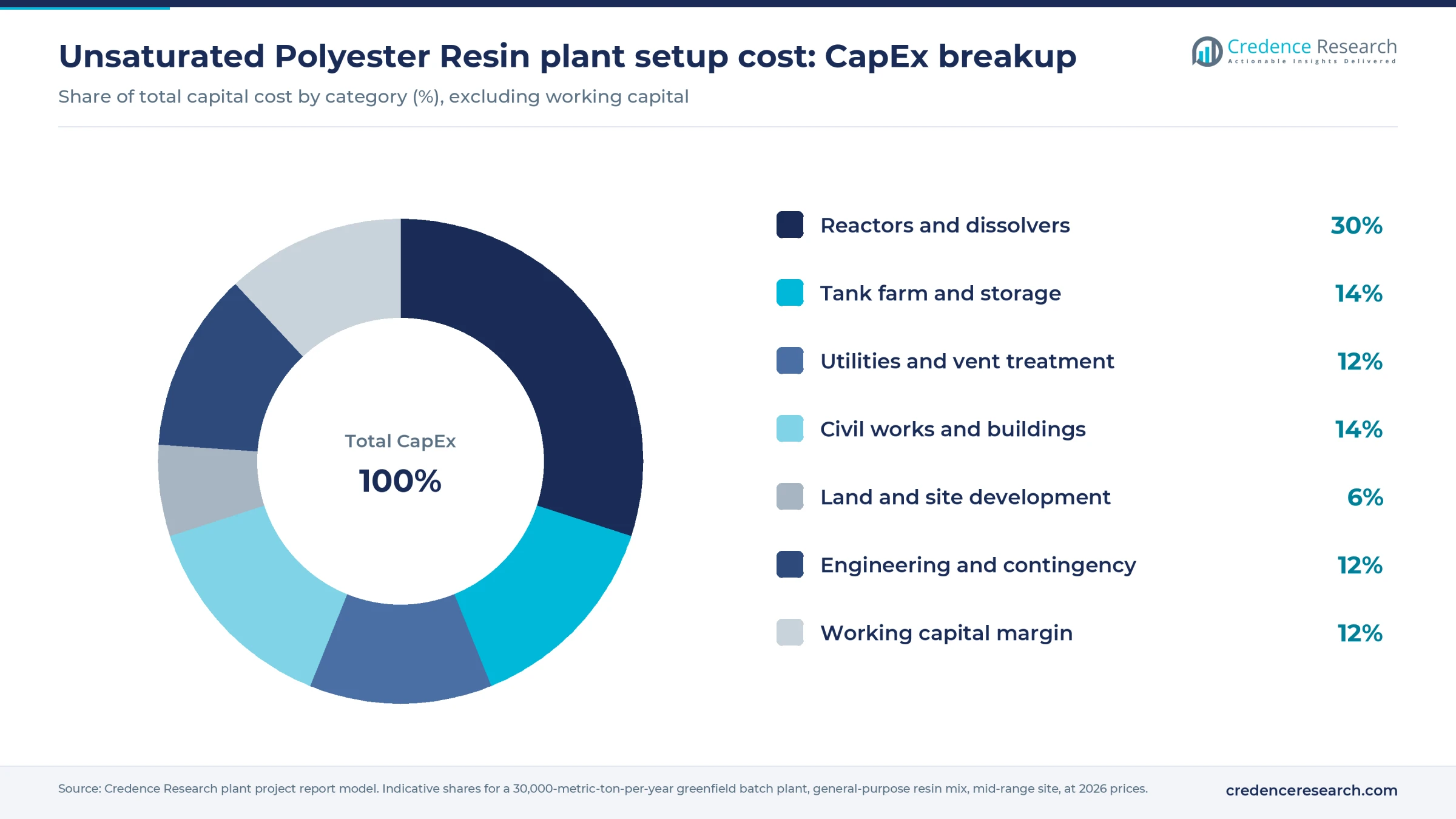
Reactors and dissolvers take the largest share, while storage and fire protection are a bigger line than in many chemical plants because styrene is flammable. Operating cost is dominated by purchased feedstocks.
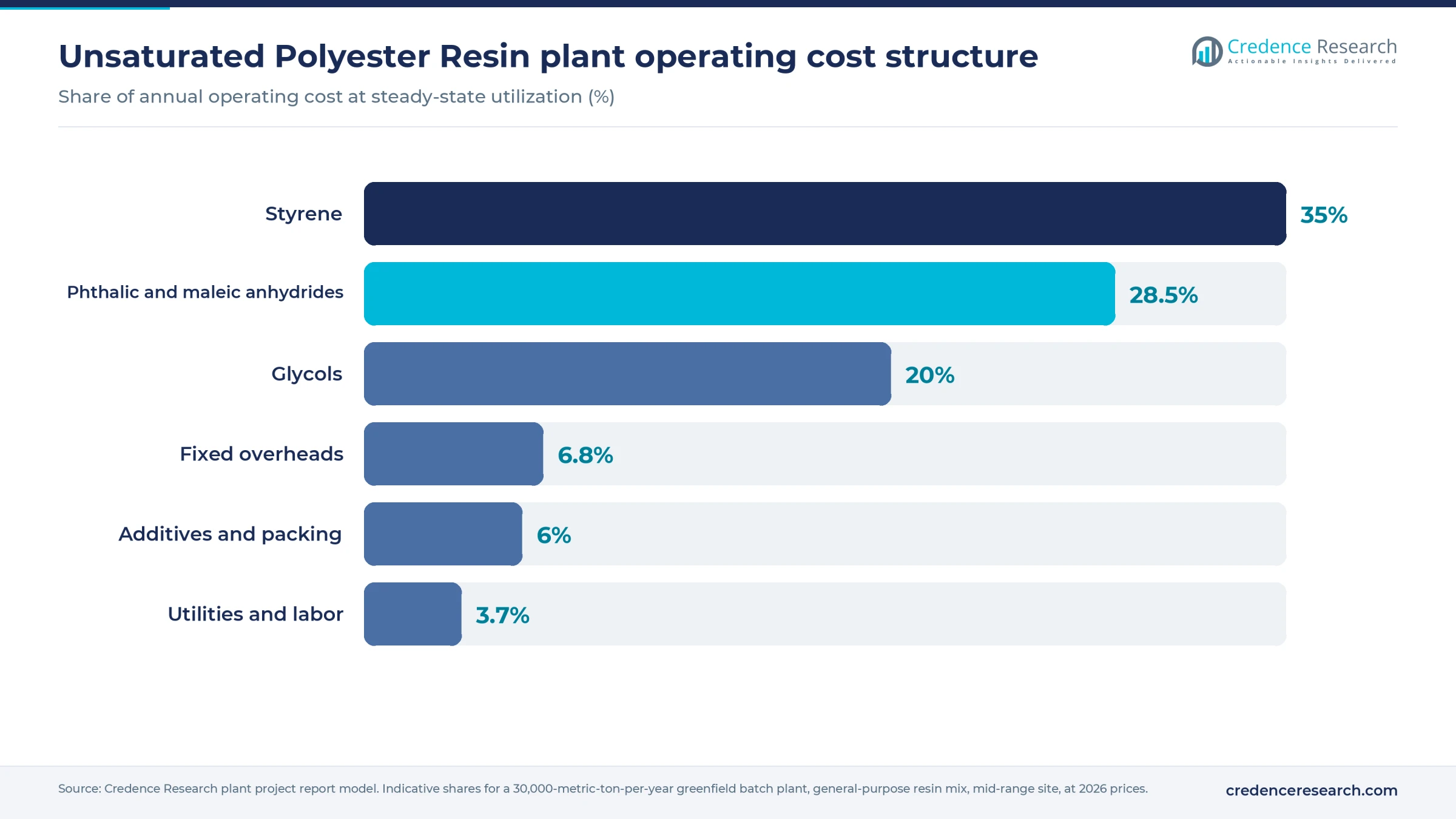
Styrene is about one-third of running cost, so its contract terms matter more than any equipment choice. The full report can be customized to any country or region.
Machinery and raw materials for an unsaturated polyester resin plant
Main equipment groups are listed below; ratings, materials and the full schedule are in the report.
- Stainless steel batch reactors with agitators, jackets and internal coils
- Packed columns, partial and total condensers and reaction water receivers
- Thinning tanks or dissolvers with chilled styrene feed
- Blending tanks for promoters, thixotropes and fillers
- Thermal oil heater, chiller, cooling tower and nitrogen generator
- Tank farm for styrene, glycols and finished resin, with heated anhydride storage or flake handling
- Filters, drum and IBC filling, and tanker loading
- Thermal oxidizer, effluent treatment, foam fire protection and gas detection
- Distributed control system and a quality lab for viscosity, gel time and acid value
At 80% utilization the plant uses about 8,900 tons of styrene, 6,000 tons of phthalic anhydride, 3,000 tons of maleic anhydride and 7,000 tons of glycols a year for a general-purpose mix. Styrene comes from ethylbenzene units in China, South Korea, the United States, Western Europe, Saudi Arabia and Singapore, with Chinese spot quotes near CNY 9,300 per ton in late November 2026. Maleic anhydride is made from butane in the United States, Europe and the Middle East and from benzene or butane in China. Propylene glycol is supplied from the United States, Europe and Asia, while diethylene glycol is a by-product of ethylene glycol plants.
Unsaturated polyester resin business profit margin and ROI
Gross margin is estimated at 12–24%, measured as selling price minus feedstock, packing and direct conversion cost. Two price cases set the bounds. A general-purpose orthophthalic resin at an assumed USD 1,300 per ton, a level set by Chinese surplus, meets a direct cost of about USD 1,143, built from styrene quotes and assumed anhydride, glycol, additive, drum and utility prices, for a margin near 12%. A specialty-weighted mix of isophthalic, fire-retardant and gelcoat grades at an assumed average of USD 1,800 per ton meets an assumed direct cost of USD 1,365, for about 24%.
At 80% utilization, or 24,000 tons, annual cash profit after an assumed USD 2.0 million of fixed overhead is about USD 8.4 million in the specialty case. On USD 18–40 million of CapEx, simple pre-tax payback is about 2–5 years, or about 3.4 years at the USD 29 million midpoint. In the commodity case cash profit falls to about USD 1.8 million and payback stretches to about 16 years, which is why newcomers rarely win on general-purpose resin alone.
Each USD 100 per ton change in selling price moves cash profit by about USD 2.4 million, while each USD 100 per ton on styrene moves it by about USD 0.9 million.
| Metric | Value |
|---|---|
| Gross margin | 12–24% |
| Payback period | 2–5 years (specialty-mix case) |
| IRR (post-tax) | Available in report |
| NPV | Available in report |
| Return on investment | Available in report |
| DSCR | Available in report |
| Break-even utilization | Available in report |
How to start an unsaturated polyester resin business, licenses and permits
Approval steps follow a common path: company and tax registration, industrial zoning and building permits, an environmental permit covering styrene emissions, process wastewater and hazardous waste, fire and occupational safety clearances for flammable liquid storage, chemical substance compliance and import or export registration. Resin shipped in styrene moves as a flammable liquid under dangerous goods rules, so packaging and labeling must meet transport codes. Composite molders audit quality systems, and ISO 9001 is the usual entry ticket, while marine and building customers may ask for type approval or fire test reports.
| Market | Key approvals for an unsaturated polyester resin plant |
|---|---|
| United States | State or EPA Clean Air Act construction and operating permits, with the miscellaneous organic chemical manufacturing NESHAP (40 CFR 63 Subpart FFFF) if styrene emissions make the site a major source; NPDES or pretreatment wastewater permit; OSHA Process Safety Management where flammable liquid inventories exceed 10,000 pounds in process; TSCA inventory compliance; DOT hazardous materials rules for shipping |
| European Union | Integrated permit under the Industrial Emissions Directive, Annex I 4.1(h), basic plastic materials; REACH registration of monomers and downstream user duties; CLP classification and labeling for styrene; Seveso III screening of flammable liquid inventories |
| India | Environmental clearance under the EIA Notification 2006, usually item 5(f), synthetic organic chemicals; state pollution control board consent to establish and operate; factory license; Manufacture, Storage and Import of Hazardous Chemical Rules 1989 for styrene; PESO license for storing flammable petroleum-class liquids |
Styrene storage sets the safety case, so tank sizing and separation distances deserve review before land is chosen.
Key unsaturated polyester resin manufacturers and recent developments
Global leaders include AOC, Polynt, INEOS Composites and Scott Bader, with Asian majors such as Resonac, DIC, Japan U-Pica, Eternal Materials and Swancor. China has many large producers, including Tianhe Resin and Fangxin Resin, and Turkey and Saudi Arabia host export-oriented plants. India's market mixes multinational units with regional makers such as Amtech Esters, which began commercial output at a 4,800-ton plant in Haryana in November 2026.
- December 2025: Fangxin Resin moved its 500,000-ton plant at Suzhou, Anhui, into control system commissioning, the last step before start-up, lifting group design capacity toward 800,000 tons.
- March 2026: AOC raised prices by up to EUR 450 per ton on unsaturated polyester and vinyl ester products in Europe, the Middle East, Africa and India from April 1, citing the Middle East crisis and oil-linked feedstock costs.
- September 2026: AOC announced a further increase of up to EUR 150 per ton across its portfolio in the same regions, effective October 6, citing renewed instability and logistics costs.
Rising Western prices and idle Chinese capacity point in opposite directions, so a new plant's grade mix and freight reach matter as much as its cost.
What's inside the Unsaturated Polyester Resin project report PDF
The report runs to 21 chapters. Open a chapter to see its sections.
1. Preface
2. Scope and Methodology
- 2.1 Objectives of the Study
- 2.2 Stakeholders
- 2.3 Research Methodology
- 2.4 Data Sources and Key Assumptions
3. Executive Summary
- 3.1 Market Snapshot
- 3.2 Project at a Glance (Capacity, CapEx, OpEx)
- 3.3 Key Financial Indicators (IRR, NPV, Payback, Break-even)
- 3.4 Feasibility Verdict
4. Product Overview
- 4.1 Unsaturated Polyester Resin Definition and Properties
- 4.2 Grades and Specifications (BIS / ISO / ASTM)
- 4.3 HS Code and Classification
- 4.4 Key Applications
- 4.5 Substitutes
5. Global Unsaturated Polyester Resin Market
- 5.1 Market Overview
- 5.2 Historical and Current Market Performance (Volume and Value)
- 5.3 Market Breakup by Grade / Type
- 5.4 Market Breakup by End-Use Industry
- 5.5 Market Breakup by Region
- 5.6 Market Drivers, Restraints and Trends
- 5.7 Value Chain Analysis
- 5.8 Market Forecast
6. Target Country Unsaturated Polyester Resin Market Analysis
- 6.1 Demand and Supply Analysis
- 6.2 Installed Capacity vs Demand Gap
- 6.3 Import Dependence
- 6.4 Demand Forecast by End-Use
7. Trade Analysis
- 7.1 Imports by Volume, Value and Country
- 7.2 Exports by Volume, Value and Country
- 7.3 Trade Balance and Opportunities
8. Price Analysis
- 8.1 Historical Unsaturated Polyester Resin Price Trends by Region
- 8.2 Raw Material / Feedstock Price Trends and Linkage
- 8.3 Price Forecast
- 8.4 Margins Across the Value Chain
9. Competitive Landscape
- 9.1 Market Structure
- 9.2 Key Players and Installed Capacities
- 9.3 Profiles of Key Players
- 9.4 Recent Developments (Expansions, M&A, New Plants)
10. Manufacturing Process and Technology
- 10.1 Comparison of Technology Routes
- 10.2 Selected Route and Process Flow Diagram
- 10.3 Unit Operations Involved
- 10.4 Chemical Reactions Involved
- 10.5 Mass Balance and Raw Material Requirements
- 10.6 Energy Balance
- 10.7 Quality Assurance Criteria and Technical Tests
- 10.8 By-products and Waste Handling
- 10.9 Technology Licensors / Providers
11. Project Details, Requirements and Costs
- 11.1 Land, Location and Site Development
- 11.1.1 Site Selection Criteria
- 11.1.2 Location Analysis
- 11.1.3 Land Requirement and Costs
- 11.1.4 Site Development Costs
- 11.2 Plant Layout
- 11.2.1 Layout Principles
- 11.2.2 Proposed Layout
- 11.2.3 Factors Influencing Layout
- 11.3 Civil Works and Buildings
- 11.4 Plant Machinery
- 11.4.1 Machinery Requirements and Specifications
- 11.4.2 Machinery Costs
- 11.4.3 Machinery Suppliers
- 11.5 Raw Materials
- 11.5.1 Requirements per Tonne of Output
- 11.5.2 Procurement and Sourcing
- 11.5.3 Costs
- 11.5.4 Suppliers
- 11.6 Packaging
- 11.6.1 Packaging Requirements
- 11.6.2 Packaging Costs
- 11.6.3 Packaging Suppliers
- 11.7 Storage and Material Handling
- 11.8 Transportation Requirements and Costs
- 11.9 Utilities
- 11.9.1 Power Requirements and Costs
- 11.9.2 Water Requirements and Costs
- 11.9.3 Steam, Fuel and Other Utilities
- 11.10 Manpower Requirements and Wages
12. Environment, Health, Safety and Sustainability
- 12.1 Effluent and Emissions Management
- 12.2 Hazard Classification and Safety Measures
- 12.3 Carbon Footprint
- 12.4 Green / Low-Carbon Process Options
13. Regulatory Procedures, Approvals and Certifications
- 13.1 Licences and Registrations
- 13.2 Environmental Clearances
- 13.3 Product Certifications (BIS, REACH, etc.)
- 13.4 Approval Timeline
14. Project Implementation Schedule
15. Project Economics
- 15.1 Capital Cost of the Project
- 15.2 Techno-Economic Parameters
- 15.3 Capacity Utilization and Ramp-up
- 15.4 Product Pricing and Margins
- 15.5 Income Projections
- 15.6 Expenditure Projections
- 15.7 Working Capital Requirement
- 15.8 Taxation
- 15.9 Depreciation
16. Financial Analysis
- 16.1 Projected Profit and Loss Account
- 16.2 Projected Cash Flow Statement
- 16.3 Projected Balance Sheet
- 16.4 Liquidity Analysis
- 16.5 Profitability Analysis (Payback, NPV, IRR, ROI)
- 16.6 Break-even Analysis
- 16.7 Debt Service Coverage Ratio (DSCR)
- 16.8 Sensitivity Analysis
- 16.9 Scenario and Uncertainty Analysis
17. Funding and Incentives
- 17.1 Means of Finance and Debt-Equity Structure
- 17.2 Loans and Financial Assistance
- 17.3 Government Schemes and Subsidies (PLI, State Policies)
18. Risk Assessment
- 18.1 Key Success Factors
- 18.2 Key Risk Factors
- 18.3 Risk Mitigation
19. Strategic Recommendations
20. Case Study of a Successful Venture
21. Appendix
- 21.1 Detailed Assumptions
- 21.2 Abbreviations
- 21.3 List of Tables and Figures
- 21.4 Sources
This page vs. the full report
| Data point | On this page (free) | In the full report |
|---|---|---|
| Total CapEx | One rounded range at one capacity | Exact figure at three capacities with a line-item breakup |
| CapEx breakup | Category shares (%) only | Cost, quantity and supplier for every machine |
| Operating cost | Share of raw materials, utilities and labor | Per-unit cost sheet with each input price and consumption |
| Profitability | Gross margin range and payback band | Exact IRR, NPV, ROI, break-even and DSCR |
| Financial statements | List of what is included | 10-year P&L, cash flow, balance sheet and Excel model |
| Sensitivity | One directional line | Full sensitivity and scenario tables |
| Process | Simplified flow diagram | Detailed process flow, mass and energy balance, operating conditions |
| Machinery | Names of the main machines | Specifications, capacity, cost and supplier list |
| Market | Headline size, growth and global demand | Segment, region, trade and price forecast tables |
| Suppliers and buyers | Supplier types and sourcing hubs | Named suppliers and buyers |
Unsaturated Polyester Resin project report: FAQs
How much does it cost to set up an unsaturated polyester resin plant?
What raw materials are used to make unsaturated polyester resin?
Which grades should a new unsaturated polyester resin plant make?
What is the profit margin in unsaturated polyester resin manufacturing?
What is the payback period for an unsaturated polyester resin plant?
Which approvals does an unsaturated polyester resin plant need?
Who buys unsaturated polyester resin?

About the analyst
Nisha Gupta, Senior Research Analyst
Nisha Gupta is a Senior Research Analyst at Credence Research Inc. who works across industry domains, including packaging, automotive parts and machinery. Her focus is the modelling engine behind each study: she builds quantitative market databases and econometric forecasting frameworks, and developed automated Excel-based market modelling templates that cut client turnaround time by 30%.
Related market research
- Unsaturated Polyester Resins Market Size, Share and Forecast 2032
- Maleic Anhydride Market Size, Share, Growth and Forecast 2032
- Propylene Glycol Market Size, Share, Trends and Forecast 2032
- Fiber Reinforced Polymer Composites Market Size & Forecast 2032
- FRP Vessels Market Size, Growth, Share and Forecast 2032
- Saturated Polyester Resin Market Size, Growth and Forecast 2032
More plant project reports
- Acrylonitrile Manufacturing Plant Project Report (DPR) 2026
- Urea Manufacturing Plant Project Report (DPR) 2026
- Methacrylic Acid Manufacturing Plant Project Report (DPR) 2026
- Vinyl Acetate Monomer Manufacturing Plant Project Report (DPR) 2026
- Vinyl Chloride Manufacturing Plant Project Report (DPR) 2026
- Neopentyl Glycol Manufacturing Plant Project Report (DPR) 2026