
Quick answer
Acrylonitrile is a toxic, flammable monomer used mainly in ABS plastics, acrylic fiber, acrylamide and nitrile rubber. A 200,000-metric-ton-a-year greenfield plant on the propylene ammoxidation route needs an estimated USD 400–910 million of CapEx, low in an Asian industrial park and high at a U.S. or EU site. Gross margin is about 24–31%, and simple payback is about 8–11 years at 90% utilization, with the propylene price and Chinese overcapacity as the main swing factors.
Viable mainly for an investor with captive propylene and a licensed catalyst, since Chinese overcapacity has pushed standalone merchant economics to long paybacks.
Acrylonitrile plant: key highlights
| Parameter | Indicative value | Note |
|---|---|---|
| Plant capacity | 200,000 metric tons per year | Fluid-bed propylene ammoxidation, 99.5% minimum purity, with HCN and acetonitrile co-products |
| Total CapEx | USD 400–910 million | Low end an Asian industrial park, top end a U.S. or EU site |
| Raw material share of operating cost | 81–85% | Propylene and ammonia, before co-product credits |
| Gross margin | 24–31% | Chinese domestic price case to an assumed Western contract price |
| Payback period | 8–11 years | Simple pre-tax, 90% utilization |
| IRR | Available in report | Post-tax, 10-year model |
| Break-even | Available in report | Capacity utilization basis |
Ranges assume a 200,000-metric-ton plant on the propylene ammoxidation route, Asian to U.S. or EU sites, 2026 prices and 90% utilization. CapEx is scaled from Sinochem's disclosed Quanzhou acrylonitrile project, with an assumed acrylonitrile share, escalation, greenfield and location factors, and cross-checked with a Saudi project budget. Propylene, ammonia, co-product and Western prices and CNY 7.1 per USD are assumed. Customizable to any country or region.
What is acrylonitrile?
Acrylonitrile, or 2-propenenitrile (C3H3N, CAS 107-13-1), is a colorless, volatile liquid with a faint, pungent odor. It boils at about 77 degrees Celsius, has a flash point near minus 1 degree and is acutely toxic, and the International Agency for Research on Cancer classified it as carcinogenic to humans in 2024. Those hazards shape how a plant is designed, permitted and staffed.
Commercial product is sold at a minimum of 99.5% purity with 0.2–0.5% water and about 35–45 ppm of hydroquinone monomethyl ether (MEHQ) to prevent polymerization. It is classified under Harmonized System subheading 2926.10, acrylonitrile, and ships as UN 1093, a Class 3 flammable liquid with a toxic subsidiary hazard.
The monomer has few direct uses but many derivatives. It goes into ABS plastics and SAN resins for appliances, cars and electronics, acrylic fibers for knitwear and blankets, acrylamide for water-treatment polymers, nitrile rubber for gloves, seals and hoses, adiponitrile for nylon 6,6 and polyacrylonitrile precursor for carbon fiber.
Acrylonitrile market overview and global demand
Acrylonitrile is a large, mature commodity whose center of gravity has moved to China. Chinese plants produced 1.953 million metric tons in the first half of 2025, up 15.63% year on year, and monthly output was expected to reach about 400,000 tons by October 2025, industry data compiled by Mysteel show. That pace implies well over 4 million tons a year from one country, much of it from units of 260,000 tons or more inside integrated refining complexes in Zhejiang, Jiangsu, Fujian, Shandong and Jilin.
Capacity has run ahead of derivative demand. Shandong prices fell to about CNY 7,000 per ton in January 2026, the lowest level since 2021, and Chinese industry utilization was slightly below 70% in August 2026 as several producers cut rates or shut units for maintenance. Prices recovered to about CNY 11,700 per ton by late November 2026 after those cuts and a pickup in export orders. China's shift from importer to exporter has pressed Asian contract prices and squeezed older plants in Japan, Europe and the United States.
Demand follows durable goods, textiles and water treatment. ABS and SAN for appliances, cars and electronics take the largest share, followed by acrylic fiber, acrylamide for polyacrylamide flocculants used in water treatment and oil recovery, and nitrile butadiene rubber for gloves and seals. Carbon fiber precursor is a small, faster-growing outlet with strict purity specifications. Import-dependent ABS and fiber makers in South and Southeast Asia, Turkey and Latin America are the natural customers for a new merchant plant outside China.
Acrylonitrile manufacturing process
Nearly all acrylonitrile is made by the propylene ammoxidation process that Sohio commercialized around 1960, in which propylene, ammonia and air react in one step over a fluidized catalyst. Licensed catalysts based on bismuth molybdate with iron, nickel, cobalt and other promoters now reach acrylonitrile yields of roughly 75–80% on propylene, with hydrogen cyanide and acetonitrile as co-products. Propane ammoxidation has been demonstrated but has not displaced the propylene route at scale, so the reference plant uses propylene with a licensed catalyst and process package.
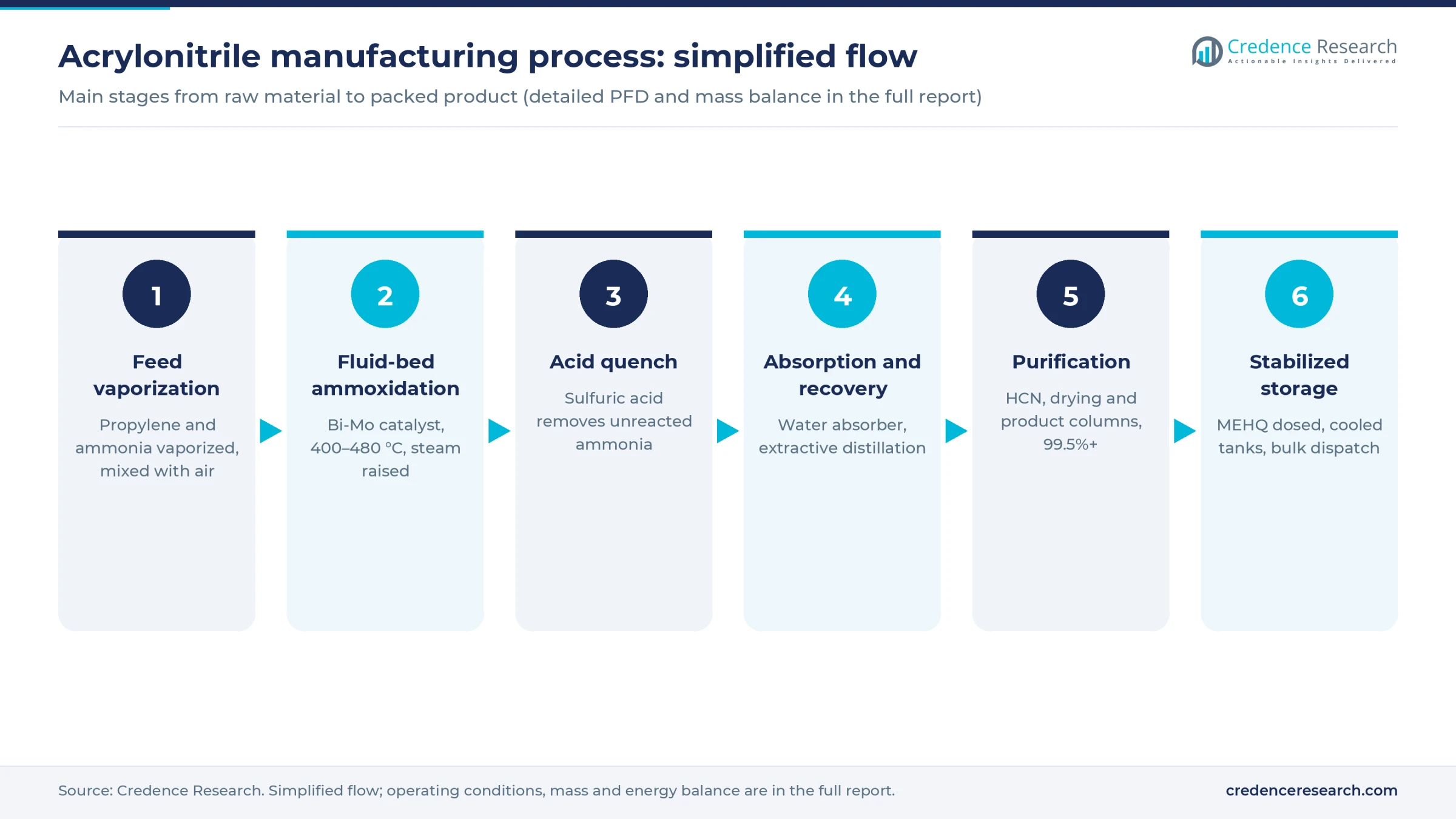
- Feed vaporization. Liquid propylene and ammonia are vaporized and mixed with compressed air near stoichiometric ratios, with ammonia in slight excess.
- Fluid-bed ammoxidation. The gas rises through a fluidized catalyst bed at roughly 400–480 degrees Celsius and 1.5–2 bar. The reaction is strongly exothermic, and cooling coils in the bed raise high-pressure steam that drives the air compressor and supplies much of the site's steam.
- Acid quench. Hot effluent is cooled in a quench tower where sulfuric acid neutralizes unreacted ammonia, forming ammonium sulfate that is recovered or treated.
- Absorption and recovery. Water absorbs acrylonitrile, hydrogen cyanide and acetonitrile, and inert off-gas goes to a thermal oxidizer. An extractive distillation column splits crude acrylonitrile from wet acetonitrile.
- Purification. Heads columns strip hydrogen cyanide for sale or captive use, then drying and product columns take acrylonitrile to at least 99.5%. Acetonitrile is refined in a separate small unit.
- Stabilized storage. MEHQ is dosed, and product is held in cooled tanks with vapor recovery before loading into ISO tanks, road tankers or ships.
Yield is the main economic lever, because propylene dominates cost. The reference case assumes a conservative 1.07 tons of propylene and 0.50 tons of ammonia per ton of product. Wastewater carrying cyanides and heavy nitriles is the hardest environmental item and is usually incinerated or, at some U.S. sites, injected into permitted deep wells.
Acrylonitrile plant setup cost
The reference plant makes 200,000 metric tons a year, close to the smallest size that new licensed trains are built at today. Total CapEx is estimated at USD 400–910 million, covering land, the fluid-bed reactors and first catalyst fill, recovery and purification, an acetonitrile unit, propylene, ammonia and product storage, air compression, utilities, a thermal oxidizer and wastewater incinerator, license fees, preoperative costs and a working capital margin. Location explains most of the spread, with USD 400–520 million in an Asian industrial park and USD 620–910 million at a U.S. or EU site.
The anchor is a disclosed project. Sinochem reported a total investment of CNY 4.3 billion for its Quanzhou complex of 260,000 tons of acrylonitrile, 8,000 tons of acetonitrile, 100,000 tons of methyl methacrylate and a spent acid regeneration unit, which started up in April 2025. Assigning an assumed 60–70% to the acrylonitrile and acetonitrile units, converting at CNY 7.1 per USD, scaling to 200,000 tons by the six-tenths rule and adding an assumed 3% escalation gives about USD 320–375 million inside an integrated park. An assumed standalone greenfield factor of 1.25–1.40 gives the Asian range, and an assumed U.S. or EU location factor of 1.55–1.75 on that gives the Western range. A Saudi project budgeted at USD 500 million to USD 1 billion in 2014 for 200,000 tons with a sodium cyanide unit sits in the same band.
For the land row, a site with tank separation distances, flare and incinerator zones needs about 150,000 square meters, an assumed figure. At an assumed USD 30–80 per square meter in an Asian park, land costs USD 4.5–12 million, about 1–2% of Asian CapEx.
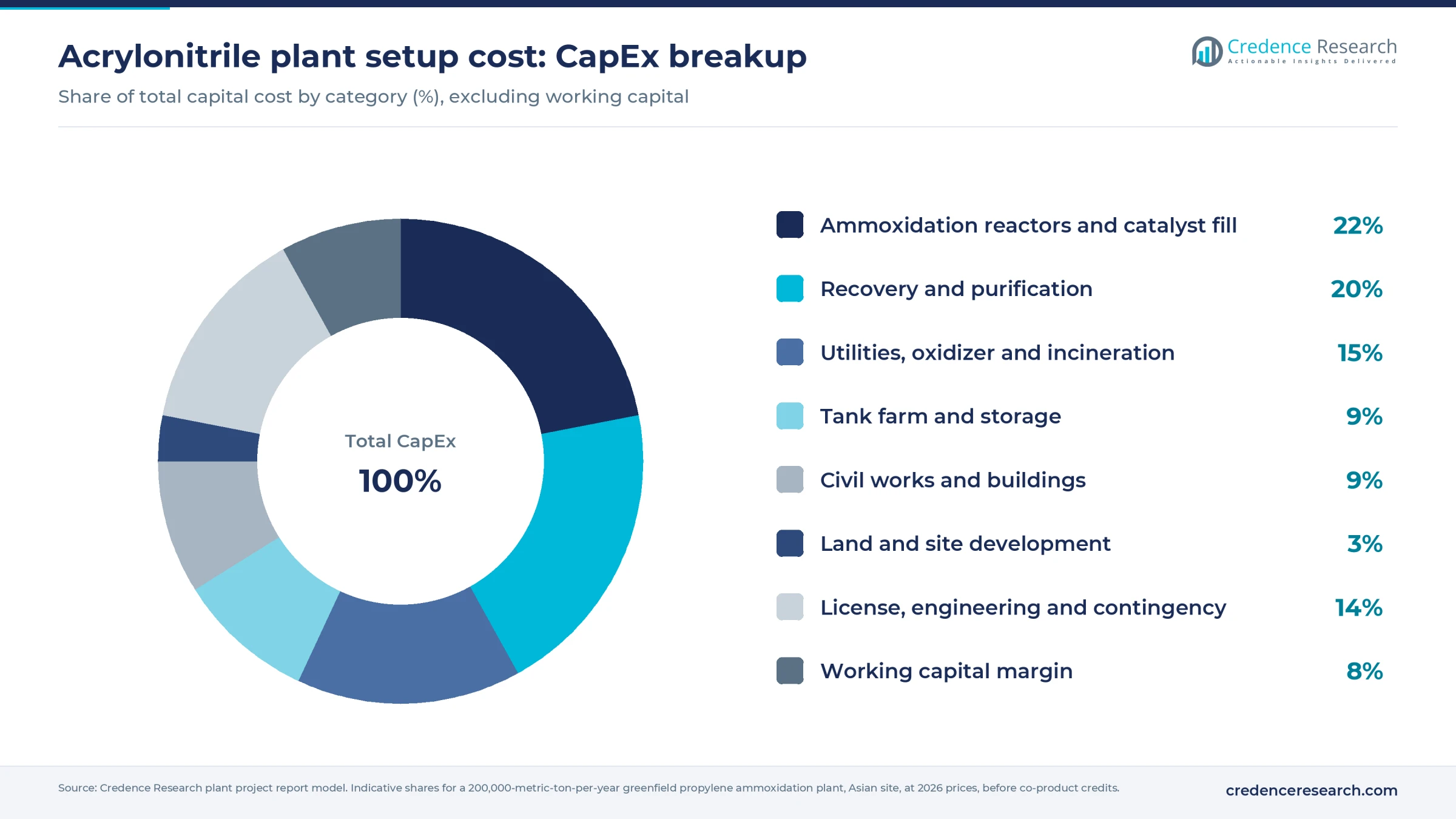
Reactors and recovery trains form the largest blocks. Operating cost is dominated by one feed.
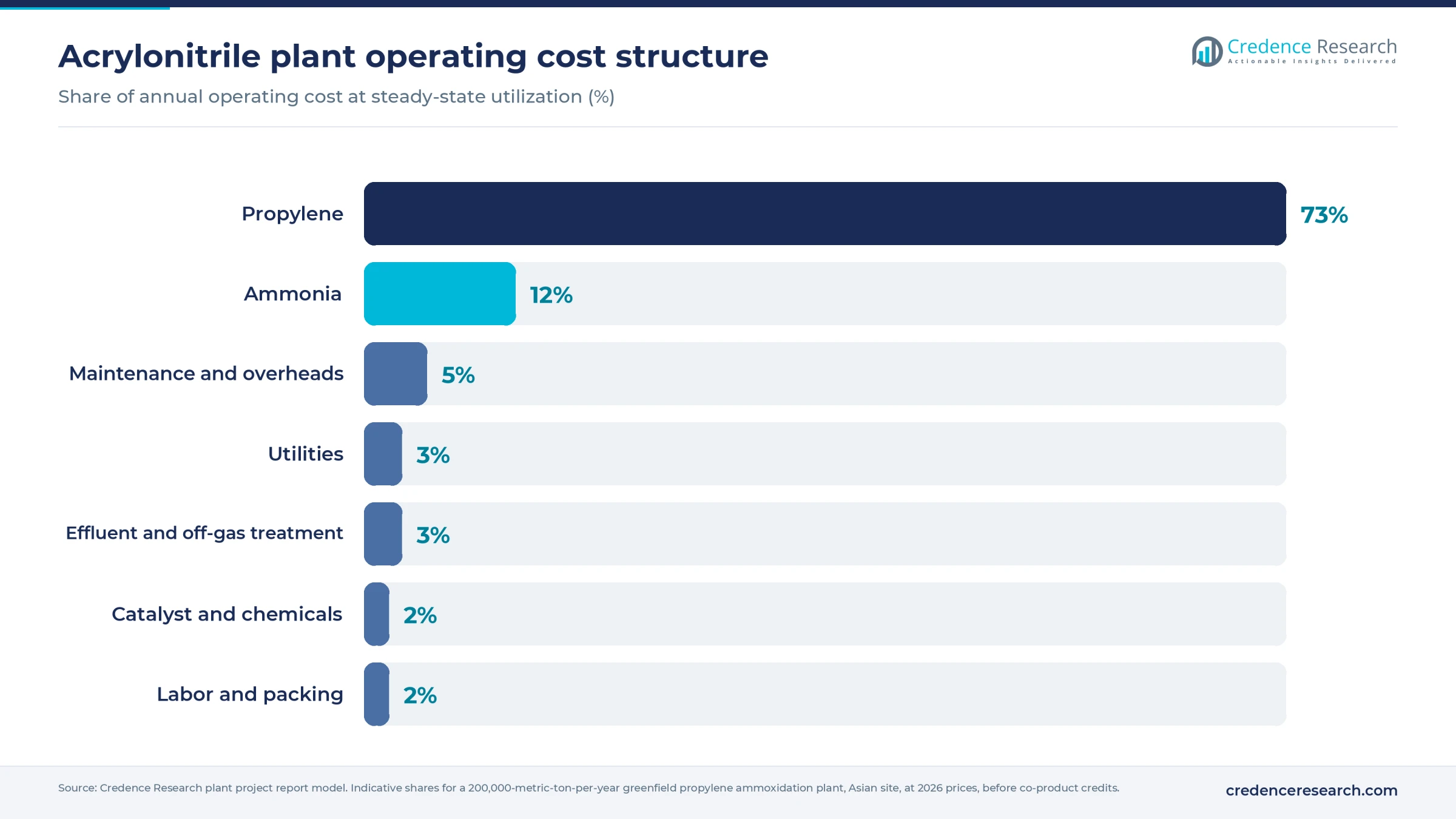
Propylene is roughly 73% of running cost, so a pipeline link to a cracker or propane dehydrogenation unit decides competitiveness. The full report can be customized to any country or region.
Machinery and raw materials for an acrylonitrile plant
Main equipment groups are listed below; ratings, materials of construction and the full schedule are in the report.
- Pressurized propylene and refrigerated or pressurized ammonia storage, vaporizers and feed mixers
- Steam-turbine-driven process air compressor
- Fluid-bed ammoxidation reactors with internal steam coils, cyclones and catalyst handling
- Acid quench tower, ammonium sulfate recovery and absorber
- Extractive distillation, heads, drying and product columns, plus a hydrogen cyanide column
- Acetonitrile purification unit
- Cooled, inhibited product tanks with vapor recovery and ship, ISO tank and road loading
- Thermal oxidizer, wastewater incinerator, flare, cooling towers and boiler feed water treatment
- Distributed control system, safety instrumented system, toxic and flammable gas detection and a lab with gas chromatography
At 90% utilization the plant uses about 193,000 tons of propylene and 90,000 tons of ammonia a year. Propylene comes from steam crackers on the U.S. Gulf Coast, in the Middle East, Western Europe and Northeast Asia, and from propane dehydrogenation units concentrated in China, the Middle East and the United States. Because it moves poorly as a pressurized liquid over long distances, most producers sit on a pipeline. Ammonia is made from natural gas in the Middle East, Russia, Trinidad and the United States and from coal in China, and trades widely. Catalyst know-how is held by a few licensors, so a license with catalyst supply is part of the package.
Acrylonitrile business profit margin and ROI
Gross margin is estimated at 24–31%, measured as selling price minus feed and direct conversion cost, net of co-product credits. In the Asian case, the Chinese domestic price of CNY 11,733 per ton on Nov. 24, 2026, about USD 1,460 before value-added tax at an assumed CNY 7.1 per USD, meets a net direct cost of about USD 1,115. That cost is built from an assumed propylene price of USD 870 per ton, assumed ammonia at USD 300 and assumed catalyst, utility, labor and effluent costs, less an assumed USD 100 per ton of hydrogen cyanide, acetonitrile and ammonium sulfate credits, for a margin near 24%. In the Western case, an assumed USD 1,800 contract price meets an assumed net cost of about USD 1,245, for about 31%.
At 90% utilization, or 180,000 tons, annual cash profit after assumed fixed costs and maintenance of USD 12–18 million is about USD 51 million in the Asian case and USD 82 million in the Western case. On the matching CapEx, simple pre-tax payback is about 8–11 years, roughly 7.9–10.3 years in Asia and 7.6–11.2 years in the United States or Europe.
Each USD 100 per ton change in the selling price moves cash profit by about USD 18 million, and each USD 100 per ton on propylene moves it by about USD 19 million.
| Metric | Value |
|---|---|
| Gross margin | 24–31% |
| Payback period | 8–11 years |
| IRR (post-tax) | Available in report |
| NPV | Available in report |
| Return on investment | Available in report |
| DSCR | Available in report |
| Break-even utilization | Available in report |
How to start an acrylonitrile business, licenses and approvals
Approval steps follow a common path: company and tax registration, industrial zoning and building permits, an environmental permit covering air toxics, cyanide-bearing wastewater and incinerator emissions, process safety and fire clearances for propylene, ammonia, hydrogen cyanide and acrylonitrile inventories, occupational exposure controls for a carcinogen, chemical substance registration, dangerous goods transport rules and import or export registration. Toxic-release modeling and emergency planning usually lengthen permitting.
| Market | Key approvals for an acrylonitrile plant |
|---|---|
| United States | State or EPA Clean Air Act construction and Title V operating permits, including applicable hazardous air pollutant standards; NPDES or Class I underground injection permit for wastewater; OSHA acrylonitrile standard (29 CFR 1910.1045) and Process Safety Management (29 CFR 1910.119); EPA Risk Management Program (40 CFR Part 68), with thresholds of 20,000 pounds for acrylonitrile, 10,000 for anhydrous ammonia and 2,500 for hydrocyanic acid; TSCA inventory compliance; PHMSA hazmat registration |
| European Union | Integrated permit under the Industrial Emissions Directive, Annex I activity 4.1(d), nitrogenous hydrocarbons including nitriles; REACH registration; CLP labeling as a carcinogen; binding exposure limit under the Carcinogens, Mutagens and Reprotoxic Substances Directive; Seveso III, with anhydrous ammonia named at 50 and 200 tonnes |
| India | Environmental clearance under item 5(e) of the EIA Notification 2006, petrochemical-based processing; state pollution control board consent to establish and operate; factory license; Manufacture, Storage and Import of Hazardous Chemical Rules 1989; PESO license under the Static and Mobile Pressure Vessels (Unfired) Rules 2016 for propylene and ammonia storage |
Exact thresholds depend on site design and stored quantities.
Key acrylonitrile manufacturers and recent developments
INEOS Nitriles, which describes itself as the largest producer and the only one operating in Europe, the United States and Asia, runs plants in Texas, Ohio and Germany. Ascend Performance Materials makes acrylonitrile in Texas, partly for its own adiponitrile and nylon chain. Asahi Kasei produces in Japan and through Tongsuh Petrochemical in South Korea, while Taekwang Industrial and Formosa Plastics supply Korea and Taiwan. In China, Sinopec, PetroChina's Jilin Petrochemical, Shenghong's Sailboat Petrochemical and Sinochem Quanzhou run the largest units, many feeding captive ABS and carbon fiber precursor lines.
- May 2026: Asahi Kasei said it will reduce the scale of its acrylonitrile line at Mizushima, Japan, targeting fiscal 2030, and will keep supplying customers together with Tongsuh Petrochemical in Korea.
- June 2026: Sinopec's Zhenhai Refining and Chemical reported one year of stable operation at its 400,000-ton acrylonitrile unit, described as the world's largest single train, with material and energy use below design values.
A Japanese scale-back beside record Chinese train sizes shows the industry sorting by feed integration and scale.
What's inside the Acrylonitrile project report PDF
The report runs to 21 chapters. Open a chapter to see its sections.
1. Preface
2. Scope and Methodology
- 2.1 Objectives of the Study
- 2.2 Stakeholders
- 2.3 Research Methodology
- 2.4 Data Sources and Key Assumptions
3. Executive Summary
- 3.1 Market Snapshot
- 3.2 Project at a Glance (Capacity, CapEx, OpEx)
- 3.3 Key Financial Indicators (IRR, NPV, Payback, Break-even)
- 3.4 Feasibility Verdict
4. Product Overview
- 4.1 Acrylonitrile Definition and Properties
- 4.2 Grades and Specifications (BIS / ISO / ASTM)
- 4.3 HS Code and Classification
- 4.4 Key Applications
- 4.5 Substitutes
5. Global Acrylonitrile Market
- 5.1 Market Overview
- 5.2 Historical and Current Market Performance (Volume and Value)
- 5.3 Market Breakup by Grade / Type
- 5.4 Market Breakup by End-Use Industry
- 5.5 Market Breakup by Region
- 5.6 Market Drivers, Restraints and Trends
- 5.7 Value Chain Analysis
- 5.8 Market Forecast
6. Target Country Acrylonitrile Market Analysis
- 6.1 Demand and Supply Analysis
- 6.2 Installed Capacity vs Demand Gap
- 6.3 Import Dependence
- 6.4 Demand Forecast by End-Use
7. Trade Analysis
- 7.1 Imports by Volume, Value and Country
- 7.2 Exports by Volume, Value and Country
- 7.3 Trade Balance and Opportunities
8. Price Analysis
- 8.1 Historical Acrylonitrile Price Trends by Region
- 8.2 Raw Material / Feedstock Price Trends and Linkage
- 8.3 Price Forecast
- 8.4 Margins Across the Value Chain
9. Competitive Landscape
- 9.1 Market Structure
- 9.2 Key Players and Installed Capacities
- 9.3 Profiles of Key Players
- 9.4 Recent Developments (Expansions, M&A, New Plants)
10. Manufacturing Process and Technology
- 10.1 Comparison of Technology Routes
- 10.2 Selected Route and Process Flow Diagram
- 10.3 Unit Operations Involved
- 10.4 Chemical Reactions Involved
- 10.5 Mass Balance and Raw Material Requirements
- 10.6 Energy Balance
- 10.7 Quality Assurance Criteria and Technical Tests
- 10.8 By-products and Waste Handling
- 10.9 Technology Licensors / Providers
11. Project Details, Requirements and Costs
- 11.1 Land, Location and Site Development
- 11.1.1 Site Selection Criteria
- 11.1.2 Location Analysis
- 11.1.3 Land Requirement and Costs
- 11.1.4 Site Development Costs
- 11.2 Plant Layout
- 11.2.1 Layout Principles
- 11.2.2 Proposed Layout
- 11.2.3 Factors Influencing Layout
- 11.3 Civil Works and Buildings
- 11.4 Plant Machinery
- 11.4.1 Machinery Requirements and Specifications
- 11.4.2 Machinery Costs
- 11.4.3 Machinery Suppliers
- 11.5 Raw Materials
- 11.5.1 Requirements per Tonne of Output
- 11.5.2 Procurement and Sourcing
- 11.5.3 Costs
- 11.5.4 Suppliers
- 11.6 Packaging
- 11.6.1 Packaging Requirements
- 11.6.2 Packaging Costs
- 11.6.3 Packaging Suppliers
- 11.7 Storage and Material Handling
- 11.8 Transportation Requirements and Costs
- 11.9 Utilities
- 11.9.1 Power Requirements and Costs
- 11.9.2 Water Requirements and Costs
- 11.9.3 Steam, Fuel and Other Utilities
- 11.10 Manpower Requirements and Wages
12. Environment, Health, Safety and Sustainability
- 12.1 Effluent and Emissions Management
- 12.2 Hazard Classification and Safety Measures
- 12.3 Carbon Footprint
- 12.4 Green / Low-Carbon Process Options
13. Regulatory Procedures, Approvals and Certifications
- 13.1 Licences and Registrations
- 13.2 Environmental Clearances
- 13.3 Product Certifications (BIS, REACH, etc.)
- 13.4 Approval Timeline
14. Project Implementation Schedule
15. Project Economics
- 15.1 Capital Cost of the Project
- 15.2 Techno-Economic Parameters
- 15.3 Capacity Utilization and Ramp-up
- 15.4 Product Pricing and Margins
- 15.5 Income Projections
- 15.6 Expenditure Projections
- 15.7 Working Capital Requirement
- 15.8 Taxation
- 15.9 Depreciation
16. Financial Analysis
- 16.1 Projected Profit and Loss Account
- 16.2 Projected Cash Flow Statement
- 16.3 Projected Balance Sheet
- 16.4 Liquidity Analysis
- 16.5 Profitability Analysis (Payback, NPV, IRR, ROI)
- 16.6 Break-even Analysis
- 16.7 Debt Service Coverage Ratio (DSCR)
- 16.8 Sensitivity Analysis
- 16.9 Scenario and Uncertainty Analysis
17. Funding and Incentives
- 17.1 Means of Finance and Debt-Equity Structure
- 17.2 Loans and Financial Assistance
- 17.3 Government Schemes and Subsidies (PLI, State Policies)
18. Risk Assessment
- 18.1 Key Success Factors
- 18.2 Key Risk Factors
- 18.3 Risk Mitigation
19. Strategic Recommendations
20. Case Study of a Successful Venture
21. Appendix
- 21.1 Detailed Assumptions
- 21.2 Abbreviations
- 21.3 List of Tables and Figures
- 21.4 Sources
This page vs. the full report
| Data point | On this page (free) | In the full report |
|---|---|---|
| Total CapEx | One rounded range at one capacity | Exact figure at three capacities with a line-item breakup |
| CapEx breakup | Category shares (%) only | Cost, quantity and supplier for every machine |
| Operating cost | Share of raw materials, utilities and labor | Per-unit cost sheet with each input price and consumption |
| Profitability | Gross margin range and payback band | Exact IRR, NPV, ROI, break-even and DSCR |
| Financial statements | List of what is included | 10-year P&L, cash flow, balance sheet and Excel model |
| Sensitivity | One directional line | Full sensitivity and scenario tables |
| Process | Simplified flow diagram | Detailed process flow, mass and energy balance, operating conditions |
| Machinery | Names of the main machines | Specifications, capacity, cost and supplier list |
| Market | Headline size, growth and global demand | Segment, region, trade and price forecast tables |
| Suppliers and buyers | Supplier types and sourcing hubs | Named suppliers and buyers |
Acrylonitrile project report: FAQs
How much does it cost to set up an acrylonitrile plant?
What raw materials does acrylonitrile production need?
Why is acrylonitrile plant capacity so large?
What is the profit margin in acrylonitrile manufacturing?
What is the payback period for an acrylonitrile plant?
Which approvals does an acrylonitrile plant need?
Who buys acrylonitrile?

About the analyst
Nisha Gupta, Senior Research Analyst
Nisha Gupta is a Senior Research Analyst at Credence Research Inc. who works across industry domains, including packaging, automotive parts and machinery. Her focus is the modelling engine behind each study: she builds quantitative market databases and econometric forecasting frameworks, and developed automated Excel-based market modelling templates that cut client turnaround time by 30%.
Related market research
- Acrylonitrile Butadiene Styrene Market Size, Growth and Forecast 2032
- Styrene Acrylonitrile Market Size, Share, Trend and Forecast 2032
- Polyacrylamide Market Size, Share, Growth and Forecast 2032
- Nitrile Butadiene Rubber Market Size, Share and Forecast, 2032
- Aerospace Carbon Fiber Market Size, Growth and Forecast 2032
- Acrylonitrile Styrene Acrylate Market Size, Growth and Forecast 2032
More plant project reports
- Unsaturated Polyester Resin Manufacturing Plant Project Report (DPR) 2026
- Urea Manufacturing Plant Project Report (DPR) 2026
- Methacrylic Acid Manufacturing Plant Project Report (DPR) 2026
- Vinyl Acetate Monomer Manufacturing Plant Project Report (DPR) 2026
- Vinyl Chloride Manufacturing Plant Project Report (DPR) 2026
- Neopentyl Glycol Manufacturing Plant Project Report (DPR) 2026