
Quick answer
Neopentyl glycol (NPG) is a branched diol made from isobutyraldehyde, formaldehyde and hydrogen, sold mainly to makers of powder coating resins. A 30,000-metric-ton-a-year greenfield plant needs an estimated USD 55–100 million of CapEx, low in an Asian industrial park and high at a U.S. or EU site. Gross margin is about 13–26%, and payback is about 5–9 years at export or Western contract prices, far longer at current Chinese domestic prices.
Viable for an investor with captive or contracted isobutyraldehyde and access to export or Western contract prices, but weak as a merchant plant competing with Chinese domestic pricing.
Neopentyl Glycol plant: key highlights
| Parameter | Indicative value | Note |
|---|---|---|
| Plant capacity | 30,000 metric tons per year | Aldol condensation and hydrogenation route, flakes, molten and 90% slurry |
| Total CapEx | USD 55–100 million | Low end an Asian industrial park, top end a U.S. or EU site |
| Raw material share of operating cost | 84–87% | Isobutyraldehyde alone is about two-thirds |
| Gross margin | 13–26% | Chinese domestic price case to an assumed Western contract price |
| Payback period | 5–9 years | Export price case, 90% utilization, simple pre-tax; about 28 years at Chinese domestic prices |
| IRR | Available in report | Post-tax, 10-year model |
| Break-even | Available in report | Capacity utilization basis |
Ranges assume a 30,000-metric-ton plant on the aldol and hydrogenation route, Asian to U.S. or EU sites, 2026 prices and 90% utilization. CapEx is scaled from two disclosed NPG projects at an assumed IDR 16,000 and CNY 7.1 per USD, with assumed escalation, greenfield and location factors. The Western selling price and non-Chinese feed prices are assumed. Customizable to any country or region.
What is neopentyl glycol?
Neopentyl glycol, or 2,2-dimethylpropane-1,3-diol (C5H12O2, CAS 126-30-7), is a white crystalline diol that melts near 129 degrees Celsius. Its two primary hydroxyl groups sit next to a carbon carrying two methyl groups, and that crowded structure is the reason buyers pay for it. Esters made from it resist attack by water, heat and ultraviolet light far better than esters of straight-chain glycols.
Commercial grades are sold as flakes, as a heated molten liquid and as a 90% aqueous slurry, which is easier to pump and avoids remelting. Purity of about 99.5% is the usual resin grade.
The product is classified under Harmonized System subheading 2905.39, other diols, so customs totals include other products.
Polyester resins for powder coatings are the largest use, followed by coil and can coatings, unsaturated polyester gelcoats, polyurethane adhesives and synthetic polyol ester lubricants, including refrigeration compressor oils. Smaller volumes go into plasticizers, acrylate monomers and drug synthesis, including ibuprofen. NPG is not classified as dangerous goods for transport, which keeps logistics simple compared with its feedstocks.
Neopentyl glycol market overview and global demand
Demand rides on powder coatings, which replace solvent-borne paint on appliances, building profiles, furniture and vehicle parts because they carry almost no volatile organic compounds. Credence Research values the global powder coating market at USD 15.28 billion in 2023, with 5.5% annual growth forecast to 2032. The resin layer above NPG is worth about USD 4.7 billion in 2025, based on Credence Research's USD 4.42 billion for 2024 and a 6.4% CAGR for the saturated polyester resin market.
No public world production statistic exists for this diol, so capacity announcements are the best indicator. BASF said in October 2025 that a new 80,000-ton plant at Zhanjiang, China, lifted its own capacity from 255,000 to 335,000 tons a year. Wanhua Chemical runs about 80,000 tons at Yantai, and Indonesia's first plant, 30,000 tons, was finished in July 2026.
China is both the largest consumer and the swing supplier. UN Comtrade shows China exported about 295,000 tons of HS 2905.39 diols worth USD 456 million in 2025, a code that includes NPG, as new domestic capacity outran local demand. That surplus explains why Chinese domestic quotes of about CNY 9,300 per ton in October 2026, roughly USD 1,160 net of value-added tax at an assumed CNY 7.1 per USD, sit well below the levels Western sellers have been trying to raise.
Europe and North America are mature, contract-driven markets where buyers value supply reliability and low color. Southeast Asia, India and the Middle East are growing outlets, largely served by imports, which is the gap a regional plant can target.
Neopentyl glycol manufacturing process
Nearly all commercial output starts with an aldol reaction between isobutyraldehyde and formaldehyde, which forms hydroxypivaldehyde. Two routes then finish the molecule. The older Cannizzaro route treats the intermediate with excess formaldehyde and caustic soda, which co-produces sodium formate and ties profit to a low-value salt. Modern plants of this size hydrogenate it instead, and the reference plant uses that route because yields are higher and the only by-products are small organic streams.
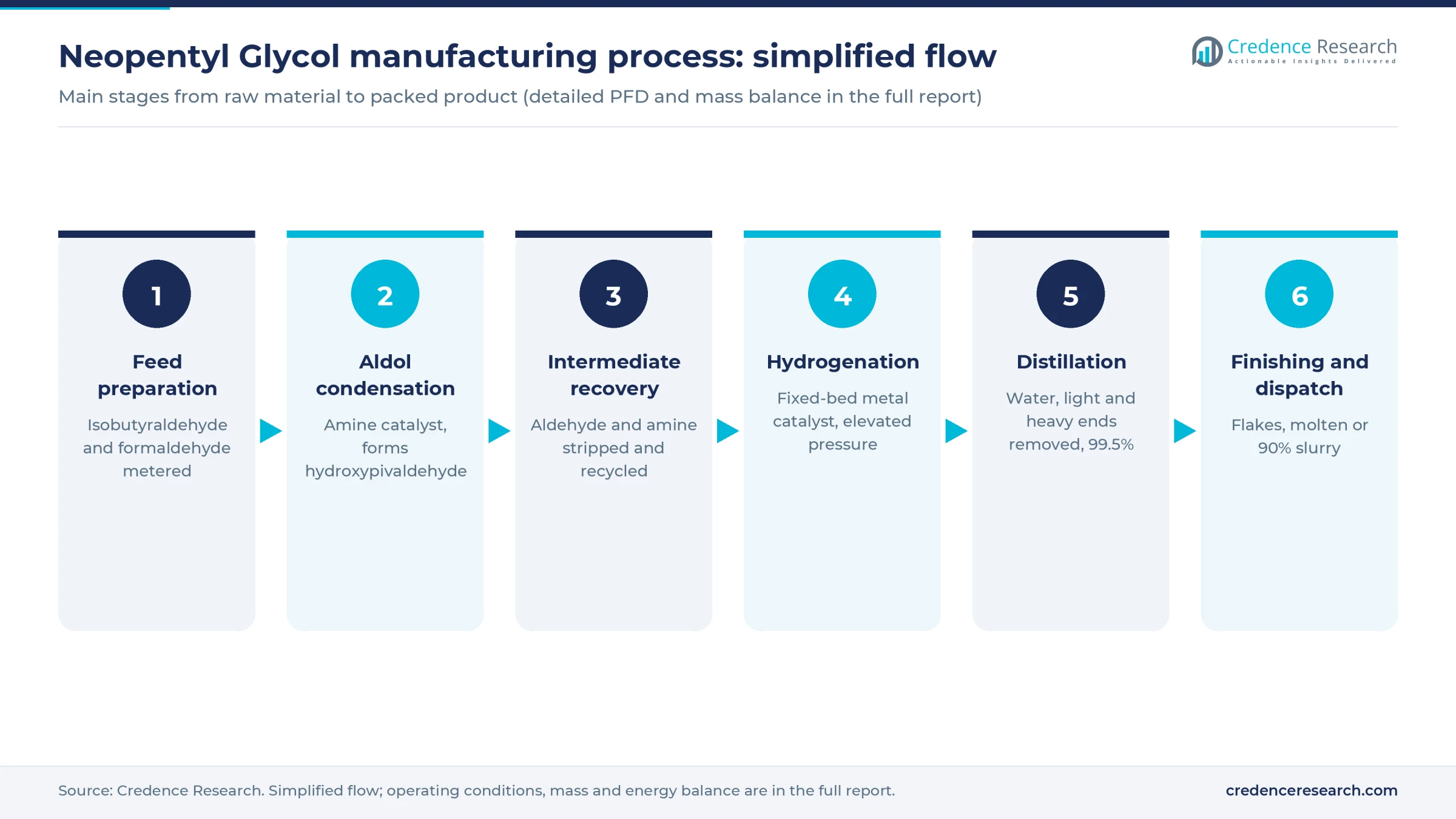
- Feed preparation. Isobutyraldehyde arrives by pipeline or tank truck from an oxo unit and is stored under nitrogen. Formaldehyde comes as an aqueous solution, often 37–50%, from an adjacent or captive methanol oxidation unit.
- Aldol condensation. The two aldehydes react in stirred or loop reactors over a tertiary amine catalyst such as triethylamine at moderate temperature. Selectivity matters here because side reactions form esters and acetals that later consume hydrogen or end as heavy residue.
- Intermediate recovery. Unreacted isobutyraldehyde and the amine are stripped and recycled, and water is partly removed so the hydroxypivaldehyde solution is ready for hydrogenation.
- Hydrogenation. The intermediate is hydrogenated in fixed-bed or trickle-bed reactors over a metal catalyst, copper-, nickel- or palladium-based depending on licensor, at elevated pressure. Catalyst life and hydrogen purity drive running cost in this step.
- Distillation. A column train removes water, isobutanol and light ends, then separates heavy esters to reach about 99.5% purity with low color.
- Finishing and dispatch. Product is flaked and bagged, kept molten in heated tanks for bulk delivery, or diluted to a 90% slurry for customers that prefer a pumpable feed.
Yield is the main cost lever in this process. Stoichiometry needs about 0.69 tons of isobutyraldehyde, 0.29 tons of formaldehyde on a 100% basis and 0.019 tons of hydrogen per ton of product, and assumed real consumption is about 0.72, 0.31 and 0.022 tons. Every point of lost selectivity costs about USD 9–12 per ton in feed. Formaldehyde and hydrogen storage set the hazard profile of the site, while the product itself is benign.
Neopentyl glycol plant setup cost
The reference plant makes 30,000 metric tons a year, the size of the newest plant in Southeast Asia. Total CapEx is estimated at USD 55–100 million, including land, aldol, hydrogenation and distillation sections, a tank farm, hydrogen supply, utilities, effluent treatment, preoperative costs and a working capital margin. Location explains most of the spread.
Two disclosed projects anchor the estimate. PT Petro Oxo Nusantara put its 30,000-ton plant at Gresik, Indonesia, at IDR 856 billion at groundbreaking in December 2024, about USD 53.5 million at an assumed IDR 16,000 per USD, on an existing oxo site with captive feed. BASF's 80,000-ton Zhanjiang unit was reported in trade press at about USD 110 million in 2022. Scaled to 30,000 tons by the six-tenths rule, that gives USD 61 million, or about USD 68 million after an assumed 1.12x escalation to 2026. An assumed greenfield factor of 1.0–1.25 on the Indonesian figure covers standalone utilities and tankage, giving USD 55–70 million in Asia. An assumed 1.4–1.6x location factor puts a U.S. or EU build near USD 85–100 million.
For the land row, a greenfield site with tank separation distances needs about 40,000 square meters, an assumed figure. At an assumed USD 30–80 per square meter in an Asian park, land costs USD 1.2–3.2 million, or about 3% of mid-range CapEx. U.S. and EU sites can cost more.
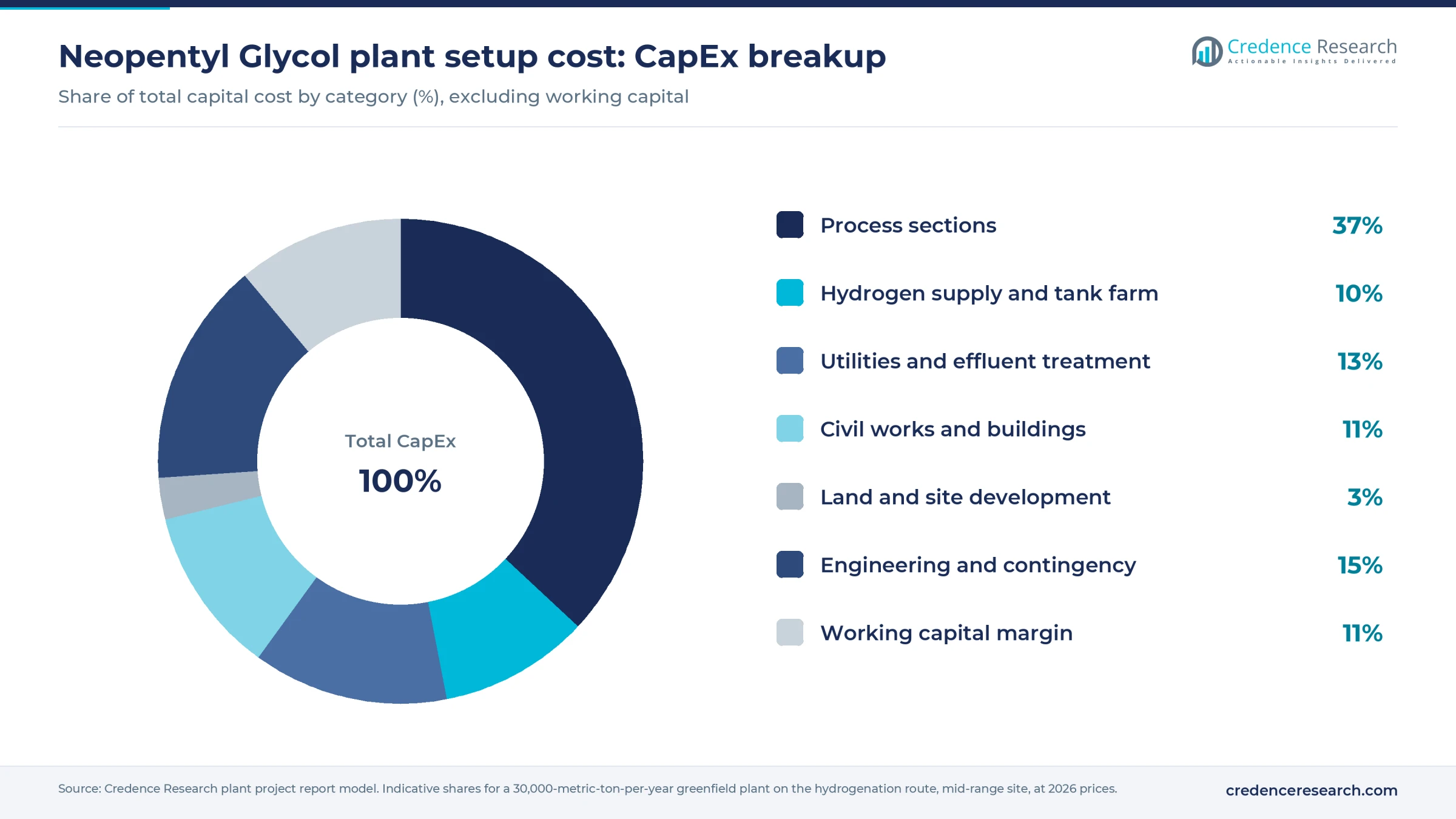
Process sections take the largest share, and hydrogen supply is a notable line because a plant without a reformer or pipeline hydrogen must build one. Operating cost is dominated by one input.
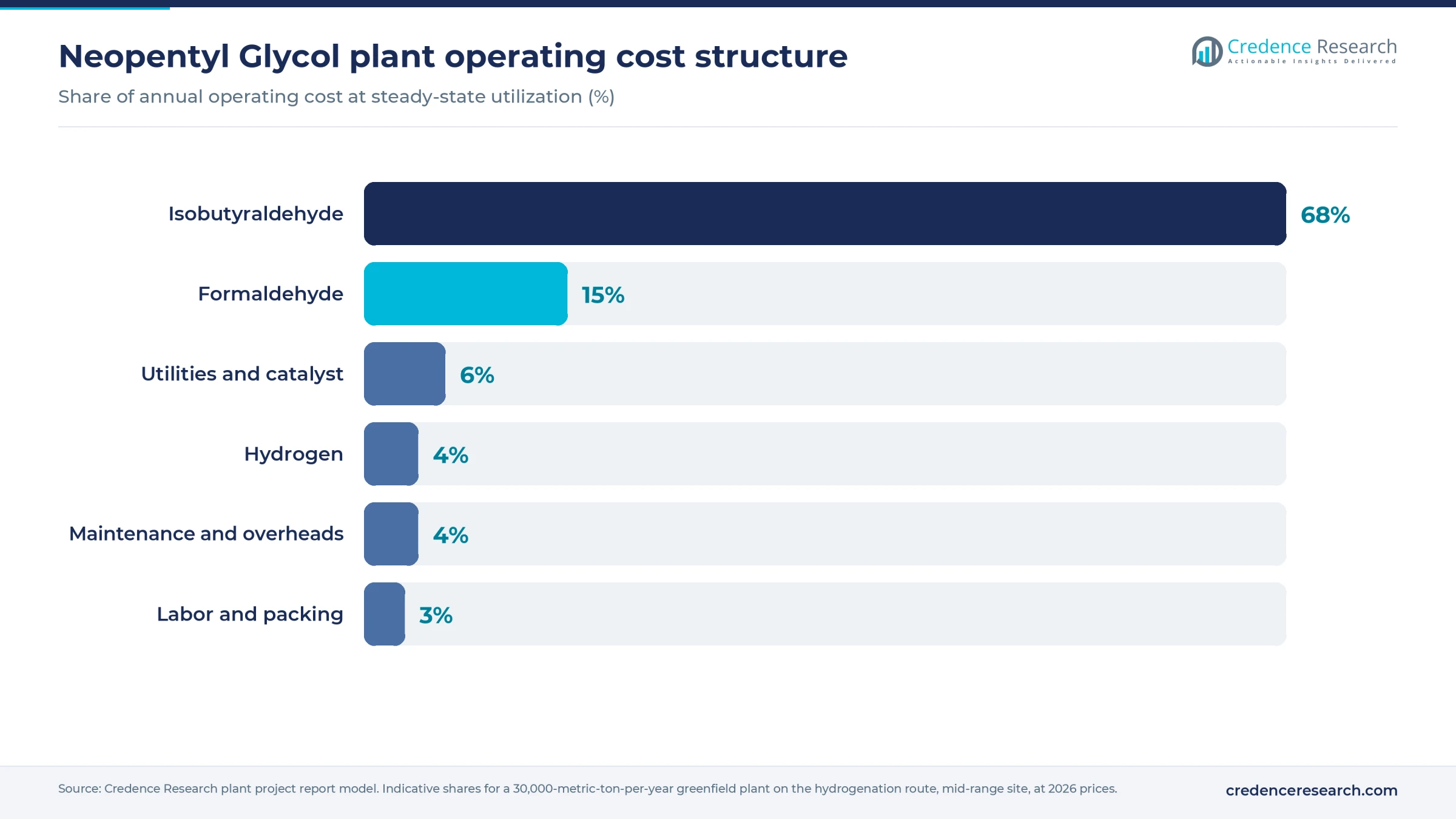
Isobutyraldehyde is about two-thirds of running cost, so access to it decides competitiveness. The full report can be customized to any country or region.
Machinery and raw materials for a neopentyl glycol plant
Main equipment groups are listed below; ratings, materials and the full schedule are in the report.
- Nitrogen-blanketed isobutyraldehyde tanks and formaldehyde solution storage
- Aldol reactors with amine dosing and recycle systems
- Strippers and evaporators for intermediate recovery
- Fixed-bed hydrogenation reactors, hydrogen compressors and catalyst handling
- Hydrogen supply, either a small steam reformer with pressure-swing adsorption or a pipeline station
- Distillation columns, reboilers and vacuum systems
- Flaker, bagging line, heated molten product tanks and slurry blending
- Boiler, cooling tower, effluent treatment and a thermal oxidizer for vent gases
- Distributed control system, gas detection and a quality lab with gas chromatography and color testing
At 90% utilization the plant uses about 19,400 tons of isobutyraldehyde, 8,400 tons of formaldehyde on a 100% basis, or about 22,600 tons of 37% solution, and 590 tons of hydrogen a year. Isobutyraldehyde is a co-product of propylene hydroformylation, so supply sits at oxo-alcohol complexes in China, the United States, Germany, South Korea, Japan and Indonesia, with Chinese Shandong quotes near CNY 8,000–8,500 per ton in October 2026. It travels poorly and is rarely traded in bulk, which is why most producers sit beside an oxo unit. Formaldehyde is made locally from methanol, which trades widely from the Middle East, China, Trinidad and the United States.
Neopentyl glycol business profit margin and ROI
Gross margin is estimated at 13–26%, measured as selling price minus feed and direct conversion cost. Two price cases set the bounds of that range. In the Chinese domestic case, October 2026 quotes of about USD 1,160 per ton before value-added tax meet a direct cost of about USD 1,005, built from Shandong isobutyraldehyde quotes and assumed formaldehyde, hydrogen and utility prices, for a margin near 13%. In the export or Western contract case, an assumed price of USD 1,800 per ton meets an assumed direct cost of USD 1,330, reflecting costlier feed outside China, for about 26%.
At 90% utilization, or 27,000 tons, annual cash profit after an assumed USD 1.5 million of fixed overhead is about USD 11.2 million in the Western case. On USD 55–100 million of CapEx, simple pre-tax payback is about 5–9 years, or about 6.7 years at the USD 75 million midpoint. In the Chinese domestic case, cash profit falls to about USD 2.7 million and payback stretches near 28 years, which is why new merchant capacity outside China needs export contracts or captive resin demand.
Each USD 100 per ton change in selling price moves cash profit by about USD 2.7 million, and each USD 100 per ton on isobutyraldehyde moves it by about USD 1.9 million.
| Metric | Value |
|---|---|
| Gross margin | 13–26% |
| Payback period | 5–9 years (export price case) |
| IRR (post-tax) | Available in report |
| NPV | Available in report |
| Return on investment | Available in report |
| DSCR | Available in report |
| Break-even utilization | Available in report |
How to start a neopentyl glycol business, licenses and approvals
Approval steps follow a common path: company and tax registration, industrial zoning and building permits, an environmental permit covering air emissions, wastewater and hazardous waste, occupational safety and fire clearances for hydrogen, aldehyde and formaldehyde storage, chemical substance registration and import or export registration. The finished diol needs no product license in most markets, but resin and lubricant customers audit quality systems, and ISO 9001 certification is the usual entry ticket.
| Market | Key approvals for a neopentyl glycol plant |
|---|---|
| United States | State or EPA Clean Air Act construction and operating permits, NPDES or pretreatment wastewater permit, OSHA formaldehyde standard (29 CFR 1910.1048) and Process Safety Management for formaldehyde and hydrogen inventories, EPA Risk Management Program review, TSCA inventory compliance |
| European Union | Integrated permit under the Industrial Emissions Directive, Annex I 4.1(b), oxygen-containing hydrocarbons; REACH registration; CLP classification and labeling, including formaldehyde rules; Seveso III review of hydrogen and formaldehyde inventories |
| India | Environmental clearance under item 5(f) of the EIA Notification 2006, synthetic organic chemicals; state pollution control board consent to establish and operate; factory license; Manufacture, Storage and Import of Hazardous Chemical Rules 1989; PESO approval for compressed hydrogen storage |
Formaldehyde storage often sets the safety case, so inventory limits deserve review before land is chosen. Exact thresholds depend on site design and stored quantities.
Key neopentyl glycol manufacturers and recent developments
BASF is the largest single producer, with plants in Germany, the United States and China. Other global makers include Oxea, formerly OQ Chemicals, Eastman and LG Chem. Chinese capacity is led by Wanhua Chemical and Luxi Chemical, with smaller Shandong producers. Most sit beside their own oxo units, which is the main barrier for a newcomer that would have to buy isobutyraldehyde on contract.
- March 2026: Oxea raised NPG prices by EUR 200 per ton in Europe and USD 220 per ton in North America for molten and flake grades, citing raw material, energy and supply chain costs.
- April 2026: Oxea announced a second increase of EUR 280 per ton on molten grade in Europe and other regions, and USD 290 per ton on 90% slurry in North America.
- July 2026: PT Petro Oxo Nusantara, part of the Pertamina group, completed its 30,000-ton plant at Gresik, the first in Indonesia and Southeast Asia, a month ahead of schedule, and expects the plant to open export opportunities.
The two price moves and Chinese export growth point in opposite directions, so a new plant's offtake strategy matters as much as its cost.
What's inside the Neopentyl Glycol project report PDF
The report runs to 21 chapters. Open a chapter to see its sections.
1. Preface
2. Scope and Methodology
- 2.1 Objectives of the Study
- 2.2 Stakeholders
- 2.3 Research Methodology
- 2.4 Data Sources and Key Assumptions
3. Executive Summary
- 3.1 Market Snapshot
- 3.2 Project at a Glance (Capacity, CapEx, OpEx)
- 3.3 Key Financial Indicators (IRR, NPV, Payback, Break-even)
- 3.4 Feasibility Verdict
4. Product Overview
- 4.1 Neopentyl Glycol Definition and Properties
- 4.2 Grades and Specifications (BIS / ISO / ASTM)
- 4.3 HS Code and Classification
- 4.4 Key Applications
- 4.5 Substitutes
5. Global Neopentyl Glycol Market
- 5.1 Market Overview
- 5.2 Historical and Current Market Performance (Volume and Value)
- 5.3 Market Breakup by Grade / Type
- 5.4 Market Breakup by End-Use Industry
- 5.5 Market Breakup by Region
- 5.6 Market Drivers, Restraints and Trends
- 5.7 Value Chain Analysis
- 5.8 Market Forecast
6. Target Country Neopentyl Glycol Market Analysis
- 6.1 Demand and Supply Analysis
- 6.2 Installed Capacity vs Demand Gap
- 6.3 Import Dependence
- 6.4 Demand Forecast by End-Use
7. Trade Analysis
- 7.1 Imports by Volume, Value and Country
- 7.2 Exports by Volume, Value and Country
- 7.3 Trade Balance and Opportunities
8. Price Analysis
- 8.1 Historical Neopentyl Glycol Price Trends by Region
- 8.2 Raw Material / Feedstock Price Trends and Linkage
- 8.3 Price Forecast
- 8.4 Margins Across the Value Chain
9. Competitive Landscape
- 9.1 Market Structure
- 9.2 Key Players and Installed Capacities
- 9.3 Profiles of Key Players
- 9.4 Recent Developments (Expansions, M&A, New Plants)
10. Manufacturing Process and Technology
- 10.1 Comparison of Technology Routes
- 10.2 Selected Route and Process Flow Diagram
- 10.3 Unit Operations Involved
- 10.4 Chemical Reactions Involved
- 10.5 Mass Balance and Raw Material Requirements
- 10.6 Energy Balance
- 10.7 Quality Assurance Criteria and Technical Tests
- 10.8 By-products and Waste Handling
- 10.9 Technology Licensors / Providers
11. Project Details, Requirements and Costs
- 11.1 Land, Location and Site Development
- 11.1.1 Site Selection Criteria
- 11.1.2 Location Analysis
- 11.1.3 Land Requirement and Costs
- 11.1.4 Site Development Costs
- 11.2 Plant Layout
- 11.2.1 Layout Principles
- 11.2.2 Proposed Layout
- 11.2.3 Factors Influencing Layout
- 11.3 Civil Works and Buildings
- 11.4 Plant Machinery
- 11.4.1 Machinery Requirements and Specifications
- 11.4.2 Machinery Costs
- 11.4.3 Machinery Suppliers
- 11.5 Raw Materials
- 11.5.1 Requirements per Tonne of Output
- 11.5.2 Procurement and Sourcing
- 11.5.3 Costs
- 11.5.4 Suppliers
- 11.6 Packaging
- 11.6.1 Packaging Requirements
- 11.6.2 Packaging Costs
- 11.6.3 Packaging Suppliers
- 11.7 Storage and Material Handling
- 11.8 Transportation Requirements and Costs
- 11.9 Utilities
- 11.9.1 Power Requirements and Costs
- 11.9.2 Water Requirements and Costs
- 11.9.3 Steam, Fuel and Other Utilities
- 11.10 Manpower Requirements and Wages
12. Environment, Health, Safety and Sustainability
- 12.1 Effluent and Emissions Management
- 12.2 Hazard Classification and Safety Measures
- 12.3 Carbon Footprint
- 12.4 Green / Low-Carbon Process Options
13. Regulatory Procedures, Approvals and Certifications
- 13.1 Licences and Registrations
- 13.2 Environmental Clearances
- 13.3 Product Certifications (BIS, REACH, etc.)
- 13.4 Approval Timeline
14. Project Implementation Schedule
15. Project Economics
- 15.1 Capital Cost of the Project
- 15.2 Techno-Economic Parameters
- 15.3 Capacity Utilization and Ramp-up
- 15.4 Product Pricing and Margins
- 15.5 Income Projections
- 15.6 Expenditure Projections
- 15.7 Working Capital Requirement
- 15.8 Taxation
- 15.9 Depreciation
16. Financial Analysis
- 16.1 Projected Profit and Loss Account
- 16.2 Projected Cash Flow Statement
- 16.3 Projected Balance Sheet
- 16.4 Liquidity Analysis
- 16.5 Profitability Analysis (Payback, NPV, IRR, ROI)
- 16.6 Break-even Analysis
- 16.7 Debt Service Coverage Ratio (DSCR)
- 16.8 Sensitivity Analysis
- 16.9 Scenario and Uncertainty Analysis
17. Funding and Incentives
- 17.1 Means of Finance and Debt-Equity Structure
- 17.2 Loans and Financial Assistance
- 17.3 Government Schemes and Subsidies (PLI, State Policies)
18. Risk Assessment
- 18.1 Key Success Factors
- 18.2 Key Risk Factors
- 18.3 Risk Mitigation
19. Strategic Recommendations
20. Case Study of a Successful Venture
21. Appendix
- 21.1 Detailed Assumptions
- 21.2 Abbreviations
- 21.3 List of Tables and Figures
- 21.4 Sources
This page vs. the full report
| Data point | On this page (free) | In the full report |
|---|---|---|
| Total CapEx | One rounded range at one capacity | Exact figure at three capacities with a line-item breakup |
| CapEx breakup | Category shares (%) only | Cost, quantity and supplier for every machine |
| Operating cost | Share of raw materials, utilities and labor | Per-unit cost sheet with each input price and consumption |
| Profitability | Gross margin range and payback band | Exact IRR, NPV, ROI, break-even and DSCR |
| Financial statements | List of what is included | 10-year P&L, cash flow, balance sheet and Excel model |
| Sensitivity | One directional line | Full sensitivity and scenario tables |
| Process | Simplified flow diagram | Detailed process flow, mass and energy balance, operating conditions |
| Machinery | Names of the main machines | Specifications, capacity, cost and supplier list |
| Market | Headline size, growth and global demand | Segment, region, trade and price forecast tables |
| Suppliers and buyers | Supplier types and sourcing hubs | Named suppliers and buyers |
Neopentyl Glycol project report: FAQs
How much does it cost to set up a neopentyl glycol plant?
What raw materials does neopentyl glycol production need?
Which process should a new neopentyl glycol plant use?
What is the profit margin in neopentyl glycol manufacturing?
What is the payback period for a neopentyl glycol plant?
Which approvals does a neopentyl glycol plant need?
Who buys neopentyl glycol?

About the analyst
Nisha Gupta, Senior Research Analyst
Nisha Gupta is a Senior Research Analyst at Credence Research Inc. who works across industry domains, including packaging, automotive parts and machinery. Her focus is the modelling engine behind each study: she builds quantitative market databases and econometric forecasting frameworks, and developed automated Excel-based market modelling templates that cut client turnaround time by 30%.
Related market research
- Saturated Polyester Resin Market Size, Growth and Forecast 2032
- Powder Coating Market Size, Growth & Forecast to 2032
- Isobutyraldehyde Market Size, Trends, Share and Forecast 2032
- Unsaturated Polyester Resins Market Size, Share and Forecast 2032
- Low Temperature Powder Coatings Market Size and Forecast 2032
- Metallic Powder Coatings Market Size, Share and Forecast 2032
More plant project reports
- Vinyl Chloride Manufacturing Plant Project Report (DPR) 2026
- Citric Acid Manufacturing Plant Project Report (DPR) 2026
- Castor Oil Processing Plant Project Report (DPR) 2026
- Styrene Manufacturing Plant Project Report (DPR) 2026
- Polyvinyl Chloride Manufacturing Plant Project Report (DPR) 2026
- Phosphoric Acid Manufacturing Plant Project Report (DPR) 2026