
Quick answer
Vinyl acetate monomer (VAM) is made from ethylene, acetic acid and oxygen and sold to makers of emulsion adhesives, paints, polyvinyl alcohol and EVA. A 300,000-metric-ton-a-year greenfield plant needs an estimated USD 280–500 million of CapEx, low in an Asian industrial park and high at a fully greenfield U.S., EU or new-market site. Gross margin is about 7–25%, and payback is about 7–9 years at U.S. export prices, far longer at Asian merchant prices.
Viable for an acetic acid producer or captive emulsion and polymer maker with ethylene access, but weak as a standalone merchant plant selling at Asian export prices.
Vinyl Acetate Monomer plant: key highlights
| Parameter | Indicative value | Note |
|---|---|---|
| Plant capacity | 300,000 metric tons per year | Gas-phase ethylene acetoxylation, 99.9% monomer |
| Total CapEx | USD 280–500 million | Low end an Asian industrial park, top end a fully greenfield U.S., EU or new-market site |
| Raw material share of operating cost | 80–85% | Acetic acid and ethylene together |
| Gross margin | 7–25% | Asian merchant price case to U.S. export price case, 2025 unit values |
| Payback period | 7–9 years | U.S. price and CapEx case, 90% utilization, simple pre-tax; past 50 years at Asian merchant prices |
| IRR | Available in report | Post-tax, 10-year model |
| Break-even | Available in report | Capacity utilization basis |
Ranges assume a 300,000-metric-ton plant on the ethylene route, Asian to U.S. or EU sites, 2026 costs and 90% utilization. CapEx is scaled from two disclosed VAM projects at an assumed 88 rupees per USD, with assumed escalation, greenfield and allocation factors. Prices use 2025 UN Comtrade export unit values; oxygen, utility, labor, overhead and delivered acetic acid costs are assumed. Customizable to any country or region.
What is vinyl acetate monomer?
Vinyl acetate monomer (VAM), or ethenyl acetate (C4H6O2, CAS 108-05-4), is a clear, volatile liquid that boils at about 73 degrees Celsius. It is the ester of acetic acid and vinyl alcohol, and it polymerizes alone or with ethylene and acrylates.
Commercial material is sold as one grade of about 99.9% purity, stabilized with a few parts per million of hydroquinone to stop polymerization in storage. It is a highly flammable liquid, UN 1301, with a flash point near minus 8 degrees Celsius, and the EU classifies it as a suspected carcinogen, which shapes plant design and handling rules.
It is classified under Harmonized System subheading 2915.32, vinyl acetate, which covers only this product.
The main outlets are polyvinyl acetate emulsions for wood glue, paper and packaging adhesives and paints; polyvinyl alcohol, made by hydrolyzing polyvinyl acetate, for textile sizing, films and polyvinyl butyral glass interlayers; ethylene vinyl acetate copolymers for solar panel encapsulants, shoe foams and hot melts; vinyl acetate-ethylene emulsions for tile adhesives and mortars; and ethylene vinyl alcohol barrier resins for food packaging.
Vinyl acetate monomer market overview and global demand
Credence Research values the global vinyl acetate monomer market at about USD 9.9 billion in 2025, based on its USD 9.36 billion for 2024 and a 5.8% CAGR forecast to 2032. Demand follows construction, packaging and solar module output, which ties prices to the economic cycle.
China is the largest producer and consumer. Chinese industry data showed that capacity reached 4.19 million metric tons a year by June 2026, up 8% from 2025, after Guangxi Huayi Chemical started a 300,000-ton ethylene-based unit. Part of China's older capacity still runs on acetylene made from coal-derived calcium carbide, a route most other regions abandoned decades ago because of its energy use and emissions.
Trade is concentrated among a few export hubs built around integrated acetyl complexes. UN Comtrade data show the United States exported about 599,000 metric tons of vinyl acetate worth USD 557 million in 2025, an average of about USD 930 per ton. Singapore shipped about 395,000 tons, Saudi Arabia about 306,000 tons and South Korea about 144,000 tons, at average values of USD 730–760 per ton. China exported only about 38,000 tons, since domestic polyvinyl alcohol and EVA plants absorb most of its output.
Importers are spread across South and Southeast Asia, Latin America, Turkey and parts of Europe. India stands out, with 2025 imports of about USD 176 million and no large domestic producer, which is why a domestic plant is now under construction there. The USD 170–200 per ton gap between U.S. and Asian export values shows that location matters as much as plant cost.
Vinyl acetate monomer manufacturing process
Nearly all modern capacity uses the gas-phase acetoxylation of ethylene, in which ethylene, acetic acid vapor and oxygen react over a palladium-gold catalyst on a silica support promoted with potassium acetate. The reaction gives vinyl acetate and water, while a few percent of the ethylene burns to carbon dioxide. The reference plant uses this route for its yields and mature licensed designs. The acetylene route, which adds acetic acid to acetylene over zinc acetate on carbon, survives mainly at coal-based sites in China.
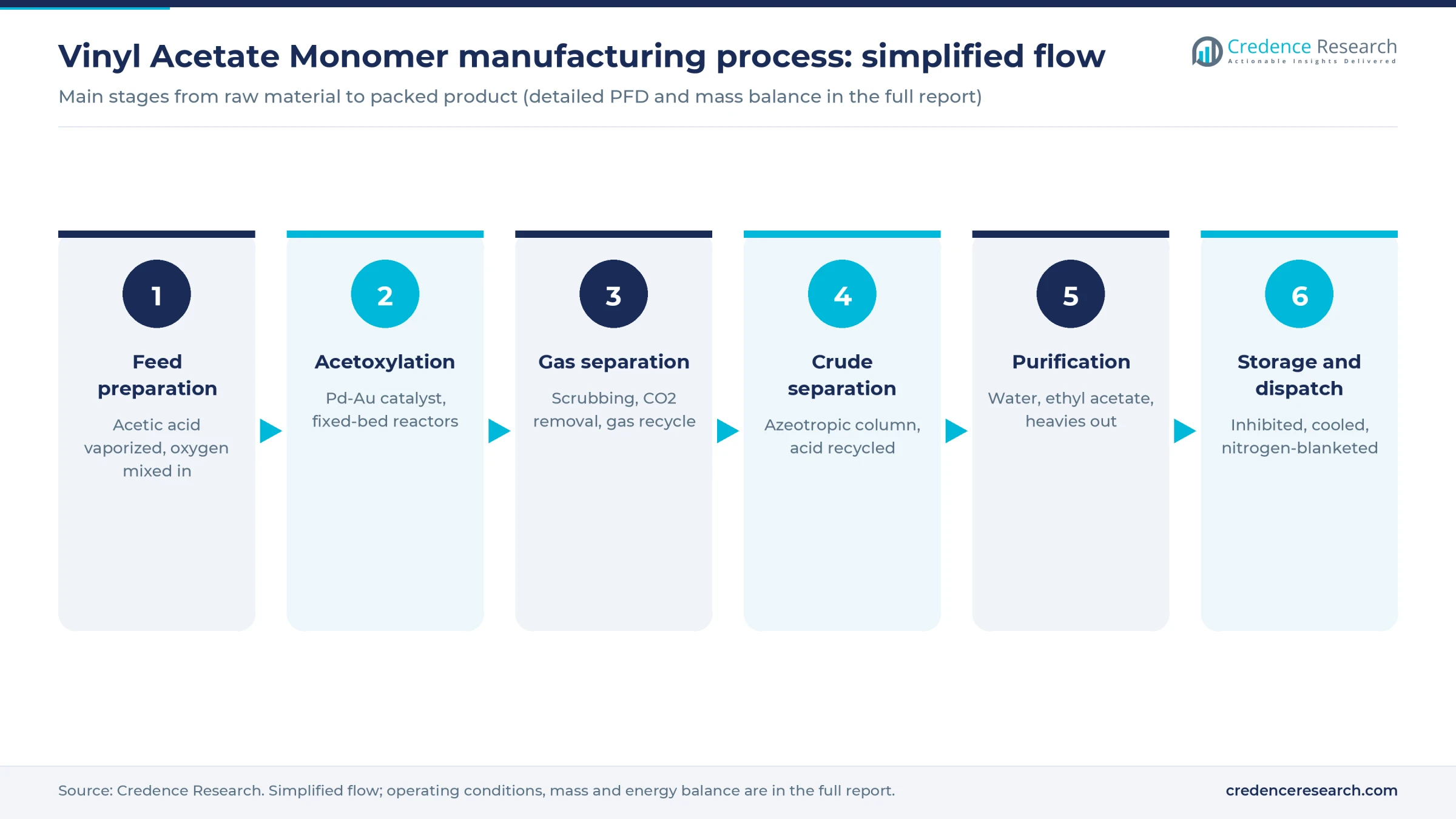
- Feed preparation. Acetic acid is vaporized into a recycle gas stream rich in ethylene, and oxygen from an air separation unit or pipeline is mixed in below the flammable limit under tight interlock control.
- Acetoxylation. The mixture passes through multitubular fixed-bed reactors cooled by boiling water, typically at about 150–200 degrees Celsius and 5–12 bar. Only about 8–10% of the ethylene and 15–35% of the acetic acid convert per pass, so large gas volumes recycle.
- Gas separation. Reactor gas is cooled and scrubbed with acetic acid to recover vinyl acetate. A hot potassium carbonate system strips carbon dioxide, and a small purge limits inert buildup before the gas returns to the reactors.
- Crude separation. The condensed crude, a mix of vinyl acetate, water and unreacted acid, is split in an azeotropic column, and acetic acid returns to the vaporizer.
- Purification. Further columns remove water, ethyl acetate and heavy ends to reach about 99.9% purity.
- Storage and dispatch. Hydroquinone inhibitor is dosed, and product is held in cooled, nitrogen-blanketed tanks before shipment by pipeline, ship, rail tank car or truck.
Stoichiometry needs about 0.33 tons of ethylene, 0.70 tons of acetic acid and 0.19 tons of oxygen per ton of product, and assumed real use is about 0.36, 0.71 and 0.25 tons. Catalyst aging erodes selectivity over a run of several years, so catalyst changeouts are a planned capital and downtime item.
Vinyl acetate monomer plant setup cost
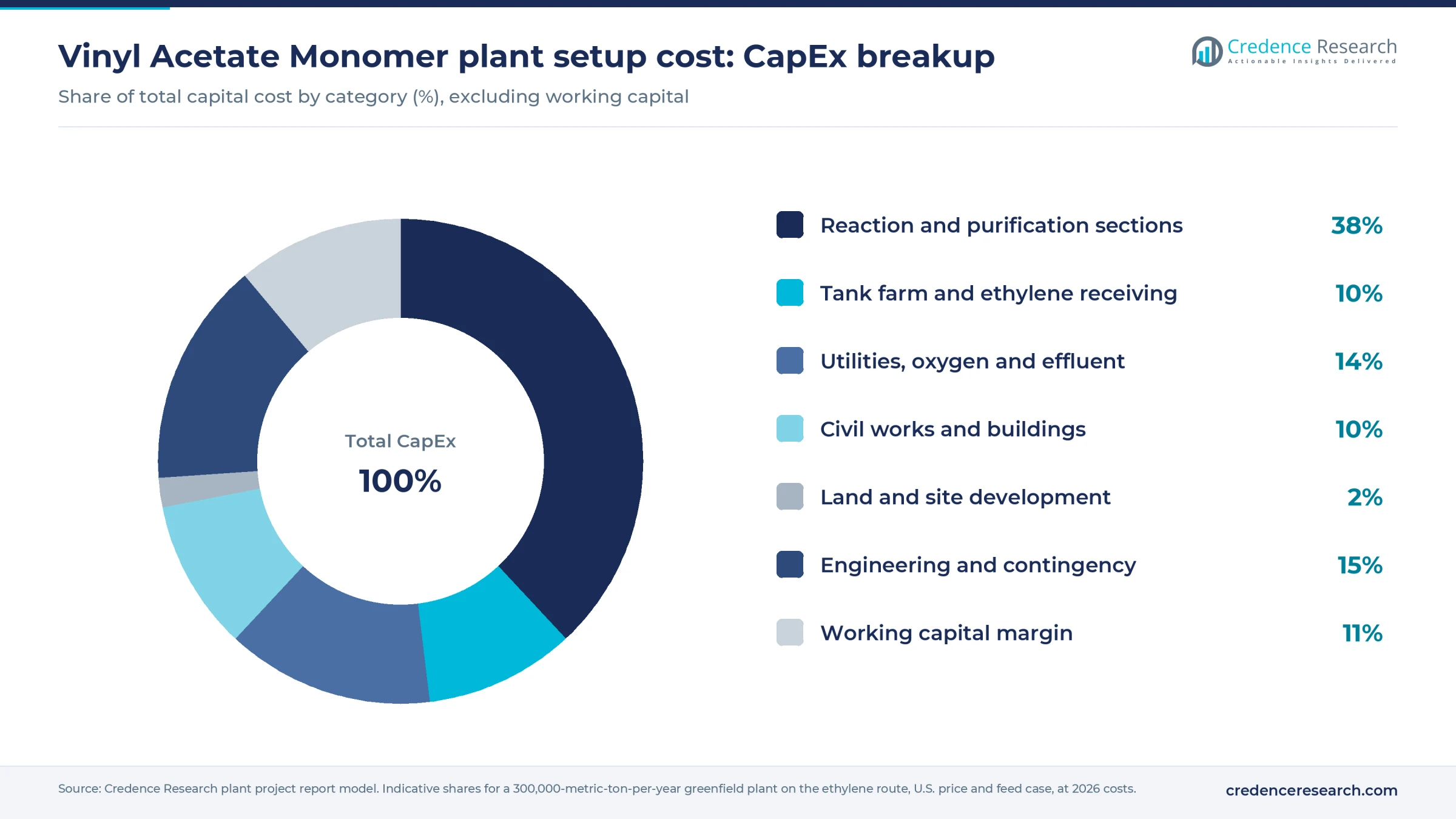
The reference plant makes 300,000 metric tons a year, the size of the newest units in China and South Korea. Total CapEx is estimated at USD 280–500 million, including land, reactor and distillation sections, an ethylene receiving and acetic acid tank farm, oxygen supply, utilities, effluent and vent treatment, preoperative costs and a working capital margin.
Two disclosed projects anchor the estimate. LOTTE INEOS Chemical's 250,000-ton third unit at Ulsan, South Korea, was reported at about USD 172 million in January 2024, on an existing site with shared utilities and captive acetic acid. Scaled to 300,000 tons by the six-tenths rule, that gives USD 192 million, or about USD 207 million after an assumed 1.08x escalation to 2026. An assumed greenfield factor of 1.4–1.8 for standalone utilities, storage and offsites gives USD 290–375 million. Asian Paints' board raised the budget for its Dahej, India, complex, which covers 100,000 tons of VAM, 150,000 tons of vinyl acetate-ethylene emulsions and ethylene storage, to about USD 369 million in March 2025 at an assumed 88 rupees per dollar. Assigning an assumed 60–70% of that to the VAM unit and scaling it to 300,000 tons gives USD 430–500 million, the top of the range for a fully greenfield coastal site. U.S. or EU builds sit in the upper half.
For the land row, a site with tank separation distances needs about 100,000 square meters, an assumed figure. At an assumed USD 30–80 per square meter in an Asian industrial park, land costs USD 3–8 million, about 1.4% of mid-range CapEx. Plots in U.S. or EU chemical parks can cost more.
Operating cost is dominated by two feeds.
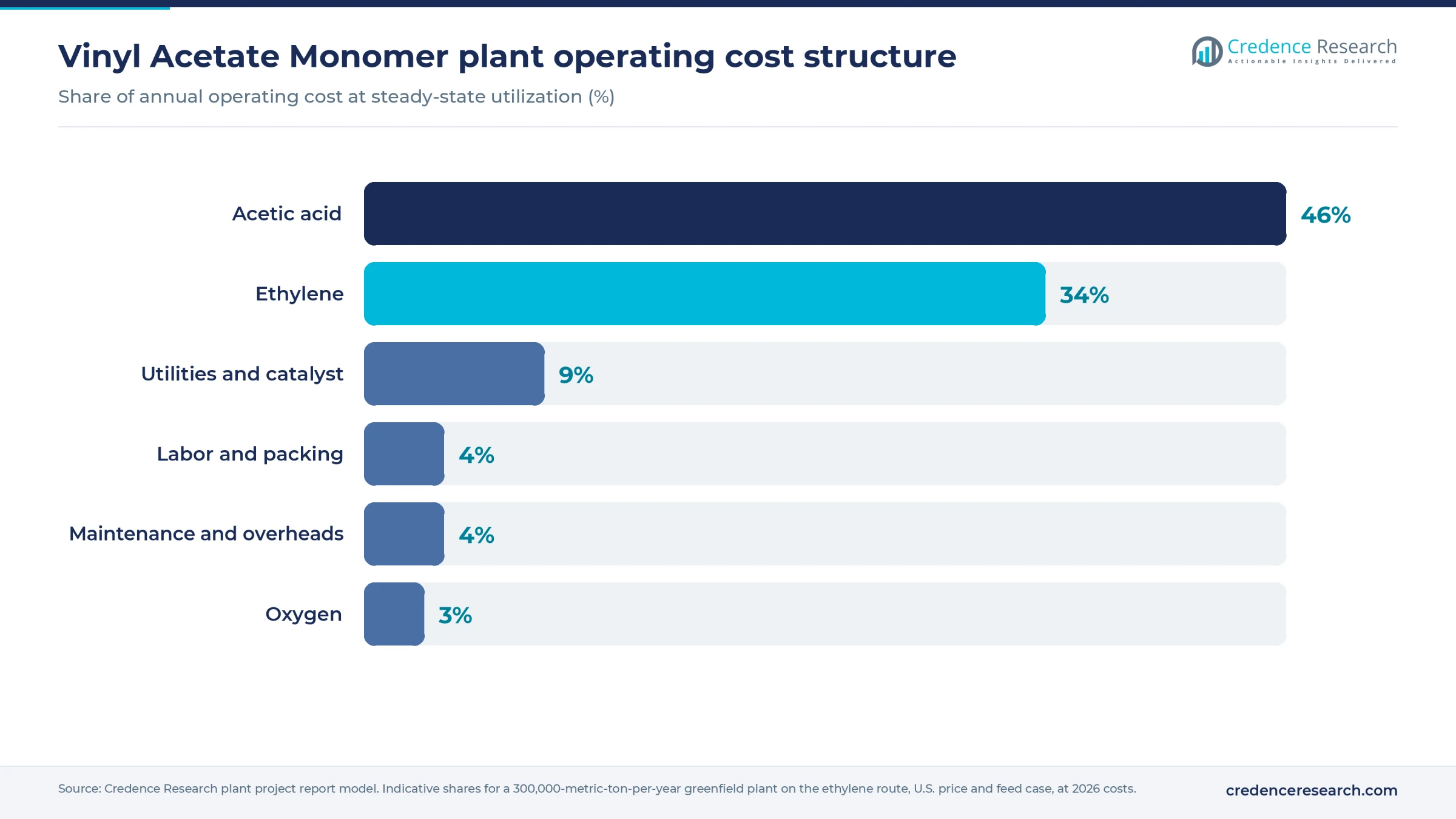
Acetic acid and ethylene together are about 80% of running cost, so feed access decides competitiveness. The full report can be customized to any country or region.
Machinery and raw materials for a vinyl acetate monomer plant
Main equipment groups include the following, with ratings and the full schedule in the report.
- Ethylene receiving, either a pipeline station or refrigerated storage with vaporizers
- Acetic acid tanks, pumps and vaporizers
- Air separation unit or oxygen pipeline station with mixing and interlock skids
- Multitubular fixed-bed reactors with steam drums and catalyst loading systems
- Recycle gas compressors, acetic acid scrubbers and a carbon dioxide removal system
- Azeotropic, light-ends and finishing distillation columns with reboilers and condensers
- Inhibitor dosing, cooled product tanks and loading bays
- Steam supply, cooling towers, flare, thermal oxidizer and effluent treatment
- Distributed control and safety instrumented systems, gas detection and a lab with gas chromatography
At 90% utilization the plant uses about 192,000 tons of acetic acid, 97,000 tons of ethylene and 68,000 tons of oxygen a year. Merchant acetic acid comes from China, the United States, Singapore, South Korea, Saudi Arabia and Taiwan. Chinese export values averaged about USD 300 per ton in 2025, against about USD 474 for U.S. exports, per UN Comtrade. Ethylene travels poorly and moves mainly in refrigerated gas carriers from the U.S. Gulf Coast, South Korea and Japan, at 2025 export values of about USD 680–780 per ton. That is why most producers sit inside a cracker complex or on an ethylene pipeline, and why a coastal site with a jetty is the minimum for a newcomer.
Vinyl acetate monomer business profit margin and ROI
Gross margin is estimated at 7–25%, measured as selling price minus feed and direct conversion cost. Two price cases set the bounds, both built from 2025 UN Comtrade export unit values. In the Asian merchant case, a price of about USD 730 per ton meets a direct cost of about USD 680, using an assumed delivered acetic acid price of USD 400, ethylene at USD 780 and assumed oxygen, utility and labor costs, for a margin near 7%. In the Gulf Coast case, a price of about USD 930 meets a direct cost of about USD 697 with feeds at U.S. export values, for about 25%.
At 90% utilization, or 270,000 tons, annual cash profit after an assumed USD 8 million of fixed overhead is about USD 55 million in the U.S. case. On the USD 390–500 million a U.S. build implies, simple pre-tax payback is about 7–9 years. In the Asian merchant case, cash profit falls to about USD 5.6 million and payback runs past 50 years, so new capacity is usually built by acetic acid producers or captive users.
Each USD 100 per ton change in selling price moves cash profit by about USD 27 million, and each USD 100 per ton on acetic acid moves it by about USD 19 million.
| Metric | Value |
|---|---|
| Gross margin | 7–25% |
| Payback period | 7–9 years (U.S. price case) |
| IRR (post-tax) | Available in report |
| NPV | Available in report |
| Return on investment | Available in report |
| DSCR | Available in report |
| Break-even utilization | Available in report |
How to start a vinyl acetate monomer business, licenses and approvals
Approval steps follow a common path: company and tax registration, industrial zoning and building permits, an environmental permit covering air emissions, wastewater and hazardous waste, process safety and fire clearances for ethylene, oxygen and flammable liquid storage, chemical substance registration, and import or export registration. Vinyl acetate is a hazardous air pollutant in the United States and a suspected carcinogen in the EU, so vent control and worker exposure monitoring sit at the center of most permits.
| Market | Key approvals for a vinyl acetate monomer plant |
|---|---|
| United States | State or EPA Clean Air Act construction and Title V operating permits, including the Hazardous Organic NESHAP (40 CFR 63 subparts F, G and H); NPDES or pretreatment wastewater permit; OSHA Process Safety Management for flammable liquid and ethylene inventories; EPA Risk Management Program, which lists vinyl acetate monomer with a 15,000-pound threshold; TSCA inventory compliance |
| European Union | Integrated permit under the Industrial Emissions Directive, Annex I 4.1(b), oxygen-containing hydrocarbons such as esters; REACH registration; CLP labeling as a highly flammable liquid and suspected carcinogen; Seveso III review of flammable liquid and ethylene inventories |
| India | Environmental clearance under the EIA Notification 2006 as a petrochemical or synthetic organic chemical project; state pollution control board consent to establish and operate; factory license; Manufacture, Storage and Import of Hazardous Chemical Rules 1989; PESO license for pressurized ethylene storage under the SMPV(U) Rules 2016 |
India rescinded its mandatory BIS quality control order for the monomer in December 2025, ChemLinked reported, so domestic sales no longer need a BIS license.
Key vinyl acetate monomer manufacturers and recent developments
Celanese is the largest producer, with units at Clear Lake, Texas, Nanjing, China, and Jurong Island, Singapore. Other global makers include LyondellBasell and Dow in the United States, Wacker Chemie in Germany, Kuraray in Japan, LOTTE INEOS Chemical in South Korea, Dairen Chemical in Taiwan and Sipchem's International Vinyl Acetate Co. in Saudi Arabia. Chinese capacity is led by Sinopec units and acetylene-route producers in the coal belt, with Guangxi Huayi as the newest entrant. Most leaders sit beside their own acetic acid plants, the main barrier for a newcomer.
- February 2026: Celanese raised Western Hemisphere prices for acetic acid, VAM and derivatives by USD 50–100 per metric ton, Rubber World reported.
- June 2026: Guangxi Huayi Chemical commissioned its 300,000-ton ethylene-based unit in southern China, the only major VAM addition in China this year.
- September 2026: Asian Paints told stock exchanges that its 150,000-ton VAE plant at Dahej had started commercial production, while construction of its VAM, ethylene storage and handling facilities continues.
What's inside the Vinyl Acetate Monomer project report PDF
The report runs to 21 chapters. Open a chapter to see its sections.
1. Preface
2. Scope and Methodology
- 2.1 Objectives of the Study
- 2.2 Stakeholders
- 2.3 Research Methodology
- 2.4 Data Sources and Key Assumptions
3. Executive Summary
- 3.1 Market Snapshot
- 3.2 Project at a Glance (Capacity, CapEx, OpEx)
- 3.3 Key Financial Indicators (IRR, NPV, Payback, Break-even)
- 3.4 Feasibility Verdict
4. Product Overview
- 4.1 Vinyl Acetate Monomer Definition and Properties
- 4.2 Grades and Specifications (BIS / ISO / ASTM)
- 4.3 HS Code and Classification
- 4.4 Key Applications
- 4.5 Substitutes
5. Global Vinyl Acetate Monomer Market
- 5.1 Market Overview
- 5.2 Historical and Current Market Performance (Volume and Value)
- 5.3 Market Breakup by Grade / Type
- 5.4 Market Breakup by End-Use Industry
- 5.5 Market Breakup by Region
- 5.6 Market Drivers, Restraints and Trends
- 5.7 Value Chain Analysis
- 5.8 Market Forecast
6. Target Country Vinyl Acetate Monomer Market Analysis
- 6.1 Demand and Supply Analysis
- 6.2 Installed Capacity vs Demand Gap
- 6.3 Import Dependence
- 6.4 Demand Forecast by End-Use
7. Trade Analysis
- 7.1 Imports by Volume, Value and Country
- 7.2 Exports by Volume, Value and Country
- 7.3 Trade Balance and Opportunities
8. Price Analysis
- 8.1 Historical Vinyl Acetate Monomer Price Trends by Region
- 8.2 Raw Material / Feedstock Price Trends and Linkage
- 8.3 Price Forecast
- 8.4 Margins Across the Value Chain
9. Competitive Landscape
- 9.1 Market Structure
- 9.2 Key Players and Installed Capacities
- 9.3 Profiles of Key Players
- 9.4 Recent Developments (Expansions, M&A, New Plants)
10. Manufacturing Process and Technology
- 10.1 Comparison of Technology Routes
- 10.2 Selected Route and Process Flow Diagram
- 10.3 Unit Operations Involved
- 10.4 Chemical Reactions Involved
- 10.5 Mass Balance and Raw Material Requirements
- 10.6 Energy Balance
- 10.7 Quality Assurance Criteria and Technical Tests
- 10.8 By-products and Waste Handling
- 10.9 Technology Licensors / Providers
11. Project Details, Requirements and Costs
- 11.1 Land, Location and Site Development
- 11.1.1 Site Selection Criteria
- 11.1.2 Location Analysis
- 11.1.3 Land Requirement and Costs
- 11.1.4 Site Development Costs
- 11.2 Plant Layout
- 11.2.1 Layout Principles
- 11.2.2 Proposed Layout
- 11.2.3 Factors Influencing Layout
- 11.3 Civil Works and Buildings
- 11.4 Plant Machinery
- 11.4.1 Machinery Requirements and Specifications
- 11.4.2 Machinery Costs
- 11.4.3 Machinery Suppliers
- 11.5 Raw Materials
- 11.5.1 Requirements per Tonne of Output
- 11.5.2 Procurement and Sourcing
- 11.5.3 Costs
- 11.5.4 Suppliers
- 11.6 Packaging
- 11.6.1 Packaging Requirements
- 11.6.2 Packaging Costs
- 11.6.3 Packaging Suppliers
- 11.7 Storage and Material Handling
- 11.8 Transportation Requirements and Costs
- 11.9 Utilities
- 11.9.1 Power Requirements and Costs
- 11.9.2 Water Requirements and Costs
- 11.9.3 Steam, Fuel and Other Utilities
- 11.10 Manpower Requirements and Wages
12. Environment, Health, Safety and Sustainability
- 12.1 Effluent and Emissions Management
- 12.2 Hazard Classification and Safety Measures
- 12.3 Carbon Footprint
- 12.4 Green / Low-Carbon Process Options
13. Regulatory Procedures, Approvals and Certifications
- 13.1 Licences and Registrations
- 13.2 Environmental Clearances
- 13.3 Product Certifications (BIS, REACH, etc.)
- 13.4 Approval Timeline
14. Project Implementation Schedule
15. Project Economics
- 15.1 Capital Cost of the Project
- 15.2 Techno-Economic Parameters
- 15.3 Capacity Utilization and Ramp-up
- 15.4 Product Pricing and Margins
- 15.5 Income Projections
- 15.6 Expenditure Projections
- 15.7 Working Capital Requirement
- 15.8 Taxation
- 15.9 Depreciation
16. Financial Analysis
- 16.1 Projected Profit and Loss Account
- 16.2 Projected Cash Flow Statement
- 16.3 Projected Balance Sheet
- 16.4 Liquidity Analysis
- 16.5 Profitability Analysis (Payback, NPV, IRR, ROI)
- 16.6 Break-even Analysis
- 16.7 Debt Service Coverage Ratio (DSCR)
- 16.8 Sensitivity Analysis
- 16.9 Scenario and Uncertainty Analysis
17. Funding and Incentives
- 17.1 Means of Finance and Debt-Equity Structure
- 17.2 Loans and Financial Assistance
- 17.3 Government Schemes and Subsidies (PLI, State Policies)
18. Risk Assessment
- 18.1 Key Success Factors
- 18.2 Key Risk Factors
- 18.3 Risk Mitigation
19. Strategic Recommendations
20. Case Study of a Successful Venture
21. Appendix
- 21.1 Detailed Assumptions
- 21.2 Abbreviations
- 21.3 List of Tables and Figures
- 21.4 Sources
This page vs. the full report
| Data point | On this page (free) | In the full report |
|---|---|---|
| Total CapEx | One rounded range at one capacity | Exact figure at three capacities with a line-item breakup |
| CapEx breakup | Category shares (%) only | Cost, quantity and supplier for every machine |
| Operating cost | Share of raw materials, utilities and labor | Per-unit cost sheet with each input price and consumption |
| Profitability | Gross margin range and payback band | Exact IRR, NPV, ROI, break-even and DSCR |
| Financial statements | List of what is included | 10-year P&L, cash flow, balance sheet and Excel model |
| Sensitivity | One directional line | Full sensitivity and scenario tables |
| Process | Simplified flow diagram | Detailed process flow, mass and energy balance, operating conditions |
| Machinery | Names of the main machines | Specifications, capacity, cost and supplier list |
| Market | Headline size, growth and global demand | Segment, region, trade and price forecast tables |
| Suppliers and buyers | Supplier types and sourcing hubs | Named suppliers and buyers |
Vinyl Acetate Monomer project report: FAQs
How much does it cost to set up a vinyl acetate monomer plant?
What raw materials does vinyl acetate monomer production need?
Which process should a new vinyl acetate monomer plant use?
What is the profit margin in vinyl acetate monomer manufacturing?
What is the payback period for a vinyl acetate monomer plant?
Which approvals does a vinyl acetate monomer plant need?
Who buys vinyl acetate monomer?

About the analyst
Nisha Gupta, Senior Research Analyst
Nisha Gupta is a Senior Research Analyst at Credence Research Inc. who works across industry domains, including packaging, automotive parts and machinery. Her focus is the modelling engine behind each study: she builds quantitative market databases and econometric forecasting frameworks, and developed automated Excel-based market modelling templates that cut client turnaround time by 30%.
Related market research
- Vinyl Acetate Monomer Market Size, Growth and Forecast 2032
- Ethylene Vinyl Acetate Resins Market Size, Growth and Forecast 2032
- Acetic Acid Market Size, Growth, Share, Trends and Forecast 2032
- Food Grade Polyvinyl Acetate Market Size, Growth and Forecast 2032
- Polyvinyl Alcohol Films Market Size, Growth and Forecast 2032
- Polyvinyl Butyral Market Size, Growth, Share and Forecast 2032
More plant project reports
- Urea Manufacturing Plant Project Report (DPR) 2026
- Methacrylic Acid Manufacturing Plant Project Report (DPR) 2026
- Vinyl Chloride Manufacturing Plant Project Report (DPR) 2026
- Neopentyl Glycol Manufacturing Plant Project Report (DPR) 2026
- Citric Acid Manufacturing Plant Project Report (DPR) 2026
- Castor Oil Processing Plant Project Report (DPR) 2026