
Market Overview
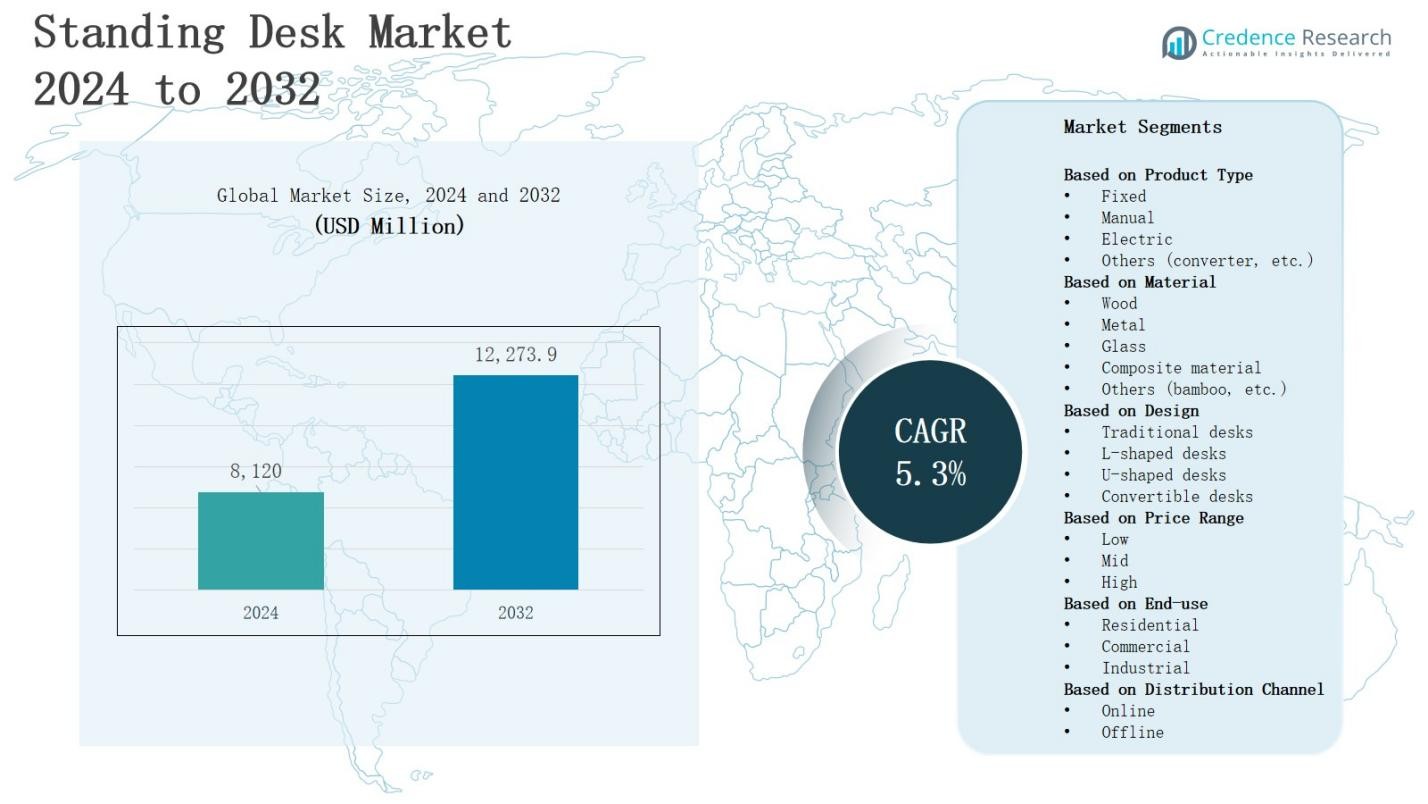
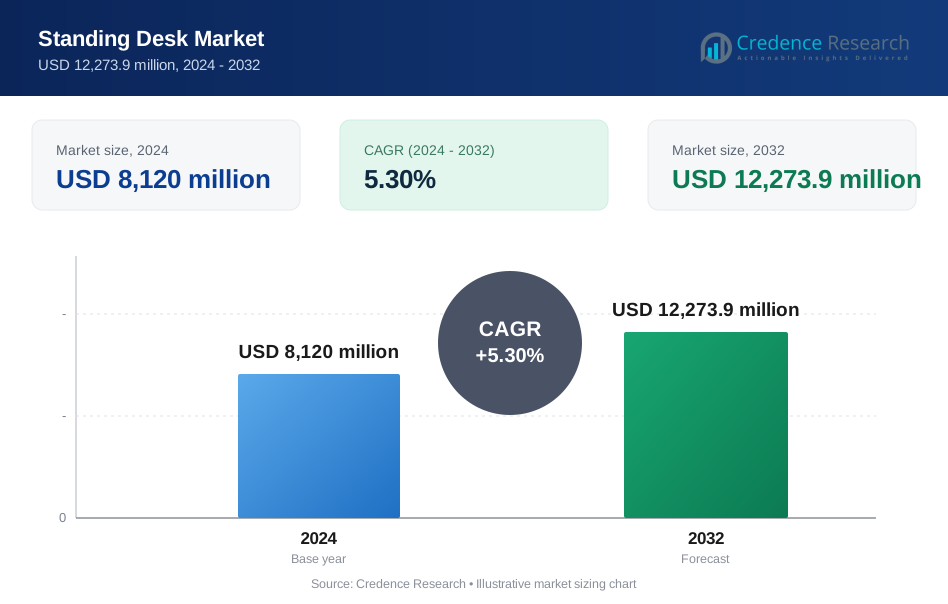
The standing desk market is projected to grow from USD 8,120 million in 2024 to USD 12,273.9 million by 2032, registering a CAGR of 5.3% during the forecast period.
| REPORT ATTRIBUTE | DETAILS |
|---|---|
| Historical Period | 2020-2024 |
| Base Year | 2024 |
| Forecast Period | 2025-2032 |
| Standing Desk Market Size 2024 | USD8,120 Million |
| Standing Desk Market, CAGR | 5.3% |
| Standing Desk Market Size 2032 | USD12,273.9 Million |
The standing desk market grows with rising awareness of health benefits associated with reducing sedentary behavior and the increasing adoption of ergonomic office furniture to enhance productivity and employee well-being. Demand strengthens due to corporate wellness initiatives, remote work expansion, and a growing preference for adjustable and smart desks with integrated features. Trends shaping the market include the integration of IoT-enabled monitoring systems, sustainable material usage, and customizable designs catering to diverse work environments. It benefits from heightened consumer focus on posture improvement, prevention of lifestyle-related diseases, and the shift toward hybrid workplace models driving long-term adoption.
The standing desk market shows strong geographical diversity, led by North America with 35% share driven by wellness initiatives and hybrid work adoption, followed by Europe at 27% supported by strict ergonomic regulations and sustainable design demand. Asia Pacific holds 25% share with rapid urbanization and rising awareness in China, Japan, and India. Latin America accounts for 7%, led by Brazil and Mexico, while the Middle East & Africa capture 6% through modern office expansion. Key players include Humanscale, Herman Miller, Ergotron, FlexiSpot, Fully, Haworth, and Autonomous.
Market Insights
- The standing desk market is projected to grow from USD 8,120 million in 2024 to USD 12,273.9 million by 2032, at a CAGR of 5.3%.
- Rising awareness of health risks from sedentary lifestyles drives demand, with organizations adopting ergonomic desks to enhance wellness and productivity.
- Corporate wellness initiatives and hybrid work adoption fuel strong uptake of height-adjustable and portable desk models across offices and home setups.
- Continuous innovation in smart features, IoT integration, and digital health tracking boosts adoption among tech-driven workplaces.
- Sustainability and customization trends shape consumer preference, with eco-friendly materials and modular designs gaining traction.
- High cost and limited awareness remain challenges, especially in price-sensitive regions, slowing adoption among small businesses and individuals.
- North America leads with 35% share, followed by Europe at 27%, Asia Pacific at 25%, Latin America at 7%, and Middle East & Africa at 6%.
Market Drivers
Rising Health Awareness and Ergonomic Needs
The standing desk market expands with growing awareness of health risks linked to sedentary lifestyles, including obesity, cardiovascular diseases, and posture-related issues. Organizations and individuals increasingly adopt ergonomic solutions to improve workplace wellness and reduce medical costs. It gains momentum as standing desks help enhance energy levels, focus, and productivity. Employers promote ergonomic furniture to support employee well-being, driving large-scale installations across corporate offices, educational institutions, and home workstations.
- For instance, Google includes standing desks in its corporate wellness program, allowing employees to alternate between sitting and standing to reduce adverse health effects.
Corporate Wellness Initiatives and Remote Work Growth
The standing desk market benefits from strong adoption driven by corporate wellness programs aimed at boosting employee engagement and lowering absenteeism. Companies invest in ergonomic furniture to align with health and safety standards while enhancing productivity. Remote and hybrid work models accelerate demand for flexible, height-adjustable desks tailored for home offices. It meets the growing need for adaptable setups, helping professionals balance comfort and efficiency in diverse working conditions.
- For instance, Steelcase reported increased corporate orders for height-adjustable desks as part of their workplace wellbeing initiatives to reduce sedentary behavior among employees.
Technological Advancements and Smart Features
The standing desk market witnesses growth through continuous innovation, with manufacturers integrating smart features such as programmable height settings, IoT connectivity, and posture reminders. It enables users to customize their workspace for improved comfort and performance. Demand rises for desks that combine functionality with digital health tracking. This trend fuels adoption across tech-driven workplaces, fostering competitive differentiation among brands that prioritize design, automation, and advanced user experience in ergonomic solutions.
Sustainability and Customization Preferences
The standing desk market experiences momentum from rising consumer preference for sustainable and eco-friendly materials. It aligns with corporate goals of reducing environmental footprints while offering durable products. Customization trends gain traction, with adjustable sizes, finishes, and designs tailored to varied user needs. Businesses and individuals increasingly value flexibility, prompting manufacturers to deliver modular solutions. Growing awareness of workplace aesthetics and personalized ergonomics strengthens demand, establishing long-term growth opportunities.
Market Trends
Integration of Smart and Connected Technologies
The standing desk market embraces advanced technologies such as IoT-enabled sensors, Bluetooth connectivity, and app-controlled adjustments that enhance user experience. It allows employees to monitor posture, calorie expenditure, and sitting-to-standing ratios in real time. Smart features encourage healthier work habits and improve workplace productivity. Companies adopt digital solutions to align with modern office trends, driving demand for intelligent ergonomic products. This shift creates opportunities for manufacturers to expand offerings in tech-enabled workstations.
- For instance, The Sleep Company's ErgoSmart desk features digital control panels and memory presets that allow users to set and adjust desk heights seamlessly, encouraging ergonomic sitting and standing transitions.
Growing Demand for Flexible and Hybrid Work Solutions
The standing desk market adapts to the rise of hybrid and remote work, with consumers seeking adjustable desks suited for both home and office settings. It supports professionals who require mobility and adaptability in compact spaces. Height-adjustable and portable models gain traction, offering convenience for varied work environments. Employers invest in flexible furniture to accommodate evolving workforce needs, reinforcing standing desks as essential ergonomic solutions. This trend drives long-term adoption across industries.
- For instance, Steelcase introduced its Series 7 sit-stand desks, featuring integrated cable management and ergonomic design tailored for flexible workspaces.
Sustainability and Eco-Friendly Manufacturing Practices
The standing desk market shows strong movement toward sustainable materials and eco-friendly production. It aligns with global corporate sustainability goals, leading to desks made from recycled metals, responsibly sourced wood, and low-emission coatings. Consumers prefer durable, environmentally responsible furniture, encouraging innovation in green design. Brands position sustainability as a differentiator, strengthening customer loyalty. The trend reshapes competitive strategies, ensuring that environmental responsibility remains a core element in ergonomic furniture manufacturing.
Rising Preference for Customization and Aesthetic Appeal
The standing desk market expands with growing emphasis on personalized designs that match workplace aesthetics. It supports user preferences for adjustable finishes, modular accessories, and tailored dimensions. Businesses and individuals increasingly demand solutions that blend functionality with visual appeal, reinforcing desks as both ergonomic and design-oriented investments. Customization helps employers build attractive workspaces that foster productivity and employee satisfaction. This trend positions manufacturers to capture broader consumer segments through diversified product lines.
Market Challenges Analysis
High Cost and Affordability Concerns
The standing desk market faces challenges due to high initial costs that limit widespread adoption among small businesses and individual buyers. It requires significant investment compared to traditional desks, making affordability a barrier in price-sensitive regions. Many customers hesitate to purchase due to perceived luxury positioning, slowing penetration in developing markets. Limited awareness about long-term health and productivity benefits further restricts consumer willingness to invest. Price competition pressures manufacturers while impacting profit margins.
Limited Awareness and Ergonomic Adoption Barriers
The standing desk market encounters resistance from users unfamiliar with ergonomic benefits or proper usage. It struggles with misconceptions that standing alone prevents health issues, reducing long-term satisfaction and adoption rates. Some employees experience discomfort when transitioning, leading to reluctance in workplace adoption. Lack of training and ergonomic education weakens effectiveness, while inconsistent regulations hinder standardization. These barriers create challenges for manufacturers and employers aiming to establish standing desks as mainstream solutions.
Market Opportunities
Expansion Through Remote Work and Hybrid Office Models
The standing desk market holds strong opportunities from the global shift toward remote and hybrid work environments. It meets rising demand for ergonomic furniture that enhances productivity in home offices and flexible corporate setups. Employers invest in adjustable desks to support workforce wellness, creating new growth avenues for suppliers. Consumers seek compact, customizable solutions suited for smaller spaces, driving innovation in portable designs. This trend accelerates adoption across diverse demographics, ensuring steady long-term demand.
Innovation in Sustainable and Smart Ergonomic Solutions
The standing desk market benefits from opportunities in eco-friendly manufacturing and advanced smart features. It aligns with consumer preference for environmentally responsible furniture and digital health integration. Manufacturers can capitalize on green materials, energy-efficient production, and smart technologies such as automated adjustments and activity tracking. Businesses and individuals value solutions that combine sustainability, functionality, and personalization. This intersection of innovation and demand positions standing desks as essential investments for modern and future workplaces.
Market Segmentation Analysis:
By Product Type
The standing desk market segments into fixed, manual, electric, and others such as converters. Electric desks lead demand due to convenience and advanced adjustability features, appealing to corporate offices and tech-savvy professionals. Manual desks remain relevant for cost-conscious buyers, while converters gain traction among individuals seeking affordable alternatives without replacing existing furniture. Fixed models serve niche applications where height adjustability is less critical. It benefits from diversification across all product categories to meet varied consumer needs.
- For instance, Jin Office Solutions offers electric desks with dual motors, enabling smooth, silent height adjustments and programmable presets, making them popular in corporate offices for ergonomic support.
By Material
The standing desk market categorizes materials into wood, metal, glass, composite, and others including bamboo. Wood dominates due to durability and aesthetic appeal, while metal provides strength and long-lasting utility in commercial spaces. Glass designs cater to premium office environments, adding modern visual appeal. Composite and bamboo gain attention for sustainability and eco-friendly attributes. It reflects a growing trend toward balancing strength, style, and environmental responsibility, driving material innovation and consumer-focused design choices.
By Design
The standing desk market divides design into traditional desks, L-shaped, U-shaped, and convertible models. Traditional desks hold widespread usage across offices, while L-shaped and U-shaped designs optimize space and enhance multitasking efficiency. Convertible desks rise in popularity for their adaptability in compact home and hybrid office environments. It shows increasing consumer demand for versatile configurations that merge ergonomics with workspace flexibility. These preferences encourage manufacturers to focus on innovation in form and usability.
- For instance, Vernal’s L-shaped standing desks emphasize elegant design, dual motors, and spacious layouts with walnut or oak finishes, targeting users who want ergonomic corners with modern aesthetics.
Segments:
Based on Product Type
- Fixed
- Manual
- Electric
- Others (converter, etc.)
Based on Material
- Wood
- Metal
- Glass
- Composite material
- Others (bamboo, etc.)
Based on Design
- Traditional desks
- L-shaped desks
- U-shaped desks
- Convertible desks
Based on Price Range
- Low
- Mid
- High
Based on End-use
- Residential
- Commercial
- Industrial
Based on Distribution Channel
- Online
- Offline
Based on the Geography:
- North America
- U.S.
- Canada
- Mexico
- Europe
- Germany
- France
- U.K.
- Italy
- Spain
- Rest of Europe
- Asia Pacific
- China
- Japan
- India
- South Korea
- South-east Asia
- Rest of Asia Pacific
- Latin America
- Brazil
- Argentina
- Rest of Latin America
- Middle East & Africa
- GCC Countries
- South Africa
- Rest of the Middle East and Africa
Regional Analysis
North America
North America dominates the standing desk market with 35% share, driven by strong adoption of ergonomic furniture in corporate and home offices. High awareness of workplace health, coupled with supportive employer wellness programs, accelerates demand. It benefits from advanced product innovations and premium consumer spending capacity. Hybrid work trends in the United States and Canada further reinforce sales. Sustainable designs and smart desks gain traction, reflecting evolving consumer priorities. Manufacturers focus on innovation and customization to maintain competitiveness.
Europe
Europe holds 27% share of the standing desk market, fueled by strict workplace health regulations and growing emphasis on employee well-being. It experiences strong demand in countries like Germany, the UK, and France, where ergonomic standards are widely enforced. Rising preference for sustainable and eco-friendly materials shapes product development. Remote work adoption supports greater use of height-adjustable desks in residential settings. Employers invest in ergonomic solutions to reduce absenteeism. Manufacturers leverage advanced design aesthetics to align with European consumer tastes.
Asia Pacific
Asia Pacific accounts for 25% share of the standing desk market, supported by rapid urbanization and expanding corporate infrastructure. It grows steadily in China, Japan, and India due to rising awareness of workplace ergonomics. Increasing adoption of hybrid work culture among younger professionals fuels market momentum. Affordable manual and converter desks witness high sales in developing economies. Multinational companies expand distribution networks to capture this diverse market. Rising disposable income supports long-term demand for electric and premium models.
Latin America
Latin America captures 7% share of the standing desk market, with growth led by Brazil and Mexico. It benefits from increasing awareness of ergonomic benefits among corporate employees and remote workers. Demand remains concentrated in urban centers with expanding office infrastructure. High price sensitivity drives preference for manual and converter models over premium electric options. Employers show gradual interest in workplace wellness programs. Market players explore affordable and modular solutions to gain stronger regional penetration.
Middle East & Africa
The Middle East & Africa hold 6% share of the standing desk market, influenced by emerging demand in the UAE, South Africa, and Saudi Arabia. It shows gradual growth due to rising adoption of modern office setups and health-conscious lifestyles. Price sensitivity continues to challenge premium product sales. Governments encourage workplace modernization, creating new opportunities for suppliers. Growing investments in corporate infrastructure and flexible workspaces drive incremental adoption. Manufacturers focus on cost-effective solutions to strengthen their presence.
Key Player Analysis
- Humanscale
- Jarvis by Fully
- Ergotron
- Global Furniture Grou
- Mayline
- Herman Miller
- FlexiSpot
- Fully
- Haworth
- StandDesk
- iMovR
- Autonomous
Competitive Analysis
The standing desk market features intense competition with global and regional players focusing on innovation, sustainability, and ergonomic design. Key companies such as Humanscale, Herman Miller, Haworth, and Global Furniture Group lead with advanced product portfolios and strong corporate clientele, emphasizing premium quality and workplace wellness solutions. Ergotron, FlexiSpot, and Autonomous strengthen their position through affordable and versatile models that appeal to both home and office users. Fully and its sub-brand Jarvis by Fully differentiate with customizable designs and sustainable materials, while iMovR and StandDesk cater to niche consumer segments with modular and compact solutions. Mayline extends its reach through diversified office furniture offerings. It thrives on continuous innovation, with players integrating smart features, eco-friendly materials, and hybrid work-focused designs to attract wider adoption across corporate offices, educational institutions, and home setups. Competitive strategies revolve around pricing, design variety, distribution networks, and digital engagement, pushing manufacturers to balance affordability with advanced ergonomics to capture a growing and health-conscious customer base.
Recent Developments
- In May 2025, Humanscale launched the eFloat Quattro, a four-leg sit-stand desk designed with ergonomic and sustainable features to enhance workplace flexibility and wellness.
- In July 2023, Haworth Inc. announced a new factory in Chennai, India, to begin production by 2025. This facility will support manufacturing furniture for domestic use and exports, indicating capacity expansion in the standing desk and office furniture market.
- In February 2025, Herman Miller unveiled the Spout Sit‑to‑Stand Table, featuring four motorized cylindrical legs, a 400 lb lifting capacity, integrated USB‑C power ports, and optional wheels-reinventing both form and function in collaborative spaces.
- In April 2025, Autonomous introduced the SmartDesk 5, its fifth-generation standing desk that blends minimalistic design with advanced ergonomic functionality and premium tabletop finishes.
Market Concentration & Characteristics
The standing desk market demonstrates moderate concentration with a mix of established global brands and emerging regional players competing on design, functionality, and affordability. Large companies such as Humanscale, Herman Miller, Haworth, and Ergotron dominate premium and corporate segments with advanced ergonomic solutions, while brands like FlexiSpot, Autonomous, and Fully target mid-range and home office users with customizable and affordable products. It reflects high product differentiation driven by smart features, sustainable materials, and modular designs tailored to diverse consumer needs. Market dynamics encourage continuous innovation and brand positioning, with players competing through strong distribution networks, digital sales channels, and workplace wellness initiatives. Pricing pressure in cost-sensitive regions and growing demand for eco-friendly solutions influence strategic moves. The standing desk market relies on balancing quality, affordability, and design versatility, creating a competitive landscape that supports both large multinational manufacturers and specialized niche providers.
Report Coverage
The research report offers an in-depth analysis based on Product Type, Material, Design, Price Range, End-User, Distribution Channel and Geography. It details leading market players, providing an overview of their business, product offerings, investments, revenue streams, and key applications. Additionally, the report includes insights into the competitive environment, SWOT analysis, current market trends, as well as the primary drivers and constraints. Furthermore, it discusses various factors that have driven market expansion in recent years. The report also explores market dynamics, regulatory scenarios, and technological advancements that are shaping the industry. It assesses the impact of external factors and global economic changes on market growth. Lastly, it provides strategic recommendations for new entrants and established companies to navigate the complexities of the market.
Future Outlook
- Demand for ergonomic furniture will continue to rise with increasing health awareness among employees and individuals.
- Hybrid and remote work adoption will drive higher sales of adjustable and portable standing desks.
- Smart desks with IoT connectivity and health tracking features will gain wider market acceptance.
- Sustainable and eco-friendly materials will become a major focus for manufacturers.
- Customizable and modular designs will attract consumers seeking flexibility and aesthetic appeal.
- Price-sensitive regions will witness growth in manual and converter desk models.
- Corporate wellness initiatives will expand the use of ergonomic desks in large organizations.
- Premium electric desks will see strong adoption in developed markets with high disposable incomes.
- Digital distribution and e-commerce platforms will strengthen sales channels for manufacturers.
- Regional players will expand through affordable solutions while global brands focus on advanced innovations.
Request a Free Sample
Fill in your details and we'll send you a free sample report.
- Sample data tables & charts
- Research methodology
Market Dynamics
Rising Health Awareness and Ergonomic Needs
Growing awareness of the health risks associated with sedentary lifestyles, such as obesity and cardiovascular diseases, is prompting organizations and individuals to invest in ergonomic solutions like standing desks to improve wellness and productivity.
Corporate Wellness Initiatives and Remote Work Growth
Companies are increasingly adopting standing desks as part of corporate wellness programs to boost employee engagement and reduce absenteeism, while the expansion of remote and hybrid work models is driving demand for flexible, height-adjustable desks for home offices.
Technological Advancements and Smart Features
Continuous innovation, including the integration of programmable height settings, IoT connectivity, and digital health tracking, is making standing desks more attractive to tech-driven workplaces and health-conscious consumers.
Sustainability and Customization Preferences
Consumer preference for sustainable, eco-friendly materials and customizable designs is encouraging manufacturers to offer modular, environmentally responsible standing desks that cater to diverse aesthetic and functional needs.
Expansion Through Hybrid Work and Digital Distribution
The shift toward hybrid work environments and the growth of e-commerce platforms are expanding the market reach of standing desks, making them more accessible to a wider range of consumers and businesses globally.
Need a Custom Version of This Report?
Tailor the scope, geography, or segments to your exact requirements.
- Custom geography or segment scope
- Direct access to our analyst team
Frequently Asked Questions
What is the current market size for standing desk market, and what is its projected size in 2032?
At what Compound Annual Growth Rate is the standing desk market projected to grow between 2025 and 2032?
Which standing desk market segment held the largest share in 2024?
What are the primary factors fueling the growth of the standing desk market?
Who are the leading companies in the standing desk market?
Which region commanded the largest share of the standing desk market in 2024?
Table of Content
Chapter 1 Market Segmentation
- 1.1 Segmentation Framework
- 1.1.1 Product and Service Classification
- 1.1.2 Application and End-Use Classification
- 1.1.3 Technology and Solution Classification
- 1.1.4 Customer and Distribution Channel Classification
- 1.1.5 Geographic Segmentation
- 1.1.6 Market Segment Definitions and Boundaries
- 1.2 By Design
- 1.2.1 Traditional desks
- 1.2.2 L-shaped desks
- 1.2.3 U-shaped desks
- 1.2.4 Convertible desks
- 1.3 By End-use
- 1.3.1 Residential
- 1.3.2 Commercial
- 1.3.3 Industrial
- 1.4 By Material
- 1.4.1 Wood
- 1.4.2 Metal
- 1.4.3 Glass
- 1.4.4 Composite material
- 1.4.5 Others (bamboo, etc.)
- 1.5 By Product Type
- 1.5.1 Fixed
- 1.5.2 Manual
- 1.5.3 Electric
- 1.5.4 Others (converter, etc.)
Chapter 2 Introduction
- 2.1 Report Objectives and Scope
- 2.2 Product Definition and Industry Terminology
- 2.3 Market Inclusions and Exclusions
- 2.4 Research Process
- 2.4.1 Primary Research and Expert Interviews
- 2.4.2 Secondary Research and Source Review
- 2.4.3 Top-Down and Bottom-Up Estimation
- 2.4.4 Data Triangulation and Verification
- 2.5 Market Size Measurement Basis
- 2.5.1 2024: USD 8,120 million → 2032: USD 12,273.9 million
- 2.6 Historical and Forecast Reference Periods
- 2.6.1 Base Year: 2024
- 2.6.2 Forecast Period: 2024-2032
- 2.7 Research Assumptions and Limitations
Chapter 3 Executive Summary
- 3.1 Market Snapshot and Key Findings
- 3.2 Base-Year Market Size, 2024
- 3.3 Forecast Market Size, 2032
- 3.4 Revenue and Volume Growth Outlook
- 3.5 Key Demand and Supply Indicators
- 3.6 Leading Market Segments
- 3.7 Fastest-Growing Market Opportunities
- 3.8 Regional Performance Highlights
- 3.9 Technology and Industry Transformation
- 3.10 Competitive Landscape Summary
- 3.11 Analyst View and Strategic Implications
Chapter 4 Global Standing Desk Market Trends and Developments
- 4.1 Historical Industry Development
- 4.2 Recent Market Trends and Developments
- 4.3 Demand and Customer Behavior Trends
- 4.4 Technology and Product Innovation
- 4.5 Artificial Intelligence, Automation and Digitalization
- 4.6 Local Manufacturing and Supply Chain Realignment
- 4.7 Industry Partnerships, Mergers and Acquisitions
- 4.8 Sustainability and Circular Economy Developments
- 4.9 Government and Private Sector Investment Trends
- 4.10 Emerging Business Models and Commercialization
- 4.11 Industry Developments and Announcements
Chapter 5 Global Standing Desk Market Production, Supply and Demand Analysis
- 5.1 Demand Trend and Consumption Analysis
- 5.2 Demand Forecast, 2024-2032
- 5.3 Production and Output Trend
- 5.4 Production and Output Forecast, 2024-2032
- 5.5 Installed Capacity and Capacity Utilization
- 5.6 Company-Wise Production Plants and Statistics
- 5.6.1 Installed Production Capacity
- 5.6.2 Actual Production
- 5.6.3 Planned Capacity and Expansion Targets
- 5.7 Supply Chain Structure and Procurement Trends
- 5.8 Supply-Demand Gap and Bottlenecks
- 5.9 Import Dependence and Sourcing Structure
- 5.10 Contract Manufacturing and Outsourcing
- 5.11 Regional Supply and Demand Concentration
Chapter 6 Global Standing Desk Market Pricing Analysis
- 6.1 Pricing Structure and Measurement
- 6.2 Historical Pricing Trends
- 6.3 Pricing Outlook, 2024-2032
- 6.4 Average Selling Price and Unit Economics
- 6.5 Pricing by Product and Market Segment
- 6.6 Geographic Pricing Differences
- 6.7 Key Input, Energy, Labor and Logistics Costs
- 6.8 Contract Pricing and Purchasing Models
- 6.9 Pricing Sensitivity and Competitive Positioning
- 6.10 Price, Margin and Profitability Implications
Chapter 7 Global Standing Desk Market Dynamics
- 7.1 Market Growth Drivers
- 7.1.1 Demand-Side Drivers
- 7.1.2 Technology and Innovation Drivers
- 7.1.3 Infrastructure and Investment Drivers
- 7.1.4 Regulatory and Policy Drivers
- 7.2 Market Restraints
- 7.2.1 Cost and Affordability Constraints
- 7.2.2 Technology and Adoption Barriers
- 7.2.3 Supply Chain and Operational Constraints
- 7.3 Market Challenges
- 7.3.1 Competitive Pressure and Margin Erosion
- 7.3.2 Skills, Infrastructure and Implementation Gaps
- 7.4 Emerging Market Opportunities
- 7.5 Market Dynamics Impact and Time-Horizon Assessment
Chapter 8 Global Standing Desk Value Chain Analysis
- 8.1 Industry Value Chain Overview
- 8.2 Upstream Suppliers and Critical Inputs
- 8.3 Technology and Component Providers
- 8.4 Manufacturing or Service Delivery
- 8.5 Distribution, Channel Partners and Integrators
- 8.6 Downstream Applications and End Users
- 8.7 Value Addition and Profit Pools
- 8.8 Vertical Integration and Outsourcing
- 8.9 Supplier Concentration and Risk
- 8.10 Supply Chain Localization and Resilience
Chapter 9 Global Standing Desk Market Regulations and Policies
- 9.1 Relevant Laws, Standards and Compliance Frameworks
- 9.2 Product, Service, Safety and Quality Requirements
- 9.3 Government Policies, Incentives and Subsidies
- 9.4 Imports, Exports and Trade Barriers
- 9.5 Public Procurement and Local Content Requirements
- 9.6 Environmental and Sustainability Compliance
- 9.7 Upcoming Policy Changes and Market Implications
Chapter 10 Global Standing Desk Market Hotspots and Opportunities
- 10.1 Market Opportunity Mapping and Growth Hotspots
- 10.2 High-Growth Applications and Customer Groups
- 10.3 Underserved Markets and White-Space Opportunities
- 10.4 Emerging Technology and Product Opportunities
- 10.5 New Capacity and Investment Hotspots
- 10.6 Market Entry and Expansion Opportunities
- 10.7 Distribution and Partnership Opportunities
- 10.8 Near-Term and Long-Term Commercial Potential
- 10.9 Opportunity Attractiveness and Execution Risks
Chapter 11 Global Standing Desk Market Outlook, 2024-2032
- 11.1 Market Size and Analysis
- 11.1.1 Revenue (Market Measurement: 2024: USD 8,120 million → 2032: USD 12,273.9 million)
- 11.1.2 Market Volume and Quantity Sold
- 11.1.3 Historical Market Size
- 11.1.4 Base-Year Market Size, 2024
- 11.2 Market Forecast, 2024-2032
- 11.2.1 Revenue Forecast to 2032
- 11.2.2 Volume Forecast to 2032
- 11.2.3 CAGR and Year-on-Year Growth
- 11.2.4 Incremental Revenue Opportunity
- 11.3 Forecast Assumptions and Scenario Analysis
- 11.3.1 Base-Case Forecast
- 11.3.2 Optimistic and Conservative Scenarios
- 11.3.3 Technology, Pricing and Policy Sensitivities
- 11.4 Market Attractiveness and Growth Outlook
Chapter 12 Global Standing Desk Market Segmentation and Outlook
- 12.1 Segmentation Summary and Market Shares, 2024
- 12.2 Largest and Fastest-Growing Segments
- 12.3 By Design - Market Size and Forecast, 2024-2032
- 12.3.1 Segment Definition and Scope
- 12.3.2 Historical Market Size
- 12.3.3 Revenue Forecast, 2024-2032
- 12.3.4 Volume Forecast, 2024-2032
- 12.3.5 Base-Year Market Share, 2024
- 12.3.6 Segment CAGR and Growth Drivers
- 12.3.7 Subsegment Market Size and Forecast
- 12.3.7.1 Traditional desks
- 12.3.7.2 L-shaped desks
- 12.3.7.3 U-shaped desks
- 12.3.7.4 Convertible desks
- 12.3.8 Subsegment Pricing and Adoption Trends
- 12.3.9 Leading Suppliers and Competition
- 12.3.10 Regional Demand and Opportunities
- 12.4 By End-use - Market Size and Forecast, 2024-2032
- 12.4.1 Segment Definition and Scope
- 12.4.2 Historical Market Size
- 12.4.3 Revenue Forecast, 2024-2032
- 12.4.4 Volume Forecast, 2024-2032
- 12.4.5 Base-Year Market Share, 2024
- 12.4.6 Segment CAGR and Growth Drivers
- 12.4.7 Subsegment Market Size and Forecast
- 12.4.7.1 Residential
- 12.4.7.2 Commercial
- 12.4.7.3 Industrial
- 12.4.8 Subsegment Pricing and Adoption Trends
- 12.4.9 Leading Suppliers and Competition
- 12.4.10 Regional Demand and Opportunities
- 12.5 By Material - Market Size and Forecast, 2024-2032
- 12.5.1 Segment Definition and Scope
- 12.5.2 Historical Market Size
- 12.5.3 Revenue Forecast, 2024-2032
- 12.5.4 Volume Forecast, 2024-2032
- 12.5.5 Base-Year Market Share, 2024
- 12.5.6 Segment CAGR and Growth Drivers
- 12.5.7 Subsegment Market Size and Forecast
- 12.5.7.1 Wood
- 12.5.7.2 Metal
- 12.5.7.3 Glass
- 12.5.7.4 Composite material
- 12.5.7.5 Others (bamboo, etc.)
- 12.5.8 Subsegment Pricing and Adoption Trends
- 12.5.9 Leading Suppliers and Competition
- 12.5.10 Regional Demand and Opportunities
- 12.6 By Product Type - Market Size and Forecast, 2024-2032
- 12.6.1 Segment Definition and Scope
- 12.6.2 Historical Market Size
- 12.6.3 Revenue Forecast, 2024-2032
- 12.6.4 Volume Forecast, 2024-2032
- 12.6.5 Base-Year Market Share, 2024
- 12.6.6 Segment CAGR and Growth Drivers
- 12.6.7 Subsegment Market Size and Forecast
- 12.6.7.1 Fixed
- 12.6.7.2 Manual
- 12.6.7.3 Electric
- 12.6.7.4 Others (converter, etc.)
- 12.6.8 Subsegment Pricing and Adoption Trends
- 12.6.9 Leading Suppliers and Competition
- 12.6.10 Regional Demand and Opportunities
- 12.7 Segment Growth Comparison
- 12.8 Segment Attractiveness and Priority Matrix
Chapter 13 Global Standing Desk End-Use and Application Market Outlook
- 13.1 End-Use Industry and Customer Demand Structure
- 13.2 Leading Applications and Customer Groups
- 13.3 End-Use Market Size, Share and Forecast
- 13.4 Major End-Use Industry Deep Dives
- 13.4.1 Customer Requirements and Use Cases
- 13.4.2 Demand and Replacement Cycles
- 13.4.3 Technical and Regulatory Considerations
- 13.4.4 Purchasing and Procurement Models
- 13.4.5 Leading Vendors and Distribution Channels
- 13.4.6 Forecast and Commercial Opportunities
- 13.5 Emerging Applications and Cross-Segment Demand
- 13.6 End-Use Industry Investment Priorities
Chapter 14 Global Standing Desk Geographic Market Outlook, 2024-2032
- 14.1 Regional Market Size and Share, 2024
- 14.2 Regional Market Forecast, 2024-2032
- 14.3 Regional Pricing, Production and Demand Differences
- 14.4 North America
- 14.4.1 United States
- 14.4.2 Canada
- 14.4.3 Mexico
- 14.5 Europe
- 14.5.1 Germany
- 14.5.2 France
- 14.5.3 Italy
- 14.5.4 United Kingdom
- 14.5.5 Spain
- 14.5.6 Poland
- 14.5.7 Russia
- 14.5.8 Netherlands
- 14.5.9 Belgium
- 14.5.10 Sweden
- 14.5.11 Denmark
- 14.5.12 Norway
- 14.5.13 Rest of Europe
- 14.6 Asia Pacific
- 14.6.1 China
- 14.6.2 India
- 14.6.3 Japan
- 14.6.4 South Korea
- 14.6.5 Thailand
- 14.6.6 Indonesia
- 14.6.7 Vietnam
- 14.6.8 Malaysia
- 14.6.9 Australia
- 14.6.10 Rest of Asia Pacific
- 14.7 Latin America
- 14.7.1 Brazil
- 14.7.2 Argentina
- 14.7.3 Colombia
- 14.7.4 Chile
- 14.7.5 Rest of Latin America
- 14.8 Middle East
- 14.8.1 Saudi Arabia
- 14.8.2 United Arab Emirates
- 14.8.3 Turkey
- 14.8.4 Israel
- 14.8.5 Iran
- 14.8.6 Rest of the Middle East
- 14.9 Africa
- 14.9.1 South Africa
- 14.9.2 Egypt
- 14.9.3 Nigeria
- 14.9.4 Morocco
- 14.9.5 Rest of Africa
- 14.10 Regional Investment, Policy and Supply Chain Differences
- 14.11 Regional Competitive Landscape
- 14.12 Geographic Growth Hotspots
Chapter 15 Global Standing Desk Technology, Innovation and Sustainability Outlook
- 15.1 Technology Landscape and Maturity
- 15.2 Product, Process and Service Innovation
- 15.3 AI, Automation and Digital Tools in the Industry
- 15.4 Technology Adoption and Performance Benchmarking
- 15.5 Innovation Pipeline and R&D Investment
- 15.6 Patent and Intellectual Property Trends
- 15.7 Energy Efficiency and Resource Management
- 15.8 Sustainability, Recycling and Circularity
- 15.9 Technology Roadmap, 2024-2032
- 15.10 Risks of Obsolescence and Technology Substitution
Chapter 16 Global Standing Desk Market Key Strategic Imperatives
- 16.1 Growth and Market Entry Priorities
- 16.2 High-Return Products and Segments
- 16.3 Pricing, Profitability and Cost Optimization
- 16.4 Technology Investment and Product Differentiation
- 16.5 Supply Chain Localization and Resilience
- 16.6 Distribution and Customer Acquisition
- 16.7 Partnership, Acquisition and Capacity Strategy
- 16.8 Regional Expansion Priorities
- 16.9 Short-, Medium- and Long-Term Actions
Chapter 17 Competition Outlook
- 17.1 Industry Competition Characteristics
- 17.2 Market Structure and Concentration
- 17.3 Market Share and Competitive Positioning, 2024
- 17.4 Company-Wise Revenue and Product Benchmarking
- 17.5 Production and Service Capacity Benchmarking
- 17.6 Technology, Pricing and Differentiation
- 17.7 Regional Footprint and Distribution Strength
- 17.8 Mergers, Acquisitions and Strategic Alliances
- 17.9 New Entrants and Competitive Threats
- 17.10 Porter's Five Forces and Industry Attractiveness
- 17.11 Competitive Outlook, 2024-2032
Chapter 18 Company Profiles
- 18.1 Company Coverage and Selection Criteria
- 18.2 Humanscale
- 18.2.1 Business Description
- 18.2.2 Company Ownership and Geographic Presence
- 18.2.3 Product and Service Portfolio
- 18.2.4 Manufacturing and Operating Footprint
- 18.2.5 Production Capacity and Expansion Plans
- 18.2.6 Financial Performance and Investment
- 18.2.7 Market Share and Competitive Position
- 18.2.8 Technology and Innovation Capabilities
- 18.2.9 Strategic Alliances or Partnerships
- 18.2.10 Recent Developments
- 18.2.11 Growth Strategy and Outlook
- 18.3 Herman Miller
- 18.4 Ergotron
- 18.5 FlexiSpot
- 18.6 Fully
- 18.7 Haworth
- 18.8 Autonomous
- 18.9 Global Furniture Group
- 18.10 Mayline
- 18.11 iMovR
- 18.12 Other Relevant Market Participants
Note: Every listed company is profiled on the structure shown under the first company. The company list is preliminary and may change based on research findings, market developments, data availability and client requirements.
Chapter 19 Disclaimer
- 19.1 Research and Forecast Disclaimer
- 19.2 Data Source and Estimation Limitations
Note: The depth of individual sections depends on data availability for this market. Volume, capacity, trade and other unit-based metrics are included where applicable.

