
Staged restraint laws keep families buying new seats
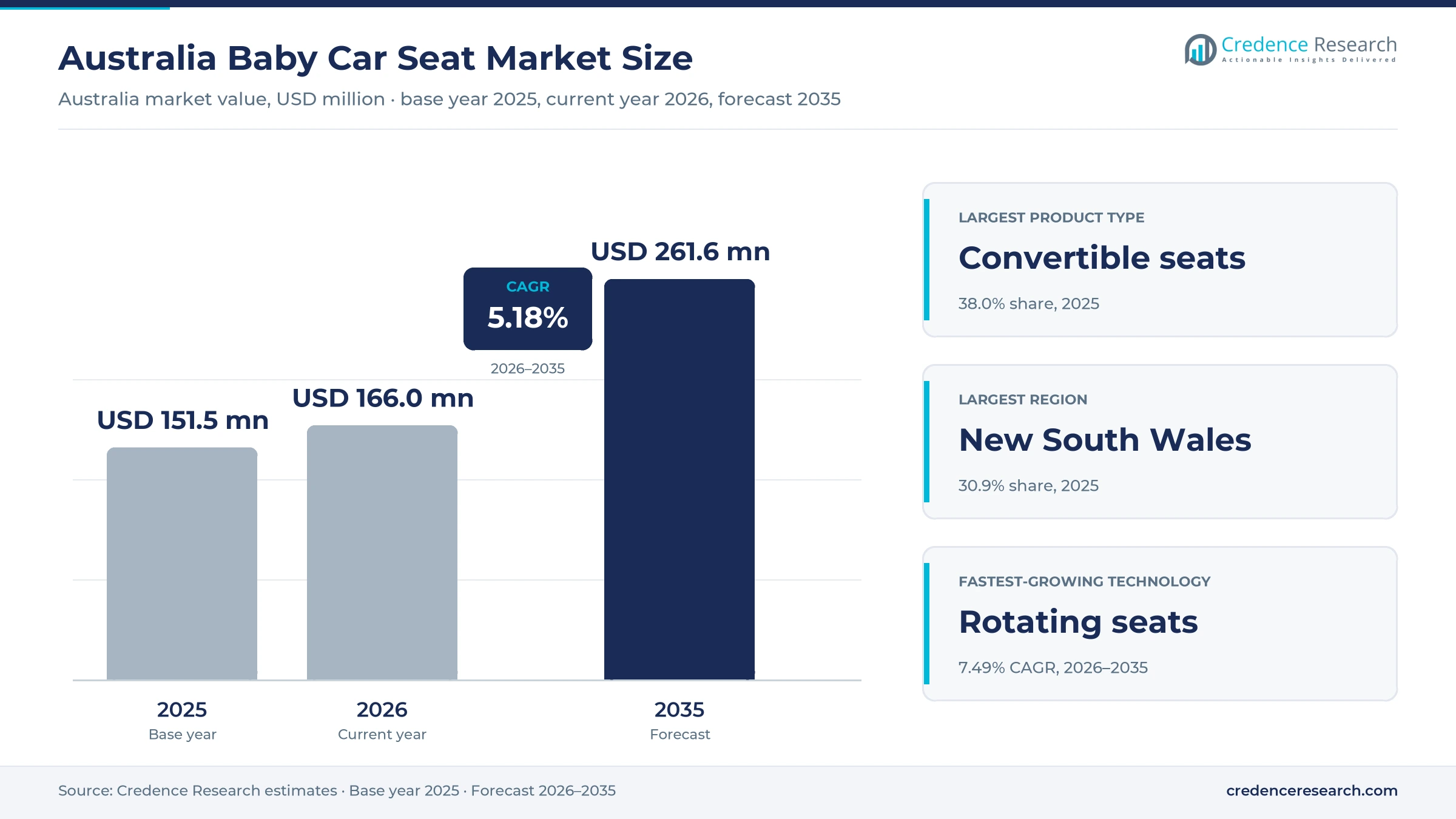
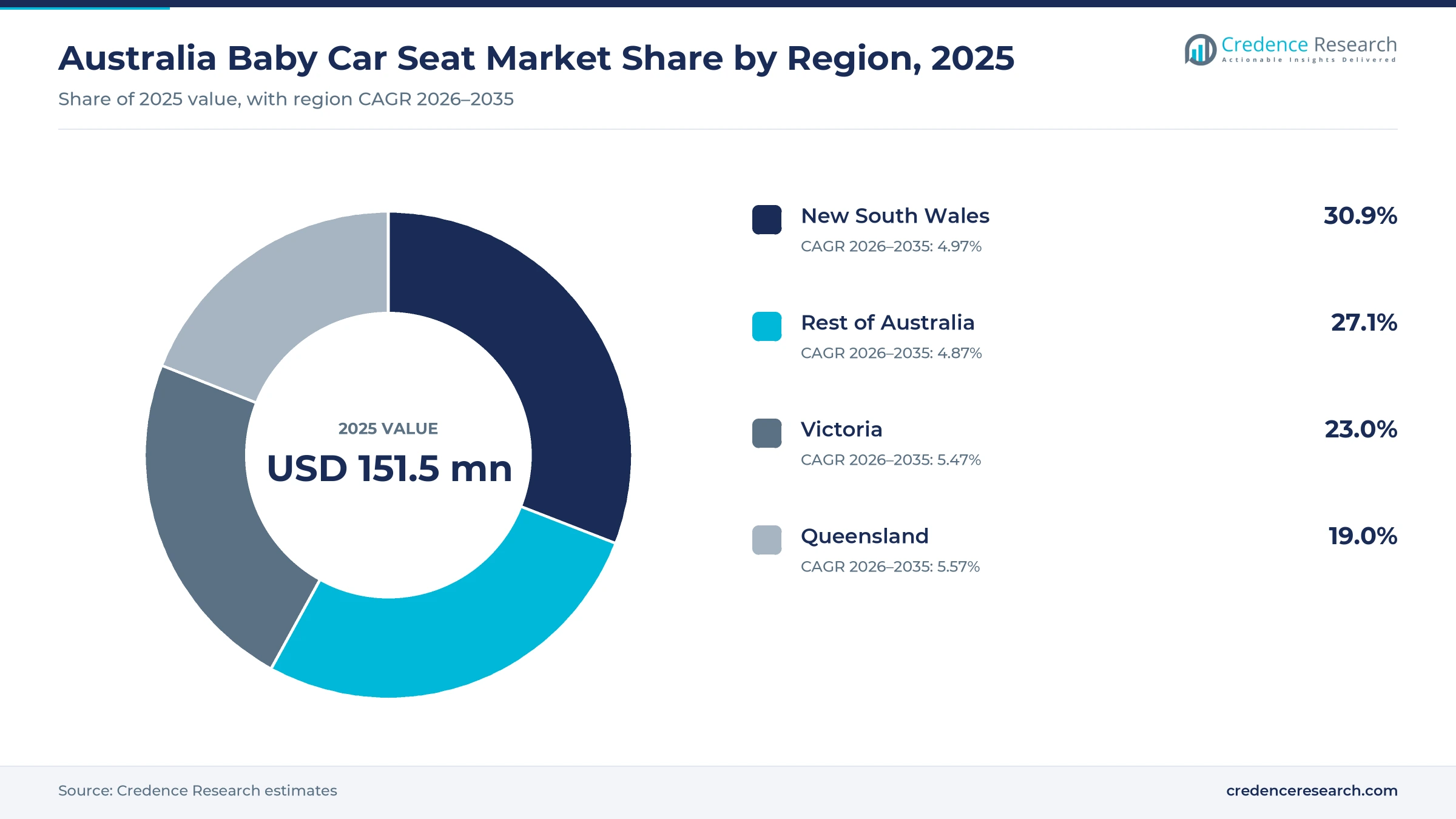
The Australia baby car seat market was valued at USD 151.5 million in 2025 and is projected to increase from USD 166.0 million in 2026 to USD 261.6 million by 2035, registering a CAGR of 5.18% during 2026–2035. Demand comes from parents, grandparents and childcare buyers that need an approved restraint for each stage from birth to about seven years. New South Wales held the largest regional share, 30.9% in 2025, because it records the most births and the most new vehicle sales in the country. Queensland is the fastest-growing region at 5.57% a year, as young families settle in the state and buy seats for more than one vehicle. The biggest regulatory change came in October 2025, when the national consumer regulator opened a limited review of the child restraint mandatory standard last updated in 2014. This review could shape design and labeling rules for future models.
Which child restraints and buyers does the estimate cover?
The estimate measures the value of new child restraints sold in Australia for use in private vehicles, including infant capsules, convertible seats, forward-facing harnessed seats and booster seats. It covers belt-only, ISOFIX-compatible and rotating designs sold to parents, relatives and childcare buyers through stores, websites and brand channels.
The estimate excludes secondhand restraints, hire services, prams, travel systems sold without a restraint and special-purpose restraints for children with medical needs. The value chain runs from global and local brands through importers and distributors to specialist baby stores, mass-market chains, online sellers and families in each region.
Australia Baby Car Seat Market Insights
- The Australia baby car seat market was valued at USD 151.5 million in 2025 and is projected to reach USD 261.6 million by 2035, registering a CAGR of 5.18% during 2026–2035.
- New South Wales held a 30.9% share of 2025 value, because the state registered 86,978 births in 2024, the most of any state.
- Convertible seats led with a 38.0% share of 2025 value, because one seat covers rearward and forward-facing use for several years.
- The national consumer regulator ran a limited review of the child restraint mandatory standard from Oct. 29 to Nov. 28, 2025.
- Rotating seats grow fastest at 7.49% a year during 2026–2035, as parents pay more for easier loading and correct fitting.
Convertible models lead while rotating designs grow fastest
Why do convertible seats hold the largest value?
Based on product type, the market is categorized into infant capsules, convertible seats, forward-facing harnessed seats and booster seats. Convertible Seats led with a 38.0% share of 2025 value, because one seat covers rearward and forward-facing use from birth to about four years. Convertible Seats also grow fastest at 5.73% a year, as families choose longer-use models with rotation and ISOFIX.
How does installation technology change prices?
Based on technology, the market is categorized into belt-only fixed seats, ISOFIX-compatible fixed seats and rotating seats. ISOFIX-Compatible Fixed Seats led with a 45.0% share of 2025 value, because most new vehicles have ISOFIX points and parents want a firmer fit. Rotating Seats grow fastest at 7.49% a year, as rotating bases make it easier to secure a child.
Which price tiers attract most spending?
Based on price tier, the market is categorized into value, mid-range and premium seats. Mid-Range led with a 42.0% share of 2025 value, because most families balance safety ratings, comfort and budget. Premium seats grow fastest at 6.16% a year, as rotating and lightweight models carry higher prices in specialist stores. Value seats keep a role in mass-market chains, because grandparents and childcare buyers often want a second seat at a lower price.
Which channels move the most restraints?
Based on distribution channel, the market is categorized into specialist baby retailers, mass-market retailers, online marketplaces and pureplays and brand direct. Specialist Baby Retailers led with a 46.0% share of 2025 value, because parents want advice and fitting help in store. Online Marketplaces and Pureplays grow fastest at 6.50% a year, as buyers compare models and prices online.
| Segment Group | Leading Sub-segment | Share, 2025 | Fastest-growing Sub-segment | CAGR, 2026–2035 |
|---|---|---|---|---|
| By Product Type | Convertible Seats | 38.0% | Convertible Seats | 5.73% |
| By Technology | ISOFIX-Compatible Fixed Seats | 45.0% | Rotating Seats | 7.49% |
| By Price Tier | Mid-Range | 42.0% | Premium | 6.16% |
| By Distribution Channel | Specialist Baby Retailers | 46.0% | Online Marketplaces and Pureplays | 6.50% |
Request a Free Sample
Fill in your details and we'll send you a free sample report.
- Sample data tables & charts
- Research methodology
Child growth stages, premium design and retail curation
How do successive growth stages create repeat purchases?
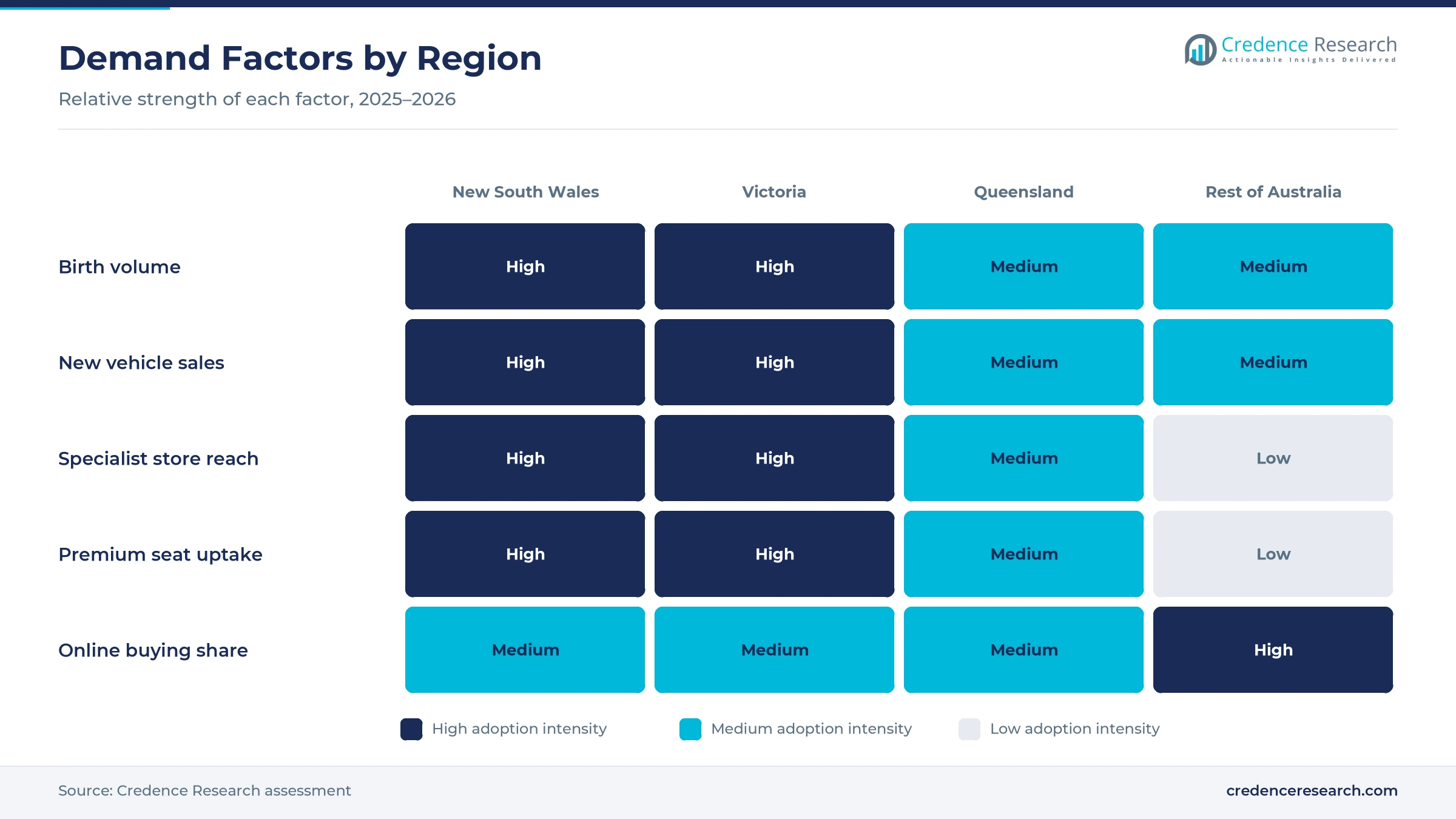
Successive child-development purchases create repeat demand, because Australian law requires a different restraint type as children grow. Children up to six months must ride in an approved rearward-facing seat, children from six months to four years need a harnessed seat and those from four to seven years need a harnessed seat or booster, according to Transport for NSW. Australia registered 292,318 births in 2024, up 1.9% from 2023, according to the Australian Bureau of Statistics. InfaSecure's Achieve seat, a 2018 Good Design gold winner, covers children from birth to eight years. As a result, convertible seats hold 38.0% of 2025 value, the largest product type.
Why do premium convenience and installation design lift value?
Premium convenience and installation design lift value, because parents pay more for seats that are easy to fit and load. Baby Bunting lists the Maxi-Cosi Raia 360 rotating convertible seat at A$999.99, while its Mico 12 Pro ISOFIX capsule costs A$549 against A$499 for the non-ISOFIX version. Baby Kingdom lists the Britax Safe-n-Sound B-Swivel LUX rotating convertible seat at A$849, which places it in the premium tier. Around 90% of more than 1,000 seats checked in a May 2023 blitz needed adjustment or reinstallation, according to Transurban. In turn, rotating seats grow at 7.49% a year, the fastest technology during 2026–2035.
How does specialist retail curation support sales?
Specialist retail execution and product curation support sales, because parents want expert advice before they buy a safety product. Baby Bunting, the largest specialty baby retailer in Australia, drew 47.1% of its fiscal 2025 sales from exclusive and private label brands, up 110 basis points. The chain reached 828,000 active customers, up 4.5%, and its three refurbished stores averaged 28% higher sales after reopening. It also announced plans to open five large-format stores and three small-format pilot stores in fiscal 2026. As a result, specialist baby retailers keep the largest channel share in the country, because parents still want to see, touch and test a seat before they buy it.
Why does the national safety standard shape demand?
The national safety standard shapes demand, because every restraint sold must meet a mandatory standard enforced by the consumer regulator. That standard first took effect in 1978 and was last updated in 2014, and the regulator opened a limited review on Oct. 29, 2025, with submissions due by Nov. 28, 2025, according to the Australian Competition and Consumer Commission. The AS/NZS 1754:2024 edition also added a section for tested variations that suit children with a disability. The Child Car Seats website rates more than 200 rearward, forward-facing and booster models for protection and ease of use. In turn, brands that win strong ratings gain share, while older belt-only models lose ground.
Rotating seats, exclusive ranges and fitting reshape demand
How is the shift to rotating seats changing demand?
The shift to rotating seats is changing demand, because a seat that turns toward the door makes loading easier and helps parents tighten the harness. Maxi-Cosi, Britax Safe-n-Sound and other brands now sell rotating convertible seats at A$849 to A$999.99 in Australian stores. SUVs made up 60.4% of new vehicles sold in the year to May 2025, up from 55.8% in 2024, according to the Federal Chamber of Automotive Industries. Larger SUVs with built-in ISOFIX points suit the heavier rotating bases. As a result, rotating seats grow fastest by technology, while belt-only fixed seats lose share during 2026–2035, because most families now drive vehicles with ISOFIX anchors.
Why is the rise of exclusive ranges notable?
The rise of exclusive and private label ranges is notable, because specialist retailers use them to stand out from online sellers and protect margins. Exclusive and private label brands made up 47.1% of Baby Bunting's fiscal 2025 sales, up from fiscal 2024. The chain also grew new customer acquisition by 6.2% in the same year, which widened the base for its exclusive ranges. It announced 10 to 12 store refurbishments for fiscal 2026 after early refurbished stores lifted sales. In turn, mid-range seats keep 42.0% of 2025 value, because exclusive ranges offer strong features at moderate prices, while strollers and prams are often sold alongside them.
Can professional fitting services open new revenue?
Professional fitting services can open new revenue, because many parents install restraints incorrectly and need expert help. Kidsafe Victoria found that 86% of more than 537 restraints checked in Yarra Ranges Shire were incorrectly installed or used, and 32% needed a complete refit. The 2023 national blitz corrected about 900 seats, and a correctly fitted seat can cut injury risk by up to 70%. Authorized restraint fitting stations operate at garages, service stations, hospitals, councils and some baby shops in New South Wales. As a result, retailers and brands that bundle fitting with each sale can win loyal customers across nursery safety products.
Is there room to grow through inclusive and longer-use designs?
Inclusive and longer-use designs offer room to grow, because new rules and steady birth numbers support demand for adaptable seats. Australia had about 27.2 million people in 2024, with 17.8% aged under 15 and a crude birth rate of 10.7 per 1,000 people, according to the World Bank. The AS/NZS 1754:2024 edition lets brands test variations for children with a disability. InfaSecure's Achieve seat already allows rearward-facing use to about 30 months and harnessed use to eight years. In turn, premium seats grow at 6.16% a year, as families pay more for models that last through several growth stages.
Low births, misuse and recalls weigh on restraint sales
How do low fertility rates limit volume growth?
Low fertility rates limit volume growth, because the total fertility rate fell to 1.481 births per woman in 2024 and families have fewer children. As a result, brands sell fewer first seats, and sales growth depends more on price, features and multi-vehicle buying. Companies respond with premium models, longer-use seats and spare bases, which raise value per family. Brands that also serve global child restraint demand can spread design costs across markets. This pressure affects value brands the most in every region.
Why does incorrect fitting damage buyer confidence?
Incorrect fitting damages buyer confidence, because nearly 40% of seats are used in ways that could seriously harm a child in a crash. In turn, parents may doubt complex designs and delay upgrades to newer seats. Brands and retailers respond with clearer instructions, ISOFIX connectors, rotation and in-store fitting, which make correct installation easier. This problem remains a major concern for safety groups, fitters and retailers across the country.
How do product recalls affect brands?
Product recalls affect brands, because a single defect can force refunds and damage trust in a model or range. The consumer regulator earlier recalled the Joie i-Travvel seat after a harness anchor detached in a crash test. As a result, brands spend more on testing and quality checks before launch, which raises costs. Companies respond with stronger supplier audits, batch tracing and faster recall processes, which limit damage to their reputation.
Why does the secondhand market reduce new sales?
The secondhand market reduces new sales, because some families buy used seats or pass seats between siblings and relatives. In turn, brands lose part of the demand from second and third children in each family. Retailers respond with trade-in programs, warnings about old or damaged seats and price promotions, which encourage new purchases. This habit weighs most on value and mid-range seats sold to cost-conscious families in regional towns.
New South Wales leads while Queensland grows fastest
| Region | Value, 2025 (USD million) | Share, 2025 | CAGR, 2026–2035 |
|---|---|---|---|
| New South Wales | 46.8 | 30.9% | 4.97% |
| Rest of Australia | 41.1 | 27.1% | 4.87% |
| Victoria | 34.8 | 23.0% | 5.47% |
| Queensland | 28.8 | 19.0% | 5.57% |
Why does New South Wales hold the largest share?
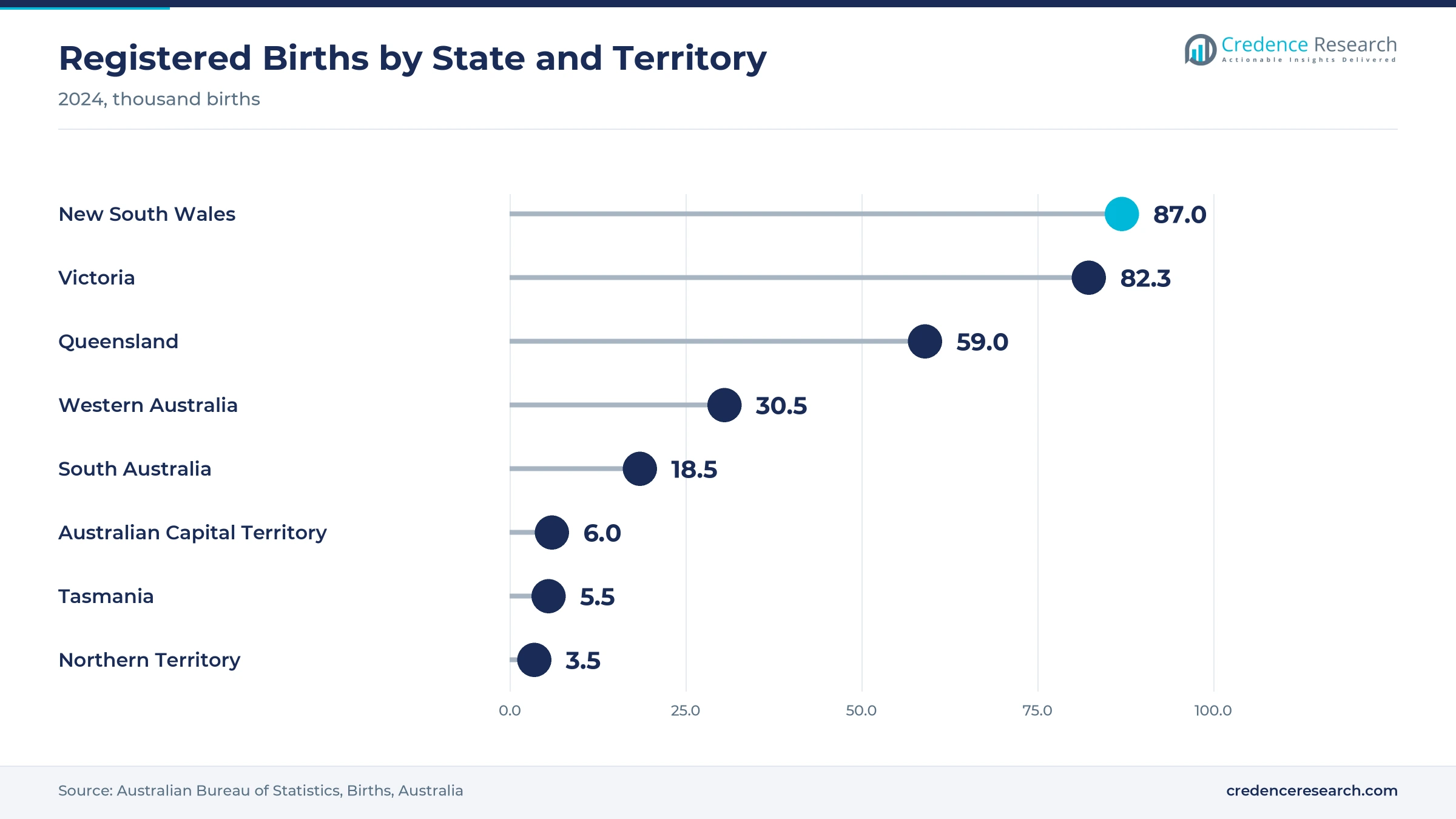
New South Wales held a 30.9% share of 2025 value and grows at 4.97% a year, because the state registered 86,978 births in 2024, the most in the country. New South Wales also led new vehicle sales with 32,177 units in May 2025, according to the Federal Chamber of Automotive Industries. Families there can use authorized restraint fitting stations at garages, hospitals and councils. As a result, New South Wales remains the largest regional market by a clear margin.
How does Victoria support steady demand?
Victoria held a 23.0% share of 2025 value and grows at 5.47% a year, because the state registered 82,328 births in 2024. That figure rose 12.9%, partly because the state cleared earlier birth registration delays, according to the national statistics office. Victoria also recorded 28,671 new vehicle sales in May 2025. In turn, Victoria adds steady demand for capsules, convertible seats and boosters each year.
What makes Queensland the fastest-growing region?
Queensland held a 19.0% share of 2025 value and grows fastest at 5.57% a year, because the state registered 58,986 births in 2024 and keeps a higher fertility rate than the national average. Queensland's total fertility rate was 1.505 in 2024, against 1.481 for Australia. The state also recorded 22,924 new vehicle sales in May 2025. As a result, Queensland adds new buyers faster than other regions.
Why do Western Australia and smaller states add steady demand?
The rest of Australia held a 27.1% share of 2025 value and grows at 4.87% a year, because Western Australia, South Australia, Tasmania and the territories together registered more than 64,000 births in 2024. Western Australia registered 30,516 births and South Australia registered 18,516 births in the same year. In turn, this group adds steady demand, although smaller towns rely more on mass-market and online channels.
Standards reviews, retail plans and data releases since 2025
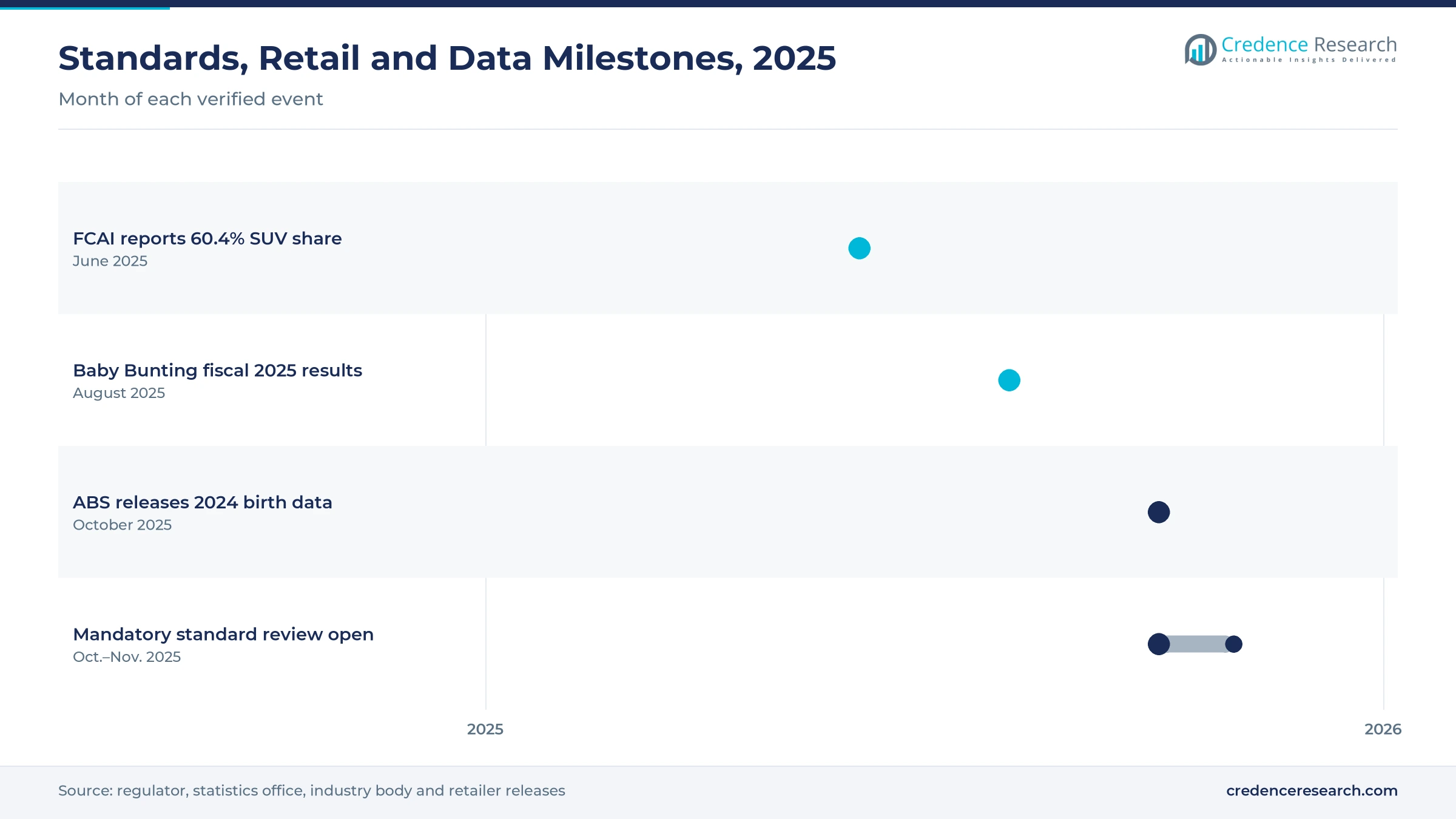
| Development | Status and market relevance |
|---|---|
| In June 2025, the Federal Chamber of Automotive Industries reported that SUVs made up 60.4% of new vehicles sold in the year to May. | Supports demand for ISOFIX and rotating seats |
| In August 2025, Baby Bunting reported that exclusive and private label brands made up 47.1% of fiscal 2025 sales. | Strengthens curated ranges in specialist stores |
| In October 2025, the Australian Bureau of Statistics reported 292,318 registered births for 2024. | Confirms a stable base of first-time buyers |
| In October 2025, the consumer regulator opened a limited review of the child restraint mandatory standard. | Could update design and labeling rules for new models |
ISOFIX, rotation and impact protection define new models
- ISOFIX connectors lock the seat to anchor points built into the vehicle, which gives a firmer fit and reduces common installation mistakes.
- Rotating bases turn the seat toward the door, which makes it easier to place a child and tighten the harness correctly.
- Side impact protection uses energy-absorbing foam, wings and headrests that spread crash forces away from the head and neck, a feature brands also promote in European child restraint sales.
- Adjustable harness and headrest systems let parents change height with one hand as the child grows, which extends use across several stages.
Need a Custom Version of This Report?
Tailor the scope, geography, or segments to your exact requirements.
- Custom geography or segment scope
- Direct access to our analyst team
Global nursery brands and local specialists compete
Competition combines global nursery brands with wide product ranges and local specialists that design for Australian standards. Maxi-Cosi competes in capsules and rotating convertible seats sold through specialist stores such as Baby Bunting. Britax Safe-n-Sound competes in convertible and rotating seats, including the B-Swivel LUX. InfaSecure competes with long-use convertible seats such as the Achieve, which won a Good Design gold award. Joie competes in ISOFIX and booster seats and has faced a past recall. Mother's Choice, Nuna, CYBEX, UPPAbaby, BabyLove and Safety 1st are also tracked in the company list. Rivals compete on crash ratings, ease of fitting, comfort, rotation, price and retail placement, which keeps independent ratings and in-store advice central to every brand.
Which brands serve Australian families?
| Company | Type | Role in the market |
|---|---|---|
| Maxi-Cosi | Global nursery brand | Sells the Raia 360 rotating seat and Mico 12 Pro capsule in Australia |
| Britax Safe-n-Sound | Restraint brand | Sells the B-Swivel LUX rotating convertible seat |
| InfaSecure | Australian-designed brand | Makes the Achieve seat for children from birth to eight years |
| Joie | Global nursery brand | Sells ISOFIX and booster models in Australia |
Credence Research view on Australian restraint demand
Credence Research's view is that Australian child restraint sales will grow steadily because legal stage rules force several purchases per child while parents trade up to rotating and ISOFIX models. Convertible seats remain the largest value pool, while rotating seats, premium tiers and online channels add the fastest growth. The review of the mandatory standard could favor brands with strong test records. Retailers that pair curated ranges with fitting help should gain the most, because many parents still struggle to install seats correctly.
How the national child restraint estimate was built
The report uses 2025 as the base year on a calendar basis, and market values come from the Credence Research model. That model combines national birth statistics, vehicle sales data, road rules, safety standard notices, retail company results and retail price listings. Regional shares follow the client-provided split, while segment splits and growth rates are Credence Research estimates. Sources used are international agency data, national statistics, government and regulator pages, industry body releases, retailer results and product listings, and no interviews or surveys were used.
Rotating seats and online buying carry growth to 2035
The Australia baby car seat market is expected to reach USD 261.6 million by 2035, a 5.18% CAGR during 2026–2035, as families buy seats for each growth stage and trade up to rotating and ISOFIX models. Growth should be strongest in rotating seats, premium tiers, online channels and Queensland, because these areas gain most from new designs and young families. Low fertility, fitting errors and secondhand seats could slow volume growth, while a revised safety standard may lift demand for newer models.
Frequently Asked Questions
How big is the Australia baby car seat market?
Which product type leads Australian child restraint sales?
Which region leads the market?
What do Australian road rules require for young children?
Why are rotating seats growing quickly?
How common are fitting mistakes?
Who are the leading companies in this market?
What are the main challenges for car seat brands?
Table of Content
Chapter 1 Market Segmentation
- 1.1 Segmentation Framework
- 1.1.1 Product and Service Classification
- 1.1.2 Application and End-Use Classification
- 1.1.3 Technology and Solution Classification
- 1.1.4 Customer and Distribution Channel Classification
- 1.1.5 Geographic Segmentation
- 1.1.6 Market Segment Definitions and Boundaries
- 1.2 By Product Type
- 1.2.1 Infant Capsules
- 1.2.2 Convertible Seats
- 1.2.3 Forward-Facing Harnessed Seats
- 1.2.4 Booster Seats
- 1.3 By Technology
- 1.3.1 Belt-Only Fixed Seats
- 1.3.2 ISOFIX-Compatible Fixed Seats
- 1.3.3 Rotating Seats
- 1.4 By Price Tier
- 1.4.1 Value
- 1.4.2 Mid-Range
- 1.4.3 Premium
Chapter 2 Introduction
- 2.1 Report Objectives and Scope
- 2.2 Product Definition and Industry Terminology
- 2.3 Market Inclusions and Exclusions
- 2.4 Research Process
- 2.4.1 Primary Research and Expert Interviews
- 2.4.2 Secondary Research and Source Review
- 2.4.3 Top-Down and Bottom-Up Estimation
- 2.4.4 Data Triangulation and Verification
- 2.5 Market Size Measurement Basis
- 2.5.1 2025: USD 151.5 million → 2035: USD 261.6 million
- 2.6 Historical and Forecast Reference Periods
- 2.6.1 Historical Period: 2018-2025
- 2.6.2 Base Year: 2025
- 2.6.3 Forecast Period: 2025-2035
- 2.7 Research Assumptions and Limitations
Chapter 3 Executive Summary
- 3.1 Market Snapshot and Key Findings
- 3.2 Base-Year Market Size, 2025
- 3.3 Forecast Market Size, 2035
- 3.4 Revenue and Volume Growth Outlook
- 3.5 Key Demand and Supply Indicators
- 3.6 Leading Market Segments
- 3.7 Fastest-Growing Market Opportunities
- 3.8 Regional Performance Highlights
- 3.9 Technology and Industry Transformation
- 3.10 Competitive Landscape Summary
- 3.11 Analyst View and Strategic Implications
Chapter 4 Australia Baby Car Seat Market Trends and Developments
- 4.1 Historical Industry Development, 2018-2025
- 4.2 Recent Market Trends and Developments
- 4.3 Demand and Customer Behavior Trends
- 4.4 Technology and Product Innovation
- 4.5 Artificial Intelligence, Automation and Digitalization
- 4.6 Local Manufacturing and Supply Chain Realignment
- 4.7 Industry Partnerships, Mergers and Acquisitions
- 4.8 Sustainability and Circular Economy Developments
- 4.9 Government and Private Sector Investment Trends
- 4.10 Emerging Business Models and Commercialization
- 4.11 Industry Developments and Announcements
Chapter 5 Australia Baby Car Seat Market Production, Supply and Demand Analysis
- 5.1 Demand Trend and Consumption Analysis, 2018-2025
- 5.2 Demand Forecast, 2025-2035
- 5.3 Production and Output Trend, 2018-2025
- 5.4 Production and Output Forecast, 2025-2035
- 5.5 Installed Capacity and Capacity Utilization
- 5.6 Company-Wise Production Plants and Statistics
- 5.6.1 Installed Production Capacity
- 5.6.2 Actual Production
- 5.6.3 Planned Capacity and Expansion Targets
- 5.7 Supply Chain Structure and Procurement Trends
- 5.8 Supply-Demand Gap and Bottlenecks
- 5.9 Import Dependence and Sourcing Structure
- 5.10 Contract Manufacturing and Outsourcing
- 5.11 Regional Supply and Demand Concentration
Chapter 6 Australia Baby Car Seat Market Pricing Analysis
- 6.1 Pricing Structure and Measurement
- 6.2 Historical Pricing Trends, 2018-2025
- 6.3 Pricing Outlook, 2025-2035
- 6.4 Average Selling Price and Unit Economics
- 6.5 Pricing by Product and Market Segment
- 6.6 Geographic Pricing Differences
- 6.7 Key Input, Energy, Labor and Logistics Costs
- 6.8 Contract Pricing and Purchasing Models
- 6.9 Pricing Sensitivity and Competitive Positioning
- 6.10 Price, Margin and Profitability Implications
Chapter 7 Australia Baby Car Seat Market Dynamics
- 7.1 Market Growth Drivers
- 7.1.1 Demand-Side Drivers
- 7.1.2 Technology and Innovation Drivers
- 7.1.3 Infrastructure and Investment Drivers
- 7.1.4 Regulatory and Policy Drivers
- 7.2 Market Restraints
- 7.2.1 Cost and Affordability Constraints
- 7.2.2 Technology and Adoption Barriers
- 7.2.3 Supply Chain and Operational Constraints
- 7.3 Market Challenges
- 7.3.1 Competitive Pressure and Margin Erosion
- 7.3.2 Skills, Infrastructure and Implementation Gaps
- 7.4 Emerging Market Opportunities
- 7.5 Market Dynamics Impact and Time-Horizon Assessment
Chapter 8 Australia Baby Car Seat Value Chain Analysis
- 8.1 Industry Value Chain Overview
- 8.2 Upstream Suppliers and Critical Inputs
- 8.3 Technology and Component Providers
- 8.4 Manufacturing or Service Delivery
- 8.5 Distribution, Channel Partners and Integrators
- 8.6 Downstream Applications and End Users
- 8.7 Value Addition and Profit Pools
- 8.8 Vertical Integration and Outsourcing
- 8.9 Supplier Concentration and Risk
- 8.10 Supply Chain Localization and Resilience
Chapter 9 Australia Baby Car Seat Market Regulations and Policies
- 9.1 Relevant Laws, Standards and Compliance Frameworks
- 9.2 Product, Service, Safety and Quality Requirements
- 9.3 Government Policies, Incentives and Subsidies
- 9.4 Imports, Exports and Trade Barriers
- 9.5 Public Procurement and Local Content Requirements
- 9.6 Environmental and Sustainability Compliance
- 9.7 Upcoming Policy Changes and Market Implications
Chapter 10 Australia Baby Car Seat Market Hotspots and Opportunities
- 10.1 Market Opportunity Mapping and Growth Hotspots
- 10.2 High-Growth Applications and Customer Groups
- 10.3 Underserved Markets and White-Space Opportunities
- 10.4 Emerging Technology and Product Opportunities
- 10.5 New Capacity and Investment Hotspots
- 10.6 Market Entry and Expansion Opportunities
- 10.7 Distribution and Partnership Opportunities
- 10.8 Near-Term and Long-Term Commercial Potential
- 10.9 Opportunity Attractiveness and Execution Risks
Chapter 11 Australia Baby Car Seat Market Outlook, 2025-2035
- 11.1 Market Size and Analysis
- 11.1.1 Revenue (Market Measurement: 2025: USD 151.5 million → 2035: USD 261.6 million)
- 11.1.2 Market Volume and Quantity Sold
- 11.1.3 Historical Market Size, 2018-2025
- 11.1.4 Base-Year Market Size, 2025
- 11.2 Market Forecast, 2025-2035
- 11.2.1 Revenue Forecast to 2035
- 11.2.2 Volume Forecast to 2035
- 11.2.3 CAGR and Year-on-Year Growth
- 11.2.4 Incremental Revenue Opportunity
- 11.3 Forecast Assumptions and Scenario Analysis
- 11.3.1 Base-Case Forecast
- 11.3.2 Optimistic and Conservative Scenarios
- 11.3.3 Technology, Pricing and Policy Sensitivities
- 11.4 Market Attractiveness and Growth Outlook
Chapter 12 Australia Baby Car Seat Market Segmentation and Outlook
- 12.1 Segmentation Summary and Market Shares, 2025
- 12.2 Largest and Fastest-Growing Segments
- 12.3 By Product Type - Market Size and Forecast, 2025-2035
- 12.3.1 Segment Definition and Scope
- 12.3.2 Historical Market Size, 2018-2025
- 12.3.3 Revenue Forecast, 2025-2035
- 12.3.4 Volume Forecast, 2025-2035
- 12.3.5 Base-Year Market Share, 2025
- 12.3.6 Segment CAGR and Growth Drivers
- 12.3.7 Subsegment Market Size and Forecast
- 12.3.7.1 Infant Capsules
- 12.3.7.2 Convertible Seats
- 12.3.7.3 Forward-Facing Harnessed Seats
- 12.3.7.4 Booster Seats
- 12.3.8 Subsegment Pricing and Adoption Trends
- 12.3.9 Leading Suppliers and Competition
- 12.3.10 Regional Demand and Opportunities
- 12.4 By Technology - Market Size and Forecast, 2025-2035
- 12.4.1 Segment Definition and Scope
- 12.4.2 Historical Market Size, 2018-2025
- 12.4.3 Revenue Forecast, 2025-2035
- 12.4.4 Volume Forecast, 2025-2035
- 12.4.5 Base-Year Market Share, 2025
- 12.4.6 Segment CAGR and Growth Drivers
- 12.4.7 Subsegment Market Size and Forecast
- 12.4.7.1 Belt-Only Fixed Seats
- 12.4.7.2 ISOFIX-Compatible Fixed Seats
- 12.4.7.3 Rotating Seats
- 12.4.8 Subsegment Pricing and Adoption Trends
- 12.4.9 Leading Suppliers and Competition
- 12.4.10 Regional Demand and Opportunities
- 12.5 By Price Tier - Market Size and Forecast, 2025-2035
- 12.5.1 Segment Definition and Scope
- 12.5.2 Historical Market Size, 2018-2025
- 12.5.3 Revenue Forecast, 2025-2035
- 12.5.4 Volume Forecast, 2025-2035
- 12.5.5 Base-Year Market Share, 2025
- 12.5.6 Segment CAGR and Growth Drivers
- 12.5.7 Subsegment Market Size and Forecast
- 12.5.7.1 Value
- 12.5.7.2 Mid-Range
- 12.5.7.3 Premium
- 12.5.8 Subsegment Pricing and Adoption Trends
- 12.5.9 Leading Suppliers and Competition
- 12.5.10 Regional Demand and Opportunities
- 12.6 Segment Growth Comparison
- 12.7 Segment Attractiveness and Priority Matrix
Chapter 13 Australia Baby Car Seat Geographic Market Outlook, 2025-2035
- 13.1 Domestic Market Distribution and Demand Clusters
- 13.2 State- or Province-Wise Market Size and Forecast, 2025-2035
- 13.3 City and Metropolitan Market Outlook
- 13.4 Industrial, Manufacturing and Commercial Clusters
- 13.5 Geographic Concentration of Key End Users
- 13.6 Local Pricing and Purchasing Differences
- 13.7 Domestic Production Facilities and Capacity Map
- 13.8 Local Infrastructure and Project Pipeline
- 13.9 State-Level Policy and Incentive Differences
- 13.10 Subnational Investment Hotspots and Opportunities
- 13.11 Distribution and Logistics Networks
- 13.12 Domestic Competitive Footprint
Chapter 14 Australia Baby Car Seat Technology, Innovation and Sustainability Outlook
- 14.1 Technology Landscape and Maturity
- 14.2 Product, Process and Service Innovation
- 14.3 AI, Automation and Digital Tools in the Industry
- 14.4 Technology Adoption and Performance Benchmarking
- 14.5 Innovation Pipeline and R&D Investment
- 14.6 Patent and Intellectual Property Trends
- 14.7 Energy Efficiency and Resource Management
- 14.8 Sustainability, Recycling and Circularity
- 14.9 Technology Roadmap, 2025-2035
- 14.10 Risks of Obsolescence and Technology Substitution
Chapter 15 Australia Baby Car Seat Market Key Strategic Imperatives
- 15.1 Growth and Market Entry Priorities
- 15.2 High-Return Products and Segments
- 15.3 Pricing, Profitability and Cost Optimization
- 15.4 Technology Investment and Product Differentiation
- 15.5 Supply Chain Localization and Resilience
- 15.6 Distribution and Customer Acquisition
- 15.7 Partnership, Acquisition and Capacity Strategy
- 15.8 Regional Expansion Priorities
- 15.9 Short-, Medium- and Long-Term Actions
Chapter 16 Competition Outlook
- 16.1 Industry Competition Characteristics
- 16.2 Market Structure and Concentration
- 16.3 Market Share and Competitive Positioning, 2025
- 16.4 Company-Wise Revenue and Product Benchmarking
- 16.5 Production and Service Capacity Benchmarking
- 16.6 Technology, Pricing and Differentiation
- 16.7 Regional Footprint and Distribution Strength
- 16.8 Mergers, Acquisitions and Strategic Alliances
- 16.9 New Entrants and Competitive Threats
- 16.10 Porter's Five Forces and Industry Attractiveness
- 16.11 Competitive Outlook, 2025-2035
Chapter 17 Company Profiles
- 17.1 Company Coverage and Selection Criteria
- 17.2 Britax Safe-n-Sound
- 17.2.1 Business Description
- 17.2.2 Company Ownership and Geographic Presence
- 17.2.3 Product and Service Portfolio
- 17.2.4 Manufacturing and Operating Footprint
- 17.2.5 Production Capacity and Expansion Plans
- 17.2.6 Financial Performance and Investment
- 17.2.7 Market Share and Competitive Position
- 17.2.8 Technology and Innovation Capabilities
- 17.2.9 Strategic Alliances or Partnerships
- 17.2.10 Recent Developments
- 17.2.11 Growth Strategy and Outlook
- 17.3 Maxi-Cosi
- 17.4 InfaSecure
- 17.5 Mother's Choice
- 17.6 Joie
- 17.7 Nuna
- 17.8 CYBEX
- 17.9 UPPAbaby
- 17.10 BabyLove
- 17.11 Safety 1st
- 17.12 Other Relevant Market Participants
Note: Every listed company is profiled on the structure shown under the first company. The company list is preliminary and may change based on research findings, market developments, data availability and client requirements.
Chapter 18 Disclaimer
- 18.1 Research and Forecast Disclaimer
- 18.2 Data Source and Estimation Limitations
Note: The depth of individual sections depends on data availability for this market. Volume, capacity, trade and other unit-based metrics are included where applicable.

