
| REPORT ATTRIBUTE | DETAILS |
|---|---|
| Historical Period | 2019-2022 |
| Base Year | 2023 |
| Forecast Period | 2024-2032 |
| X-Ray Equipment Market Size 2023 | USD 17512.2 Million |
| X-Ray Equipment Market, CAGR | 3.40% |
| X-Ray Equipment Market11 Size 2032 | USD 23660.58 Million |
Market Insights
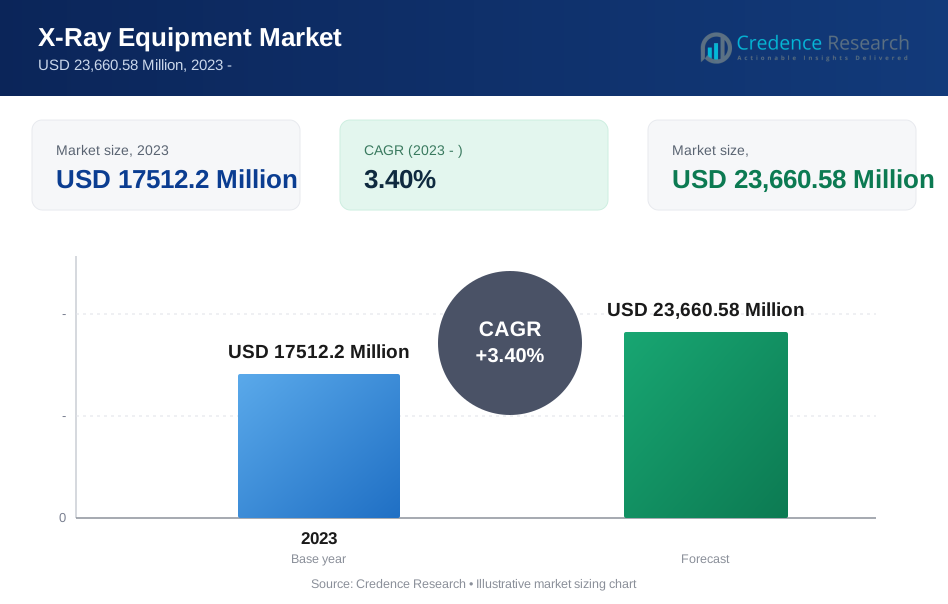
- The global demand for X-Ray Equipment was valued at USD 17512.2 Million in 2023 and is expected to reach USD 23660.58 Million in 2032, growing at a CAGR of 3.40% between 2024 and 2032.
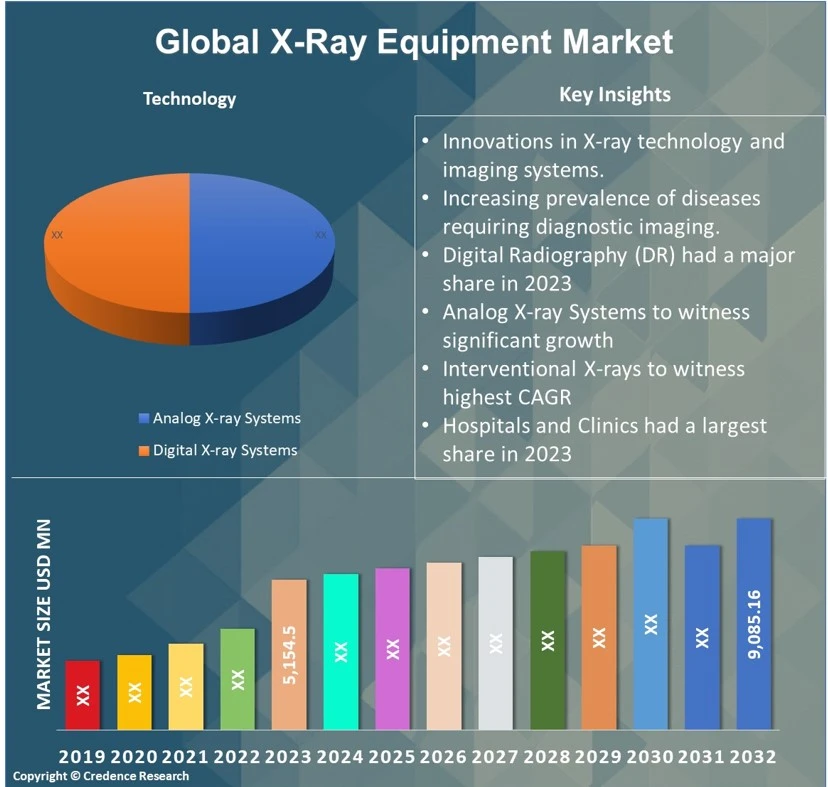
- The Digital Radiography (DR) sector is the market leader by interface type, accounting for more than 31% of total value in 2023, while the Computed Tomography (CT) segment is expected to grow rapidly throughout the forecast period.
- The Analog X-ray Systems technology dominates the global need for X-Ray Equipment, accounting for more than 55% in 2023 and Digital X-ray Systems technology is predicted to expand at a high CAGR.
- The Interventional X-rays sector is predicted to grow fastest over the projection period, while the Diagnostic X-rays segment will have a market share of more than 25% in 2023.
- Over the projection period, the Diagnostic Imaging Centers end user is expected to expand at the highest rate, while the Hospitals and Clinics end user will dominate the market in 2023 with a 25% share.
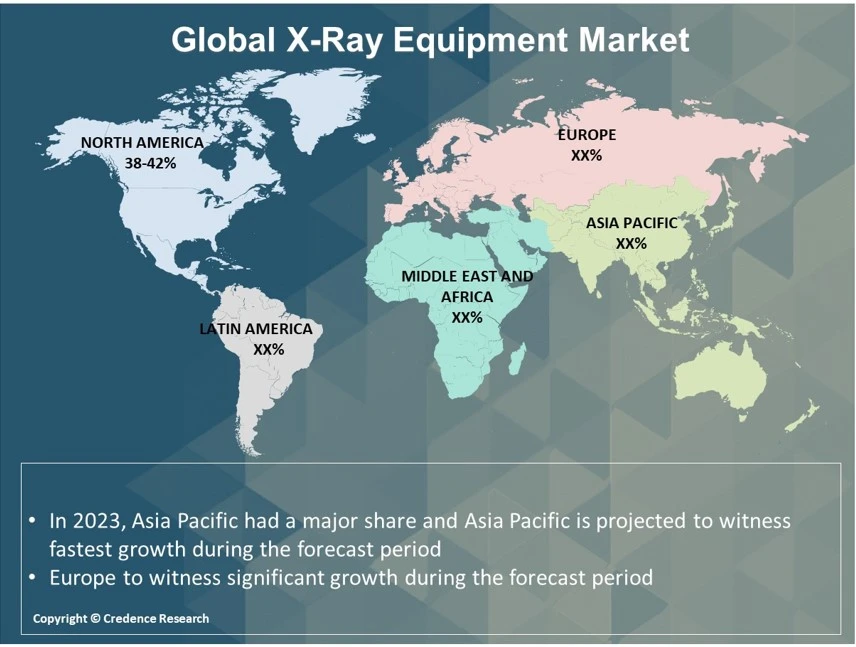
- North America is fueling the growth of the X-Ray Equipment industry with over one-third share in 2023, while Asia Pacific and Europe collectively account for just under 55% share in 2023. Europe held over 20% share in 2023.
- Due to rising incidence of chronic diseases, the market for X-Ray Equipment is driven by increasing awareness and health consciousness and increased adoption of X-Ray Equipment.
- The market's primary possibilities include the significant growth potential in North America, supportive government initiatives and policies.
Executive Summary
Market Definition
The X-ray equipment refers to a set of medical devices that utilize X-rays, which are a form of electromagnetic radiation, for diagnostic or therapeutic purposes. These devices are widely used in the field of medical imaging to visualize the internal structures of the human body. The basic components of X-ray equipment include an X-ray tube, which produces the X-rays, and a detector, which captures the X-rays after they pass through the body. The interaction of X-rays with different tissues in the body results in varying levels of radiation absorption, creating detailed images of bones, organs, and other structures.
Market Overview
The global demand for X-Ray Equipment was valued at USD 17512.2 Million in 2023 and is expected to reach USD 23660.58 Million in 2032, growing at a CAGR of 3.40% between 2024 and 2032.The key driver boosting the growth rate of the X-Ray Equipment market is the advancements in technology play a crucial role. When scientists and engineers discover new ways to make X-ray machines better, like producing clearer images or making the equipment more portable, it encourages more people to use these machines for medical purposes.
Furthermore, the increase in chronic diseases, especially as people get older, leads to a higher demand for diagnostic tools like X-rays. As more individuals face health challenges, the need for accurate and quick medical imaging grows, boosting the overall demand for X-ray equipment. These factors, along with improvements in healthcare infrastructure, awareness campaigns, and government support, contribute to the expansion of the X-ray equipment market.
In addition, the increasing investments in research and development and the miniaturization of X-ray equipment will create several new opportunities for the X-Ray Equipment market to expand during the time covered by the estimate.
Segmentation by Type of X-ray Equipment
- Digital Radiography (DR) is the leading segment by interface type and held over 31% share in value in 2023, attributable to the increasing prevalence of diseases requiring diagnostic imaging.
- The Computed Tomography (CT) segment will likely exhibit a significant CAGR during the forecast period. Growth in public awareness campaigns in driving demand for diagnostic services.
- Portable/Handheld X-ray Devices is another segment but contributes very little to the global X-Ray Equipment market compared to the Digital Radiography (DR), and Computed Tomography (CT) segments.
Segmentation by Technology
- The Analog X-ray Systems segment governs the demand for X-Ray Equipment in the world, holding a massive share of over 55% in 2023, and Digital X-ray Systems is also expected to grow at a rapid CAGR because influence of government policies on the adoption and accessibility of X-ray equipment. In addition, the rising R&D investments on product innovation and market growth.
- The Digital X-ray Systems sectors segment contributes to the demand for X-Ray Equipment during the forecast period.
Segmentation by Application
- The Interventional X-rays segment is expected to post the highest CAGR during the forecast period. This is primarily due to globalization in expanding the market for X-ray equipment.
- The Diagnostic X-rays segment is leading the market share with over 25% share in 2023.
Segmentation by End-User
- The diagnostic imaging centers segment is anticipated to register the highest CAGR during the projection period.
- With a market share of nearly 25% in 2023, the hospitals and clinics category is currently in the lead.
- The other end-user of X-Ray equipment includes ambulatory surgical centers, and emergency care centers.
Segmentation by Region
- North America is fueling the growth of the X-Ray Equipment industry with over one-third share in 2023 due to the supportive government policies on the adoption and accessibility of X-ray equipment.
- Asia Pacific and Europe collectively account for just under 55% share in 2023, with Europe holding over 20% share in the same year.
- The rest of the world, including Latin America, the Middle East, and Africa, supplies the remaining demand for X-Ray Equipment.
The market for X-Ray Equipment is driven by increasing prevalence of diseases requiring diagnostic imaging and growth potential in developing regions with expanding healthcare facilities.
North America is a dominating region in the global X-ray equipment market, driven by a combination of advanced healthcare infrastructure, a high prevalence of chronic diseases, and robust technological advancements. The region's well-established medical facilities and a strong emphasis on adopting cutting-edge diagnostic technologies contribute to the significant market share. Moreover, the presence of leading manufacturers and continuous investments in research and development further solidify North America's leadership position. The demand for sophisticated imaging solutions in the diagnosis and treatment of various medical conditions, coupled with a growing aging population, continues to propel the X-ray equipment market forward in this region.
The Asia Pacific is expected to be the fastest-growing region over the forecast period. The growth is fueled by factors such as increasing healthcare awareness, rising disposable income, and substantial investments in healthcare infrastructure. Developing economies within Asia Pacific are witnessing a surge in demand for medical imaging technologies, including X-ray equipment, as they strive to enhance their healthcare capabilities. The rapid urbanization and lifestyle changes in the region contribute to the growing incidence of chronic diseases, boosting the need for advanced diagnostic tools. Furthermore, supportive government initiatives, collaborations with global healthcare organizations, and the adoption of innovative technologies drive the expansion of the X-ray equipment market in the Asia Pacific region.
The primary factor driving the X-Ray Equipment market's growth rate is the advancements in technology play a crucial role. When scientists and engineers discover new ways to make X-ray machines better, like producing clearer images or making the equipment more portable, it encourages more people to use these machines for medical purposes.
Key Highlights of the Report
The global X-Ray Equipment market is segmented by type of x-ray equipment, technology, application, end-user, and region. Digital Radiography (DR)-based X-Ray Equipment are the most popular, while computed tomography (CT), and fluoroscopy are the primary segments. In addition, Analog X-ray Systems and Diagnostic X-rays are the most commonly used categories. However, Hospitals and Clinics dominate the market, with North America leading the market growth.
One of the main factors propelling the global market for X-Ray Equipment is the increase in chronic diseases, especially as people get older, leads to a higher demand for diagnostic tools like X-rays. As more individuals face health challenges, the need for accurate and quick medical imaging grows, boosting the overall demand for X-ray equipment. These factors, along with improvements in healthcare infrastructure, awareness campaigns, and government support, contribute to the expansion of the X-ray equipment market.
Nonetheless, North America is anticipated to have the greatest share of the worldwide X-Ray Equipment market because of the supportive government policies on the adoption and accessibility of X-ray equipment. Furthermore, the market is anticipated to expand at the highest rate in the Asia-Pacific (APAC) region due to the growth potential in developing regions with expanding healthcare facilities.
What Are The Main Drivers Of The Global X-Ray Equipment Market?
The main drivers of the global X-ray equipment market are multifaceted, encompassing technological advancements, increasing prevalence of chronic diseases, an aging population, global healthcare infrastructure development, and growing awareness and health consciousness. Continuous innovations in X-ray technology, such as enhanced imaging capabilities and the integration of artificial intelligence, play a pivotal role in driving market growth. The rising incidence of chronic diseases, particularly cardiovascular conditions and cancer, fuels the demand for diagnostic imaging services, contributing to the widespread adoption of X-ray equipment.
What Are The Major Challenges Faced By The Global X-Ray Equipment Market?
The global X-ray equipment market faces major challenges such as the high cost associated with acquiring and maintaining advanced X-ray equipment poses a significant barrier, particularly for healthcare facilities in resource-limited settings. Concerns about radiation exposure, despite safety measures, persist and lead to increased scrutiny and the need for ongoing safety improvements.
What Are The Growth Opportunities In The Global X-Ray Equipment Market?
Expanding market presence in emerging economies, driven by increasing healthcare investments and rising demand for diagnostic services, presents a significant avenue for growth. Continued investment in research and development for advanced imaging technologies, such as 3D and 4D imaging, offers opportunities for market expansion and product differentiation.
Market Drivers
The global X-Ray Equipment market is driven by several factors. The following are the key drivers of the global X-Ray Equipment market:
Technological Advancements and Innovation
The global X-ray equipment market is growing due to the continuous progress in technological advancements and innovation. Ongoing developments in X-ray technology, including improvements in imaging resolution, faster scanning times, and the integration of artificial intelligence (AI), enhance the diagnostic capabilities of X-ray equipment. Advanced features contribute to more accurate and efficient diagnoses, driving the adoption of X-ray equipment in medical facilities. The incorporation of innovative technologies not only improves the quality of medical imaging but also positions manufacturers at the forefront of market competition.
Market Restraints
The global X-Ray Equipment market faces some challenges that may hinder its growth. These include the following:
High Cost of Acquisition and Maintenance
The global X-ray equipment market is hampered by the high cost associated with acquiring and maintaining advanced X-ray machines. The initial investment required for purchasing state-of-the-art equipment and the ongoing expenses for maintenance and upgrades can be a significant financial burden for healthcare facilities, particularly in resource-limited settings. The cost factor poses challenges to widespread adoption, limiting access to advanced diagnostic services in certain regions and impacting the overall market penetration of X-ray equipment.
Opportunities
The global X-Ray Equipment market offers significant growth opportunities. These include the following:
Expansion in Emerging Markets
Growth in the global X-ray equipment market lies in expanding market presence in emerging economies. Increasing healthcare investments, rising disposable income, and growing awareness of the importance of early disease detection create a conducive environment for market expansion. As these regions focus on enhancing their healthcare infrastructure, there is an increased demand for advanced diagnostic services, providing a significant growth opportunity for X-ray equipment manufacturers. Capitalizing on the untapped potential in emerging markets can lead to increased sales and a broader market reach for X-ray equipment providers.
Competitive Landscape
Key Players
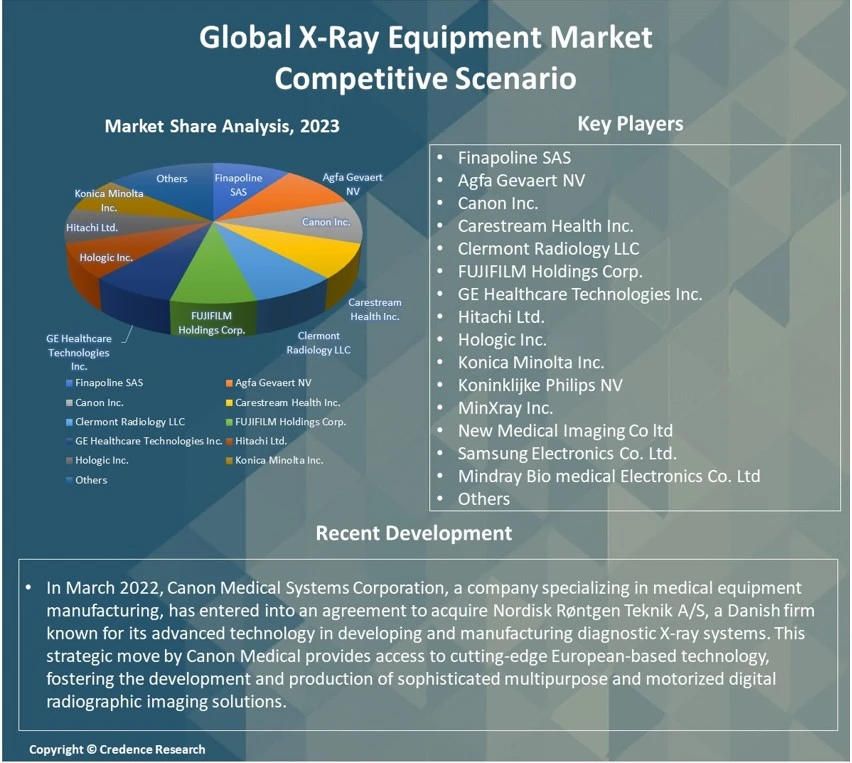
The global X-Ray Equipment market is highly competitive, with several key players. Some of the major players in the market and their market share are as follows:
- Finapoline SAS
- Agfa Gevaert NV
- Canon Inc.
- Carestream Health Inc.
- Clermont Radiology LLC
- FUJIFILM Holdings Corp.
- GE Healthcare Technologies Inc.
- Hitachi Ltd.
- Hologic Inc.
- Konica Minolta Inc.
- Koninklijke Philips NV
- MinXray Inc.
- New Medical Imaging Co ltd
- Samsung Electronics Co. Ltd.
- Mindray Bio medical Electronics Co. Ltd
- Others
These organizations prioritize product innovation, distribution channel expansion, and mergers and acquisitions to stay competitive.
The global X-Ray Equipment market's key players continually seek to stay ahead by offering new products and developments.
In March 2022, Canon Medical Systems Corporation, a company specializing in medical equipment manufacturing, has entered into an agreement to acquire Nordisk Røntgen Teknik A/S, a Danish firm known for its advanced technology in developing and manufacturing diagnostic X-ray systems. This strategic move by Canon Medical provides access to cutting-edge European-based technology, fostering the development and production of sophisticated multipurpose and motorized digital radiographic imaging solutions.
In May 2022, Carestream Health, a global provider of medical imaging systems and a subsidiary of Onex Corporation, has introduced Smart Noise Cancellation (SNC), a revolutionary artificial intelligence (AI)-based technology designed to significantly enhance image quality. This innovation results in images that are notably clearer compared to those produced through standard processing. SNC has received FDA 510(k) Clearance and is now available as an optional feature within Carestream’s ImageView Software, powered by Eclipse. This breakthrough technology marks a significant advancement in medical imaging, further reinforcing Carestream Health's commitment to delivering state-of-the-art solutions.
Summary of Key Findings
- The demand for x-ray equipment is rising due to the ongoing technological advancements play a pivotal role, with continuous innovations enhancing imaging capabilities, resolution, and the integration of artificial intelligence. The increasing prevalence of chronic diseases, such as cardiovascular conditions and cancer, which is boosting the growth of the X-Ray Equipment market.
- Market segmented by type of x-ray equipment, technology, application, end-user, and region.
- Digital Radiography (DR)-based X-Ray Equipment are the most popular, with innovations in X-ray technology and imaging systems.
- Analog X-ray Systems are most commonly used for devices.
- North America is leading market growth; the market is highly competitive with key players including Finapoline SAS, Agfa Gevaert NV, Canon Inc., Carestream Health Inc., Clermont Radiology LLC, FUJIFILM Holdings Corp., GE Healthcare Technologies Inc., Hitachi Ltd., Hologic Inc., Konica Minolta Inc., Koninklijke Philips NV, MinXray Inc., New Medical Imaging Co ltd, Samsung Electronics Co. Ltd., Mindray Bio medical Electronics Co. Ltd, and Others.
Future Outlook
- Positive outlook for the global X-Ray Equipment market with significant growth potential in the North American region
- One of the main factors promoting the market's expansion is the government and business sectors' current reliance on X-Ray Equipment.
- During the forecast period, high cost of equipment is a significant factor projected to restrain the growth of the X-Ray Equipment market.
- Key firms must focus on product innovation, growing market reach, and maintaining competitive pricing to keep ahead of the competition.
How CXOs Can Benefit from the Credence Research X-Ray Equipment Market Report
The Credence Research X-Ray Equipment Market Report provides CXOs with a comprehensive overview of the market, including:
- Market size and growth forecast: The report provides detailed estimates of the global X-Ray Equipment market size, segmented by type of x-ray equipment, technology, application, end-user, and region. It also includes forecasts for the market through 2032, based on key trends and drivers.
- Market segmentation: The report segments the X-Ray Equipment market by type of x-ray equipment, technology, application, end-user, and region. This segmentation provides CXOs with a granular understanding of the market and the opportunities in each segment.
- Competitive landscape: The report profiles the key players in the X-Ray Equipment market and provides insights into their strategies, product offerings, and financial performance. This information can help CXOs to identify and assess their competition.
- Key trends and drivers: The report identifies and analyzes the key trends and drivers that are shaping the X-Ray Equipment This information can help CXOs to make informed decisions about their investments and strategies.
CXOs can use the insights from the Credence Research X-Ray Equipment Market Report to:
- Identify growth opportunities: The report can help CXOs to identify new growth opportunities in the X-Ray Equipment For example, the report identifies the growing demand for X-Ray Equipment from equipment providers and hospitals and clinics as a key opportunity.
- Make informed investment decisions: The report can help CXOs to make informed investment decisions about X-Ray Equipment. For example, the report provides insights into the key factors to consider when evaluating X-Ray Equipment providers and selecting X-Ray Equipment
- Develop competitive strategies: The report can help CXOs to develop competitive strategies for their X-Ray Equipment For example, the report identifies the key strategies that X-Ray Equipment providers are using to differentiate themselves from their competitors.
- Track market developments: The report can help CXOs to track market developments and stay ahead of the curve. For example, the report provides insights into the latest trends and innovations in the X-Ray Equipment
Overall, the Credence Research X-Ray Equipment Market Report is a valuable resource for CXOs who are looking to gain a deeper understanding of the market and identify opportunities for growth.
Segmentation
- By Type of X-ray Equipment
- Digital Radiography (DR)
- Computed Tomography (CT)
- Fluoroscopy
- Mammography
- C-Arm Systems
- Portable/Handheld X-ray Devices
- By Technology
- Analog X-ray Systems
- Digital X-ray Systems
- By Application
- Diagnostic X-rays
- Interventional X-rays
- Mammography
- Computed Tomography (CT)
- By End-User
- Hospitals and Clinics
- Diagnostic Imaging Centers
- Ambulatory Surgical Centers
- Emergency Care Centers
- By Region
- North America
- The U.S,
- Canada
- Mexico
- Europe
- Germany
- France
- The U.K.
- Italy
- Spain
- Rest of Europe
- Asia Pacific
- China
- Japan
- India
- South Korea
- South-east Asia
- Rest of Asia Pacific
- Latin America
- Brazil
- Argentina
- Rest of Latin America
- Middle East & Africa
- GCC Countries
- South Africa
- Rest of Middle East and Africa
- North America
Request a Free Sample
Fill in your details and we'll send you a free sample report.
- Sample data tables & charts
- Research methodology
Market Dynamics
Technological Advancements and Innovation
Continuous improvements in imaging resolution, integration of artificial intelligence, and development of portable and digital X-ray systems are making X-ray equipment more effective and accessible, driving adoption across healthcare settings.
Rising Prevalence of Chronic Diseases and Aging Population
The increasing incidence of chronic conditions such as cardiovascular diseases and cancer, especially among aging populations, is boosting the demand for diagnostic imaging, thereby fueling the need for X-ray equipment.
Expansion of Healthcare Infrastructure in Emerging Markets
Significant investments in healthcare facilities and infrastructure in developing regions are increasing the accessibility and adoption of advanced X-ray equipment, opening new growth opportunities for manufacturers.
Supportive Government Initiatives and Policies
Government programs aimed at improving healthcare access, promoting early disease detection, and subsidizing advanced diagnostic equipment are accelerating the uptake of X-ray technologies, particularly in North America and Asia Pacific.
Need a Custom Version of This Report?
Tailor the scope, geography, or segments to your exact requirements.
- Custom geography or segment scope
- Direct access to our analyst team
Frequently Asked Questions
What is the current size of the global X-Ray Equipment market?
What is the expected growth rate of the X-Ray Equipment market between 2024 and 2032?
Which segment is leading the market share in terms of type of x-ray equipment?
Which end users segment governs the demand for X-Ray Equipment in the world?
Which application segment is expected to post the highest CAGR during the forecast period?
Who are the major players in the global X-Ray Equipment market?
Table of Content
Chapter 1 Market Segmentation
- 1.1 Segmentation Framework
- 1.1.1 Product and Service Classification
- 1.1.2 Application and End-Use Classification
- 1.1.3 Technology and Solution Classification
- 1.1.4 Customer and Distribution Channel Classification
- 1.1.5 Geographic Segmentation
- 1.1.6 Market Segment Definitions and Boundaries
- 1.2 By End-User
- 1.2.1 Hospitals and Clinics
- 1.2.2 Diagnostic Imaging Centers
- 1.2.3 Ambulatory Surgical Centers
- 1.2.4 Emergency Care Centers
- 1.3 By Technology
- 1.3.1 Analog X-ray Systems
- 1.3.2 Digital X-ray Systems
- 1.4 By Application
- 1.4.1 Diagnostic X-rays
- 1.4.2 Interventional X-rays
- 1.4.3 Mammography
- 1.4.4 Computed Tomography (CT)
- 1.5 By Type of X-ray Equipment
- 1.5.1 Digital Radiography (DR)
- 1.5.2 Computed Tomography (CT)
- 1.5.3 Fluoroscopy
- 1.5.4 Mammography
- 1.5.5 C-Arm Systems
- 1.5.6 Portable/Handheld X-ray Devices
Chapter 2 Introduction
- 2.1 Report Objectives and Scope
- 2.2 Product Definition and Industry Terminology
- 2.3 Market Inclusions and Exclusions
- 2.4 Research Process
- 2.4.1 Primary Research and Expert Interviews
- 2.4.2 Secondary Research and Source Review
- 2.4.3 Top-Down and Bottom-Up Estimation
- 2.4.4 Data Triangulation and Verification
- 2.5 Market Size Measurement Basis
- 2.5.1 2023: USD 17512.2 Million → 2032: USD 23,660.58 Million
- 2.6 Historical and Forecast Reference Periods
- 2.6.1 Base Year: 2023
- 2.6.2 Forecast Period: 2023-2032
- 2.7 Research Assumptions and Limitations
Chapter 3 Executive Summary
- 3.1 Market Snapshot and Key Findings
- 3.2 Base-Year Market Size, 2023
- 3.3 Forecast Market Size, 2032
- 3.4 Revenue and Volume Growth Outlook
- 3.5 Key Demand and Supply Indicators
- 3.6 Leading Market Segments
- 3.7 Fastest-Growing Market Opportunities
- 3.8 Regional Performance Highlights
- 3.9 Technology and Industry Transformation
- 3.10 Competitive Landscape Summary
- 3.11 Analyst View and Strategic Implications
Chapter 4 Global X-Ray Equipment Market Trends and Developments
- 4.1 Historical Industry Development
- 4.2 Recent Market Trends and Developments
- 4.3 Demand and Customer Behavior Trends
- 4.4 Technology and Product Innovation
- 4.5 Artificial Intelligence, Automation and Digitalization
- 4.6 Local Manufacturing and Supply Chain Realignment
- 4.7 Industry Partnerships, Mergers and Acquisitions
- 4.8 Sustainability and Circular Economy Developments
- 4.9 Government and Private Sector Investment Trends
- 4.10 Emerging Business Models and Commercialization
- 4.11 Industry Developments and Announcements
Chapter 5 Global X-Ray Equipment Market Production, Supply and Demand Analysis
- 5.1 Demand Trend and Consumption Analysis
- 5.2 Demand Forecast, 2023-2032
- 5.3 Production and Output Trend
- 5.4 Production and Output Forecast, 2023-2032
- 5.5 Installed Capacity and Capacity Utilization
- 5.6 Company-Wise Production Plants and Statistics
- 5.6.1 Installed Production Capacity
- 5.6.2 Actual Production
- 5.6.3 Planned Capacity and Expansion Targets
- 5.7 Supply Chain Structure and Procurement Trends
- 5.8 Supply-Demand Gap and Bottlenecks
- 5.9 Import Dependence and Sourcing Structure
- 5.10 Contract Manufacturing and Outsourcing
- 5.11 Regional Supply and Demand Concentration
Chapter 6 Global X-Ray Equipment Market Pricing Analysis
- 6.1 Pricing Structure and Measurement
- 6.2 Historical Pricing Trends
- 6.3 Pricing Outlook, 2023-2032
- 6.4 Average Selling Price and Unit Economics
- 6.5 Pricing by Product and Market Segment
- 6.6 Geographic Pricing Differences
- 6.7 Key Input, Energy, Labor and Logistics Costs
- 6.8 Contract Pricing and Purchasing Models
- 6.9 Pricing Sensitivity and Competitive Positioning
- 6.10 Price, Margin and Profitability Implications
Chapter 7 Global X-Ray Equipment Market Dynamics
- 7.1 Market Growth Drivers
- 7.1.1 Demand-Side Drivers
- 7.1.2 Technology and Innovation Drivers
- 7.1.3 Infrastructure and Investment Drivers
- 7.1.4 Regulatory and Policy Drivers
- 7.2 Market Restraints
- 7.2.1 Cost and Affordability Constraints
- 7.2.2 Technology and Adoption Barriers
- 7.2.3 Supply Chain and Operational Constraints
- 7.3 Market Challenges
- 7.3.1 Competitive Pressure and Margin Erosion
- 7.3.2 Skills, Infrastructure and Implementation Gaps
- 7.4 Emerging Market Opportunities
- 7.5 Market Dynamics Impact and Time-Horizon Assessment
Chapter 8 Global X-Ray Equipment Value Chain Analysis
- 8.1 Industry Value Chain Overview
- 8.2 Upstream Suppliers and Critical Inputs
- 8.3 Technology and Component Providers
- 8.4 Manufacturing or Service Delivery
- 8.5 Distribution, Channel Partners and Integrators
- 8.6 Downstream Applications and End Users
- 8.7 Value Addition and Profit Pools
- 8.8 Vertical Integration and Outsourcing
- 8.9 Supplier Concentration and Risk
- 8.10 Supply Chain Localization and Resilience
Chapter 9 Global X-Ray Equipment Market Regulations and Policies
- 9.1 Relevant Laws, Standards and Compliance Frameworks
- 9.2 Product, Service, Safety and Quality Requirements
- 9.3 Government Policies, Incentives and Subsidies
- 9.4 Imports, Exports and Trade Barriers
- 9.5 Public Procurement and Local Content Requirements
- 9.6 Environmental and Sustainability Compliance
- 9.7 Upcoming Policy Changes and Market Implications
Chapter 10 Global X-Ray Equipment Market Hotspots and Opportunities
- 10.1 Market Opportunity Mapping and Growth Hotspots
- 10.2 High-Growth Applications and Customer Groups
- 10.3 Underserved Markets and White-Space Opportunities
- 10.4 Emerging Technology and Product Opportunities
- 10.5 New Capacity and Investment Hotspots
- 10.6 Market Entry and Expansion Opportunities
- 10.7 Distribution and Partnership Opportunities
- 10.8 Near-Term and Long-Term Commercial Potential
- 10.9 Opportunity Attractiveness and Execution Risks
Chapter 11 Global X-Ray Equipment Market Outlook, 2023-2032
- 11.1 Market Size and Analysis
- 11.1.1 Revenue (Market Measurement: 2023: USD 17512.2 Million → 2032: USD 23,660.58 Million)
- 11.1.2 Market Volume and Quantity Sold
- 11.1.3 Historical Market Size
- 11.1.4 Base-Year Market Size, 2023
- 11.2 Market Forecast, 2023-2032
- 11.2.1 Revenue Forecast to 2032
- 11.2.2 Volume Forecast to 2032
- 11.2.3 CAGR and Year-on-Year Growth
- 11.2.4 Incremental Revenue Opportunity
- 11.3 Forecast Assumptions and Scenario Analysis
- 11.3.1 Base-Case Forecast
- 11.3.2 Optimistic and Conservative Scenarios
- 11.3.3 Technology, Pricing and Policy Sensitivities
- 11.4 Market Attractiveness and Growth Outlook
Chapter 12 Global X-Ray Equipment Market Segmentation and Outlook
- 12.1 Segmentation Summary and Market Shares, 2023
- 12.2 Largest and Fastest-Growing Segments
- 12.3 By End-User - Market Size and Forecast, 2023-2032
- 12.3.1 Segment Definition and Scope
- 12.3.2 Historical Market Size
- 12.3.3 Revenue Forecast, 2023-2032
- 12.3.4 Volume Forecast, 2023-2032
- 12.3.5 Base-Year Market Share, 2023
- 12.3.6 Segment CAGR and Growth Drivers
- 12.3.7 Subsegment Market Size and Forecast
- 12.3.7.1 Hospitals and Clinics
- 12.3.7.2 Diagnostic Imaging Centers
- 12.3.7.3 Ambulatory Surgical Centers
- 12.3.7.4 Emergency Care Centers
- 12.3.8 Subsegment Pricing and Adoption Trends
- 12.3.9 Leading Suppliers and Competition
- 12.3.10 Regional Demand and Opportunities
- 12.4 By Technology - Market Size and Forecast, 2023-2032
- 12.4.1 Segment Definition and Scope
- 12.4.2 Historical Market Size
- 12.4.3 Revenue Forecast, 2023-2032
- 12.4.4 Volume Forecast, 2023-2032
- 12.4.5 Base-Year Market Share, 2023
- 12.4.6 Segment CAGR and Growth Drivers
- 12.4.7 Subsegment Market Size and Forecast
- 12.4.7.1 Analog X-ray Systems
- 12.4.7.2 Digital X-ray Systems
- 12.4.8 Subsegment Pricing and Adoption Trends
- 12.4.9 Leading Suppliers and Competition
- 12.4.10 Regional Demand and Opportunities
- 12.5 By Application - Market Size and Forecast, 2023-2032
- 12.5.1 Segment Definition and Scope
- 12.5.2 Historical Market Size
- 12.5.3 Revenue Forecast, 2023-2032
- 12.5.4 Volume Forecast, 2023-2032
- 12.5.5 Base-Year Market Share, 2023
- 12.5.6 Segment CAGR and Growth Drivers
- 12.5.7 Subsegment Market Size and Forecast
- 12.5.7.1 Diagnostic X-rays
- 12.5.7.2 Interventional X-rays
- 12.5.7.3 Mammography
- 12.5.7.4 Computed Tomography (CT)
- 12.5.8 Subsegment Pricing and Adoption Trends
- 12.5.9 Leading Suppliers and Competition
- 12.5.10 Regional Demand and Opportunities
- 12.6 By Type of X-ray Equipment - Market Size and Forecast, 2023-2032
- 12.6.1 Segment Definition and Scope
- 12.6.2 Historical Market Size
- 12.6.3 Revenue Forecast, 2023-2032
- 12.6.4 Volume Forecast, 2023-2032
- 12.6.5 Base-Year Market Share, 2023
- 12.6.6 Segment CAGR and Growth Drivers
- 12.6.7 Subsegment Market Size and Forecast
- 12.6.7.1 Digital Radiography (DR)
- 12.6.7.2 Computed Tomography (CT)
- 12.6.7.3 Fluoroscopy
- 12.6.7.4 Mammography
- 12.6.7.5 C-Arm Systems
- 12.6.7.6 Portable/Handheld X-ray Devices
- 12.6.8 Subsegment Pricing and Adoption Trends
- 12.6.9 Leading Suppliers and Competition
- 12.6.10 Regional Demand and Opportunities
- 12.7 Segment Growth Comparison
- 12.8 Segment Attractiveness and Priority Matrix
Chapter 13 Global X-Ray Equipment End-Use and Application Market Outlook
- 13.1 End-Use Industry and Customer Demand Structure
- 13.2 Leading Applications and Customer Groups
- 13.3 End-Use Market Size, Share and Forecast
- 13.4 Major End-Use Industry Deep Dives
- 13.4.1 Customer Requirements and Use Cases
- 13.4.2 Demand and Replacement Cycles
- 13.4.3 Technical and Regulatory Considerations
- 13.4.4 Purchasing and Procurement Models
- 13.4.5 Leading Vendors and Distribution Channels
- 13.4.6 Forecast and Commercial Opportunities
- 13.5 Emerging Applications and Cross-Segment Demand
- 13.6 End-Use Industry Investment Priorities
Chapter 14 Global X-Ray Equipment Geographic Market Outlook, 2023-2032
- 14.1 Regional Market Size and Share, 2023
- 14.2 Regional Market Forecast, 2023-2032
- 14.3 Regional Pricing, Production and Demand Differences
- 14.4 North America
- 14.4.1 United States
- 14.4.2 Canada
- 14.4.3 Mexico
- 14.5 Europe
- 14.5.1 Germany
- 14.5.2 France
- 14.5.3 Italy
- 14.5.4 United Kingdom
- 14.5.5 Spain
- 14.5.6 Poland
- 14.5.7 Russia
- 14.5.8 Netherlands
- 14.5.9 Belgium
- 14.5.10 Sweden
- 14.5.11 Denmark
- 14.5.12 Norway
- 14.5.13 Rest of Europe
- 14.6 Asia Pacific
- 14.6.1 China
- 14.6.2 India
- 14.6.3 Japan
- 14.6.4 South Korea
- 14.6.5 Thailand
- 14.6.6 Indonesia
- 14.6.7 Vietnam
- 14.6.8 Malaysia
- 14.6.9 Australia
- 14.6.10 Rest of Asia Pacific
- 14.7 Latin America
- 14.7.1 Brazil
- 14.7.2 Argentina
- 14.7.3 Colombia
- 14.7.4 Chile
- 14.7.5 Rest of Latin America
- 14.8 Middle East
- 14.8.1 Saudi Arabia
- 14.8.2 United Arab Emirates
- 14.8.3 Turkey
- 14.8.4 Israel
- 14.8.5 Iran
- 14.8.6 Rest of the Middle East
- 14.9 Africa
- 14.9.1 South Africa
- 14.9.2 Egypt
- 14.9.3 Nigeria
- 14.9.4 Morocco
- 14.9.5 Rest of Africa
- 14.10 Regional Investment, Policy and Supply Chain Differences
- 14.11 Regional Competitive Landscape
- 14.12 Geographic Growth Hotspots
Chapter 15 Global X-Ray Equipment Technology, Innovation and Sustainability Outlook
- 15.1 Technology Landscape and Maturity
- 15.2 Product, Process and Service Innovation
- 15.3 AI, Automation and Digital Tools in the Industry
- 15.4 Technology Adoption and Performance Benchmarking
- 15.5 Innovation Pipeline and R&D Investment
- 15.6 Patent and Intellectual Property Trends
- 15.7 Energy Efficiency and Resource Management
- 15.8 Sustainability, Recycling and Circularity
- 15.9 Technology Roadmap, 2023-2032
- 15.10 Risks of Obsolescence and Technology Substitution
Chapter 16 Global X-Ray Equipment Market Key Strategic Imperatives
- 16.1 Growth and Market Entry Priorities
- 16.2 High-Return Products and Segments
- 16.3 Pricing, Profitability and Cost Optimization
- 16.4 Technology Investment and Product Differentiation
- 16.5 Supply Chain Localization and Resilience
- 16.6 Distribution and Customer Acquisition
- 16.7 Partnership, Acquisition and Capacity Strategy
- 16.8 Regional Expansion Priorities
- 16.9 Short-, Medium- and Long-Term Actions
Chapter 17 Competition Outlook
- 17.1 Industry Competition Characteristics
- 17.2 Market Structure and Concentration
- 17.3 Market Share and Competitive Positioning, 2023
- 17.4 Company-Wise Revenue and Product Benchmarking
- 17.5 Production and Service Capacity Benchmarking
- 17.6 Technology, Pricing and Differentiation
- 17.7 Regional Footprint and Distribution Strength
- 17.8 Mergers, Acquisitions and Strategic Alliances
- 17.9 New Entrants and Competitive Threats
- 17.10 Porter's Five Forces and Industry Attractiveness
- 17.11 Competitive Outlook, 2023-2032
Chapter 18 Company Profiles
- 18.1 Company Coverage and Selection Criteria
- 18.2 GE Healthcare Technologies Inc.
- 18.2.1 Business Description
- 18.2.2 Company Ownership and Geographic Presence
- 18.2.3 Product and Service Portfolio
- 18.2.4 Manufacturing and Operating Footprint
- 18.2.5 Production Capacity and Expansion Plans
- 18.2.6 Financial Performance and Investment
- 18.2.7 Market Share and Competitive Position
- 18.2.8 Technology and Innovation Capabilities
- 18.2.9 Strategic Alliances or Partnerships
- 18.2.10 Recent Developments
- 18.2.11 Growth Strategy and Outlook
- 18.3 Siemens Healthineers
- 18.4 Canon Inc.
- 18.5 FUJIFILM Holdings Corp.
- 18.6 Carestream Health Inc.
- 18.7 Hologic Inc.
- 18.8 Konica Minolta Inc.
- 18.9 Philips (Koninklijke Philips NV)
- 18.10 Samsung Electronics Co. Ltd.
- 18.11 Mindray Bio-Medical Electronics Co. Ltd.
- 18.12 Other Relevant Market Participants
Note: Every listed company is profiled on the structure shown under the first company. The company list is preliminary and may change based on research findings, market developments, data availability and client requirements.
Chapter 19 Disclaimer
- 19.1 Research and Forecast Disclaimer
- 19.2 Data Source and Estimation Limitations
Note: The depth of individual sections depends on data availability for this market. Volume, capacity, trade and other unit-based metrics are included where applicable.

