
Market Overview
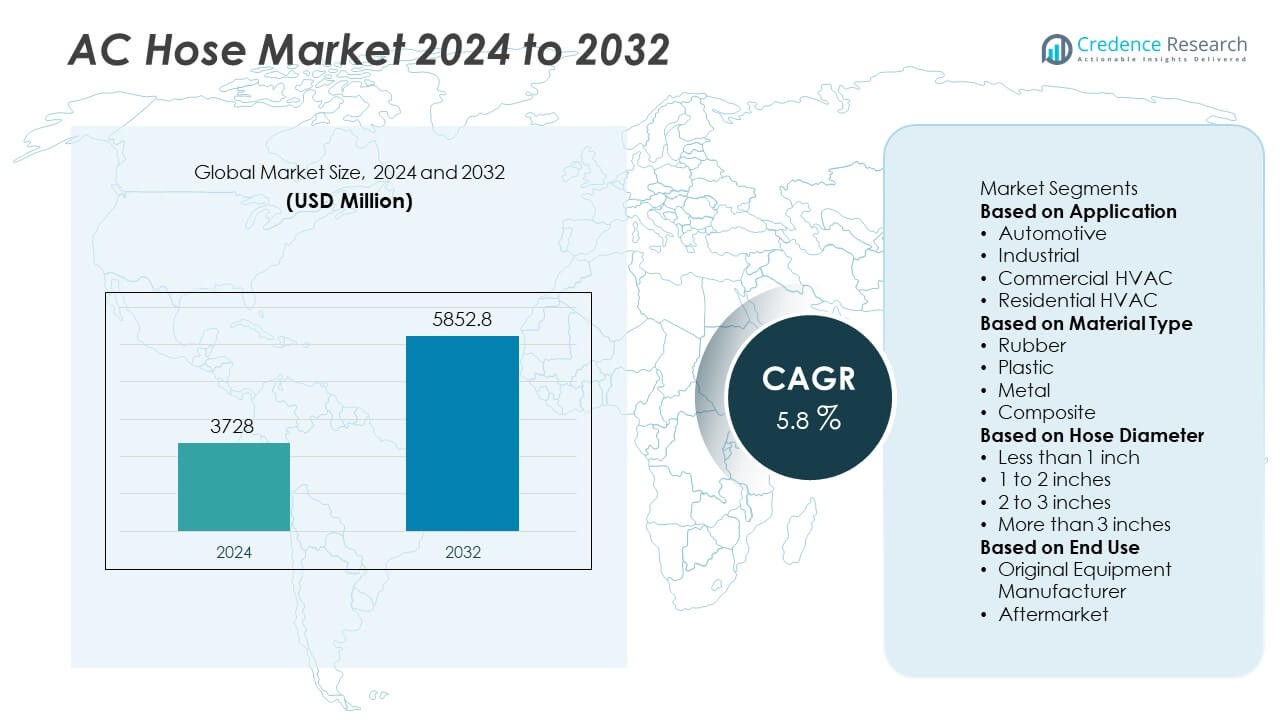
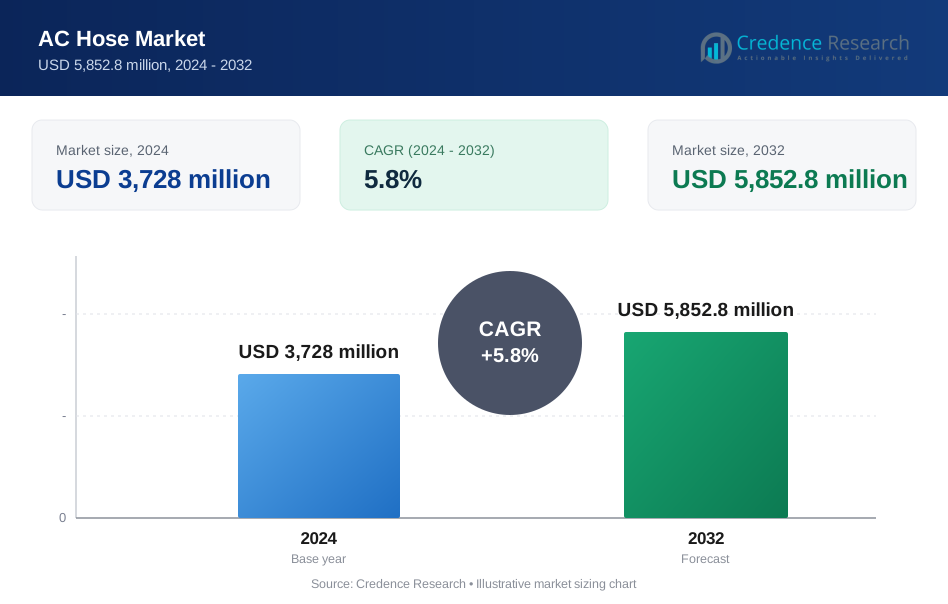
The AC Hose Market was valued at USD 3,728 million in 2024 and is projected to reach USD 5,852.8 million by 2032, growing at a CAGR of 5.8% during the forecast period.
| REPORT ATTRIBUTE | DETAILS |
|---|---|
| Historical Period | 2020-2023 |
| Base Year | 2024 |
| Forecast Period | 2025-2032 |
| AC Hose Market Size 2024 | USD 3,728 Million |
| AC Hose Market, CAGR | 5.8% |
| AC Hose Market Size 2032 | USD 5,852.8 Million |
AC Hose Market grows with rising vehicle production and increasing demand for air conditioning systems in passenger and commercial vehicles. Automakers integrate advanced HVAC systems to improve comfort and energy efficiency, boosting hose adoption. It benefits from stricter emission regulations that drive development of low-permeation, eco-friendly hose materials.
AC Hose Market shows strong presence across North America, Europe, Asia-Pacific, Latin America, and Middle East & Africa, with Asia-Pacific leading growth due to high vehicle production, urbanization, and rising adoption of air conditioning systems in mass-market vehicles. North America follows with robust demand supported by a large vehicle fleet, extreme weather conditions, and growing adoption of electric and hybrid vehicles requiring advanced thermal management solutions. Europe maintains steady growth, driven by strict emission regulations and a focus on lightweight, eco-friendly hoses compatible with new refrigerants. Latin America and Middle East & Africa present rising opportunities with increasing consumer preference for comfort features and expansion of automotive assembly plants. Key players such as Continental AG, Goodyear Tire and Rubber Company, Sumitomo Riko, and Hosepower LLC focus on developing durable, leak-resistant hoses, investing in R&D for advanced materials, and expanding regional production capabilities to meet global demand efficiently.
Market Insights
- AC Hose Market was valued at USD 3,728 million in 2024 and is projected to reach USD 5,852.8 million by 2032, growing at a CAGR of 5.8%.
- Rising vehicle production and consumer demand for air conditioning systems drive strong adoption across passenger cars, SUVs, and commercial vehicles.
- Trends highlight the use of lightweight, low-permeation, and eco-friendly materials to meet emission norms and improve system efficiency.
- Key players such as Continental AG, Goodyear Tire and Rubber Company, Sumitomo Riko, Hosepower LLC, and Hoses Direct focus on advanced material development, precision manufacturing, and global supply chain expansion.
- Market faces challenges from raw material price volatility, refrigerant transition requirements, and the need for continuous compliance with global emission regulations.
- Asia-Pacific leads growth supported by rising automotive production and electrification, while North America and Europe show steady demand driven by extreme climate conditions and regulatory pressure.
- Opportunities emerge from growing EV production, government incentives for energy-efficient systems, and rising aftermarket demand for durable and maintenance-free AC hoses worldwide.
Market Drivers
Rising Demand for Automotive Air Conditioning Systems
AC Hose Market grows with increasing installation of air conditioning systems in passenger and commercial vehicles. Rising consumer preference for comfort and climate control drives higher demand for reliable hose assemblies. It ensures proper flow of refrigerant, contributing to vehicle performance and cooling efficiency. Automakers integrate advanced AC systems even in entry-level models to meet customer expectations. Growth in the automotive sector, especially in emerging economies, fuels adoption of AC hoses. This demand supports steady revenue for suppliers and manufacturers globally.
- For instance, Continental's ContiTech division now manufactures the Galaxy OEM #6 AC barrier hose, following its acquisition of Goodyear's Engineered Products business, Veyance Technologies, in 2015. This hose is recommended for R-134a systems and is available with a 5/16-inch (7.94 mm) inner diameter.
Stringent Emission and Efficiency Standards
AC Hose Market benefits from regulatory pressure to improve energy efficiency and reduce refrigerant leakage. Governments enforce strict emission norms, pushing manufacturers to develop durable and leak-resistant hose materials. It encourages innovation in lightweight and eco-friendly hose designs compatible with low-GWP refrigerants. Automotive OEMs prefer high-performance hoses that meet global standards and support sustainability goals. This compliance-driven demand strengthens the position of premium hose manufacturers. The shift aligns with the industry's focus on environmental responsibility.
- For instance, Sumitomo Riko has developed automotive AC refrigerant circulation hoses that utilize polymer materials for superior heat resistance and combine rubber and resin technology. Their portfolio of automotive hoses, including AC hoses, features lightweight properties and strong sealing technology to prevent leaks and better withstand harsh engine bay conditions.
Growth in Electric and Hybrid Vehicle Production
AC Hose Market expands with rising production of electric and hybrid vehicles requiring efficient thermal management. EVs depend on optimized AC systems for cabin cooling and battery temperature control. It increases demand for hoses that can handle higher pressures and new refrigerants. Suppliers design specialized hose solutions to improve thermal efficiency and extend vehicle range. Government incentives for EV adoption further support this trend. The transition to electric mobility creates significant growth opportunities for hose manufacturers.
Advancements in Material and Manufacturing Technologies
AC Hose Market is driven by innovations in rubber compounds, thermoplastics, and reinforcement technologies. Advanced materials offer better flexibility, durability, and resistance to extreme temperatures. It enables production of lightweight hoses that improve fuel efficiency and reduce vehicle weight. Automation and precision manufacturing ensure consistent quality and reduced defect rates. Manufacturers invest in R&D to develop hoses compatible with next-generation refrigerants. These technological improvements help suppliers stay competitive and meet evolving automotive requirements.
Market Trends
Shift Toward Lightweight and Eco-Friendly Materials
AC Hose Market is witnessing a transition toward lightweight, recyclable, and low-permeation materials. Automakers focus on reducing vehicle weight to improve fuel efficiency and lower emissions. It drives demand for thermoplastic and advanced rubber hoses with superior strength and flexibility. These materials also enhance resistance to leakage and ensure compatibility with new refrigerants. Manufacturers invest in sustainable production processes to meet environmental regulations. This trend supports the industry’s move toward greener and more efficient automotive components.
- For instance, Gates developed its PolarSeal™ II Hose where a specific version has an inside diameter of 10.3 mm, a maximum working pressure of 350 psi, and meets SAE J3062 Type C, Class I standards.
Integration of Hoses in Advanced HVAC Systems
AC Hose Market benefits from rising adoption of integrated HVAC systems in modern vehicles. Automakers design compact and efficient systems that require precise and reliable hose assemblies. It ensures smooth refrigerant flow for consistent cooling performance in diverse driving conditions. Growing popularity of multi-zone climate control increases demand for specialized hoses. Tier-1 suppliers collaborate with OEMs to develop customized solutions that optimize space and reduce energy consumption. This trend enhances the overall passenger comfort and vehicle performance.
- For instance, Gates offers a PolarSeal II hose, part number 71091, with a continuous operating temperature range of -22°F to +257°F and a minimum bend radius of 50.8 mm for the Dash 8 size, enabling tight routing in complex HVAC module assemblies.
Rising Adoption in Electric and Hybrid Vehicles
AC Hose Market experiences growth from expanding EV and hybrid production worldwide. Thermal management plays a critical role in maintaining battery performance and cabin comfort. It leads to demand for hoses capable of handling high pressures and advanced refrigerants. Manufacturers focus on developing low-conductivity and high-strength hose designs to improve efficiency. EV makers adopt innovative AC systems that require tailored hose configurations. This trend is expected to remain a key growth driver over the coming years.
Focus on Durability and Extended Lifespan
AC Hose Market sees growing emphasis on durability and maintenance-free performance. Customers expect longer-lasting components that reduce service costs and downtime. It drives R&D efforts to create hoses with improved abrasion, ozone, and chemical resistance. High-performance reinforcement layers and precision fittings improve reliability under extreme conditions. OEMs prefer hoses that maintain performance across a wide temperature range. This trend aligns with industry goals of improving overall vehicle quality and customer satisfaction.
Market Challenges Analysis
Volatility in Raw Material Prices and Supply Chain Issues
AC Hose Market faces challenges due to fluctuations in prices of rubber, plastics, and reinforcement materials. Rising costs increase production expenses and impact profit margins for manufacturers. It puts pressure on suppliers to maintain competitive pricing while meeting quality standards. Global supply chain disruptions and logistics delays further affect timely delivery of hoses. Automakers face risks of production slowdowns when component availability becomes uncertain. Companies must invest in supplier diversification and inventory planning to minimize these risks. Ensuring consistent raw material supply remains a major operational challenge.
Stringent Regulatory Compliance and Compatibility Requirements
AC Hose Market is affected by strict environmental regulations and refrigerant transition standards. Manufacturers must design hoses that are compatible with new low-GWP refrigerants while preventing leakage. It requires significant R&D investment and continuous product testing to meet global compliance. Failure to meet standards can lead to recalls and reputational damage. Smaller players struggle to keep up with evolving norms due to high development costs. OEMs demand validated and certified components, raising entry barriers for new suppliers. Maintaining compliance while managing costs remains a key challenge for industry participants.
Market Opportunities
Rising Demand from Emerging Automotive Markets
AC Hose Market holds strong opportunities due to growing vehicle production in Asia-Pacific, Latin America, and Africa. Rising disposable incomes and urbanization drive demand for passenger vehicles equipped with air conditioning systems. It encourages OEMs to expand manufacturing facilities and increase local sourcing of components. Governments support automotive sector growth through incentives and infrastructure development. Suppliers can capture significant market share by offering cost-effective and reliable hose solutions tailored to regional needs. This expansion opens new revenue streams for global and regional players.
Innovation in Thermal Management for Electric Vehicles
AC Hose Market gains growth potential from increasing adoption of electric and hybrid vehicles requiring advanced cooling systems. EVs depend on efficient AC hoses to manage battery temperature and maintain cabin comfort. It creates demand for specialized hoses capable of handling higher pressures and next-generation refrigerants. Manufacturers investing in lightweight, high-performance materials can gain competitive advantage. Collaborations with EV makers help suppliers design custom solutions for optimized thermal efficiency. This trend positions hose manufacturers to benefit from the accelerating transition to electric mobility.
Market Segmentation Analysis:
By Application
AC Hose Market is segmented by application into passenger cars, commercial vehicles, and off-highway vehicles. Passenger cars hold the largest share due to high demand for air conditioning systems across compact, mid-size, and luxury models. It supports vehicle comfort and contributes to energy-efficient climate control. Commercial vehicles, including trucks and buses, show steady demand for durable hoses to maintain cooling in heavy-duty conditions. Off-highway vehicles such as construction and agricultural equipment also integrate AC hoses to improve operator comfort. Growth in each segment is driven by rising production volumes and consumer expectations for thermal comfort.
- For instance, Continental’s Galaxy SLE G4890 AC suction-hose series offers an inside diameter of 12.7 mm (½ inch), an outside diameter of 19.40 mm, and a minimum burst pressure of 2 000 psi for the -10 size.
By Material Type
AC Hose Market by material type includes rubber hoses, thermoplastic hoses, and metal-reinforced hoses. Rubber hoses remain widely used due to flexibility, cost efficiency, and reliable performance. It performs well under varying pressure and temperature ranges. Thermoplastic hoses gain popularity for their lightweight construction and improved resistance to chemical degradation. Metal-reinforced hoses are preferred for high-pressure applications and extreme operating conditions. Continuous R&D focuses on developing low-permeation and eco-friendly materials to meet regulatory requirements and improve system efficiency.
- For instance, Sumitomo Riko's ADVANSTAR DHD-4SP hose in size -25 (25.4 mm inner diameter) has a maximum working pressure of 4,061 psi (280 bar), a minimum burst pressure of 16,244 psi (1120 bar), and a minimum bend radius of 340 mm.
By Hose Diameter
AC Hose Market by hose diameter is categorized into small, medium, and large bore hoses. Small diameter hoses are commonly used in passenger cars where space is limited and weight reduction is critical. It offers compact routing options while maintaining refrigerant flow efficiency. Medium diameter hoses are widely adopted in SUVs, light trucks, and commercial vehicles for balanced performance and durability. Large bore hoses are designed for heavy-duty and off-road applications where higher refrigerant flow rates are required. This segmentation allows manufacturers to offer tailored solutions for different vehicle categories and performance needs.
Segments:
Based on Application
- Automotive
- Industrial
- Commercial HVAC
- Residential HVAC
Based on Material Type
- Rubber
- Plastic
- Metal
- Composite
Based on Hose Diameter
- Less than 1 inch
- 1 to 2 inches
- 2 to 3 inches
- More than 3 inches
Based on End Use
- Original Equipment Manufacturer
- Aftermarket
Based on the Geography:
- North America
- U.S.
- Canada
- Mexico
- Europe
- UK
- France
- Germany
- Italy
- Spain
- Russia
- Belgium
- Netherlands
- Austria
- Sweden
- Poland
- Denmark
- Switzerland
- Rest of Europe
- Asia Pacific
- China
- Japan
- South Korea
- India
- Australia
- Thailand
- Indonesia
- Vietnam
- Malaysia
- Philippines
- Taiwan
- Rest of Asia Pacific
- Latin America
- Brazil
- Argentina
- Peru
- Chile
- Colombia
- Rest of Latin America
- Middle East
- UAE
- KSA
- Israel
- Turkey
- Iran
- Rest of Middle East
- Africa
- Egypt
- Nigeria
- Algeria
- Morocco
- Rest of Africa
Regional Analysis
North America
North America holds 26% market share in the AC Hose Market, supported by strong demand for passenger vehicles and SUVs equipped with advanced air conditioning systems. The U.S. leads production, with automakers integrating efficient HVAC systems across all vehicle segments to meet rising consumer expectations for comfort. It benefits from steady replacement demand driven by the large on-road vehicle fleet and harsh weather conditions that require reliable cooling. Growth in electric and hybrid vehicle adoption also fuels demand for specialized AC hoses designed for thermal management systems. Canada and Mexico contribute significantly through manufacturing facilities and supply chain networks, strengthening regional production capacity. The focus on energy efficiency and compliance with environmental standards further boosts innovation in hose design and materials.
Europe
Europe accounts for 29% market share, making it one of the leading regions for the AC Hose Market. Strong automotive manufacturing bases in Germany, France, and Italy drive consistent demand for advanced HVAC components. It benefits from strict EU regulations on emissions and refrigerant leakage, encouraging adoption of low-permeation and eco-friendly hoses. European OEMs invest in lightweight materials and compact system designs to enhance fuel efficiency. The region is also experiencing growth in electric and plug-in hybrid vehicles, which require specialized hoses for battery cooling and cabin climate control. Expansion of premium vehicle production supports the use of high-performance and durable hoses. Collaboration between Tier-1 suppliers and automakers accelerates innovation and product customization to meet regional requirements.
Asia-Pacific
Asia-Pacific captures 33% market share and represents the fastest-growing region in the AC Hose Market. China, India, Japan, and South Korea are major contributors, driven by rapid urbanization, rising disposable incomes, and strong vehicle production rates. It benefits from growing demand for air-conditioned vehicles even in entry-level segments, making AC systems a standard feature. Government initiatives promoting electric vehicle manufacturing and adoption support development of hoses designed for next-generation refrigerants and high-pressure systems. Local suppliers expand capacity to meet the needs of global OEMs operating in the region. Rising exports of vehicles from Asia-Pacific further boost production of AC hoses for international markets. Continuous investment in R&D and manufacturing technology enhances competitiveness of regional players.
Latin America
Latin America holds 7% market share, driven by increasing demand for passenger vehicles and light commercial vehicles with integrated AC systems. Brazil and Mexico dominate production, supported by automotive assembly plants catering to both domestic and export markets. It faces challenges from economic fluctuations but continues to show steady growth due to improving living standards and consumer expectations for in-vehicle comfort. Adoption of replacement hoses also supports aftermarket demand. Regional suppliers focus on providing cost-effective and durable hoses suitable for diverse climate conditions.
Middle East & Africa
Middle East & Africa represent 5% market share, supported by the high need for efficient cooling systems due to extreme weather conditions. Gulf countries such as UAE and Saudi Arabia lead adoption with high vehicle ownership and demand for reliable HVAC components. It benefits from strong aftermarket sales as harsh operating conditions increase replacement frequency. South Africa and Nigeria contribute to demand with growing passenger and commercial vehicle markets. Investment in automotive distribution networks and assembly plants further supports regional growth. Rising interest in electric mobility is expected to create future demand for specialized AC hoses designed for EV thermal management.
Key Player Analysis
- Sae International
- Hoses Direct
- Continental AG
- Goodyear Tire and Rubber Company
- Sumitomo Riko
- Dexter Magnetic Technologies
- Hosepower LLC
- Rubber and Plastics Company
- Air Systems Components
- Hydraulic Hose Manufacturer
Competitive Analysis
Competitive landscape of the AC Hose Market is shaped by leading players such as Continental AG, Goodyear Tire and Rubber Company, Sumitomo Riko, Hosepower LLC, Hoses Direct, Rubber and Plastics Company, Dexter Magnetic Technologies, Air Systems Components, and Sae International. These companies focus on developing advanced hose designs with improved flexibility, durability, and resistance to refrigerant leakage. They invest in R&D to produce low-permeation hoses compatible with next-generation refrigerants and meet stringent global emission standards. Strategic partnerships with automakers and HVAC system manufacturers enable them to deliver customized solutions for passenger cars, commercial vehicles, and electric vehicle applications. Players expand production capacity and adopt automation technologies to enhance quality and reduce manufacturing costs. Global presence and robust distribution networks help ensure timely delivery and support aftermarket demand. Continuous innovation in lightweight materials and thermal management solutions allows these companies to maintain competitiveness and capture new opportunities in growing automotive markets.
Recent Developments
- In June 2025, Continental AG, Introduced a multi-purpose marine hose to simplify vessel maintenance.
- In February 2025, Sumitomo Riko exhibited mobility components at H2 & FC EXPO.
- In December 2024, Continental AG, Unveiled the X-Life XCP5 hose: a high-pressure braided hose (5000 PSI), ISO 18752 compliant, with extra abrasion resistance.
- In January 2024, Continental revealed a new hydraulic hose plant plan in Aguascalientes, Mexico.
Report Coverage
The research report offers an in-depth analysis based on Application, Material Type, Hose Diameter, End Use and Geography. It details leading market players, providing an overview of their business, product offerings, investments, revenue streams, and key applications. Additionally, the report includes insights into the competitive environment, SWOT analysis, current market trends, as well as the primary drivers and constraints. Furthermore, it discusses various factors that have driven market expansion in recent years. The report also explores market dynamics, regulatory scenarios, and technological advancements that are shaping the industry. It assesses the impact of external factors and global economic changes on market growth. Lastly, it provides strategic recommendations for new entrants and established companies to navigate the complexities of the market.
Future Outlook
- Demand for AC hoses will rise with increasing global vehicle production and HVAC system installation.
- Adoption of lightweight and low-permeation materials will become a key manufacturing priority.
- Electric and hybrid vehicle growth will create demand for specialized thermal management hoses.
- Development of hoses compatible with next-generation refrigerants will gain momentum.
- Automation in manufacturing will improve quality control and reduce production costs.
- Aftermarket demand will grow due to aging vehicle fleets and replacement needs.
- Asia-Pacific will remain the fastest-growing region with expanding automotive production.
- Strategic partnerships with OEMs will drive innovation and customized product development.
- Regulatory compliance will continue to shape product design and material selection.
- Focus on durability and extended lifespan will enhance customer satisfaction and reduce maintenance costs.
Request a Free Sample
Fill in your details and we'll send you a free sample report.
- Sample data tables & charts
- Research methodology
Market Dynamics
Rising Demand for Automotive Air Conditioning Systems
Increasing installation of air conditioning systems in both passenger and commercial vehicles is driving demand for AC hoses, as consumers expect enhanced comfort and climate control even in entry-level models.
Stringent Emission and Efficiency Standards
Global regulations on emissions and refrigerant leakage are pushing manufacturers to develop durable, leak-resistant, and eco-friendly hose materials, fostering innovation and adoption of advanced AC hoses.
Growth in Electric and Hybrid Vehicle Production
The expansion of electric and hybrid vehicle manufacturing requires efficient thermal management, increasing the need for specialized AC hoses that can handle higher pressures and new refrigerants.
Advancements in Material and Manufacturing Technologies
Innovations in rubber compounds, thermoplastics, and reinforcement technologies are enabling the production of lightweight, durable, and efficient hoses, which meet evolving automotive requirements and regulatory standards.
Expansion in Emerging Automotive Markets
Rapid urbanization, rising disposable incomes, and increased vehicle production in Asia-Pacific, Latin America, and Africa are creating significant opportunities for AC hose suppliers to capture new market share.
Need a Custom Version of This Report?
Tailor the scope, geography, or segments to your exact requirements.
- Custom geography or segment scope
- Direct access to our analyst team
Frequently Asked Questions
What is the current market size for AC Hose, and what is its projected size in 2032?
At what Compound Annual Growth Rate is the AC Hose market projected to grow between 2025 and 2032?
Which AC Hose market segment held the largest share in 2024?
What are the primary factors fueling the growth of the AC Hose market?
Who are the leading companies in the AC Hose market?
Which region commanded the largest share of the AC Hose market in 2024?
Table of Content
Chapter 1 Market Segmentation
- 1.1 Segmentation Framework
- 1.1.1 Product and Service Classification
- 1.1.2 Application and End-Use Classification
- 1.1.3 Technology and Solution Classification
- 1.1.4 Customer and Distribution Channel Classification
- 1.1.5 Geographic Segmentation
- 1.1.6 Market Segment Definitions and Boundaries
- 1.2 By End Use
- 1.2.1 Original Equipment Manufacturer
- 1.2.2 Aftermarket
- 1.3 By Application
- 1.3.1 Automotive
- 1.3.2 Industrial
- 1.3.3 Commercial HVAC
- 1.3.4 Residential HVAC
- 1.4 By Hose Diameter
- 1.4.1 Less than 1 inch
- 1.4.2 1 to 2 inches
- 1.4.3 2 to 3 inches
- 1.4.4 More than 3 inches
- 1.5 By Material Type
- 1.5.1 Rubber
- 1.5.2 Plastic
- 1.5.3 Metal
- 1.5.4 Composite
Chapter 2 Introduction
- 2.1 Report Objectives and Scope
- 2.2 Product Definition and Industry Terminology
- 2.3 Market Inclusions and Exclusions
- 2.4 Research Process
- 2.4.1 Primary Research and Expert Interviews
- 2.4.2 Secondary Research and Source Review
- 2.4.3 Top-Down and Bottom-Up Estimation
- 2.4.4 Data Triangulation and Verification
- 2.5 Market Size Measurement Basis
- 2.5.1 2024: USD 3,728 million → 2032: USD 5,852.8 million
- 2.6 Historical and Forecast Reference Periods
- 2.6.1 Base Year: 2024
- 2.6.2 Forecast Period: 2024-2032
- 2.7 Research Assumptions and Limitations
Chapter 3 Executive Summary
- 3.1 Market Snapshot and Key Findings
- 3.2 Base-Year Market Size, 2024
- 3.3 Forecast Market Size, 2032
- 3.4 Revenue and Volume Growth Outlook
- 3.5 Key Demand and Supply Indicators
- 3.6 Leading Market Segments
- 3.7 Fastest-Growing Market Opportunities
- 3.8 Regional Performance Highlights
- 3.9 Technology and Industry Transformation
- 3.10 Competitive Landscape Summary
- 3.11 Analyst View and Strategic Implications
Chapter 4 Global AC Hose Market Trends and Developments
- 4.1 Historical Industry Development
- 4.2 Recent Market Trends and Developments
- 4.3 Demand and Customer Behavior Trends
- 4.4 Technology and Product Innovation
- 4.5 Artificial Intelligence, Automation and Digitalization
- 4.6 Local Manufacturing and Supply Chain Realignment
- 4.7 Industry Partnerships, Mergers and Acquisitions
- 4.8 Sustainability and Circular Economy Developments
- 4.9 Government and Private Sector Investment Trends
- 4.10 Emerging Business Models and Commercialization
- 4.11 Industry Developments and Announcements
Chapter 5 Global AC Hose Market Production, Supply and Demand Analysis
- 5.1 Demand Trend and Consumption Analysis
- 5.2 Demand Forecast, 2024-2032
- 5.3 Production and Output Trend
- 5.4 Production and Output Forecast, 2024-2032
- 5.5 Installed Capacity and Capacity Utilization
- 5.6 Company-Wise Production Plants and Statistics
- 5.6.1 Installed Production Capacity
- 5.6.2 Actual Production
- 5.6.3 Planned Capacity and Expansion Targets
- 5.7 Supply Chain Structure and Procurement Trends
- 5.8 Supply-Demand Gap and Bottlenecks
- 5.9 Import Dependence and Sourcing Structure
- 5.10 Contract Manufacturing and Outsourcing
- 5.11 Regional Supply and Demand Concentration
Chapter 6 Global AC Hose Market Pricing Analysis
- 6.1 Pricing Structure and Measurement
- 6.2 Historical Pricing Trends
- 6.3 Pricing Outlook, 2024-2032
- 6.4 Average Selling Price and Unit Economics
- 6.5 Pricing by Product and Market Segment
- 6.6 Geographic Pricing Differences
- 6.7 Key Input, Energy, Labor and Logistics Costs
- 6.8 Contract Pricing and Purchasing Models
- 6.9 Pricing Sensitivity and Competitive Positioning
- 6.10 Price, Margin and Profitability Implications
Chapter 7 Global AC Hose Market Dynamics
- 7.1 Market Growth Drivers
- 7.1.1 Demand-Side Drivers
- 7.1.2 Technology and Innovation Drivers
- 7.1.3 Infrastructure and Investment Drivers
- 7.1.4 Regulatory and Policy Drivers
- 7.2 Market Restraints
- 7.2.1 Cost and Affordability Constraints
- 7.2.2 Technology and Adoption Barriers
- 7.2.3 Supply Chain and Operational Constraints
- 7.3 Market Challenges
- 7.3.1 Competitive Pressure and Margin Erosion
- 7.3.2 Skills, Infrastructure and Implementation Gaps
- 7.4 Emerging Market Opportunities
- 7.5 Market Dynamics Impact and Time-Horizon Assessment
Chapter 8 Global AC Hose Value Chain Analysis
- 8.1 Industry Value Chain Overview
- 8.2 Upstream Suppliers and Critical Inputs
- 8.3 Technology and Component Providers
- 8.4 Manufacturing or Service Delivery
- 8.5 Distribution, Channel Partners and Integrators
- 8.6 Downstream Applications and End Users
- 8.7 Value Addition and Profit Pools
- 8.8 Vertical Integration and Outsourcing
- 8.9 Supplier Concentration and Risk
- 8.10 Supply Chain Localization and Resilience
Chapter 9 Global AC Hose Market Regulations and Policies
- 9.1 Relevant Laws, Standards and Compliance Frameworks
- 9.2 Product, Service, Safety and Quality Requirements
- 9.3 Government Policies, Incentives and Subsidies
- 9.4 Imports, Exports and Trade Barriers
- 9.5 Public Procurement and Local Content Requirements
- 9.6 Environmental and Sustainability Compliance
- 9.7 Upcoming Policy Changes and Market Implications
Chapter 10 Global AC Hose Market Hotspots and Opportunities
- 10.1 Market Opportunity Mapping and Growth Hotspots
- 10.2 High-Growth Applications and Customer Groups
- 10.3 Underserved Markets and White-Space Opportunities
- 10.4 Emerging Technology and Product Opportunities
- 10.5 New Capacity and Investment Hotspots
- 10.6 Market Entry and Expansion Opportunities
- 10.7 Distribution and Partnership Opportunities
- 10.8 Near-Term and Long-Term Commercial Potential
- 10.9 Opportunity Attractiveness and Execution Risks
Chapter 11 Global AC Hose Market Outlook, 2024-2032
- 11.1 Market Size and Analysis
- 11.1.1 Revenue (Market Measurement: 2024: USD 3,728 million → 2032: USD 5,852.8 million)
- 11.1.2 Market Volume and Quantity Sold
- 11.1.3 Historical Market Size
- 11.1.4 Base-Year Market Size, 2024
- 11.2 Market Forecast, 2024-2032
- 11.2.1 Revenue Forecast to 2032
- 11.2.2 Volume Forecast to 2032
- 11.2.3 CAGR and Year-on-Year Growth
- 11.2.4 Incremental Revenue Opportunity
- 11.3 Forecast Assumptions and Scenario Analysis
- 11.3.1 Base-Case Forecast
- 11.3.2 Optimistic and Conservative Scenarios
- 11.3.3 Technology, Pricing and Policy Sensitivities
- 11.4 Market Attractiveness and Growth Outlook
Chapter 12 Global AC Hose Market Segmentation and Outlook
- 12.1 Segmentation Summary and Market Shares, 2024
- 12.2 Largest and Fastest-Growing Segments
- 12.3 By End Use - Market Size and Forecast, 2024-2032
- 12.3.1 Segment Definition and Scope
- 12.3.2 Historical Market Size
- 12.3.3 Revenue Forecast, 2024-2032
- 12.3.4 Volume Forecast, 2024-2032
- 12.3.5 Base-Year Market Share, 2024
- 12.3.6 Segment CAGR and Growth Drivers
- 12.3.7 Subsegment Market Size and Forecast
- 12.3.7.1 Original Equipment Manufacturer
- 12.3.7.2 Aftermarket
- 12.3.8 Subsegment Pricing and Adoption Trends
- 12.3.9 Leading Suppliers and Competition
- 12.3.10 Regional Demand and Opportunities
- 12.4 By Application - Market Size and Forecast, 2024-2032
- 12.4.1 Segment Definition and Scope
- 12.4.2 Historical Market Size
- 12.4.3 Revenue Forecast, 2024-2032
- 12.4.4 Volume Forecast, 2024-2032
- 12.4.5 Base-Year Market Share, 2024
- 12.4.6 Segment CAGR and Growth Drivers
- 12.4.7 Subsegment Market Size and Forecast
- 12.4.7.1 Automotive
- 12.4.7.2 Industrial
- 12.4.7.3 Commercial HVAC
- 12.4.7.4 Residential HVAC
- 12.4.8 Subsegment Pricing and Adoption Trends
- 12.4.9 Leading Suppliers and Competition
- 12.4.10 Regional Demand and Opportunities
- 12.5 By Hose Diameter - Market Size and Forecast, 2024-2032
- 12.5.1 Segment Definition and Scope
- 12.5.2 Historical Market Size
- 12.5.3 Revenue Forecast, 2024-2032
- 12.5.4 Volume Forecast, 2024-2032
- 12.5.5 Base-Year Market Share, 2024
- 12.5.6 Segment CAGR and Growth Drivers
- 12.5.7 Subsegment Market Size and Forecast
- 12.5.7.1 Less than 1 inch
- 12.5.7.2 1 to 2 inches
- 12.5.7.3 2 to 3 inches
- 12.5.7.4 More than 3 inches
- 12.5.8 Subsegment Pricing and Adoption Trends
- 12.5.9 Leading Suppliers and Competition
- 12.5.10 Regional Demand and Opportunities
- 12.6 By Material Type - Market Size and Forecast, 2024-2032
- 12.6.1 Segment Definition and Scope
- 12.6.2 Historical Market Size
- 12.6.3 Revenue Forecast, 2024-2032
- 12.6.4 Volume Forecast, 2024-2032
- 12.6.5 Base-Year Market Share, 2024
- 12.6.6 Segment CAGR and Growth Drivers
- 12.6.7 Subsegment Market Size and Forecast
- 12.6.7.1 Rubber
- 12.6.7.2 Plastic
- 12.6.7.3 Metal
- 12.6.7.4 Composite
- 12.6.8 Subsegment Pricing and Adoption Trends
- 12.6.9 Leading Suppliers and Competition
- 12.6.10 Regional Demand and Opportunities
- 12.7 Segment Growth Comparison
- 12.8 Segment Attractiveness and Priority Matrix
Chapter 13 Global AC Hose End-Use and Application Market Outlook
- 13.1 End-Use Industry and Customer Demand Structure
- 13.2 Leading Applications and Customer Groups
- 13.3 End-Use Market Size, Share and Forecast
- 13.4 Major End-Use Industry Deep Dives
- 13.4.1 Customer Requirements and Use Cases
- 13.4.2 Demand and Replacement Cycles
- 13.4.3 Technical and Regulatory Considerations
- 13.4.4 Purchasing and Procurement Models
- 13.4.5 Leading Vendors and Distribution Channels
- 13.4.6 Forecast and Commercial Opportunities
- 13.5 Emerging Applications and Cross-Segment Demand
- 13.6 End-Use Industry Investment Priorities
Chapter 14 Global AC Hose Geographic Market Outlook, 2024-2032
- 14.1 Regional Market Size and Share, 2024
- 14.2 Regional Market Forecast, 2024-2032
- 14.3 Regional Pricing, Production and Demand Differences
- 14.4 North America
- 14.4.1 United States
- 14.4.2 Canada
- 14.4.3 Mexico
- 14.5 Europe
- 14.5.1 Germany
- 14.5.2 France
- 14.5.3 Italy
- 14.5.4 United Kingdom
- 14.5.5 Spain
- 14.5.6 Poland
- 14.5.7 Russia
- 14.5.8 Netherlands
- 14.5.9 Belgium
- 14.5.10 Sweden
- 14.5.11 Denmark
- 14.5.12 Norway
- 14.5.13 Rest of Europe
- 14.6 Asia Pacific
- 14.6.1 China
- 14.6.2 India
- 14.6.3 Japan
- 14.6.4 South Korea
- 14.6.5 Thailand
- 14.6.6 Indonesia
- 14.6.7 Vietnam
- 14.6.8 Malaysia
- 14.6.9 Australia
- 14.6.10 Rest of Asia Pacific
- 14.7 Latin America
- 14.7.1 Brazil
- 14.7.2 Argentina
- 14.7.3 Colombia
- 14.7.4 Chile
- 14.7.5 Rest of Latin America
- 14.8 Middle East
- 14.8.1 Saudi Arabia
- 14.8.2 United Arab Emirates
- 14.8.3 Turkey
- 14.8.4 Israel
- 14.8.5 Iran
- 14.8.6 Rest of the Middle East
- 14.9 Africa
- 14.9.1 South Africa
- 14.9.2 Egypt
- 14.9.3 Nigeria
- 14.9.4 Morocco
- 14.9.5 Rest of Africa
- 14.10 Regional Investment, Policy and Supply Chain Differences
- 14.11 Regional Competitive Landscape
- 14.12 Geographic Growth Hotspots
Chapter 15 Global AC Hose Technology, Innovation and Sustainability Outlook
- 15.1 Technology Landscape and Maturity
- 15.2 Product, Process and Service Innovation
- 15.3 AI, Automation and Digital Tools in the Industry
- 15.4 Technology Adoption and Performance Benchmarking
- 15.5 Innovation Pipeline and R&D Investment
- 15.6 Patent and Intellectual Property Trends
- 15.7 Energy Efficiency and Resource Management
- 15.8 Sustainability, Recycling and Circularity
- 15.9 Technology Roadmap, 2024-2032
- 15.10 Risks of Obsolescence and Technology Substitution
Chapter 16 Global AC Hose Market Key Strategic Imperatives
- 16.1 Growth and Market Entry Priorities
- 16.2 High-Return Products and Segments
- 16.3 Pricing, Profitability and Cost Optimization
- 16.4 Technology Investment and Product Differentiation
- 16.5 Supply Chain Localization and Resilience
- 16.6 Distribution and Customer Acquisition
- 16.7 Partnership, Acquisition and Capacity Strategy
- 16.8 Regional Expansion Priorities
- 16.9 Short-, Medium- and Long-Term Actions
Chapter 17 Competition Outlook
- 17.1 Industry Competition Characteristics
- 17.2 Market Structure and Concentration
- 17.3 Market Share and Competitive Positioning, 2024
- 17.4 Company-Wise Revenue and Product Benchmarking
- 17.5 Production and Service Capacity Benchmarking
- 17.6 Technology, Pricing and Differentiation
- 17.7 Regional Footprint and Distribution Strength
- 17.8 Mergers, Acquisitions and Strategic Alliances
- 17.9 New Entrants and Competitive Threats
- 17.10 Porter's Five Forces and Industry Attractiveness
- 17.11 Competitive Outlook, 2024-2032
Chapter 18 Company Profiles
- 18.1 Company Coverage and Selection Criteria
- 18.2 Continental AG
- 18.2.1 Business Description
- 18.2.2 Company Ownership and Geographic Presence
- 18.2.3 Product and Service Portfolio
- 18.2.4 Manufacturing and Operating Footprint
- 18.2.5 Production Capacity and Expansion Plans
- 18.2.6 Financial Performance and Investment
- 18.2.7 Market Share and Competitive Position
- 18.2.8 Technology and Innovation Capabilities
- 18.2.9 Strategic Alliances or Partnerships
- 18.2.10 Recent Developments
- 18.2.11 Growth Strategy and Outlook
- 18.3 Goodyear Tire and Rubber Company
- 18.4 Sumitomo Riko
- 18.5 Hosepower LLC
- 18.6 Hoses Direct
- 18.7 Rubber and Plastics Company
- 18.8 Dexter Magnetic Technologies
- 18.9 Air Systems Components
- 18.10 Sae International
- 18.11 Gates Corporation
- 18.12 Other Relevant Market Participants
Note: Every listed company is profiled on the structure shown under the first company. The company list is preliminary and may change based on research findings, market developments, data availability and client requirements.
Chapter 19 Disclaimer
- 19.1 Research and Forecast Disclaimer
- 19.2 Data Source and Estimation Limitations
Note: The depth of individual sections depends on data availability for this market. Volume, capacity, trade and other unit-based metrics are included where applicable.

