
Market Overview:
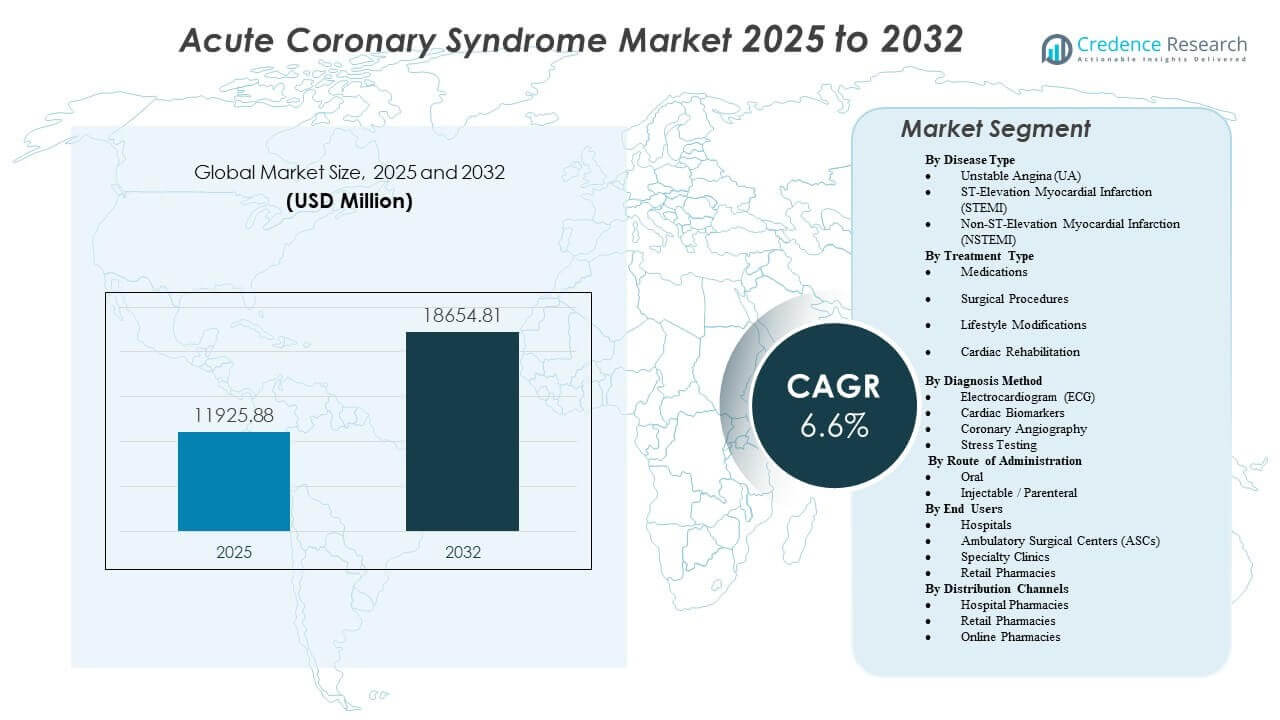
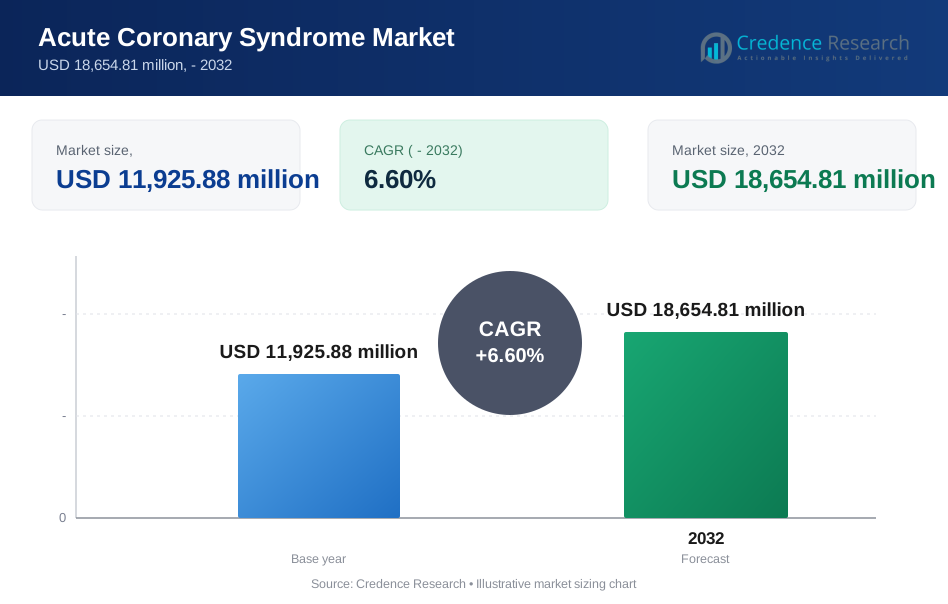
The Acute Coronary Syndrome Market is projected to grow from USD 11,925.88 million in 2025 to an estimated USD 18,654.81 million by 2032, with a compound annual growth rate (CAGR) of 6.6% from 2025 to 2032.
| REPORT ATTRIBUTE | DETAILS |
|---|---|
| Historical Period | 2020-2023 |
| Base Year | 2024 |
| Forecast Period | 2025-2032 |
| Acute Coronary Syndrome Market Size 2025 | USD 11,925.88 million |
| Acute Coronary Syndrome Market, CAGR | 6.6% |
| Acute Coronary Syndrome Market Size 2032 | USD 18,654.81 million |
The market for acute coronary syndrome (ACS) is being driven by the rising global prevalence of cardiovascular diseases, coupled with lifestyle changes such as sedentary behavior, poor diet, and increased stress levels. Additionally, advancements in diagnostic technologies and interventional procedures, including drug-eluting stents and novel antiplatelet agents, are improving treatment outcomes. Pharmaceutical innovation, such as fast-acting P2Y12 inhibitors and lipid-lowering therapies, is further fueling market expansion. Growing awareness among patients and healthcare providers, along with improved access to emergency cardiac care, continues to accelerate demand for ACS-related products and services.
Regionally, North America leads the acute coronary syndrome market due to its advanced healthcare infrastructure, high awareness levels, and strong presence of key pharmaceutical players. Europe follows closely, benefiting from favorable reimbursement policies and a growing elderly population. In contrast, the Asia Pacific region is emerging as a high-growth market, driven by an increasing burden of cardiovascular diseases, urbanization, and expanding healthcare access in countries like China and India. Latin America and the Middle East & Africa are also witnessing gradual growth, spurred by improving medical infrastructure and a focus on early disease detection and treatment.
Market Insights:
- The Acute Coronary Syndrome Market reached USD 11,925.88 million and is forecast to hit USD 18,654.81 million by 2032, supported by a steady 6.6% CAGR driven by rising diagnosis and treatment demand.
- Growing cardiovascular risk factors strengthen market expansion as hospitals invest in faster diagnostics, structured treatment pathways, and wider access to evidence-based therapies.
- Infrastructure gaps, uneven access to advanced procedures, and high treatment costs limit adoption in low-resource regions, creating varied growth potential across care settings.
- North America maintains the largest share due to strong emergency networks and advanced interventional capacity, while Europe benefits from standardized cardiac protocols.
- Asia-Pacific delivers strong momentum driven by rising lifestyle-related risks, expanding cardiac centers, and higher investment in diagnostic and interventional technologies.
Market Drivers
Rising Burden of Cardiovascular Risk Factors Accelerating Demand Across Care Pathways
The Acute Coronary Syndrome Market gains strong momentum due to the surge in high-risk conditions such as diabetes, hypertension, and obesity. Demand climbs because more patients experience plaque instability that requires immediate medical attention. Hospitals rely on faster diagnostic tools to manage rising case loads. Clinicians stress early testing to support accurate triage in crowded emergency units. Governments promote prevention programs to curb recurrent events. Pharmaceutical firms strengthen access to guideline-directed therapies through wider distribution networks. Health systems adopt integrated care models to reduce delays in treatment. The Acute Coronary Syndrome Market benefits from this shift toward standardized intervention.
Growing Adoption of High-Sensitivity Diagnostic Technologies Across Emergency Networks
High-sensitivity biomarker assays reshape detection protocols by reducing the time needed for clinical decisions. Emergency teams depend on rapid troponin tests to confirm myocardial injury with greater accuracy. Hospitals deploy advanced ECG systems to track subtle changes linked to ischemia. Adoption rises because clinicians value more precise risk scoring. Diagnostic labs expand capacity to support high patient volumes. Digital reporting speeds communication between emergency rooms and cardiology units. Remote facilities gain access through portable platforms that maintain test quality. The Acute Coronary Syndrome Market strengthens due to the demand for reliable point-of-care testing.
- For instance, Roche’s Elecsys High-Sensitivity Troponin-T assay detects troponin levels as low as 5 ng/L, enabling rule-in or rule-out decisions within 1 hour in validated clinical pathways.
Increasing Preference for Early Invasive Procedures and Evidence-Driven Revascularization Strategies
Cardiology departments focus on quicker referral for angiography to limit muscle damage. Patients reach centers that deliver interventional treatment within shorter time windows. Hospitals expand catheter labs to meet the rising need for PCI. Clinicians trust invasive strategies due to clear survival benefits in high-risk groups. Demand for advanced stents and guided devices grows in urban facilities. Training programs enhance operator skill levels across growing networks. Health systems invest in structured post-procedural care to prevent future complications. The Acute Coronary Syndrome Market gains from the strong focus on guideline-driven invasive care.
- For instance, Boston Scientific’s SYNERGY Bioabsorbable-Polymer Stent showed a target lesion failure rate of only 6.3% at 5 years, reinforcing its use in evidence-based intervention pathways.
Expanding Use of Digital Care Coordination Tools Across Treatment and Recovery Ecosystems
Digital platforms improve care quality by enabling real-time communication between emergency teams and cardiology units. Hospitals link decision support tools to reduce treatment delays. Clinicians gain access to risk dashboards that help refine therapy plans. Remote monitoring aids recovery for patients with unstable health profiles. Device makers offer connected tools that track vital signs. Telehealth channels support counseling to prevent recurrent events. Data integration platforms ease information flow between providers. The Acute Coronary Syndrome Market grows due to the focus on coordinated and technology-enabled treatment pathways.
Market Trends
Shift Toward Precision-Guided Therapeutics and Biomarker-Driven Care Protocols
Clinicians fine-tune treatment selection through deeper biomarker insights. High-risk patients receive therapies matched to their individual profiles. Drug makers invest in targeted antithrombotic agents that improve treatment safety. Physicians track therapy outcomes through structured monitoring plans. Advanced analytics highlight recovery patterns in specific risk groups. Diagnostic firms introduce tools that support complex decision rules. Health systems refine treatment pathways to reduce variation across facilities. The Acute Coronary Syndrome Market evolves with the push toward precision-aligned care.
Growth of Hybrid Emergency Models Integrating Tele-Cardiology and Mobile Response Units
Tele-cardiology links remote specialists to frontline units that need fast evaluation support. Ambulance teams share ECG data to speed treatment planning before hospital arrival. Mobile care units scale faster intervention across high-density regions. Emergency networks deploy cloud-based communication channels to handle more calls. Physicians rely on digital review tools to interpret complex clinical signs. Rural clinics benefit from remote decision support. Urban networks enhance capacity through mobile hubs and rapid triage stations. The Acute Coronary Syndrome Market advances with wider use of hybrid emergency frameworks.
- For instance, GE Healthcare’s MUSE ECG system enables transmission of 12-lead ECGs within seconds, supporting pre-hospital triage across more than 12,000 global facilities.
Rising Use of AI-Enabled Risk Stratification Tools Across Diagnostic and Treatment Decisions
AI models help clinicians identify high-risk patients at an earlier stage. Hospitals adopt algorithms that support more accurate diagnosis in busy emergency rooms. Machine-based scoring improves prediction of complications. Providers gain clearer insights into treatment response patterns. Imaging workflows integrate AI to detect subtle coronary changes. Risk dashboards improve coordination among multidisciplinary teams. Clinical training programs promote AI literacy among frontline professionals. The Acute Coronary Syndrome Market incorporates intelligent tools that increase decision accuracy.
Increasing Expansion of Same-Day Discharge Programs Supported by Digital Monitoring Tools
Hospitals reduce inpatient stays through structured recovery models. Clinicians release selected patients after safe evaluation steps. Remote monitoring tracks vital signs during early recovery. Mobile apps guide medication use and symptom checks. Nursing teams follow progress through digital dashboards. Facilities rely on clear protocols to identify patients eligible for early discharge. Health systems lower resource pressure through streamlined pathways. The Acute Coronary Syndrome Market supports these programs through connected recovery tools.
- For instance, Boston Scientific’s LATITUDE remote monitoring platform supports continuous cardiac rhythm tracking for more than 1 million patients, improving early complication detection.
Market Challenges Analysis
High Cost Burden and Uneven Access to Advanced Treatment Across Diverse Care Settings
Healthcare systems face rising costs linked to advanced diagnostics and invasive treatment. Patients in low-resource regions struggle to reach centers with the latest equipment. Skilled personnel remain limited in smaller hospitals. Supply chain gaps reduce access to essential devices in certain markets. Insurance coverage differs widely across regions and slows adoption of new therapies. Clinicians depend on consistent funding to upgrade infrastructure. Hospitals aim to reduce delays caused by equipment shortages. The Acute Coronary Syndrome Market experiences pressure from uneven access across care ecosystems.
Complexity of Treatment Pathways and Growing Need for Coordinated Multidisciplinary Care Models Clinicians navigate multiple steps that require precise coordination between departments. Emergency units depend on fast evaluation to support downstream specialists. Hospitals face workflow pressure due to rising patient loads. Physicians need continuous training to manage evolving treatment standards. Data gaps hinder communication between acute and recovery teams. Patients require counseling to maintain adherence after discharge. Providers seek digital systems that simplify complex pathways. The Acute Coronary Syndrome Market encounters challenges linked to coordination across expanding treatment networks.
Market Opportunities
Expansion of Digital Health Platforms and Remote Patient Management Across Recovery Cycles
Digital platforms create new value by improving communication between providers and patients. Remote monitoring supports early detection of complications. Clinicians use mobile tools to maintain post-discharge engagement. AI-supported dashboards refine therapy adjustments. Hospitals gain better insight into patient progress through continuous data flow. Telehealth increases access for rural communities. Providers reduce readmission risks through structured follow-up plans. The Acute Coronary Syndrome Market benefits from stronger digital integration across recovery phases.
Growth Potential in Advanced Interventional Devices and Next-Generation Pharmacologic Therapies
Device firms innovate with more precise stents and guided tools that enhance procedural outcomes. Drug developers explore new antithrombotic agents that improve safety profiles. Hospitals adopt advanced imaging tools to support complex PCI. Clinicians use precision-driven protocols to tailor therapy plans. Training centers expand capacity to meet demand for skilled operators. Health systems upgrade catheter labs with modern platforms. Providers introduce structured recovery pathways linked to improved procedural outcomes. The Acute Coronary Syndrome Market gains opportunities through next-generation therapeutic innovations.
Market Segmentation Analysis:
By Disease Type
The Acute Coronary Syndrome Market reflects strong demand across unstable angina, STEMI, and NSTEMI due to their high clinical urgency. Unstable angina cases drive consistent evaluations in emergency units because symptoms require close monitoring. STEMI cases push rapid intervention due to full arterial blockage that demands immediate revascularization. NSTEMI cases show steady growth because more patients present with partial blockage linked to lifestyle and metabolic risks. Hospitals invest in faster triage tools to reduce delays in identifying each disease type. Clinicians refine care pathways to limit complications in higher-risk patients. Diagnostic upgrades improve the accuracy of early classification. The Acute Coronary Syndrome Market benefits from strong adoption across all three categories.
- For instance, Siemens Healthineers’ Atellica IM High-Sensitivity Troponin I assay supports rule-in and rule-out pathways within 60 minutes, improving early differentiation of STEMI vs NSTEMI.
By Treatment Type
Treatment spans medications, surgical procedures, lifestyle planning, and cardiac rehabilitation. Medications dominate due to the wide use of antiplatelets, beta-blockers, anticoagulants, and statins. Surgical procedures gain relevance where artery restoration is required to limit muscle damage. Lifestyle planning supports long-term risk control in patients with recurring symptoms. Cardiac rehabilitation grows through structured programs that improve recovery and prevent repeated events. Hospitals promote guideline-based therapy to reduce adverse outcomes. Clinicians tailor plans to individual risk profiles for better stability. The Acute Coronary Syndrome Market gains from the broader adoption of comprehensive therapy models.
By Diagnosis Method
Diagnosis relies on ECG, cardiac biomarkers, coronary angiography, and stress testing. ECG remains the frontline tool because it offers rapid insights in emergency rooms. Cardiac biomarkers confirm myocardial injury through sensitive laboratory testing. Coronary angiography provides direct visualization that guides interventional steps. Stress testing supports evaluation in stable patients with unclear symptom patterns. Hospitals expand diagnostic capacity to match rising case volumes. Clinicians depend on clear protocols to shorten decision time. The Acute Coronary Syndrome Market advances through the availability of reliable diagnostic methods.
By Route of Administration
Route of administration includes oral and injectable pathways. Oral drugs encourage long-term adherence in patients who require regular secondary prevention therapy. Injectable agents hold value in emergency settings where faster action is necessary. Hospitals streamline protocols to ensure proper dosing in acute cases. Clinicians choose routes based on stability, comorbidities, and symptom severity. Pharmacies support continued access to essential medications in large patient groups. It strengthens confidence in standardized care delivery. The Acute Coronary Syndrome Market supports both routes due to diverse clinical needs.
- For instance, Sanofi’s enoxaparin is administered subcutaneously and has demonstrated predictable anticoagulation profiles with anti-Xa levels maintained consistently within therapeutic ranges across diverse patient cohorts.
By End Users
End users include hospitals, ASCs, specialty clinics, and retail pharmacies. Hospitals manage the majority of acute cases due to immediate diagnostic and interventional needs. ASCs handle selected follow-up procedures and chronic care planning. Specialty clinics guide long-term management in high-risk groups. Retail pharmacies distribute chronic medications that maintain cardiovascular stability. Providers enhance coordination to improve care continuity across settings. Facilities invest in skilled teams to manage rising patient flows. The Acute Coronary Syndrome Market aligns with multi-tier care delivery models.
By Distribution Channels
Distribution channels include hospital pharmacies, retail pharmacies, and online pharmacies. Hospital pharmacies handle acute therapies used in emergency and interventional units. Retail pharmacies support ongoing medication needs for secondary prevention. Online pharmacies expand access for patients who maintain long-term therapy plans. Clinicians emphasize consistent supply to support adherence. Patients benefit from flexible access points that reduce refill barriers. Providers track usage patterns to refine therapy plans. The Acute Coronary Syndrome Market grows through broad distribution coverage.
Segmentation:
By Disease Type
- Unstable Angina (UA)
- ST-Elevation Myocardial Infarction (STEMI)
- Non-ST-Elevation Myocardial Infarction (NSTEMI)
By Treatment Type
- Medications
- Surgical Procedures
- Lifestyle Modifications
- Cardiac Rehabilitation
By Diagnosis Method
- Electrocardiogram (ECG)
- Cardiac Biomarkers
- Coronary Angiography
- Stress Testing
By Route of Administration
- Oral
- Injectable / Parenteral
By End Users
- Hospitals
- Ambulatory Surgical Centers (ASCs)
- Specialty Clinics
- Retail Pharmacies
By Distribution Channels
- Hospital Pharmacies
- Retail Pharmacies
- Online Pharmacies
By Regions
- North America
- U.S.
- Canada
- Mexico
- Europe
- Germany
- France
- U.K.
- Italy
- Spain
- Rest of Europe
- Asia Pacific
- China
- Japan
- India
- South Korea
- South-east Asia
- Rest of Asia Pacific
- Latin America
- Brazil
- Argentina
- Rest of Latin America
- Middle East & Africa
- GCC Countries
- South Africa
- Rest of the Middle East and Africa
Regional Analysis:
North America holds the largest share of the Acute Coronary Syndrome Market at nearly 38%, driven by strong diagnostic capacity and rapid access to interventional care. Hospitals operate mature cardiac networks that support high patient throughput with minimal treatment delays. Pharmaceutical adoption remains high due to broad insurance coverage and guideline-following clinical practice. The region benefits from advanced biomarker testing that improves accuracy during early evaluation. Providers focus on structured post-event care to lower readmissions. It gains steady support from ongoing investment in cardiovascular programs.
Europe represents about 30% of the global share, supported by organized emergency response systems and expanding use of precision-guided therapies. Countries strengthen cardiac units that focus on STEMI and NSTEMI care pathways. Diagnostic integration across public and private facilities enhances patient flow and reduces mortality risk. Clinicians rely on standardized protocols that improve consistency across national networks. Pharmaceutical firms maintain strong distribution channels across high-burden populations. The Acute Coronary Syndrome Market grows through wider adoption of advanced imaging and rehabilitation services.
Asia-Pacific accounts for nearly 24% of the global market, driven by lifestyle shifts, rising diabetes rates, and strong urban hospital expansion. Governments invest in new cardiac centers to handle increasing patient loads. Diagnostic capability strengthens due to rapid deployment of high-sensitivity biomarkers. Interventional cardiology expands in major cities where patient awareness improves. Regional players work to reduce gaps in treatment access across diverse healthcare systems. It gains momentum from growing insurance penetration and higher demand for chronic cardiac care.
Key Player Analysis:
- AstraZeneca
- Sanofi
- Daiichi Sankyo
- Pfizer
- Merck
- Amgen
- Bristol Myers Squibb
- Johnson & Johnson
- Jiangsu Vcare PharmaTech
- Abcentra
- Resverlogix Corp
- Idorsia Pharmaceuticals
- DalCor Pharmaceuticals
Competitive Analysis:
The Acute Coronary Syndrome Market features strong competition among pharmaceutical companies, device manufacturers, and diagnostics firms that target high-acuity care settings. Leading drug makers focus on antiplatelets, anticoagulants, and lipid-lowering agents that support evidence-based therapy. Device companies strengthen their portfolios with advanced stents, catheters, and imaging tools designed to improve procedural outcomes. Diagnostic firms compete through faster biomarker platforms and compact ECG systems that enhance emergency triage. Hospitals prefer suppliers that deliver consistent performance across large patient volumes. Companies expand partnerships with cardiology centers to support training and technology upgrades. It maintains a competitive landscape shaped by innovation, clinical evidence, and strong focus on lowering treatment delays.
Recent Developments:
- In August 2025, Gland Pharma announced that it received S. FDA approvalfor its generic version of cangrelor for injection. This P2Y12 inhibitor is specifically administered during percutaneous coronary intervention (PCI) to reduce the risk of periprocedural myocardial infarction and stent thrombosis in patients with acute coronary syndrome.
- In February 2025, Idorsia and Viatris revised their global collaboration agreement for selatogrel and cenerimod, advancing development efforts for acute coronary syndrome treatments.
Report Coverage:
The research report offers an in-depth analysis based on Disease Type, Treatment Type, Diagnosis Method, Route of Administration, End Users, Distribution Channels, and Region. It details leading market players, providing an overview of their business, product offerings, investments, revenue streams, and key applications. Additionally, the report includes insights into the competitive environment, SWOT analysis, current market trends, as well as the primary drivers and constraints. Furthermore, it discusses various factors that have driven market expansion in recent years. The report also explores market dynamics, regulatory scenarios, and technological advancements that are shaping the industry. It assesses the impact of external factors and global economic changes on market growth. Lastly, it provides strategic recommendations for new entrants and established companies to navigate the complexities of the market.
Future Outlook:
- Growing adoption of high-sensitivity diagnostics strengthens earlier detection and improves treatment alignment across emergency networks.
- Rising focus on precision-guided therapies supports targeted intervention and enhances long-term patient stability.
- Expansion of catheterization labs in high-burden regions increases access to advanced revascularization options.
- Digital integration accelerates coordinated care models that reduce delays in acute treatment pathways.
- Remote monitoring tools improve recovery tracking and enhance adherence for post-event management.
- AI-based decision systems gain wider use to refine risk assessment during the first clinical evaluation.
- Pharmaceutical innovation strengthens therapy depth through next-generation antithrombotic and lipid-lowering agents.
- Hospitals scale structured rehabilitation programs to support long-term cardiovascular outcomes.
- Shifting lifestyle patterns in emerging regions increase demand for early diagnosis and preventive care.
- The Acute Coronary Syndrome Market advances through continuous upgrades in clinical infrastructure and data-driven care models.
Request a Free Sample
Fill in your details and we'll send you a free sample report.
- Sample data tables & charts
- Research methodology
Need a Custom Version of This Report?
Tailor the scope, geography, or segments to your exact requirements.
- Custom geography or segment scope
- Direct access to our analyst team
Frequently Asked Questions
What is the current market size for the Acute Coronary Syndrome Market, and what is its projected size in 2032?
At what Compound Annual Growth Rate is the Acute Coronary Syndrome Market projected to grow between 2025 and 2032?
Which Acute Coronary Syndrome Market segment held the largest share in 2025?
What are the primary factors fueling the growth of the Acute Coronary Syndrome Market?
Who are the leading companies in the Acute Coronary Syndrome Market?
Which region commanded the largest share of the Acute Coronary Syndrome Market in 2025?
Table of Content
Chapter 1. Report Introduction
- 1.1 Report Description & Purpose
- 1.1.1 Report Title & Market Definition
- 1.1.2 Unique Selling Propositions (USP) & Key Differentiators
- 1.1.3 Value Proposition for Stakeholders
- 1.2 Research Objectives
- 1.2.1 Market Sizing Objectives (Volume & Revenue)
- 1.2.2 Segmentation Objectives
- 1.2.3 Competitive Intelligence Objectives
- 1.2.4 Forecast & Scenario Objectives
- 1.3 Report Scope
- 1.3.1 Acute Coronary Syndrome Scope – Types & Subtypes Covered
- 1.3.2 Geographic Scope – Regions & Countries Covered
- 1.3.3 Historical Period, Base Year & Forecast Period (the historical period; forecast to 2032)
- 1.3.4 Inclusions & Exclusions
- 1.4 HS Code & Classification Framework
- 1.5 Currency, Units & Pricing Basis
- 1.6 Target Stakeholders
- 1.7 Limitations & Assumptions
Chapter 2. Executive Summary
- 2.1 Global Acute Coronary Syndrome Market Snapshot
- 2.1.1 Market Size – Historical (the historical period) & Forecast (2032) (base year: USD 11,925.88 million → 2032: USD 18,654.81 million)
- 2.1.2 Volume & Revenue – Global Totals
- 2.1.3 Key Market Highlights – Top Five Facts
- 2.2 Acute Coronary Syndrome Market Segmentation Snapshot
- 2.2.1 Market Split by Region – vs. 2032
- 2.3 Competitive Snapshot
- 2.3.1 Top 10 Players by Revenue Share –
- 2.3.2 Top 10 Players by Volume Share –
- 2.3.3 Recent Strategic Developments (18-Month Summary)
- 2.4 Key Investment Highlights & Strategic Conclusions
Chapter 3. Acute Coronary Syndrome Market Dynamics & Industry Analysis
- 3.1 Market Overview & Context
- 3.1.1 Acute Coronary Syndrome Market Position in the Broader Automotive Value Chain
- 3.1.2 OEM vs. Replacement Market Dynamics
- 3.1.3 Market Maturity & Development Stage by Region
- 3.2 Acute Coronary Syndrome Market Drivers
- 3.3 Acute Coronary Syndrome Market Restraints & Challenges
- 3.4 Acute Coronary Syndrome Market Opportunities
- 3.5 Porter's Five Forces Analysis
- 3.5.1 Threat of New Entrants
- 3.5.2 Bargaining Power of Suppliers
- 3.5.3 Bargaining Power of Buyers
- 3.5.4 Threat of Substitutes
- 3.5.5 Competitive Rivalry – Intensity Assessment
- 3.6 Acute Coronary Syndrome Value Chain Analysis
- 3.6.1 Upstream – Raw Material/Input Suppliers
- 3.6.1.1 Raw Material/Input 1
- 3.6.1.2 Raw Material/Input 2
- 3.6.1.3 Raw Material/Input 3
- 3.6.2 Midstream – Production/Manufacturing/Service Delivery
- 3.6.2.1 Production/Process Overview
- 3.6.2.2 Key Facility Locations & Capacity by Manufacturer
- 3.6.3 Downstream – Distribution & End Consumer
- 3.6.3.1 Primary Channel – B2B/OEM
- 3.6.3.2 Secondary Channels – Dealer, Retail, Online, Direct
- 3.6.4 Value Chain Profitability Analysis
- 3.6.1 Upstream – Raw Material/Input Suppliers
- 3.7 PESTEL Analysis
- 3.7.1 Political Factors
- 3.7.2 Economic Factors
- 3.7.3 Social Factors
- 3.7.4 Technological Factors
- 3.7.5 Environmental Factors
- 3.7.6 Legal Factors
- 3.8 Acute Coronary Syndrome Supply Chain Analysis
- 3.8.1 Raw Material/Input Supply Risk Assessment
- 3.8.2 Manufacturing Concentration Risk (Geographic Exposure)
- 3.8.3 Trade Disruption Impact Analysis
- 3.9 Regulatory & Policy Landscape
Note: The regulatory and policy landscape section covers regulations based on their applicability to the market, Acute Coronary Syndrome category, geography, and scope of the study. Only regulatory frameworks with a material impact on operations, compliance, trade, sustainability, or market access are analyzed in detail.
Chapter 4. Key Investment Pockets & Opportunity Analysis
- 4.1 Acute Coronary Syndrome Market Attractiveness Analysis
- 4.1.1 By Region – Investment Attractiveness Matrix (Volume × CAGR)
- 4.2 Absolute Revenue Growth Opportunity
- 4.2.1 By Region – Absolute USD Growth Through 2032
- 4.3 Incremental Volume Opportunity
- 4.3.1 By Region – Incremental Volume Through 2032
- 4.3.2 Segment – Incremental Volume
- 4.4 Emerging Submarket Opportunity Deep Dive (Subject to Applicability)
- 4.5 Emerging Market Opportunity Scorecards
- 4.5.1 United States
- 4.5.2 Europe
- 4.5.3 Asia
- 4.5.4 Middle East & Africa
Note: Emerging Market Opportunity Scorecards will be included based on relevance and strategic importance. Regions listed are indicative and may vary depending on data availability and market dynamics.
Chapter 5. Acute Coronary Syndrome Import-Export Analysis & Trade Flows
- 5.1 Global Trade Overview
- 5.1.1 Global Export Value by Country (the historical period)
- 5.1.2 Global Export Volume by Country (the historical period)
- 5.1.3 Global Import Value by Country (the historical period)
- 5.1.4 Global Import Volume by Country (the historical period)
- 5.1.5 Net Trade Balance by Country (the historical period)
- 5.2 Export Analysis – Segment
- 5.2.1 Type 1 (HS Code)
- 5.2.2 Type 2 (HS Code)
- 5.2.3 Type 3 (HS Code)
- 5.2.4 Type 4 (HS Code)
- 5.2.5 Type 5 (HS Code)
- 5.3 Import Analysis – Segment
- 5.3.1 Type 1 (HS Code)
- 5.3.2 Type 2 (HS Code)
- 5.3.3 Type 3 (HS Code)
- 5.3.4 Type 4 (HS Code)
- 5.3.5 Type 5 (HS Code)
- 5.4 Average Unit Trade Prices
- 5.4.1 Average Export Price – Segment & Country
- 5.4.2 Average Import Price – Segment & Source Country
- 5.4.3 Price Trends (the historical period)
- 5.5 Key Trade Route Analysis
- 5.5.1 Trade Route 1
- 5.5.2 Trade Route 2
- 5.5.3 Trade Route 3
- 5.5.4 Trade Route 4
- 5.5.5 Trade Route 5
- 5.6 Trade Policy Impact Assessment
- 5.6.1 US Anti-Dumping & Section 301 Tariffs
- 5.6.2 EU Customs Union Impact
- 5.6.3 Major Free Trade Agreements
- 5.6.4 USMCA Rules of Origin
Note: Trade policy analysis will be included only where relevant to the Acute Coronary Syndrome market.
Chapter 6. Competitive Landscape & Company Benchmarking
- 6.1 Acute Coronary Syndrome Market Concentration & Structure
- 6.1.1 Herfindahl-Hirschman Index (HHI) – vs.
- 6.1.2 Tier 1, Tier 2 & Tier 3 Market Structure
- 6.1.3 Global, Regional & Local Player Dynamics
- 6.2 Acute Coronary Syndrome Market Share Analysis –
- 6.2.1 Global Revenue Share by Company
- 6.2.2 Global Volume Share by Company
- 6.2.3 Regional Revenue Share
- 6.2.4 Market Share Evolution ( vs. )
- 6.2.5 OEM Segment Share by Company
- 6.2.6 Replacement Segment Share by Company
- 6.3 Production/Delivery Capacity & Facility Analysis
- 6.3.1 Global Installed Capacity
- 6.3.2 Capacity Utilization Rates
- 6.3.3 Production/Output Volume
- 6.3.4 Facility Locations & Capacity Map
- 6.3.5 Planned Capacity Additions
- 6.4 Acute Coronary Syndrome Competitive Benchmarking Matrix
- 6.4.1 Revenue, Volume, CAGR & Profitability Comparison
- 6.4.2 Channel Revenue Mix
- 6.4.3 Geographic Revenue Exposure
- 6.4.4 R&D Intensity
- 6.4.5 Sustainability Maturity
- 6.5 Strategic Developments in Acute Coronary Syndrome (Last 24 Months)
- 6.5.1 Mergers, Acquisitions & Divestments
- 6.5.2 New Acute Coronary Syndrome Launches
- 6.5.3 Facility Expansions
- 6.5.4 Strategic Alliances, Joint Ventures & Partnerships
- 6.5.5 Distribution Expansion & Market Entry
- 6.5.6 Sustainability & ESG Initiatives
- 6.6 Competitive Strategy Mapping
- 6.6.1 Leader, Challenger, Follower & Niche Classification
- 6.6.2 Pricing Strategy Comparison
- 6.6.3 Channel Strategy Matrix
Note: Strategic developments are included based on their materiality and the availability of reliable information.
Chapter 7. Global Acute Coronary Syndrome Market – By Distribution Channel
- 7.1 Segment Overview
- 7.1.1 Volume & Revenue Split by Channel ( & 2032)
- 7.1.2 Channel Mix Evolution (2032)
Chapter 8. Regional Market Analysis – Global Overview
- 8.1 Global Regional Overview
- 8.1.1 Regional Volume Share
- 8.1.2 Regional Revenue Share
- 8.1.3 Regional Volume by Region
- 8.1.4 Regional Revenue by Region
- 8.1.5 Regional Forecast Through 2032
- 8.2 Cross-Regional Segment Analysis
- 8.2.1 By Distribution Channel
- 8.2.2 By Brand/Price Tier
Chapter 9. North America Acute Coronary Syndrome Market
- 9.1 United States
- 9.2 Canada
- 9.3 Mexico
Chapter 10. Europe Acute Coronary Syndrome Market
- 10.1 Germany
- 10.2 France
- 10.3 Italy
- 10.4 United Kingdom
- 10.5 Spain
- 10.6 Poland
- 10.7 Russia
- 10.8 Netherlands
- 10.9 Belgium
- 10.10 Sweden
- 10.11 Denmark
- 10.12 Norway
- 10.13 Rest of Europe
Chapter 11. Asia Pacific Acute Coronary Syndrome Market
- 11.1 China
- 11.2 India
- 11.3 Japan
- 11.4 South Korea
- 11.5 Thailand
- 11.6 Indonesia
- 11.7 Vietnam
- 11.8 Malaysia
- 11.9 Australia
- 11.10 Rest of Asia Pacific
Chapter 12. Latin America Acute Coronary Syndrome Market
- 12.1 Brazil
- 12.2 Argentina
- 12.3 Colombia
- 12.4 Chile
- 12.5 Rest of Latin America
Chapter 13. Middle East Acute Coronary Syndrome Market
- 13.1 Saudi Arabia
- 13.2 United Arab Emirates
- 13.3 Turkey
- 13.4 Israel
- 13.5 Iran
- 13.6 Rest of the Middle East
Chapter 14. Africa Acute Coronary Syndrome Market
- 14.1 South Africa
- 14.2 Egypt
- 14.3 Nigeria
- 14.4 Morocco
- 14.5 Rest of Africa
Chapter 15. Acute Coronary Syndrome Company Profiles
- 15.1 [Company 01]
- 15.1.1 Company Overview
- 15.1.2 Key Management Personnel
- 15.1.3 Products & Services Portfolio
- 15.1.4 Financial Performance
- 15.1.5 Key Market Focus & Geographic Presence
- 15.1.6 Recent Developments & Strategic Initiatives
Note: The company profile list is preliminary and may change based on research findings, market developments, data availability, and client requirements.
Chapter 16. Appendices
- Appendix A – List of Abbreviations & Acronyms
- Appendix B – Industry Classification Code Reference – Full Series
- Appendix C – Production & Capacity Data Tables
- Appendix D – End-Use & Demand Base Tables
- Appendix E – Consumption & Replacement Rate Assumptions
- Appendix F – ASP Reference Tables
- Appendix G – Manufacturing & Facility Database
- Appendix H – Import-Export Data Tables
- Appendix I – Regulatory Summary Tables
- Appendix J – Primary Research Participant List (Anonymized)
- Appendix K – Primary Research Questionnaire Framework
- Appendix L – Data Sources & Bibliography
- Appendix M – Market Size Divergence & Source Comparison
Chapter 17. Research Methodology
- 17.1 Research Framework & Philosophy
- 17.2 Secondary Research – Sources, Hierarchy & Data Extraction
- 17.3 Data Modeling – Bottom-Up & Top-Down Market Sizing
- 17.4 Primary Research – Stakeholder Framework, LOI & Sample Sizes
- 17.5 Forecast Methodology – Regression, Scenario & Sensitivity Analysis
- 17.6 Quality Control – Four-Layer Validation Framework
- 17.7 Limitations & Standard Assumptions
- 17.8 Disclaimer
