
Evening primrose oil anchors Australian GLA demand
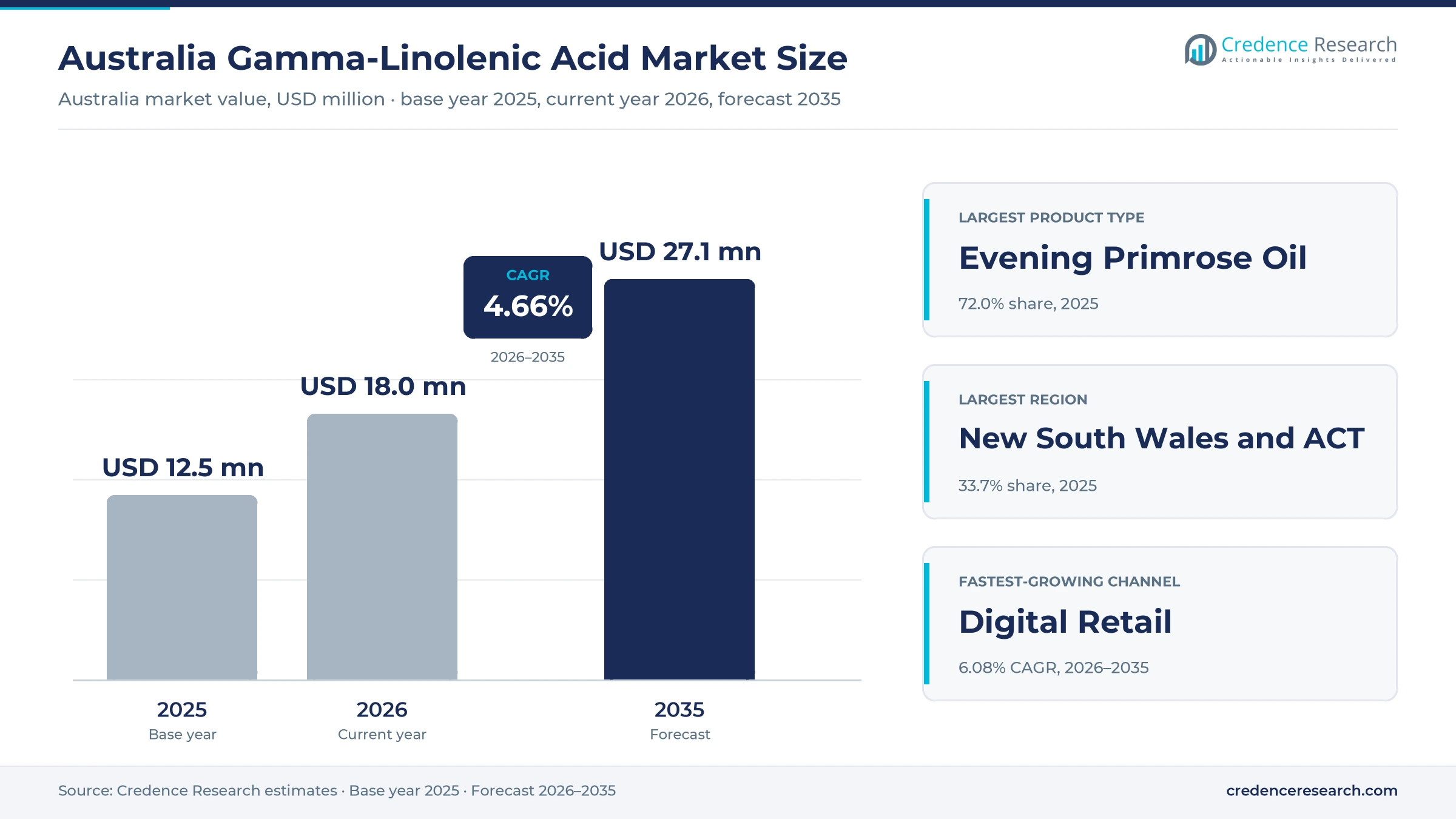
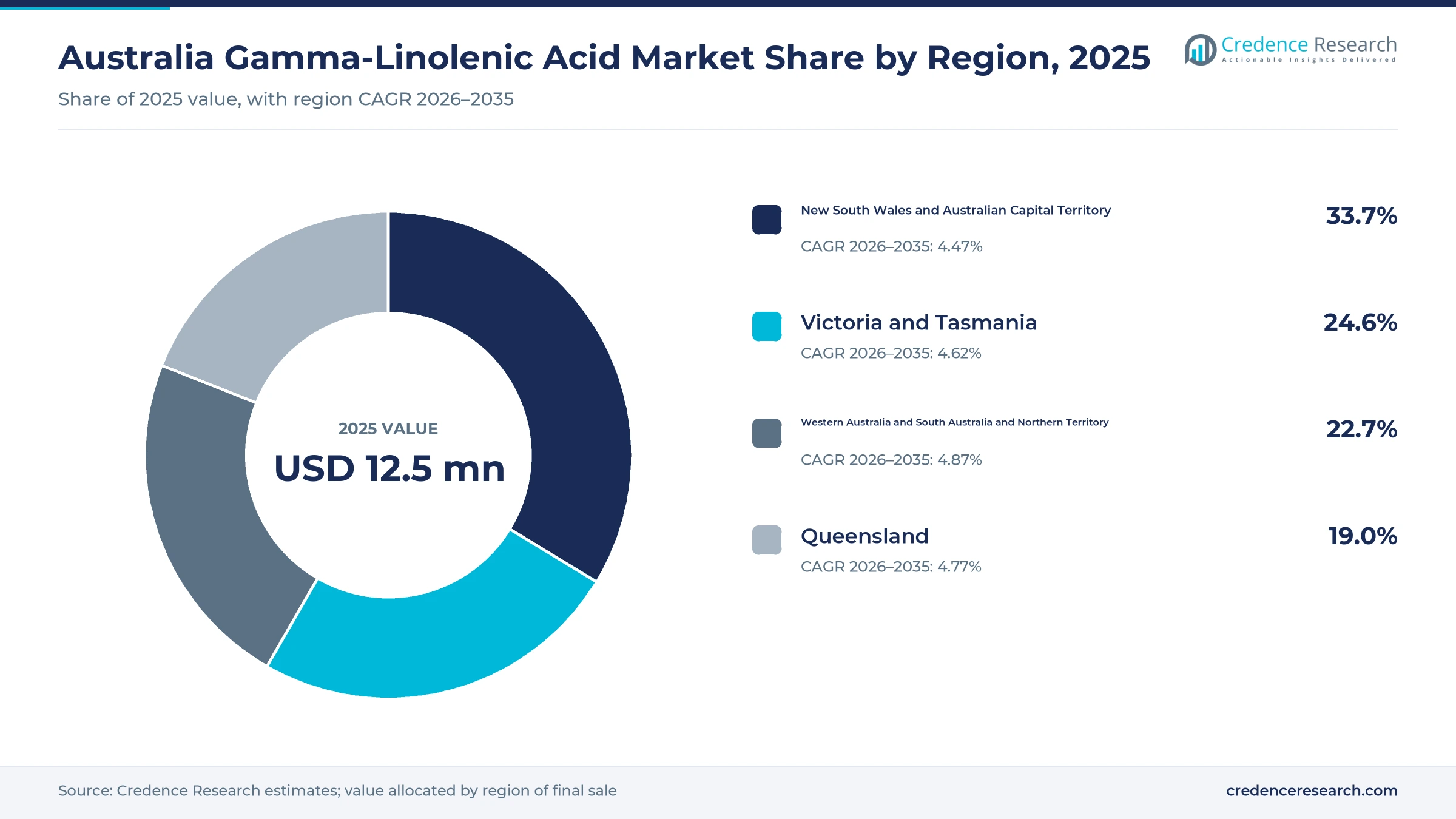
The Australia gamma-linolenic acid market was valued at USD 12.5 million in 2025 and is projected to increase from USD 18.0 million in 2026 to USD 27.1 million by 2035, registering a CAGR of 4.66% during 2026–2035. Demand comes mainly from adult women who buy evening primrose oil capsules for skin health and hormonal comfort, plus smaller volumes of borage and black currant seed oils used in supplements and skin care. New South Wales and the Australian Capital Territory held the largest regional share, 33.7% in 2025, because Sydney has the largest population and the densest pharmacy network. Western Australia, South Australia and the Northern Territory form the fastest-growing zone at 4.87% a year, as Perth leads national population growth. Most products reach buyers through pharmacies, naturopaths and online stores. The merger of Sigma Healthcare and Chemist Warehouse in February 2025 also changed how supplement brands reach pharmacy shelves.
Which GLA oils and buyers does the estimate cover?
The estimate measures the value of oils rich in gamma-linolenic acid sold in Australia, covering evening primrose oil, borage oil and black currant seed oil. It includes finished capsules sold as dietary supplements, oils used in cosmetic formulation and oils supplied as pharmaceutical ingredients. Values are stated at manufacturer and importer selling prices across pharmacy, retail, online and direct ingredient sales.
The estimate excludes fish oil, flaxseed oil and other omega oils that do not carry meaningful amounts of this fatty acid. The value chain runs from overseas seed growers and oil processors through Australian encapsulators and brand owners to pharmacies, practitioners, supermarkets and online stores that sell finished products to adult buyers.
Australia Gamma-Linolenic Acid Market Insights
- The Australia gamma-linolenic acid market was valued at USD 12.5 million in 2025 and is projected to reach USD 27.1 million by 2035, registering a CAGR of 4.66% during 2026–2035.
- New South Wales and the Australian Capital Territory held a 33.7% share of 2025 value, because Sydney has the largest population and pharmacy base.
- Evening primrose oil led with a 72.0% share of 2025 value, because the leading pharmacy brands sell it in large capsule packs.
- Sigma Healthcare and Chemist Warehouse began operating as a merged entity on Feb. 13, 2025, reshaping pharmacy supply for supplement brands.
- Online retail held about 20.6% of vitamin and dietary supplement sales in 2025, which makes it the fastest-growing channel.
Evening primrose oil leads while cosmetic use grows fastest
Why does evening primrose oil lead GLA demand?
Based on product type, the market is categorized into evening primrose oil, borage oil and black currant seed oil. Evening Primrose Oil led with a 72.0% share of 2025 value, because the leading pharmacy brands sell it in large capsule packs for skin health and hormonal comfort. Borage Oil grows fastest at 5.17% a year, as brands look for oils that deliver more of the fatty acid in each capsule.
How does cosmetic formulation outpace supplement use?
Based on application, the market is categorized into dietary supplements, cosmetic formulation and pharmaceutical ingredients. Dietary Supplements led with a 78.0% share of 2025 value, because most of the oil is sold in soft capsules through pharmacies. Cosmetic Formulation grows fastest at 5.57% a year, as skin care makers add seed oils to serums, creams and facial oils that target dry skin.
Why are concentrated oils growing fastest?
Based on technology, the market is categorized into cold-pressed oil, refined oil and concentrated oil. Cold-Pressed Oil led with a 46.0% share of 2025 value, because brands promote cold-pressing as a sign of quality on their packs. Concentrated Oil grows fastest at 5.50% a year, as practitioner brands seek higher strength in fewer capsules for daily dosing.
How do pharmacies and online stores reach buyers?
Based on distribution channel, the market is categorized into pharmacy and practitioner, general retail, digital retail and direct ingredient sales. Pharmacy and Practitioner led with a 60.0% share of 2025 value, because buyers seek advice on supplements for skin and hormonal health. Digital Retail grows fastest at 6.08% a year, as shoppers compare pack sizes and reorder online.
| Segment Group | Leading Sub-segment | Share, 2025 | Fastest-growing Sub-segment | CAGR, 2026–2035 |
|---|---|---|---|---|
| By Product Type | Evening Primrose Oil | 72.0% | Borage Oil | 5.17% |
| By Application | Dietary Supplements | 78.0% | Cosmetic Formulation | 5.57% |
| By Technology | Cold-Pressed Oil | 46.0% | Concentrated Oil | 5.50% |
| By Distribution Channel | Pharmacy and Practitioner | 60.0% | Digital Retail | 6.08% |
Request a Free Sample
Fill in your details and we'll send you a free sample report.
- Sample data tables & charts
- Research methodology
Refill buying, online access and oil choice lift demand
How does population growth support refill demand?
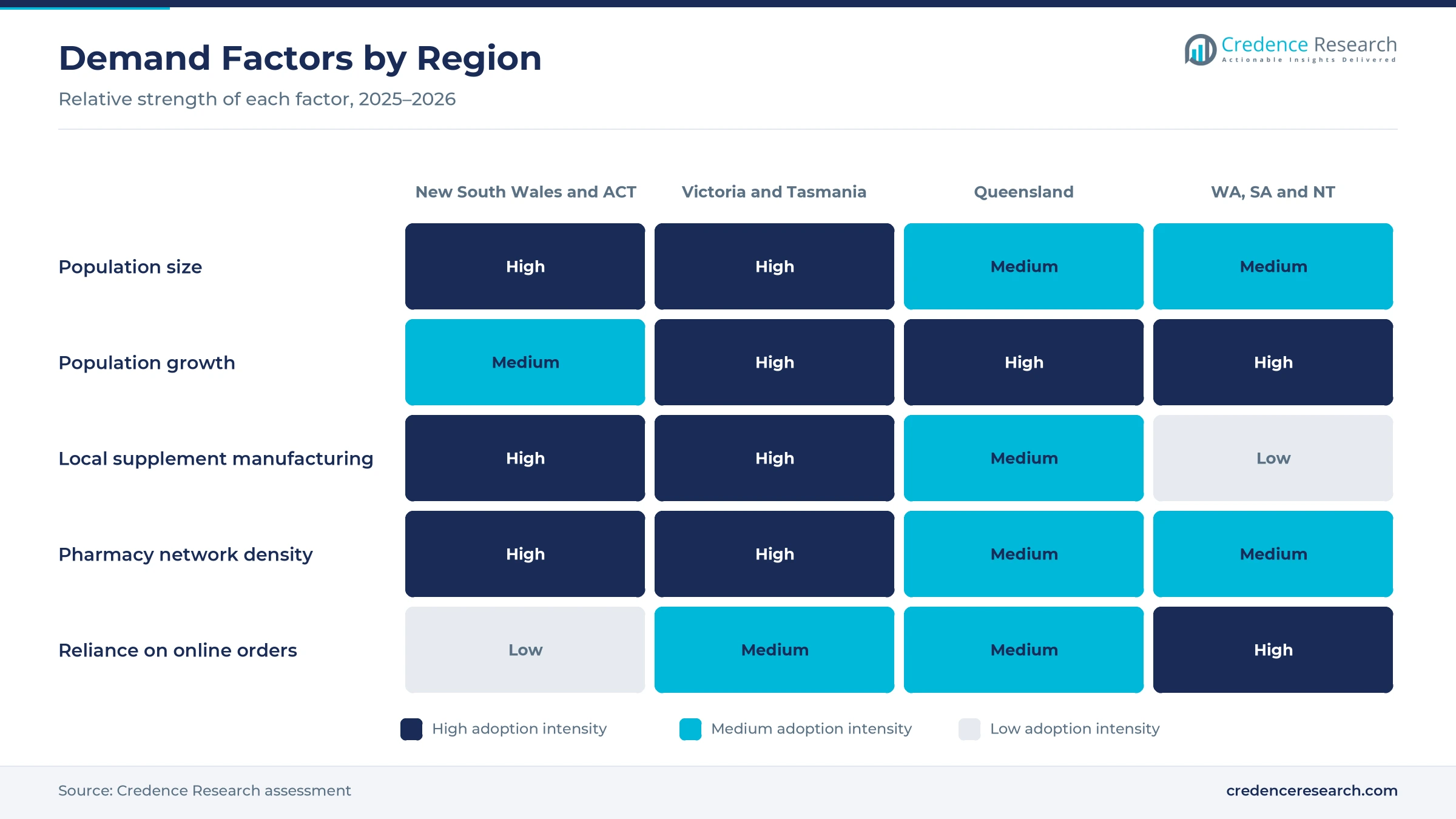
Population growth supports refill demand, because buyers of evening primrose oil tend to repurchase large packs on a regular schedule. Australia's population reached 27.92 million at March 31, 2026, after growing 1.4% over the year, according to the Australian Bureau of Statistics. Supplement use is already broad, with 74% of Australians taking supplements in the past year and 41% taking them daily, according to an industry snapshot. Large packs reinforce this repeat cycle, as Blackmores sells a 190-capsule pack and Swisse sells a 200-capsule pack, each giving 100 milligrams of the fatty acid per capsule. As a result, dietary supplements hold a 78.0% share of 2025 value, while refills track population gains in Perth, Brisbane and Melbourne.
Why do online discovery and repeat orders widen access?
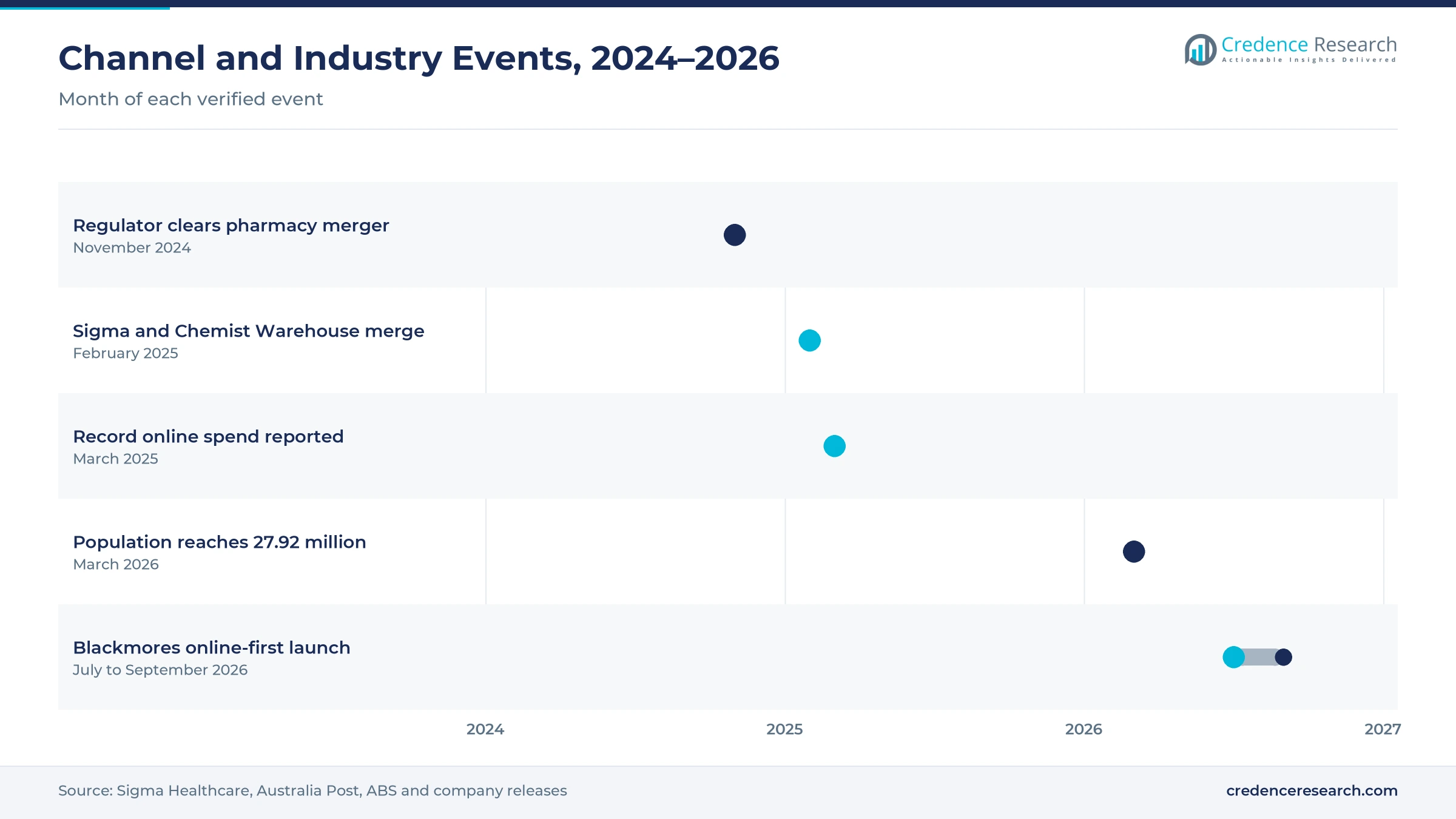
Online discovery and repeat ordering widen access, because shoppers compare capsule strength, pack size and price on screen before they reorder. Australians spent a record $69 billion online in 2024, up 12% on the prior year, and about 9.8 million households made online purchases, according to Australia Post data. Online retail held about 20.6% of vitamin and dietary supplement sales in 2025 and was the fastest-growing channel, according to the same industry snapshot. In July 2026, Blackmores released Cognition Ultra through its own online store first, with pharmacy supply following in September 2026, according to Antara News. In turn, digital retail grows at 6.08% a year, the fastest channel rate in the forecast.
How do source oil and formulation choices add value?
Source oil and formulation choices add value, because brands compete on extraction method, capsule strength and stated uses rather than on price alone. Herbs of Gold markets a cold-pressed evening primrose oil with 100 milligrams of the fatty acid in each 1,000-milligram capsule, sold in a 200-capsule pack. Nature's Care Pro positions its 1,000-milligram capsules for premenstrual tension, mild eczema and skin health, which targets women's health buyers. Swisse lists relief of inflammation and skin health among the uses for its Ultiboost product, with a dose of two capsules three times daily. As a result, cold-pressed oil holds a 46.0% share of 2025 value, while concentrated oil gains share as brands seek stronger claims.
Why do pharmacy scale and local manufacturing matter?
Pharmacy scale and local manufacturing keep supply close to buyers, because most capsules are made in licensed plants and sold over pharmacy counters. Pharmacies held 61% of vitamin and dietary supplement sales in 2025, which keeps the pharmacy and practitioner channel at a 60.0% share of 2025 value. Sigma Healthcare and Chemist Warehouse began operating as a merged entity on Feb. 13, 2025, after the competition regulator said on Nov. 7, 2024, that it would not oppose the deal, according to Sigma Healthcare. Australia also has 81 licensed complementary medicine manufacturing facilities, including 34 in New South Wales, 26 in Victoria and 17 in Queensland. In turn, local makers can refill pharmacy shelves quickly across the eastern states.
Large packs and skin-health claims reshape the shelf
How is the rise of large value packs changing buying?
The rise of large value packs is changing buying, because shoppers facing higher living costs look for a lower price per capsule. Chemist Warehouse listed the Blackmores 190-capsule evening primrose oil pack at $41.49, down from a recommended price of $54.99. Herbs of Gold sells a 200-capsule cold-pressed pack at $32.99 through an online pharmacy, which places large packs within reach of value buyers. Healthylife lists Nature's Care Pro at $29.99 for 90 capsules, with a multi-buy price of $27.89 each for 12 or more bottles and an automatic delivery option. As a result, retailers that run repeat delivery for online pharmacy orders gain loyal buyers who reorder every few months.
Why is the shift to skin-health positioning gaining ground?
The shift to skin-health positioning is gaining ground, because brands now market the oil for hydration and dryness as well as hormonal comfort. Blackmores says each 1,000-milligram capsule gives 100 milligrams of the fatty acid and supports skin health and hydration. Swisse lists skin health among the uses for its 200-capsule Ultiboost pack, with an adult dose of two capsules three times daily, or about 600 milligrams of the fatty acid a day. Nature's Care Pro sells 90-capsule bottles that target mild eczema and dermatitis symptoms. These claims place the oil next to collagen and other skincare supplement products on pharmacy shelves. In turn, cosmetic formulation grows at 5.57% a year, the fastest application rate in the forecast.
Can export-linked brands open new demand for local makers?
Export-linked brands can open new demand for local makers, because Australian supplements carry a strong reputation in Asian markets. Complementary medicine exports reached $1.02 billion in 2024, with China and Hong Kong taking $697 million, or 68% of the total. Vietnam took $86 million, followed by New Zealand at $49 million and South Korea at $32 million, which spreads demand beyond one buyer country. Blackmores joined the Kirin Group in August 2023, which links a leading local maker of evening primrose oil to a large Japanese parent. As a result, encapsulators that serve export brands can run larger batches, which lowers unit costs for products sold at home.
Is there room for practitioner and higher-strength lines?
Practitioner and higher-strength lines have room to grow, because buyers who see naturopaths often accept higher prices for stronger doses. The natural therapies sector includes 39,534 practitioners supported by 21,238 businesses, and women make up 80% of that workforce. Integria Healthcare, part of the Todd group, makes and wholesales herbal, nutritional and complementary healthcare products, which positions it for the practitioner channel. Nature's Care also runs a Pro range that names specific women's health uses on its packs. In turn, concentrated oil grows at 5.50% a year, as practitioner brands seek more of the fatty acid in fewer capsules for each daily dose.
Evidence scrutiny and omega-3 rivalry limit growth
How does clinical evidence scrutiny limit claims?
Clinical evidence scrutiny limits claims, because regulators and pharmacists expect listed products to hold only low-level indications that brands can support. Studies on hormonal and skin outcomes give mixed results, which keeps doctors cautious about recommending the oil. As a result, brands cannot promise strong outcomes on packs or in advertising. Suppliers respond by focusing on general skin and wellbeing claims, publishing ingredient amounts clearly and training pharmacy staff.
Why does omega-3 competition cap shelf space?
Omega-3 competition caps shelf space, because fish oil and krill oil dominate the fatty acid section of most pharmacies. Buyers who already take omega-3 capsules may see a second oil as unnecessary. In turn, evening primrose oil competes for a small number of facings in each store. Brands respond with combination packs, women's health positioning and online bundles that place the oil beside fish oil rather than against it.
How do overseas source oils expose brands to cost swings?
Overseas source oils expose brands to cost swings, because seed harvests, processing capacity and freight rates change from year to year. Brands that buy oil in foreign currency also face exchange rate moves before capsules are made. As a result, margins on value packs can shrink when harvests are weak. Suppliers respond by contracting with several oil processors, holding larger stocks and shifting some lines to borage oil when evening primrose supply is tight.
Why does price discounting squeeze brand margins?
Price discounting squeezes brand margins, because large pharmacy chains run frequent promotions on big capsule packs. Shoppers learn to wait for sales, which lowers the average selling price across the year. In turn, smaller brands find it hard to match discount depth in major chains. They respond by selling through practitioners and independent pharmacies, using cold-pressed and higher-strength claims and offering repeat delivery to build loyalty.
New South Wales leads while the west grows fastest
| Region | Value, 2025 (USD million) | Share, 2025 | CAGR, 2026–2035 |
|---|---|---|---|
| New South Wales and Australian Capital Territory | 4.2 | 33.7% | 4.47% |
| Victoria and Tasmania | 3.1 | 24.6% | 4.62% |
| Western Australia and South Australia and Northern Territory | 2.8 | 22.7% | 4.87% |
| Queensland | 2.4 | 19.0% | 4.77% |
Why does New South Wales hold the largest share?
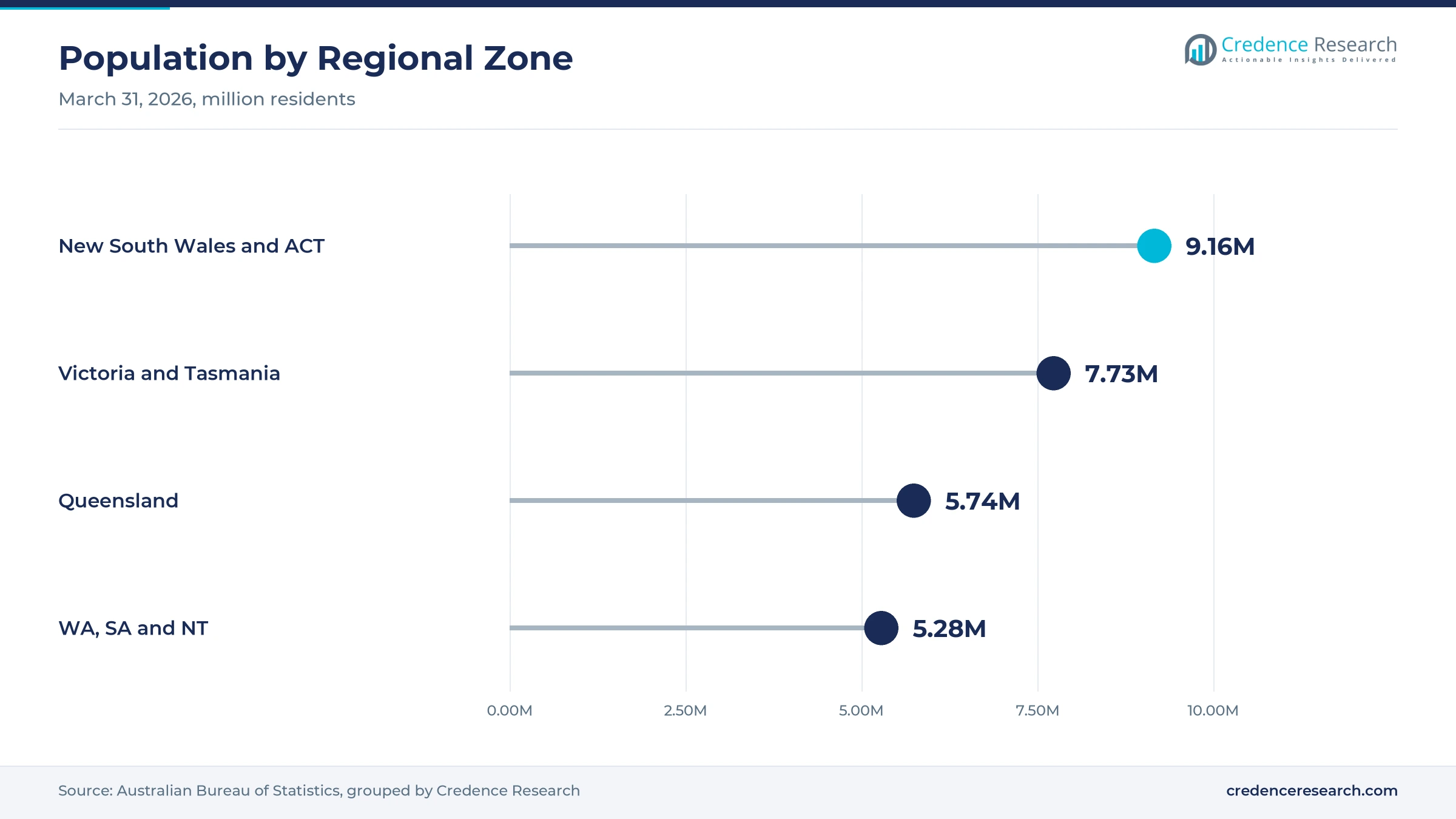
New South Wales and the Australian Capital Territory held a 33.7% share of 2025 value and grow at 4.47% a year, because Sydney has the largest population and pharmacy base. The two jurisdictions had about 9.16 million residents at March 31, 2026. New South Wales also hosts 34 licensed complementary medicine plants. However, growth is slower than in the west, because New South Wales population growth was 1.1% over the year.
How do Victoria and Tasmania support refill buying?
Victoria and Tasmania held a 24.6% share of 2025 value and grow at 4.62% a year, because Melbourne has a large base of adult women who buy supplements through pharmacies. Victoria's population grew 1.6% in the year to March 2026, which supports steady refill demand. Victoria also hosts 26 licensed complementary medicine plants that make capsules for local brands. In turn, local makers supply Melbourne pharmacies with short lead times.
Why is Queensland gaining share?
Queensland held a 19.0% share of 2025 value and grows at 4.77% a year, because Brisbane and the Gold Coast attract new residents who join the supplement buyer base. Queensland had about 5.74 million residents in March 2026 and grew 1.6% over the year. The state also hosts 17 licensed complementary medicine plants that serve local brands. As a result, demand for skin health products rises in a warm climate where dry skin and sun exposure concern many buyers.
What drives growth in the western and central zone?
Western Australia, South Australia and the Northern Territory held a 22.7% share of 2025 value and grow fastest at 4.87% a year, because Western Australia had the fastest population growth at 2.1%. Long distances from eastern warehouses also push buyers toward online orders. As a result, brands that sell through dietary supplement websites with fast delivery gain buyers in Perth and Adelaide.
Pharmacy merger and online launches marked 2024 to 2026
| Development | Status and market relevance |
|---|---|
| In November 2024, the competition regulator said it would not oppose the merger of Sigma Healthcare and Chemist Warehouse, subject to undertakings. | Cleared the way for a larger pharmacy group that sells supplement brands |
| In February 2025, Sigma Healthcare and Chemist Warehouse began operating as a merged entity. | Combined wholesale supply with the largest discount pharmacy chain |
| In March 2025, Australia Post reported that Australians spent a record $69 billion online in 2024. | Showed rising online buying that supports supplement reorders |
| In July 2026, Blackmores released Cognition Ultra in Australia through its own online store first. | Showed the leading evening primrose oil brand testing online-first launches |
Extraction and capsule strength separate GLA products
- Cold-pressing extracts seed oil without high heat or solvents, which brands promote as a sign of quality on their packs.
- Refining removes odor, color and free fatty acids, which gives a stable oil for value capsules and cosmetic use.
- Concentration raises the share of the fatty acid in each capsule, which lets practitioner brands cut the daily capsule count.
- Soft-gel encapsulation seals the oil from air and light, which slows oxidation and protects shelf life in warm climates.
Need a Custom Version of This Report?
Tailor the scope, geography, or segments to your exact requirements.
- Custom geography or segment scope
- Direct access to our analyst team
Pharmacy brands and practitioner lines compete on trust
Competition is led by pharmacy brands that sell evening primrose oil in large capsule packs. Blackmores, part of the Kirin Group since August 2023, sells a 190-capsule pack with 100 milligrams of the fatty acid per capsule. Swisse sells its Ultiboost product in a 200-capsule pack with the same strength per capsule. Herbs of Gold markets a cold-pressed 200-capsule pack, while Nature's Care sells a Pro product that names premenstrual tension and mild eczema among its uses. Rivals compete on brand trust, pharmacy placement, pack size, price per capsule and stated uses. Integria Healthcare serves the practitioner channel with herbal and nutritional products. The 2025 pharmacy merger raises the bargaining power of the largest chain, which pushes smaller brands toward practitioners and online stores.
Companies profiled and their roles in this market
| Company | Type | Role in the market |
|---|---|---|
| Blackmores Ltd | Pharmacy brand | Sells a 190-capsule evening primrose oil pack with 100 mg of the fatty acid per capsule |
| Swisse Wellness Pty Ltd | Pharmacy brand | Sells a 200-capsule Ultiboost evening primrose oil pack |
| Herbs of Gold Pty Ltd | Practitioner brand | Markets a cold-pressed 200-capsule evening primrose oil pack |
| Nature's Care Manufacture Pty Limited | Pharmacy brand | Sells a Pro evening primrose oil product for women's health uses |
Credence Research view on Australian GLA demand
Credence Research's view is that Australian demand for this fatty acid will grow steadily because evening primrose oil buyers repurchase large packs and the population keeps rising. Evening primrose oil remains the base of the market, while borage oil and concentrated oils gain share. Online retail grows fastest as buyers compare pack prices and set up repeat delivery. However, evidence scrutiny, omega-3 competition and discounting in large pharmacy chains will limit price growth. Brands that combine cold-pressed or concentrated oils with clear skin-health claims should gain share fastest.
How the Australian GLA estimate was built
The report uses 2025 as the base year on a calendar basis, and market values come from the Credence Research model. That model combines population statistics, World Bank income data, an industry snapshot on supplement use, channels and exports, company product pages and retailer price listings. Segment splits and regional growth rates are Credence Research estimates, while regional shares follow the client-defined split. Sources used are public reports, official statistics, company websites and news releases, and no interviews or surveys were used. Australian GDP per capita of about $65,130 in 2025, from World Bank data, was used as an income input.
Refill buying and online reach carry GLA demand to 2035
Sales of oils rich in this fatty acid are expected to reach USD 27.1 million by 2035, a 4.66% CAGR during 2026–2035, as refill buying, online access and skin-health positioning keep demand rising. Growth should stay steady through 2028 while pharmacy chains adjust after the 2025 merger and brands build online repeat delivery. After that, concentrated oils and cosmetic uses will carry more growth as standard capsule demand matures. Weaker consumer spending would lower this outlook, while faster growth in skin care use would raise it. Brands with strong pharmacy and online reach are expected to gain the most.
Frequently Asked Questions
How big is the Australia gamma-linolenic acid market?
Which oil leads demand in Australia?
Which region leads the Australia gamma-linolenic acid market?
Which sales channel is growing fastest?
What drives demand for these oils in Australia?
How does pharmacy consolidation affect supplement brands?
Who are the leading companies in Australia?
What are the main challenges for suppliers?
Table of Content
Chapter 1 Market Segmentation
- 1.1 Segmentation Framework
- 1.1.1 Product and Service Classification
- 1.1.2 Application and End-Use Classification
- 1.1.3 Technology and Solution Classification
- 1.1.4 Customer and Distribution Channel Classification
- 1.1.5 Geographic Segmentation
- 1.1.6 Market Segment Definitions and Boundaries
- 1.2 By Product Type
- 1.2.1 Evening Primrose Oil
- 1.2.2 Borage Oil
- 1.2.3 Black Currant Seed Oil
- 1.3 By Application
- 1.3.1 Dietary Supplements
- 1.3.2 Cosmetic Formulation
- 1.3.3 Pharmaceutical Ingredients
- 1.4 By Technology
- 1.4.1 Cold-Pressed Oil
- 1.4.2 Refined Oil
- 1.4.3 Concentrated Oil
Chapter 2 Introduction
- 2.1 Report Objectives and Scope
- 2.2 Product Definition and Industry Terminology
- 2.3 Market Inclusions and Exclusions
- 2.4 Research Process
- 2.4.1 Primary Research and Expert Interviews
- 2.4.2 Secondary Research and Source Review
- 2.4.3 Top-Down and Bottom-Up Estimation
- 2.4.4 Data Triangulation and Verification
- 2.5 Market Size Measurement Basis
- 2.5.1 2025: USD 12.5 million → 2035: USD 27.1 million
- 2.6 Historical and Forecast Reference Periods
- 2.6.1 Historical Period: 2018-2025
- 2.6.2 Base Year: 2025
- 2.6.3 Forecast Period: 2025-2035
- 2.7 Research Assumptions and Limitations
Chapter 3 Executive Summary
- 3.1 Market Snapshot and Key Findings
- 3.2 Base-Year Market Size, 2025
- 3.3 Forecast Market Size, 2035
- 3.4 Revenue and Volume Growth Outlook
- 3.5 Key Demand and Supply Indicators
- 3.6 Leading Market Segments
- 3.7 Fastest-Growing Market Opportunities
- 3.8 Regional Performance Highlights
- 3.9 Technology and Industry Transformation
- 3.10 Competitive Landscape Summary
- 3.11 Analyst View and Strategic Implications
Chapter 4 Australia Gamma-Linolenic Acid Market Trends and Developments
- 4.1 Historical Industry Development, 2018-2025
- 4.2 Recent Market Trends and Developments
- 4.3 Demand and Customer Behavior Trends
- 4.4 Technology and Product Innovation
- 4.5 Artificial Intelligence, Automation and Digitalization
- 4.6 Local Manufacturing and Supply Chain Realignment
- 4.7 Industry Partnerships, Mergers and Acquisitions
- 4.8 Sustainability and Circular Economy Developments
- 4.9 Government and Private Sector Investment Trends
- 4.10 Emerging Business Models and Commercialization
- 4.11 Industry Developments and Announcements
Chapter 5 Australia Gamma-Linolenic Acid Market Production, Supply and Demand Analysis
- 5.1 Demand Trend and Consumption Analysis, 2018-2025
- 5.2 Demand Forecast, 2025-2035
- 5.3 Production and Output Trend, 2018-2025
- 5.4 Production and Output Forecast, 2025-2035
- 5.5 Installed Capacity and Capacity Utilization
- 5.6 Company-Wise Production Plants and Statistics
- 5.6.1 Installed Production Capacity
- 5.6.2 Actual Production
- 5.6.3 Planned Capacity and Expansion Targets
- 5.7 Supply Chain Structure and Procurement Trends
- 5.8 Supply-Demand Gap and Bottlenecks
- 5.9 Import Dependence and Sourcing Structure
- 5.10 Contract Manufacturing and Outsourcing
- 5.11 Regional Supply and Demand Concentration
Chapter 6 Australia Gamma-Linolenic Acid Market Pricing Analysis
- 6.1 Pricing Structure and Measurement
- 6.2 Historical Pricing Trends, 2018-2025
- 6.3 Pricing Outlook, 2025-2035
- 6.4 Average Selling Price and Unit Economics
- 6.5 Pricing by Product and Market Segment
- 6.6 Geographic Pricing Differences
- 6.7 Key Input, Energy, Labor and Logistics Costs
- 6.8 Contract Pricing and Purchasing Models
- 6.9 Pricing Sensitivity and Competitive Positioning
- 6.10 Price, Margin and Profitability Implications
Chapter 7 Australia Gamma-Linolenic Acid Market Dynamics
- 7.1 Market Growth Drivers
- 7.1.1 Demand-Side Drivers
- 7.1.2 Technology and Innovation Drivers
- 7.1.3 Infrastructure and Investment Drivers
- 7.1.4 Regulatory and Policy Drivers
- 7.2 Market Restraints
- 7.2.1 Cost and Affordability Constraints
- 7.2.2 Technology and Adoption Barriers
- 7.2.3 Supply Chain and Operational Constraints
- 7.3 Market Challenges
- 7.3.1 Competitive Pressure and Margin Erosion
- 7.3.2 Skills, Infrastructure and Implementation Gaps
- 7.4 Emerging Market Opportunities
- 7.5 Market Dynamics Impact and Time-Horizon Assessment
Chapter 8 Australia Gamma-Linolenic Acid Value Chain Analysis
- 8.1 Industry Value Chain Overview
- 8.2 Upstream Suppliers and Critical Inputs
- 8.3 Technology and Component Providers
- 8.4 Manufacturing or Service Delivery
- 8.5 Distribution, Channel Partners and Integrators
- 8.6 Downstream Applications and End Users
- 8.7 Value Addition and Profit Pools
- 8.8 Vertical Integration and Outsourcing
- 8.9 Supplier Concentration and Risk
- 8.10 Supply Chain Localization and Resilience
Chapter 9 Australia Gamma-Linolenic Acid Market Regulations and Policies
- 9.1 Relevant Laws, Standards and Compliance Frameworks
- 9.2 Product, Service, Safety and Quality Requirements
- 9.3 Government Policies, Incentives and Subsidies
- 9.4 Imports, Exports and Trade Barriers
- 9.5 Public Procurement and Local Content Requirements
- 9.6 Environmental and Sustainability Compliance
- 9.7 Upcoming Policy Changes and Market Implications
Chapter 10 Australia Gamma-Linolenic Acid Market Hotspots and Opportunities
- 10.1 Market Opportunity Mapping and Growth Hotspots
- 10.2 High-Growth Applications and Customer Groups
- 10.3 Underserved Markets and White-Space Opportunities
- 10.4 Emerging Technology and Product Opportunities
- 10.5 New Capacity and Investment Hotspots
- 10.6 Market Entry and Expansion Opportunities
- 10.7 Distribution and Partnership Opportunities
- 10.8 Near-Term and Long-Term Commercial Potential
- 10.9 Opportunity Attractiveness and Execution Risks
Chapter 11 Australia Gamma-Linolenic Acid Market Outlook, 2025-2035
- 11.1 Market Size and Analysis
- 11.1.1 Revenue (Market Measurement: 2025: USD 12.5 million → 2035: USD 27.1 million)
- 11.1.2 Market Volume and Quantity Sold
- 11.1.3 Historical Market Size, 2018-2025
- 11.1.4 Base-Year Market Size, 2025
- 11.2 Market Forecast, 2025-2035
- 11.2.1 Revenue Forecast to 2035
- 11.2.2 Volume Forecast to 2035
- 11.2.3 CAGR and Year-on-Year Growth
- 11.2.4 Incremental Revenue Opportunity
- 11.3 Forecast Assumptions and Scenario Analysis
- 11.3.1 Base-Case Forecast
- 11.3.2 Optimistic and Conservative Scenarios
- 11.3.3 Technology, Pricing and Policy Sensitivities
- 11.4 Market Attractiveness and Growth Outlook
Chapter 12 Australia Gamma-Linolenic Acid Market Segmentation and Outlook
- 12.1 Segmentation Summary and Market Shares, 2025
- 12.2 Largest and Fastest-Growing Segments
- 12.3 By Product Type - Market Size and Forecast, 2025-2035
- 12.3.1 Segment Definition and Scope
- 12.3.2 Historical Market Size, 2018-2025
- 12.3.3 Revenue Forecast, 2025-2035
- 12.3.4 Volume Forecast, 2025-2035
- 12.3.5 Base-Year Market Share, 2025
- 12.3.6 Segment CAGR and Growth Drivers
- 12.3.7 Subsegment Market Size and Forecast
- 12.3.7.1 Evening Primrose Oil
- 12.3.7.2 Borage Oil
- 12.3.7.3 Black Currant Seed Oil
- 12.3.8 Subsegment Pricing and Adoption Trends
- 12.3.9 Leading Suppliers and Competition
- 12.3.10 Regional Demand and Opportunities
- 12.4 By Application - Market Size and Forecast, 2025-2035
- 12.4.1 Segment Definition and Scope
- 12.4.2 Historical Market Size, 2018-2025
- 12.4.3 Revenue Forecast, 2025-2035
- 12.4.4 Volume Forecast, 2025-2035
- 12.4.5 Base-Year Market Share, 2025
- 12.4.6 Segment CAGR and Growth Drivers
- 12.4.7 Subsegment Market Size and Forecast
- 12.4.7.1 Dietary Supplements
- 12.4.7.2 Cosmetic Formulation
- 12.4.7.3 Pharmaceutical Ingredients
- 12.4.8 Subsegment Pricing and Adoption Trends
- 12.4.9 Leading Suppliers and Competition
- 12.4.10 Regional Demand and Opportunities
- 12.5 By Technology - Market Size and Forecast, 2025-2035
- 12.5.1 Segment Definition and Scope
- 12.5.2 Historical Market Size, 2018-2025
- 12.5.3 Revenue Forecast, 2025-2035
- 12.5.4 Volume Forecast, 2025-2035
- 12.5.5 Base-Year Market Share, 2025
- 12.5.6 Segment CAGR and Growth Drivers
- 12.5.7 Subsegment Market Size and Forecast
- 12.5.7.1 Cold-Pressed Oil
- 12.5.7.2 Refined Oil
- 12.5.7.3 Concentrated Oil
- 12.5.8 Subsegment Pricing and Adoption Trends
- 12.5.9 Leading Suppliers and Competition
- 12.5.10 Regional Demand and Opportunities
- 12.6 Segment Growth Comparison
- 12.7 Segment Attractiveness and Priority Matrix
Chapter 13 Australia Gamma-Linolenic Acid End-Use and Application Market Outlook
- 13.1 End-Use Industry and Customer Demand Structure
- 13.2 Leading Applications and Customer Groups
- 13.3 End-Use Market Size, Share and Forecast
- 13.4 Major End-Use Industry Deep Dives
- 13.4.1 Customer Requirements and Use Cases
- 13.4.2 Demand and Replacement Cycles
- 13.4.3 Technical and Regulatory Considerations
- 13.4.4 Purchasing and Procurement Models
- 13.4.5 Leading Vendors and Distribution Channels
- 13.4.6 Forecast and Commercial Opportunities
- 13.5 Emerging Applications and Cross-Segment Demand
- 13.6 End-Use Industry Investment Priorities
Chapter 14 Australia Gamma-Linolenic Acid Geographic Market Outlook, 2025-2035
- 14.1 Domestic Market Distribution and Demand Clusters
- 14.2 State- or Province-Wise Market Size and Forecast, 2025-2035
- 14.3 City and Metropolitan Market Outlook
- 14.4 Industrial, Manufacturing and Commercial Clusters
- 14.5 Geographic Concentration of Key End Users
- 14.6 Local Pricing and Purchasing Differences
- 14.7 Domestic Production Facilities and Capacity Map
- 14.8 Local Infrastructure and Project Pipeline
- 14.9 State-Level Policy and Incentive Differences
- 14.10 Subnational Investment Hotspots and Opportunities
- 14.11 Distribution and Logistics Networks
- 14.12 Domestic Competitive Footprint
Chapter 15 Australia Gamma-Linolenic Acid Technology, Innovation and Sustainability Outlook
- 15.1 Technology Landscape and Maturity
- 15.2 Product, Process and Service Innovation
- 15.3 AI, Automation and Digital Tools in the Industry
- 15.4 Technology Adoption and Performance Benchmarking
- 15.5 Innovation Pipeline and R&D Investment
- 15.6 Patent and Intellectual Property Trends
- 15.7 Energy Efficiency and Resource Management
- 15.8 Sustainability, Recycling and Circularity
- 15.9 Technology Roadmap, 2025-2035
- 15.10 Risks of Obsolescence and Technology Substitution
Chapter 16 Australia Gamma-Linolenic Acid Market Key Strategic Imperatives
- 16.1 Growth and Market Entry Priorities
- 16.2 High-Return Products and Segments
- 16.3 Pricing, Profitability and Cost Optimization
- 16.4 Technology Investment and Product Differentiation
- 16.5 Supply Chain Localization and Resilience
- 16.6 Distribution and Customer Acquisition
- 16.7 Partnership, Acquisition and Capacity Strategy
- 16.8 Regional Expansion Priorities
- 16.9 Short-, Medium- and Long-Term Actions
Chapter 17 Competition Outlook
- 17.1 Industry Competition Characteristics
- 17.2 Market Structure and Concentration
- 17.3 Market Share and Competitive Positioning, 2025
- 17.4 Company-Wise Revenue and Product Benchmarking
- 17.5 Production and Service Capacity Benchmarking
- 17.6 Technology, Pricing and Differentiation
- 17.7 Regional Footprint and Distribution Strength
- 17.8 Mergers, Acquisitions and Strategic Alliances
- 17.9 New Entrants and Competitive Threats
- 17.10 Porter's Five Forces and Industry Attractiveness
- 17.11 Competitive Outlook, 2025-2035
Chapter 18 Company Profiles
- 18.1 Company Coverage and Selection Criteria
- 18.2 Blackmores Ltd
- 18.2.1 Business Description
- 18.2.2 Company Ownership and Geographic Presence
- 18.2.3 Product and Service Portfolio
- 18.2.4 Manufacturing and Operating Footprint
- 18.2.5 Production Capacity and Expansion Plans
- 18.2.6 Financial Performance and Investment
- 18.2.7 Market Share and Competitive Position
- 18.2.8 Technology and Innovation Capabilities
- 18.2.9 Strategic Alliances or Partnerships
- 18.2.10 Recent Developments
- 18.2.11 Growth Strategy and Outlook
- 18.3 Swisse Wellness Pty Ltd
- 18.4 Integria Healthcare Australia Pty Ltd
- 18.5 Nature's Care Manufacture Pty Limited
- 18.6 Herbs of Gold Pty Ltd
- 18.7 Other Relevant Market Participants
Note: Every listed company is profiled on the structure shown under the first company. The company list is preliminary and may change based on research findings, market developments, data availability and client requirements.
Chapter 19 Disclaimer
- 19.1 Research and Forecast Disclaimer
- 19.2 Data Source and Estimation Limitations
Note: The depth of individual sections depends on data availability for this market. Volume, capacity, trade and other unit-based metrics are included where applicable.

