
Pharmacist-only tablets anchor after-sex pregnancy care
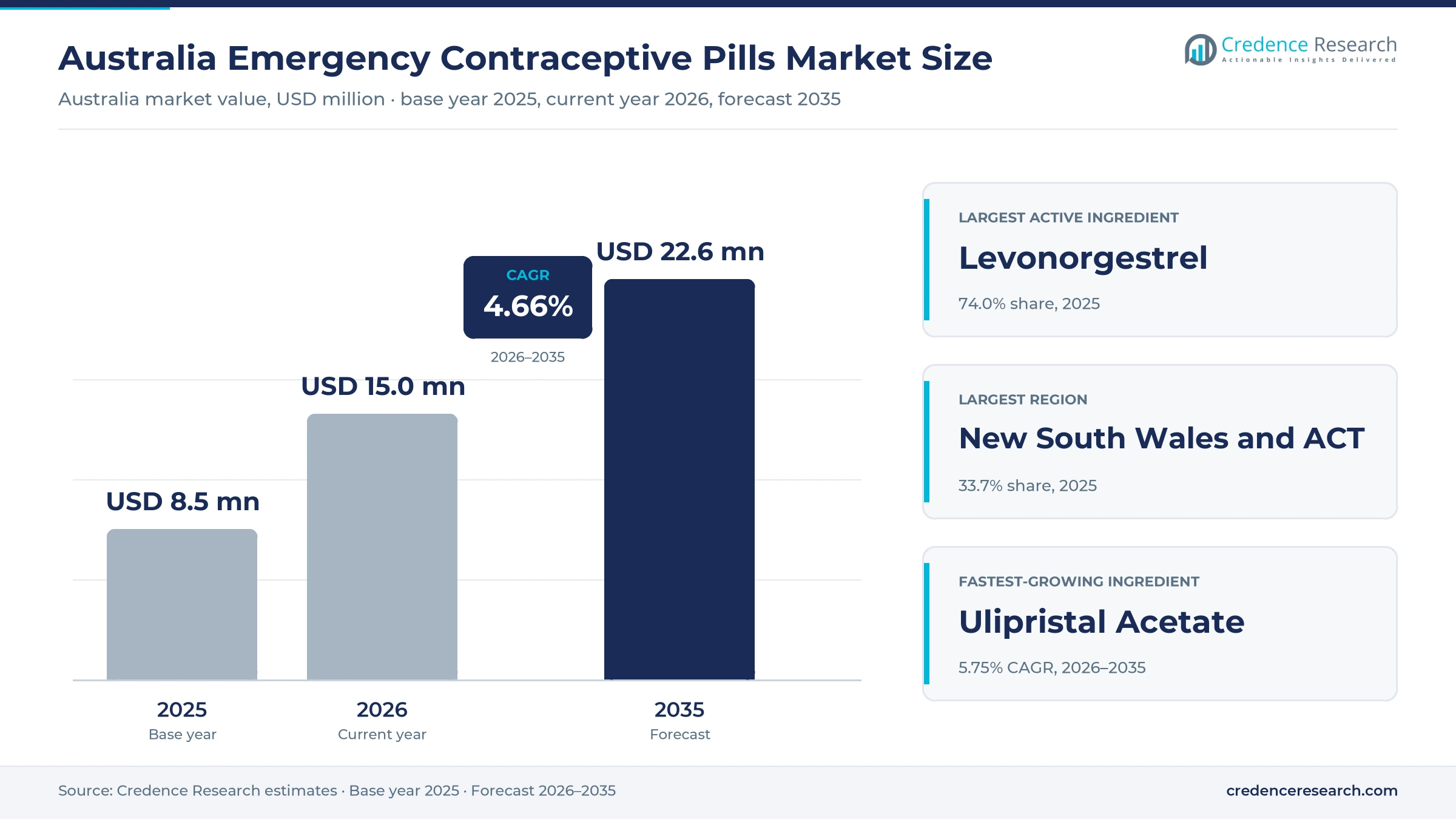
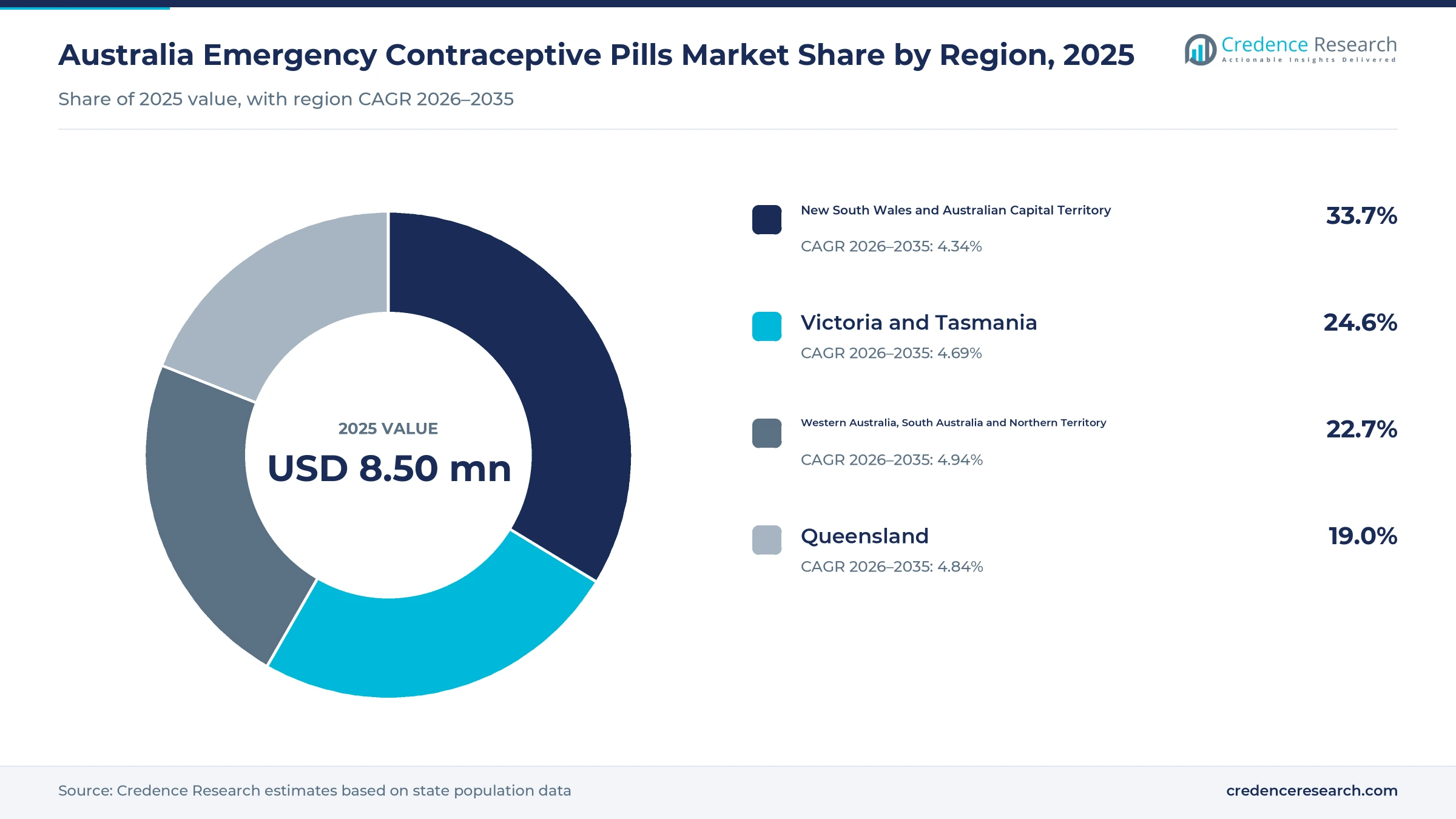
The Australia emergency contraceptive pills market was valued at USD 8.50 million in 2025 and is projected to increase from USD 15.0 million in 2026 to USD 22.6 million by 2035, registering a CAGR of 4.66% during 2026–2035. Demand comes from people who buy a single tablet at a community pharmacy after a condom breaks, a pill is missed or no method was used, and from clinics that supply subsidized packs. Both levonorgestrel and ulipristal acetate are Schedule 3 pharmacist-only medicines, so a short consultation with a pharmacist comes before every sale. New South Wales and Australian Capital Territory held the largest regional share, 33.7% in 2025, because the zone has the largest population and dense metropolitan pharmacy networks. Western Australia, South Australia and Northern Territory is the fastest-growing region at 4.94% a year. In turn, the product mix is changing as cheaper generic levonorgestrel packs reach shelves and clinical guidance favors ulipristal acetate for more buyers.
What sales are counted in the national estimate?
The estimate measures the value of oral tablets taken after unprotected intercourse or contraceptive failure in Australia. It counts levonorgestrel 1.5 mg and ulipristal acetate 30 mg packs sold over the pharmacy counter, reserved online and collected in store, or delivered by a pharmacy after a pharmacist consultation, at consumer prices.
The estimate excludes copper intrauterine devices fitted after intercourse, daily oral contraceptives and consultation fees charged by doctors or clinics. The value chain runs from overseas manufacturers and their local sponsors through wholesalers and pharmacy groups to pharmacists, who assess each buyer before supply.
Australia Emergency Contraceptive Pills Market Insights
- The Australia emergency contraceptive pills market was valued at USD 8.50 million in 2025 and is projected to reach USD 22.6 million by 2035, registering a CAGR of 4.66% during 2026–2035.
- New South Wales and Australian Capital Territory held a 33.7% share of 2025 value, because the zone has the largest population and pharmacy base.
- Levonorgestrel led active ingredients with a 74.0% share of 2025 value, because nearly every community pharmacy stocks it at a lower price.
- A June 2026 Australian Prescriber review states that ulipristal acetate is preferred for buyers with a body weight over 70 kg or a body mass index above 26.
- Generic levonorgestrel launches by Nova Pharmaceuticals in May 2024 and an Apohealth tablet in April 2026 have added lower-priced packs to pharmacy shelves.
Levonorgestrel leads while ulipristal acetate gains ground
Why does levonorgestrel still carry most tablet value?
Based on active ingredient, the market is categorized into Levonorgestrel and Ulipristal Acetate. Levonorgestrel led with a 74.0% share of 2025 value, because almost every community pharmacy stocks it and several generic packs sell at lower prices. Ulipristal Acetate grows fastest at 5.75% a year, as guidance favors it for people with higher body weight and for use three to five days after intercourse.
How do originator and generic packs split the shelf?
Based on brand type, the market is categorized into Originator-branded Levonorgestrel, Generic-branded Levonorgestrel and Branded Ulipristal Acetate. Originator-branded Levonorgestrel led with a 39.0% share of 2025 value, because long-standing brands such as Postinor-1 keep strong pharmacist recognition. Generic-branded Levonorgestrel grows fastest at 5.66% a year, as sponsors and pharmacy groups add lower-priced 1.5 mg packs.
Why do counter purchases dominate tablet sales?
Based on distribution channel, the market is categorized into Walk-in Pharmacy Purchase, Digital Reservation and Collection, and Pharmacy Delivery. Walk-in Pharmacy Purchase led with 86.0% of 2025 value, because buyers need same-day supply and a pharmacist consultation. Digital Reservation and Collection grows fastest at 6.81% a year, as buyers reserve a pack online and complete the consultation at collection.
Which age groups account for most tablet purchases?
Based on end user, the market is categorized into Under 25 Years, 25-34 Years, and 35 Years and Over. Under 25 Years led with a 43.0% share of 2025 value, because Credence Research estimates that younger adults make the most frequent counter purchases after condom failure or missed pills. 25-34 Years grows fastest at 4.95% a year, as more buyers in this group delay pregnancy into their thirties.
| Segment Group | Leading Sub-segment | Share, 2025 | Fastest-growing Sub-segment | CAGR, 2026–2035 |
|---|---|---|---|---|
| By Active Ingredient | Levonorgestrel | 74.0% | Ulipristal Acetate | 5.75% |
| By Brand Type | Originator-branded Levonorgestrel | 39.0% | Generic-branded Levonorgestrel | 5.66% |
| By Distribution Channel | Walk-in Pharmacy Purchase | 86.0% | Digital Reservation and Collection | 6.81% |
| By End User | Under 25 Years | 43.0% | 25-34 Years | 4.95% |
Request a Free Sample
Fill in your details and we'll send you a free sample report.
- Sample data tables & charts
- Research methodology
Population growth, counter access and wider stocking
How does population growth widen the pool of buyers?
Demand for after-sex tablets scales with the number of adults of reproductive age, and the national population keeps adding new potential buyers each year. The population reached 27.9 million on March 31, 2026, after growth of 392,700 people or 1.4% over the year, according to the Australian Bureau of Statistics. Net overseas migration added 292,100 people in that year, which renews the adult customer base of community pharmacies. Registered births rose 1.9% to 292,318 in 2024, while the total fertility rate fell to 1.481 babies per woman. The median age of mothers reached 32.1 years in 2024, which means most women spend their twenties preventing rather than planning pregnancy. As a result, Under 25 Years buyers held 43.0% of 2025 value.
Why does pharmacist-only status keep access fast?
Both oral methods are sold without a prescription, which keeps the pharmacy counter the main point of purchase after a contraceptive failure. Levonorgestrel and ulipristal acetate are both available from pharmacies without a prescription, according to healthdirect. The first dedicated levonorgestrel product was registered as a prescription item in 2002 and moved over the counter shortly after, while ulipristal acetate became a pharmacist-only medicine on Feb. 1, 2017, according to the RACGP journal Australian Family Physician. The Pharmacy Guild of Australia counted 6,013 community pharmacies in June 2025, and 96% of capital city residents live within 2.5 km of one. As a result, Walk-in Pharmacy Purchase held 86.0% of 2025 value, because buyers need same-day supply.
How is wider ulipristal stocking shifting the mix?
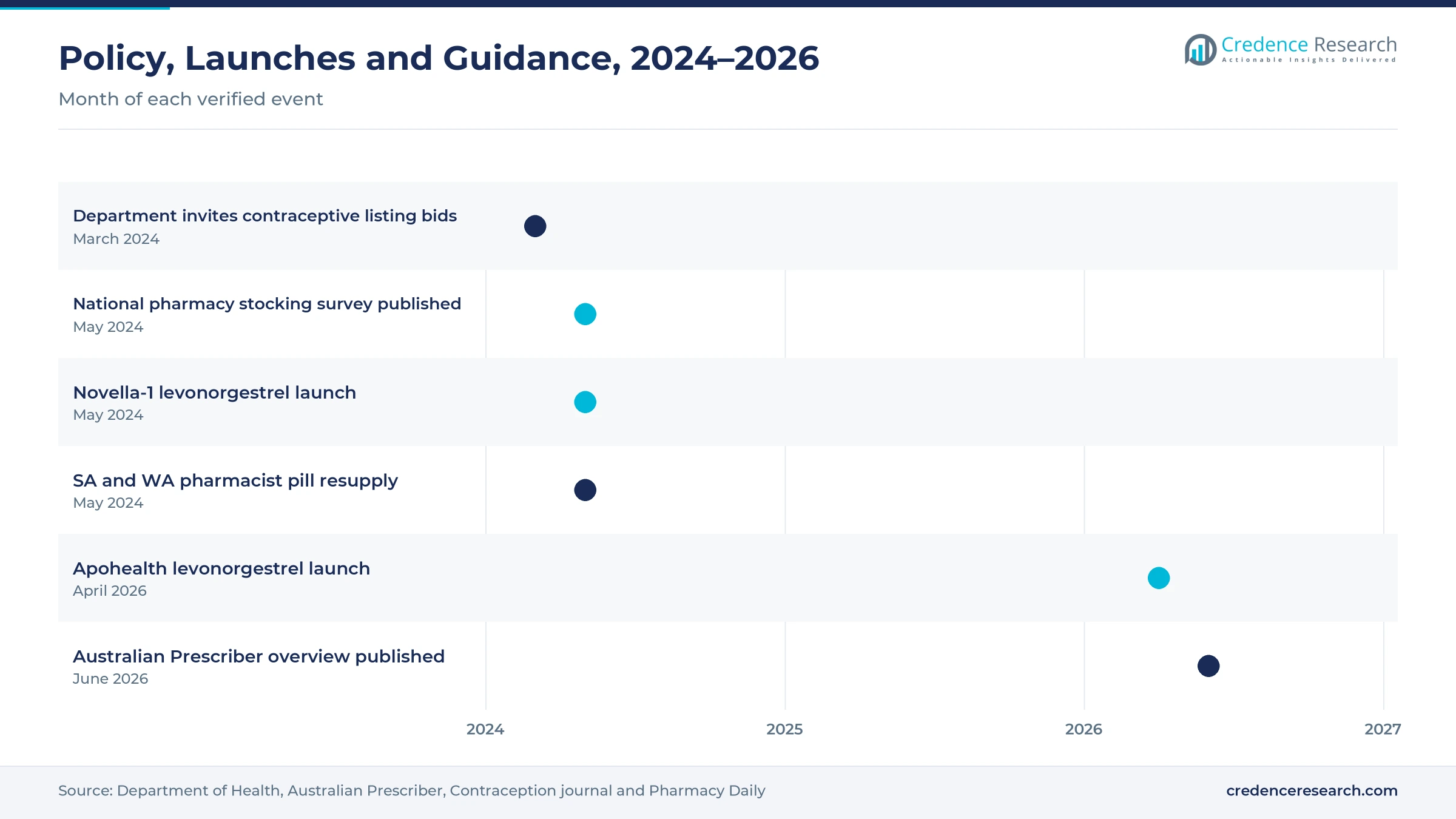
Ulipristal acetate works for longer after intercourse, and wider pharmacy stocking is moving more purchases toward it. The World Health Organization states that ulipristal acetate pills are more effective than other emergency pills between 72 and 120 hours after unprotected intercourse. A national telephone survey of 233 community pharmacies, published in the journal Contraception in May 2024, found that 98% stocked levonorgestrel but only 70% stocked ulipristal acetate. The same study found that ulipristal acetate cost on average AUD 13 more than levonorgestrel when it was stocked. Because the clinical case is strong but stocking still lags, Ulipristal Acetate grows fastest at 5.75% a year during 2026–2035, as more pharmacies keep it on hand.
How do lower-priced generic tablets widen choice?
Generic and pharmacy-label levonorgestrel tablets have multiplied, which lowers shelf prices and widens choice at the counter. Nova Pharmaceuticals launched Novella-1 at a recommended retail price of AUD 19.95, Pharmacy Daily reported on May 22, 2024. The national medicines regulator lists Pharmacy Choice and Pharmacy Health levonorgestrel 1.5 mg tablets sponsored by Lupin Australia, and an APO-Levonorgestrel-1 tablet sponsored by Arrotex Pharmaceuticals. Pharmacy Daily reported on April 29, 2026, the launch of an Apohealth levonorgestrel 1.5 mg tablet at a recommended retail price of AUD 14.99, with stockist inquiries directed to Arrotex. As a result, Generic-branded Levonorgestrel grows fastest among brand types at 5.66% a year, as pharmacy groups add their own labeled packs.
Wider pharmacist scope, advance supply and subsidy debate
Why is pharmacist contraceptive scope on the rise?
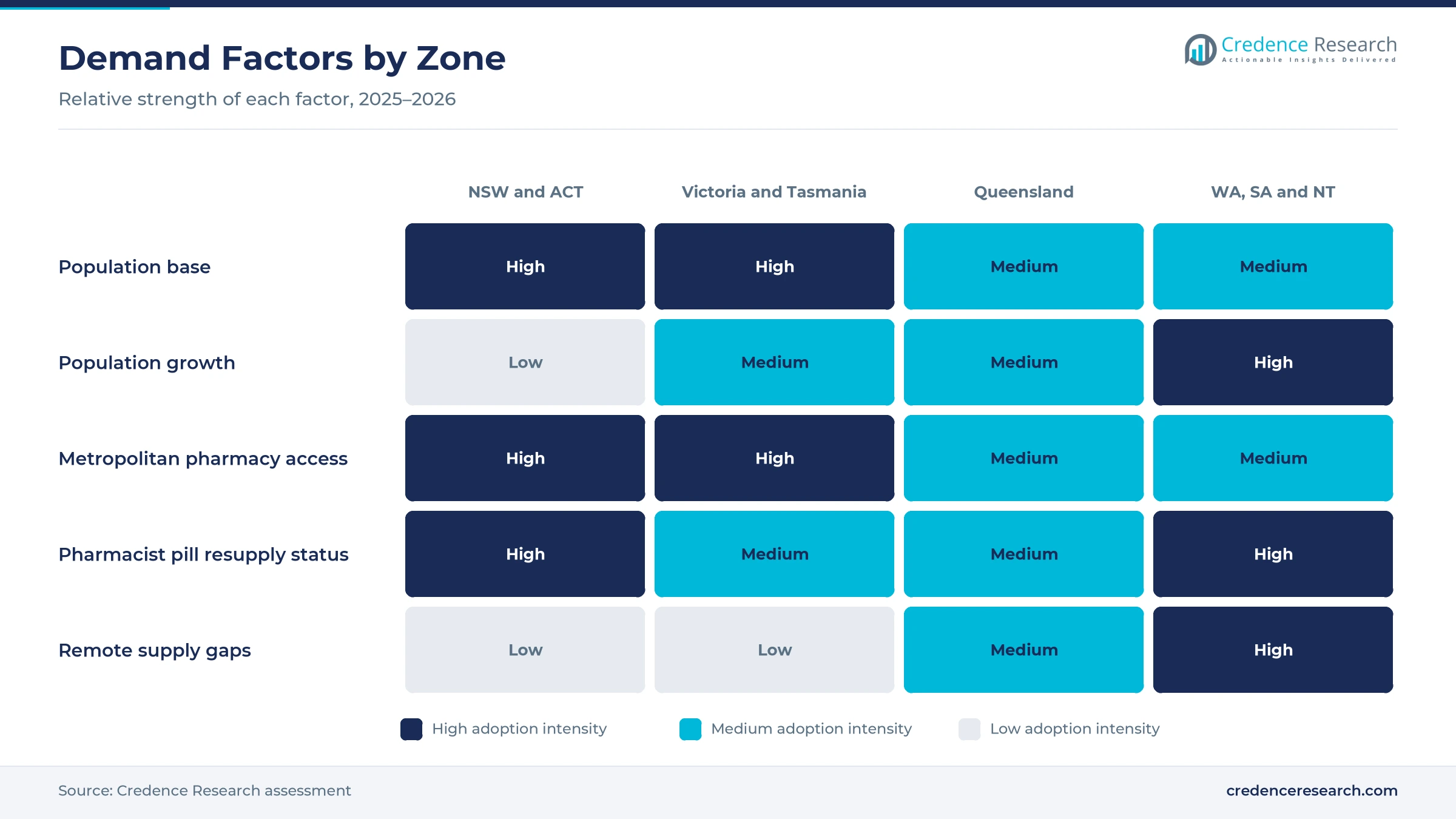
State governments are widening what pharmacists may supply, which reinforces the counter as a first stop for contraceptive care. New South Wales, South Australia and Tasmania have made pharmacist resupply of the oral contraceptive pill a permanent scope-of-practice change, according to the federal government response to a Senate inquiry. South Australia and Western Australia announced in May 2024 that trained pharmacists could resupply the pill as usual practice, and Tasmania followed in July 2024. The Australian Capital Territory, Queensland and Victoria ran pilots of the same service, and the Pharmacy Guild of Australia counted 41,451 registered pharmacists in September 2025. In turn, pharmacists who handle routine pill resupply can discuss ongoing methods after a one-off purchase, which links urgent sales to birth control products bought over many years.
Why is advance provision emerging in pharmacy practice?
Supplying a pack before it is needed is gaining clinical support, because earlier use improves effectiveness. Advance provision of oral tablets is endorsed by the Pharmaceutical Society of Australia, according to a June 2026 overview in Australian Prescriber. The same review states that ulipristal acetate is preferred for body weight over 70 kg or a body mass index above 26, and that a 3 mg levonorgestrel dose may be considered when it is unavailable. The Postinor-1 consumer leaflet advises taking the tablet preferably within 12 hours and no later than 72 hours after intercourse. As a result, buyers who keep a pack at home shift some purchases away from urgent visits, which supports Digital Reservation and Collection growth at 6.81% a year.
Can wider public subsidy open new supply routes?
The public funding debate creates an opening for suppliers that can serve clinics and hospitals. No emergency method is listed on the Pharmaceutical Benefits Scheme, and public hospitals and family planning clinics typically provide subsidized supply, the Australian Prescriber review notes. The Senate committee recommended that health officials and the Pharmaceutical Benefits Advisory Committee consider options to improve access to emergency oral pills, and the government supported this in principle. The health department wrote to sponsors of unsubsidized oral pills in March 2024 inviting listing applications, and the advisory committee recommended listing drospirenone 4 mg tablets in November 2024. The government response also describes AUD 124.6 million from 2025-26 for access to long-acting methods. Suppliers with a low-cost levonorgestrel pack are therefore well placed if subsidized or clinic channels grow.
Is the ulipristal stocking gap an opening for suppliers?
The gap between clinical guidance and shelf availability is an opening for ulipristal acetate suppliers and for pharmacies that stock it reliably. Australian Prescriber notes that ulipristal acetate can cost up to AUD 15 more than levonorgestrel at the counter. True Relationships and Reproductive Health in Queensland lists levonorgestrel at AUD 15 to 30 and ulipristal acetate at AUD 30 to 50 per dose. Chemist Warehouse lists EllaOne at AUD 29.99 but states that the product is not available online unless on a prescription. Lower-priced ulipristal acetate packs could therefore win shelf space in the pharmacies that now stock only levonorgestrel, and in turn lift the value of each sale.
Price gaps, online limits and thin data slow uptake
Why does the price gap slow ulipristal uptake?
Ulipristal acetate costs more than levonorgestrel at most pharmacies, which pushes price-sensitive buyers toward the older tablet even when the newer one suits them better. The 2024 national survey found an average premium of AUD 13 where both were stocked. As a result, younger buyers and people on low incomes may choose the cheaper pack. Pharmacists can reduce this effect by explaining the clinical differences, while clinics offer subsidized supply to eligible buyers.
Why do pharmacist-only rules limit online sales?
Pharmacist-only status requires a consultation before supply, which limits how far online pharmacy services can sell these tablets without a pharmacist conversation. Healthdirect advises that both pills are sold from pharmacies without a prescription, so the pharmacist conversation is the step that every online order must replicate. In turn, delivery models depend on telephone or video consultations, which adds cost and time to an urgent purchase. Reservation services that end in a short in-store consultation remain the most practical digital route.
How do body weight and timing limits affect results?
Oral tablets work less well when they are taken late or by people with higher body weight, which can lead to unplanned pregnancies and lower trust in the products. Australian Prescriber reports overall pregnancy rates of 0.6% to 2.6% for levonorgestrel and 1% to 2% for ulipristal acetate. The copper device is preferred for body weight over 85 kg, because its efficacy is not known to be affected by weight. As a result, pharmacists must screen carefully and refer some buyers to doctors.
Why do data gaps cloud the national demand picture?
No national dataset tracks how often these tablets are used, which makes demand planning harder for sponsors, pharmacies and public clinics. The 2024-25 federal Budget allocated AUD 5.5 million over three years for an Australian Institute of Health and Welfare sexual and reproductive health dataset. Until that work is published, suppliers rely on pharmacy sales records and small surveys. As a result, sponsors plan stock conservatively, which can leave smaller pharmacies with a narrower range.
New South Wales and ACT lead as western states grow fastest
| Region | Value, 2025 (USD million) | Share, 2025 | CAGR, 2026–2035 |
|---|---|---|---|
| New South Wales and Australian Capital Territory | 2.9 | 33.7% | 4.34% |
| Victoria and Tasmania | 2.1 | 24.6% | 4.69% |
| Western Australia, South Australia and Northern Territory | 1.9 | 22.7% | 4.94% |
| Queensland | 1.6 | 19.0% | 4.84% |
What keeps New South Wales and ACT in the lead?
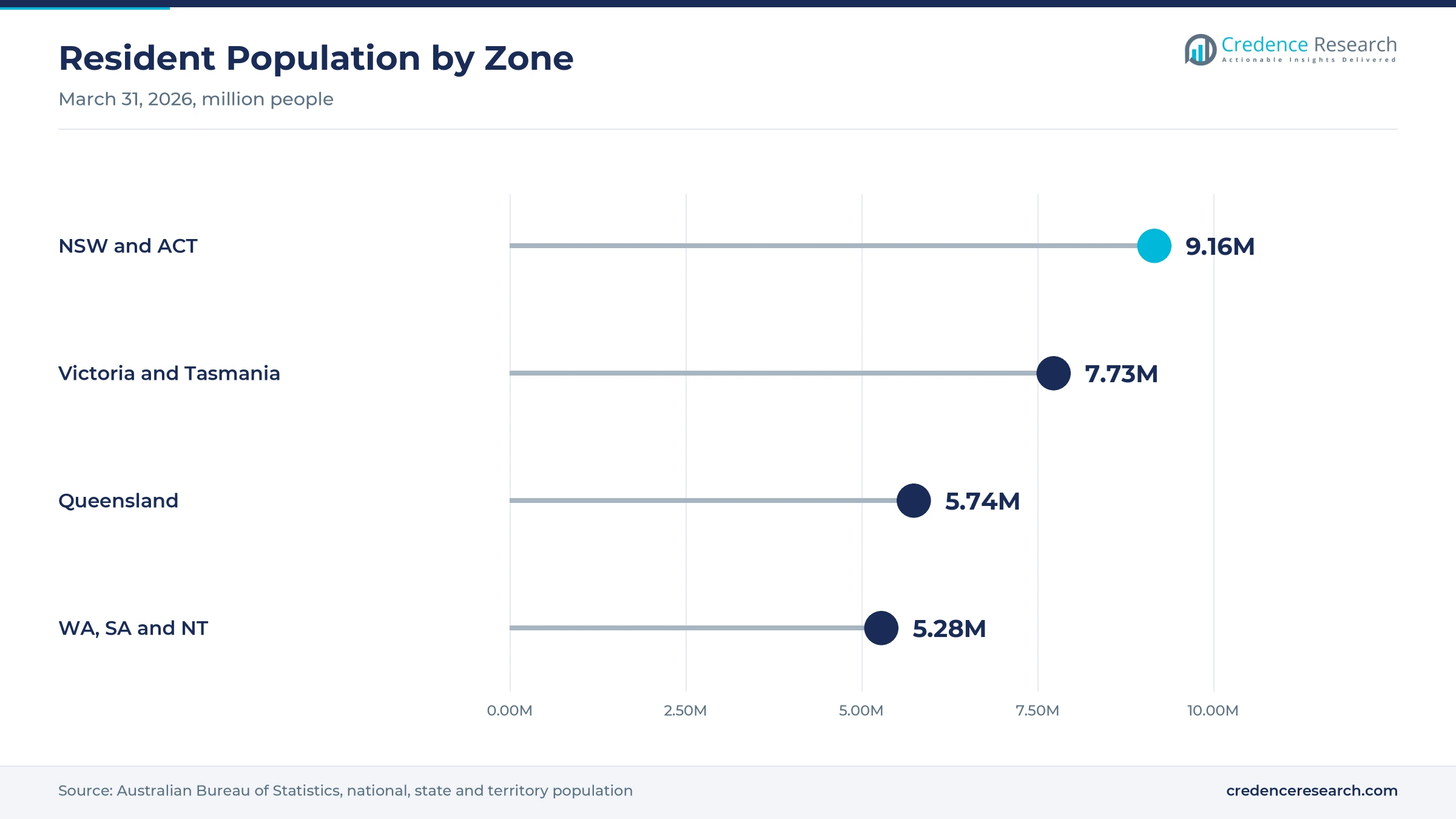
New South Wales and Australian Capital Territory held 33.7% of 2025 value and grows at 4.34% a year, because the zone has the largest population. New South Wales had 8,670,100 residents and the Australian Capital Territory had 489,700 on March 31, 2026. New South Wales has made pharmacist resupply of the oral pill permanent, which keeps the counter central to contraceptive care. Slower population growth of 1.1% in New South Wales holds the zone below the national rate.
How do Victoria and Tasmania support steady demand?
Victoria and Tasmania held a 24.6% share of 2025 value and grow at 4.69% a year. Victoria had 7,154,200 residents on March 31, 2026, after growth of 1.6% over the year, while Tasmania grew only 0.6% to 580,700. Tasmania announced pharmacist pill resupply as usual practice in July 2024, and Victoria ran a pilot of the same service. In turn, faster growth in Victoria offsets slower growth in Tasmania and keeps the zone close to the national pace.
What drives Queensland pharmacy demand?
Queensland held a 19.0% share of 2025 value and grows at 4.84% a year, as population growth adds new buyers across the southeast corner and regional cities. The state had 5,739,500 residents on March 31, 2026, after growth of 1.6% over the year. Queensland ran a pilot of pharmacist pill resupply, which widened the pharmacy role in contraceptive care. Because the state is large and dispersed, regional pharmacies that stock both active ingredients gain a larger part of demand.
Why do the western and central states grow fastest?
Western Australia, South Australia and Northern Territory held 22.7% of 2025 value and grows fastest at 4.94% a year. Western Australia grew 2.1% to 3,096,200 residents in the year to March 31, 2026, the fastest rate nationally. South Australia and Western Australia announced pharmacist pill resupply as usual practice in May 2024. In turn, remote areas of the Northern Territory and Western Australia rely heavily on pharmacies and clinics for urgent supply.
Generic launches, stocking data and guidance, 2024–2026
| Development | Status and market relevance |
|---|---|
| In May 2024, a national survey of 233 community pharmacies published in the journal Contraception found that 98% stocked levonorgestrel and 70% stocked ulipristal acetate. | Documented a stocking gap for the guideline-preferred tablet |
| In May 2024, Nova Pharmaceuticals launched Novella-1 levonorgestrel 1.5 mg at a recommended retail price of AUD 19.95. | Added a value-priced generic pack to pharmacy shelves |
| In May 2024, South Australia and Western Australia announced that trained pharmacists could resupply the oral contraceptive pill as usual practice. | Widened pharmacist scope in contraceptive care |
| In April 2026, Pharmacy Daily reported the launch of an Apohealth levonorgestrel 1.5 mg tablet at a recommended retail price of AUD 14.99. | Lowered the entry price for generic levonorgestrel |
| In June 2026, Australian Prescriber published an overview stating that ulipristal acetate is preferred for body weight over 70 kg. | Supports a gradual shift in the active ingredient mix |
Two oral tablets and one device set the clinical choice
- Levonorgestrel 1.5 mg tablets are a single-dose progestogen taken within 72 hours, with some effect up to 96 hours, and they sell at the lowest prices.
- Ulipristal acetate 30 mg tablets are a selective progesterone receptor modulator that works up to 120 hours after intercourse and is preferred for people with higher body weight.
- Copper devices are the most effective option, and clinicians fit intrauterine devices within five days to prevent more than 99% of pregnancies.
- Pharmacist consultation protocols screen timing, body weight, other medicines and breastfeeding before supply, and advise a pregnancy test if a period is more than one week late.
Need a Custom Version of This Report?
Tailor the scope, geography, or segments to your exact requirements.
- Custom geography or segment scope
- Direct access to our analyst team
Originator, generic and private-label packs compete
Competition among suppliers of emergency contraceptive pills combines an originator levonorgestrel brand, a growing set of generic and pharmacy-label tablets, and a single widely known ulipristal acetate brand. Gedeon Richter Australia is the sponsor of Postinor-1, which first gained approval in January 2008 and is distributed by Pharmacor. Perrigo Australia distributes EllaOne, the ulipristal acetate tablet first approved in March 2015 and made by Laboratoire HRA Pharma. Arrotex Pharmaceuticals sponsors APO-Levonorgestrel-1, while Lupin Australia sponsors Pharmacy Choice and Pharmacy Health levonorgestrel tablets. Nova Pharmaceuticals launched Novella-1 in May 2024 with a value price guarantee. Rivals compete on pharmacist recognition, wholesale terms, shelf price and stock reliability across the community pharmacy sector. Because pharmacists recommend a product during every consultation, recognition among pharmacists matters as much as shelf price for each sponsor.
Which sponsors supply after-sex tablets to pharmacies?
| Company | Type | Role in the market |
|---|---|---|
| Gedeon Richter Australia Pty Ltd | Originator sponsor | Sponsor of Postinor-1 levonorgestrel 1.5 mg, distributed by Pharmacor |
| Perrigo Australia Pty Ltd | Branded distributor | Distributes EllaOne ulipristal acetate 30 mg in Australia |
| Arrotex Pharmaceuticals Pty Ltd | Generic sponsor | Sponsors APO-Levonorgestrel-1 and handles Apohealth stockist inquiries |
| Nova Pharmaceuticals Australasia Pty Ltd | Generic supplier | Launched Novella-1 levonorgestrel 1.5 mg in May 2024 |
| Lupin Australia Pty Limited | Generic sponsor | Sponsors Pharmacy Choice and Pharmacy Health levonorgestrel tablets |
Credence Research view on after-sex oral methods
Credence Research's view is that Australian demand for emergency contraceptive pills will grow steadily because pharmacist access is already wide and the adult population keeps rising. Levonorgestrel remains the largest value pool, while ulipristal acetate adds the fastest growth as pharmacies close the stocking gap and guidance favors it for more buyers. Generic packs will keep pressure on originator prices, which supports volume but limits value growth. A subsidy decision or a national usage dataset would change the outlook most, because both would reshape supply through clinics and pharmacies.
How the national pharmacy-based estimate was built
The report uses 2025 as the base year on a calendar basis, and market values come from the Credence Research model. That model combines state population data, pharmacy network counts, published stocking and price surveys, medicine registration records and company announcements. Segment splits and zone growth rates are Credence Research estimates, while zone shares follow the client's regional split. Sources used are government agencies, official statistics, clinical journals, pharmacy trade publications and company publications, and no interviews or surveys were conducted.
Ulipristal stocking and generic prices shape 2035
Value across Australian emergency contraceptive pills is expected to reach USD 22.6 million by 2035, a 4.66% CAGR during 2026–2035, as population growth, wide pharmacist access and a shift toward ulipristal acetate lift spending. Growth should be strongest in the western and central states, where population growth is fastest. Generic levonorgestrel packs will hold down average prices, while wider ulipristal stocking raises the value of each sale. A subsidy listing or a national usage dataset would change supply planning most, and advance provision could spread purchases more evenly.
Frequently Asked Questions
How big is the Australia emergency contraceptive pills market?
Which active ingredient leads tablet sales?
Which region leads after-sex tablet spending in Australia?
Do buyers need a prescription for these tablets?
How long after intercourse do the tablets work?
Are these tablets subsidized on the Pharmaceutical Benefits Scheme?
Which companies supply after-sex tablets in Australia?
What are the main challenges for this pharmacy category?
Table of Content
Chapter 1 Market Segmentation
- 1.1 Segmentation Framework
- 1.1.1 Product and Service Classification
- 1.1.2 Application and End-Use Classification
- 1.1.3 Technology and Solution Classification
- 1.1.4 Customer and Distribution Channel Classification
- 1.1.5 Geographic Segmentation
- 1.1.6 Market Segment Definitions and Boundaries
- 1.2 By Active Ingredient
- 1.2.1 Levonorgestrel
- 1.2.2 Ulipristal Acetate
- 1.3 By Brand Type
- 1.3.1 Originator-branded Levonorgestrel
- 1.3.2 Generic-branded Levonorgestrel
- 1.3.3 Branded Ulipristal Acetate
- 1.4 By End User
- 1.4.1 Under 25 Years
- 1.4.2 25-34 Years
- 1.4.3 35 Years and Over
Chapter 2 Introduction
- 2.1 Report Objectives and Scope
- 2.2 Product Definition and Industry Terminology
- 2.3 Market Inclusions and Exclusions
- 2.4 Research Process
- 2.4.1 Primary Research and Expert Interviews
- 2.4.2 Secondary Research and Source Review
- 2.4.3 Top-Down and Bottom-Up Estimation
- 2.4.4 Data Triangulation and Verification
- 2.5 Market Size Measurement Basis
- 2.5.1 2025: USD 8.50 million → 2035: USD 22.6 million
- 2.6 Historical and Forecast Reference Periods
- 2.6.1 Historical Period: 2018-2025
- 2.6.2 Base Year: 2025
- 2.6.3 Forecast Period: 2025-2035
- 2.7 Research Assumptions and Limitations
Chapter 3 Executive Summary
- 3.1 Market Snapshot and Key Findings
- 3.2 Base-Year Market Size, 2025
- 3.3 Forecast Market Size, 2035
- 3.4 Revenue and Volume Growth Outlook
- 3.5 Key Demand and Supply Indicators
- 3.6 Leading Market Segments
- 3.7 Fastest-Growing Market Opportunities
- 3.8 Regional Performance Highlights
- 3.9 Technology and Industry Transformation
- 3.10 Competitive Landscape Summary
- 3.11 Analyst View and Strategic Implications
Chapter 4 Australia Emergency Contraceptive Pills Market Trends and Developments
- 4.1 Historical Industry Development, 2018-2025
- 4.2 Recent Market Trends and Developments
- 4.3 Demand and Customer Behavior Trends
- 4.4 Technology and Product Innovation
- 4.5 Artificial Intelligence, Automation and Digitalization
- 4.6 Local Manufacturing and Supply Chain Realignment
- 4.7 Industry Partnerships, Mergers and Acquisitions
- 4.8 Sustainability and Circular Economy Developments
- 4.9 Government and Private Sector Investment Trends
- 4.10 Emerging Business Models and Commercialization
- 4.11 Industry Developments and Announcements
Chapter 5 Australia Emergency Contraceptive Pills Market Production, Supply and Demand Analysis
- 5.1 Demand Trend and Consumption Analysis, 2018-2025
- 5.2 Demand Forecast, 2025-2035
- 5.3 Production and Output Trend, 2018-2025
- 5.4 Production and Output Forecast, 2025-2035
- 5.5 Installed Capacity and Capacity Utilization
- 5.6 Company-Wise Production Plants and Statistics
- 5.6.1 Installed Production Capacity
- 5.6.2 Actual Production
- 5.6.3 Planned Capacity and Expansion Targets
- 5.7 Supply Chain Structure and Procurement Trends
- 5.8 Supply-Demand Gap and Bottlenecks
- 5.9 Import Dependence and Sourcing Structure
- 5.10 Contract Manufacturing and Outsourcing
- 5.11 Regional Supply and Demand Concentration
Chapter 6 Australia Emergency Contraceptive Pills Market Pricing Analysis
- 6.1 Pricing Structure and Measurement
- 6.2 Historical Pricing Trends, 2018-2025
- 6.3 Pricing Outlook, 2025-2035
- 6.4 Average Selling Price and Unit Economics
- 6.5 Pricing by Product and Market Segment
- 6.6 Geographic Pricing Differences
- 6.7 Key Input, Energy, Labor and Logistics Costs
- 6.8 Contract Pricing and Purchasing Models
- 6.9 Pricing Sensitivity and Competitive Positioning
- 6.10 Price, Margin and Profitability Implications
Chapter 7 Australia Emergency Contraceptive Pills Market Dynamics
- 7.1 Market Growth Drivers
- 7.1.1 Demand-Side Drivers
- 7.1.2 Technology and Innovation Drivers
- 7.1.3 Infrastructure and Investment Drivers
- 7.1.4 Regulatory and Policy Drivers
- 7.2 Market Restraints
- 7.2.1 Cost and Affordability Constraints
- 7.2.2 Technology and Adoption Barriers
- 7.2.3 Supply Chain and Operational Constraints
- 7.3 Market Challenges
- 7.3.1 Competitive Pressure and Margin Erosion
- 7.3.2 Skills, Infrastructure and Implementation Gaps
- 7.4 Emerging Market Opportunities
- 7.5 Market Dynamics Impact and Time-Horizon Assessment
Chapter 8 Australia Emergency Contraceptive Pills Value Chain Analysis
- 8.1 Industry Value Chain Overview
- 8.2 Upstream Suppliers and Critical Inputs
- 8.3 Technology and Component Providers
- 8.4 Manufacturing or Service Delivery
- 8.5 Distribution, Channel Partners and Integrators
- 8.6 Downstream Applications and End Users
- 8.7 Value Addition and Profit Pools
- 8.8 Vertical Integration and Outsourcing
- 8.9 Supplier Concentration and Risk
- 8.10 Supply Chain Localization and Resilience
Chapter 9 Australia Emergency Contraceptive Pills Market Regulations and Policies
- 9.1 Relevant Laws, Standards and Compliance Frameworks
- 9.2 Product, Service, Safety and Quality Requirements
- 9.3 Government Policies, Incentives and Subsidies
- 9.4 Imports, Exports and Trade Barriers
- 9.5 Public Procurement and Local Content Requirements
- 9.6 Environmental and Sustainability Compliance
- 9.7 Upcoming Policy Changes and Market Implications
Chapter 10 Australia Emergency Contraceptive Pills Market Hotspots and Opportunities
- 10.1 Market Opportunity Mapping and Growth Hotspots
- 10.2 High-Growth Applications and Customer Groups
- 10.3 Underserved Markets and White-Space Opportunities
- 10.4 Emerging Technology and Product Opportunities
- 10.5 New Capacity and Investment Hotspots
- 10.6 Market Entry and Expansion Opportunities
- 10.7 Distribution and Partnership Opportunities
- 10.8 Near-Term and Long-Term Commercial Potential
- 10.9 Opportunity Attractiveness and Execution Risks
Chapter 11 Australia Emergency Contraceptive Pills Market Outlook, 2025-2035
- 11.1 Market Size and Analysis
- 11.1.1 Revenue (Market Measurement: 2025: USD 8.50 million → 2035: USD 22.6 million)
- 11.1.2 Market Volume and Quantity Sold
- 11.1.3 Historical Market Size, 2018-2025
- 11.1.4 Base-Year Market Size, 2025
- 11.2 Market Forecast, 2025-2035
- 11.2.1 Revenue Forecast to 2035
- 11.2.2 Volume Forecast to 2035
- 11.2.3 CAGR and Year-on-Year Growth
- 11.2.4 Incremental Revenue Opportunity
- 11.3 Forecast Assumptions and Scenario Analysis
- 11.3.1 Base-Case Forecast
- 11.3.2 Optimistic and Conservative Scenarios
- 11.3.3 Technology, Pricing and Policy Sensitivities
- 11.4 Market Attractiveness and Growth Outlook
Chapter 12 Australia Emergency Contraceptive Pills Market Segmentation and Outlook
- 12.1 Segmentation Summary and Market Shares, 2025
- 12.2 Largest and Fastest-Growing Segments
- 12.3 By Active Ingredient - Market Size and Forecast, 2025-2035
- 12.3.1 Segment Definition and Scope
- 12.3.2 Historical Market Size, 2018-2025
- 12.3.3 Revenue Forecast, 2025-2035
- 12.3.4 Volume Forecast, 2025-2035
- 12.3.5 Base-Year Market Share, 2025
- 12.3.6 Segment CAGR and Growth Drivers
- 12.3.7 Subsegment Market Size and Forecast
- 12.3.7.1 Levonorgestrel
- 12.3.7.2 Ulipristal Acetate
- 12.3.8 Subsegment Pricing and Adoption Trends
- 12.3.9 Leading Suppliers and Competition
- 12.3.10 Regional Demand and Opportunities
- 12.4 By Brand Type - Market Size and Forecast, 2025-2035
- 12.4.1 Segment Definition and Scope
- 12.4.2 Historical Market Size, 2018-2025
- 12.4.3 Revenue Forecast, 2025-2035
- 12.4.4 Volume Forecast, 2025-2035
- 12.4.5 Base-Year Market Share, 2025
- 12.4.6 Segment CAGR and Growth Drivers
- 12.4.7 Subsegment Market Size and Forecast
- 12.4.7.1 Originator-branded Levonorgestrel
- 12.4.7.2 Generic-branded Levonorgestrel
- 12.4.7.3 Branded Ulipristal Acetate
- 12.4.8 Subsegment Pricing and Adoption Trends
- 12.4.9 Leading Suppliers and Competition
- 12.4.10 Regional Demand and Opportunities
- 12.5 By End User - Market Size and Forecast, 2025-2035
- 12.5.1 Segment Definition and Scope
- 12.5.2 Historical Market Size, 2018-2025
- 12.5.3 Revenue Forecast, 2025-2035
- 12.5.4 Volume Forecast, 2025-2035
- 12.5.5 Base-Year Market Share, 2025
- 12.5.6 Segment CAGR and Growth Drivers
- 12.5.7 Subsegment Market Size and Forecast
- 12.5.7.1 Under 25 Years
- 12.5.7.2 25-34 Years
- 12.5.7.3 35 Years and Over
- 12.5.8 Subsegment Pricing and Adoption Trends
- 12.5.9 Leading Suppliers and Competition
- 12.5.10 Regional Demand and Opportunities
- 12.6 Segment Growth Comparison
- 12.7 Segment Attractiveness and Priority Matrix
Chapter 13 Australia Emergency Contraceptive Pills End-Use and Application Market Outlook
- 13.1 End-Use Industry and Customer Demand Structure
- 13.2 Leading Applications and Customer Groups
- 13.3 End-Use Market Size, Share and Forecast
- 13.4 Major End-Use Industry Deep Dives
- 13.4.1 Customer Requirements and Use Cases
- 13.4.2 Demand and Replacement Cycles
- 13.4.3 Technical and Regulatory Considerations
- 13.4.4 Purchasing and Procurement Models
- 13.4.5 Leading Vendors and Distribution Channels
- 13.4.6 Forecast and Commercial Opportunities
- 13.5 Emerging Applications and Cross-Segment Demand
- 13.6 End-Use Industry Investment Priorities
Chapter 14 Australia Emergency Contraceptive Pills Geographic Market Outlook, 2025-2035
- 14.1 Domestic Market Distribution and Demand Clusters
- 14.2 State- or Province-Wise Market Size and Forecast, 2025-2035
- 14.3 City and Metropolitan Market Outlook
- 14.4 Industrial, Manufacturing and Commercial Clusters
- 14.5 Geographic Concentration of Key End Users
- 14.6 Local Pricing and Purchasing Differences
- 14.7 Domestic Production Facilities and Capacity Map
- 14.8 Local Infrastructure and Project Pipeline
- 14.9 State-Level Policy and Incentive Differences
- 14.10 Subnational Investment Hotspots and Opportunities
- 14.11 Distribution and Logistics Networks
- 14.12 Domestic Competitive Footprint
Chapter 15 Australia Emergency Contraceptive Pills Technology, Innovation and Sustainability Outlook
- 15.1 Technology Landscape and Maturity
- 15.2 Product, Process and Service Innovation
- 15.3 AI, Automation and Digital Tools in the Industry
- 15.4 Technology Adoption and Performance Benchmarking
- 15.5 Innovation Pipeline and R&D Investment
- 15.6 Patent and Intellectual Property Trends
- 15.7 Energy Efficiency and Resource Management
- 15.8 Sustainability, Recycling and Circularity
- 15.9 Technology Roadmap, 2025-2035
- 15.10 Risks of Obsolescence and Technology Substitution
Chapter 16 Australia Emergency Contraceptive Pills Market Key Strategic Imperatives
- 16.1 Growth and Market Entry Priorities
- 16.2 High-Return Products and Segments
- 16.3 Pricing, Profitability and Cost Optimization
- 16.4 Technology Investment and Product Differentiation
- 16.5 Supply Chain Localization and Resilience
- 16.6 Distribution and Customer Acquisition
- 16.7 Partnership, Acquisition and Capacity Strategy
- 16.8 Regional Expansion Priorities
- 16.9 Short-, Medium- and Long-Term Actions
Chapter 17 Competition Outlook
- 17.1 Industry Competition Characteristics
- 17.2 Market Structure and Concentration
- 17.3 Market Share and Competitive Positioning, 2025
- 17.4 Company-Wise Revenue and Product Benchmarking
- 17.5 Production and Service Capacity Benchmarking
- 17.6 Technology, Pricing and Differentiation
- 17.7 Regional Footprint and Distribution Strength
- 17.8 Mergers, Acquisitions and Strategic Alliances
- 17.9 New Entrants and Competitive Threats
- 17.10 Porter's Five Forces and Industry Attractiveness
- 17.11 Competitive Outlook, 2025-2035
Chapter 18 Company Profiles
- 18.1 Company Coverage and Selection Criteria
- 18.2 Perrigo Australia Pty Ltd
- 18.2.1 Business Description
- 18.2.2 Company Ownership and Geographic Presence
- 18.2.3 Product and Service Portfolio
- 18.2.4 Manufacturing and Operating Footprint
- 18.2.5 Production Capacity and Expansion Plans
- 18.2.6 Financial Performance and Investment
- 18.2.7 Market Share and Competitive Position
- 18.2.8 Technology and Innovation Capabilities
- 18.2.9 Strategic Alliances or Partnerships
- 18.2.10 Recent Developments
- 18.2.11 Growth Strategy and Outlook
- 18.3 Gedeon Richter Australia Pty Ltd
- 18.4 Arrotex Pharmaceuticals Pty Ltd
- 18.5 Nova Pharmaceuticals Australasia Pty Ltd
- 18.6 Lupin Australia Pty Limited
- 18.7 Other Relevant Market Participants
Note: Every listed company is profiled on the structure shown under the first company. The company list is preliminary and may change based on research findings, market developments, data availability and client requirements.
Chapter 19 Disclaimer
- 19.1 Research and Forecast Disclaimer
- 19.2 Data Source and Estimation Limitations
Note: The depth of individual sections depends on data availability for this market. Volume, capacity, trade and other unit-based metrics are included where applicable.

