
Market Overview:
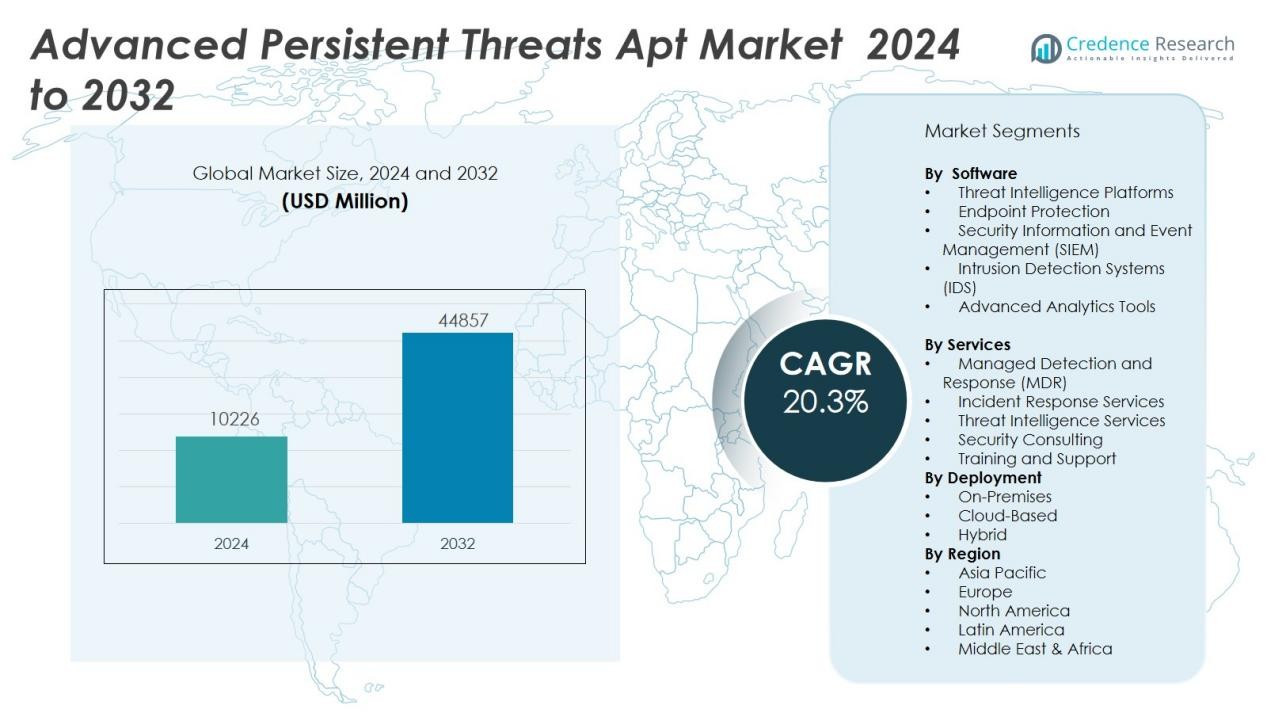
The advanced persistent threats apt market size was valued at USD 10226 million in 2024 and is anticipated to reach USD 44857 million by 2032, at a CAGR of 20.3 % during the forecast period (2024-2032).
| REPORT ATTRIBUTE | DETAILS |
|---|---|
| Historical Period | 2020-2024 |
| Base Year | 2024 |
| Forecast Period | 2025-2032 |
| Advanced Persistent Threats Apt Market Size 2024 | USD 10226 Million |
| Advanced Persistent Threats Apt Market, CAGR | 20.3 % |
| Advanced Persistent Threats Apt Market Size 2032 | USD 44857 Million |
Key drivers for the advanced persistent threats market include rising incidents of targeted cyberattacks, the proliferation of connected devices, and the evolution of malware techniques. Increasing regulatory pressures and the growing need for real-time threat intelligence further compel businesses to deploy advanced detection and response systems. Strategic partnerships, ongoing R&D, and integration of AI and machine learning technologies have strengthened the capabilities of APT solutions, enabling organizations to proactively identify and neutralize advanced cyber threats.
Regionally, North America dominates the APT market due to strong cybersecurity awareness, substantial IT spending, and the presence of leading technology vendors. Europe follows, supported by strict data protection regulations and rising investments in cyber defense. The Asia-Pacific region is experiencing the fastest growth, driven by rapid digitalization, expanding enterprise networks, and increased government focus on cybersecurity readiness.
Market Insights:
- The advanced persistent threats apt market was valued at USD 10,226 million in 2024 and is projected to reach USD 44,857 million by 2032, growing at a CAGR of 20.3%.
- Rising frequency of targeted cyberattacks has driven enterprises and governments to invest in advanced threat detection and response technologies.
- Growing cloud adoption and expanding digital footprints create new attack surfaces, compelling organizations to deploy scalable and integrated APT solutions.
- Regulatory pressure and compliance obligations, especially in finance and healthcare, are pushing demand for specialized and proactive security platforms.
- AI and machine learning continue to transform the market by enhancing real-time monitoring, behavior-based threat detection, and automated incident response.
- North America leads the market with a 38.2% share, supported by strong IT infrastructure, cybersecurity maturity, and presence of major technology firms.
- Asia-Pacific exhibits the fastest growth, driven by digital transformation, rising cyber incidents, and increasing investment in advanced cybersecurity systems.
Market Drivers:
Rising Incidence of Targeted Cyberattacks Spurs Market Growth:
The advanced persistent threats apt market faces significant momentum due to the escalating frequency and sophistication of targeted cyberattacks against enterprises and government agencies. Threat actors employ stealthy tactics to gain prolonged access to sensitive networks, making traditional security measures inadequate. Organizations are allocating larger budgets to advanced threat detection and response capabilities, seeking to minimize the risk of data breaches and operational disruption. This sustained threat landscape keeps demand for robust APT solutions consistently high.
- For instance, Palo Alto Networks Cortex XDR blocked all 50 attack scenarios in the AV-Comparatives Endpoint Prevention and Response test in 2023.
Expanding Digital Footprint and Cloud Adoption Increases Exposure:
Enterprises are expanding their digital presence and migrating workloads to the cloud at an accelerated pace, creating more complex and vulnerable attack surfaces. The advanced persistent threats apt market benefits as organizations recognize the need for advanced security frameworks that address both on-premises and cloud environments. It drives adoption of integrated security platforms designed to provide end-to-end visibility and rapid response. Heightened digital transformation has intensified the urgency for resilient threat protection strategies.
Regulatory Pressures and Compliance Requirements Drive Investment:
Heightened regulatory scrutiny and stricter data protection laws compel organizations to enhance cybersecurity postures. The advanced persistent threats apt market experiences increased investments from sectors facing stringent compliance mandates, including finance, healthcare, and critical infrastructure. Meeting legal obligations for breach detection, reporting, and mitigation requires deployment of specialized APT detection and response tools. Regulatory frameworks have made advanced security measures a top priority for many businesses.
- For instance, JPMorgan Chase allocates $600 million annually to its cybersecurity infrastructure to support AI-driven early-warning and APT detection systems.
Advancements in Threat Intelligence and Security Technologies Fuel Adoption:
Rapid innovations in artificial intelligence, machine learning, and behavioral analytics empower organizations to detect and neutralize complex threats with greater precision. The advanced persistent threats apt market leverages these technological advances to deliver solutions that adapt to evolving attack techniques. It supports proactive threat hunting, automated incident response, and continuous network monitoring. Advancements in cybersecurity technology ensure that organizations stay ahead of emerging threats and minimize risk exposure.
Market Trends:
Integration of Artificial Intelligence and Automation Transforms Threat Detection:
The advanced persistent threats apt market demonstrates a shift toward integrating artificial intelligence, machine learning, and automation into security operations. Security vendors develop platforms that leverage AI-driven analytics to identify hidden patterns, suspicious behaviors, and zero-day threats faster than manual processes allow. Automated threat intelligence sharing and response mechanisms enable organizations to react to incidents in real time and contain breaches more efficiently. It empowers security teams to focus on higher-priority investigations while automating routine monitoring and response tasks. Continuous innovation in AI technologies helps improve threat accuracy and reduce false positives, supporting more adaptive and scalable APT defenses.
- For instance, CrowdStrike Falcon Complete MDR detects and begins remediating threats in a median of 4 minutes after attack initiation, allowing security teams to contain breaches almost immediately.
Expansion of Managed Detection and Response (MDR) and Threat Intelligence Services:
Organizations increasingly adopt managed detection and response (MDR) services and external threat intelligence feeds to supplement their internal cybersecurity capabilities. The advanced persistent threats apt market benefits from rising demand for MDR providers that deliver 24/7 monitoring, incident response, and expert analysis, especially for organizations facing skill shortages. It creates opportunities for solution providers to offer subscription-based security operations that combine advanced analytics, threat hunting, and forensic capabilities. The trend toward outsourcing specialized security functions allows enterprises to stay resilient against evolving threat actors while optimizing resource allocation and focusing on core business priorities.
- For instance, Rapid7’s agentic AI workflows in InsightIDR close benign alerts with 99.93% accuracy, saving customers’ SOC teams more than 200 hours per week.
Market Challenges Analysis:
Complexity of Attack Techniques and Evolving Threat Landscape Increases Security Gaps:
The advanced persistent threats apt market faces persistent challenges due to the growing complexity and sophistication of cyberattack methods. Threat actors deploy multi-stage campaigns, leveraging social engineering, zero-day vulnerabilities, and customized malware to evade detection. Organizations struggle to keep pace with rapidly changing tactics and the sheer volume of potential threats. Limited visibility across distributed networks often leads to delayed threat identification and response. Security teams require advanced skills and tools to counter these challenges, but talent shortages and resource constraints hinder effective protection.
High Implementation Costs and Integration Barriers Limit Adoption:
High costs associated with deploying advanced APT detection and response solutions present a significant barrier for many organizations, especially small and mid-sized enterprises. The advanced persistent threats apt market sees slow adoption in sectors where budgets remain tight or where legacy infrastructure complicates integration. Organizations must invest not only in new technologies but also in staff training and ongoing maintenance. Compatibility issues between existing systems and modern APT platforms further delay implementation. These financial and operational challenges limit the widespread deployment of cutting-edge threat protection.
Market Opportunities:
Expansion into Underserved and Emerging Markets Unlocks New Potential:
The advanced persistent threats apt market holds significant opportunities in emerging economies and underserved sectors where cybersecurity maturity remains low. Rapid digitalization and increasing internet penetration in regions such as Asia-Pacific, Latin America, and Africa create new demand for advanced threat protection solutions. Organizations in these markets seek to strengthen cyber resilience amid growing risks from targeted attacks. Vendors can tailor offerings to address local compliance requirements and specific threat landscapes, broadening their customer base. Expanding channel partnerships and localized support further help drive market penetration.
Development of Specialized Solutions for Industry Verticals Drives Growth:
Growing demand for industry-specific security solutions presents another key opportunity for the advanced persistent threats apt market. Sectors such as healthcare, critical infrastructure, and finance require highly customized APT defenses to meet regulatory obligations and unique risk profiles. It creates scope for vendors to innovate with tailored detection technologies, threat intelligence, and incident response services. The adoption of advanced persistent threat protection in operational technology (OT) environments, including energy and manufacturing, offers additional growth avenues. Vendors that address these niche needs can secure long-term partnerships and strengthen their competitive position.
Market Segmentation Analysis:
By Software:
The advanced persistent threats apt market features robust growth in the software segment, driven by the adoption of advanced threat detection, analytics, and endpoint protection solutions. Organizations seek integrated platforms that combine network security, sandboxing, and behavioral analysis to identify and mitigate complex threats. Leading vendors continue to innovate with solutions that leverage artificial intelligence, machine learning, and real-time monitoring to improve threat visibility and response. The software segment remains critical for enterprises aiming to build layered, adaptive defense strategies.
- For instance, Palo Alto Networks’ Prisma Access platform achieved a Security Effectiveness score of 98.89% and blocked 100% of evasion attempts across 6,184 malware samples in CyberRatings.org’s May 2025 SSE test.
By Services:
Professional and managed security services represent a significant share of the advanced persistent threats apt market, with rising demand for 24/7 threat monitoring, incident response, and threat intelligence. It provides organizations with access to expert analysis, rapid remediation, and strategic guidance, reducing reliance on in-house security resources. Managed detection and response (MDR) services gain traction as companies seek to address talent shortages and manage advanced threats effectively. Growth in the services segment underscores the importance of ongoing support and proactive cyber defense.
By Deployment:
Deployment models in the advanced persistent threats apt market include on-premises, cloud-based, and hybrid solutions. Cloud deployment registers the fastest growth due to scalability, cost-efficiency, and the ability to support distributed workforces. On-premises solutions maintain relevance in sectors with strict regulatory requirements and sensitive data environments. Hybrid deployment options gain interest from organizations aiming to balance control, compliance, and operational flexibility. It reflects the diverse security needs of enterprises across different industries.
- For instance, a medium-sized manufacturing firm deployed an IBM QRadar 3105 All-in-One appliance on-premises, achieving real-time processing of up to 5,000 events per second.
Segmentations:
By Software:
- Threat Intelligence Platforms
- Endpoint Protection
- Security Information and Event Management (SIEM)
- Intrusion Detection Systems (IDS)
- Advanced Analytics Tools
By Services:
- Managed Detection and Response (MDR)
- Incident Response Services
- Threat Intelligence Services
- Security Consulting
- Training and Support
By Deployment:
- On-Premises
- Cloud-Based
- Hybrid
By Region:
- North America
- U.S.
- Canada
- Mexico
- Europe
- Germany
- France
- U.K.
- Italy
- Spain
- Rest of Europe
- Asia Pacific
- China
- Japan
- India
- South Korea
- South-east Asia
- Rest of Asia Pacific
- Latin America
- Brazil
- Argentina
- Rest of Latin America
- Middle East & Africa
- GCC Countries
- South Africa
- Rest of the Middle East and Africa
Regional Analysis:
North America :
North America commands a market share of 38.2% in the advanced persistent threats apt market due to robust investments in cybersecurity infrastructure and the presence of leading technology firms. The region benefits from heightened awareness of advanced threats, widespread adoption of cloud computing, and a mature regulatory landscape that prioritizes cyber defense. Enterprises and government agencies focus heavily on proactive threat intelligence and incident response strategies, driving steady demand for APT solutions. The United States represents the largest contributor, supported by extensive digital transformation initiatives and high-profile cyber incidents. Canada follows with ongoing investment in critical infrastructure protection and national security programs. Regional collaboration and a strong ecosystem of cybersecurity vendors further reinforce North America's leadership position.
Europe :
Europe holds a market share of 27.6% in the advanced persistent threats apt market, supported by strict data protection regulations and a rising threat landscape. The enforcement of the General Data Protection Regulation (GDPR) and sector-specific compliance requirements drive organizations to strengthen their cyber defenses. Leading economies such as Germany, the United Kingdom, and France prioritize investment in advanced security solutions, spurred by high rates of digitalization and increasing cyber risks. The region witnesses growing adoption of threat intelligence platforms and managed detection and response services. Collaborative initiatives at the EU level support information sharing and cross-border cyber resilience. It fosters a dynamic environment for both established and emerging cybersecurity vendors.
Asia-Pacific :
Asia-Pacific captures a market share of 21.8% in the advanced persistent threats apt market and records the fastest growth rate among global regions. Rapid digital transformation, expanding enterprise networks, and rising connectivity across China, Japan, India, and South Korea fuel demand for advanced APT solutions. Governments and large organizations strengthen their cyber defense frameworks in response to increasing incidents of targeted attacks. Investments in smart cities, IoT infrastructure, and digital financial services accelerate adoption of next-generation security platforms. Local and international vendors expand their presence through strategic partnerships and tailored offerings. The region’s dynamic business environment and ongoing technology adoption position Asia-Pacific as a key growth engine for the market.
Key Player Analysis:
- Broadcom, Inc.
- VMware
- Cisco Systems, Inc.
- Microsoft Corporation
- Kaspersky Labs
- McAfee, LLC
- CyberArk Software Ltd.
- Red Sift
- F-Secure
- Forcepoint
- WiJungle
Competitive Analysis:
The advanced persistent threats apt market is highly competitive, with leading players focusing on advanced analytics, real-time threat detection, and scalable security platforms. Key participants include Broadcom, Inc., VMware, Cisco Systems, Inc., Microsoft Corporation, Kaspersky Labs, McAfee, LLC, CyberArk Software Ltd., and Red Sift. These companies invest heavily in R&D to enhance product capabilities, integrate AI, and improve response speed against evolving threats. It remains a priority for vendors to offer unified solutions that address endpoint, network, and cloud vulnerabilities. Strategic partnerships, acquisitions, and global threat intelligence networks help strengthen market presence and expand customer reach. Large enterprises prefer established players for their proven reliability, while innovative startups gain traction through specialized services and niche technologies. Market dynamics reflect an ongoing race to deliver faster, smarter, and more adaptive APT defense systems across industries. Competitive differentiation lies in speed, scalability, and proactive response capabilities.
Recent Developments:
- In July 2025, Broadcom launched the Tomahawk Ultra Ethernet switch, engineered for high-performance AI workloads in data centers, delivering ultra-low latency and massive throughput.
- In June 2025, Broadcom announced the Tomahawk 6 networking chip, which doubles the performance of its predecessor and is specifically designed for scaling GPU clusters in AI environments.
Market Concentration & Characteristics:
The advanced persistent threats apt market displays a moderate to high level of market concentration, with several established cybersecurity vendors holding significant shares. It features a competitive landscape shaped by ongoing innovation, strategic partnerships, and frequent product launches. Major players invest in research and development to enhance detection and response capabilities, leveraging artificial intelligence and advanced analytics. The market is characterized by a strong focus on integrated solutions, tailored offerings for critical sectors, and an expanding presence of managed security service providers. Leading vendors differentiate through global threat intelligence, rapid response, and compliance-focused platforms.
Report Coverage:
The research report offers an in-depth analysis based on Software, Services, Deployment and Region. It details leading Market players, providing an overview of their business, product offerings, investments, revenue streams, and key applications. Additionally, the report includes insights into the competitive environment, SWOT analysis, current Market trends, as well as the primary drivers and constraints. Furthermore, it discusses various factors that have driven Market expansion in recent years. The report also explores Market dynamics, regulatory scenarios, and technological advancements that are shaping the industry. It assesses the impact of external factors and global economic changes on Market growth. Lastly, it provides strategic recommendations for new entrants and established companies to navigate the complexities of the Market.
Future Outlook:
- The advanced persistent threats apt market will continue to evolve as cyberattack methods become increasingly sophisticated and persistent.
- Organizations will prioritize proactive threat detection and real-time response to minimize the risk of data breaches and operational disruptions.
- Integration of artificial intelligence, machine learning, and behavioral analytics will further enhance the effectiveness of APT solutions.
- Demand for managed detection and response (MDR) and threat intelligence services will rise as businesses seek continuous protection and expert support.
- Regulatory requirements and compliance mandates will drive investment in advanced security platforms across highly regulated sectors.
- Cloud security and hybrid infrastructure protection will become a core focus for enterprises expanding their digital footprint.
- Vendors will develop industry-specific APT solutions to address unique risks in sectors such as healthcare, finance, and critical infrastructure.
- Partnerships and collaborations among cybersecurity firms, technology vendors, and governments will increase to strengthen global threat intelligence sharing.
- Growth opportunities will emerge in emerging economies as digitalization accelerates and awareness of cyber risks improves.
- Ongoing innovation in security automation, orchestration, and response technologies will enable organizations to reduce response times and strengthen overall cyber resilience.

Request a Free Sample
Fill in your details and we'll send you a free sample report.
- Sample data tables & charts
- Research methodology
Market Dynamics
Rising Incidence of Targeted Cyberattacks
The increasing frequency and sophistication of targeted cyberattacks against enterprises and government agencies is driving organizations to invest in advanced persistent threat (APT) detection and response solutions, as traditional security measures are no longer sufficient.
Expanding Digital Footprint and Cloud Adoption
Accelerated digital transformation and migration to cloud environments are creating more complex and vulnerable attack surfaces, compelling organizations to deploy scalable and integrated APT solutions for comprehensive protection.
Regulatory Pressures and Compliance Requirements
Stricter data protection laws and industry-specific regulations, especially in finance and healthcare, are pushing organizations to enhance their cybersecurity postures and invest in specialized APT detection and response tools to meet compliance mandates.
Advancements in AI and Machine Learning
Rapid innovation in artificial intelligence, machine learning, and behavioral analytics is enabling more precise and proactive detection of complex threats, making APT solutions more effective and attractive to organizations seeking to stay ahead of evolving cyber risks.
Shortage of Skilled Cybersecurity Professionals
The ongoing shortage of skilled cybersecurity talent is increasing demand for managed detection and response (MDR) and threat intelligence services, as organizations look to external experts to supplement their internal capabilities and ensure continuous protection.
Need a Custom Version of This Report?
Tailor the scope, geography, or segments to your exact requirements.
- Custom geography or segment scope
- Direct access to our analyst team
Frequently Asked Questions
What is the current market size for the Advanced Persistent Threats (APT) market, and what is its projected size in 2032?
At what Compound Annual Growth Rate (CAGR) is the APT market projected to grow between 2024 and 2032?
Which APT market segment held the largest share in 2024?
What are the primary factors fueling the growth of the APT market?
Who are the leading companies in the APT market?
Which region commanded the largest share of the APT market in 2024?
Table of Content
Chapter 1 Market Segmentation
- 1.1 Segmentation Framework
- 1.1.1 Product and Service Classification
- 1.1.2 Application and End-Use Classification
- 1.1.3 Technology and Solution Classification
- 1.1.4 Customer and Distribution Channel Classification
- 1.1.5 Geographic Segmentation
- 1.1.6 Market Segment Definitions and Boundaries
- 1.2 By Services
- 1.2.1 Managed Detection and Response (MDR)
- 1.2.2 Incident Response Services
- 1.2.3 Threat Intelligence Services
- 1.2.4 Security Consulting
- 1.2.5 Training and Support
- 1.3 By Software
- 1.3.1 Threat Intelligence Platforms
- 1.3.2 Endpoint Protection
- 1.3.3 Security Information and Event Management (SIEM)
- 1.3.4 Intrusion Detection Systems (IDS)
- 1.3.5 Advanced Analytics Tools
- 1.4 By Deployment
- 1.4.1 On-Premises
- 1.4.2 Cloud-Based
- 1.4.3 Hybrid
Chapter 2 Introduction
- 2.1 Report Objectives and Scope
- 2.2 Product Definition and Industry Terminology
- 2.3 Market Inclusions and Exclusions
- 2.4 Research Process
- 2.4.1 Primary Research and Expert Interviews
- 2.4.2 Secondary Research and Source Review
- 2.4.3 Top-Down and Bottom-Up Estimation
- 2.4.4 Data Triangulation and Verification
- 2.5 Market Size Measurement Basis
- 2.5.1 2024: USD 10,226 million → 2032: USD 44,857 million
- 2.6 Historical and Forecast Reference Periods
- 2.6.1 Base Year: 2024
- 2.6.2 Forecast Period: 2024-2032
- 2.7 Research Assumptions and Limitations
Chapter 3 Executive Summary
- 3.1 Market Snapshot and Key Findings
- 3.2 Base-Year Market Size, 2024
- 3.3 Forecast Market Size, 2032
- 3.4 Revenue and Volume Growth Outlook
- 3.5 Key Demand and Supply Indicators
- 3.6 Leading Market Segments
- 3.7 Fastest-Growing Market Opportunities
- 3.8 Regional Performance Highlights
- 3.9 Technology and Industry Transformation
- 3.10 Competitive Landscape Summary
- 3.11 Analyst View and Strategic Implications
Chapter 4 Global Advanced Persistent Threats Market Trends and Developments
- 4.1 Historical Industry Development
- 4.2 Recent Market Trends and Developments
- 4.3 Demand and Customer Behavior Trends
- 4.4 Technology and Product Innovation
- 4.5 Artificial Intelligence, Automation and Digitalization
- 4.6 Local Manufacturing and Supply Chain Realignment
- 4.7 Industry Partnerships, Mergers and Acquisitions
- 4.8 Sustainability and Circular Economy Developments
- 4.9 Government and Private Sector Investment Trends
- 4.10 Emerging Business Models and Commercialization
- 4.11 Industry Developments and Announcements
Chapter 5 Global Advanced Persistent Threats Market Production, Supply and Demand Analysis
- 5.1 Demand Trend and Consumption Analysis
- 5.2 Demand Forecast, 2024-2032
- 5.3 Production and Output Trend
- 5.4 Production and Output Forecast, 2024-2032
- 5.5 Installed Capacity and Capacity Utilization
- 5.6 Company-Wise Production Plants and Statistics
- 5.6.1 Installed Production Capacity
- 5.6.2 Actual Production
- 5.6.3 Planned Capacity and Expansion Targets
- 5.7 Supply Chain Structure and Procurement Trends
- 5.8 Supply-Demand Gap and Bottlenecks
- 5.9 Import Dependence and Sourcing Structure
- 5.10 Contract Manufacturing and Outsourcing
- 5.11 Regional Supply and Demand Concentration
Chapter 6 Global Advanced Persistent Threats Market Pricing Analysis
- 6.1 Pricing Structure and Measurement
- 6.2 Historical Pricing Trends
- 6.3 Pricing Outlook, 2024-2032
- 6.4 Average Selling Price and Unit Economics
- 6.5 Pricing by Product and Market Segment
- 6.6 Geographic Pricing Differences
- 6.7 Key Input, Energy, Labor and Logistics Costs
- 6.8 Contract Pricing and Purchasing Models
- 6.9 Pricing Sensitivity and Competitive Positioning
- 6.10 Price, Margin and Profitability Implications
Chapter 7 Global Advanced Persistent Threats Market Dynamics
- 7.1 Market Growth Drivers
- 7.1.1 Demand-Side Drivers
- 7.1.2 Technology and Innovation Drivers
- 7.1.3 Infrastructure and Investment Drivers
- 7.1.4 Regulatory and Policy Drivers
- 7.2 Market Restraints
- 7.2.1 Cost and Affordability Constraints
- 7.2.2 Technology and Adoption Barriers
- 7.2.3 Supply Chain and Operational Constraints
- 7.3 Market Challenges
- 7.3.1 Competitive Pressure and Margin Erosion
- 7.3.2 Skills, Infrastructure and Implementation Gaps
- 7.4 Emerging Market Opportunities
- 7.5 Market Dynamics Impact and Time-Horizon Assessment
Chapter 8 Global Advanced Persistent Threats Value Chain Analysis
- 8.1 Industry Value Chain Overview
- 8.2 Upstream Suppliers and Critical Inputs
- 8.3 Technology and Component Providers
- 8.4 Manufacturing or Service Delivery
- 8.5 Distribution, Channel Partners and Integrators
- 8.6 Downstream Applications and End Users
- 8.7 Value Addition and Profit Pools
- 8.8 Vertical Integration and Outsourcing
- 8.9 Supplier Concentration and Risk
- 8.10 Supply Chain Localization and Resilience
Chapter 9 Global Advanced Persistent Threats Market Regulations and Policies
- 9.1 Relevant Laws, Standards and Compliance Frameworks
- 9.2 Product, Service, Safety and Quality Requirements
- 9.3 Government Policies, Incentives and Subsidies
- 9.4 Imports, Exports and Trade Barriers
- 9.5 Public Procurement and Local Content Requirements
- 9.6 Environmental and Sustainability Compliance
- 9.7 Data Protection, AI and Cybersecurity Compliance
- 9.8 Upcoming Policy Changes and Market Implications
Chapter 10 Global Advanced Persistent Threats Market Hotspots and Opportunities
- 10.1 Market Opportunity Mapping and Growth Hotspots
- 10.2 High-Growth Applications and Customer Groups
- 10.3 Underserved Markets and White-Space Opportunities
- 10.4 Emerging Technology and Product Opportunities
- 10.5 New Capacity and Investment Hotspots
- 10.6 Market Entry and Expansion Opportunities
- 10.7 Distribution and Partnership Opportunities
- 10.8 Near-Term and Long-Term Commercial Potential
- 10.9 Opportunity Attractiveness and Execution Risks
Chapter 11 Global Advanced Persistent Threats Market Outlook, 2024-2032
- 11.1 Market Size and Analysis
- 11.1.1 Revenue (Market Measurement: 2024: USD 10,226 million → 2032: USD 44,857 million)
- 11.1.2 Market Volume and Quantity Sold
- 11.1.3 Historical Market Size
- 11.1.4 Base-Year Market Size, 2024
- 11.2 Market Forecast, 2024-2032
- 11.2.1 Revenue Forecast to 2032
- 11.2.2 Volume Forecast to 2032
- 11.2.3 CAGR and Year-on-Year Growth
- 11.2.4 Incremental Revenue Opportunity
- 11.3 Forecast Assumptions and Scenario Analysis
- 11.3.1 Base-Case Forecast
- 11.3.2 Optimistic and Conservative Scenarios
- 11.3.3 Technology, Pricing and Policy Sensitivities
- 11.4 Market Attractiveness and Growth Outlook
Chapter 12 Global Advanced Persistent Threats Market Segmentation and Outlook
- 12.1 Segmentation Summary and Market Shares, 2024
- 12.2 Largest and Fastest-Growing Segments
- 12.3 By Services - Market Size and Forecast, 2024-2032
- 12.3.1 Segment Definition and Scope
- 12.3.2 Historical Market Size
- 12.3.3 Revenue Forecast, 2024-2032
- 12.3.4 Volume Forecast, 2024-2032
- 12.3.5 Base-Year Market Share, 2024
- 12.3.6 Segment CAGR and Growth Drivers
- 12.3.7 Subsegment Market Size and Forecast
- 12.3.7.1 Managed Detection and Response (MDR)
- 12.3.7.2 Incident Response Services
- 12.3.7.3 Threat Intelligence Services
- 12.3.7.4 Security Consulting
- 12.3.7.5 Training and Support
- 12.3.8 Subsegment Pricing and Adoption Trends
- 12.3.9 Leading Suppliers and Competition
- 12.3.10 Regional Demand and Opportunities
- 12.4 By Software - Market Size and Forecast, 2024-2032
- 12.4.1 Segment Definition and Scope
- 12.4.2 Historical Market Size
- 12.4.3 Revenue Forecast, 2024-2032
- 12.4.4 Volume Forecast, 2024-2032
- 12.4.5 Base-Year Market Share, 2024
- 12.4.6 Segment CAGR and Growth Drivers
- 12.4.7 Subsegment Market Size and Forecast
- 12.4.7.1 Threat Intelligence Platforms
- 12.4.7.2 Endpoint Protection
- 12.4.7.3 Security Information and Event Management (SIEM)
- 12.4.7.4 Intrusion Detection Systems (IDS)
- 12.4.7.5 Advanced Analytics Tools
- 12.4.8 Subsegment Pricing and Adoption Trends
- 12.4.9 Leading Suppliers and Competition
- 12.4.10 Regional Demand and Opportunities
- 12.5 By Deployment - Market Size and Forecast, 2024-2032
- 12.5.1 Segment Definition and Scope
- 12.5.2 Historical Market Size
- 12.5.3 Revenue Forecast, 2024-2032
- 12.5.4 Volume Forecast, 2024-2032
- 12.5.5 Base-Year Market Share, 2024
- 12.5.6 Segment CAGR and Growth Drivers
- 12.5.7 Subsegment Market Size and Forecast
- 12.5.7.1 On-Premises
- 12.5.7.2 Cloud-Based
- 12.5.7.3 Hybrid
- 12.5.8 Subsegment Pricing and Adoption Trends
- 12.5.9 Leading Suppliers and Competition
- 12.5.10 Regional Demand and Opportunities
- 12.6 Segment Growth Comparison
- 12.7 Segment Attractiveness and Priority Matrix
Chapter 13 Global Advanced Persistent Threats Geographic Market Outlook, 2024-2032
- 13.1 Regional Market Size and Share, 2024
- 13.2 Regional Market Forecast, 2024-2032
- 13.3 Regional Pricing, Production and Demand Differences
- 13.4 North America
- 13.4.1 United States
- 13.4.2 Canada
- 13.4.3 Mexico
- 13.5 Europe
- 13.5.1 Germany
- 13.5.2 France
- 13.5.3 Italy
- 13.5.4 United Kingdom
- 13.5.5 Spain
- 13.5.6 Poland
- 13.5.7 Russia
- 13.5.8 Netherlands
- 13.5.9 Belgium
- 13.5.10 Sweden
- 13.5.11 Denmark
- 13.5.12 Norway
- 13.5.13 Rest of Europe
- 13.6 Asia Pacific
- 13.6.1 China
- 13.6.2 India
- 13.6.3 Japan
- 13.6.4 South Korea
- 13.6.5 Thailand
- 13.6.6 Indonesia
- 13.6.7 Vietnam
- 13.6.8 Malaysia
- 13.6.9 Australia
- 13.6.10 Rest of Asia Pacific
- 13.7 Latin America
- 13.7.1 Brazil
- 13.7.2 Argentina
- 13.7.3 Colombia
- 13.7.4 Chile
- 13.7.5 Rest of Latin America
- 13.8 Middle East
- 13.8.1 Saudi Arabia
- 13.8.2 United Arab Emirates
- 13.8.3 Turkey
- 13.8.4 Israel
- 13.8.5 Iran
- 13.8.6 Rest of the Middle East
- 13.9 Africa
- 13.9.1 South Africa
- 13.9.2 Egypt
- 13.9.3 Nigeria
- 13.9.4 Morocco
- 13.9.5 Rest of Africa
- 13.10 Regional Investment, Policy and Supply Chain Differences
- 13.11 Regional Competitive Landscape
- 13.12 Geographic Growth Hotspots
Chapter 14 Global Advanced Persistent Threats Technology, Innovation and Sustainability Outlook
- 14.1 Technology Landscape and Maturity
- 14.2 Product, Process and Service Innovation
- 14.3 AI, Automation and Digital Tools in the Industry
- 14.4 Technology Adoption and Performance Benchmarking
- 14.5 Innovation Pipeline and R&D Investment
- 14.6 Patent and Intellectual Property Trends
- 14.7 Energy Efficiency and Resource Management
- 14.8 Sustainability, Recycling and Circularity
- 14.9 Technology Roadmap, 2024-2032
- 14.10 Risks of Obsolescence and Technology Substitution
Chapter 15 Global Advanced Persistent Threats Market Key Strategic Imperatives
- 15.1 Growth and Market Entry Priorities
- 15.2 High-Return Products and Segments
- 15.3 Pricing, Profitability and Cost Optimization
- 15.4 Technology Investment and Product Differentiation
- 15.5 Supply Chain Localization and Resilience
- 15.6 Distribution and Customer Acquisition
- 15.7 Partnership, Acquisition and Capacity Strategy
- 15.8 Regional Expansion Priorities
- 15.9 Short-, Medium- and Long-Term Actions
Chapter 16 Competition Outlook
- 16.1 Industry Competition Characteristics
- 16.2 Market Structure and Concentration
- 16.3 Market Share and Competitive Positioning, 2024
- 16.4 Company-Wise Revenue and Product Benchmarking
- 16.5 Production and Service Capacity Benchmarking
- 16.6 Technology, Pricing and Differentiation
- 16.7 Regional Footprint and Distribution Strength
- 16.8 Mergers, Acquisitions and Strategic Alliances
- 16.9 New Entrants and Competitive Threats
- 16.10 Porter's Five Forces and Industry Attractiveness
- 16.11 Competitive Outlook, 2024-2032
Chapter 17 Company Profiles
- 17.1 Company Coverage and Selection Criteria
- 17.2 Broadcom, Inc.
- 17.2.1 Business Description
- 17.2.2 Company Ownership and Geographic Presence
- 17.2.3 Product and Service Portfolio
- 17.2.4 Manufacturing and Operating Footprint
- 17.2.5 Production Capacity and Expansion Plans
- 17.2.6 Financial Performance and Investment
- 17.2.7 Market Share and Competitive Position
- 17.2.8 Technology and Innovation Capabilities
- 17.2.9 Strategic Alliances or Partnerships
- 17.2.10 Recent Developments
- 17.2.11 Growth Strategy and Outlook
- 17.3 VMware
- 17.4 Cisco Systems, Inc.
- 17.5 Microsoft Corporation
- 17.6 Kaspersky Labs
- 17.7 McAfee, LLC
- 17.8 CyberArk Software Ltd.
- 17.9 Red Sift
- 17.10 F-Secure
- 17.11 Forcepoint
- 17.12 Other Relevant Market Participants
Note: Every listed company is profiled on the structure shown under the first company. The company list is preliminary and may change based on research findings, market developments, data availability and client requirements.
Chapter 18 Disclaimer
- 18.1 Research and Forecast Disclaimer
- 18.2 Data Source and Estimation Limitations
Note: The depth of individual sections depends on data availability for this market. Volume, capacity, trade and other unit-based metrics are included where applicable.

