
A young, connected player base anchors Saudi rig demand
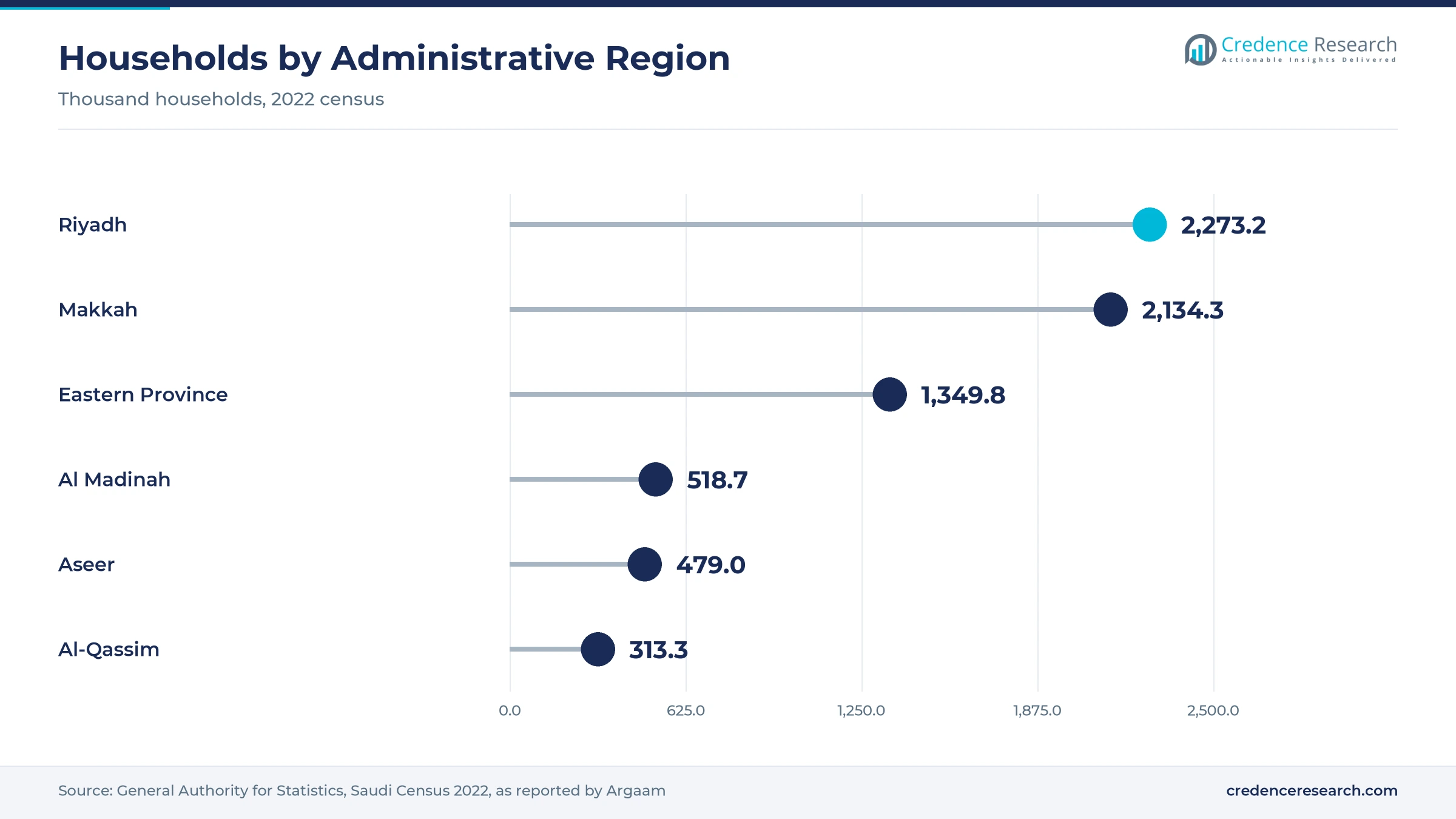
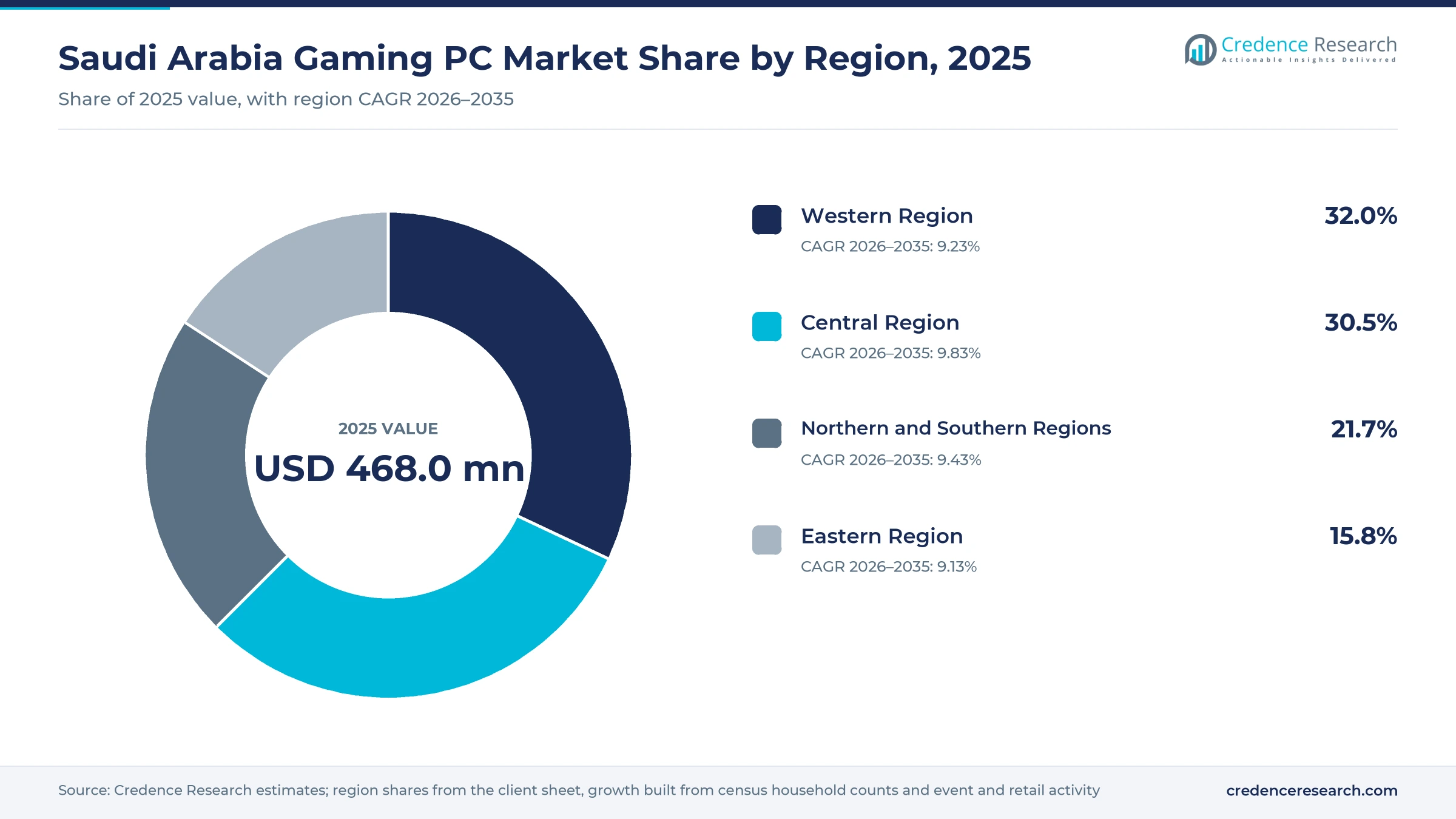
The Saudi Arabia gaming PC market was valued at USD 468.0 million in 2025 and is projected to increase from USD 512.2 million in 2026 to USD 1.15 billion by 2035, registering a CAGR of 9.44% during 2026–2035. Demand comes from a large population of young players who buy gaming laptops for school and home, from competitive players who build high-refresh desktops, and from streamers and esports venues that need workstation-class graphics. The Western Region held the largest regional share, 32.0% in 2025, because Jeddah, Makkah and Madinah hold about a third of the households counted in the 2022 census. The Central Region is the fastest-growing region at 9.83% a year, as Riyadh hosts the Esports World Cup each summer and the Qiddiya gaming district takes shape nearby. Supply is also changing, because Lenovo is building a factory near Riyadh that will assemble laptops and desktops in the Kingdom. As a result, local stock and service should improve for buyers across the country.
Which machines and buyers does the estimate cover?
The estimate measures the value of new gaming laptops, prebuilt gaming desktops, custom-built gaming desktops and compact gaming PCs sold in Saudi Arabia. Values are stated at the prices that casual players, competitive players, streamers, esports teams and gaming venues pay through specialist stores, electronics chains, brand web stores and online marketplaces.
The estimate excludes consoles, handheld devices, monitors sold separately, peripherals such as headsets and mice, games and subscriptions. The value chain runs from processor, graphics and memory makers through brand assemblers and system builders to distributors and retailers, and onward to the households and venues that play on them.
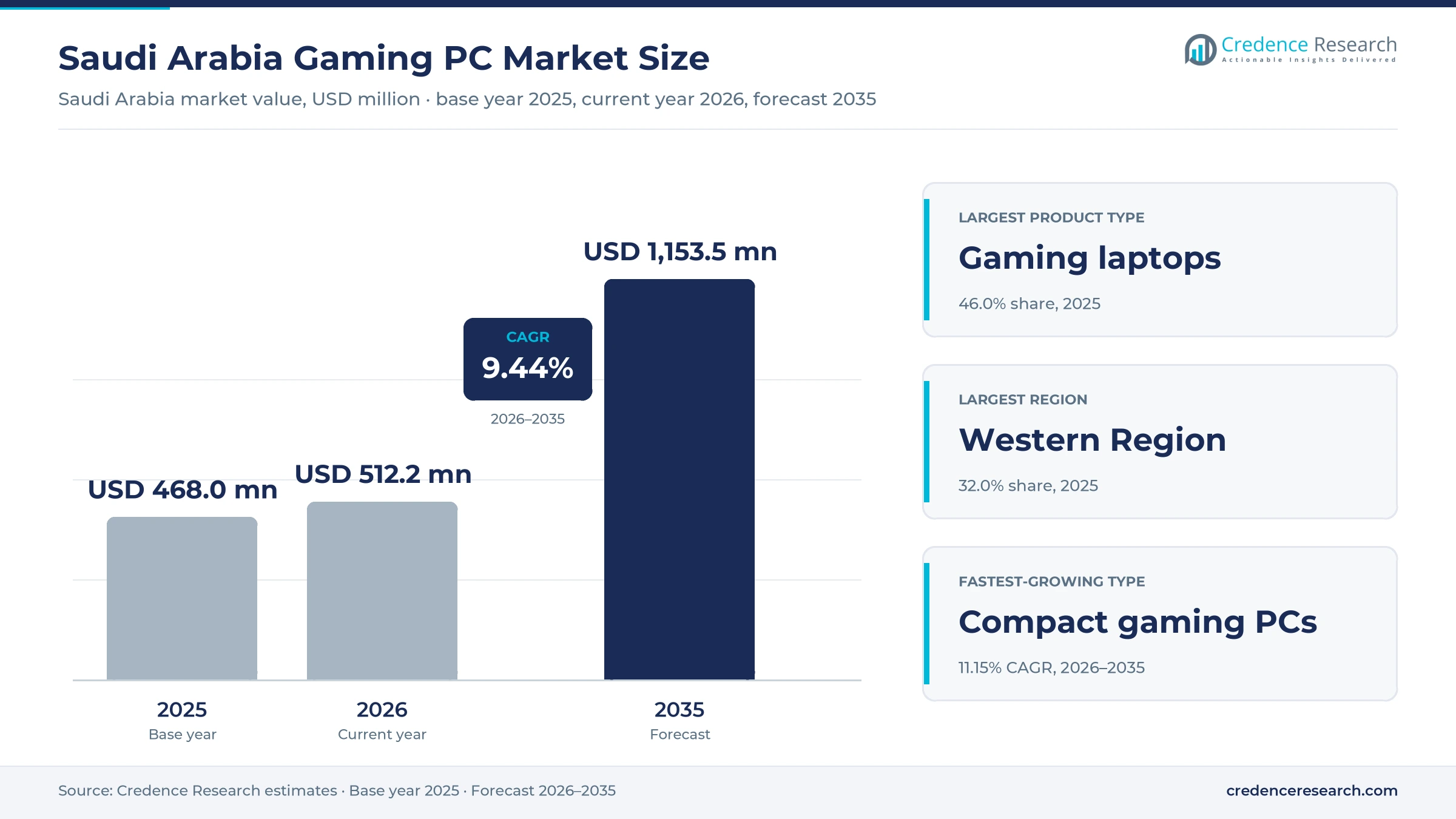
Saudi Arabia Gaming PC Market Insights
- The Saudi Arabia gaming PC market was valued at USD 468.0 million in 2025 and is projected to reach USD 1.15 billion by 2035, registering a CAGR of 9.44% during 2026–2035.
- The Western Region held a 32.0% share of 2025 value, because the Makkah and Madinah regions contain about a third of Saudi households.
- Gaming laptops led with a 46.0% share of 2025 value, because students and young professionals want one machine for study, work and play.
- The Esports World Cup 2025 in Riyadh offered more than $70 million in prize money across 25 tournaments, the largest prize pool in esports.
- Lenovo opened a regional headquarters in Riyadh in April 2026 and plans large-scale laptop and desktop production near the capital in late 2026.
Laptops lead as compact rigs and venues grow fastest
Why do gaming laptops lead product demand?
Based on product type, the market is categorized into gaming laptops, prebuilt gaming desktops, custom-built gaming desktops and compact gaming PCs. Gaming Laptops led with a 46.0% share of 2025 value, because students and young professionals want one portable machine for study, work and play. Compact Gaming PCs grow fastest at 11.15% a year, as small apartments and living-room setups favor small towers with desktop graphics.
How does the mid-range tier hold the largest value?
Based on price tier, the market is categorized into entry-level, mid-range, high-end and enthusiast machines. Mid-Range systems led with 42.0% of 2025 value, because most buyers want current graphics at prices that suit a household budget. Enthusiast machines grow fastest at 10.30% a year, as competitive players and streamers pay for top graphics cards and high-refresh displays.
Which player groups buy the most machines?
Based on customer type, the market is categorized into casual gamers, competitive gamers, content creators and streamers, and esports teams and gaming venues. Casual Gamers led with 52.0% of 2025 value, because most Saudi players buy one machine for mixed use at home. Esports Teams and Gaming Venues grow fastest at 10.96% a year, as new arenas, clubs and training centers open in Riyadh and Jeddah.
Where do Saudi buyers purchase their machines?
Based on distribution channel, the market is categorized into specialist gaming retailers, consumer electronics chains, brand direct e-commerce and online marketplaces. Consumer Electronics Chains led with 38.0% of 2025 value, because large showroom networks offer financing, trade-in and same-day pickup. Brand Direct E-Commerce grows fastest at 10.29% a year, as brands sell custom configurations through their own Saudi web stores.
| Segment Group | Leading Sub-segment | Share, 2025 | Fastest-growing Sub-segment | CAGR, 2026–2035 |
|---|---|---|---|---|
| By Product Type | Gaming Laptops | 46.0% | Compact Gaming PCs | 11.15% |
| By Price Tier | Mid-Range | 42.0% | Enthusiast | 10.30% |
| By Customer Type | Casual Gamers | 52.0% | Esports Teams and Gaming Venues | 10.96% |
| By Distribution Channel | Consumer Electronics Chains | 38.0% | Brand Direct E-Commerce | 10.29% |
Request a Free Sample
Fill in your details and we'll send you a free sample report.
- Sample data tables & charts
- Research methodology
Players, state esports policy and new hardware lift sales
How does a large connected player base lift sales?
Saudi Arabia combines a young population with near-universal internet use, which creates a deep pool of buyers for gaming hardware. Arab News reported 23.5 million gaming enthusiasts in the Kingdom, about 67% of the population, and said about 90% of them take part in esports at an amateur or semi-professional level. Individuals using the internet reached 100% of the population in 2024, according to the World Bank, while the population reached about 37 million in 2025. The Communications, Space and Technology Commission also reported a median mobile internet speed of 129 Mbps for 2024, fourth among G20 countries. As a result, casual gamers formed the largest customer group with 52.0% of 2025 value.
Why does state-backed esports policy raise demand?
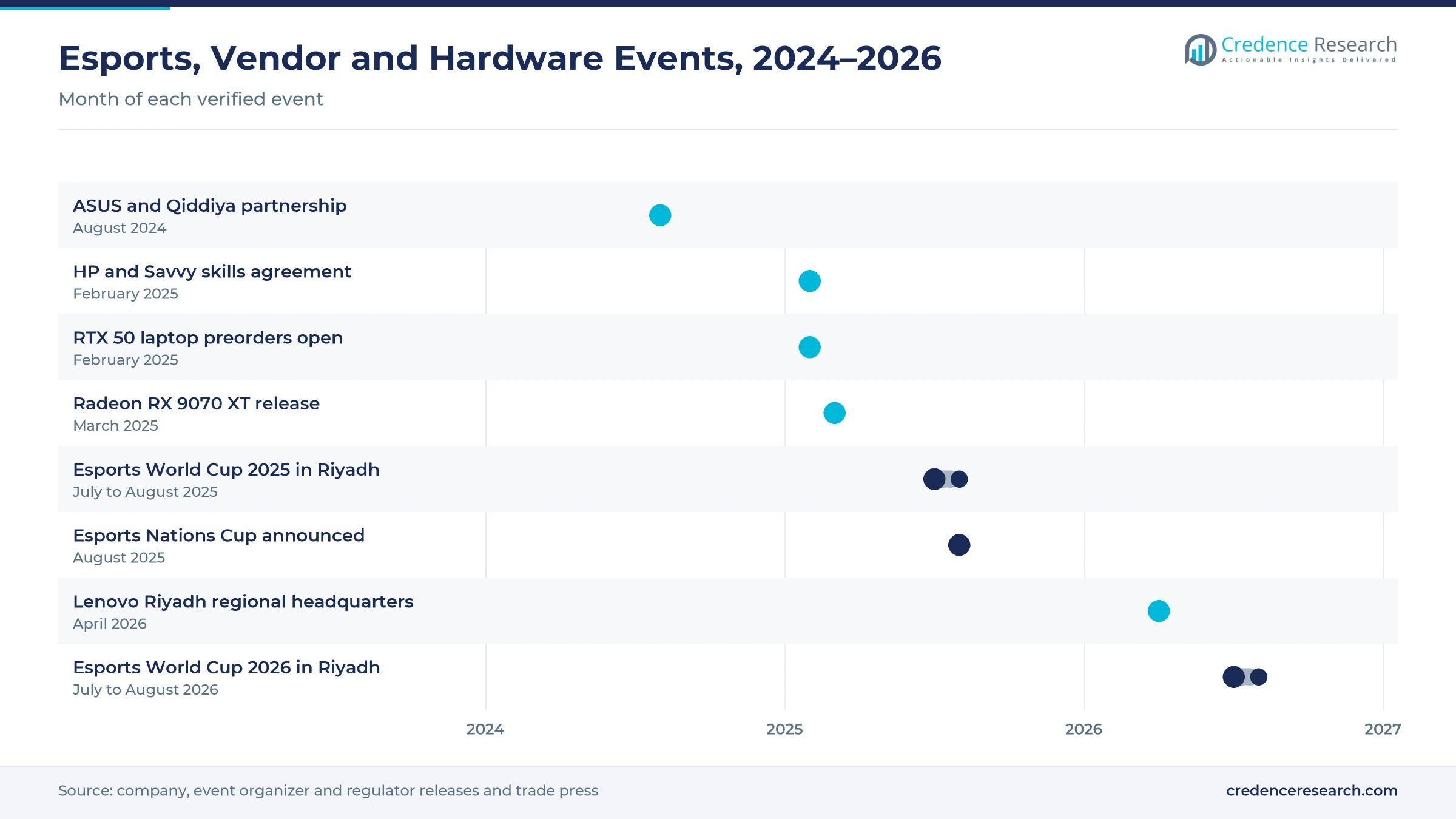
Government policy treats gaming as an economic sector, which raises the visibility of PC titles and of competitive play. The National Gaming and Esports Strategy, launched on Sept. 15, 2022, targets a SAR 50 billion contribution to the economy and 39,000 jobs by 2030 through 86 initiatives, according to Al Arabiya. The Esports World Cup 2025 in Riyadh then offered more than $70 million in prize money across 25 tournaments from July 7 to Aug. 24, according to the Esports World Cup Foundation. Counter-Strike 2, Dota 2 and VALORANT featured again on the 2026 schedule, which tied the event to growth in professional esports worldwide. In turn, competitive gamers spend more on high-refresh desktops and faster graphics.
How do new components trigger upgrade-led spending?
Each new graphics generation gives Saudi players a reason to replace or upgrade their machines, which supports repeat spending. Laptops with Nvidia GeForce RTX 50 Series graphics opened for preorder on Feb. 25, 2025, with shipping from March, according to Lowyat. AMD released the Radeon RX 9070 XT on March 6, 2025, at a launch price of $599 in the United States, according to GamersNexus. Jarir said in January 2025 that it would expand its gaming categories and offer trade-in for old devices, according to Argaam. Each new graphics card launch also lifts custom-built desktop sales, because builders and players buy the card first and the rest of the system around it.
Why does local assembly and vendor investment matter?
Global brands are now investing in Saudi offices, plants and partnerships, which improves stock, service and marketing for gaming machines. Lenovo completed a $2 billion deal with the Public Investment Fund company Alat to build a factory in Saudi Arabia, according to AGBI. The Riyadh site covers about 200,000 square meters and will make laptops and desktops, with large-scale production expected in late 2026, according to Asharq Al-Awsat. Lenovo also unveiled its first laptop made in the Kingdom at LEAP 2026, according to tbreak. ASUS signed a partnership with Qiddiya on Aug. 28, 2024, that includes a Republic of Gamers flagship store. As a result, gaming laptops led product types with 46.0% of 2025 value.
Esports districts, national team events and studio deals
How is the rise of esports districts changing venue demand?
Purpose-built esports districts are emerging near Riyadh, which creates demand from arenas, clubs and training centers that need fleets of high-end machines. Qiddiya Investment Co. announced a 500,000-square-meter gaming and esports district on Dec. 14, 2023, with four arenas and 73,000 seats in total, according to Argaam. The district plans to host up to 25 esports clubs and regional offices for more than 30 game companies, and it targets 10 million visits a year. ASUS also plans to co-design a Republic of Gamers flagship store in the district, according to Sharikat Mubasher. As a result, esports teams and gaming venues grow fastest by customer type at 10.96% a year.
Why is the shift to online and brand direct buying notable?
Saudi buyers increasingly research and buy machines online, which shifts sales toward web stores and marketplaces that offer custom configurations. Jarir lists gaming as its own category online and calls the growth of its e-commerce business a strategic priority, according to its company profile, which counts 62 showrooms and a target of more than 80 in Saudi Arabia and the GCC. The retailer also said in January 2025 that it would open five new stores in Riyadh, Jeddah, the Eastern Province and Qatar, according to Argaam. Lenovo, ASUS and HP each run Saudi web stores that sell gaming laptops and desktops directly to consumers. In turn, brand direct e-commerce grows fastest by channel at 10.29% a year, although showroom chains keep the largest share.
Can nation-based esports events open new hardware demand?
Saudi Arabia is adding new international events that need training hardware for national teams and qualifiers, which opens room for system builders and venue suppliers. The Esports World Cup Foundation announced the first Esports Nations Cup on Aug. 25, 2025, for November 2026 in Riyadh, with more than 100 countries and 1,500 finalists across 15 titles, according to Arabian Business. The Esports World Cup 2026 then set a $75 million prize pool for July 6 to Aug. 23, 2026. The International Olympic Committee ended its esports partnership with Saudi Arabia in late 2025, according to VGC, so Saudi organizers are pursuing their own events. As a result, competitive players and venues gain more reasons to upgrade.
Is studio investment an opening for high-end systems?
Saudi capital is moving into game publishing and development, which opens demand for workstation-class machines used to build, test and stream games. Electronic Arts agreed on Sept. 29, 2025, to be acquired by a consortium of PIF, Silver Lake and Affinity Partners at about $55 billion of enterprise value, according to a release filed with the U.S. Securities and Exchange Commission. Savvy Games Group earlier set out SR142 billion of planned investment, and the national strategy targets 250 game developers and 30 competitive games by 2030, according to Arab News. HP and Savvy also agreed in February 2025 to promote HP Gaming Garage training with universities. In turn, content creators and streamers form a fast-growing group, and enthusiast machines grow at 10.30% a year.
Taxes, console rivalry and heat raise ownership costs
How does VAT raise the cost of high-end machines?
Saudi Arabia applies a standard VAT rate of 15%, which rose from 5% with effect from July 1, 2020, according to ClearTax. Because the tax applies to the full shelf price, it adds a large amount to enthusiast laptops and desktops. As a result, some buyers delay upgrades or move to lower price tiers. Retailers respond with installment plans, trade-in programs and bundle offers that spread the cost over time.
Why do consoles compete for the same household budget?
Consoles offer a lower entry price and simple living-room setup, which draws casual players away from PCs. Saudi Arabia imported more than 1.7 million video game consoles in 2024, according to Zakat, Tax and Customs Authority data reported by Economy Middle East. In turn, many households spend their gaming budget on a console before a PC. Brands answer with compact PCs and laptops that connect easily to large televisions.
How do launch shortages and price swings affect buyers?
New graphics cards often sell above their launch price for several months, because global supply is tight at release. Saudi buyers depend on imported components, so local prices follow those global swings with a delay. As a result, custom builders face uncertain margins and buyers sometimes wait for prices to settle. Distributors reduce this risk by securing allocations early and offering preorders with fixed prices.
Why do heat and power use shape machine choice?
Saudi summers bring very high indoor cooling loads, and high-end graphics cards draw hundreds of watts under load. The Radeon RX 9070 XT has an advertised board power of 304 watts, according to GamersNexus, which adds heat to small rooms. In turn, thin laptops can throttle during long evening sessions in summer. Buyers therefore favor larger cases, better fans and liquid cooling, which raises the cost of a balanced system.
Western Region leads as Central Region grows fastest
| Region | Value, 2025 (USD million) | Share, 2025 | CAGR, 2026–2035 |
|---|---|---|---|
| Western Region | 149.8 | 32.0% | 9.23% |
| Central Region | 142.7 | 30.5% | 9.83% |
| Northern and Southern Regions | 101.6 | 21.7% | 9.43% |
| Eastern Region | 73.9 | 15.8% | 9.13% |
How do Jeddah and the holy cities make the Western Region first?
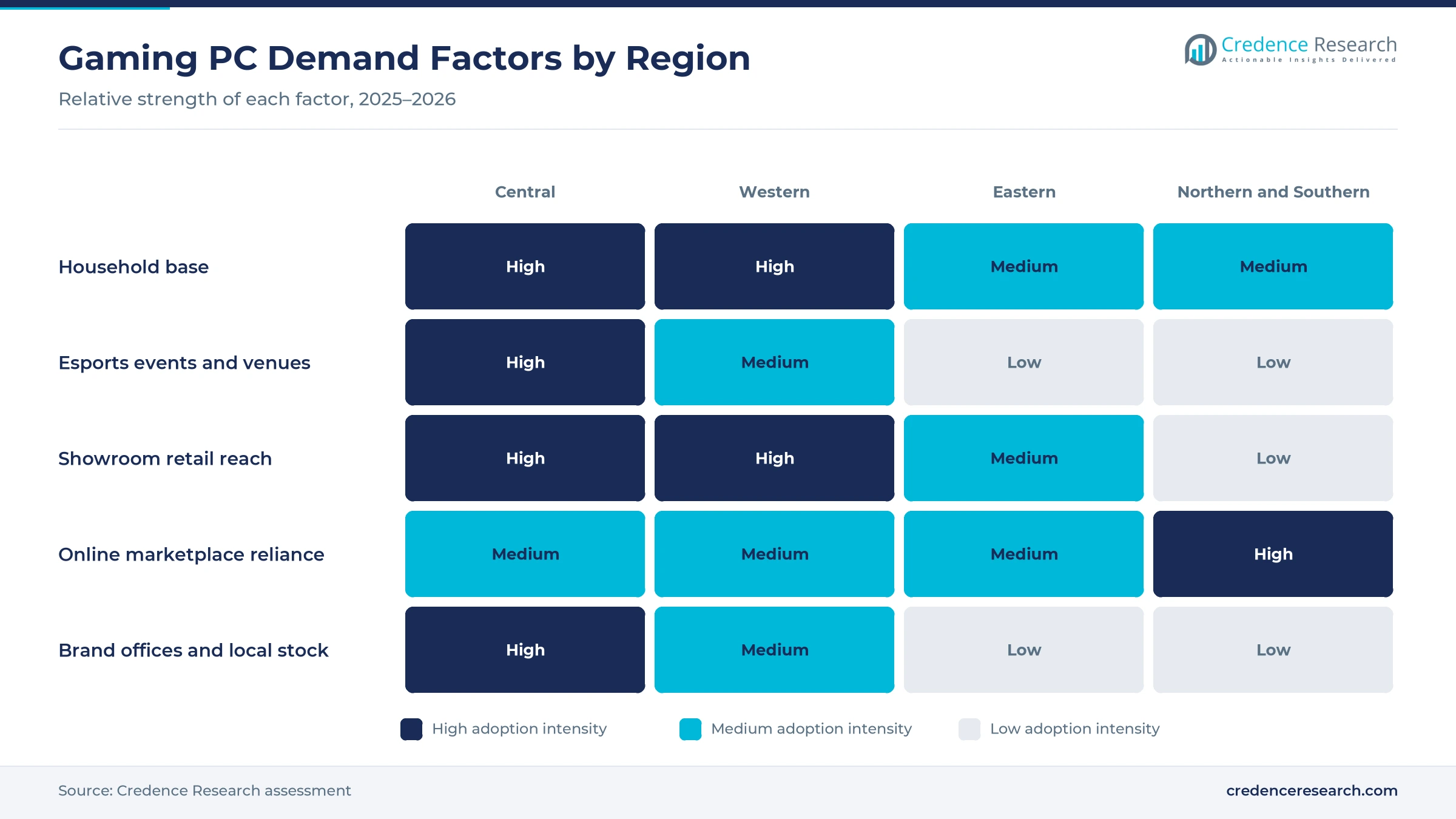
The Western Region held 32.0% of 2025 value and grows at 9.23% a year, because the Makkah and Madinah regions held about 2.65 million households in the 2022 census, nearly a third of the national total. Jeddah is the main retail hub in the zone, and Jarir named it among the cities for new stores in 2025. Large malls and electronics chains also give buyers easy access to demonstration units. As a result, the zone remains the largest single source of household demand.
Why does Riyadh make the Central Region the fastest grower?
The Central Region held 30.5% of 2025 value and grows fastest at 9.83% a year, because Riyadh hosts the Esports World Cup, the Esports Nations Cup and most brand offices. The Riyadh region alone held about 2.27 million households in the 2022 census, the largest of any region. Lenovo opened its regional headquarters in Riyadh in April 2026, and its nearby plant should improve local stock. New data center capacity in the capital also supports low-latency online play.
How do Dammam and Al Khobar shape the Eastern Region?
The Eastern Region held 15.8% of 2025 value and grows at 9.13% a year, because Dammam, Al Khobar and Dhahran combine high household incomes with a large expatriate workforce. The Eastern Province held about 1.35 million households in the 2022 census. Jarir also listed the province among its locations for new stores in 2025. However, smaller event activity than Riyadh holds growth in the zone slightly below the national rate.
Why do the Northern and Southern Regions add steady demand?
The Northern and Southern Regions held 21.7% of 2025 value and grow at 9.43% a year, because cities such as Abha, Jazan, Tabuk and Hail have young populations with growing online access. Aseer and Jazan together held nearly 0.8 million households in the 2022 census. Online marketplaces reach these cities more easily than showroom chains, which makes delivery and warranty service important to buyers.
Esports, vendor and hardware milestones, 2024 to 2026
| Development | Status and market relevance |
|---|---|
| In August 2024, ASUS signed a long-term partnership with Qiddiya that includes a Republic of Gamers flagship store. | Lays groundwork for an ASUS regional office in Saudi Arabia |
| In February 2025, HP and Savvy Games Group agreed to promote HP Gaming Garage training with Saudi universities. | Builds skills for game development and esports careers |
| In August 2025, the Esports World Cup Foundation announced the Esports Nations Cup for November 2026 in Riyadh. | More than 100 countries and 1,500 finalists expected |
| In January 2026, the Esports World Cup 2026 set a $75 million prize pool for its July and August event in Riyadh. | Largest prize pool of the series |
| In April 2026, Lenovo opened its regional headquarters for the Middle East, Türkiye and Africa in Riyadh. | Large-scale PC production near Riyadh expected in late 2026 |
GPU generation, platform and cooling shape purchases
- Discrete GPU architecture sets frame rates and ray tracing quality, which is why Blackwell and RDNA 4 cards drove 2025 upgrades.
- Processor platform decides gaming and streaming speed, because more cores help players who play and encode video at once.
- High-refresh displays show more frames each second, which suits competitive players who also buy 4K monitors for home rigs.
- Compact form factors fit desktop graphics into small cases, which suits apartments and living-room setups.
- Thermal management uses vapor chambers, larger fans and liquid coolers, which keeps machines stable in hot Saudi summers.
Need a Custom Version of This Report?
Tailor the scope, geography, or segments to your exact requirements.
- Custom geography or segment scope
- Direct access to our analyst team
Brand ecosystems and retail reach separate leaders
Competition centers on brand ecosystems, retail reach, local service and sponsorship of events, because Saudi buyers compare machines in showrooms and follow brands through esports. Lenovo sells Legion machines through a Saudi web store and is building a plant near Riyadh with Alat, which should shorten delivery times. ASUS markets Republic of Gamers laptops and desktops and has a long partnership with Qiddiya. HP sells Omen and Victus machines through its Saudi store and backs local skills programs with Savvy Games Group and Merak Capital. Jarir and other electronics chains control a large share of shelf space and financing offers. Other global brands compete for Saudi buyers through distributors and retailers. As a result, brands with local stock, service centers and event visibility win the most repeat buyers.
Companies profiled and their roles in this market
| Company | Type | Role in the market |
|---|---|---|
| Lenovo Group | PC brand | Legion range; Riyadh regional headquarters and plant with Alat |
| ASUS | PC brand | Republic of Gamers range; Qiddiya partnership and flagship store plan |
| HP Inc. | PC brand | Omen and Victus range; HP Gaming Garage programs with Savvy and Merak |
| Jarir Marketing Co. | Retailer | Showroom and online network with a dedicated gaming category |
Credence Research view on Saudi rig demand
Credence Research's view is that Saudi gaming PC demand will grow steadily, because a large, connected player base, state support for esports and regular hardware launches keep buyers upgrading. Gaming laptops keep the largest share, while compact PCs and enthusiast machines gain ground as players and venues seek more power. The Western Region stays the largest zone by households, while the Central Region grows fastest around Riyadh events and Qiddiya. Brands that combine local stock, service and event visibility should win the most buyers.
Trade, census and company data anchor the model
The report uses 2025 as the base year on a calendar basis, and market values come from the Credence Research model. That model combines import values for portable and desktop computers, shipment data for the Gulf region, census household counts by region, typical retail prices and company announcements. Segment splits and zone growth rates are Credence Research estimates, and zone shares follow the client sheet. Sources used are government and regulator releases, World Bank data, trade statistics, company releases and trade press, and no interviews or surveys were used.
Upgrades and esports events carry demand to 2035
Sales of gaming machines in Saudi Arabia are expected to reach USD 1.15 billion by 2035, a 9.44% CAGR during 2026–2035, as players upgrade with each graphics generation and esports events keep PC titles visible. Growth should stay firm through 2028 as Qiddiya venues open and local production improves stock. After that, replacement cycles and higher-priced machines will set the pace. Lower component prices would widen the buyer base, while weaker consumer spending would delay upgrades. Compact gaming PCs are expected to gain the most share through 2035.
Frequently Asked Questions
How big is the Saudi Arabia gaming PC market?
Which product type leads demand in Saudi Arabia?
Which region leads the Saudi market?
How many gamers live in Saudi Arabia?
How does the Esports World Cup affect demand?
Is Lenovo making PCs in Saudi Arabia?
Who are the leading gaming PC brands in Saudi Arabia?
What are the main challenges for the market?
Table of Content
Chapter 1 Market Segmentation
- 1.1 Segmentation Framework
- 1.1.1 Product and Service Classification
- 1.1.2 Application and End-Use Classification
- 1.1.3 Technology and Solution Classification
- 1.1.4 Customer and Distribution Channel Classification
- 1.1.5 Geographic Segmentation
- 1.1.6 Market Segment Definitions and Boundaries
- 1.2 By Product Type
- 1.2.1 Gaming Laptops
- 1.2.2 Prebuilt Gaming Desktops
- 1.2.3 Custom-Built Gaming Desktops
- 1.2.4 Compact Gaming PCs
- 1.3 By Price Tier
- 1.3.1 Entry-Level
- 1.3.2 Mid-Range
- 1.3.3 High-End
- 1.3.4 Enthusiast
- 1.4 By Customer Type
- 1.4.1 Casual Gamers
- 1.4.2 Competitive Gamers
- 1.4.3 Content Creators and Streamers
- 1.4.4 Esports Teams and Gaming Venues
Chapter 2 Introduction
- 2.1 Report Objectives and Scope
- 2.2 Product Definition and Industry Terminology
- 2.3 Market Inclusions and Exclusions
- 2.4 Research Process
- 2.4.1 Primary Research and Expert Interviews
- 2.4.2 Secondary Research and Source Review
- 2.4.3 Top-Down and Bottom-Up Estimation
- 2.4.4 Data Triangulation and Verification
- 2.5 Market Size Measurement Basis
- 2.5.1 2025: USD 468.0 million → 2035: USD 1.15 billion
- 2.6 Historical and Forecast Reference Periods
- 2.6.1 Historical Period: 2018-2025
- 2.6.2 Base Year: 2025
- 2.6.3 Forecast Period: 2025-2035
- 2.7 Research Assumptions and Limitations
Chapter 3 Executive Summary
- 3.1 Market Snapshot and Key Findings
- 3.2 Base-Year Market Size, 2025
- 3.3 Forecast Market Size, 2035
- 3.4 Revenue and Volume Growth Outlook
- 3.5 Key Demand and Supply Indicators
- 3.6 Leading Market Segments
- 3.7 Fastest-Growing Market Opportunities
- 3.8 Regional Performance Highlights
- 3.9 Technology and Industry Transformation
- 3.10 Competitive Landscape Summary
- 3.11 Analyst View and Strategic Implications
Chapter 4 Saudi Arabia Gaming PC Market Trends and Developments
- 4.1 Historical Industry Development, 2018-2025
- 4.2 Recent Market Trends and Developments
- 4.3 Demand and Customer Behavior Trends
- 4.4 Technology and Product Innovation
- 4.5 Artificial Intelligence, Automation and Digitalization
- 4.6 Local Manufacturing and Supply Chain Realignment
- 4.7 Industry Partnerships, Mergers and Acquisitions
- 4.8 Sustainability and Circular Economy Developments
- 4.9 Government and Private Sector Investment Trends
- 4.10 Emerging Business Models and Commercialization
- 4.11 Industry Developments and Announcements
Chapter 5 Saudi Arabia Gaming PC Market Production, Supply and Demand Analysis
- 5.1 Demand Trend and Consumption Analysis, 2018-2025
- 5.2 Demand Forecast, 2025-2035
- 5.3 Production and Output Trend, 2018-2025
- 5.4 Production and Output Forecast, 2025-2035
- 5.5 Installed Capacity and Capacity Utilization
- 5.6 Company-Wise Production Plants and Statistics
- 5.6.1 Installed Production Capacity
- 5.6.2 Actual Production
- 5.6.3 Planned Capacity and Expansion Targets
- 5.7 Supply Chain Structure and Procurement Trends
- 5.8 Supply-Demand Gap and Bottlenecks
- 5.9 Import Dependence and Sourcing Structure
- 5.10 Contract Manufacturing and Outsourcing
- 5.11 Regional Supply and Demand Concentration
Chapter 6 Saudi Arabia Gaming PC Market Pricing Analysis
- 6.1 Pricing Structure and Measurement
- 6.2 Historical Pricing Trends, 2018-2025
- 6.3 Pricing Outlook, 2025-2035
- 6.4 Average Selling Price and Unit Economics
- 6.5 Pricing by Product and Market Segment
- 6.6 Geographic Pricing Differences
- 6.7 Key Input, Energy, Labor and Logistics Costs
- 6.8 Contract Pricing and Purchasing Models
- 6.9 Pricing Sensitivity and Competitive Positioning
- 6.10 Price, Margin and Profitability Implications
Chapter 7 Saudi Arabia Gaming PC Market Dynamics
- 7.1 Market Growth Drivers
- 7.1.1 Demand-Side Drivers
- 7.1.2 Technology and Innovation Drivers
- 7.1.3 Infrastructure and Investment Drivers
- 7.1.4 Regulatory and Policy Drivers
- 7.2 Market Restraints
- 7.2.1 Cost and Affordability Constraints
- 7.2.2 Technology and Adoption Barriers
- 7.2.3 Supply Chain and Operational Constraints
- 7.3 Market Challenges
- 7.3.1 Competitive Pressure and Margin Erosion
- 7.3.2 Skills, Infrastructure and Implementation Gaps
- 7.4 Emerging Market Opportunities
- 7.5 Market Dynamics Impact and Time-Horizon Assessment
Chapter 8 Saudi Arabia Gaming PC Value Chain Analysis
- 8.1 Industry Value Chain Overview
- 8.2 Upstream Suppliers and Critical Inputs
- 8.3 Technology and Component Providers
- 8.4 Manufacturing or Service Delivery
- 8.5 Distribution, Channel Partners and Integrators
- 8.6 Downstream Applications and End Users
- 8.7 Value Addition and Profit Pools
- 8.8 Vertical Integration and Outsourcing
- 8.9 Supplier Concentration and Risk
- 8.10 Supply Chain Localization and Resilience
Chapter 9 Saudi Arabia Gaming PC Market Regulations and Policies
- 9.1 Relevant Laws, Standards and Compliance Frameworks
- 9.2 Product, Service, Safety and Quality Requirements
- 9.3 Government Policies, Incentives and Subsidies
- 9.4 Imports, Exports and Trade Barriers
- 9.5 Public Procurement and Local Content Requirements
- 9.6 Environmental and Sustainability Compliance
- 9.7 Data Protection, AI and Cybersecurity Compliance
- 9.8 Upcoming Policy Changes and Market Implications
Chapter 10 Saudi Arabia Gaming PC Market Hotspots and Opportunities
- 10.1 Market Opportunity Mapping and Growth Hotspots
- 10.2 High-Growth Applications and Customer Groups
- 10.3 Underserved Markets and White-Space Opportunities
- 10.4 Emerging Technology and Product Opportunities
- 10.5 New Capacity and Investment Hotspots
- 10.6 Market Entry and Expansion Opportunities
- 10.7 Distribution and Partnership Opportunities
- 10.8 Near-Term and Long-Term Commercial Potential
- 10.9 Opportunity Attractiveness and Execution Risks
Chapter 11 Saudi Arabia Gaming PC Market Outlook, 2025-2035
- 11.1 Market Size and Analysis
- 11.1.1 Revenue (Market Measurement: 2025: USD 468.0 million → 2035: USD 1.15 billion)
- 11.1.2 Market Volume and Quantity Sold
- 11.1.3 Historical Market Size, 2018-2025
- 11.1.4 Base-Year Market Size, 2025
- 11.2 Market Forecast, 2025-2035
- 11.2.1 Revenue Forecast to 2035
- 11.2.2 Volume Forecast to 2035
- 11.2.3 CAGR and Year-on-Year Growth
- 11.2.4 Incremental Revenue Opportunity
- 11.3 Forecast Assumptions and Scenario Analysis
- 11.3.1 Base-Case Forecast
- 11.3.2 Optimistic and Conservative Scenarios
- 11.3.3 Technology, Pricing and Policy Sensitivities
- 11.4 Market Attractiveness and Growth Outlook
Chapter 12 Saudi Arabia Gaming PC Market Segmentation and Outlook
- 12.1 Segmentation Summary and Market Shares, 2025
- 12.2 Largest and Fastest-Growing Segments
- 12.3 By Product Type - Market Size and Forecast, 2025-2035
- 12.3.1 Segment Definition and Scope
- 12.3.2 Historical Market Size, 2018-2025
- 12.3.3 Revenue Forecast, 2025-2035
- 12.3.4 Volume Forecast, 2025-2035
- 12.3.5 Base-Year Market Share, 2025
- 12.3.6 Segment CAGR and Growth Drivers
- 12.3.7 Subsegment Market Size and Forecast
- 12.3.7.1 Gaming Laptops
- 12.3.7.2 Prebuilt Gaming Desktops
- 12.3.7.3 Custom-Built Gaming Desktops
- 12.3.7.4 Compact Gaming PCs
- 12.3.8 Subsegment Pricing and Adoption Trends
- 12.3.9 Leading Suppliers and Competition
- 12.3.10 Regional Demand and Opportunities
- 12.4 By Price Tier - Market Size and Forecast, 2025-2035
- 12.4.1 Segment Definition and Scope
- 12.4.2 Historical Market Size, 2018-2025
- 12.4.3 Revenue Forecast, 2025-2035
- 12.4.4 Volume Forecast, 2025-2035
- 12.4.5 Base-Year Market Share, 2025
- 12.4.6 Segment CAGR and Growth Drivers
- 12.4.7 Subsegment Market Size and Forecast
- 12.4.7.1 Entry-Level
- 12.4.7.2 Mid-Range
- 12.4.7.3 High-End
- 12.4.7.4 Enthusiast
- 12.4.8 Subsegment Pricing and Adoption Trends
- 12.4.9 Leading Suppliers and Competition
- 12.4.10 Regional Demand and Opportunities
- 12.5 By Customer Type - Market Size and Forecast, 2025-2035
- 12.5.1 Segment Definition and Scope
- 12.5.2 Historical Market Size, 2018-2025
- 12.5.3 Revenue Forecast, 2025-2035
- 12.5.4 Volume Forecast, 2025-2035
- 12.5.5 Base-Year Market Share, 2025
- 12.5.6 Segment CAGR and Growth Drivers
- 12.5.7 Subsegment Market Size and Forecast
- 12.5.7.1 Casual Gamers
- 12.5.7.2 Competitive Gamers
- 12.5.7.3 Content Creators and Streamers
- 12.5.7.4 Esports Teams and Gaming Venues
- 12.5.8 Subsegment Pricing and Adoption Trends
- 12.5.9 Leading Suppliers and Competition
- 12.5.10 Regional Demand and Opportunities
- 12.6 Segment Growth Comparison
- 12.7 Segment Attractiveness and Priority Matrix
Chapter 13 Saudi Arabia Gaming PC End-Use and Application Market Outlook
- 13.1 End-Use Industry and Customer Demand Structure
- 13.2 Leading Applications and Customer Groups
- 13.3 End-Use Market Size, Share and Forecast
- 13.4 Major End-Use Industry Deep Dives
- 13.4.1 Customer Requirements and Use Cases
- 13.4.2 Demand and Replacement Cycles
- 13.4.3 Technical and Regulatory Considerations
- 13.4.4 Purchasing and Procurement Models
- 13.4.5 Leading Vendors and Distribution Channels
- 13.4.6 Forecast and Commercial Opportunities
- 13.5 Emerging Applications and Cross-Segment Demand
- 13.6 End-Use Industry Investment Priorities
Chapter 14 Saudi Arabia Gaming PC Geographic Market Outlook, 2025-2035
- 14.1 Domestic Market Distribution and Demand Clusters
- 14.2 State- or Province-Wise Market Size and Forecast, 2025-2035
- 14.3 City and Metropolitan Market Outlook
- 14.4 Industrial, Manufacturing and Commercial Clusters
- 14.5 Geographic Concentration of Key End Users
- 14.6 Local Pricing and Purchasing Differences
- 14.7 Domestic Production Facilities and Capacity Map
- 14.8 Local Infrastructure and Project Pipeline
- 14.9 State-Level Policy and Incentive Differences
- 14.10 Subnational Investment Hotspots and Opportunities
- 14.11 Distribution and Logistics Networks
- 14.12 Domestic Competitive Footprint
Chapter 15 Saudi Arabia Gaming PC Technology, Innovation and Sustainability Outlook
- 15.1 Technology Landscape and Maturity
- 15.2 Product, Process and Service Innovation
- 15.3 AI, Automation and Digital Tools in the Industry
- 15.4 Technology Adoption and Performance Benchmarking
- 15.5 Innovation Pipeline and R&D Investment
- 15.6 Patent and Intellectual Property Trends
- 15.7 Energy Efficiency and Resource Management
- 15.8 Sustainability, Recycling and Circularity
- 15.9 Technology Roadmap, 2025-2035
- 15.10 Risks of Obsolescence and Technology Substitution
Chapter 16 Saudi Arabia Gaming PC Market Key Strategic Imperatives
- 16.1 Growth and Market Entry Priorities
- 16.2 High-Return Products and Segments
- 16.3 Pricing, Profitability and Cost Optimization
- 16.4 Technology Investment and Product Differentiation
- 16.5 Supply Chain Localization and Resilience
- 16.6 Distribution and Customer Acquisition
- 16.7 Partnership, Acquisition and Capacity Strategy
- 16.8 Regional Expansion Priorities
- 16.9 Short-, Medium- and Long-Term Actions
Chapter 17 Competition Outlook
- 17.1 Industry Competition Characteristics
- 17.2 Market Structure and Concentration
- 17.3 Market Share and Competitive Positioning, 2025
- 17.4 Company-Wise Revenue and Product Benchmarking
- 17.5 Production and Service Capacity Benchmarking
- 17.6 Technology, Pricing and Differentiation
- 17.7 Regional Footprint and Distribution Strength
- 17.8 Mergers, Acquisitions and Strategic Alliances
- 17.9 New Entrants and Competitive Threats
- 17.10 Porter's Five Forces and Industry Attractiveness
- 17.11 Competitive Outlook, 2025-2035
Chapter 18 Company Profiles
- 18.1 Company Coverage and Selection Criteria
- 18.2 Lenovo Group
- 18.2.1 Business Description
- 18.2.2 Company Ownership and Geographic Presence
- 18.2.3 Product and Service Portfolio
- 18.2.4 Manufacturing and Operating Footprint
- 18.2.5 Production Capacity and Expansion Plans
- 18.2.6 Financial Performance and Investment
- 18.2.7 Market Share and Competitive Position
- 18.2.8 Technology and Innovation Capabilities
- 18.2.9 Strategic Alliances or Partnerships
- 18.2.10 Recent Developments
- 18.2.11 Growth Strategy and Outlook
- 18.3 ASUS
- 18.4 HP Inc.
- 18.5 Dell Technologies
- 18.6 Acer Inc.
- 18.7 Micro-Star International (MSI)
- 18.8 GIGABYTE Technology
- 18.9 Razer Inc.
- 18.10 Corsair Gaming
- 18.11 ZOTAC Technology
- 18.12 Other Relevant Market Participants
Note: Every listed company is profiled on the structure shown under the first company. The company list is preliminary and may change based on research findings, market developments, data availability and client requirements.
Chapter 19 Disclaimer
- 19.1 Research and Forecast Disclaimer
- 19.2 Data Source and Estimation Limitations
Note: The depth of individual sections depends on data availability for this market. Volume, capacity, trade and other unit-based metrics are included where applicable.

