
Sales teams hand prospecting work to autonomous agents
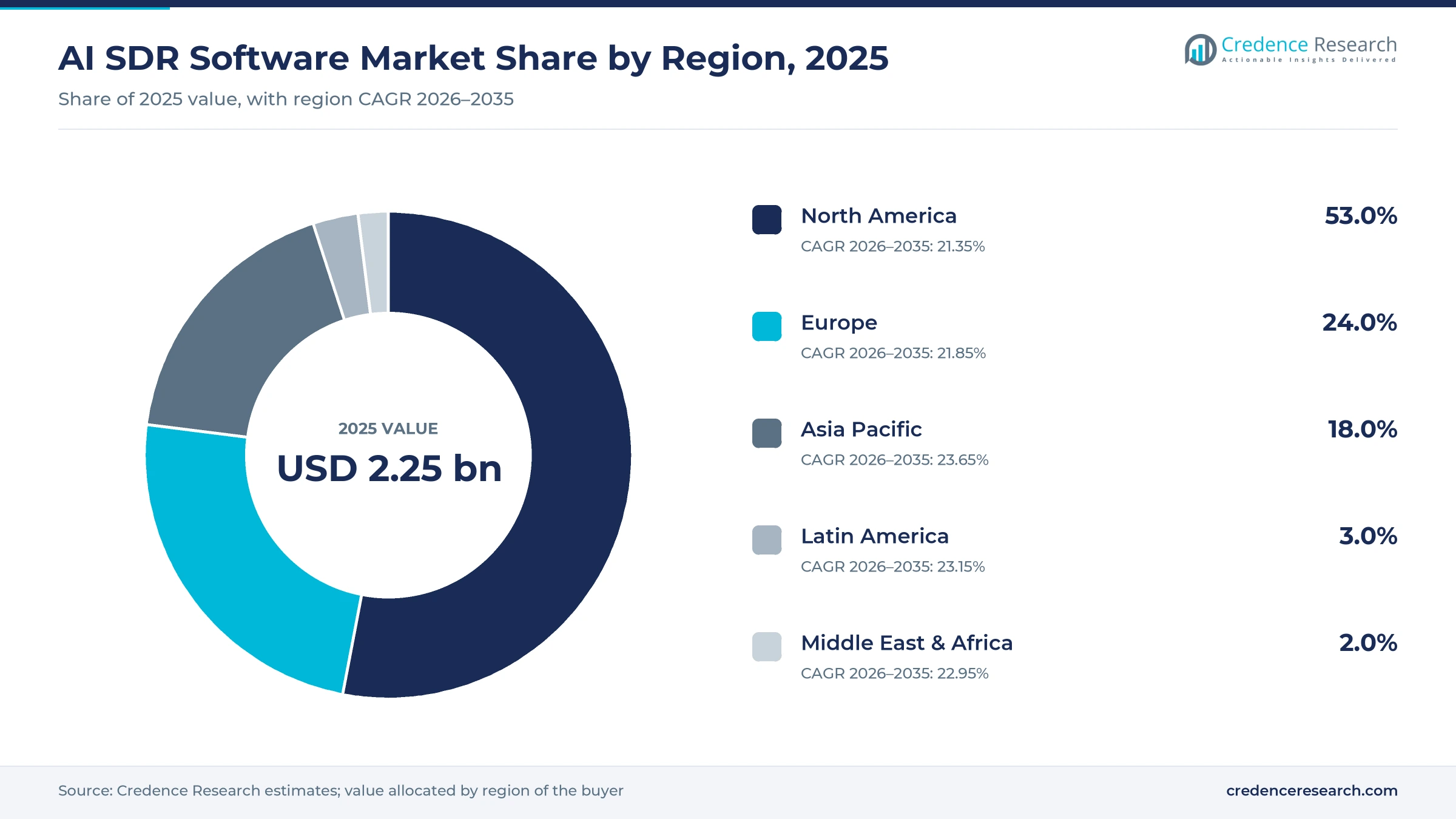
The global AI SDR software market was valued at USD 2.25 billion in 2025 and is projected to increase from USD 2.75 billion in 2026 to USD 16.44 billion by 2035, registering a CAGR of 22.00% during 2026–2035. Demand comes from B2B sales teams that want software agents to research accounts, write outbound email, place calls and book meetings, so that human sellers spend more time on qualified buyers. North America held the largest regional share, 53.0% in 2025, because the main CRM suites and most specialist vendors are based in the United States and sell first to U.S. technology companies. Asia Pacific is the fastest-growing region at 23.65% a year as CRM vendors release agents in Japanese and other local languages. A major commercial change is the move from per-seat licenses to usage and outcome pricing, with vendors charging per action, conversation or booked meeting. Autonomous agents that work around the clock inside the CRM are also replacing earlier writing assistants.
Which tools count as AI sales development software?
The AI SDR software market covers software agents that perform the work of a sales development representative. These tools research prospects and accounts, write and send personalized outbound email, place or assist outbound calls, answer early questions and book meetings for account executives. Buyers subscribe per seat or per agent, or pay by usage or by booked meeting.
The scope excludes general CRM licenses, contact databases sold on their own, marketing automation, conversation recording and human outsourced lead generation services. Value is counted as subscription and usage fees paid by end users, including agent modules sold inside larger sales platforms, but excluding implementation services and data purchases.
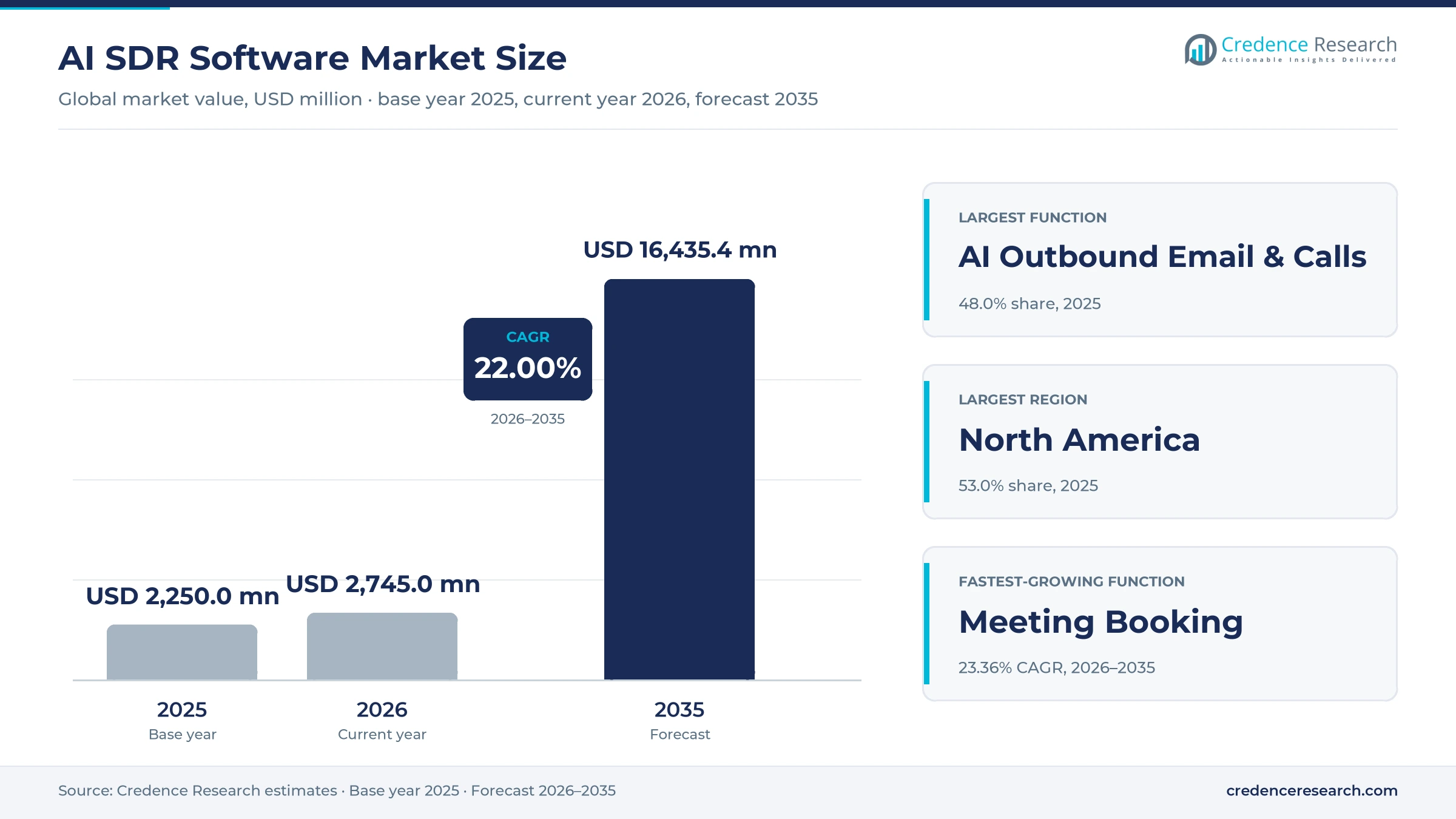
AI SDR Software Market Insights
- The market is valued at USD 2.25 billion in 2025 and is projected to reach USD 16.44 billion by 2035, growing at a 22.00% CAGR as sales teams hand outreach to agents.
- North America led with 53.0% of 2025 value, while Asia Pacific grows fastest after Salesforce launched a Japanese sales agent on April 3, 2025.
- AI Outbound Email & Calls held 48.0% of 2025 value, and Apollo reported 47 million targeted prospecting actions on its AI platform in 2025.
- Salesforce moved Agentforce to Flex Credits on May 15, 2025, pricing each agent action at $0.10 after thousands of organizations used $2 per conversation pricing.
- Specialist vendors raised fresh capital, including a $50 million Series B for 11x in November 2024 and a $25 million Series A for Artisan on April 9, 2025.
Outbound email and calls lead, meeting booking grows fastest
Why do outbound email and calls lead function value?
Based on function, the market is categorized into prospect research, AI outbound email and calls, and meeting booking. AI Outbound Email & Calls led with 48.0% of 2025 value because sending and following up messages is the most repeated task in prospecting. Apollo reported 47 million targeted prospecting actions on its AI platform in 2025, and 11x said in November 2024 that its Jordan phone agent handles calls in more than 30 languages. Meeting Booking grows fastest at 23.36% a year as agents take over scheduling. Qualified said on Aug. 26, 2025 that more than 500 companies had hired its Piper agent, which books meetings and sends follow-ups.
Why do enterprise sales teams lead buyer value?
Based on buyer, the market is categorized into SMB, mid-market and enterprise. Enterprise buyers led with 45.0% of 2025 value because large sales teams buy agents across many seats and regions. Clari and Salesloft said their merged platform, completed in December 2025, serves more than 5,000 companies, including Adobe, IBM, 3M and Zoom. Mid-Market buyers grow fastest at 22.94% a year as entry prices fall. Artisan lists plans at $250 and $600 a month with a 30-day free trial, according to PricingSaaS in November 2026, which puts an agent within reach of teams without a large sales budget.
Why does per-seat pricing still lead pricing value?
Based on pricing, the market is categorized into per seat and per meeting models. Per Seat contracts led with 66.0% of 2025 value because sales leaders already budget software by headcount. Salesforce kept per-user-per-month Agentforce licenses for unmetered employee use when it changed pricing on May 15, 2025, and Artisan sells its human power dialer at $67 per seat a month. Per Meeting models grow fastest at 22.97% a year as buyers pay for outcomes. Salesforce said thousands of organizations had used its $2 per conversation pricing before moving each agent action to $0.10.
| Segment Group | Leading Sub-segment | Share, 2025 | Fastest-growing Sub-segment | CAGR, 2026–2035 |
|---|---|---|---|---|
| By Function | AI Outbound Email & Calls | 48.0% | Meeting Booking | 23.36% |
| By Buyer | Enterprise | 45.0% | Mid-Market | 22.94% |
| By Pricing | Per Seat | 66.0% | Per Meeting | 22.97% |
Request a Free Sample
Fill in your details and we'll send you a free sample report.
- Sample data tables & charts
- Research methodology
Prospecting automation, CRM agents and new pricing lead
B2B sales teams automate prospecting and qualification
B2B sales teams are automating prospecting and lead qualification because human prospecting time is costly and hard to scale. The U.S. Bureau of Labor Statistics counted 1,571,400 wholesale and manufacturing sales representatives in 2025 at a median wage of $76,460, with no job growth projected to 2035. At the same time, an Outreach Insights Group study found that prospecting effort rose 17% because each buyer persona needs more personalized outreach. Microsoft then opened public preview of its Dynamics 365 Sales Qualification Agent on Aug. 22, 2025, which researches leads and hands only qualified ones to sellers. In the Credence Research model this adds about 8.80 percentage points to annual growth to 2035.
CRM and workflow integration lifts AI SDR adoption
Integration with CRM and workflow tools lifts adoption because agents can act on account history without new data entry. Salesforce introduced its Agentforce sales development agent on Sept. 12, 2024, built to answer questions, handle objections and schedule meetings from CRM data. HubSpot launched Breeze on Sept. 18, 2024 with a Prospecting Agent, and said go-to-market teams switch among an average of 15 point solutions. Apollo also embeds its contact database of more than 230 million records in the HubSpot agent. As a result, buyers that already run CRM systems can switch on agents inside tools their sellers use every day. In the Credence Research model this adds about 6.16 percentage points to annual growth to 2035.
Subscription and pay-for-performance models widen access
Subscription and pay-for-performance pricing widens access because buyers can start small and pay in line with results. Salesforce introduced Flex Credits on May 15, 2025, pricing one agent action at $0.10 and 100,000 credits at $500, after thousands of organizations used its $2 per conversation pricing. Artisan lists its Intern plan at $250 a month and its Employee plan at $600 a month, according to PricingSaaS in November 2026. Both plans include a 30-day free trial, which lowers the risk for first-time buyers. In turn, Mid-Market buyers grow fastest at 22.94% a year. In the Credence Research model this adds about 3.96 percentage points to annual growth to 2035.
Venture capital scales specialist agent vendors
Venture capital is scaling specialist vendors, which funds faster product releases and wider sales coverage for AI sales agents. 11x raised a $50 million Series B led by Andreessen Horowitz in November 2024 to expand its Alice and Jordan agents, according to Intelligent CIO. Regie.ai raised a $30 million Series B on Feb. 26, 2025, according to FinSMEs, and introduced RegieOne, which combines email, social outreach and parallel dialing. Artisan followed with a $25 million Series A on April 9, 2025, with HubSpot Ventures among the investors. Clay then raised $100 million at a $3.1 billion valuation on Aug. 5, 2025 and reported more than 10,000 customers, according to Business Wire. As a result, buyers can choose among more specialist tools at falling prices.
Autonomous agents and local languages reshape outbound
Shift from copilots to fully autonomous prospecting agents
Vendors are shifting from writing copilots to agents that run whole prospecting plays with little human input. Outreach launched AI Prospecting Agents on Dec. 10, 2024, letting teams start with copilots or deploy fully autonomous agents that work around the clock. Microsoft made its Sales Qualification Agent able to research, email and follow up on leads on its own when it opened public preview in August 2025. Artisan describes its Ava agent as working independently at Level 2 of its autonomy framework, with Level 3 in development. Qualified also turned Piper into a full-funnel agent using text, voice and video on Aug. 26, 2025. This shift moves budgets from seat tools to agents priced on the work they complete.
Rise of consolidation across revenue platforms
Revenue platforms are consolidating as buyers want prospecting, forecasting and conversation data in one system. Clari and Salesloft completed their merger in December 2025, saying the combined platform ingests more than 10 billion revenue interactions and serves more than 5,000 companies. Apollo reported 500% year-over-year growth in its AI platform and more than 50,000 weekly active users, which pulls sales intelligence and outreach into one product. HubSpot Ventures also invested in Artisan in April 2025, linking a CRM suite with a specialist agent vendor. As a result, standalone point tools face pressure to integrate or sell to larger platforms.
Local-language agents open non-English markets
Agents that speak local languages are an opening because most early tools were built for English-speaking sales teams. Salesforce made its sales development agent available in Japanese on April 3, 2025, handling product questions, objections and meeting scheduling, according to Salesforce Japan. Saudi Arabia-based Velents raised $1.5 million on Oct. 27, 2025 to launch Agent.sa, an Arabic-speaking agent that can close sales over phone and WhatsApp, according to Wamda. Zoho announced English and Hindi speech models on July 17, 2025 and will run its Zia language model in data centers in India, the U.S. and Europe. These launches support Asia Pacific, the fastest-growing region in the Credence Research model.
Messaging and voice channels open new outbound reach
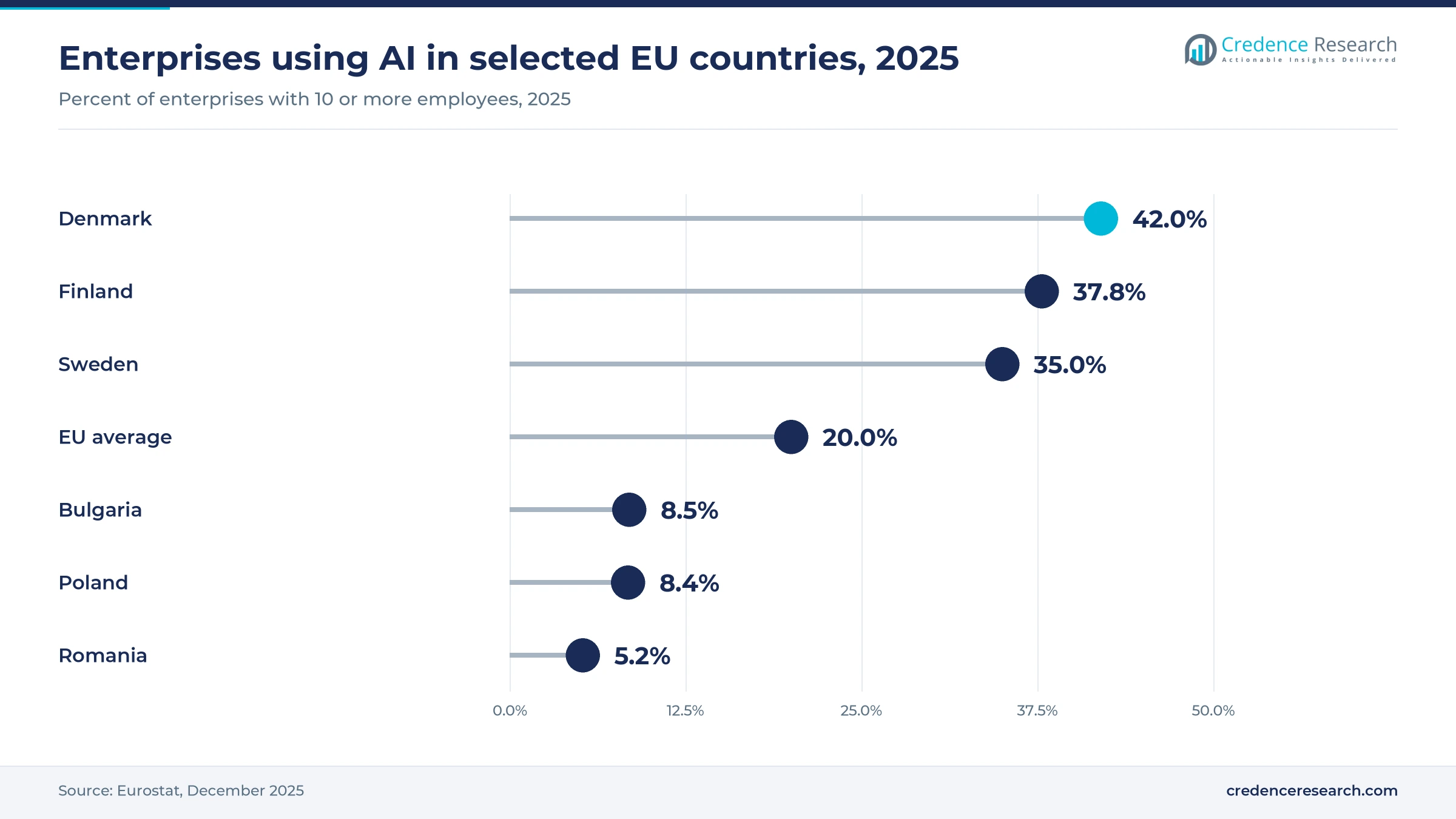
Messaging apps and voice agents are an opening in regions where buyers answer WhatsApp faster than email. Brazil-based Sellera.ai raised $3 million on May 29, 2025 for a platform that runs outreach across LinkedIn, WhatsApp, Instagram, email and SMS, with clients such as Mapfre and BTG Pactual, according to LatamList. India-based Vodex raised $2 million in seed funding from Unicorn India Ventures for generative AI outbound voice calling, according to TechObserver. In Europe, only about 20% of enterprises used AI in 2025, up from 13.5% in 2024, according to Eurostat. These gaps leave a large base of companies still to adopt outbound agents.
Call rules, inbox limits and trust gaps slow adoption
AI voice rules restrict automated outbound calls
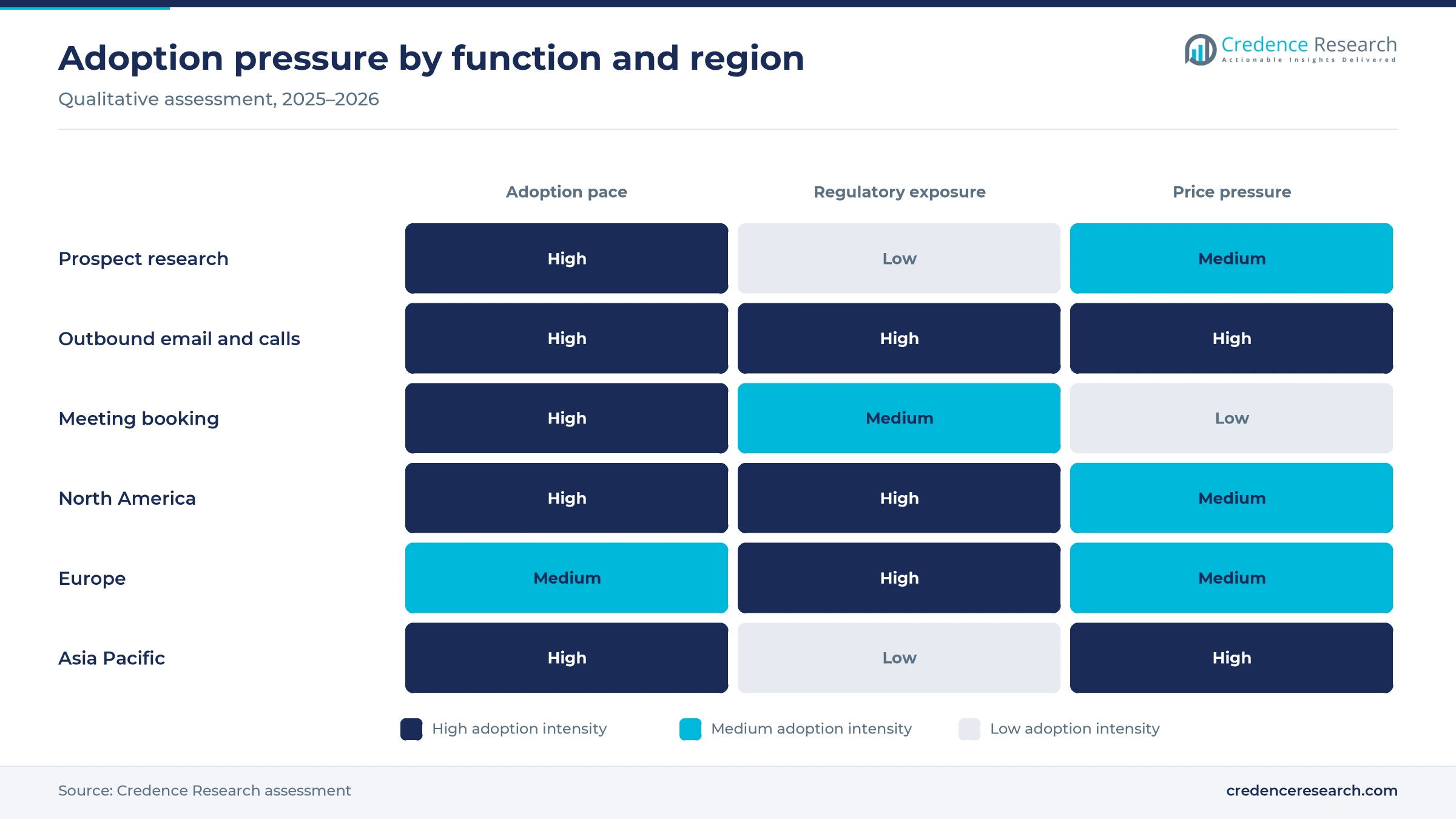
Rules on artificial voices limit how far vendors can automate cold calling. The Federal Communications Commission unanimously ruled on Feb. 8, 2024 that calls made with AI-generated voices count as artificial under the Telephone Consumer Protection Act. As a result, voice agents need prior consent for many consumer calls, and state attorneys general gained more ways to act. Vendors therefore focus voice agents on business contacts, inbound follow-up and seller-assisted dialing.
Inbox rules cap high-volume cold email
Mailbox providers now penalize the high-volume sending that early outbound tools relied on. Google required senders of more than 5,000 messages a day to Gmail users to keep spam rates under 0.3% and honor unsubscribe requests within two days from February 2024, according to TechSpot. These limits, which also affect email marketing senders, push AI SDR vendors toward smaller, better targeted lists, domain warm-up and signal-based timing, which reduces raw message volume.
Inflated customer claims erode buyer trust
Disputed customer claims have made buyers more cautious about vendor marketing. TechCrunch reported on March 24, 2025 that 11x had shown ZoomInfo and Airtable as customers, and both companies said they were not, with ZoomInfo describing only a one-month trial. One employee also told TechCrunch that the company was losing 70% to 80% of inbound customers. As a result, buyers now ask for pilots, break clauses and meeting-based proof before signing annual contracts.
EU AI Act disclosure duties add compliance work
New transparency rules add design and legal work for agents that write to or speak with prospects in Europe. Article 50 of the EU AI Act has applied since Aug. 2, 2026 and requires providers to tell people when they are interacting with an AI system unless that is obvious, according to Sidley Austin. Adoption is also uneven, with 42% of Danish firms but only 5.2% of Romanian firms using AI in 2025, according to Eurostat. Vendors therefore add disclosure lines and audit logs for European customers.
North America leads as Asia Pacific grows fastest
| Region | Value, 2025 (USD billion) | Share, 2025 | CAGR, 2026–2035 |
|---|---|---|---|
| North America | 1.19 | 53.0% | 21.35% |
| Europe | 0.54 | 24.0% | 21.85% |
| Asia Pacific | 0.41 | 18.0% | 23.65% |
| Latin America | 0.07 | 3.0% | 23.15% |
| Middle East & Africa | 0.04 | 2.0% | 22.95% |
North America leads on vendor base and sales headcount
North America held 53.0% of 2025 value and grows at 21.35% a year to 2035. The region leads because Salesforce, HubSpot, Outreach, Salesloft, Apollo, 11x and Artisan are all headquartered in the United States. The U.S. Bureau of Labor Statistics counted about 1.57 million wholesale and manufacturing sales representatives in 2025, a large pool of prospecting work to automate. However, the FCC ruling of February 2024 limits AI voice calls, which keeps most U.S. volume in email and scheduling.
Europe grows within EU transparency rules
Europe held 24.0% of 2025 value and grows at 21.85% a year. About 20% of EU enterprises used AI in 2025, up from 13.5% a year earlier, and Denmark, Finland and Sweden led with 42%, 37.8% and 35.0%, according to Eurostat. Payments company SumUp uses Artisan to reach small merchants, according to Artisan. Article 50 of the EU AI Act, in force from August 2026, requires agents to disclose that they are AI, which adds work for vendors.
Asia Pacific is the fastest-growing region
Asia Pacific held 18.0% of 2025 value and grows fastest at 23.65% a year. Salesforce made its sales development agent available in Japanese on April 3, 2025, which brought autonomous prospecting to Japanese-speaking sales teams. In India, Zoho announced a Hindi speech model and prebuilt sales agents on July 17, 2025, while Vodex raised $2 million for outbound voice agents. These local releases let mid-market teams buy agents that work in their own language.
Latin America builds on messaging-led selling
Latin America held 3.0% of 2025 value and grows at 23.15% a year. Brazil-based Sellera.ai raised $3 million on May 29, 2025 to scale a sales platform that prospects through WhatsApp, Instagram, LinkedIn, email and SMS. Its clients include Mapfre, Remaza and BTG Pactual, according to LatamList. Messaging-first agents fit buyers who reply on WhatsApp more than email, although smaller budgets keep average contract values below U.S. levels.
Middle East & Africa adopts Arabic-speaking agents
Middle East & Africa held 2.0% of 2025 value and grows at 22.95% a year. Saudi Arabia-based Velents raised $1.5 million on Oct. 27, 2025 to launch Agent.sa, an Arabic-speaking agent that handles calls and WhatsApp messages and serves clients in Saudi Arabia and Egypt, according to Wamda. Global vendors still offer limited Arabic support, so local providers fill the gap for Gulf and North African sales teams.
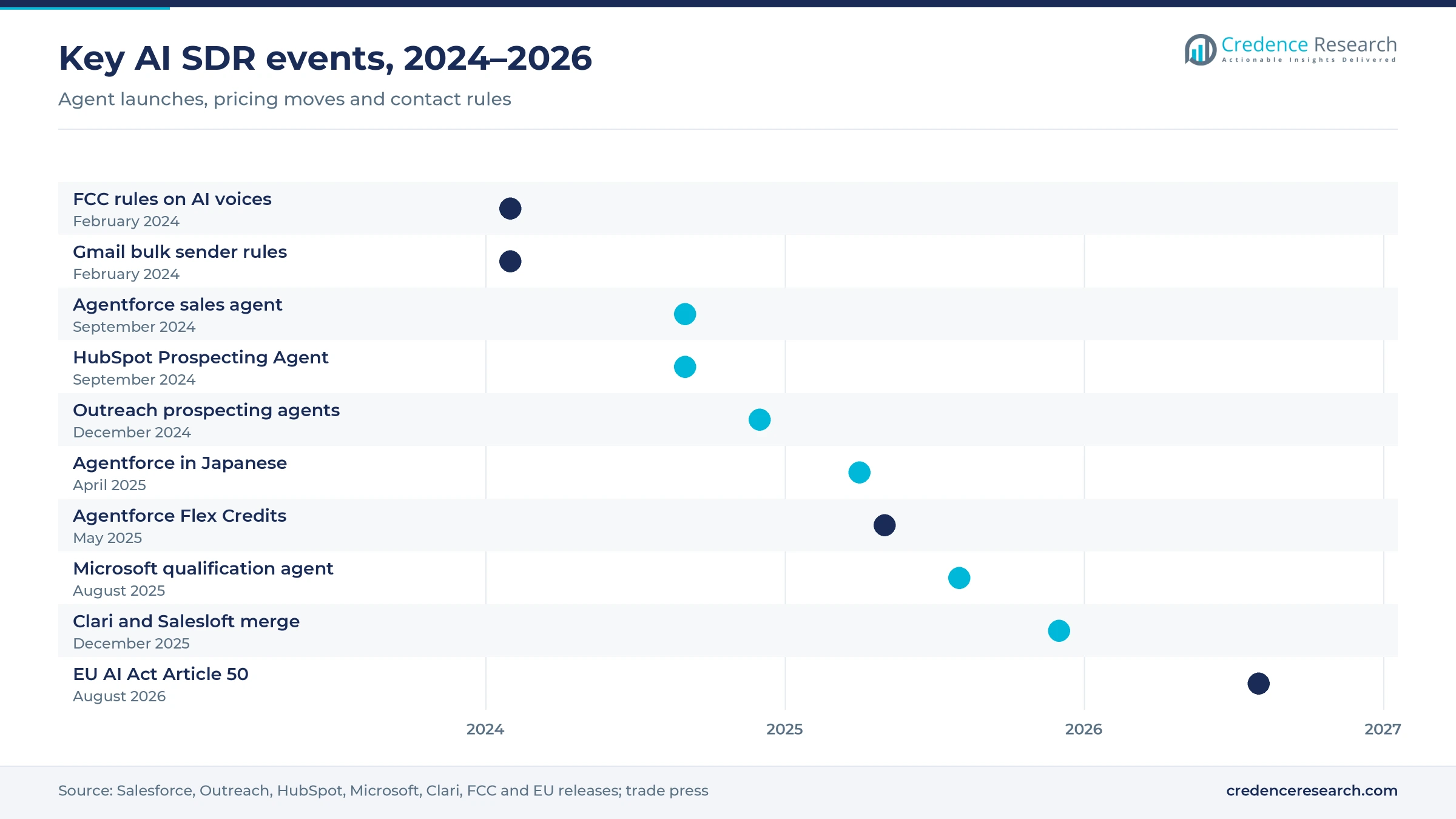
CRM vendors and startups launched agents in 2024 to 2026
| Development | Status and market relevance |
|---|---|
| In September 2024, Salesforce introduced the Agentforce sales development agent, which answers prospect questions and schedules meetings from CRM data. | Live; brings agents into the largest CRM suite |
| In December 2024, Outreach launched AI Prospecting Agents that research accounts and run autonomous sales plays around the clock. | Live; moves a sales engagement leader to agents |
| In April 2025, Artisan raised a $25 million Series A led by Glade Brook Capital, with HubSpot Ventures participating. | Funded; scales the Ava outbound agent |
| In May 2025, Salesforce moved Agentforce to Flex Credits, pricing each agent action at $0.10. | Live; shifts pricing toward usage |
| In December 2025, Clari and Salesloft completed their merger to combine engagement, forecasting and revenue data. | Completed; consolidates revenue platforms |
Language models, buying signals and voice agents shape tools
- Large language models write personalized emails and replies from CRM history, company news and the seller's own content.
- Buying-signal engines watch job changes, funding rounds and web activity, so that Artisan and Outreach agents time outreach to intent.
- Voice agents place and answer calls in many languages, and 11x said its Jordan agent covers more than 30 languages.
- CRM-native agent frameworks such as Salesforce Agentforce and Microsoft Dynamics 365 agents run inside the system of record and hand qualified leads to sellers.
Need a Custom Version of This Report?
Tailor the scope, geography, or segments to your exact requirements.
- Custom geography or segment scope
- Direct access to our analyst team
CRM suites and specialist startups compete on data and price
Competition centers on data access, CRM integration, deliverability and pricing. Salesforce, HubSpot and Microsoft build agents into their CRM suites, which gives them account history and an installed base. Outreach and the merged Clari and Salesloft platform add agents to sales engagement tools already used by large teams. Apollo combines a contact database of more than 230 million records with AI research and outreach. Specialist vendors such as 11x, Artisan, Regie.ai and Qualified sell agents that act as digital workers, often on monthly plans with free trials. Vendors also compete with sales enablement platforms for the same budget. Vendors that prove booked meetings, respect inbox and calling rules and support more languages win renewals, because buyers now test agents in short pilots before signing annual contracts.
Companies profiled and their roles in this market
| Company | Type | Role in the market |
|---|---|---|
| 11x | Specialist vendor | Alice outbound agent and Jordan phone agent, funded by Andreessen Horowitz |
| Artisan | Specialist vendor | Ava outbound agent that researches leads, writes emails and books meetings |
| Outreach | Sales engagement platform | AI Prospecting Agents inside its sales execution platform |
| Salesloft | Sales engagement platform | Engagement platform merged with Clari in December 2025 |
| Apollo.io | Data and engagement platform | Contact database with AI research agent and outreach sequences |
| Regie.ai | Specialist vendor | RegieOne platform combining email, social outreach and parallel dialing |
| Salesforce | CRM suite | Agentforce sales development agent, priced by Flex Credits or per user |
| HubSpot | CRM suite | Breeze Prospecting Agent for small and mid-market teams |
| Qualified | Specialist vendor | Piper agent for inbound and outbound meeting booking |
Data access and compliance will decide long-term share
Credence Research's view is that the AI SDR software market will be decided by access to clean account data and by compliance with contact rules rather than by message volume. CRM suites hold an advantage because their agents work from the system of record, while specialist vendors win on speed of release and simple monthly plans. However, the 2025 dispute over customer claims at 11x and new inbox and calling rules have made buyers demand proof of booked meetings. Vendors that price on outcomes and support local languages will gain share through 2035.
Vendor activity model checked against labor statistics
The report uses 2025 as the base year and forecasts to 2035. Market values come from the Credence Research model, built from vendor product releases, public pricing, disclosed customer counts and U.S. sales labor statistics. Function, buyer, pricing and regional splits are Credence Research estimates based on vendor locations, language support and enterprise AI adoption data from Eurostat and the U.S. Bureau of Labor Statistics. Company releases, regulator documents and trade press coverage were used to date events. No interviews or surveys were conducted for this edition of the report.
Autonomous outbound agents extend growth through 2035
The market is expected to grow from USD 2.75 billion in 2026 to USD 16.44 billion by 2035 as sales teams move research, outbound messaging and scheduling to autonomous agents. Outbound email and calls will remain the largest function in the AI SDR software market after holding 48.0% of 2025 value, while meeting booking gains as buyers pay for outcomes. North America will keep the largest share, and Asia Pacific will grow fastest as CRM vendors add Japanese, Hindi and other languages. Calling rules, inbox limits and EU disclosure duties will remain the main limits on AI SDR software growth through 2035.
Frequently Asked Questions
How big is the AI SDR software market?
Which function leads the market?
Which region leads the market?
Which region grows fastest?
Which function grows fastest?
Who are the main companies in the market?
How are AI SDR tools priced?
What rules limit AI SDR outreach?
Table of Content
Chapter 1 Market Segmentation
- 1.1 Segmentation Framework
- 1.1.1 Product and Service Classification
- 1.1.2 Application and End-Use Classification
- 1.1.3 Technology and Solution Classification
- 1.1.4 Customer and Distribution Channel Classification
- 1.1.5 Geographic Segmentation
- 1.1.6 Market Segment Definitions and Boundaries
- 1.2 By Function
- 1.2.1 Prospect Research
- 1.2.2 AI Outbound Email & Calls
- 1.2.3 Meeting Booking
- 1.3 By Buyer
- 1.3.1 SMB
- 1.3.2 Mid-Market
- 1.3.3 Enterprise
- 1.4 By Pricing
- 1.4.1 Per Seat
- 1.4.2 Per Meeting
Chapter 2 Introduction
- 2.1 Report Objectives and Scope
- 2.2 Product Definition and Industry Terminology
- 2.3 Market Inclusions and Exclusions
- 2.4 Research Process
- 2.4.1 Primary Research and Expert Interviews
- 2.4.2 Secondary Research and Source Review
- 2.4.3 Top-Down and Bottom-Up Estimation
- 2.4.4 Data Triangulation and Verification
- 2.5 Market Size Measurement Basis
- 2.5.1 2025: USD 2.25 billion → 2035: USD 16.44 billion
- 2.6 Historical and Forecast Reference Periods
- 2.6.1 Historical Period: 2018-2025
- 2.6.2 Base Year: 2025
- 2.6.3 Forecast Period: 2025-2035
- 2.7 Research Assumptions and Limitations
Chapter 3 Executive Summary
- 3.1 Market Snapshot and Key Findings
- 3.2 Base-Year Market Size, 2025
- 3.3 Forecast Market Size, 2035
- 3.4 Revenue and Volume Growth Outlook
- 3.5 Key Demand and Supply Indicators
- 3.6 Leading Market Segments
- 3.7 Fastest-Growing Market Opportunities
- 3.8 Regional Performance Highlights
- 3.9 Technology and Industry Transformation
- 3.10 Competitive Landscape Summary
- 3.11 Analyst View and Strategic Implications
Chapter 4 Global AI SDR Software Market Trends and Developments
- 4.1 Historical Industry Development, 2018-2025
- 4.2 Recent Market Trends and Developments
- 4.3 Demand and Customer Behavior Trends
- 4.4 Technology and Product Innovation
- 4.5 Artificial Intelligence, Automation and Digitalization
- 4.6 Local Manufacturing and Supply Chain Realignment
- 4.7 Industry Partnerships, Mergers and Acquisitions
- 4.8 Sustainability and Circular Economy Developments
- 4.9 Government and Private Sector Investment Trends
- 4.10 Emerging Business Models and Commercialization
- 4.11 Industry Developments and Announcements
Chapter 5 Global AI SDR Software Market Supply and Demand Analysis
- 5.1 Demand Trend and Consumption Analysis, 2018-2025
- 5.2 Demand Forecast, 2025-2035
- 5.3 Supply Chain Structure and Procurement Trends
- 5.4 Supply-Demand Gap and Bottlenecks
- 5.5 Import Dependence and Sourcing Structure
- 5.6 Regional Supply and Demand Concentration
Chapter 6 Global AI SDR Software Market Pricing Analysis
- 6.1 Pricing Structure and Measurement
- 6.2 Historical Pricing Trends, 2018-2025
- 6.3 Pricing Outlook, 2025-2035
- 6.4 Pricing by Product and Market Segment
- 6.5 Geographic Pricing Differences
- 6.6 Key Input, Energy, Labor and Logistics Costs
- 6.7 Contract Pricing and Purchasing Models
- 6.8 Pricing Sensitivity and Competitive Positioning
- 6.9 Price, Margin and Profitability Implications
Chapter 7 Global AI SDR Software Market Dynamics
- 7.1 Market Growth Drivers
- 7.1.1 Demand-Side Drivers
- 7.1.2 Technology and Innovation Drivers
- 7.1.3 Infrastructure and Investment Drivers
- 7.1.4 Regulatory and Policy Drivers
- 7.2 Market Restraints
- 7.2.1 Cost and Affordability Constraints
- 7.2.2 Technology and Adoption Barriers
- 7.2.3 Supply Chain and Operational Constraints
- 7.3 Market Challenges
- 7.3.1 Competitive Pressure and Margin Erosion
- 7.3.2 Skills, Infrastructure and Implementation Gaps
- 7.4 Emerging Market Opportunities
- 7.5 Market Dynamics Impact and Time-Horizon Assessment
Chapter 8 Global AI SDR Software Value Chain Analysis
- 8.1 Industry Value Chain Overview
- 8.2 Upstream Suppliers and Critical Inputs
- 8.3 Technology and Component Providers
- 8.4 Manufacturing or Service Delivery
- 8.5 Distribution, Channel Partners and Integrators
- 8.6 Downstream Applications and End Users
- 8.7 Value Addition and Profit Pools
- 8.8 Vertical Integration and Outsourcing
- 8.9 Supplier Concentration and Risk
- 8.10 Supply Chain Localization and Resilience
Chapter 9 Global AI SDR Software Market Regulations and Policies
- 9.1 Relevant Laws, Standards and Compliance Frameworks
- 9.2 Product, Service, Safety and Quality Requirements
- 9.3 Government Policies, Incentives and Subsidies
- 9.4 Imports, Exports and Trade Barriers
- 9.5 Public Procurement and Local Content Requirements
- 9.6 Data Protection, AI and Cybersecurity Compliance
- 9.7 Upcoming Policy Changes and Market Implications
Chapter 10 Global AI SDR Software Market Hotspots and Opportunities
- 10.1 Market Opportunity Mapping and Growth Hotspots
- 10.2 High-Growth Applications and Customer Groups
- 10.3 Underserved Markets and White-Space Opportunities
- 10.4 Emerging Technology and Product Opportunities
- 10.5 New Capacity and Investment Hotspots
- 10.6 Market Entry and Expansion Opportunities
- 10.7 Distribution and Partnership Opportunities
- 10.8 Near-Term and Long-Term Commercial Potential
- 10.9 Opportunity Attractiveness and Execution Risks
Chapter 11 Global AI SDR Software Market Outlook, 2025-2035
- 11.1 Market Size and Analysis
- 11.1.1 Revenue (Market Measurement: 2025: USD 2.25 billion → 2035: USD 16.44 billion)
- 11.1.2 Historical Market Size, 2018-2025
- 11.1.3 Base-Year Market Size, 2025
- 11.2 Market Forecast, 2025-2035
- 11.2.1 Revenue Forecast to 2035
- 11.2.2 CAGR and Year-on-Year Growth
- 11.2.3 Incremental Revenue Opportunity
- 11.3 Forecast Assumptions and Scenario Analysis
- 11.3.1 Base-Case Forecast
- 11.3.2 Optimistic and Conservative Scenarios
- 11.3.3 Technology, Pricing and Policy Sensitivities
- 11.4 Market Attractiveness and Growth Outlook
Chapter 12 Global AI SDR Software Market Segmentation and Outlook
- 12.1 Segmentation Summary and Market Shares, 2025
- 12.2 Largest and Fastest-Growing Segments
- 12.3 By Function - Market Size and Forecast, 2025-2035
- 12.3.1 Segment Definition and Scope
- 12.3.2 Historical Market Size, 2018-2025
- 12.3.3 Revenue Forecast, 2025-2035
- 12.3.4 Base-Year Market Share, 2025
- 12.3.5 Segment CAGR and Growth Drivers
- 12.3.6 Subsegment Market Size and Forecast
- 12.3.6.1 Prospect Research
- 12.3.6.2 AI Outbound Email & Calls
- 12.3.6.3 Meeting Booking
- 12.3.7 Subsegment Pricing and Adoption Trends
- 12.3.8 Leading Suppliers and Competition
- 12.3.9 Regional Demand and Opportunities
- 12.4 By Buyer - Market Size and Forecast, 2025-2035
- 12.4.1 Segment Definition and Scope
- 12.4.2 Historical Market Size, 2018-2025
- 12.4.3 Revenue Forecast, 2025-2035
- 12.4.4 Base-Year Market Share, 2025
- 12.4.5 Segment CAGR and Growth Drivers
- 12.4.6 Subsegment Market Size and Forecast
- 12.4.6.1 SMB
- 12.4.6.2 Mid-Market
- 12.4.6.3 Enterprise
- 12.4.7 Subsegment Pricing and Adoption Trends
- 12.4.8 Leading Suppliers and Competition
- 12.4.9 Regional Demand and Opportunities
- 12.5 By Pricing - Market Size and Forecast, 2025-2035
- 12.5.1 Segment Definition and Scope
- 12.5.2 Historical Market Size, 2018-2025
- 12.5.3 Revenue Forecast, 2025-2035
- 12.5.4 Base-Year Market Share, 2025
- 12.5.5 Segment CAGR and Growth Drivers
- 12.5.6 Subsegment Market Size and Forecast
- 12.5.6.1 Per Seat
- 12.5.6.2 Per Meeting
- 12.5.7 Subsegment Pricing and Adoption Trends
- 12.5.8 Leading Suppliers and Competition
- 12.5.9 Regional Demand and Opportunities
- 12.6 Segment Growth Comparison
- 12.7 Segment Attractiveness and Priority Matrix
Chapter 13 Global AI SDR Software Geographic Market Outlook, 2025-2035
- 13.1 Regional Market Size and Share, 2025
- 13.2 Regional Market Forecast, 2025-2035
- 13.3 Regional Pricing, Production and Demand Differences
- 13.4 North America
- 13.4.1 United States
- 13.4.2 Canada
- 13.4.3 Mexico
- 13.5 Europe
- 13.5.1 Germany
- 13.5.2 France
- 13.5.3 Italy
- 13.5.4 United Kingdom
- 13.5.5 Spain
- 13.5.6 Poland
- 13.5.7 Russia
- 13.5.8 Netherlands
- 13.5.9 Belgium
- 13.5.10 Sweden
- 13.5.11 Denmark
- 13.5.12 Norway
- 13.5.13 Rest of Europe
- 13.6 Asia Pacific
- 13.6.1 China
- 13.6.2 India
- 13.6.3 Japan
- 13.6.4 South Korea
- 13.6.5 Thailand
- 13.6.6 Indonesia
- 13.6.7 Vietnam
- 13.6.8 Malaysia
- 13.6.9 Australia
- 13.6.10 Rest of Asia Pacific
- 13.7 Latin America
- 13.7.1 Brazil
- 13.7.2 Argentina
- 13.7.3 Colombia
- 13.7.4 Chile
- 13.7.5 Rest of Latin America
- 13.8 Middle East
- 13.8.1 Saudi Arabia
- 13.8.2 United Arab Emirates
- 13.8.3 Turkey
- 13.8.4 Israel
- 13.8.5 Iran
- 13.8.6 Rest of the Middle East
- 13.9 Africa
- 13.9.1 South Africa
- 13.9.2 Egypt
- 13.9.3 Nigeria
- 13.9.4 Morocco
- 13.9.5 Rest of Africa
- 13.10 Regional Investment, Policy and Supply Chain Differences
- 13.11 Regional Competitive Landscape
- 13.12 Geographic Growth Hotspots
Chapter 14 Global AI SDR Software Technology, Innovation and Sustainability Outlook
- 14.1 Technology Landscape and Maturity
- 14.2 Product, Process and Service Innovation
- 14.3 AI, Automation and Digital Tools in the Industry
- 14.4 Technology Adoption and Performance Benchmarking
- 14.5 Innovation Pipeline and R&D Investment
- 14.6 Patent and Intellectual Property Trends
- 14.7 Energy Efficiency and Resource Management
- 14.8 Sustainability, Recycling and Circularity
- 14.9 Technology Roadmap, 2025-2035
- 14.10 Risks of Obsolescence and Technology Substitution
Chapter 15 Global AI SDR Software Market Key Strategic Imperatives
- 15.1 Growth and Market Entry Priorities
- 15.2 High-Return Products and Segments
- 15.3 Pricing, Profitability and Cost Optimization
- 15.4 Technology Investment and Product Differentiation
- 15.5 Supply Chain Localization and Resilience
- 15.6 Distribution and Customer Acquisition
- 15.7 Partnership, Acquisition and Capacity Strategy
- 15.8 Regional Expansion Priorities
- 15.9 Short-, Medium- and Long-Term Actions
Chapter 16 Competition Outlook
- 16.1 Industry Competition Characteristics
- 16.2 Market Structure and Concentration
- 16.3 Market Share and Competitive Positioning, 2025
- 16.4 Company-Wise Revenue and Product Benchmarking
- 16.5 Production and Service Capacity Benchmarking
- 16.6 Technology, Pricing and Differentiation
- 16.7 Regional Footprint and Distribution Strength
- 16.8 Mergers, Acquisitions and Strategic Alliances
- 16.9 New Entrants and Competitive Threats
- 16.10 Porter's Five Forces and Industry Attractiveness
- 16.11 Competitive Outlook, 2025-2035
Chapter 17 Company Profiles
- 17.1 Company Coverage and Selection Criteria
- 17.2 11x
- 17.2.1 Business Description
- 17.2.2 Company Ownership and Geographic Presence
- 17.2.3 Product and Service Portfolio
- 17.2.4 Manufacturing and Operating Footprint
- 17.2.5 Financial Performance and Investment
- 17.2.6 Market Share and Competitive Position
- 17.2.7 Technology and Innovation Capabilities
- 17.2.8 Strategic Alliances or Partnerships
- 17.2.9 Recent Developments
- 17.2.10 Growth Strategy and Outlook
- 17.3 Artisan
- 17.4 Outreach
- 17.5 Salesloft
- 17.6 Apollo.io
- 17.7 Regie.ai
- 17.8 Salesforce
- 17.9 HubSpot
- 17.10 Qualified
- 17.11 Other Relevant Market Participants
Note: Every listed company is profiled on the structure shown under the first company. The company list is preliminary and may change based on research findings, market developments, data availability and client requirements.
Chapter 18 Disclaimer
- 18.1 Research and Forecast Disclaimer
- 18.2 Data Source and Estimation Limitations
Note: The depth of individual sections depends on data availability for this market. Volume, capacity, trade and other unit-based metrics are included where applicable.

