Paid hosts and fast lanes speed travelers through hubs
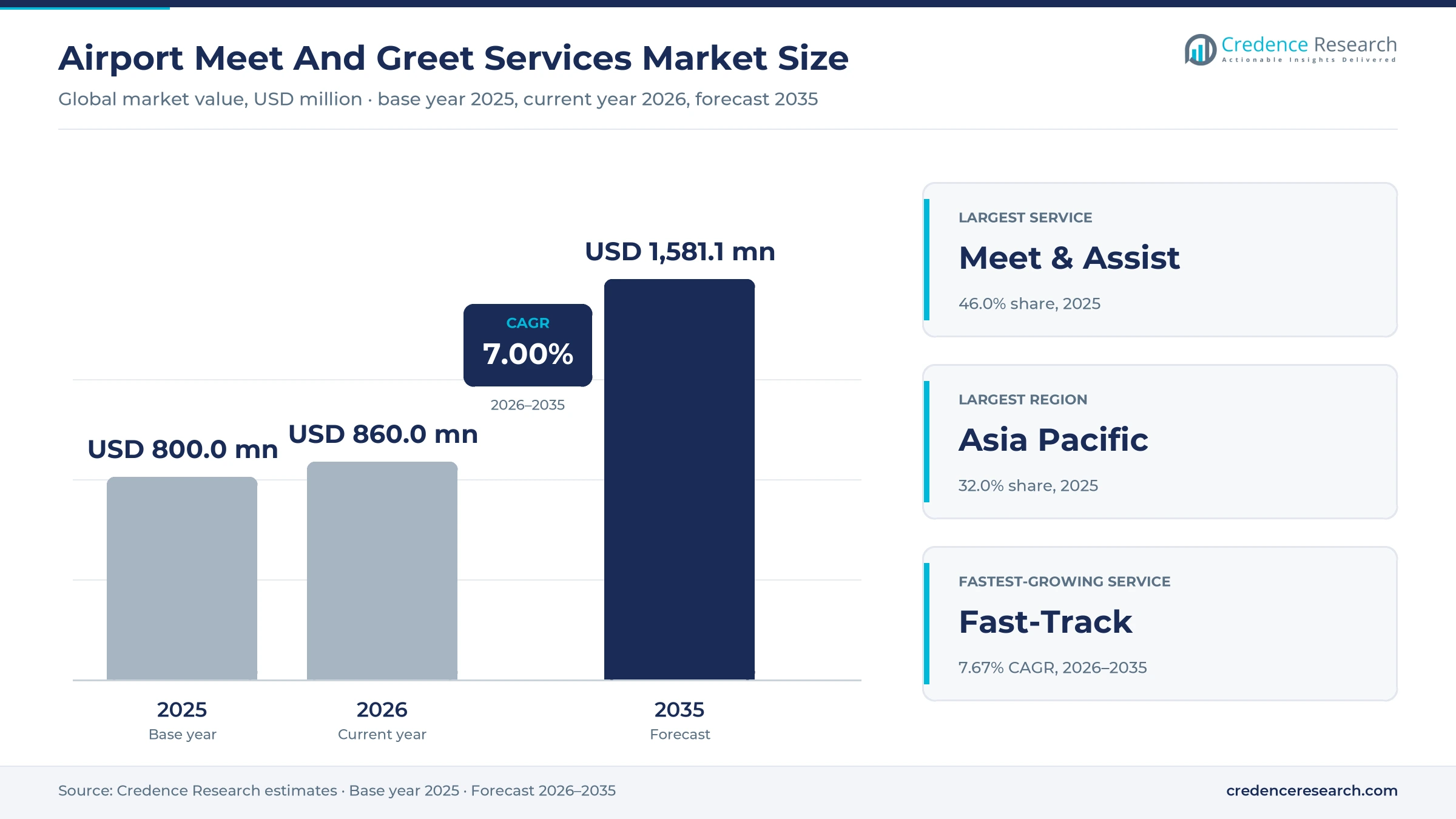
The global airport meet and greet services market was valued at USD 800.0 million in 2025 and is projected to increase from USD 860.0 million in 2026 to USD 1.58 billion by 2035, registering a CAGR of 7.00% during 2026–2035. Demand comes from premium-cabin flyers, families, older travelers and corporate guests who pay for a host, faster security and immigration lanes and help with bags between the curb and the gate. Asia Pacific held the largest regional share, 32.0% in 2025, because hubs such as Singapore Changi handle heavy flows from China, Indonesia and India. Middle East & Africa is the fastest-growing region at 8.00% a year, as Saudi airports handled about 140.9 million passengers in 2025 and Gulf hubs keep adding transfer traffic. On the commercial side, lounge networks and card issuers now package fast-track lanes and greeting services with memberships, which shifts more bookings from walk-up desks to prepaid digital channels.
What do travelers pay for when they book an airport host?
The market covers fees paid for fast-track access through security and immigration, meet and assist hosts who escort passengers through check-in, transfers and arrivals, and porter or escort help with bags and mobility. Buyers book through airport desks, provider websites, airlines, travel agents, banks and lounge memberships, usually a day or two before the flight.
The scope excludes lounge entry sold on its own, private jet terminal handling, chauffeur transfers and the free assistance that airports and airlines must give passengers with reduced mobility. The value chain runs from airport operators that license lanes and desks, through specialist providers and lounge groups, to airlines, card issuers and travel agents that resell or bundle the service.
Airport Meet And Greet Services Market Insights
- The market grows from USD 800.0 million in 2025 to USD 1.58 billion by 2035 at a 7.00% CAGR, as more passengers pay for help at crowded hubs.
- Asia Pacific held 32.0% of 2025 value, as Singapore Changi alone handled a record 69.98 million passenger movements in 2025.
- Meet & Assist led with 46.0% of 2025 value, because one host covers check-in, immigration and transfers in a single booking.
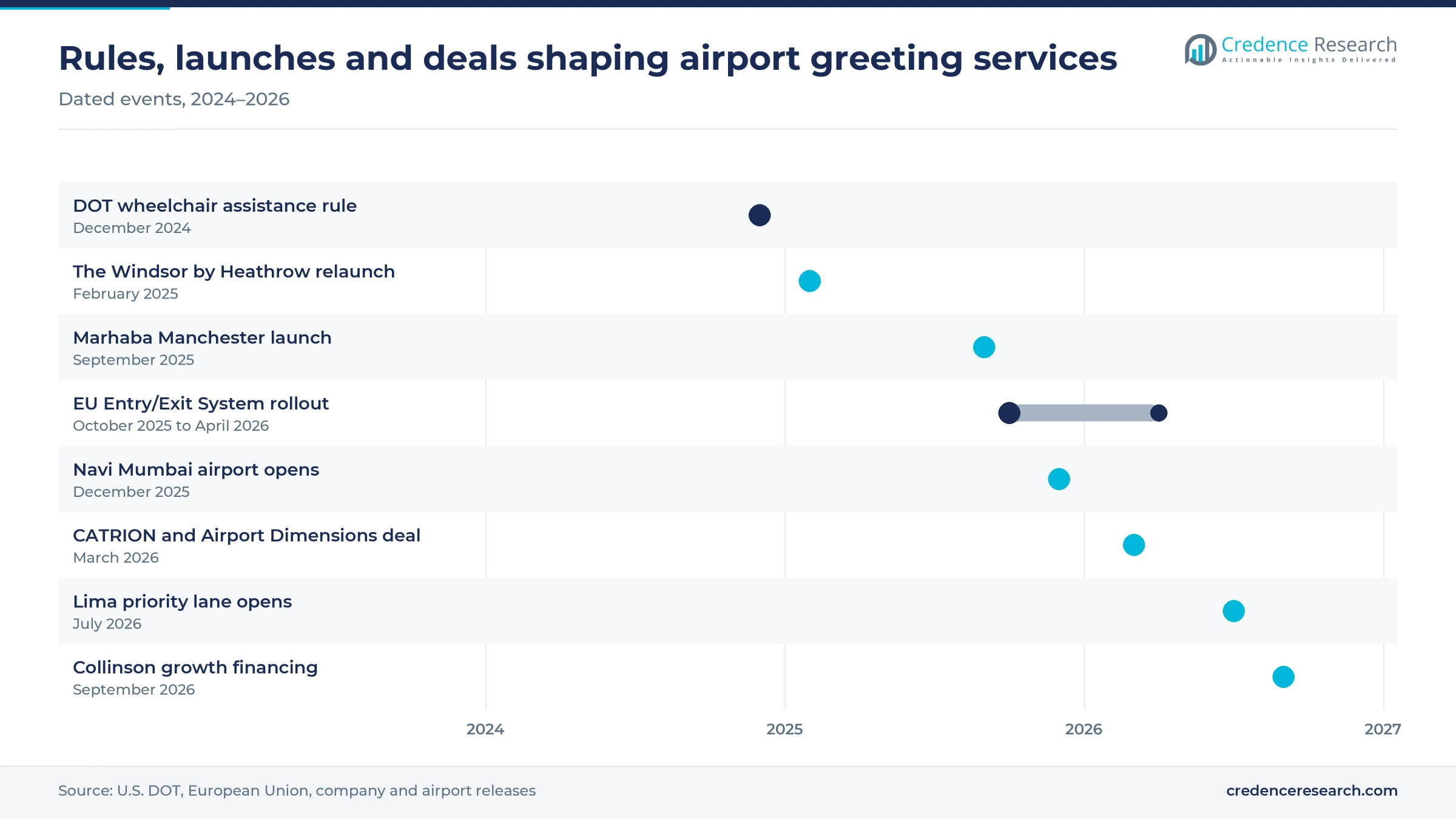
- Europe began its Entry/Exit System on Oct. 12, 2025, adding biometric border checks that lengthen queues for non-EU travelers.
- Collinson set out a £500 million five-year growth program in September 2026, with fast-track lanes planned at more than 130 airports.
Meet and assist leads while fast-track lanes grow fastest
Why does meet and assist lead paid airport help?
Based on service, the market is categorized into meet and assist, fast-track and porter and escort services. Meet & Assist led with 46.0% of 2025 value because one host covers check-in, immigration, transfers and baggage claim, and YQ Now offers this service at about 600 airports in 140 countries, according to Airport Improvement. Fast-Track grows fastest at 7.67% a year, as Collinson said in September 2026 that its bookable network would pass 170 lanes at more than 130 airports within 12 months. Porter and escort services hold steady, since families and older travelers pay for help with heavy bags and long walks.
How do leisure, business and VIP travelers differ?
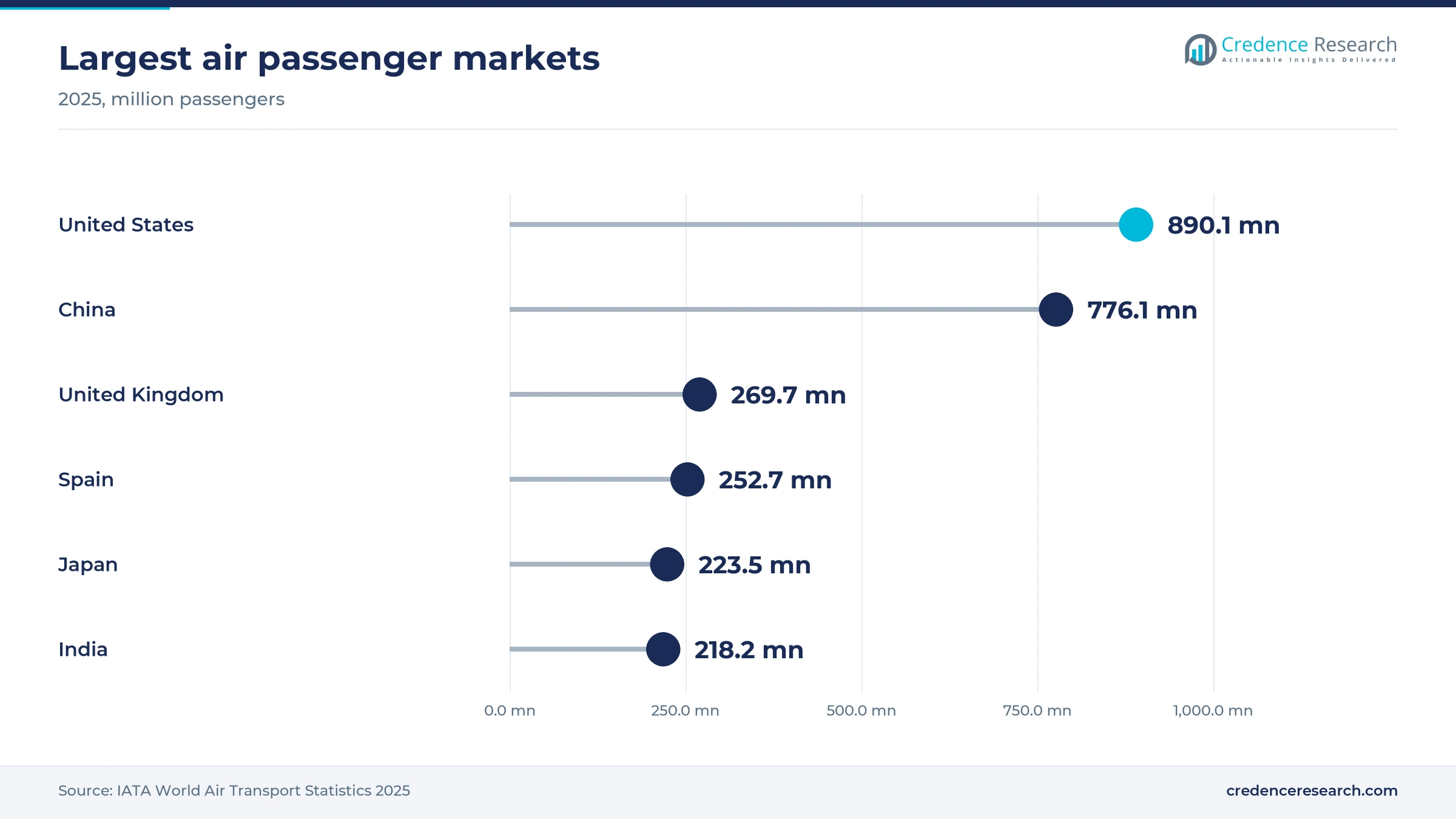
Based on traveler, the market is categorized into leisure, business and VIP travelers. Leisure led with 44.0% of 2025 value because holiday flows dominate airport volumes, and UN Tourism counted about 1.52 billion international tourist arrivals in 2025, up 4% from 2024. Spain alone reached 252.7 million air passengers in 2025, according to IATA. VIP travelers grow fastest at 7.80% a year, as Heathrow relaunched The Windsor in February 2025 with private suites priced from £3,812 for up to three guests, a level aimed at luxury travel buyers. Business travelers keep steady demand through corporate travel programs and premium-cabin perks.
Which booking channels bring in the most greeting sales?
Based on booking channel, the market is categorized into direct and online bookings, airline and travel-agent bundles, and card and loyalty programs. Direct & Online led with 48.0% of 2025 value because passengers book providers ahead of travel, and Marhaba takes bookings through its own site across eight countries, according to dnata in September 2025. Card & Loyalty Programs grow fastest at 7.89% a year, as Citi in the UAE gives Ultima and Prestige primary cardholders two complimentary Marhaba Silver bookings each year at Dubai International. Airline and travel-agent bundles sit between the two, since carriers add hosts to fares and loyalty tiers.
| Segment Group | Leading Sub-segment | Share, 2025 | Fastest-growing Sub-segment | CAGR, 2026–2035 |
|---|---|---|---|---|
| By Service | Meet & Assist | 46.0% | Fast-Track | 7.67% |
| By Traveler | Leisure | 44.0% | VIP | 7.80% |
| By Booking Channel | Direct & Online | 48.0% | Card & Loyalty Programs | 7.89% |
Request a Free Sample
Fill in your details and we'll send you a free sample report.
- Sample data tables & charts
- Research methodology
Premium flyers, crowded hubs and bundles lift bookings
Premium passengers buy concierge and fast-track support
Premium passengers are the core buyers of paid airport help, because their time at the airport is worth more than the fee for a faster route through it. IATA reported in July 2026 that international premium-class passengers rose 4.5% in 2025 to 109.7 million, which widens the pool of travelers who expect a host at each end of the trip. Europe accounted for 39.7 million of these premium passengers, the largest regional pool, according to the same IATA statistics. Collinson said in September 2026 that 73% of travelers it surveyed saw fast track as the leading technology for improving the airport experience. In the Credence Research model this adds about 2.59 percentage points to annual growth to 2035.
Crowded terminals and travel recovery favor assisted trips
Record traffic at major hubs makes the walk from curb to gate slower, which pushes more passengers to pay for a guided route through the terminal. Dubai International handled a record 95.2 million passengers in 2025, up 3.1%, and Dubai Airports said in February 2026 that it expects about 99.5 million in 2026. Saudi airports handled 9.6% more passengers in 2025, according to the General Authority of Civil Aviation. In the U.S., the Transportation Security Administration screened a record 3.13 million people on Nov. 30, 2025, beating the 3.09 million set on June 22. In the Credence Research model this adds about 2.10 percentage points to annual growth to 2035.
Airline and travel-agent bundles raise service bookings
Airlines and lounge groups increasingly fold greeting services into fares, memberships and packages, which turns occasional buyers into repeat users. Qatar Airways gives Privilege Club Platinum and Gold members Al Maha meet and assist at Hamad International at no extra cost, according to its website. Etihad sells meet and assist at almost 50 airports, including an Airport by Invitation package with lounge access and a private car to the aircraft. Plaza Premium Group, which runs more than 170 locations at 46 airports, partnered with YQ Now to bundle lounge and hotel access with meet and assist, according to Airport Improvement. In the Credence Research model this adds about 1.26 percentage points to annual growth to 2035.
Biometric border checks and assistance needs widen demand
New border rules and a more varied traveling public raise the number of passengers who want help through the terminal. The European Union began its Entry/Exit System on Oct. 12, 2025, capturing fingerprints and photos of non-EU travelers at biometric kiosks, with all member states required to run it for every passenger by April 2026, according to The National. The rollout required states to register 10% of travelers by day 30 and 50% by day 150. The U.K. Civil Aviation Authority said in August 2026 that a record 5.9 million passengers used assistance at U.K. airports in 2025, with requests up 115.8% since 2015 against 23.9% traffic growth.
Network lanes and card perks reshape how service is sold
Fast-track lanes shift to networked, bookable products
Fast track is shifting from a perk sold at one airport desk to a bookable product run across networks of terminals. Collinson said in September 2026 that its fast track was live at 28 airports in eight countries, and it plans more than 170 bookable lanes across more than 150 terminals within 12 months, backed by a £350 million financing facility. Airport Dimensions opened its first self-operated priority lane, a 31-square-meter facility at Lima, on July 28, 2026, according to CAPA. Istanbul Airport already sells fast track at 12 points through its annual iGA Pass membership. As a result, Fast-Track grows at 7.67% a year, the quickest pace among services.
Card issuers rise as buyers of bundled greeting services
Banks are emerging as large buyers of airport meet and greet services, because a free greeting at a busy hub is a visible card benefit that members use. In India, Visa offered eligible Infinite cardholders one free international meet and greet from April 1, 2025, to March 31, 2026, after more than $1,000 of in-store spending, according to CardExpert. DBS Bank India gives Vantage cardholders two complimentary services after Rs 3 lakh of annual spending, according to its offer terms. Priority Pass, which Collinson runs, now spans more than 1,900 lounges and travel experiences at 865 airports in 143 countries. These programs lift Card & Loyalty Programs, which grow at 7.89% a year.
New terminals in India and the Gulf open service contracts
New capacity in India and the Gulf creates fresh concessions for greeting desks, lanes and escort teams. Navi Mumbai International Airport began commercial flights on Dec. 25, 2025, with a first phase sized for 20 million passengers a year and up to 90 million planned, according to Business Today. Encalm Hospitality added its Atithya Meet & Assist service and two lounges at Vizag International Airport, according to Indian Eagle in September 2026. In Saudi Arabia, CATRION agreed in March 2026 to add the Airport Dimensions Connecta platform for paid upgrades, according to PAX International. India also ranked as the sixth-largest air market with 218.2 million passengers in 2025, according to IATA.
Older and family travelers open paid escort services
Passengers who need guidance but not a wheelchair form a growing pool for paid escort and porter services. An IATA survey cited by the Oman Observer in December 2024 found wheelchair requests up 30% at bigger airports, often from travelers unsure of large terminals rather than passengers with disabilities. Qatar Airways sells an Al Maha Family package next to its Platinum Plus, Platinum and Gold tiers at Hamad International. Istanbul Airport adds buggy rides from passport control to the gate at three points through iGA Pass. A paid host can serve these travelers while free assistance teams focus on passengers with reduced mobility. The U.K. Civil Aviation Authority reported 82% satisfaction among passengers with accessibility needs in August 2026, against 88% for all passengers.
Free assistance, staffing and airport rivals test margins
Free mandated assistance caps paid escort pricing
Paid porter and escort services compete with help that airlines and airports must give free to passengers with reduced mobility. The U.S. Department of Transportation rule published Dec. 17, 2024, and effective Jan. 16, 2025, requires prompt, safe and dignified wheelchair assistance, at an estimated industry cost of $14.7 million a year. Because this support is free, paid providers must sell speed, comfort and a personal host rather than basic mobility help. The rule also requires aisle chairs to be ready once other passengers have deplaned.
Staff shortages strain service reliability at peak hours
Greeting and escort services depend on trained staff, and thin teams quickly turn into long waits that damage repeat bookings. At Palma de Mallorca, staff reported arrival waits of an hour or more for assistance and dozens of delays on some days, according to Palma Airport Info in January 2026. The contractor Adelte runs that service for Aena under a contract due to expire in 2026. Providers that roster staff to flight banks and share teams across terminals can protect service levels during summer peaks.
Overloaded terminals and border checks stretch handoffs
Hosts can only move passengers as fast as terminals and border posts allow, so congestion limits how many bookings each staff member handles. Saudi Arabia's aviation regulator said Jeddah's King Abdulaziz International ran 107% above its design capacity in 2025, while Madinah ran above 137%. In Europe, the Advantage Travel Partnership advised travelers in October 2025 to allow three to four hours at points of entry as the Entry/Exit System began. Providers respond with tighter slot booking, dedicated lanes and hosts placed at border halls.
Airport-owned premium services squeeze independent providers
Airports increasingly run their own premium services, which narrows the room for independent providers at the busiest hubs. Heathrow operates The Windsor directly, with suites from £3,812 for up to three guests since its February 2025 relaunch. Istanbul Airport sells iGA Pass memberships priced at 299, 399 and 799 euros, and Qatar Airways runs Al Maha at Hamad International. Independent firms therefore rely on secondary airports, network bookings and bank contracts where the airport has no in-house offer.
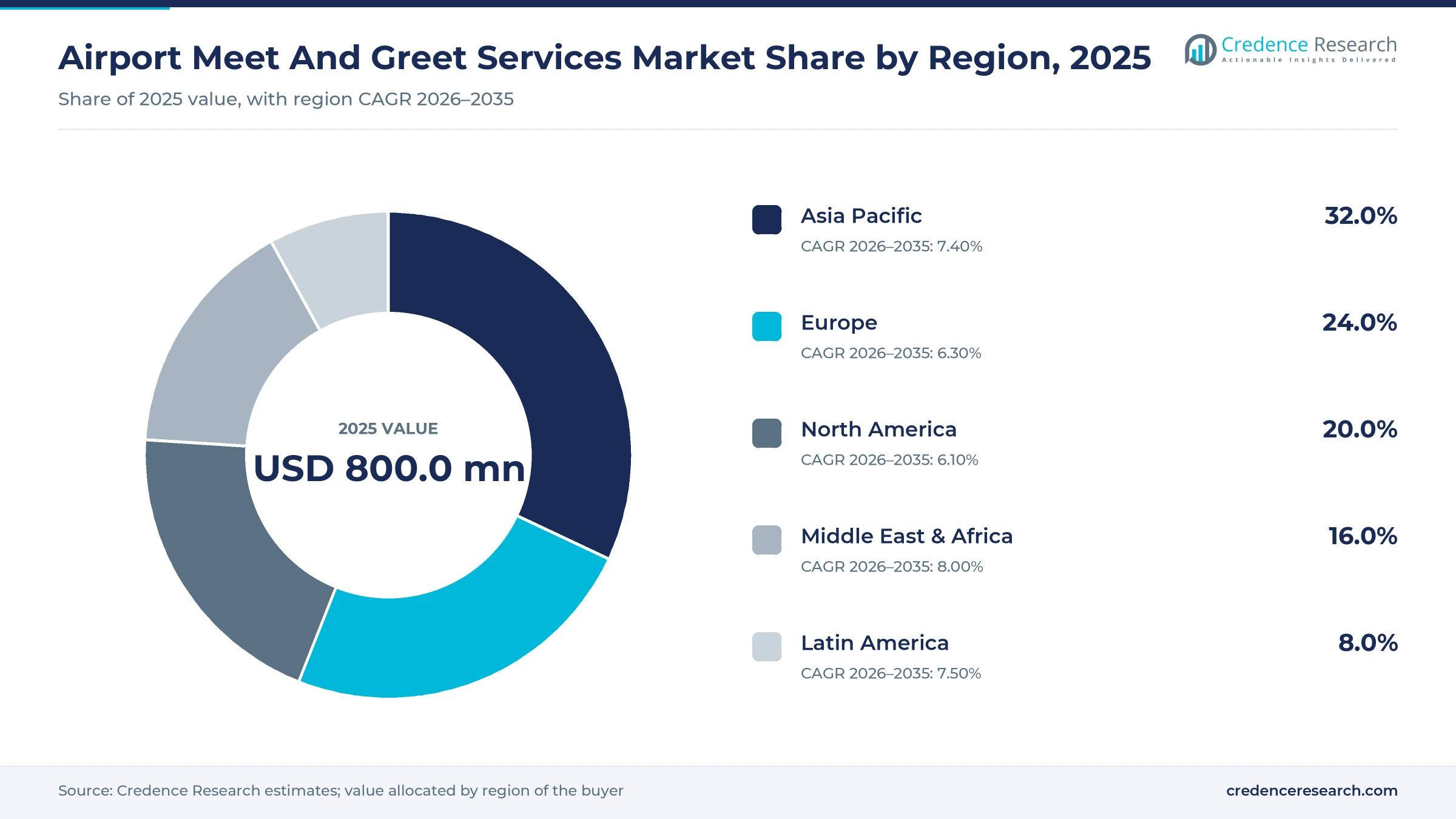
Asia Pacific leads as Middle East & Africa grows fastest
| Region | Value, 2025 (USD million) | Share, 2025 | CAGR, 2026–2035 |
|---|---|---|---|
| Asia Pacific | 256.0 | 32.0% | 7.40% |
| Europe | 192.0 | 24.0% | 6.30% |
| North America | 160.0 | 20.0% | 6.10% |
| Middle East & Africa | 128.0 | 16.0% | 8.00% |
| Latin America | 64.0 | 8.0% | 7.50% |
Asia Pacific leads on hub traffic and outbound flows
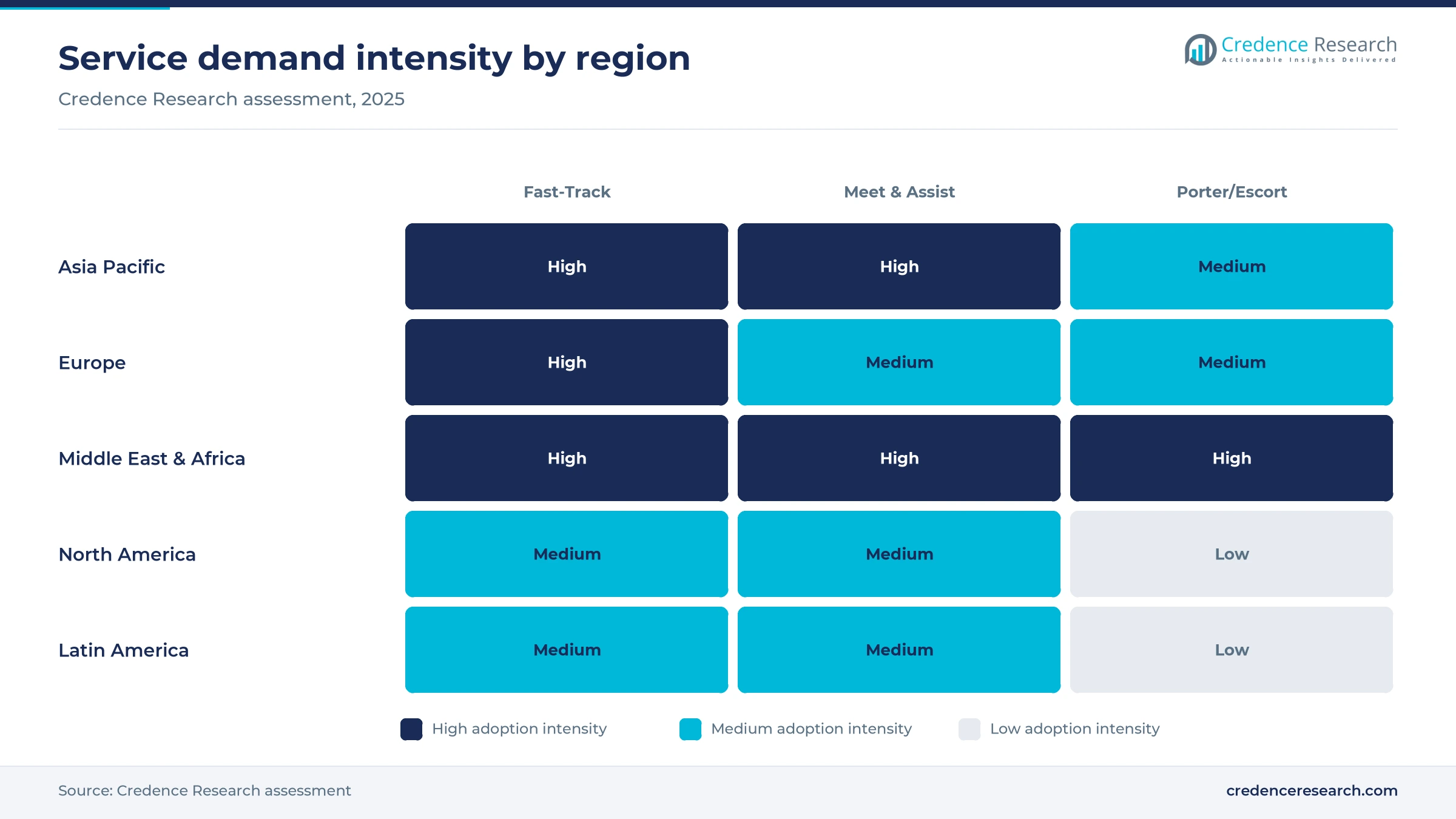
Asia Pacific held 32.0% of 2025 value and grows at 7.40% a year, the largest regional pool of paid airport help. Singapore Changi handled a record 69.98 million passenger movements in 2025, up 3.4%, with China, Indonesia, Malaysia, Australia and India as its top markets, according to TTG Asia. Japan's air market grew 9.2% to 223.5 million passengers, according to IATA. In India, Encalm's Atithya service and the new Navi Mumbai terminal add gateways where providers can place hosts and lanes.
Europe gains from border checks and Marhaba's U.K. entry
Europe held 24.0% of 2025 value and grows at 6.30% a year. The region received 793 million international tourist arrivals in 2025, up 4%, according to UN Tourism. Marhaba entered the U.K. in September 2025 with Meet & Greet at Manchester Airport, which handles 27 million passengers a year. The Entry/Exit System adds border time for non-EU visitors, which keeps fast track in demand at Schengen hubs. Faster processing also leaves more airside time for duty-free shopping before departure.
Middle East & Africa grows fastest on Gulf transfer hubs
Middle East & Africa held 16.0% of 2025 value and grows at 8.00% a year, the fastest pace of any region. India was Dubai International's largest market in 2025 with 11.9 million guests, ahead of Saudi Arabia at 7.5 million, according to Dubai Airports. The Middle East received close to 100 million international visitors in 2025, 39% above 2019, according to UN Tourism, while Africa rose 8% to 81 million. Premium seats made up 9.5% of Middle East traffic, according to IATA.
North America grows slowly in a mature U.S. market
North America held 20.0% of 2025 value and grows at 6.10% a year, the slowest pace among regions. IATA counted 890.1 million U.S. passengers in 2025, the largest market but the slowest-growing in its top 10, up 1.6%. Premium seats made up 10.4% of North American traffic, which supports fast track at large hubs. Hosts often hand arriving passengers to pre-booked car transfers at the curb, which links the two purchases for corporate travelers.
Latin America adds premium flyers and new fast lanes
Latin America held 8.0% of 2025 value and grows at 7.50% a year. Premium-class passengers in the region rose 22.1% to 4.0 million in 2025, the largest jump of any region, according to IATA. Airport Dimensions opened a priority lane at Lima Jorge Chávez International Airport in July 2026, open to any traveler regardless of airline or ticket class. Bogotá to Medellín was the region's busiest route with 3.5 million passengers, which shows the scale of domestic hubs.
Lounge groups and airports expand services in 2025–2026
| Development | Status and market relevance |
|---|---|
| In February 2025, Heathrow relaunched The Windsor with eight upgraded private lounges and a redesigned entrance lobby. | Live, sets the top price point for airport-owned VIP greeting |
| In September 2025, dnata's Marhaba launched Meet & Greet at Manchester Airport, its first location in the U.K. | Live, extends Marhaba to eight countries |
| In March 2026, CATRION agreed to add the Airport Dimensions Connecta platform to its Saudi airport hospitality business. | Agreed, supports paid upgrades at Saudi airports |
| In July 2026, Airport Dimensions opened its first self-operated priority lane at Lima Jorge Chávez International Airport. | Open, Priority Pass access from August 2026 |
| In September 2026, Collinson secured £350 million of financing to accelerate its five-year growth program. | Underway, fast track planned at more than 130 airports |
Booking portals, biometric kiosks and bookable lanes
- Online booking portals let passengers reserve a host or lane in advance, and Citi UAE asks cardholders to book Marhaba at least 48 hours before travel.
- Connecta platforms from Airport Dimensions combine lounge services, wayfinding and personalized offers that support paid upgrades.
- Biometric border kiosks under the Entry/Exit System capture fingerprints and photos of non-EU travelers, which changes where hosts wait.
- Bookable fast-track lanes such as the 31-square-meter Lima priority lane are open to any traveler regardless of airline or ticket class.
Need a Custom Version of This Report?
Tailor the scope, geography, or segments to your exact requirements.
- Custom geography or segment scope
- Direct access to our analyst team
Network reach and bank contracts decide who wins
Competition splits between network specialists, lounge groups, ground handlers and airports that run their own services. Collinson, through Priority Pass and Airport Dimensions, and Plaza Premium Group with its ALLWAYS brand came from lounge operation and now sell fast track and greeting services to the same members. Marhaba, part of dnata, grew from Dubai into eight countries, while Encalm Hospitality builds lounge and Atithya Meet & Assist bundles at Indian airports. YQ Now works as an aggregator, offering meet and assist at about 600 airports through local partners and bank programs. Airport-owned offers such as The Windsor at Heathrow, iGA Pass at Istanbul and Al Maha at Hamad International compete directly at their hubs. Providers win on airport coverage, staff reliability, digital booking and contracts with banks and airlines rather than on price alone.
Companies profiled and their roles in this market
| Company | Type | Role in the market |
|---|---|---|
| Collinson (Airport Dimensions) | Network operator | Priority Pass, fast-track lanes and lounge networks |
| Marhaba (dnata) | Specialist provider | Meet and greet in eight countries, Manchester since 2025 |
| Encalm Hospitality | Airport hospitality | Atithya Meet & Assist with lounges in India |
| YQ Now (YQ Meet & Assist) | Aggregator | Meet and assist at about 600 airports |
| Plaza Premium Group | Lounge group | ALLWAYS meet and greet and YQ Now partnership |
| Al Maha Services (Qatar Airways) | Airline-linked | Meet and assist packages at Hamad International |
| The Windsor by Heathrow | Airport-owned | Private suites and VIP handling at Heathrow |
Reliable staffing will matter more than new lanes
Credence Research's view is that reliable staffing will decide which providers keep their contracts, more than the number of lanes they announce. Passengers who pay for a host expect a short, certain journey and a single missed handoff at a crowded hub undoes the value of the booking. Card issuers and airlines are now important repeat buyers, so providers that report service levels by airport will hold those contracts. Growth will be strongest where new terminals open in India and the Gulf, while mature U.S. hubs will grow more slowly from a large base.
Model built from airport, airline and regulator data
The report uses 2025 as the base year and forecasts to 2035. Market values come from the Credence Research model, which links passenger traffic, premium-cabin volumes and typical service prices, and regional and segment splits are Credence Research estimates. Inputs came from IATA and UN Tourism statistics, releases from Dubai Airports, the Saudi General Authority of Civil Aviation, the U.K. Civil Aviation Authority and the U.S. Department of Transportation, company announcements and published service and card offer pages. No interviews or surveys were conducted by Credence Research for this edition.
Gulf and Asian hubs carry growth to 2035
The market is set to grow from USD 860.0 million in 2026 to USD 1.58 billion by 2035 at a 7.00% CAGR. Gulf hubs and new Indian terminals will add the most new capacity for hosts and lanes, while Europe's border checks keep fast track in demand for non-EU visitors. Card and loyalty programs will take a larger share of meet and greet services bookings as banks compete on travel benefits. Providers that combine wide airport coverage with dependable staffing will gain share, while airport-owned services will keep the top price tier at the largest hubs through the forecast period.
Frequently Asked Questions
How big is the airport meet and greet services market?
Which service type leads the market?
Which service grows fastest?
Which region holds the largest share?
Which region grows fastest?
How do banks influence demand for meet and greet services?
How does the EU Entry/Exit System affect the market?
Who are the main companies in the market?
Table of Content
Chapter 1 Market Segmentation
- 1.1 Segmentation Framework
- 1.1.1 Product and Service Classification
- 1.1.2 Application and End-Use Classification
- 1.1.3 Technology and Solution Classification
- 1.1.4 Customer and Distribution Channel Classification
- 1.1.5 Geographic Segmentation
- 1.1.6 Market Segment Definitions and Boundaries
- 1.2 By Service
- 1.2.1 Meet & Assist
- 1.2.2 Fast-Track
- 1.2.3 Porter/Escort
- 1.3 By Traveler
- 1.3.1 Leisure
- 1.3.2 Business
- 1.3.3 VIP
- 1.4 By Booking Channel
- 1.4.1 Direct & Online
- 1.4.2 Airline & Travel-Agent Bundles
- 1.4.3 Card & Loyalty Programs
Chapter 2 Introduction
- 2.1 Report Objectives and Scope
- 2.2 Product Definition and Industry Terminology
- 2.3 Market Inclusions and Exclusions
- 2.4 Research Process
- 2.4.1 Primary Research and Expert Interviews
- 2.4.2 Secondary Research and Source Review
- 2.4.3 Top-Down and Bottom-Up Estimation
- 2.4.4 Data Triangulation and Verification
- 2.5 Market Size Measurement Basis
- 2.5.1 2025: USD 800.0 million → 2035: USD 1.58 billion
- 2.6 Historical and Forecast Reference Periods
- 2.6.1 Historical Period: 2018-2025
- 2.6.2 Base Year: 2025
- 2.6.3 Forecast Period: 2025-2035
- 2.7 Research Assumptions and Limitations
Chapter 3 Executive Summary
- 3.1 Market Snapshot and Key Findings
- 3.2 Base-Year Market Size, 2025
- 3.3 Forecast Market Size, 2035
- 3.4 Revenue and Volume Growth Outlook
- 3.5 Key Demand and Supply Indicators
- 3.6 Leading Market Segments
- 3.7 Fastest-Growing Market Opportunities
- 3.8 Regional Performance Highlights
- 3.9 Technology and Industry Transformation
- 3.10 Competitive Landscape Summary
- 3.11 Analyst View and Strategic Implications
Chapter 4 Global Airport Meet And Greet Services Market Trends and Developments
- 4.1 Historical Industry Development, 2018-2025
- 4.2 Recent Market Trends and Developments
- 4.3 Demand and Customer Behavior Trends
- 4.4 Technology and Product Innovation
- 4.5 Artificial Intelligence, Automation and Digitalization
- 4.6 Local Manufacturing and Supply Chain Realignment
- 4.7 Industry Partnerships, Mergers and Acquisitions
- 4.8 Sustainability and Circular Economy Developments
- 4.9 Government and Private Sector Investment Trends
- 4.10 Emerging Business Models and Commercialization
- 4.11 Industry Developments and Announcements
Chapter 5 Global Airport Meet And Greet Services Market Supply and Demand Analysis
- 5.1 Demand Trend and Consumption Analysis, 2018-2025
- 5.2 Demand Forecast, 2025-2035
- 5.3 Supply Chain Structure and Procurement Trends
- 5.4 Supply-Demand Gap and Bottlenecks
- 5.5 Import Dependence and Sourcing Structure
- 5.6 Regional Supply and Demand Concentration
Chapter 6 Global Airport Meet And Greet Services Market Pricing Analysis
- 6.1 Pricing Structure and Measurement
- 6.2 Historical Pricing Trends, 2018-2025
- 6.3 Pricing Outlook, 2025-2035
- 6.4 Pricing by Product and Market Segment
- 6.5 Geographic Pricing Differences
- 6.6 Key Input, Energy, Labor and Logistics Costs
- 6.7 Contract Pricing and Purchasing Models
- 6.8 Pricing Sensitivity and Competitive Positioning
- 6.9 Price, Margin and Profitability Implications
Chapter 7 Global Airport Meet And Greet Services Market Dynamics
- 7.1 Market Growth Drivers
- 7.1.1 Demand-Side Drivers
- 7.1.2 Technology and Innovation Drivers
- 7.1.3 Infrastructure and Investment Drivers
- 7.1.4 Regulatory and Policy Drivers
- 7.2 Market Restraints
- 7.2.1 Cost and Affordability Constraints
- 7.2.2 Technology and Adoption Barriers
- 7.2.3 Supply Chain and Operational Constraints
- 7.3 Market Challenges
- 7.3.1 Competitive Pressure and Margin Erosion
- 7.3.2 Skills, Infrastructure and Implementation Gaps
- 7.4 Emerging Market Opportunities
- 7.5 Market Dynamics Impact and Time-Horizon Assessment
Chapter 8 Global Airport Meet And Greet Services Value Chain Analysis
- 8.1 Industry Value Chain Overview
- 8.2 Upstream Suppliers and Critical Inputs
- 8.3 Technology and Component Providers
- 8.4 Manufacturing or Service Delivery
- 8.5 Distribution, Channel Partners and Integrators
- 8.6 Downstream Applications and End Users
- 8.7 Value Addition and Profit Pools
- 8.8 Vertical Integration and Outsourcing
- 8.9 Supplier Concentration and Risk
- 8.10 Supply Chain Localization and Resilience
Chapter 9 Global Airport Meet And Greet Services Market Regulations and Policies
- 9.1 Relevant Laws, Standards and Compliance Frameworks
- 9.2 Product, Service, Safety and Quality Requirements
- 9.3 Government Policies, Incentives and Subsidies
- 9.4 Imports, Exports and Trade Barriers
- 9.5 Public Procurement and Local Content Requirements
- 9.6 Data Protection, AI and Cybersecurity Compliance
- 9.7 Upcoming Policy Changes and Market Implications
Chapter 10 Global Airport Meet And Greet Services Market Hotspots and Opportunities
- 10.1 Market Opportunity Mapping and Growth Hotspots
- 10.2 High-Growth Applications and Customer Groups
- 10.3 Underserved Markets and White-Space Opportunities
- 10.4 Emerging Technology and Product Opportunities
- 10.5 New Capacity and Investment Hotspots
- 10.6 Market Entry and Expansion Opportunities
- 10.7 Distribution and Partnership Opportunities
- 10.8 Near-Term and Long-Term Commercial Potential
- 10.9 Opportunity Attractiveness and Execution Risks
Chapter 11 Global Airport Meet And Greet Services Market Outlook, 2025-2035
- 11.1 Market Size and Analysis
- 11.1.1 Revenue (Market Measurement: 2025: USD 800.0 million → 2035: USD 1.58 billion)
- 11.1.2 Historical Market Size, 2018-2025
- 11.1.3 Base-Year Market Size, 2025
- 11.2 Market Forecast, 2025-2035
- 11.2.1 Revenue Forecast to 2035
- 11.2.2 CAGR and Year-on-Year Growth
- 11.2.3 Incremental Revenue Opportunity
- 11.3 Forecast Assumptions and Scenario Analysis
- 11.3.1 Base-Case Forecast
- 11.3.2 Optimistic and Conservative Scenarios
- 11.3.3 Technology, Pricing and Policy Sensitivities
- 11.4 Market Attractiveness and Growth Outlook
Chapter 12 Global Airport Meet And Greet Services Market Segmentation and Outlook
- 12.1 Segmentation Summary and Market Shares, 2025
- 12.2 Largest and Fastest-Growing Segments
- 12.3 By Service - Market Size and Forecast, 2025-2035
- 12.3.1 Segment Definition and Scope
- 12.3.2 Historical Market Size, 2018-2025
- 12.3.3 Revenue Forecast, 2025-2035
- 12.3.4 Base-Year Market Share, 2025
- 12.3.5 Segment CAGR and Growth Drivers
- 12.3.6 Subsegment Market Size and Forecast
- 12.3.6.1 Meet & Assist
- 12.3.6.2 Fast-Track
- 12.3.6.3 Porter/Escort
- 12.3.7 Subsegment Pricing and Adoption Trends
- 12.3.8 Leading Suppliers and Competition
- 12.3.9 Regional Demand and Opportunities
- 12.4 By Traveler - Market Size and Forecast, 2025-2035
- 12.4.1 Segment Definition and Scope
- 12.4.2 Historical Market Size, 2018-2025
- 12.4.3 Revenue Forecast, 2025-2035
- 12.4.4 Base-Year Market Share, 2025
- 12.4.5 Segment CAGR and Growth Drivers
- 12.4.6 Subsegment Market Size and Forecast
- 12.4.6.1 Leisure
- 12.4.6.2 Business
- 12.4.6.3 VIP
- 12.4.7 Subsegment Pricing and Adoption Trends
- 12.4.8 Leading Suppliers and Competition
- 12.4.9 Regional Demand and Opportunities
- 12.5 By Booking Channel - Market Size and Forecast, 2025-2035
- 12.5.1 Segment Definition and Scope
- 12.5.2 Historical Market Size, 2018-2025
- 12.5.3 Revenue Forecast, 2025-2035
- 12.5.4 Base-Year Market Share, 2025
- 12.5.5 Segment CAGR and Growth Drivers
- 12.5.6 Subsegment Market Size and Forecast
- 12.5.6.1 Direct & Online
- 12.5.6.2 Airline & Travel-Agent Bundles
- 12.5.6.3 Card & Loyalty Programs
- 12.5.7 Subsegment Pricing and Adoption Trends
- 12.5.8 Leading Suppliers and Competition
- 12.5.9 Regional Demand and Opportunities
- 12.6 Segment Growth Comparison
- 12.7 Segment Attractiveness and Priority Matrix
Chapter 13 Global Airport Meet And Greet Services Geographic Market Outlook, 2025-2035
- 13.1 Regional Market Size and Share, 2025
- 13.2 Regional Market Forecast, 2025-2035
- 13.3 Regional Pricing, Production and Demand Differences
- 13.4 North America
- 13.4.1 United States
- 13.4.2 Canada
- 13.4.3 Mexico
- 13.5 Europe
- 13.5.1 Germany
- 13.5.2 France
- 13.5.3 Italy
- 13.5.4 United Kingdom
- 13.5.5 Spain
- 13.5.6 Poland
- 13.5.7 Russia
- 13.5.8 Netherlands
- 13.5.9 Belgium
- 13.5.10 Sweden
- 13.5.11 Denmark
- 13.5.12 Norway
- 13.5.13 Rest of Europe
- 13.6 Asia Pacific
- 13.6.1 China
- 13.6.2 India
- 13.6.3 Japan
- 13.6.4 South Korea
- 13.6.5 Thailand
- 13.6.6 Indonesia
- 13.6.7 Vietnam
- 13.6.8 Malaysia
- 13.6.9 Australia
- 13.6.10 Rest of Asia Pacific
- 13.7 Latin America
- 13.7.1 Brazil
- 13.7.2 Argentina
- 13.7.3 Colombia
- 13.7.4 Chile
- 13.7.5 Rest of Latin America
- 13.8 Middle East
- 13.8.1 Saudi Arabia
- 13.8.2 United Arab Emirates
- 13.8.3 Turkey
- 13.8.4 Israel
- 13.8.5 Iran
- 13.8.6 Rest of the Middle East
- 13.9 Africa
- 13.9.1 South Africa
- 13.9.2 Egypt
- 13.9.3 Nigeria
- 13.9.4 Morocco
- 13.9.5 Rest of Africa
- 13.10 Regional Investment, Policy and Supply Chain Differences
- 13.11 Regional Competitive Landscape
- 13.12 Geographic Growth Hotspots
Chapter 14 Global Airport Meet And Greet Services Technology, Innovation and Sustainability Outlook
- 14.1 Technology Landscape and Maturity
- 14.2 Product, Process and Service Innovation
- 14.3 AI, Automation and Digital Tools in the Industry
- 14.4 Technology Adoption and Performance Benchmarking
- 14.5 Innovation Pipeline and R&D Investment
- 14.6 Energy Efficiency and Resource Management
- 14.7 Sustainability, Recycling and Circularity
- 14.8 Technology Roadmap, 2025-2035
- 14.9 Risks of Obsolescence and Technology Substitution
Chapter 15 Global Airport Meet And Greet Services Market Key Strategic Imperatives
- 15.1 Growth and Market Entry Priorities
- 15.2 High-Return Products and Segments
- 15.3 Pricing, Profitability and Cost Optimization
- 15.4 Technology Investment and Product Differentiation
- 15.5 Supply Chain Localization and Resilience
- 15.6 Distribution and Customer Acquisition
- 15.7 Partnership, Acquisition and Capacity Strategy
- 15.8 Regional Expansion Priorities
- 15.9 Short-, Medium- and Long-Term Actions
Chapter 16 Competition Outlook
- 16.1 Industry Competition Characteristics
- 16.2 Market Structure and Concentration
- 16.3 Market Share and Competitive Positioning, 2025
- 16.4 Company-Wise Revenue and Product Benchmarking
- 16.5 Production and Service Capacity Benchmarking
- 16.6 Technology, Pricing and Differentiation
- 16.7 Regional Footprint and Distribution Strength
- 16.8 Mergers, Acquisitions and Strategic Alliances
- 16.9 New Entrants and Competitive Threats
- 16.10 Porter's Five Forces and Industry Attractiveness
- 16.11 Competitive Outlook, 2025-2035
Chapter 17 Company Profiles
- 17.1 Company Coverage and Selection Criteria
- 17.2 Collinson (Airport Dimensions)
- 17.2.1 Business Description
- 17.2.2 Company Ownership and Geographic Presence
- 17.2.3 Product and Service Portfolio
- 17.2.4 Manufacturing and Operating Footprint
- 17.2.5 Financial Performance and Investment
- 17.2.6 Market Share and Competitive Position
- 17.2.7 Technology and Innovation Capabilities
- 17.2.8 Strategic Alliances or Partnerships
- 17.2.9 Recent Developments
- 17.2.10 Growth Strategy and Outlook
- 17.3 Marhaba (dnata)
- 17.4 Encalm Hospitality
- 17.5 YQ Now (YQ Meet & Assist)
- 17.6 Plaza Premium Group
- 17.7 Al Maha Services (Qatar Airways)
- 17.8 The Windsor by Heathrow
- 17.9 iGA Pass (Istanbul Airport)
- 17.10 Other Relevant Market Participants
Note: Every listed company is profiled on the structure shown under the first company. The company list is preliminary and may change based on research findings, market developments, data availability and client requirements.
Chapter 18 Disclaimer
- 18.1 Research and Forecast Disclaimer
- 18.2 Data Source and Estimation Limitations
Note: The depth of individual sections depends on data availability for this market. Volume, capacity, trade and other unit-based metrics are included where applicable.