
Duty Free and Travel Retail Market Overview:
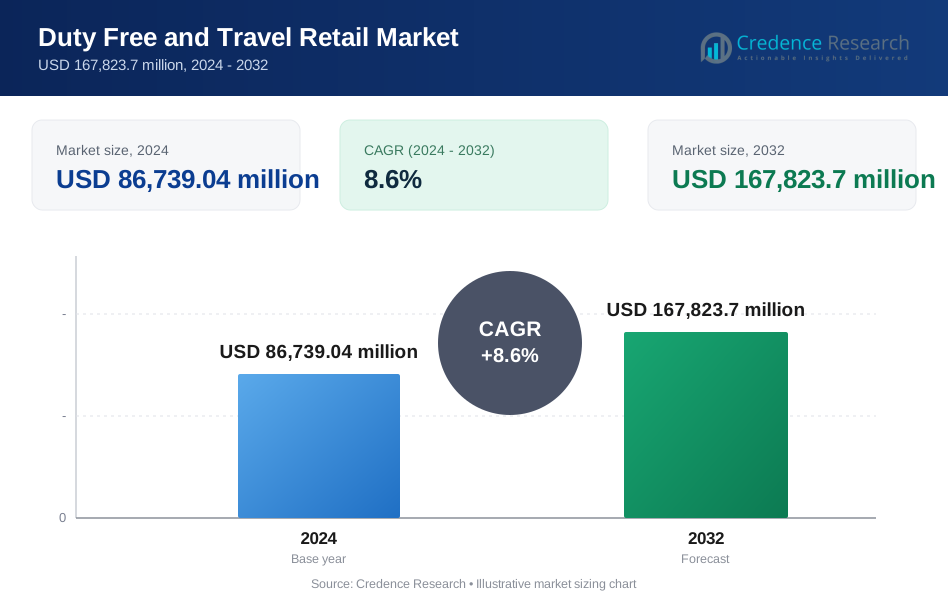
The global duty-free and travel retail market was valued at USD 86,739.04 million in 2024 and is projected to reach USD 167,823.7 million by 2032, expanding at a CAGR of 8.6% over the forecast period.
| REPORT ATTRIBUTE | DETAILS |
|---|---|
| Historical Period | 2020-2023 |
| Base Year | 2024 |
| Forecast Period | 2025-2032 |
| Duty Free and Travel Retail Market Size 2024 | USD 86,739.04 million |
| Duty Free and Travel Retail Market, CAGR | 8.6% |
| Duty Free and Travel Retail Market Size 2032 | USD 167,823.7 million |
Duty Free and Travel Retail Market Insights
- Market growth is driven by the recovery of global air travel, increasing outbound tourism from Asia-Pacific and the Middle East, and strong demand for premium beauty, personal care, and luxury goods, with beauty and personal care dominating product segments due to high margins and frequent travel-exclusive launches.
- Key trends include premiumization, experiential retail concepts, and digital pre-order and click-and-collect services, while airports dominate distribution channels, accounting for the largest share due to high footfall and longer dwell times.
- The competitive landscape is led by large global operators with long-term airport concessions, focusing on exclusive assortments, digital engagement, and partnerships with luxury brands to enhance conversion and basket size.
- Regionally, Asia-Pacific leads with ~41% market share, followed by Europe (~27%), North America (~17%), Middle East & Africa (~10%), and Latin America (~5%), reflecting variations in travel volume, spending behavior, and airport retail maturity.
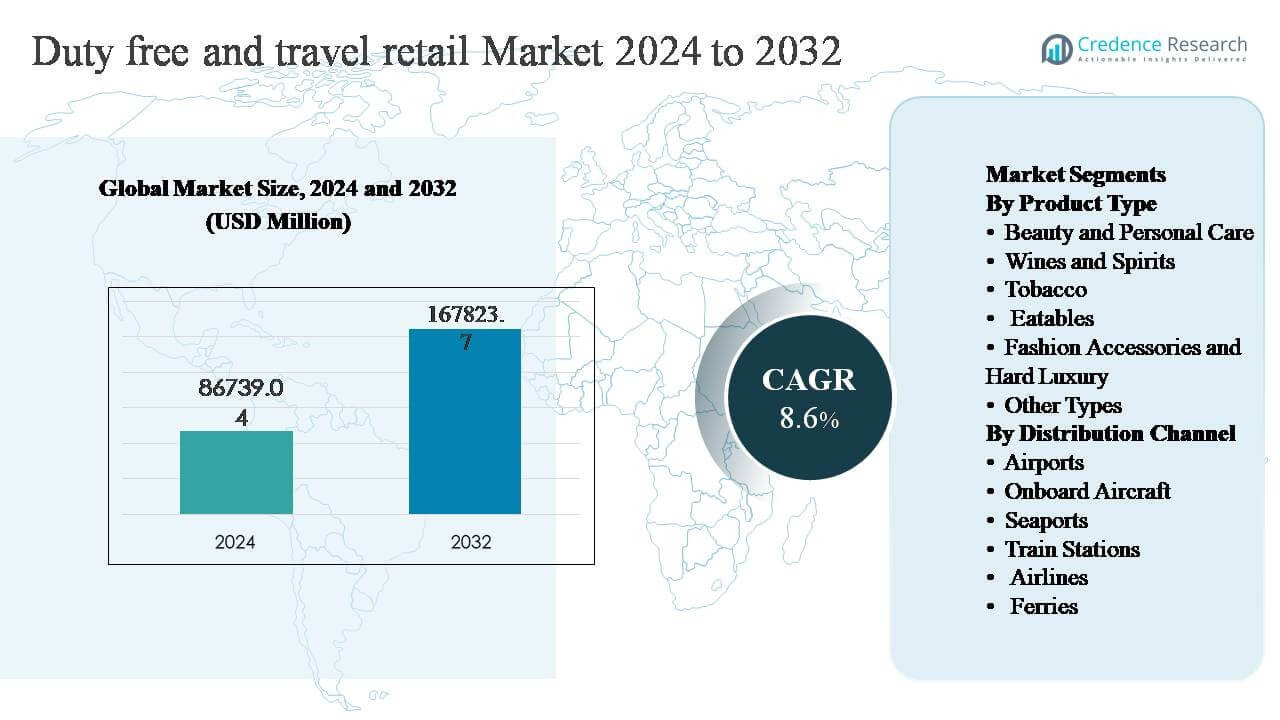
Duty Free and Travel Retail Market Segmentation Analysis:
By Product Type:
By product type, beauty and personal care is the dominant sub-segment, accounting for the largest share of duty-free and travel retail sales, supported by strong demand for premium skincare, fragrances, and cosmetics. High margins, compact packaging, and frequent product launches tailored to travel exclusives drive its leadership. Wines and spirits follow, benefiting from gifting demand and price advantages versus domestic retail. Tobacco remains relevant in select regions due to regulatory price arbitrage. Eatables, fashion accessories, hard luxury, and other types contribute incremental growth, supported by impulse purchases and experiential retail formats.
- For instance, Japan Tobacco International reported in June 2024 that its Geneva-based duty-free manufacturing and logistics hub supplies more than 90 airport markets, processing over 6 billion cigarette sticks per year for travel retail distribution alone.
By Distribution Channel:
By distribution channel, airports represent the dominant sub-segment, holding the majority market share due to high passenger volumes, extended dwell times, and well-developed retail infrastructure. International terminals, in particular, support premium brand visibility and high conversion rates. Onboard aircraft and airlines provide incremental sales through captive audiences, while seaports and ferries benefit from cruise tourism growth. Train stations contribute selectively in high-speed rail corridors. Overall dominance of airports is driven by rising global air traffic, terminal expansions, and digitally enabled omnichannel retail strategies.
- For instance, In March 2025, Avolta (the company formed by the merger of Dufry and Autogrill) reported a global presence in 75 countries across more than 1,000 locations, including duty-free and travel retail outlets in hundreds of international airports. With access to approximately 2.3 to 2.5 billion passengers annually, the group maintains an extensive operational network supported by a centralized digital strategy and loyalty program (Club Avolta) integrated across more than 5,100 outlets worldwide.
Key Growth Drivers
Recovery and Expansion of Global Air Travel
The sustained rebound in international air travel remains the primary growth driver for duty-free and travel retail. Passenger traffic recovery across major aviation hubs, combined with capacity expansion on long-haul routes, has significantly increased footfall in airport retail zones. Emerging outbound markets particularly in Asia-Pacific, the Middle East, and Latin America are contributing higher passenger volumes and stronger per-capita spend. Airlines and airports are also prioritizing retail revenue as a core non-aeronautical income stream, leading to improved terminal layouts, longer dwell times, and better passenger flow management. These factors collectively enhance conversion rates and average transaction values, reinforcing travel retail’s growth trajectory.
- For instance, In January 2025, Dubai Airports announced that Dubai International (DXB) handled a record-breaking 3 million passengersduring the 2024 calendar year, a milestone later confirmed by Airports Council International (ACI) in its global traffic rankings.
Rising Demand for Premium and Luxury Products
Duty-free and travel retail continues to benefit from strong consumer appetite for premium beauty, fragrances, wines & spirits, and hard luxury goods. Travelers increasingly perceive duty-free outlets as destinations for aspirational and exclusive purchases rather than convenience shopping. Price advantages driven by tax exemptions, combined with travel-retail-exclusive SKUs and limited-edition launches, stimulate higher-value transactions. Luxury brands are actively investing in immersive store formats, personalized services, and curated assortments tailored to international travelers. This premiumization trend supports margin expansion and positions travel retail as a strategic extension of global luxury distribution networks.
- For instance, As of 2025, DFS Group majority-owned by LVMH operates more than 400 points of sale globally, including boutiques in 15 major international airports and 18 downtown T Gallerias. To enhance product availability for high-value travelers, DFS continues to invest in innovative technologies and digital platforms that support curated assortments of premium fashion, beauty, and jewelry from over 750 brands.
Airport Infrastructure Development and Retail Optimization
Ongoing investments in airport modernization and new terminal development are accelerating travel retail growth. Airports worldwide are redesigning retail spaces to maximize visibility, accessibility, and experiential engagement. Walk-through duty-free concepts, digital wayfinding, and optimized store zoning encourage impulse buying and longer in-store dwell times. Airports are also leveraging data analytics to align product mixes with passenger demographics and travel patterns. These infrastructure-led improvements strengthen retail productivity per passenger and solidify airports’ role as the dominant distribution channel within the duty-free and travel retail ecosystem.
Key Trends & Opportunities
Digitalization and Omnichannel Travel Retail
Digital integration is transforming duty-free and travel retail operations, creating new opportunities for engagement and revenue growth. Click-and-collect platforms, pre-order services, and mobile-based promotions allow travelers to browse and reserve products before arrival, improving purchase certainty. Retailers are using passenger data, loyalty programs, and AI-driven personalization to tailor offers based on nationality, travel purpose, and past behavior. This omnichannel approach reduces dependency on impulse footfall alone and enhances conversion rates, while also strengthening brand loyalty beyond the physical travel environment.
- For instance, in May 2025, Singapore Changi Airport Group confirmed that its iShopChangi platform integrates airport retail, airline passenger data, and fulfillment logistics, operating a centralized distribution center capable of handling more than 20,000 order lines per day, with real-time inventory synchronization across terminals and home-delivery options for travelers after arrival.
Growth of Experiential and Brand-Led Retail Concepts
Experiential retail is emerging as a key opportunity, with brands and retailers emphasizing storytelling, sampling, and interactive environments. Beauty and spirits brands are investing in experiential zones such as fragrance bars, tasting lounges, and personalization counters to differentiate travel retail from domestic outlets. These concepts increase dwell time and emotional engagement, leading to higher basket sizes. As airports compete to enhance passenger experience, experiential retail is becoming a strategic lever to drive both commercial returns and overall terminal satisfaction.
- For instance, In December 2024, the Incheon International Airport Corporation (IIAC) completed its Phase 4 expansion, officially launching full commercial operations on December 3, 2024. This project integrated 18 immersive art pavilions across Terminal 2 as part of its "Art-Port" vision, transforming the terminal into a multi-dimensional cultural hub.
Key Challenges
Regulatory Pressure and Product Restrictions
Duty-free and travel retail faces increasing regulatory scrutiny, particularly across tobacco, alcohol, and liquid products. Stricter health regulations, packaging requirements, and advertising limitations reduce promotional flexibility and product visibility. In some regions, reduced duty-free allowances and harmonization of excise taxes diminish price advantages, directly impacting consumer purchasing incentives. Regulatory uncertainty across markets complicates assortment planning and increases compliance costs for retailers and brand owners, posing a structural challenge to sustained growth.
Dependence on Travel Volatility and Geopolitical Risks
The market remains highly sensitive to external disruptions such as geopolitical tensions, economic slowdowns, public health events, and fuel price volatility. Any decline in international travel directly affects passenger volumes and retail sales. Currency fluctuations also influence tourist spending behavior and pricing strategies. This inherent dependency on global mobility makes duty-free and travel retail more exposed to macroeconomic shocks than conventional retail channels, requiring greater operational flexibility and risk diversification strategies.
Regional Analysis
Asia-Pacific
Asia-Pacific holds the largest share of the duty-free and travel retail market, accounting for approximately 41% of global revenue. The region benefits from high outbound and inbound travel volumes, led by China, South Korea, Japan, Singapore, and key Southeast Asian hubs. Large international airports, strong demand for beauty, personal care, and luxury goods, and the rapid recovery of regional air traffic support market dominance. Additionally, rising middle-class consumption, expanding airport retail infrastructure, and strong participation from global luxury brands continue to drive higher per-passenger spending across major Asia-Pacific travel corridors.
Europe
Europe represents around 27% of the global duty-free and travel retail market, supported by dense international travel networks and high intra-regional mobility. Major hubs such as London, Paris, Frankfurt, Amsterdam, and Madrid drive consistent passenger flows. The region benefits from strong demand for wines, spirits, fragrances, and fashion accessories, particularly among leisure and business travelers. While regulatory changes within the European Union have moderated duty-free advantages on intra-EU routes, non-EU travel, tourism inflows, and premium brand-led retail concepts continue to sustain Europe’s strong market position.
North America
North America accounts for approximately 17% of the global duty-free and travel retail market. Growth is driven by high international passenger traffic through major U.S. and Canadian airports such as New York, Los Angeles, Miami, Toronto, and Vancouver. Beauty, personal care, and premium spirits dominate product sales, supported by strong brand awareness and purchasing power. While domestic travel limits duty-free penetration, rising cross-border and long-haul international travel, airport terminal upgrades, and increased focus on experiential retail are strengthening North America’s travel retail performance.
Middle East & Africa
The Middle East & Africa region holds about 10% of the global market, anchored by major aviation hubs in the Gulf. Airports such as Dubai, Doha, and Abu Dhabi serve as global transit centers, generating high retail spend per passenger. The region benefits from strong luxury consumption, premium spirits demand, and high tourist inflows. Africa contributes modestly, supported by growing regional air connectivity and tourism development. Continued airport expansions, luxury-focused assortments, and strong international transit traffic sustain the region’s strategic importance in global travel retail.
Latin America
Latin America accounts for roughly 5% of the global duty-free and travel retail market. Key contributors include Brazil, Mexico, Chile, and Panama, supported by rising tourism and improving airport infrastructure. Demand is driven by beauty products, fragrances, alcohol, and confectionery, with price-sensitive purchasing behavior influencing product mix. While passenger volumes are lower compared to other regions, steady growth in international travel, airport modernization programs, and increasing participation from global retailers are gradually enhancing the region’s travel retail penetration and revenue contribution.
Duty Free and Travel Retail Market Segmentations:
By Product Type
- Beauty and Personal Care
- Wines and Spirits
- Tobacco
- Eatables
- Fashion Accessories and Hard Luxury
- Other Types
By Distribution Channel
- Airports
- Onboard Aircraft
- Seaports
- Train Stations
- Airlines
- Ferries
By Geography
- North America
- U.S.
- Canada
- Mexico
- Europe
- Germany
- France
- U.K.
- Italy
- Spain
- Rest of Europe
- Asia Pacific
- China
- Japan
- India
- South Korea
- South-east Asia
- Rest of Asia Pacific
- Latin America
- Brazil
- Argentina
- Rest of Latin America
- Middle East & Africa
- GCC Countries
- South Africa
- Rest of the Middle East and Africa
Competitive Landscape
The competitive landscape of the duty-free and travel retail market is characterized by the presence of large global operators alongside regionally strong retailers, competing through scale, airport concessions, and brand partnerships. Leading players focus on securing long-term contracts at high-traffic international airports, enabling consistent passenger access and revenue visibility. Competition is driven by assortment depth in beauty, fragrances, wines, spirits, and luxury goods, supported by exclusive travel-retail launches and premium store formats. Players increasingly differentiate through digital pre-order platforms, data-driven personalization, and experiential retail concepts to improve conversion rates and basket size. Strategic collaborations with airport authorities, investments in terminal redesigns, and expansion across emerging travel hubs further intensify competition, while operational efficiency and supply chain resilience remain critical to sustaining margins in a highly traffic-dependent retail environment.
Key Player Analysis
- China Duty-Free Group Co. Ltd.
- Dufry
- Dubai Duty-Free
- DFS Group
- Lotte Duty-Free
- King Power
- Duty Free Americas Inc.
- Flemingo International Ltd.
- Delhi Duty-Free
- WHSmith
Recent Developments
- In December 2025, Fuzhou Downtown Store Opening: China Duty-Free Group officially opened its Fuzhou downtown duty-free store, expanding its presence beyond traditional airport locations as part of its strategy to build integrated retail hubs in major Chinese cities.
- In October 2025,Duty-Free Contract, Avolta secured an 11-year duty-free contract at John F. Kennedy International Airport’s Terminal 8, expanding its retail footprint by over 4,400 m² of global luxury and New-York-inspired retail space as part of the terminal’s broader commercial redevelopment.
- In July 2025, DFS announced a strategic exit from Oceania markets, including closures in Sydney, Auckland, and Queenstown, as part of network optimization and portfolio rebalancing.
Report Coverage
The research report offers an in-depth analysis based on Product type, Distribution channel and Geography. It details leading market players, providing an overview of their business, product offerings, investments, revenue streams, and key applications. Additionally, the report includes insights into the competitive environment, SWOT analysis, current market trends, as well as the primary drivers and constraints. Furthermore, it discusses various factors that have driven market expansion in recent years. The report also explores market dynamics, regulatory scenarios, and technological advancements that are shaping the industry. It assesses the impact of external factors and global economic changes on market growth. Lastly, it provides strategic recommendations for new entrants and established companies to navigate the complexities of the market.
Future Outlook
- International passenger traffic will continue to expand, supporting sustained growth in duty-free and travel retail sales.
- Airports will further prioritize retail as a core non-aeronautical revenue stream, driving layout optimization and store expansion.
- Beauty, personal care, and premium luxury categories will remain the primary revenue contributors due to high margins and repeat purchase behavior.
- Digital pre-order, click-and-collect, and omnichannel retail models will become standard across major travel hubs.
- Experiential retail formats will gain importance as brands focus on engagement, personalization, and immersive shopping environments.
- Travel-retail-exclusive products will increase as brands seek differentiation from domestic retail channels.
- Sustainability and responsible sourcing will influence product assortments and consumer purchasing decisions.
- Data-driven personalization and loyalty integration will enhance conversion rates and average transaction values.
- Emerging travel hubs in Asia-Pacific and the Middle East will attract higher investment from global retailers.
- Operational efficiency and supply chain resilience will remain critical to managing traffic volatility and regulatory pressures.
Request a Free Sample
Fill in your details and we'll send you a free sample report.
- Sample data tables & charts
- Research methodology
Need a Custom Version of This Report?
Tailor the scope, geography, or segments to your exact requirements.
- Custom geography or segment scope
- Direct access to our analyst team
Frequently Asked Questions
What is the current market size for Duty free and travel retail, and what is its projected size in 2032?
At what Compound Annual Growth Rate is the Duty free and travel retail projected to grow between 2024 and 2032?
Which Duty free and travel retail segment held the largest share in 2024?
What are the primary factors fueling the growth of the Duty free and travel retail market?
Who are the leading companies in the Duty free and travel retail market?
Which region commanded the largest share of the Duty free and travel retail market in 2024?
Table of Content
Chapter 1. Report Introduction
- 1.1 Report Description & Purpose
- 1.1.1 Report Title & Market Definition
- 1.1.2 Unique Selling Propositions (USP) & Key Differentiators
- 1.1.3 Value Proposition for Stakeholders
- 1.2 Research Objectives
- 1.2.1 Market Sizing Objectives (Volume & Revenue)
- 1.2.2 Segmentation Objectives
- 1.2.3 Competitive Intelligence Objectives
- 1.2.4 Forecast & Scenario Objectives
- 1.3 Report Scope
- 1.3.1 Duty Free and Travel Retail Scope – Types & Subtypes Covered
- 1.3.2 Geographic Scope – Regions & Countries Covered
- 1.3.3 Historical Period, Base Year & Forecast Period (2024; forecast to 2032)
- 1.3.4 Inclusions & Exclusions
- 1.4 HS Code & Classification Framework
- 1.5 Currency, Units & Pricing Basis
- 1.6 Target Stakeholders
- 1.7 Limitations & Assumptions
Chapter 2. Executive Summary
- 2.1 Global Duty Free and Travel Retail Market Snapshot
- 2.1.1 Market Size – Historical (2024) & Forecast (2024-2032) (2024: USD 86,739.04 million → 2032: USD 167,823.7 million)
- 2.1.2 Volume & Revenue – Global Totals
- 2.1.3 Key Market Highlights – Top Five Facts
- 2.2 Duty Free and Travel Retail Market Segmentation Snapshot
- 2.2.1 Market Split by Region – 2024 vs. 2032
- 2.3 Competitive Snapshot
- 2.3.1 Top 10 Players by Revenue Share – 2024
- 2.3.2 Top 10 Players by Volume Share – 2024
- 2.3.3 Recent Strategic Developments (18-Month Summary)
- 2.4 Key Investment Highlights & Strategic Conclusions
Chapter 3. Duty Free and Travel Retail Market Dynamics & Industry Analysis
- 3.1 Market Overview & Context
- 3.1.1 Duty Free and Travel Retail Market Position in the Broader Automotive Value Chain
- 3.1.2 OEM vs. Replacement Market Dynamics
- 3.1.3 Market Maturity & Development Stage by Region
- 3.2 Duty Free and Travel Retail Market Drivers
- 3.3 Duty Free and Travel Retail Market Restraints & Challenges
- 3.4 Duty Free and Travel Retail Market Opportunities
- 3.5 Porter's Five Forces Analysis
- 3.5.1 Threat of New Entrants
- 3.5.2 Bargaining Power of Suppliers
- 3.5.3 Bargaining Power of Buyers
- 3.5.4 Threat of Substitutes
- 3.5.5 Competitive Rivalry – Intensity Assessment
- 3.6 Duty Free and Travel Retail Value Chain Analysis
- 3.6.1 Upstream – Raw Material/Input Suppliers
- 3.6.1.1 Raw Material/Input 1
- 3.6.1.2 Raw Material/Input 2
- 3.6.1.3 Raw Material/Input 3
- 3.6.2 Midstream – Production/Manufacturing/Service Delivery
- 3.6.2.1 Production/Process Overview
- 3.6.2.2 Key Facility Locations & Capacity by Manufacturer
- 3.6.3 Downstream – Distribution & End Consumer
- 3.6.3.1 Primary Channel – B2B/OEM
- 3.6.3.2 Secondary Channels – Dealer, Retail, Online, Direct
- 3.6.4 Value Chain Profitability Analysis
- 3.6.1 Upstream – Raw Material/Input Suppliers
- 3.7 PESTEL Analysis
- 3.7.1 Political Factors
- 3.7.2 Economic Factors
- 3.7.3 Social Factors
- 3.7.4 Technological Factors
- 3.7.5 Environmental Factors
- 3.7.6 Legal Factors
- 3.8 Duty Free and Travel Retail Supply Chain Analysis
- 3.8.1 Raw Material/Input Supply Risk Assessment
- 3.8.2 Manufacturing Concentration Risk (Geographic Exposure)
- 3.8.3 Trade Disruption Impact Analysis
- 3.9 Regulatory & Policy Landscape
Note: The regulatory and policy landscape section covers regulations based on their applicability to the market, Duty Free and Travel Retail category, geography, and scope of the study. Only regulatory frameworks with a material impact on operations, compliance, trade, sustainability, or market access are analyzed in detail.
Chapter 4. Key Investment Pockets & Opportunity Analysis
- 4.1 Duty Free and Travel Retail Market Attractiveness Analysis
- 4.1.1 By Region – Investment Attractiveness Matrix (Volume × CAGR)
- 4.2 Absolute Revenue Growth Opportunity
- 4.2.1 By Region – Absolute USD Growth Through 2032
- 4.3 Incremental Volume Opportunity
- 4.3.1 By Region – Incremental Volume Through 2032
- 4.3.2 Segment – Incremental Volume
- 4.4 Emerging Submarket Opportunity Deep Dive (Subject to Applicability)
- 4.5 Emerging Market Opportunity Scorecards
- 4.5.1 United States
- 4.5.2 Europe
- 4.5.3 Asia
- 4.5.4 Middle East & Africa
Note: Emerging Market Opportunity Scorecards will be included based on relevance and strategic importance. Regions listed are indicative and may vary depending on data availability and market dynamics.
Chapter 5. Duty Free and Travel Retail Import-Export Analysis & Trade Flows
- 5.1 Global Trade Overview
- 5.1.1 Global Export Value by Country (2024)
- 5.1.2 Global Export Volume by Country (2024)
- 5.1.3 Global Import Value by Country (2024)
- 5.1.4 Global Import Volume by Country (2024)
- 5.1.5 Net Trade Balance by Country (2024)
- 5.2 Export Analysis – Segment
- 5.2.1 Type 1 (HS Code)
- 5.2.2 Type 2 (HS Code)
- 5.2.3 Type 3 (HS Code)
- 5.2.4 Type 4 (HS Code)
- 5.2.5 Type 5 (HS Code)
- 5.3 Import Analysis – Segment
- 5.3.1 Type 1 (HS Code)
- 5.3.2 Type 2 (HS Code)
- 5.3.3 Type 3 (HS Code)
- 5.3.4 Type 4 (HS Code)
- 5.3.5 Type 5 (HS Code)
- 5.4 Average Unit Trade Prices
- 5.4.1 Average Export Price – Segment & Country
- 5.4.2 Average Import Price – Segment & Source Country
- 5.4.3 Price Trends (2024)
- 5.5 Key Trade Route Analysis
- 5.5.1 Trade Route 1
- 5.5.2 Trade Route 2
- 5.5.3 Trade Route 3
- 5.5.4 Trade Route 4
- 5.5.5 Trade Route 5
- 5.6 Trade Policy Impact Assessment
- 5.6.1 US Anti-Dumping & Section 301 Tariffs
- 5.6.2 EU Customs Union Impact
- 5.6.3 Major Free Trade Agreements
- 5.6.4 USMCA Rules of Origin
Note: Trade policy analysis will be included only where relevant to the Duty Free and Travel Retail market.
Chapter 6. Competitive Landscape & Company Benchmarking
- 6.1 Duty Free and Travel Retail Market Concentration & Structure
- 6.1.1 Herfindahl-Hirschman Index (HHI) – vs. 2024
- 6.1.2 Tier 1, Tier 2 & Tier 3 Market Structure
- 6.1.3 Global, Regional & Local Player Dynamics
- 6.2 Duty Free and Travel Retail Market Share Analysis – 2024
- 6.2.1 Global Revenue Share by Company
- 6.2.2 Global Volume Share by Company
- 6.2.3 Regional Revenue Share
- 6.2.4 Market Share Evolution ( vs. 2024)
- 6.2.5 OEM Segment Share by Company
- 6.2.6 Replacement Segment Share by Company
- 6.3 Production/Delivery Capacity & Facility Analysis
- 6.3.1 Global Installed Capacity
- 6.3.2 Capacity Utilization Rates
- 6.3.3 Production/Output Volume
- 6.3.4 Facility Locations & Capacity Map
- 6.3.5 Planned Capacity Additions
- 6.4 Duty Free and Travel Retail Competitive Benchmarking Matrix
- 6.4.1 Revenue, Volume, CAGR & Profitability Comparison
- 6.4.2 Channel Revenue Mix
- 6.4.3 Geographic Revenue Exposure
- 6.4.4 R&D Intensity
- 6.4.5 Sustainability Maturity
- 6.5 Strategic Developments in Duty Free and Travel Retail (Last 24 Months)
- 6.5.1 Mergers, Acquisitions & Divestments
- 6.5.2 New Duty Free and Travel Retail Launches
- 6.5.3 Facility Expansions
- 6.5.4 Strategic Alliances, Joint Ventures & Partnerships
- 6.5.5 Distribution Expansion & Market Entry
- 6.5.6 Sustainability & ESG Initiatives
- 6.6 Competitive Strategy Mapping
- 6.6.1 Leader, Challenger, Follower & Niche Classification
- 6.6.2 Pricing Strategy Comparison
- 6.6.3 Channel Strategy Matrix
Note: Strategic developments are included based on their materiality and the availability of reliable information.
Chapter 7. Global Duty Free and Travel Retail Market – By Distribution Channel
- 7.1 Segment Overview
- 7.1.1 Volume & Revenue Split by Channel (2024 & 2032)
- 7.1.2 Channel Mix Evolution (2024-2032)
Chapter 8. Regional Market Analysis – Global Overview
- 8.1 Global Regional Overview
- 8.1.1 Regional Volume Share
- 8.1.2 Regional Revenue Share
- 8.1.3 Regional Volume by Region
- 8.1.4 Regional Revenue by Region
- 8.1.5 Regional Forecast Through 2032
- 8.2 Cross-Regional Segment Analysis
- 8.2.1 By Distribution Channel
- 8.2.2 By Brand/Price Tier
Chapter 9. North America Duty Free and Travel Retail Market
- 9.1 United States
- 9.2 Canada
- 9.3 Mexico
Chapter 10. Europe Duty Free and Travel Retail Market
- 10.1 Germany
- 10.2 France
- 10.3 Italy
- 10.4 United Kingdom
- 10.5 Spain
- 10.6 Poland
- 10.7 Russia
- 10.8 Netherlands
- 10.9 Belgium
- 10.10 Sweden
- 10.11 Denmark
- 10.12 Norway
- 10.13 Rest of Europe
Chapter 11. Asia Pacific Duty Free and Travel Retail Market
- 11.1 China
- 11.2 India
- 11.3 Japan
- 11.4 South Korea
- 11.5 Thailand
- 11.6 Indonesia
- 11.7 Vietnam
- 11.8 Malaysia
- 11.9 Australia
- 11.10 Rest of Asia Pacific
Chapter 12. Latin America Duty Free and Travel Retail Market
- 12.1 Brazil
- 12.2 Argentina
- 12.3 Colombia
- 12.4 Chile
- 12.5 Rest of Latin America
Chapter 13. Middle East Duty Free and Travel Retail Market
- 13.1 Saudi Arabia
- 13.2 United Arab Emirates
- 13.3 Turkey
- 13.4 Israel
- 13.5 Iran
- 13.6 Rest of the Middle East
Chapter 14. Africa Duty Free and Travel Retail Market
- 14.1 South Africa
- 14.2 Egypt
- 14.3 Nigeria
- 14.4 Morocco
- 14.5 Rest of Africa
Chapter 15. Duty Free and Travel Retail Company Profiles
- 15.1 [Company 01]
- 15.1.1 Company Overview
- 15.1.2 Key Management Personnel
- 15.1.3 Products & Services Portfolio
- 15.1.4 Financial Performance
- 15.1.5 Key Market Focus & Geographic Presence
- 15.1.6 Recent Developments & Strategic Initiatives
Note: The company profile list is preliminary and may change based on research findings, market developments, data availability, and client requirements.
Chapter 16. Appendices
- Appendix A – List of Abbreviations & Acronyms
- Appendix B – Industry Classification Code Reference – Full Series
- Appendix C – Production & Capacity Data Tables
- Appendix D – End-Use & Demand Base Tables
- Appendix E – Consumption & Replacement Rate Assumptions
- Appendix F – ASP Reference Tables
- Appendix G – Manufacturing & Facility Database
- Appendix H – Import-Export Data Tables
- Appendix I – Regulatory Summary Tables
- Appendix J – Primary Research Participant List (Anonymized)
- Appendix K – Primary Research Questionnaire Framework
- Appendix L – Data Sources & Bibliography
- Appendix M – Market Size Divergence & Source Comparison
Chapter 17. Research Methodology
- 17.1 Research Framework & Philosophy
- 17.2 Secondary Research – Sources, Hierarchy & Data Extraction
- 17.3 Data Modeling – Bottom-Up & Top-Down Market Sizing
- 17.4 Primary Research – Stakeholder Framework, LOI & Sample Sizes
- 17.5 Forecast Methodology – Regression, Scenario & Sensitivity Analysis
- 17.6 Quality Control – Four-Layer Validation Framework
- 17.7 Limitations & Standard Assumptions
- 17.8 Disclaimer
