
| REPORT ATTRIBUTE | DETAILS |
|---|---|
| Historical Period | 2020-2023 |
| Base Year | 2024 |
| Forecast Period | 2025-2032 |
| Alpha Olefin Sulfonates Market Size 2024 | USD 446 Million |
| Alpha Olefin Sulfonates Market , CAGR | 5.1 % |
| Alpha Olefin Sulfonates Market Size 2032 | USD 663.9 Million |
Market Overview:
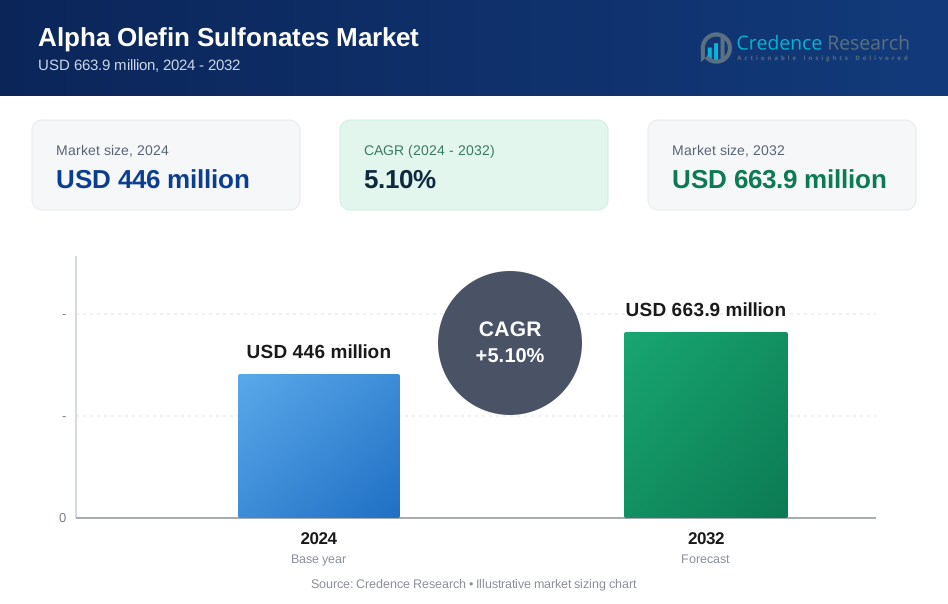
Alpha-olefin sulfonates market size was valued at USD 446 million in 2024 and is anticipated to reach USD 663.9 million by 2032, at a CAGR of 5.1 % during the forecast period (2024-2032).
Several key factors are fueling growth in the alpha-olefin sulfonates market. The increasing adoption of eco-friendly and biodegradable surfactants in response to stringent environmental regulations has elevated demand for alpha-olefin sulfonates as a preferred alternative to conventional anionic surfactants. The surge in consumer awareness regarding personal hygiene and cleaning, especially following the COVID-19 pandemic, has further boosted the consumption of household and personal care products that utilize these sulfonates as primary ingredients. The market also benefits from the superior hard water tolerance and chemical stability of alpha-olefin sulfonates, making them suitable for diverse industrial and consumer applications. Competitive pricing and an established supply chain network further accelerate their adoption across various sectors.
Regionally, Asia Pacific dominates the global alpha-olefin sulfonates market, led by key manufacturers such as Zanyu Technology Group Co. Ltd. and Stepan Company. The region holds the largest share due to high production capacities, significant consumption in detergent manufacturing, and a rapidly growing middle-class population. China and India are pivotal markets, benefiting from strong industrial bases and increasing urbanization. North America and Europe represent mature markets with steady demand, supported by advanced regulatory frameworks and established end-user industries. Emerging markets in Latin America and the Middle East & Africa are also witnessing rising consumption, driven by increasing penetration of modern cleaning and personal care products. Growing investments in capacity expansion and localization of production facilities by major manufacturers are strengthening regional supply security.
Market Insights:
- The Alpha-olefin sulfonates market was valued at USD 446 million in 2024 and is forecast to reach USD 663.9 million by 2032.
- Rising adoption of eco-friendly and biodegradable surfactants is driving demand, supported by stricter environmental regulations.
- Consumer focus on hygiene, especially post-pandemic, is boosting use of alpha-olefin sulfonates in household and personal care products.
- Expansion of applications in agrochemicals, textiles, and oilfield chemicals is broadening market opportunities.
- Asia Pacific holds the largest share at 48%, led by robust detergent and personal care industries in China and India.
- Raw material price volatility and competition from alternative surfactants present ongoing market challenges.
- Strong R\&D, capacity expansion, and local partnerships are enabling manufacturers to meet evolving global and regional requirements.
Market Drivers:
Shift Toward Eco-Friendly Surfactants Elevates Market Demand
The Alpha-olefin sulfonates market is experiencing strong momentum due to the global transition toward environmentally sustainable surfactants. Regulatory authorities continue to implement stricter controls on conventional surfactants, prompting manufacturers and end users to adopt alpha-olefin sulfonates, which offer biodegradability and lower toxicity. Consumers show increasing preference for green products, particularly in detergents, personal care, and cleaning applications. Companies that prioritize eco-friendly formulations are gaining market advantage by aligning with evolving environmental standards. The compatibility of alpha-olefin sulfonates with sustainable chemistry goals supports their rising usage across key sectors. Its low aquatic toxicity further broadens its acceptance in regulated regions. This sustainability focus remains a significant engine of demand growth.
- For instance, Stepan Company, in June 2025, announced it increased its annual production capacity for alpha‑olefin sulfonates by 25%, boosting output by approximately 7,500 metric tons, up from a previous level of around 30,000 t/year
Rising Hygiene Awareness Drives Household and Personal Care Demand
Growing consumer consciousness around hygiene and cleanliness directly propels the Alpha-olefin sulfonates market. The pandemic has heightened the importance of effective cleaning agents in both domestic and institutional settings. Alpha-olefin sulfonates are widely incorporated into soaps, body washes, shampoos, and household cleaners, supporting robust market volumes. Companies respond to changing lifestyles by developing products with enhanced cleansing and foaming properties, leveraging alpha-olefin sulfonates as a core ingredient. Increased urbanization and a growing middle class, particularly in emerging markets, drive up consumption of modern cleaning products. The market benefits from strong brand investments in marketing and product innovation. Shifting hygiene expectations underpin sustained, long-term growth.
Technological Advancements in Formulations Expand Application Scope
Continuous research and development in surfactant chemistry are unlocking new opportunities within the Alpha-olefin sulfonates market. Advanced formulations now address performance gaps related to hard water tolerance, emulsification, and mildness, allowing broader application across laundry detergents, industrial cleaners, and specialty products. Manufacturers are investing in production upgrades to deliver high-purity sulfonates tailored to evolving industry requirements. These advancements support the trend toward sulfate-free and hypoallergenic formulations, expanding the addressable market. Enhanced process efficiency also enables cost-competitive production. The introduction of innovative product lines strengthens the position of alpha-olefin sulfonates in a competitive landscape.
- For instance, Stepan Company announced on June 3, 2025, that it increased its annual alpha-olefin sulfonate production by approximately 7,500 metric tons—from about 30,000 metric tons to 37,500 metric tons—at its Millsdale, Illinois facility following its latest plant modernization efforts
Expansion into Industrial and Agricultural Applications
The versatility of alpha-olefin sulfonates is supporting their penetration into industrial and agricultural segments. Its chemical stability and high-performance attributes suit demanding uses in oilfield chemicals, textile processing, and agrochemical formulations. Growing industrialization, particularly in Asia Pacific and Latin America, increases the volume of surfactants required for processing and manufacturing. The product’s compatibility with other surfactants and additives makes it attractive for complex formulations. Its cost-effectiveness and availability through established supply chains enhance uptake in price-sensitive markets. This industrial diversification provides a solid foundation for continued market expansion.
Market Trends:
Growth of Sulfate-Free and High-Purity Formulations Shapes Product Innovation
The Alpha-olefin sulfonates market is witnessing a clear shift toward sulfate-free and high-purity formulations, reflecting rising consumer sensitivity to harsh chemicals and regulatory mandates on product safety. Brands are emphasizing gentle, hypoallergenic solutions in personal care and home care applications, leveraging the mild yet effective cleansing profile of alpha-olefin sulfonates. This trend is driving manufacturers to develop innovative blends that maintain foaming power and cleaning efficacy without causing skin or environmental irritation. The demand for premium, multifunctional formulations is accelerating investments in R&D and process optimization to enhance purity and performance. Product differentiation through advanced chemistry now plays a critical role in market competitiveness. The focus on mild and safe surfactants is fostering a wave of next-generation cleaning and care products globally.
- For instance, Huntsman Corporation introduced a new high-purity alpha-olefin sulfonate with less than 10 ppm residual olefin, as documented in its 2024 innovation release.
Regional Expansion and Customization Drive Market Growth
Regional diversification and tailored product offerings are emerging as defining trends in the Alpha-olefin sulfonates market. Leading producers are expanding manufacturing capacities and forming strategic partnerships in high-growth regions such as Asia Pacific, capitalizing on surging demand for detergents and industrial cleaners. Customization to local performance requirements, fragrance preferences, and regulatory standards enables brands to gain traction in competitive markets. This regional focus supports resilient supply chains and faster response times, ensuring consistent product availability. Growing investments in local R&D and technical support further empower manufacturers to address evolving customer needs and regulatory shifts. The ability to deliver region-specific solutions and agile service remains central to capturing market share in a dynamic global environment.
- For instance, Zanyu Technology Group Co. Ltd. expanded its Jiangsu plant to an annual capacity of 180,000 tons of alpha-olefin sulfonates in 2023, supporting supply across China and Southeast Asia.
Market Challenges Analysis:
Raw Material Price Volatility and Supply Chain Disruptions Impact Profitability
The Alpha-olefin sulfonates market faces significant challenges due to fluctuations in raw material prices, particularly those derived from petrochemical feedstocks. Instability in crude oil prices directly influences production costs, creating uncertainty for manufacturers and end users. Supply chain disruptions, such as logistical delays and shortages of key inputs, have further compounded cost pressures across the value chain. Companies must implement effective risk management strategies to secure consistent raw material supplies and stabilize pricing. Increased competition for limited resources intensifies these challenges, especially during periods of high demand or geopolitical tensions. Persistent volatility undermines profitability and complicates long-term planning for market participants.
Stringent Regulations and Competition from Alternative Surfactants Restrain Market Growth
Stringent environmental and safety regulations impose compliance burdens on participants in the Alpha-olefin sulfonates market, driving up costs for testing, certification, and product reformulation. Regulatory frameworks in developed regions are particularly rigorous, requiring continual adaptation of manufacturing processes and product portfolios. The market also contends with competition from alternative surfactants, such as alcohol ethoxylates and methyl ester sulfonates, which offer similar or improved performance in certain applications. This competition pressures margins and limits the ability of some suppliers to differentiate their products. Shifts in consumer preferences toward novel green surfactants could further challenge traditional market growth trajectories.
Market Opportunities:
Emerging Demand for Sustainable and Multifunctional Products Fuels Growth
The Alpha-olefin sulfonates market stands to benefit from the rising demand for sustainable and multifunctional cleaning solutions across consumer and industrial segments. End users increasingly seek products that combine strong cleaning performance with environmental safety, creating opportunities for alpha-olefin sulfonates in next-generation formulations. Brands investing in biodegradable, sulfate-free, and hypoallergenic products can capture new market share by appealing to eco-conscious consumers. This trend also encourages partnerships between manufacturers and global consumer goods companies to develop tailored solutions. The shift toward high-value, differentiated products supports stronger margins and long-term market resilience. The ability to address evolving consumer expectations for safety and sustainability represents a significant growth lever.
Expansion in High-Growth Regions and New Application Segments
Rapid economic development in Asia Pacific, Latin America, and the Middle East & Africa presents a major opportunity for the Alpha-olefin sulfonates market. Manufacturers can expand their footprint by establishing local production facilities and collaborating with regional distributors. The market also finds new avenues in applications beyond traditional detergents, including agrochemicals, oilfield chemicals, and textile processing. These segments require surfactants with high performance and cost efficiency, aligning well with the attributes of alpha-olefin sulfonates. Customizing products to meet local regulations and end-user needs strengthens competitive positioning. The ability to innovate and diversify applications secures future growth prospects.
Market Segmentation Analysis:
By Type: Liquid, Powder, and Paste
The Alpha-olefin sulfonates market segments by type into liquid, powder, and paste forms. The liquid segment commands the largest share, supported by its ease of formulation, rapid solubility, and strong demand in both household and industrial cleaning products. Powder and paste variants address specific requirements in industrial operations, offering advantages such as controlled handling, storage stability, and suitability for concentrated formulations.
- For instance, Stepan Company recently expanded its AOS production capacity by 25%, adding tens of thousands of tons across its North American network — a quantitative growth of exactly 25% capacity announced June 3, 2025
By Application: Detergents, Personal Care, and Industrial Uses
By application, detergents represent the dominant segment in the Alpha-olefin sulfonates market, valued for their superior foaming, cleaning efficiency, and resilience in hard water conditions. Personal care items—including shampoos and body washes—demonstrate significant growth as brands prioritize sulfate-free and gentle formulations. Industrial cleaners, agrochemicals, textiles, and oilfield chemicals round out the application landscape, benefiting from the chemical stability and versatility of alpha-olefin sulfonates.
By End-Use: Household, Industrial, and Personal Care
In terms of end-use, the household sector leads market consumption, fueled by heightened hygiene awareness and rapid urbanization in emerging markets. The industrial segment is expanding, with manufacturers incorporating high-performance, eco-friendly surfactants for specialty processes. Personal care and cosmetics are rapidly growing, driven by demand for safe, sustainable, and skin-friendly products. The Alpha-olefin sulfonates market leverages this diverse segmentation to sustain its trajectory of growth and innovation.
Segmentations:
By Type
- Liquid
- Powder
- Paste
By Application
- Detergents
- Personal Care Products
- Industrial Cleaners
- Agrochemicals
- Textiles
- Oilfield Chemicals
By End-Use
- Household
- Industrial
- Personal Care and Cosmetics
By Region
- Asia Pacific
- North America
- Europe
- Latin America
- Middle East & Africa
Regional Analysis:
Asia Pacific
Asia Pacific accounts for 48% of the global Alpha-olefin sulfonates market, cementing its position as the largest regional contributor by volume and value. This leadership is driven by robust demand from the detergent and personal care industries, which continue to grow rapidly across China, India, and Southeast Asian countries. Urbanization, rising disposable incomes, and a shift toward modern cleaning products underpin strong market fundamentals. The region benefits from advanced manufacturing infrastructure and ready access to key raw materials, allowing for cost-efficient production and competitive pricing. Investments in technology upgrades and product development support evolving regulatory standards and the growing preference for sustainable solutions. Global manufacturers increasingly form strategic alliances with local players to strengthen distribution and supply chain resilience. The move toward local manufacturing ensures faster response to market dynamics and greater regional autonomy.
North America
North America holds 23% of the Alpha-olefin sulfonates market, maintaining a substantial presence in home care, industrial cleaning, and personal care applications. The United States and Canada lead regional demand, supported by regulatory frameworks that prioritize product safety, environmental protection, and innovation. Companies invest heavily in research and development to introduce differentiated, eco-friendly formulations and respond to the surge in sulfate-free and hypoallergenic product preferences. The region’s established supply chain and distribution networks enable efficient market access and reliable delivery. Expansion into adjacent applications such as oilfield chemicals and agrochemicals provides additional growth pathways for manufacturers. Continued focus on sustainability, product quality, and regulatory compliance secures North America’s role as a center for innovation and high-value product development.
Europe
Europe represents 19% of the global Alpha-olefin sulfonates market, reflecting its strong emphasis on environmental stewardship, regulatory rigor, and sustainable product innovation. The region’s advanced personal care and household product sectors drive stable, ongoing demand for high-purity and low-toxicity surfactants. Stringent legislation—such as REACH—and ambitious circular economy initiatives accelerate the shift toward biodegradable solutions and continuous product reformulation. European manufacturers prioritize green chemistry investments, aligning portfolios with evolving sustainability goals and market expectations. Collaborative efforts with research institutions and leading consumer brands foster the development of region-specific, environmentally responsible products. Heightened consumer awareness regarding health and eco-friendliness further accelerates the adoption of alpha-olefin sulfonates across diverse applications.
Key Player Analysis:
- Huntsman Corporation
- Kao Corporation
- Zanyu Technology Group Co. Ltd.
- Stepan Company
- Pilot Chemical Company
- Enaspol a.s.
- Clariant AG
- Chemicals
- STPP Group
Competitive Analysis:
The Alpha-olefin sulfonates market features strong competition among leading players such as Huntsman Corporation, Kao Corporation, and Zanyu Technology Group Co. Ltd. It benefits from robust demand across detergents, personal care, and industrial cleaning applications. Companies compete on product quality, technological advancements, and the ability to meet evolving regulatory requirements. Innovation in sustainable formulations and green chemistry drives product differentiation, while investments in production efficiency and supply chain integration enhance cost competitiveness. Expansion in emerging markets, particularly in Asia Pacific, supports volume growth and provides opportunities for local partnerships. Major participants focus on developing application-specific grades and strengthening customer relationships to secure long-term contracts. It faces challenges from fluctuating raw material prices and the need to comply with increasingly stringent environmental standards. Strategic alliances, capacity expansions, and R&D initiatives remain central to the competitive landscape, enabling market leaders to sustain their position and respond quickly to market shifts.
Recent Developments:
- In May , 2025, Huntsman announced the expansion of its Conroe, Texas manufacturing site with a new E-GRADE® unit.
- In June , 2025, Clariant announced the launch of its new AddWorks PPA product line—innovative PFAS-free polymer processing aids designed for more sustainable polyolefin extrusion.
- In January, 2025, Pilot Chemical announced an exclusive partnership with Kao Corporation to introduce Bio IOS® biobased internal olefin sulfonate surfactant technology to North America, with commercial availability expected in 2026.
Market Concentration & Characteristics:
The Alpha-olefin sulfonates market exhibits moderate market concentration, with a few multinational chemical companies controlling a significant portion of global capacity and technology. It features a mix of established players and regional producers, each leveraging scale, supply chain reach, and technical expertise to maintain competitiveness. The market is characterized by high product customization, strong regulatory oversight, and a continuous shift toward eco-friendly and high-performance formulations. Pricing dynamics reflect raw material cost fluctuations and regional competition. Long-term contracts with major detergent and personal care manufacturers create stable demand, while ongoing innovation and capacity expansion drive differentiation. Responsiveness to changing environmental regulations and consumer trends remains a defining characteristic.
Report Coverage:
The research report offers an in-depth analysis based on Type, Application, End-Use, Region. It details leading market players, providing an overview of their business, product offerings, investments, revenue streams, and key applications. Additionally, the report includes insights into the competitive environment, SWOT analysis, current market trends, as well as the primary drivers and constraints. Furthermore, it discusses various factors that have driven market expansion in recent years. The report also explores market dynamics, regulatory scenarios, and technological advancements that are shaping the industry. It assesses the impact of external factors and global economic changes on market growth. Lastly, it provides strategic recommendations for new entrants and established companies to navigate the complexities of the market.
Future Outlook:
- Industry stakeholders expect increasing demand for bio-based and sulfate-free alpha-olefin sulfonates as sustainability priorities solidify across consumer and industrial sectors.
- Regional expansion in Asia Pacific, Latin America, and Middle East will open new manufacturing and distribution channels, enhancing global market penetration.
- Investment in advanced formulation techniques will yield products with improved mildness, foaming, and compatibility for niche applications in personal care and pharmaceuticals.
- Partnerships between surfactant producers and consumer goods companies will yield co-developed applications tailored to consumer preferences and regulatory standards.
- Manufacturers will adopt digital production monitoring and supply‑chain automation to enhance operational efficiency and respond swiftly to market fluctuations.
- Regulatory shifts toward stricter environmental standards in Europe and North America will incentivize development of low-toxicity and biodegradable products.
- Integration of alpha-olefin sulfonates into agrochemical and oilfield treatment products will diversify revenue streams and reduce dependence on traditional detergent markets.
- Market participants will prioritize building flexible production capabilities that allow rapid formulation adjustments in response to raw‑material volatility.
- Expansion of technical support and customer service initiatives will reinforce long-term partnerships and facilitate product adoption across complex end-use industries.
- Continuous innovation in green chemistry and raw-material sourcing will help companies maintain competitive differentiation while meeting growing environmental expectations.
Request a Free Sample
Fill in your details and we'll send you a free sample report.
- Sample data tables & charts
- Research methodology
Need a Custom Version of This Report?
Tailor the scope, geography, or segments to your exact requirements.
- Custom geography or segment scope
- Direct access to our analyst team
Frequently Asked Questions
What is the current size of the Alpha-olefin sulfonates market?
What factors are driving the growth of the Alpha-olefin sulfonates market?
What are the key segments within the Alpha-olefin sulfonates market?
What are some challenges faced by the Alpha-olefin sulfonates market?
Who are the major players in the Alpha-olefin sulfonates market?
Table of Content
Chapter 1. Report Introduction
- 1.1 Report Description & Purpose
- 1.1.1 Report Title & Market Definition
- 1.1.2 Unique Selling Propositions (USP) & Key Differentiators
- 1.1.3 Value Proposition for Stakeholders
- 1.2 Research Objectives
- 1.2.1 Market Sizing Objectives (Volume & Revenue)
- 1.2.2 Segmentation Objectives
- 1.2.3 Competitive Intelligence Objectives
- 1.2.4 Forecast & Scenario Objectives
- 1.3 Report Scope
- 1.3.1 Alpha Olefin Sulfonates Scope – Types & Subtypes Covered
- 1.3.2 Geographic Scope – Regions & Countries Covered
- 1.3.3 Historical Period, Base Year & Forecast Period (2024; forecast to 2032)
- 1.3.4 Inclusions & Exclusions
- 1.4 HS Code & Classification Framework
- 1.5 Currency, Units & Pricing Basis
- 1.6 Target Stakeholders
- 1.7 Limitations & Assumptions
Chapter 2. Executive Summary
- 2.1 Global Alpha Olefin Sulfonates Market Snapshot
- 2.1.1 Market Size – Historical (2024) & Forecast (2024-2032) (2024: USD 446 million → 2032: USD 663.9 million)
- 2.1.2 Volume & Revenue – Global Totals
- 2.1.3 Key Market Highlights – Top Five Facts
- 2.2 Alpha Olefin Sulfonates Market Segmentation Snapshot
- 2.2.1 Market Split by Region – 2024 vs. 2032
- 2.3 Competitive Snapshot
- 2.3.1 Top 10 Players by Revenue Share – 2024
- 2.3.2 Top 10 Players by Volume Share – 2024
- 2.3.3 Recent Strategic Developments (18-Month Summary)
- 2.4 Key Investment Highlights & Strategic Conclusions
Chapter 3. Alpha Olefin Sulfonates Market Dynamics & Industry Analysis
- 3.1 Market Overview & Context
- 3.1.1 Alpha Olefin Sulfonates Market Position in the Broader Automotive Value Chain
- 3.1.2 OEM vs. Replacement Market Dynamics
- 3.1.3 Market Maturity & Development Stage by Region
- 3.2 Alpha Olefin Sulfonates Market Drivers
- 3.3 Alpha Olefin Sulfonates Market Restraints & Challenges
- 3.4 Alpha Olefin Sulfonates Market Opportunities
- 3.5 Porter's Five Forces Analysis
- 3.5.1 Threat of New Entrants
- 3.5.2 Bargaining Power of Suppliers
- 3.5.3 Bargaining Power of Buyers
- 3.5.4 Threat of Substitutes
- 3.5.5 Competitive Rivalry – Intensity Assessment
- 3.6 Alpha Olefin Sulfonates Value Chain Analysis
- 3.6.1 Upstream – Raw Material/Input Suppliers
- 3.6.1.1 Raw Material/Input 1
- 3.6.1.2 Raw Material/Input 2
- 3.6.1.3 Raw Material/Input 3
- 3.6.2 Midstream – Production/Manufacturing/Service Delivery
- 3.6.2.1 Production/Process Overview
- 3.6.2.2 Key Facility Locations & Capacity by Manufacturer
- 3.6.3 Downstream – Distribution & End Consumer
- 3.6.3.1 Primary Channel – B2B/OEM
- 3.6.3.2 Secondary Channels – Dealer, Retail, Online, Direct
- 3.6.4 Value Chain Profitability Analysis
- 3.6.1 Upstream – Raw Material/Input Suppliers
- 3.7 PESTEL Analysis
- 3.7.1 Political Factors
- 3.7.2 Economic Factors
- 3.7.3 Social Factors
- 3.7.4 Technological Factors
- 3.7.5 Environmental Factors
- 3.7.6 Legal Factors
- 3.8 Alpha Olefin Sulfonates Supply Chain Analysis
- 3.8.1 Raw Material/Input Supply Risk Assessment
- 3.8.2 Manufacturing Concentration Risk (Geographic Exposure)
- 3.8.3 Trade Disruption Impact Analysis
- 3.9 Regulatory & Policy Landscape
Note: The regulatory and policy landscape section covers regulations based on their applicability to the market, Alpha Olefin Sulfonates category, geography, and scope of the study. Only regulatory frameworks with a material impact on operations, compliance, trade, sustainability, or market access are analyzed in detail.
Chapter 4. Key Investment Pockets & Opportunity Analysis
- 4.1 Alpha Olefin Sulfonates Market Attractiveness Analysis
- 4.1.1 By Region – Investment Attractiveness Matrix (Volume × CAGR)
- 4.2 Absolute Revenue Growth Opportunity
- 4.2.1 By Region – Absolute USD Growth Through 2032
- 4.3 Incremental Volume Opportunity
- 4.3.1 By Region – Incremental Volume Through 2032
- 4.3.2 Segment – Incremental Volume
- 4.4 Emerging Submarket Opportunity Deep Dive (Subject to Applicability)
- 4.5 Emerging Market Opportunity Scorecards
- 4.5.1 United States
- 4.5.2 Europe
- 4.5.3 Asia
- 4.5.4 Middle East & Africa
Note: Emerging Market Opportunity Scorecards will be included based on relevance and strategic importance. Regions listed are indicative and may vary depending on data availability and market dynamics.
Chapter 5. Alpha Olefin Sulfonates Import-Export Analysis & Trade Flows
- 5.1 Global Trade Overview
- 5.1.1 Global Export Value by Country (2024)
- 5.1.2 Global Export Volume by Country (2024)
- 5.1.3 Global Import Value by Country (2024)
- 5.1.4 Global Import Volume by Country (2024)
- 5.1.5 Net Trade Balance by Country (2024)
- 5.2 Export Analysis – Segment
- 5.2.1 Type 1 (HS Code)
- 5.2.2 Type 2 (HS Code)
- 5.2.3 Type 3 (HS Code)
- 5.2.4 Type 4 (HS Code)
- 5.2.5 Type 5 (HS Code)
- 5.3 Import Analysis – Segment
- 5.3.1 Type 1 (HS Code)
- 5.3.2 Type 2 (HS Code)
- 5.3.3 Type 3 (HS Code)
- 5.3.4 Type 4 (HS Code)
- 5.3.5 Type 5 (HS Code)
- 5.4 Average Unit Trade Prices
- 5.4.1 Average Export Price – Segment & Country
- 5.4.2 Average Import Price – Segment & Source Country
- 5.4.3 Price Trends (2024)
- 5.5 Key Trade Route Analysis
- 5.5.1 Trade Route 1
- 5.5.2 Trade Route 2
- 5.5.3 Trade Route 3
- 5.5.4 Trade Route 4
- 5.5.5 Trade Route 5
- 5.6 Trade Policy Impact Assessment
- 5.6.1 US Anti-Dumping & Section 301 Tariffs
- 5.6.2 EU Customs Union Impact
- 5.6.3 Major Free Trade Agreements
- 5.6.4 USMCA Rules of Origin
Note: Trade policy analysis will be included only where relevant to the Alpha Olefin Sulfonates market.
Chapter 6. Competitive Landscape & Company Benchmarking
- 6.1 Alpha Olefin Sulfonates Market Concentration & Structure
- 6.1.1 Herfindahl-Hirschman Index (HHI) – vs. 2024
- 6.1.2 Tier 1, Tier 2 & Tier 3 Market Structure
- 6.1.3 Global, Regional & Local Player Dynamics
- 6.2 Alpha Olefin Sulfonates Market Share Analysis – 2024
- 6.2.1 Global Revenue Share by Company
- 6.2.2 Global Volume Share by Company
- 6.2.3 Regional Revenue Share
- 6.2.4 Market Share Evolution ( vs. 2024)
- 6.2.5 OEM Segment Share by Company
- 6.2.6 Replacement Segment Share by Company
- 6.3 Production/Delivery Capacity & Facility Analysis
- 6.3.1 Global Installed Capacity
- 6.3.2 Capacity Utilization Rates
- 6.3.3 Production/Output Volume
- 6.3.4 Facility Locations & Capacity Map
- 6.3.5 Planned Capacity Additions
- 6.4 Alpha Olefin Sulfonates Competitive Benchmarking Matrix
- 6.4.1 Revenue, Volume, CAGR & Profitability Comparison
- 6.4.2 Channel Revenue Mix
- 6.4.3 Geographic Revenue Exposure
- 6.4.4 R&D Intensity
- 6.4.5 Sustainability Maturity
- 6.5 Strategic Developments in Alpha Olefin Sulfonates (Last 24 Months)
- 6.5.1 Mergers, Acquisitions & Divestments
- 6.5.2 New Alpha Olefin Sulfonates Launches
- 6.5.3 Facility Expansions
- 6.5.4 Strategic Alliances, Joint Ventures & Partnerships
- 6.5.5 Distribution Expansion & Market Entry
- 6.5.6 Sustainability & ESG Initiatives
- 6.6 Competitive Strategy Mapping
- 6.6.1 Leader, Challenger, Follower & Niche Classification
- 6.6.2 Pricing Strategy Comparison
- 6.6.3 Channel Strategy Matrix
Note: Strategic developments are included based on their materiality and the availability of reliable information.
Chapter 7. Global Alpha Olefin Sulfonates Market – By Distribution Channel
- 7.1 Segment Overview
- 7.1.1 Volume & Revenue Split by Channel (2024 & 2032)
- 7.1.2 Channel Mix Evolution (2024-2032)
Chapter 8. Regional Market Analysis – Global Overview
- 8.1 Global Regional Overview
- 8.1.1 Regional Volume Share
- 8.1.2 Regional Revenue Share
- 8.1.3 Regional Volume by Region
- 8.1.4 Regional Revenue by Region
- 8.1.5 Regional Forecast Through 2032
- 8.2 Cross-Regional Segment Analysis
- 8.2.1 By Distribution Channel
- 8.2.2 By Brand/Price Tier
Chapter 9. North America Alpha Olefin Sulfonates Market
- 9.1 United States
- 9.2 Canada
- 9.3 Mexico
Chapter 10. Europe Alpha Olefin Sulfonates Market
- 10.1 Germany
- 10.2 France
- 10.3 Italy
- 10.4 United Kingdom
- 10.5 Spain
- 10.6 Poland
- 10.7 Russia
- 10.8 Netherlands
- 10.9 Belgium
- 10.10 Sweden
- 10.11 Denmark
- 10.12 Norway
- 10.13 Rest of Europe
Chapter 11. Asia Pacific Alpha Olefin Sulfonates Market
- 11.1 China
- 11.2 India
- 11.3 Japan
- 11.4 South Korea
- 11.5 Thailand
- 11.6 Indonesia
- 11.7 Vietnam
- 11.8 Malaysia
- 11.9 Australia
- 11.10 Rest of Asia Pacific
Chapter 12. Latin America Alpha Olefin Sulfonates Market
- 12.1 Brazil
- 12.2 Argentina
- 12.3 Colombia
- 12.4 Chile
- 12.5 Rest of Latin America
Chapter 13. Middle East Alpha Olefin Sulfonates Market
- 13.1 Saudi Arabia
- 13.2 United Arab Emirates
- 13.3 Turkey
- 13.4 Israel
- 13.5 Iran
- 13.6 Rest of the Middle East
Chapter 14. Africa Alpha Olefin Sulfonates Market
- 14.1 South Africa
- 14.2 Egypt
- 14.3 Nigeria
- 14.4 Morocco
- 14.5 Rest of Africa
Chapter 15. Alpha Olefin Sulfonates Company Profiles
- 15.1 [Company 01]
- 15.1.1 Company Overview
- 15.1.2 Key Management Personnel
- 15.1.3 Products & Services Portfolio
- 15.1.4 Financial Performance
- 15.1.5 Key Market Focus & Geographic Presence
- 15.1.6 Recent Developments & Strategic Initiatives
Note: The company profile list is preliminary and may change based on research findings, market developments, data availability, and client requirements.
Chapter 16. Appendices
- Appendix A – List of Abbreviations & Acronyms
- Appendix B – Industry Classification Code Reference – Full Series
- Appendix C – Production & Capacity Data Tables
- Appendix D – End-Use & Demand Base Tables
- Appendix E – Consumption & Replacement Rate Assumptions
- Appendix F – ASP Reference Tables
- Appendix G – Manufacturing & Facility Database
- Appendix H – Import-Export Data Tables
- Appendix I – Regulatory Summary Tables
- Appendix J – Primary Research Participant List (Anonymized)
- Appendix K – Primary Research Questionnaire Framework
- Appendix L – Data Sources & Bibliography
- Appendix M – Market Size Divergence & Source Comparison
Chapter 17. Research Methodology
- 17.1 Research Framework & Philosophy
- 17.2 Secondary Research – Sources, Hierarchy & Data Extraction
- 17.3 Data Modeling – Bottom-Up & Top-Down Market Sizing
- 17.4 Primary Research – Stakeholder Framework, LOI & Sample Sizes
- 17.5 Forecast Methodology – Regression, Scenario & Sensitivity Analysis
- 17.6 Quality Control – Four-Layer Validation Framework
- 17.7 Limitations & Standard Assumptions
- 17.8 Disclaimer