
Market Overview
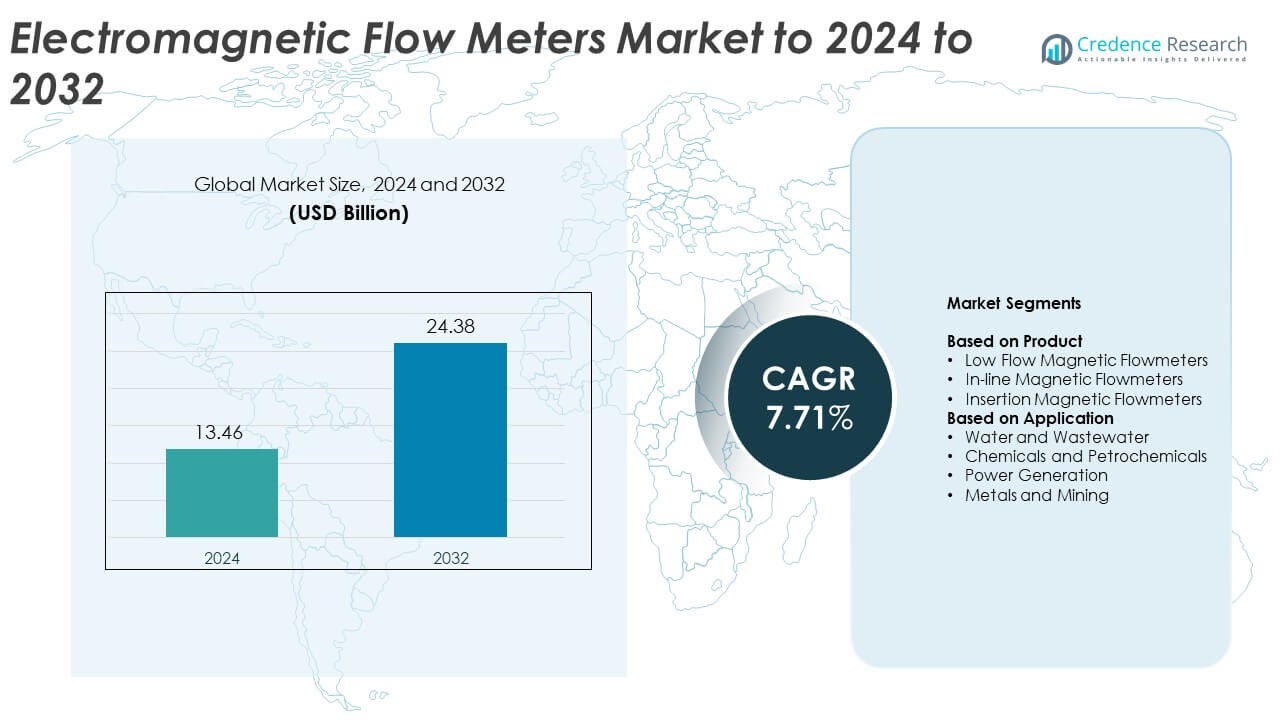
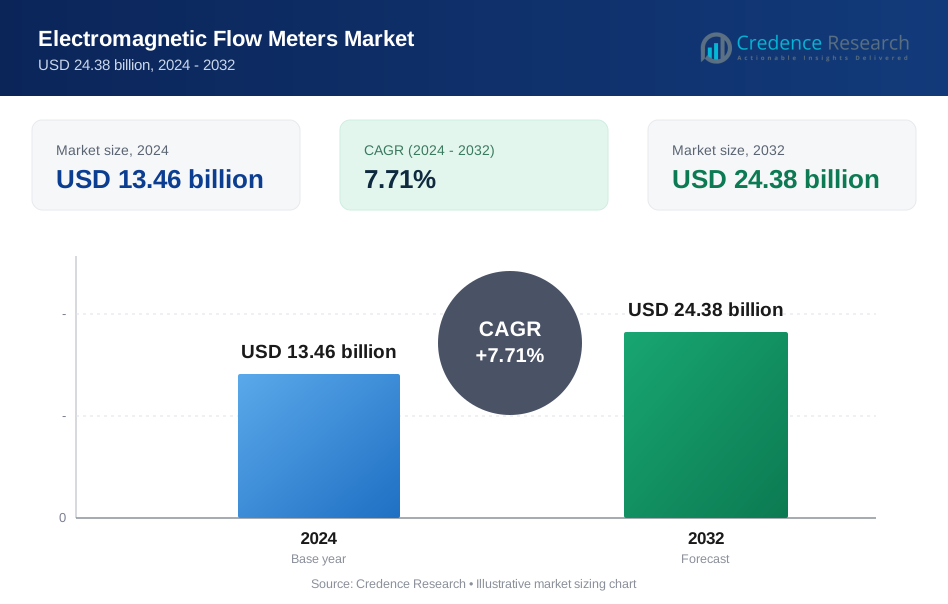
Electromagnetic Flow Meters Market size was valued at USD 13.46 billion in 2024 and is anticipated to reach USD 24.38 billion by 2032, growing at a CAGR of 7.71% during the forecast period.
| REPORT ATTRIBUTE | DETAILS |
|---|---|
| Historical Period | 2020-2023 |
| Base Year | 2024 |
| Forecast Period | 2025-2032 |
| Electromagnetic Flow Meters Market Size 2024 | USD 13.46 Billion |
| Electromagnetic Flow Meters Market, CAGR | 7.71% |
| Electromagnetic Flow Meters Market Size 2032 | USD 24.38 Billion |
The electromagnetic flow meters market includes top players such as Honeywell International Inc., Emerson Electric Corporation, KROHNE Messtechnik GmbH, Toshiba Corporation, Yokogawa Electric Corporation, Siemens AG, ABB Ltd, Endress+Hauser AG, OMEGA Engineering Inc. (Spectris PLC), and Azbil Corporation. These companies compete through high-accuracy designs, digital diagnostics, and strong service networks across industrial and municipal applications. Asia Pacific leads the global market with about 34% share in 2024 due to rapid industrial expansion and large water-infrastructure projects. North America follows with nearly 32% share, supported by smart metering upgrades, while Europe holds around 28% share driven by strong regulatory compliance and advanced automation adoption.
Market Insights
- The electromagnetic flow meters market reached USD 13.46 billion in 2024 and is projected to hit USD 24.38 billion by 2032 at a CAGR of 7.71%.
- Market growth is driven by rising demand for accurate flow measurement in water and wastewater treatment, which led the application segment with about 48% share in 2024.
- Smart metering, IoT-enabled diagnostics, and predictive monitoring are shaping key trends as industries shift toward digital and automated flow-control systems.
- Competition strengthens as leading manufacturers expand product innovation, focusing on higher accuracy, improved liner materials, and connectivity, while high installation costs remain a restraint for smaller utilities and plants.
- Asia Pacific led the market with nearly 34% share in 2024, followed by North America at about 32% and Europe at around 28%, supported by strong industrial automation and large municipal infrastructure upgrades across all regions.
Market Segmentation Analysis:
By Product
Low flow magnetic flowmeters led the product segment in 2024 with about 44% share. This lead came from rising demand for precise measurement in dosing systems, chemical batching, and food-grade liquid handling. These compact units support high accuracy at very low velocities, which helps industries reduce product loss and maintain process stability. In-line magnetic flowmeters continued to grow due to strong adoption in large pipelines and municipal networks, while insertion magnetic flowmeters gained traction for retrofit projects that need lower installation costs and reduced downtime.
- For instance, Emerson's Rosemount Slurry Magnetic Flow Meter is a robust device designed for demanding applications in process plants. The meter is capable of measuring conductive slurries across a full velocity range of up to 12 m/s (39 ft/s) for certain models, with the preferred operational range for abrasive slurries being 0.9 to 3.1 m/s (3 to 10 ft/s) to ensure optimal accuracy while significantly minimizing wear and extending the liner's lifespan.
By Application
Water and wastewater dominated the application segment in 2024 with nearly 48% share. Utilities rely on electromagnetic flowmeters for high-accuracy measurement, non-intrusive design, and maintenance-free operation across treatment plants and distribution lines. The segment grows further due to stricter metering regulations, leak-detection programs, and rising investments in smart infrastructure. Chemicals and petrochemicals recorded steady growth as plants adopt corrosion-resistant meters for aggressive fluids, while power generation and metals and mining increased uptake to support cooling water monitoring and slurry flow control.
- For instance, ABB’s AquaMaster 4 electromagnetic flowmeter is targeted at potable water and wastewater networks and offers battery operation for up to 10 years, enabling accurate flow monitoring in remote district-metered areas without external power.
Key Growth Drivers
Rising investment in water and wastewater infrastructure
Growing upgrades in municipal networks drive strong demand for electromagnetic flow meters. Utilities need accurate, drift-free measurement to support leak detection, billing accuracy, and treatment-plant optimization. Governments continue to expand spending on smart metering programs and network rehabilitation, which increases adoption across urban and industrial regions. The non-intrusive design and long service life of these meters help reduce maintenance costs and operational downtime, making them a preferred choice for large-scale distribution and treatment systems.
- For instance, Diehl Metering reports that its HYDRUS 2.0 ultrasonic smart water meters have reached about 8 million installed units worldwide, indicating large-scale utility programs to modernize water-network measurement and leak-detection capabilities.
Expansion of process automation in industrial plants
Industries across chemicals, power, and food processing are adding more automated flow-control systems to improve efficiency. Electromagnetic flow meters offer high precision with zero pressure drop, which supports stable batch control and quality assurance. Plants depend on these meters to handle conductive liquids, slurries, and corrosive media without mechanical wear. As factories continue adopting digital monitoring platforms and advanced process-control technologies, the need for reliable, maintenance-free flow measurement accelerates across multiple production lines.
- For instance, Honeywell’s VersaFlow TWM 1000 and TWM 9000 electromagnetic flow converters provide a 4–20 mA output with HART communication, along with pulse, frequency, and status outputs.
Shift toward energy-efficient and sustainable operations
Manufacturers and utilities are adopting flow-measurement devices that support energy savings and reduce environmental impact. Electromagnetic flow meters meet these needs through low power consumption, long calibration cycles, and minimal waste generation. Growing sustainability targets across industries encourage firms to replace older mechanical meters with modern magnetic designs. These meters help facilities optimize water use, reduce chemical dosing errors, and enhance compliance with environmental regulations, which strengthens market demand during the forecast period.
Key Trends & Opportunities
Integration of smart and IoT-enabled systems
Digital platforms continue to reshape flow-measurement practices across utilities and industries. New electromagnetic flow meters support wireless connectivity, cloud dashboards, and real-time diagnostics that simplify asset management. Smart features help operators detect anomalies early, reduce unplanned downtime, and streamline maintenance schedules. Growing adoption of digital water networks and predictive monitoring creates strong opportunities for manufacturers offering advanced connectivity and analytics-driven solutions built for large-scale infrastructure.
- For instance, Sensus (a Xylem brand) documents that its FlexNet AMI system underpins over 1,700 electric, water, and gas projects, supports more than 50 million endpoints, and carries over 795 million data messages per day, demonstrating large-scale IoT connectivity for metering and network analytics.
Rising adoption in harsh and abrasive fluid applications
Industries handling slurries, mining effluents, and chemical mixtures are increasing their use of electromagnetic flow meters. Modern designs with advanced liner materials and reinforced electrodes deliver long service life in abrasive and corrosive conditions. This boosts reliability in demanding processes such as mineral processing, cooling water loops, and effluent discharge monitoring. The trend opens opportunities for specialized product lines designed for high-wear environments where mechanical meters fail.
- For instance, KROHNE’s OPTIFLUX 5100 electromagnetic flowmeter is designed for slurries and corrosive liquids and is specified for operating temperatures up to 180 °C with robust liners, which aligns with demanding duties in chemical, mining, and mineral-slurry applications.
Growing demand for retrofit and replacement projects
Aging pipeline networks and outdated metering devices create strong growth potential for retrofit solutions. Insertion-type electromagnetic flow meters are gaining traction due to their lower installation effort and minimal downtime. Industries and utilities prefer these options when upgrading existing systems without major piping changes. The shift toward replacement-driven demand provides a steady market base across mature regions, especially in industrial clusters and municipal facilities.
Key Challenges
High initial installation and calibration costs
Electromagnetic flow meters require higher upfront spending than many traditional flow-measurement devices. Installation may involve pipe modifications, grounding requirements, and integration with control systems, which increases project costs for smaller facilities. Budget-constrained municipalities and small manufacturers may delay adoption due to these expenses. The need for proper calibration and setup also adds technical complexity, creating barriers for end users with limited engineering resources.
Performance limitations with non-conductive fluids
These meters rely on liquid conductivity to measure flow, which restricts use with oils, hydrocarbons, and other non-conductive media. Industries dealing with such fluids must depend on alternative technologies, reducing the total addressable market. This limitation also affects hybrid process lines where both conductive and non-conductive liquids are present. Manufacturers must invest in product diversification or complementary technologies to overcome lost opportunities in sectors where electromagnetic designs cannot operate effectively.
Regional Analysis
North America
North America held about 32% share of the electromagnetic flow meters market in 2024. The region benefits from strong investment in water treatment upgrades, smart metering programs, and industrial automation. Utilities adopt advanced flow monitoring to improve leak detection and meet tightening regulatory standards. Growth also comes from chemical, food processing, and power plants modernizing flow-control systems. Rising spending on digital water networks and pipeline rehabilitation supports steady adoption across the United States and Canada, while replacement of aging mechanical meters continues to drive long-term demand.
Europe
Europe accounted for nearly 28% share in 2024, supported by strict environmental regulations and rapid deployment of smart water infrastructure. Water utilities in Germany, the United Kingdom, France, and Italy continue adopting magnetic flow meters to enhance accuracy in distribution networks and wastewater treatment facilities. Industrial sectors such as chemicals, pharmaceuticals, and food processing also use these meters for compliance and efficiency improvement. Ongoing investments in digital monitoring platforms and sustainability-focused upgrades reinforce market growth across both Western and Eastern Europe.
Asia Pacific
Asia Pacific led the global market with about 34% share in 2024. Expanding water management programs in China, India, and Southeast Asia drive high adoption across municipal and industrial networks. Rapid industrialization increases demand for accurate flow measurement in chemicals, power generation, and food processing. Governments in the region continue investing in large-scale pipeline expansion and wastewater treatment, boosting long-term consumption. Growing manufacturing capacity for low-cost magnetic meters also strengthens regional supply and accelerates adoption in cost-sensitive industries.
Latin America
Latin America held around 4% share in 2024, driven by gradual upgrades in water supply systems and rising industrial activity. Countries such as Brazil, Mexico, and Chile are adopting electromagnetic flow meters to improve measurement accuracy in treatment plants and distribution networks. Mining operations across Peru and Chile use these meters for slurry handling and effluent monitoring. Although budget constraints slow large-scale deployment, increasing public investment in water infrastructure and improving industrial automation continue to support moderate growth across the region.
Middle East and Africa
The Middle East and Africa captured about 2% share in 2024, supported by water scarcity challenges and rising investments in desalination plants and wastewater treatment. Gulf countries adopt electromagnetic flow meters to enhance efficiency in large-scale water distribution and industrial cooling systems. Mining and metals processing in South Africa also contribute to demand. Infrastructure limitations and cost barriers restrain rapid expansion, yet ongoing pipeline modernization projects and industrial diversification initiatives continue to create emerging opportunities across the region.
Market Segmentations:
By Product
- Low Flow Magnetic Flowmeters
- In-line Magnetic Flowmeters
- Insertion Magnetic Flowmeters
By Application
- Water and Wastewater
- Chemicals and Petrochemicals
- Power Generation
- Metals and Mining
By Geography
- North America
- U.S.
- Canada
- Mexico
- Europe
- Germany
- France
- U.K.
- Italy
- Spain
- Rest of Europe
- Asia Pacific
- China
- Japan
- India
- South Korea
- South-east Asia
- Rest of Asia Pacific
- Latin America
- Brazil
- Argentina
- Rest of Latin America
- Middle East & Africa
- GCC Countries
- South Africa
- Rest of the Middle East and Africa
Competitive Landscape
The electromagnetic flow meters market is shaped by major players such as Honeywell International Inc., Emerson Electric Corporation, KROHNE Messtechnik GmbH, Toshiba Corporation, Yokogawa Electric Corporation, Siemens AG, ABB Ltd, Endress+Hauser AG, OMEGA Engineering Inc. (Spectris PLC), and Azbil Corporation. The competitive landscape reflects strong focus on accuracy, durability, and advanced digital features tailored to water management and industrial automation. Leading manufacturers invest heavily in smart diagnostics, IoT connectivity, and predictive maintenance tools that improve system reliability and reduce downtime. Many companies enhance competitiveness through expanded global manufacturing footprints, offering region-specific product variants with improved liner materials and enhanced corrosion resistance. Firms also strengthen market presence by deepening partnerships with utilities and industrial clients, providing integrated solutions that combine sensors, controllers, and software platforms. Growing demand for retrofit installations encourages suppliers to develop flexible, easy-to-install designs that support aging pipeline networks and complex industrial environments.
Key Player Analysis
- Honeywell International Inc.
- Emerson Electric Corporation
- KROHNE Messtechnik GmbH
- Toshiba Corporation
- Yokogawa Electric Corporation
- Siemens AG
- ABB Ltd
- Endress+Hauser AG
- OMEGA Engineering Inc. (Spectris PLC)
- Azbil Corporation
Recent Developments
- In 2025, Endress+Hauser AG’s development team won an AMA Innovation Award for their ultrasonic flowmeter technology, Proline Prosonic Flow P 500, which, while ultrasonic, represents a significant advance in clamp-on flow measurement complementary to their electromagnetic flowmeter efforts.
- In 2025, KROHNE Messtechnik GmbH showcased the Enviromag Electromagnetic Flowmeter in April 2025 at Data Center World for precise measurement in water management and cooling systems, highlighting its robust design with no moving parts and minimal pressure drop.
- In 2024, ABB Ltd announced the launch of its next-generation electromagnetic flowmeters, featuring two advanced products-ProcessMaster and AquaMaster.
Report Coverage
The research report offers an in-depth analysis based on Product, Application and Geography. It details leading market players, providing an overview of their business, product offerings, investments, revenue streams, and key applications. Additionally, the report includes insights into the competitive environment, SWOT analysis, current market trends, as well as the primary drivers and constraints. Furthermore, it discusses various factors that have driven market expansion in recent years. The report also explores market dynamics, regulatory scenarios, and technological advancements that are shaping the industry. It assesses the impact of external factors and global economic changes on market growth. Lastly, it provides strategic recommendations for new entrants and established companies to navigate the complexities of the market.
Future Outlook
- The market will grow steadily as water utilities expand smart metering networks.
- Industrial plants will increase adoption due to rising automation and digital control.
- Demand will rise for meters with advanced diagnostics and self-monitoring features.
- Mining and chemical sectors will boost usage for abrasive and corrosive fluid applications.
- Replacement of aging mechanical meters will remain a major growth driver.
- IoT-enabled electromagnetic meters will gain wider acceptance in large infrastructure projects.
- Manufacturers will focus on energy-efficient and low-maintenance product designs.
- Asia Pacific will strengthen its lead due to rapid industrial and municipal expansion.
- Adoption in wastewater reuse and recycling projects will accelerate.
- Growing emphasis on sustainability will push industries toward accurate and reliable flow measurement technologies.
Request a Free Sample
Fill in your details and we'll send you a free sample report.
- Sample data tables & charts
- Research methodology
Need a Custom Version of This Report?
Tailor the scope, geography, or segments to your exact requirements.
- Custom geography or segment scope
- Direct access to our analyst team
Frequently Asked Questions
What is the current market size for Electromagnetic Flow Meters Market, and what is its projected size in 2032?
At what Compound Annual Growth Rate is the Electromagnetic Flow Meters Market projected to grow between 2025 and 2032?
Which Electromagnetic Flow Meters Market segment held the largest share in 2024?
What are the primary factors fueling the growth of the Electromagnetic Flow Meters Market?
Who are the leading companies in the Electromagnetic Flow Meters Market?
Which region commanded the largest share of the Electromagnetic Flow Meters Market in 2024?
Table of Content
Chapter 1. Report Introduction
- 1.1 Report Description & Purpose
- 1.1.1 Report Title & Market Definition
- 1.1.2 Unique Selling Propositions (USP) & Key Differentiators
- 1.1.3 Value Proposition for Stakeholders
- 1.2 Research Objectives
- 1.2.1 Market Sizing Objectives (Volume & Revenue) (Volume Where Applicable)
- 1.2.2 Segmentation Objectives
- 1.2.3 Competitive Intelligence Objectives
- 1.2.4 Forecast & Scenario Objectives
- 1.3 Report Scope
- 1.3.1 Electromagnetic Flow Meters Scope – Segments & Subsegments Covered
- 1.3.2 Geographic Scope – Regions & Countries Covered
- 1.3.3 Historical Period, Base Year & Forecast Period (2024; forecast to 2032)
- 1.3.4 Inclusions & Exclusions
- 1.4 Industry Classification & Applicable Codes
- 1.5 Currency, Measurement Units & Valuation Basis
- 1.6 Target Stakeholders
- 1.7 Limitations & Assumptions
Chapter 2. Executive Summary
- 2.1 Global Electromagnetic Flow Meters Market Snapshot
- 2.1.1 Market Size – Historical (2024) & Forecast (2024-2032) (2024: USD 13.46 billion → 2032: USD 24.38 billion)
- 2.1.2 Volume & Revenue – Global Totals (Volume Where Applicable)
- 2.1.3 Key Market Highlights – Top Five Facts
- 2.2 Electromagnetic Flow Meters Market Segmentation Snapshot
- 2.2.1 Market Split by Region – 2024 vs. 2032
- 2.3 Competitive Snapshot
- 2.3.1 Top 10 Players by Revenue Share – 2024
- 2.3.2 Top 10 Players by Volume Share – 2024 (Volume Where Applicable)
- 2.3.3 Recent Strategic Developments (18-Month Summary)
- 2.4 Key Investment Highlights & Strategic Conclusions
Chapter 3. Electromagnetic Flow Meters Market Dynamics & Industry Analysis
- 3.1 Market Overview & Context
- 3.1.1 Electromagnetic Flow Meters Market Position in the Broader Industry Value Chain
- 3.1.2 Demand Structure & Purchasing Dynamics
- 3.1.3 Market Maturity & Development Stage by Region
- 3.2 Electromagnetic Flow Meters Market Drivers
- 3.3 Electromagnetic Flow Meters Market Restraints & Challenges
- 3.4 Electromagnetic Flow Meters Market Opportunities
- 3.5 Porter's Five Forces Analysis
- 3.5.1 Threat of New Entrants
- 3.5.2 Bargaining Power of Suppliers
- 3.5.3 Bargaining Power of Buyers
- 3.5.4 Threat of Substitutes
- 3.5.5 Competitive Rivalry – Intensity Assessment
- 3.6 Electromagnetic Flow Meters Value Chain Analysis
- 3.6.1 Upstream – Key Inputs, Resources & Suppliers
- 3.6.1.1 Key Input/Resource 1
- 3.6.1.2 Key Input/Resource 2
- 3.6.1.3 Key Input/Resource 3
- 3.6.2 Midstream – Core Operations & Value Creation
- 3.6.2.1 Operating Model & Process Overview
- 3.6.2.2 Key Operating Locations & Capabilities by Company
- 3.6.3 Downstream – Market Channels & End Users
- 3.6.3.1 Direct Sales & Customer Engagement Channels
- 3.6.3.2 Indirect Sales, Intermediaries & Partner Channels
- 3.6.4 Value Chain Profitability Analysis
- 3.6.1 Upstream – Key Inputs, Resources & Suppliers
- 3.7 PESTEL Analysis
- 3.7.1 Political Factors
- 3.7.2 Economic Factors
- 3.7.3 Social Factors
- 3.7.4 Technological Factors
- 3.7.5 Environmental Factors
- 3.7.6 Legal Factors
- 3.8 Electromagnetic Flow Meters Supply Chain Analysis
- 3.8.1 Critical Input & Resource Availability Risk Assessment
- 3.8.2 Supplier & Operational Concentration Risk (Geographic Exposure)
- 3.8.3 Supply & Service Disruption Impact Analysis
- 3.9 Regulatory & Policy Landscape
Note: The regulatory and policy landscape section covers regulations based on their applicability to the market, Electromagnetic Flow Meters category, geography, and scope of the study. Only regulatory frameworks with a material impact on operations, compliance, trade, sustainability, or market access are analyzed in detail.
Chapter 4. Key Investment Pockets & Opportunity Analysis
- 4.1 Electromagnetic Flow Meters Market Attractiveness Analysis
- 4.1.1 By Region – Investment Attractiveness Matrix (Market Size × CAGR)
- 4.2 Absolute Revenue Growth Opportunity
- 4.2.1 By Region – Absolute Revenue Growth Through 2032
- 4.3 Incremental Demand Opportunity
- 4.3.1 By Region – Incremental Demand Through 2032
- 4.3.2 Segment – Incremental Demand
- 4.4 Emerging Submarket Opportunity Deep Dive (Subject to Applicability)
- 4.5 Priority Market Opportunity Scorecards
- 4.5.1 United States
- 4.5.2 Europe
- 4.5.3 Asia
- 4.5.4 Middle East & Africa
Note: Priority market opportunity scorecards reflect the geographic scope and strategic relevance of the study. Listed markets are indicative and may be adapted to the industry.
Chapter 5. Electromagnetic Flow Meters Cross-Border Trade & Market Access Analysis
- 5.1 International Trade & Cross-Border Activity Overview
- 5.1.1 Global Export Value by Country (2024)
- 5.1.2 Global Export Volume by Country (2024) (Volume Where Applicable)
- 5.1.3 Global Import Value by Country (2024)
- 5.1.4 Global Import Volume by Country (2024) (Volume Where Applicable)
- 5.1.5 Net Trade Balance by Country (2024)
- 5.2 Export Analysis – Segment
- 5.2.1 Category 1 (Applicable Classification Code)
- 5.2.2 Category 2 (Applicable Classification Code)
- 5.2.3 Category 3 (Applicable Classification Code)
- 5.2.4 Category 4 (Applicable Classification Code)
- 5.2.5 Category 5 (Applicable Classification Code)
- 5.3 Import Analysis – Segment
- 5.3.1 Category 1 (Applicable Classification Code)
- 5.3.2 Category 2 (Applicable Classification Code)
- 5.3.3 Category 3 (Applicable Classification Code)
- 5.3.4 Category 4 (Applicable Classification Code)
- 5.3.5 Category 5 (Applicable Classification Code)
- 5.4 Cross-Border Pricing & Transaction Benchmarks
- 5.4.1 Export Pricing – Segment & Country
- 5.4.2 Import Pricing – Segment & Source Country
- 5.4.3 Price Trends (2024)
- 5.5 Key Cross-Border Trade & Delivery Routes
- 5.5.1 Cross-Border Trade/Delivery Route 1
- 5.5.2 Cross-Border Trade/Delivery Route 2
- 5.5.3 Cross-Border Trade/Delivery Route 3
- 5.5.4 Cross-Border Trade/Delivery Route 4
- 5.5.5 Cross-Border Trade/Delivery Route 5
- 5.6 Trade Policy & Market Access Impact Assessment
- 5.6.1 Tariff & Non-Tariff Barriers
- 5.6.2 Regional Trade & Economic Integration Frameworks
- 5.6.3 Bilateral & Multilateral Trade Agreements
- 5.6.4 Cross-Border Operating, Licensing & Localization Requirements
Note: This chapter applies where cross-border trade or delivery is relevant to Electromagnetic Flow Meters. Goods, services, and digital offerings are assessed using applicable classifications and transaction measures. Import-export volumes, trade balances, and route analyses are included only where meaningful to the market.
Chapter 6. Competitive Landscape & Company Benchmarking
- 6.1 Electromagnetic Flow Meters Market Concentration & Structure
- 6.1.1 Herfindahl-Hirschman Index (HHI) – vs. 2024
- 6.1.2 Leading, Mid-Sized & Emerging Player Structure
- 6.1.3 Global, Regional & Local Player Dynamics
- 6.2 Electromagnetic Flow Meters Market Share Analysis – 2024
- 6.2.1 Global Revenue Share by Company
- 6.2.2 Global Volume Share by Company (Volume Where Applicable)
- 6.2.3 Regional Revenue Share
- 6.2.4 Market Share Evolution ( vs. 2024)
- 6.2.5 Company Market Share by Key Segment
- 6.2.6 Company Market Share by Customer Group
- 6.3 Operating Scale, Capacity & Infrastructure Analysis
- 6.3.1 Global Operating Scale & Supply Capacity
- 6.3.2 Resource Utilization & Operating Efficiency
- 6.3.3 Output, Service Delivery & Activity Metrics
- 6.3.4 Operating Footprint & Infrastructure Map
- 6.3.5 Planned Operational & Capacity Expansion
- 6.4 Electromagnetic Flow Meters Competitive Benchmarking Matrix
- 6.4.1 Revenue, Growth, Profitability & Operating Metric Comparison
- 6.4.2 Channel Revenue Mix
- 6.4.3 Geographic Revenue Exposure
- 6.4.4 R&D Intensity
- 6.4.5 Sustainability Maturity
- 6.5 Strategic Developments in Electromagnetic Flow Meters (Last 24 Months)
- 6.5.1 Mergers, Acquisitions & Divestments
- 6.5.2 New Products, Services & Solutions in Electromagnetic Flow Meters
- 6.5.3 Operational & Infrastructure Expansions
- 6.5.4 Strategic Alliances, Joint Ventures & Partnerships
- 6.5.5 Distribution Expansion & Market Entry
- 6.5.6 Sustainability & ESG Initiatives
- 6.6 Competitive Strategy Mapping
- 6.6.1 Leader, Challenger, Follower & Niche Classification
- 6.6.2 Pricing Strategy Comparison
- 6.6.3 Channel Strategy Matrix
Note: Strategic developments are included based on their materiality and the availability of reliable information.
Chapter 7. Global Electromagnetic Flow Meters Market – By Sales & Delivery Channel
- 7.1 Segment Overview
- 7.1.1 Volume & Revenue Split by Channel (2024 & 2032) (Volume Where Applicable)
- 7.1.2 Channel Mix Evolution (2024-2032)
Chapter 8. Regional Market Analysis – Global Overview
- 8.1 Global Regional Overview
- 8.1.1 Regional Volume Share (Volume Where Applicable)
- 8.1.2 Regional Revenue Share
- 8.1.3 Regional Volume by Region (Volume Where Applicable)
- 8.1.4 Regional Revenue by Region
- 8.1.5 Regional Forecast Through 2032
- 8.2 Cross-Regional Segment Analysis
- 8.2.1 By Sales & Delivery Channel
- 8.2.2 By Competitive Positioning & Price Tier
Chapter 9. North America Electromagnetic Flow Meters Market
- 9.1 United States
- 9.2 Canada
- 9.3 Mexico
Chapter 10. Europe Electromagnetic Flow Meters Market
- 10.1 Germany
- 10.2 France
- 10.3 Italy
- 10.4 United Kingdom
- 10.5 Spain
- 10.6 Poland
- 10.7 Russia
- 10.8 Netherlands
- 10.9 Belgium
- 10.10 Sweden
- 10.11 Denmark
- 10.12 Norway
- 10.13 Rest of Europe
Chapter 11. Asia Pacific Electromagnetic Flow Meters Market
- 11.1 China
- 11.2 India
- 11.3 Japan
- 11.4 South Korea
- 11.5 Thailand
- 11.6 Indonesia
- 11.7 Vietnam
- 11.8 Malaysia
- 11.9 Australia
- 11.10 Rest of Asia Pacific
Chapter 12. Latin America Electromagnetic Flow Meters Market
- 12.1 Brazil
- 12.2 Argentina
- 12.3 Colombia
- 12.4 Chile
- 12.5 Rest of Latin America
Chapter 13. Middle East Electromagnetic Flow Meters Market
- 13.1 Saudi Arabia
- 13.2 United Arab Emirates
- 13.3 Turkey
- 13.4 Israel
- 13.5 Iran
- 13.6 Rest of the Middle East
Chapter 14. Africa Electromagnetic Flow Meters Market
- 14.1 South Africa
- 14.2 Egypt
- 14.3 Nigeria
- 14.4 Morocco
- 14.5 Rest of Africa
Chapter 15. Electromagnetic Flow Meters Company Profiles
- 15.1 [Company 01]
- 15.1.1 Company Overview
- 15.1.2 Key Management Personnel
- 15.1.3 Products & Services Portfolio
- 15.1.4 Financial Performance
- 15.1.5 Key Market Focus & Geographic Presence
- 15.1.6 Recent Developments & Strategic Initiatives
Note: The company profile list is preliminary and may change based on research findings, market developments, data availability, and client requirements.
Chapter 16. Appendices
- Appendix A – List of Abbreviations & Acronyms
- Appendix B – Industry Classification Code Reference – Full Series
- Appendix C – Supply, Output & Operating Capacity Data Tables
- Appendix D – End-Use & Demand Base Tables
- Appendix E – Demand, Adoption & Usage Assumptions
- Appendix F – Pricing & Revenue Metric Reference Tables
- Appendix G – Company Operations & Infrastructure Database
- Appendix H – Cross-Border Trade & Activity Data Tables (Where Applicable)
- Appendix I – Regulatory Summary Tables
- Appendix J – Primary Research Participant List (Anonymized)
- Appendix K – Primary Research Questionnaire Framework
- Appendix L – Data Sources & Bibliography
- Appendix M – Market Size Divergence & Source Comparison
Chapter 17. Research Methodology
- 17.1 Research Framework & Philosophy
- 17.2 Secondary Research – Sources, Hierarchy & Data Extraction
- 17.3 Data Modeling – Bottom-Up & Top-Down Market Sizing
- 17.4 Primary Research – Stakeholder Framework, LOI & Sample Sizes
- 17.5 Forecast Methodology – Regression, Scenario & Sensitivity Analysis
- 17.6 Quality Control – Four-Layer Validation Framework
- 17.7 Limitations & Standard Assumptions
- 17.8 Disclaimer